In Eastern metaphysics, becoming an ancestor after death is a delicate process, and the Pishachas show what happens when that process fails. They are more than just scavengers of the body; they represent spiritual decay and appear where important rites have been ignored or violated.
Looking at their roles in the Sanskrit epics and the Pali Canon, we see that these beings stand in opposition to the Dharma and serve as warnings of the breakdown of social and ritual order. They also appear as evil spirits in Hindu mythology. For more about their Vedic origins, see the Hindu Demons category.
In this article, I decided to focus on the hierarchical classifications in the Lotus Sutra to ensure the research reflects the Pishacha’s role in Buddhist cosmology, rather than relying on scattered modern interpretations. [View Full Bibliography ↓]
Summary
Key Takeaways
| Attribute | Details |
| Names | Pishacha, Pisaca, Pishachi (female), Pisakas |
| Title | Eaters of Raw Flesh |
| Region | Ancient India, Central Asia, Southeast Asia |
| Type | Buddhist and Hindu malevolent spirit (Preta-variant) |
| Gender | Male and Female |
| Realm | Preta-loka (Hungry Ghost Realm) and Human Realm |
| Obstacle/Threat | Possession, consumption of human energy, and spreading of disease |
| Associated Figures | Kashyapa, Krodha, Lord Shiva, Mara |
| Weapon/Item | None (uses claws and subtle possession) |
| Weaknesses | Mantras, Atharvavedic hymns, purification by fire, iron |
| Associated Deity/Figure | Shiva (as Lord of Spirits), Gautama Buddha |
| Pantheon | Vedic, Puranic, and Buddhist |
| Primary Sources | Atharvaveda, Mahabharata, Garuda Purana, Lotus Sutra |
Who or What is the Pishacha?
A Pishacha is a harmful, flesh-eating spirit found among the lower ranks of supernatural beings in Indian cosmology. They are often grouped with Rakshasas and Asuras, but are known for their focus on filth and eating raw flesh (Kravyada).
In the unseen world, they fall between wandering ghosts and powerful demons. They are often found in cremation grounds, charnel houses, and lonely places where death has happened.
Unlike the more warlike Rakshasa, these beings act more like parasites. They hide in the shadows and can enter the human body through the mouth or other openings, causing mental problems, physical decline, and moral weakness.
In Buddhist traditions, they are often listed among non-human tribes that are eventually converted or controlled by the Dharma. Yet, they remain closely linked to the Preta-loka, the realm of hungry spirits.
Pishacha Meaning
The name comes from the Sanskrit word Piśāca, which linguists often connect to the root piś, meaning “to carve” or “to fashion.” This may refer to how they tear at flesh. Some scholars also link it to piśita, which means “flesh” or “meat.”
Over time, the term shifted from describing a tribe to a supernatural meaning. In old texts like the Manusmriti, “Pishacha marriage” (Paisaca) is called the lowest and most sinful type of union, involving the violation of a sleeping or drunk woman. This shows the entity’s link to cowardice and lack of self-control.
In Buddhism, the name spread with the Tripitaka into East Asia. While the Sanskrit term is often retained, the entity’s traits blended with local ideas of hungry ghosts in China and Korea. The language change shows a move from a specific group of “raw-meat eaters” to a wider group of harmful spirits that drain the life force (ojas) from the living.
You may also enjoy:
The Kumbhāṇḍa: Grotesque Demons of Buddhist Hell
November 13, 2025
Who Is Andromalius, and Why Is He the Last Demon of the Goetia?
January 20, 2026
Iblis, the Jinn King of Darkness and Deception
September 29, 2025
Nasnas: The Monstrous Demon Hybrid That Haunted Pre-Human Earth
November 12, 2025
What Is a Qareen and Why Does It Follow Every Human Being?
October 8, 2025
How to Pronounce Pishacha in English
The name is usually pronounced as pi-SHAH-chuh. The first part sounds like “pi” in “pin.” The second part, which is stressed, has a long “ah” like in “father.” The last part is a soft “chuh” with a neutral sound. The plural is pronounced pi-SHAH-chuhz.
What Does a Pishacha Look Like?
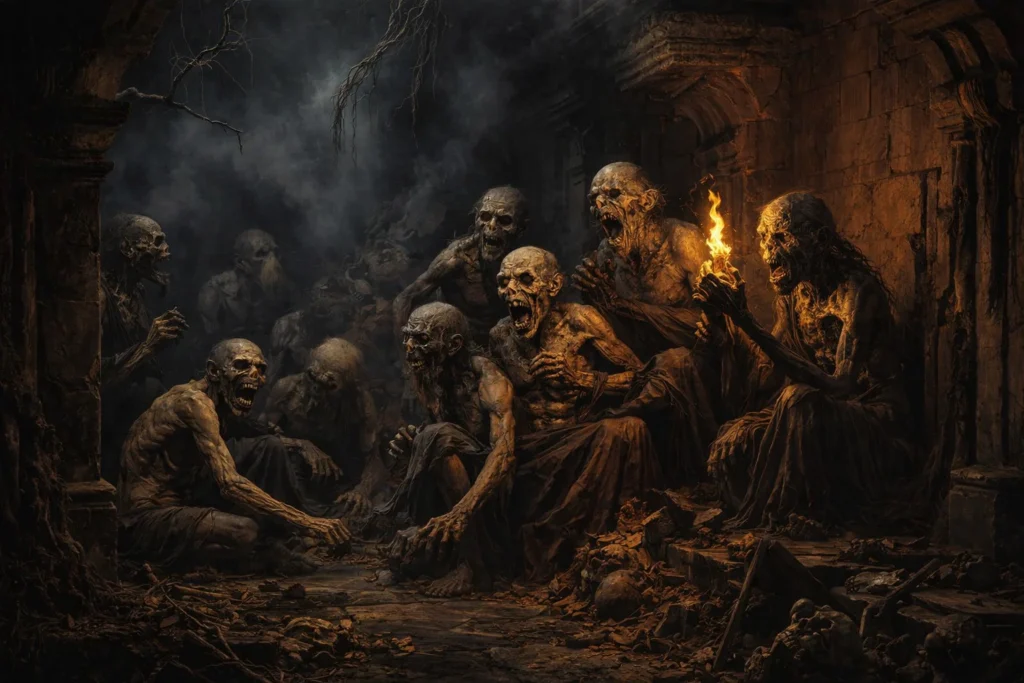
These beings are always depicted grotesquely, highlighting their connection to decay.
They usually have dark, bulging veins and skin the color of smoke or burnt wood. Their eyes are often red and glowing, showing constant hunger and restlessness. Unlike Rakshasas, who can look grand and frightening, these spirits are shown as thin, withered, hunched, and with long fingers ending in sharp claws.
In many artistic traditions, especially in Buddhist murals, they are shown with large fangs and messy, matted hair that sticks up. Their look is meant to disgust viewers, and they are often covered in dirt or the remnants of their last meal.
They can change their shape or become invisible to people. Still, their usual form shows clear signs of starvation, such as thin necks and swollen bellies, which are also seen in Pretas. Some stories say they can look like a dead loved one to trick people when they are most vulnerable.
Origins
The earliest records of a Pishacha are in the Rigveda and, even more so, in the Atharvaveda, where they are seen as real pests in the spirit world. During the Vedic period, people saw them as a chaotic force living on the edges of society.
The Puranas, especially the Padma Purana, say that Kashyapa, one of the seven ancient sages, created them with his wife Krodha, whose name means “Anger.” This origin story shows that they represent strong, negative emotions.
As Buddhist cosmology grew, these beings became part of the Caturmaharajika, or Four Heavenly Kings system. They are especially linked to Dhrtarastra, the Guardian of the East, who is said to be their leader.
This change from wild, independent spirits to followers of a heavenly king shows how they were “domesticated” in Buddhism. In the Mahayana sutras, they are often depicted as part of the large crowd listening to the Buddha, suggesting that even the lowest beings can eventually reach enlightenment. However, they now suffer because of past cruelty and greed.
Powers and Abilities
Pishachas are usually seen as less powerful than Asuras or Devas. Still, they are much more dangerous to ordinary people than regular ghosts. Their main strength is being sneaky and persistent. While an Asura might fight a god directly, these spirits wait for a person to lose focus or ritual purity before attacking.
- Possession: The ability to enter a human host, causing “Pishacha-grastha” (possession), leading to insanity or paralysis.
- Energy Consumption: They not only eat flesh; they are “Ojaharas,” or stealers of vital energy, causing victims to wither away without apparent medical cause.
- Invisibility: They remain unseen by the naked eye, allowing them to inhabit human houses without being noticed.
- Transformation: The capacity to take on the form of animals or other humans to deceive their prey.
- Pathogen Transmission: They are often cited as the spiritual cause of sudden epidemics and wasting diseases.
You may also enjoy:
What Is Baku? The Bizarre Yōkai That Eats Nightmares
January 28, 2026
Andhaka: The Blind Demon Born From Cosmic Darkness
February 6, 2026
Palis: The Foot-Licking Desert Jinn That Drinks Your Blood
December 3, 2025
What Is the Akkorokamui, Japan’s Colossal Sea Monster?
November 14, 2025
Arāti: The Beautiful Demon of Aversion in Buddhist Mythology
October 15, 2025
Who Is Abaddon, the Demon of the Abyss, in the Bible?
September 29, 2025
Pishacha as the Demonization of the Primitive “Other”
In my research, I have found that the Pishacha holds a special and complex place as Vedic literature changed into Puranic literature. They are more than just “flesh-eaters.” My analysis shows that this being reflects the social fears that came with the early Aryan expansion into India.
Today, people often see these beings as just “ghouls,” but ancient texts such as the Mahabharata and Panini’s Ashtadhyayi describe them as a “warrior clan” or an original race. This shows a process in which a rival group, probably from the Hindu Kush or Nuristan, was turned into a race of blood-drinking spirits to justify excluding them from Vedic rituals.
I find it interesting that the Pishacha has left a linguistic legacy in the form of Paiśācī, a now-extinct Middle Indo-Aryan language. Unlike other demons, who are seen as simple beasts, this spirit was thought to have its own complex, though “barbaric,” language.
I believe that keeping Gunadhya’s Brihatkatha (Great Narrative) in Paiśācī shows a reluctant respect for the ideas of this “demonized” group. This highlights a key tension in ancient Indian thought: the Pishacha reflects the repressed native, seen as physically disgusting and spiritually “impure,” yet possessing a “lost” literature that the dominant culture deemed important to record.
My research into the Harita Samhita and other Ayurvedic texts shows an interesting “medicalization” of this being.
In Bhoota Vidya, or ancient Indian psychiatry, a “Pishacha-graha” is not only a spiritual possession but also a medical diagnosis for certain mental illnesses. The symptoms—insanity, nonstop talking, and craving raw meat—match the old descriptions of the “Pishacha people.”
This shows that the being changed from a geographic enemy into a symbol of disease, representing the fear of “contagion” from the wild edges of the known world. By studying this being, we see how ancient societies used myths to group both foreign tribes and mental illness into one frightening idea of the “impure.”
Pishacha Myths, Legends, and Stories
Stories about these beings are widespread, appearing in ancient Indian forest texts and in the long tales of the Mahabharata.
The Battle of Kurukshetra
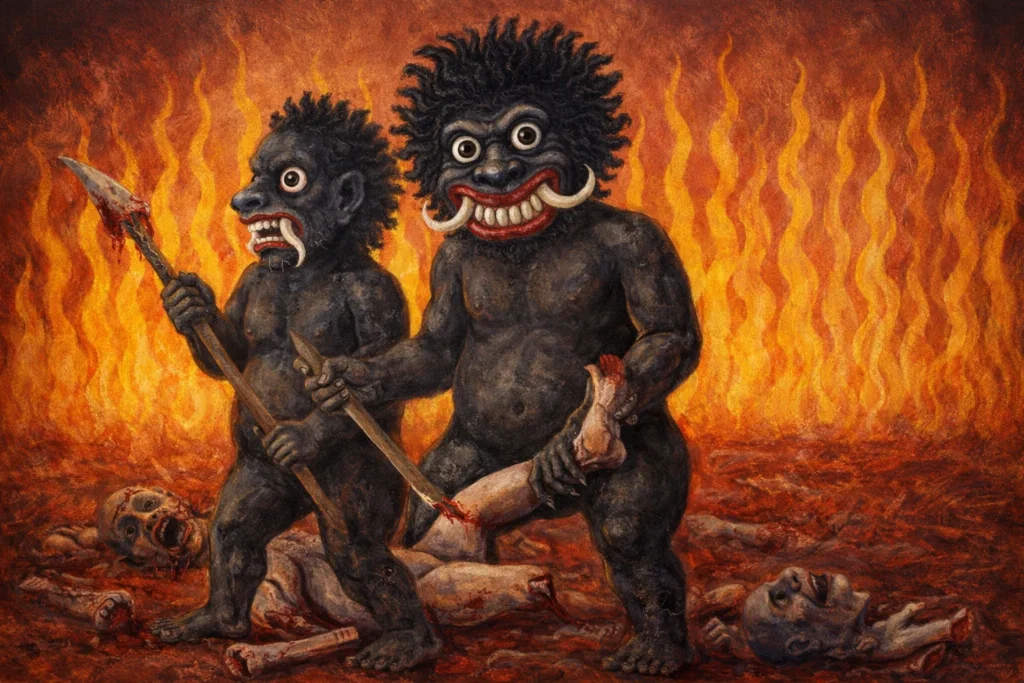
In the Mahabharata, Pishachas are often mentioned as being present on the battlefield. During the Great War, as night came and the fighting was at its worst, the air filled with spirits. The story says they crowded the field to drink the blood of dead warriors and elephants.
Their presence made the battle even more terrifying, as they were said to dance among the bodies, encouraged by the amount of “raw meat” around them. This shows their role as the final scavengers of human ambition and violence.
The Conversion in the Lotus Sutra
In the Saddharma Pundarika Sutra (The Lotus Sutra), the Pishacha appears early on among many types of non-human beings. Although they were once terrifying, the text says the Buddha’s light calms them. They are called “demons” who promise to protect those who follow the Sutra.
This story marks a major shift in their myth, as their harmful nature is redirected toward protecting the Dharma when they are guided correctly.
The Origin of the Drops of Sweat
One legend in the Brahmanda Purana gives a more symbolic origin. It says that when Brahma was creating the world, he became tired and sweat fell from his forehead. From the darker drops of this sweat, the first Pishachas appeared.
Seeing that the world was already full of more beautiful beings, they asked Brahma what their role was. He gave them the dark places of the earth and the job of eating what was thrown away or unclean, making them a kind of “janitor” in the world of demons.
The Tale of the Pishacha and the King
In story collections such as the Kathasaritsagara (Ocean of the Streams of Story), there are tales of kings encountering Pishachas in thick forests. In one story, a king finds a spirit crying under a tree. The spirit says it was once a rich merchant who refused to give charity and cheated people.
After death, his greed turned into a constant, burning hunger that no meat could satisfy. The king feels sorry for him and performs a water ritual, which gives the spirit some relief and helps him move to a better place.
Pishacha vs Other Similar Entities
| Demon Name | Associated Obstacle/Role | Origin/Source | Key Traits/Powers |
| Mara | Temptation and Delusion | Pali Canon | Lord of the Desire Realm |
| Yaksha | Nature spirits/Guardians | Vedic/Buddhist texts | Wealth and fertility; shapeshifting |
| Rakshasa | Aggression and Chaos | Ramayana | Great physical strength; illusion |
| Preta | Eternal Hunger | Abhidharma | Invisible; needle-thin throats |
| Kumbhanda | Draining vitality | Buddhist Sutras | Shapeshifting; stunted growth |
| Vetalas | Possession of corpses | Baital Pachisi | Knowledge of the past/future |
| Bhuta | Haunting and unrest | Puranas | Ability to cause nightmares |
| Asura | Pride and War | Rigveda | Rivals to the Devas |
| Gandharva | Sensual Distraction | Buddhist Cosmology | Music and fragrance |
| Dakini | Spiritual challenge | Tantric texts | Flight; consuming ego |
Mystical Correspondences
| Attribute | Details |
| Planet | Saturn (associated with decay and obstacles) |
| Zodiac Sign | Scorpio (associated with death and the unseen) |
| Element | Earth (specifically impure or “heavy” earth) |
| Direction | South or Southeast |
| Color | Black, Ash-Grey, or Dull Red |
| Crystal/Mineral | Black Tourmaline or Obsidian (for protection) |
| Metal | Iron (traditional deterrent) |
| Herb/Plant | Neem or Mustard seeds (used in exorcism) |
| Animal | Hyena or Vulture |
| Trait/Role | Consumption, Possession, Entropy |
These beings are mainly linked to Tamas, which means darkness, laziness, and chaos. They are usually associated with the waning moon and twilight, times when the line between the physical and spiritual worlds is at its weakest. In rituals, people rarely call on them; instead, they often try to calm or drive them away.
To protect against these spirits, people often use iron, which is thought to repel them.
In old medical practices, some mental illnesses were called “Pishacha-unmada,” and treatments included herbal mixtures and chanting Vedic mantras to “cleanse” the air. Their presence reminds people to keep both rituals and their surroundings clean, since these spirits are attracted to decay.
You may also enjoy:
Palis: The Foot-Licking Desert Jinn That Drinks Your Blood
December 3, 2025
Who Is Futakuchi-onna, the Two-Mouthed Woman?
March 9, 2026
What Is Baku? The Bizarre Yōkai That Eats Nightmares
January 28, 2026
Abura-akago: The Bizarre Oil-Licking Yōkai
October 22, 2025
Who Is Aka Manto, Japan’s Terrifying Red-Cloaked Yōkai?
October 24, 2025
Erinyes: The Chthonic Goddesses Who Enforced Blood-Guilt
November 20, 2025
Bibliography
Author’s Note: In writing this article, I focused on the language changes in Panini’s Ashtadhyayi to show how this being is seen both as a biological threat and as a historical ethnic group. By comparing the medical ideas in the Harita Samhita with the myths in the Puranas, I showed how “consumption” changed from eating flesh to draining vital energy. This mix of early Sanskrit grammar and medieval Ayurvedic psychiatry lets us see these spirits not just as folklore, but as a complex way for society to define who is pure and who is excluded.
- Ganguli, Kisari Mohan, translator. The Mahabharata of Krishna-Dwaipayana Vyasa. Edited and published by Pratap Chandra Roy, Bharata Press, 1883-1896. Internet Archive.
- Kubo, Tsugunari, and Akira Yuyama, translators. The Lotus Sutra. 2nd ed., Bukkyō Dendō Kyōkai and Numata Center for Buddhist Translation and Research, 2007. BDK English Tripiṭaka Series. BDK America.
- Naunidhirâma. The Garuda Purâna (Sâroddhâra). Translated by Ernest Wood and S. V. Subrahmanyam, edited by Major B. D. Basu, AMS Press, 1974. Internet Archive.
- Sen, Soumyajit. Metamorphosis of Asura: From Might to Myth in the Vedic Textual Tradition. Ajasraa (Peer-Reviewed, Refereed, UGC CARE Listed Journal), 2025.
- Buswell, Robert E., Jr., and Donald S. Lopez, Jr. The Princeton Dictionary of Buddhism. Princeton University Press, 2014. Internet Archive.
- De Nebesky-Wojkowitz, René. Oracles and Demons of Tibet: The Cult and Iconography of the Tibetan Protective Deities. Mouton & Co., 1956. Internet Archive.