Middle Eastern occultism has a clear hierarchy in which earthly power is reflected in the spiritual world. Al-Abyad stands at the crossroads of the heavens and the underworld, and is one of the Seven Jinn Kings who rule over the days of the week.
Many Jinn are known for unpredictable or aggressive behavior, but Al-Abyad is different. He is recognized for his role as a judge and administrator in the Shams al-Ma’arif. His connection to the Moon makes him more of a regulator of hidden laws than a tempter.
In this article, I used the main translations of Shams al-Ma’arif and Kitab al-Bulhan to ensure Al-Abyad’s classification is accurate. By studying these important texts, my research separates his official lunar role from broader Middle Eastern folklore. [View Full Bibliography ↓]
Summary
Key Takeaways
| Attribute | Details |
| Names | Al-Abyad, Abu Jamil, the White King, Al-Abyad al-Kattani |
| Type | Lunar Jinn / King of the Jinn |
| Title | King of Monday, Sovereign of the Moon |
| Gender | Male |
| Servitors | Jinn of the Monday Sphere, specifically the spirit Jibril (as a planetary intermediary) |
| Powers | Inducing madness, causing physical tremors, manipulating hidden thoughts, and enforcing spiritual contracts through coercion |
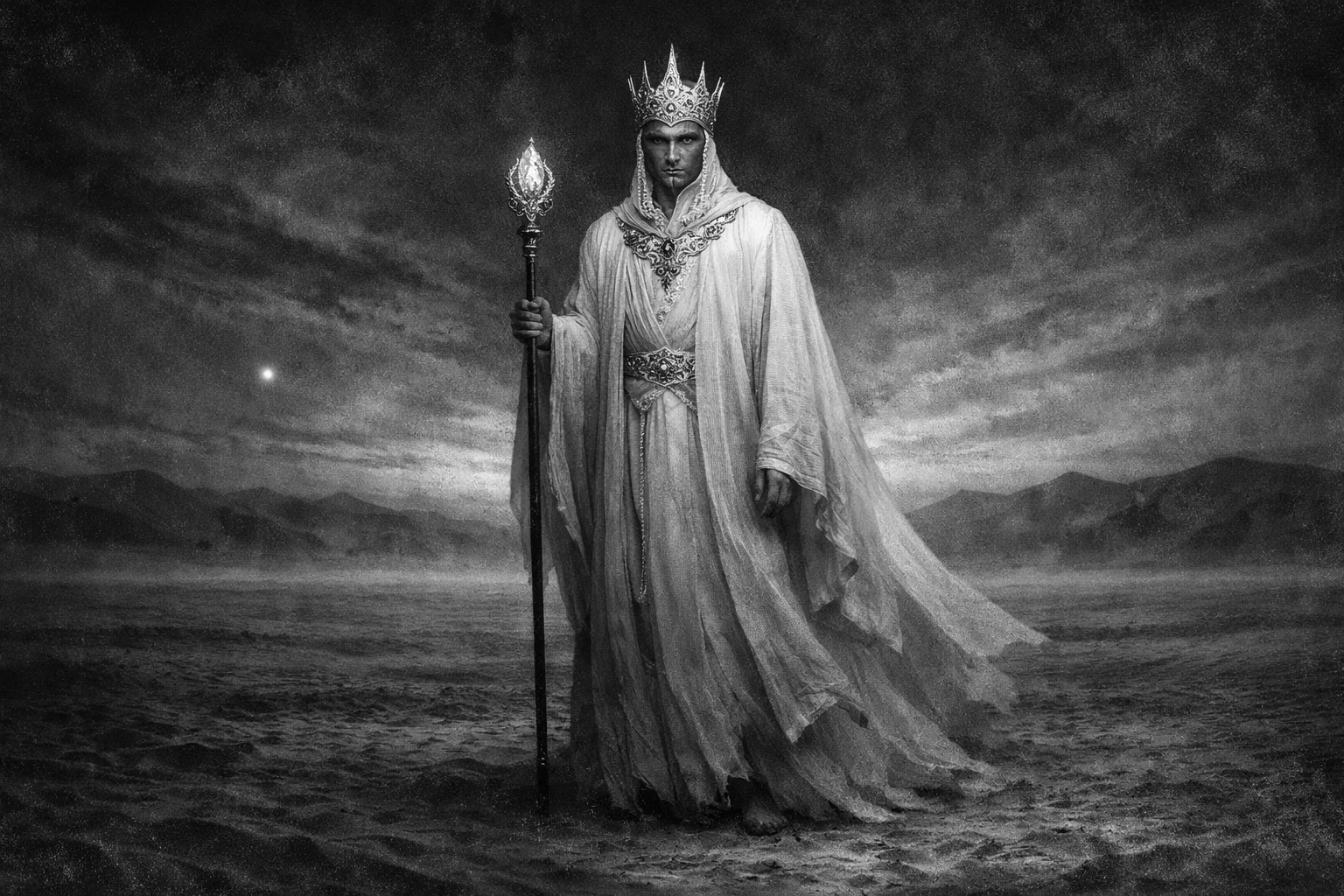
| Appearance | Commonly depicted wearing white robes and a white crown, sometimes appearing as a dignified older man or a tall figure of radiant light |
| Etymology | Derived from the Arabic ‘abyad’, meaning ‘white’, signifying his association with the moon and purity of light |
| Associated Figures | King Solomon (Sulayman), Angel Ismail, and the other six terrestrial Jinn Kings |
| Weaknesses | Specific Quranic verses (Surah Al-Jinn), salt, and the authority of the Angel Ismail |
| Opposing Holy Figure | The Angel Ismail (presiding angel of Monday) and Archangel Gabriel (Jibril) |
| Social Structure or Tribe | Monarch of the lunar tribe of Jinn; holds a seat on the Council of Seven |
| Followers/Tribe Size | Commands a vast legion of spirits associated with the tides and the silver sphere |
| Primary Sources | Shams al-Ma’arif (The Sun of Gnosis), Kitab al-Bulhan (Book of Surprises), and various Moroccan folklore traditions |
Who or What is Al-Abyad?
Al-Abyad is a high-ranking leader in the spiritual system of Islamic and Arabic occult traditions. Instead of being a lone demon, he is a king who rules over Monday. He follows a divine order, as each day of the week is ruled by a spirit king, a planet, and an angel.
In old magical texts, Al-Abyad is described as a judge or noble, very different from the wild Ghul or the powerful Ifrit. He represents the organized power of the Jinn world, connecting the angels’ rules with the actions of lesser spirits. He is closely linked to the Moon, its phases, its effect on the mind, and the color white.
“Al-Abyad” Meaning
The name Al-Abyad comes from Arabic and means both a title and a name. It is based on the root b-y-d, which means ‘the white one.’ This name refers to the moon’s light, which is his area of influence.
In medieval Arabic demonology, ‘white’ does not mean moral purity, but rather a type of spiritual energy and a way to distinguish him from the ‘Red King’ (Mars) or the ‘Black King’ (Saturn).
Over time, his name has changed in North African and Levantine stories. He is sometimes called Abu Jamil (Father of Beauty), a respectful title used in rituals to avoid angering him. In Morocco, he is also known as Al-Abyad al-Kattani, linking him to local traditions of magic.
His name remains the same in important texts such as the Kitab al-Bulhan and the Shams al-Ma’arif. This shows he is a stable entity in the spiritual hierarchy, unlike local spirits whose names often change from place to place.
How to Pronounce “Al-Abyad” in English
In English, ‘Al-Abyad’ is pronounced al-AB-yad. The first part, ‘al,’ is short. ‘AB’ sounds like ‘cab,’ and ‘yad’ rhymes with ‘bad.’ In Arabic, the ‘d’ at the end is often softer.
What Does Al-Abyad Look Like?
Descriptions of Al-Abyad focus on his dignity, height, and brightness. The Kitab al-Bulhan, a 14th-century manuscript, shows him as a royal figure on a throne. He is almost always described as wearing bright white robes and a white turban or crown.
His skin is usually shown as pale or glowing, like the full moon. Unlike the Ifrit, who may look animal-like or smoky, Al-Abyad usually appears as a tall, human-like entity.
Some stories say he looks like an old man with a long white beard, showing wisdom and long life. Others highlight his great height, making him seem royal. When he appears in rituals, a cool breeze or pale light comes first, and there are no bad smells like those linked to lesser demons.
Origins
Al-Abyad’s history is closely tied to the growth of Arabic astrology and Hermeticism during the Islamic Golden Age. He was not created from a single myth. Still, he was formed by combining older Arabian spirit stories with Greek ideas about planets.
When early Middle Eastern scholars translated Greek works, they added the idea of Planetary Daemons to the Jinn tradition. Al-Abyad became the Arabic version of the Moon’s spirit. The Jinn were said to be made from ‘smokeless fire,’ but Al-Abyad’s role as King of Monday was set when occultists from the 9th to 13th centuries organized the spirit world into seven rulers.
This system copied the Caliphs’ courts, making Al-Abyad, dressed in white, the governor of the lunar world. He was responsible for managing the spirits under the Moon and their contact with people.
Historical & Folkloric Mentions
“The King of Monday is Al-Abyad, and his sign is the Moon, and his angel is Ismail. He is the one who is summoned for the works of love, the binding of tongues, and the curing of the sick by the permission of God.” [Kitab al-Bulhan (The Book of Surprises), 14th Century (Mamluk Period)]
This 14th-century text shows Al-Abyad’s main role as a heavenly administrator, not a wild spirit. By connecting him to the Moon and the Angel Ismail, it establishes a strict order in which Jinn are not merely evil beings but ‘servants of the day’ who must follow divine rules.
This is a big change: unlike the Ifrit, who are known for fire and destruction, Al-Abyad is linked to ‘works of love’ and healing. His calm nature matches his connection to the Moon.
This view shows the ‘Scientific Turn’ in medieval Islamic demonology, in which scholars sought to organize the spirit world using the same logic as medicine and astronomy. Here, ‘King’ (Malik) is not just a title but a spirit who rules a certain time or place, making him a predictable part of the universe that can be approached through rituals at the right time.
“On Monday, one should write the square of the Moon and call upon the King of the Jinn, Abu al-Abyad, who is the servant of the white light. He appears in the form of a man of great dignity, clothed in white, with a crown of silver upon his head.” [Shams al-Ma’arif al-Kubra (The Sun of Gnosis), Ahmad al-Buni, 13th Century (Attributed/Compiled 17th Century)]
The Shams al-Ma’arif provides a clear picture of Al-Abyad. Instead of just a name, he is described as wearing white with a silver crown, which helps practitioners picture him. This text also calls him Abu al-Abyad, turning him from just ‘the white one’ into a respected, fatherly figure in the Jinn courts. This change gives him more personality and status.
This text highlights Al-Abyad’s higher rank compared to more dangerous spirits like the Ghul. It also introduces the idea of ‘White Magic’ (Sihr al-Abyad). By showing a Jinn king who is dignified and dressed in white, the author suggests a type of magic that is orderly and pure, different from the ‘Black Magic’ linked to chaotic kings like Maymun.
“Among the Seven Kings of the Jinn, Al-Abyad is the most sought after by the seekers of the hidden, for he governs the secrets of the mind and the fluctuations of the soul, just as the moon governs the waters of the sea.” [Al-Ajnas (The Types/Genera), Attributed to Sayyid al-Tukhi (Modern compilation of earlier manuscripts), 20th Century]
This newer source shows a change in how Al-Abyad is seen. Now, his power is not just about healing or love, but also about the ‘secrets of the mind.’ The comparison of the moon controlling the sea is used to explain human emotions and madness, showing a shift from the old view of him as an administrator to one of him affecting people’s inner lives.
The term Al-Ajnas (The Types) shows how later North African occultism focused on classifying spirits. Al-Abyad is now seen not just as a king, but as a type of energy. This change reflects how Jinn stories moved from fears of desert dangers to worries about mental health and hidden influences on people’s minds.
The Lunar Dialectics of Judicial Coldness
Al-Abyad’s change from an old atmospheric spirit to the ‘King of Monday’ shows how ideas about mental illness and social order changed in the medieval Near East. In early Bedouin stories, moon Jinn were unpredictable and blamed for ‘silver-blindness’ in desert travelers.
By the time of the Mamluk sultanates, the White King was seen as a heavenly judge. This change is similar to the rise of the Hisba, the Islamic office for public order. Like the Muhtasib (market inspector) who checked weights and measures, the White King was believed to keep the balance of the human soul, especially the four humors.
Al-Abyad is seen as the mythological symbol of ‘Phlegmatic Stasis.’ In medieval medicine, the Moon and its king were linked to water and the qualities of cold and moisture.
When Al-Abyad influences someone, it does not cause wild, fiery behavior like an Ifrit. Instead, it leads to withdrawal and a coldness of spirit, similar to modern depression or catatonia. He stands for the risk of ‘Quiet Sin,’ in which a person slowly loses will and stops fulfilling social duties, not through loud rebellion but through silent decline.
He is often listed as the ‘First King’ in groups of seven, ruling the day after the holy Sabbath or Friday. This makes him the Guardian between the sacred and everyday life. He represents ‘Monday Morning,’ the return to work and rules after a time of rest and community.
Looking at his relationship with the Angel Ismail shows a deep religious idea about reflection. The moon has no light of its own. Still, it reflects the sun, and Al-Abyad stands for the risks of living only by others’ expectations or copying virtue without real belief. He warns against losing your true inner drive.
Powers and Abilities
Among spirits, Al-Abyad is more powerful than regular Jinn, ghuls, and shaitans. As a king, he gives orders instead of doing small tasks himself. His power is ‘cool’ and ‘fluid,’ unlike the ‘hot’ and destructive powers of the kings of Mars or the Sun.
- Mental Manipulation: He can cloud the human intellect, inducing states of confusion or sudden “lunar” madness (lunacy).
- Physical Affliction: Historically, he is associated with spasms, epilepsy, and tremors, often viewed as the physical manifestation of a lunar imbalance.
- Command of Waters: Given his lunar nature, he is believed to influence the tides and spirits inhabiting coastal regions.
- Dream Incubation: He can enter the human dream state, appearing as a guide or a judge to deliver messages or extract promises.
- Spiritual Enforcement: He has the authority to punish lower Jinn who violate the laws set by the Solomonic covenants.
Influence on Humans and Possession
Al-Abyad’s effect on people is usually subtle and mental, not violent. His presence is often tied to the phases of the moon. People thought to be under his influence may look pale, prefer to be alone, and show distress that comes and goes in cycles.
When someone is possessed by Al-Abyad or his followers, they may feel stiff and cold, a chill that fire cannot fix. Unlike the wild, aggressive possession by a Red Jinn, a person under the White King may become unresponsive or speak in a calm, judge-like way.
Protection and Exorcism Methods
To protect against a powerful spirit like Al-Abyad, people turn to higher spiritual powers. Traditional remedies focus on keeping balance and staying ritually pure.
- The Use of Silver: As the metal of the moon, silver is used in the construction of protective talismans (hijab) to harmonize the entity’s influence.
- Salt and Water: Because of his connection to the tides, consecrated salt and moving water are frequently cited as barriers that his subordinates cannot cross.
- Specific Incense: The burning of camphor or white sandalwood is used to appease or repel his energy, as these scents are traditionally associated with his “cool” nature.
- Spiritual Intercession: Exorcism involves reciting the “Seven Covenants of Solomon,” believed to be ancient legal contracts that bind the Jinn Kings to serve God.
- Planetary Timing: Rituals of protection are most effective when performed during the hour of the Moon on a Monday, using the entity’s own temporal window to “lock” his influence.
Al-Abyad Myths, Legends, and Stories
The Attendance at the Court of Solomon
In the vast cycle of legends surrounding King Solomon (Sulayman), it is recounted that all the kings of the Jinn were summoned to Jerusalem to pledge their fealty. When it was the Lunar Sovereign’s turn, he arrived with a retinue that appeared like a cloud of white mist. Unlike the more rebellious spirits who were dragged in chains, the White King approached with a calculated dignity.
Solomon, endowed with the power to understand the speech of all creatures, questioned him regarding his duties. The king explained that his task was to oversee the fluctuations of the human mind and to ensure that the lower spirits of the air did not overstep their bounds during the night.
Solomon then required him to assist in the building of the Temple by commanding the divers and sea-spirits to bring up pearls and precious corals from the deep, using his lunar command over the oceans. This legend reinforces his status as a “civilized” Jinn who operates within a legalistic framework.
The Trial of the Seven Kings in the Shams al-Ma’arif
The Shams al-Ma’arif details a cosmic “trial” or arrangement where the Seven Kings were assigned their specific days and colors. According to this tradition, the entity known as Al-Abyad was granted the Day of Monday and the Color White because of his temperament.
During this primordial distribution of power, the Angel Ismail was placed above him as a celestial overseer. The story serves to explain why certain days are better for specific types of magic; Monday became the day of “white magic”—aimed at healing, reconciliation, and mental clarity—because the king who governs it is the most refined and least chaotic of the seven.
According to lore, he accepted this role under the condition that he would have the final say over any Jinn found wandering the earth during the lunar eclipses.
The Encounter with the Moroccan Saint
North African folklore tells of a Sufi saint who was traveling through the desert on a Monday night. He was approached by a creature of immense height, dressed in fine white linen, who blocked his path. The entity did not attack but demanded to know if the saint had performed his evening prayers.
The saint, recognizing the entity as the King of the Moon, replied with a verse from the Quran. Impressed by the saint’s lack of fear and his spiritual authority, the king offered him a white stone that was said to glow whenever a spirit of malice was near.
Al-Abyad vs Other Jinn
| Jinn Name | Associated Traits/Influence | Rank/Origin | Key Traits/Powers |
| Al-Ahmar | Wrath and Bloodshed | King of Tuesday / Mars | Causes violent fevers and wars |
| Murrah | Grief and Bitterness | King of Monday (Alt) / Moon | Sometimes confused with Al-Abyad; focuses on sorrow |
| Shamhurish | Justice and Law | King of Thursday / Jupiter | Acts as the Chief Justice of the Jinn |
| Zawba’ah | Chaos and Whirlwinds | King of Friday / Venus | Commands the spirits of the wind and storms |
| Maymun | Misfortune and Lead | King of Saturday / Saturn | The “Black King”; associated with time and death |
| Al-Mudhib | Radiance and Authority | King of Sunday / Sun | The “Golden King”; commands spirits of the day |
| Barqan | Knowledge and Speed | King of Wednesday / Mercury | Patron of scribes and hidden messages |
| Ifrit | Malice and Strength | Class of spirits / Underworld | Great physical strength and fire manipulation |
| Marid | Arrogance and Water | Class of spirits / Oceans | Sublime power; difficult to bind or control |
| Si’lat | Deception and Shape-shifting | Forest spirits / Folklore | Expert mimics who lure travelers to their doom |
| Hatif | Auditory Hallucination | Solitary spirits / Deserts | Disembodied voices that drive people mad |
Position Among Jinn
Within the complex sociology of the Jinn, Al-Abyad has a position of Aristocratic Authority. He is one of the Muluk al-Ard (Kings of the Earth), a group of seven spirits who are believed to be the most powerful terrestrial beings after the primary fallen angels.
His relationship with the other kings is described as one of competitive equilibrium. While they each rule their own day and planet, they are frequently depicted as a “divan” or council. He is particularly close to Shamhurish (the King of Jupiter), as both spirits favor order and law over the chaotic destruction favored by Al-Ahmar.
However, he is the ideological opposite of Maymun (the King of Saturn), where Maymun represents darkness, contraction, and the end of things, the White King represents light, reflection, and the fluidity of the mind. In the hierarchy, he is a regulator, ensuring that the lower “shaitans” (demons) do not disrupt the cosmic balance of the lunar weeks.
Mystical Correspondences
| Attribute | Details |
| Planet | The Moon (Al-Qamar) |
| Zodiac Sign | Cancer (Al-Saratan) |
| Element | Water (Ma’) |
| Direction | North (Shamal) |
| Color | White (Abyad) |
| Number | 2 (Reflecting the duality of the moon and its phase) |
| Crystal/Mineral | Moonstone, Pearl, or Selenite |
| Metal | Silver (Fidda) |
| Herb/Plant | White Poppy or Camphor |
| Animal | White Owl or White Camel |
Al-Abyad’s mystical traits come from the Moon’s reflective nature. As the Moon’s ruler, his power is linked to the sign of Cancer, which controls tides and the subconscious. This shows his ‘watery’ side; his influence moves like water, quietly affecting people’s minds and the world. Unlike the firm fire of the Ifrit, his energy is flexible and cold, often connected to the North, where it is dim and chilly.
Al-Abyad is linked to the number 2, showing his dual nature. He is both a king of the Jinn (spirits of fire) and a servant of the moon’s light (which reflects the sun). This mix makes him powerful and unpredictable, as he works both by day and by night. Silver and moonstone were used in old talismans not just for looks, but to hold his changing lunar energy in a form that could be controlled by those practicing magic.
You may also enjoy:
Andrealphus: The Peacock Demon Who Twists Minds and Bodies
January 19, 2026
Who Are the Yaksha, and Why Did Buddhists Fear Their Wrath?
October 20, 2025
Who Was Abezethibou, the Fallen Angel Who Opposed Moses?
October 1, 2025
Who Is Al-Abyad? The White King Jinn Who Rules Love and Chaos
January 26, 2026
Bibliography
Author’s Note: While putting this article together, I noticed a strong contrast between the strict planetary order in the Kitab al-Bulhan and the more psychological side described in Volkan’s recent studies. It was interesting to see how the ‘judicial coldness’ of the medieval White King has become a modern symbol of inner stillness. I chose to focus on the seven-part hierarchy to show Al-Abyad as a key, stabilizing the entity in the complex system that connects the heavens and the earth.
- Abu Ma’shar al-Balkhi. Kitab al-Bulhan (Book of Wonders). Bodleian Library, MS. Bodl. Or. 133, late 14th century. Internet Archive.
- al-Ṭabarī, Abū Jaʿfar Muḥammad ibn Jarīr. The History of al-Ṭabarī, Vol. 39: Biographies of the Prophet’s Companions and Their Successors. Translated by Ella Landau-Tasseron, State University of New York Press, 1998. Internet Archive.
- Ali, Abdullah Yusuf (translator). The Holy Qur’an: English Translation and Commentary. 1934. Internet Archive.
- Meri, Josef W. (editor). Medieval Islamic Civilization: An Encyclopedia. Routledge, 2006. Internet Archive.
- Volkan, Kevin. The Jinn: Islam, Exorcism, and Psychology. Journal of Social and Political Sciences, 2023. 6. 1-14. 10.31014/aior.1991.06.03.425.
- Kalmin, Richard. The Demons in Solomon’s Temple. (2014). ResearchGate.
- Larsen, Iver. Seven Covenants in the Bible. Academia.edu.