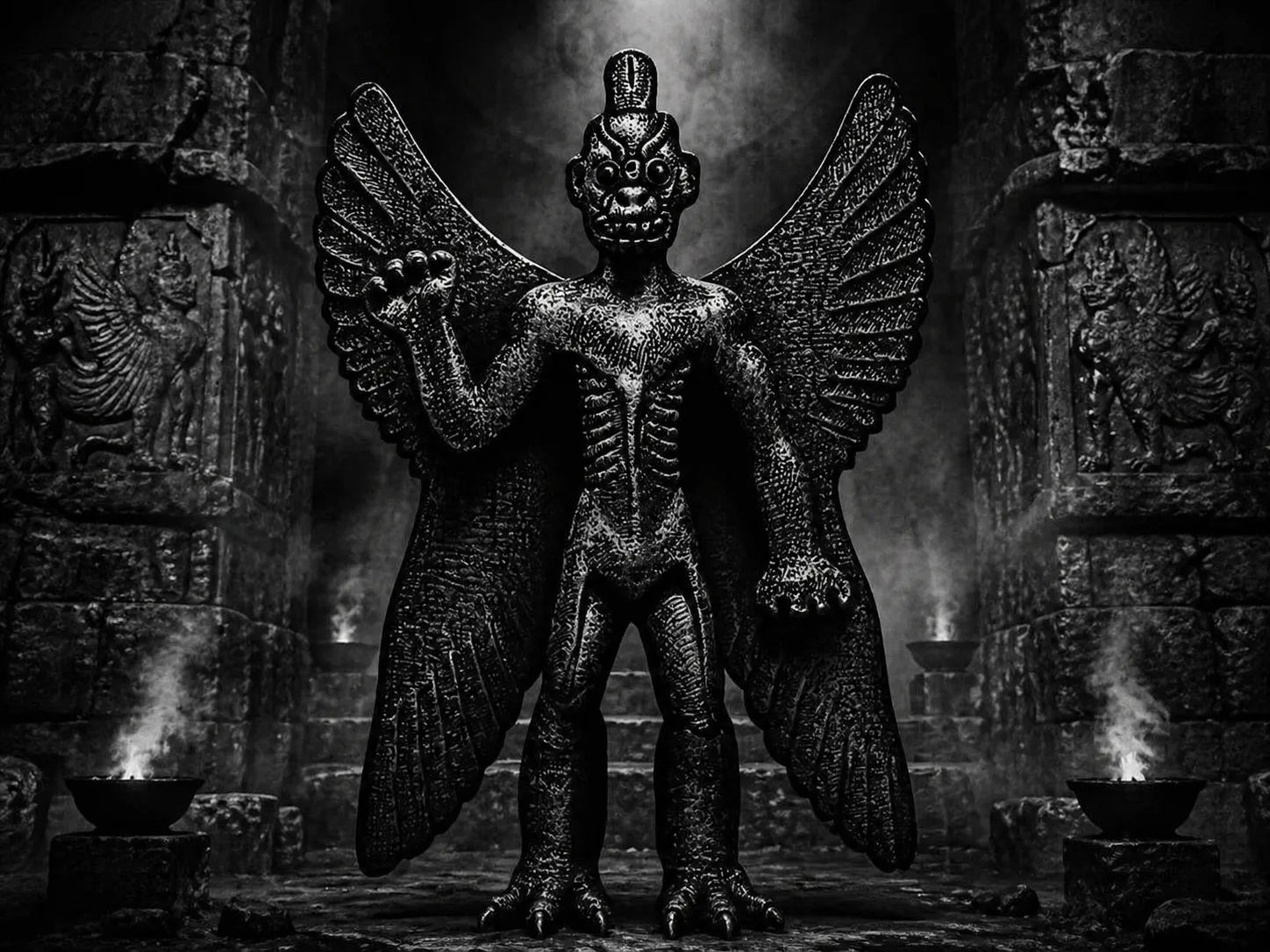
Pazuzu shows the paradox of being both dangerous and protective in Mesopotamian belief. Unlike most Near Eastern demons, who were seen as threats to be expelled, this wind spirit acted as a shield against worse dangers.
He stood between destructive atmospheric forces and the vulnerable home, showing that ancient theology often relied on a controlled threat to guard against greater chaos.
For this article, I relied mainly on archaeological evidence from the Nimrud (Kalhu) excavations rather than later Greek interpretations to maintain the demon’s role true to its original 8th-century BCE context. [View Full Bibliography ↓]
Summary
Key Takeaways
| Attribute | Details |
| Names | Pazuzu, Fazuzu |
| Title | King of the Lilu-demons, Lord of the Wind-Demons, King of the Evil Spirits of the Air |
| Origin | Neo-Assyrian and Neo-Babylonian Empires, early 1st millennium BCE |
| Gender | Male |
| Genealogy | Son of Hanbu (or Hanpa) |
| Role | Personification of the southwestern wind; protector of pregnant women against Lamashtu |
| Associated Deity | Enlil (as a wind deity), Anu (ancestral link), Lamashtu (rival/adversary) |
| Brings | Famine during the dry season; locust swarms; respiratory ailments; protection from the supernatural |
| Weaknesses | Apotropaic imagery; ritual identification with the divine; superior celestial authority |
| Realm/Domain | The Underworld (Irkalla) and the lower atmosphere/winds |
| Weapon/Item | The “Evil Wind” (Imhullu) and the power of the right hand pointed upward |
| Symbolism | The duality of the wind as both a bringer of plague and a cleanser of evil |
| Sources | Neo-Assyrian bronze statuettes, stone amulets, incantation tablets (e.g., Maqlû series) |
Who or What is Pazuzu?
Pazuzu was known in the first millennium BCE in Assyria and Babylonia, and was both a spirit of the Underworld and the air. He was called the King of the Lilu, a group of wind spirits that preyed on humans. Unlike other Mesopotamian monsters that only aimed to destroy, he had a more complicated role in religion.
People mainly called on Pazuzu to fight the demoness Lamashtu. Since he ruled over evil air spirits, both ordinary people and royalty used his image to protect infants and mothers. He was not worshipped as a god in temples, but his power was used in homes through magic and protective objects.
“Pazuzu” Meaning
Experts still debate the origin of the name. It is thought to come from Akkadian, but there is no clear Semitic root word that matches it. Some believe the name imitates the sound of the wind, especially the dry, hot winds from the eastern mountains or southwestern deserts.
There are a few differences in the name’s history because this demon appears late in Mesopotamian records, mainly during the Neo-Assyrian period (about 911–612 BCE). Unlike older Sumerian gods, whose names modified over time, his name appeared complete from the beginning.
In many incantations, his name is often written with the dingir sign, a cuneiform symbol for divinity. This shows that even though he was a demon, he had a recognized supernatural status in the heavenly order.
How to Pronounce “Pazuzu” in English
In English, the name is pronounced with three syllables, stressing the second: pah-ZOO-zoo. The first ‘a’ sounds like in ‘father,’ and the ‘u’ sounds are long, like in ‘moon’ or ‘zoo.’ Say it with an even rhythm.
Origins
Pazuzu first appeared in history during the Iron Age, in the Neo-Assyrian Empire of the 8th century BCE. Although Mesopotamian religion had known about wind demons and the ‘Seven Evil Spirits’ since the Sumerian Third Dynasty of Ur, this particular demon does not show up in Bronze Age records.
The earliest clear evidence for this demon comes from small bronze heads and statues found at Nimrud (ancient Kalhu) and Nineveh, mostly from the time of kings such as Sargon II and Ashurbanipal.
Pazuzu was believed to come from the Underworld (Irkalla), but he acted in the lower atmosphere. In myths, he was depicted as the spirit of the southwestern wind, emanating from the Zagros Mountains.
In Mesopotamia, this wind brought extreme heat, famine, and locusts. Still, it could also chase away ‘fevers’ caused by other spirits. By the 7th century BCE, his influence had spread from Assyria to Babylonia and even to the Levant and Samos, showing how quickly people adopted his protective role.
His growing importance stemmed from shifts in Neo-Assyrian religion, which began to focus more on personal protection and home-based magic than on temple rituals. He was introduced as a specialist—a powerful demon meant to keep the unpredictable and dangerous Lamashtu in check.
Genealogy
Pazuzu’s family line is clear and unique, which sets his rank among Mesopotamian demons. Cuneiform texts always call him the son of Hanbu (or Hanpa), who was seen as a king in the Underworld.
This father-son link is important because it gives him royal status among the Lilu, the wind spirits, and sets him apart from nameless ghosts (etimmu) who had no family ties. Being called ‘son of Hanbu’ gives him the right to command lesser evil spirits and rule over the dangerous winds.
Apart from his father, there is no record of him having a wife or children in Neo-Assyrian or Neo-Babylonian texts. Instead, his main connection is his rivalry with Lamashtu. They are not related by blood, but their roles are closely tied, as he is the only one who can drive her back underground.
As King of the Lilu, Pazuzu leads a group of spirits, but he is still seen as a lone creature of power. Not having a family highlights his role as a unique cosmic official, focused on managing supernatural conflicts instead of starting a family line.
You may also enjoy:
Kuchisake-onna: Folklore, Origins, and Urban Legend History
February 10, 2026
Chort: The Sinister Slavic Demon of Chaos and Bad Luck
March 10, 2026
What Is Baku? The Bizarre Yōkai That Eats Nightmares
January 28, 2026
Who Is Asmodeus in Demonology and the Bible?
February 18, 2026
Ammit: Devourer of the Dead in Ancient Egyptian Mythology
November 10, 2025
What Does Pazuzu Look Like?
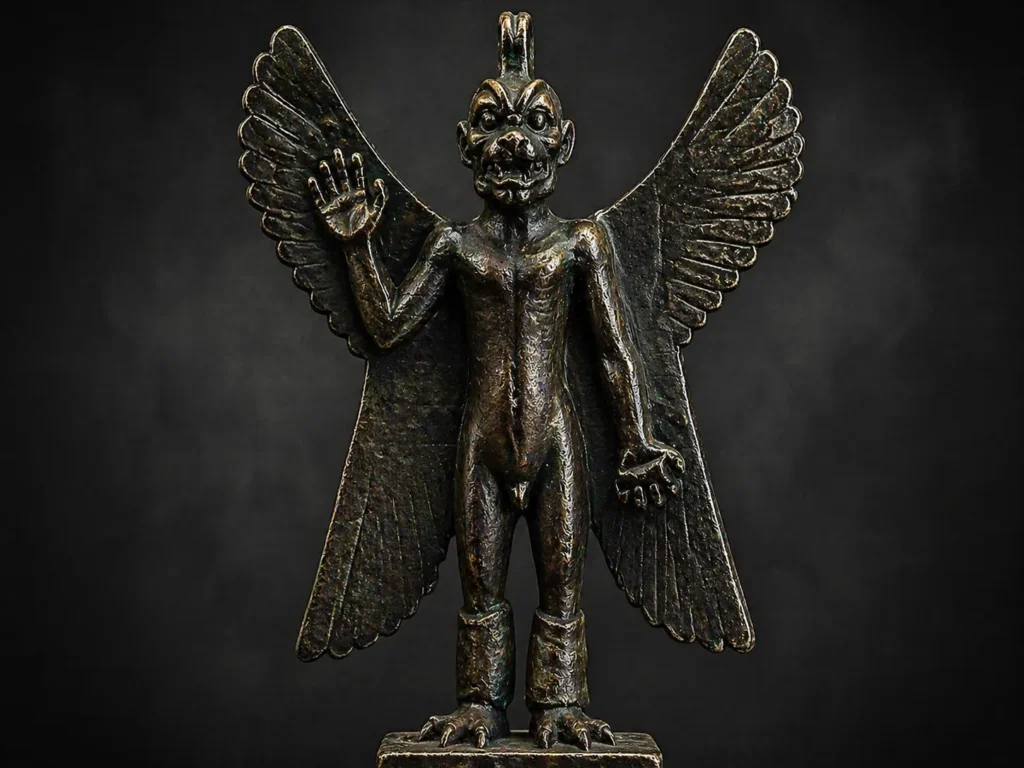
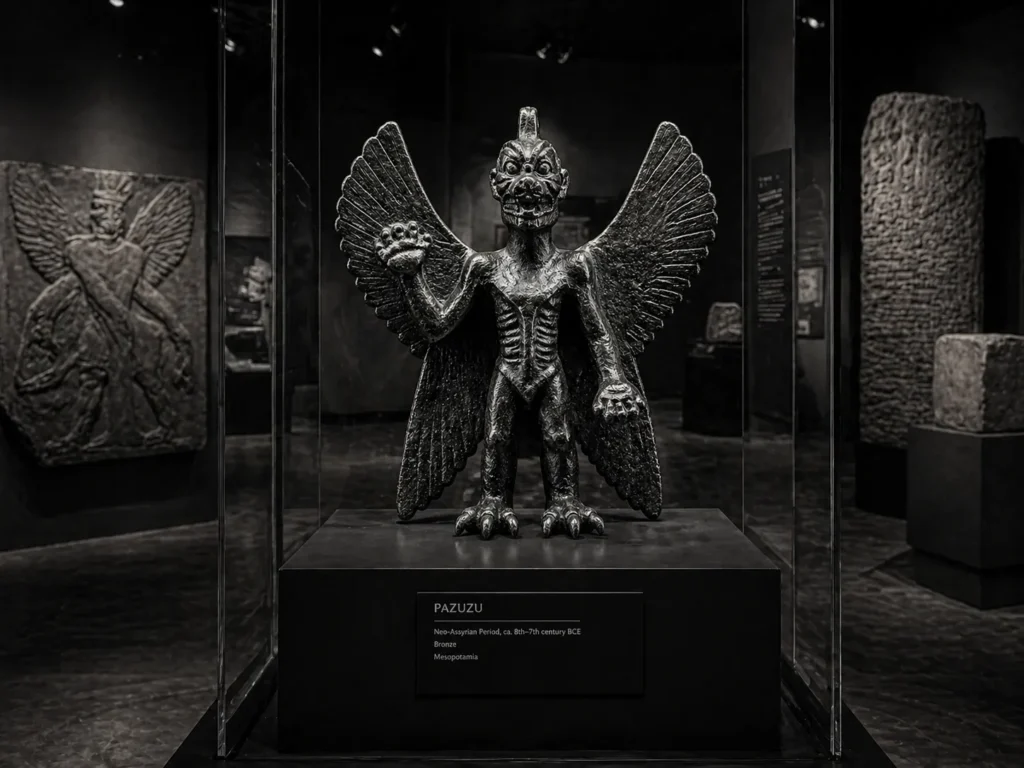
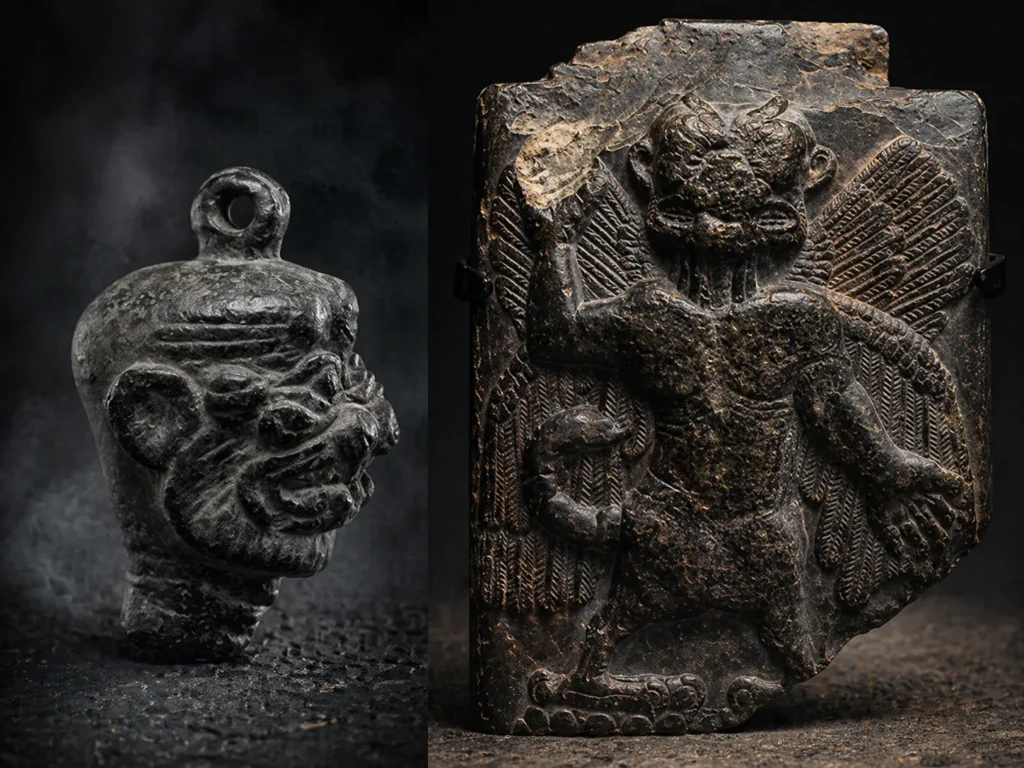
This demon’s body combines features from many fierce animals to show his power over different realms. He has a man’s body, a lion’s or monstrous dog’s head with bulging eyes and a snarling mouth, four wings (two up, two down), eagle’s talons for feet, a scorpion’s tail, and a body often covered in scales.
These features were not just for show—they had meaning. The four wings stood for Pazuzu’s ability to be everywhere and move quickly in any direction. The lion’s head showed his top-level strength, and the scorpion tail meant he could deliver a deadly sting to other spirits.
Based on the archaeological evidence, I have noticed that his right hand is almost always raised and his left hand lowered. This pose is rarely mentioned, but it likely shows his control over both the sky and the earth’s winds, symbolizing his total authority over the world’s vertical axis.
Connections to Other Ancient Demons
| Name | Genealogy | Type | Appearance |
| Lamashtu | Mesopotamian | Infant-snatcher | Lion head, donkey body, nursing a pig/dog. |
| Asag | Sumerian | Disease monster | Hideous, many-limbed, stone-skinned. |
| Lilith | Jewish/Semitic | Night demon | Winged female with bird talons. |
| Apep | Egyptian | Chaos serpent | Giant constrictor snake. |
| Ammit | Egyptian | Soul devourer | Crocodile, lion, and hippo hybrid. |
| Humbaba | Sumerian | Guardian giant | Face of coiled intestines; lion claws. |
| Kappas | Japanese | Water imp | Reptilian with a water-filled shell on head. |
| Gorgon | Greek | Chthonic monster | Female with snakes for hair, tusks. |
| Aeshma | Persian | Spirit of wrath | Anthropomorphic but often invisible/bloody. |
| Rakshasa | Hindu | Shape-shifter | Fanged, clawed, often multi-headed. |
Powers and Abilities
He is known for his complete control over the wind, especially the deadly winds that caused disease and drought. He is seen as a powerful demon who can command lesser spirits and control the boundary between the human world and the unknown.
- Atmospheric Control: The ability to summon and direct the southwestern wind, which could carry dust, heat, or locusts.
- Protection (Apotropaic Power): The unique capacity to repel the demoness Lamashtu, forcing her back to the Underworld.
- Disease Manipulation: He was believed to be the source of certain fevers and “cold winds” that caused respiratory distress, but he could also withdraw these ailments.
- Demonic Authority: As the “King of the Lilu,” he possessed the power to command a host of lesser malevolent spirits.
The Paradox of the Southwind
My research shows that Pazuzu appeared in the 8th century BCE, during a period that researchers such as Jeremy Black call the ‘demonic phase’ in Mesopotamian art. Earlier times focused on gods controlling chaos, but the Neo-Assyrian era used specialized demons as tools for spiritual protection.
In particular, Pazuzu is hardly mentioned in the big state epics of the Bronze Age. Instead, he appears almost fully developed in the Iron Age, likely in response to high infant mortality rates blamed on Lamashtu. I believe his rise was a practical addition to Mesopotamian protective charms rather than a major religious change.
I think the demon’s pose, with one hand up and one down, means more than just a balance between life and death. In ancient Near Eastern medicine, this gesture reflects the two-sided nature of the winds he rules.
The southwestern wind was a real danger, causing sickness and ruining crops. By making small bronze amulets of the demon, people believed they could treat the spiritual cause of disease in a way similar to homeopathy. The tiny size of these amulets, often just a few centimeters, was intentional.
People thought that a small image of the demon king focused his power into a protective shield. This turned his dangerous side away from the wearer and against other, more chaotic spirits.
One important but often missed point is that this demon acted as a cosmic official of the air. Unlike the Christian idea of a devil, he was seen as a ‘servant of Enlil,’ the main god of the sky. I see Pazuzu as part of a divine system that enforces the boundary between the civilized world and the wild winds. For ancient Assyrians, using his image was a legal act.
Wearing his image was not about worshipping a demon. Instead, it was a way to call on a powerful protector to make sure lesser evil spirits obeyed the gods’ rules and stayed outside the home.
Rituals, Amulets, and Protective Practices
The main reason people used Pazuzu’s image was to transfer and repel danger. They did not worship him, but used his fearsome reputation to protect themselves. Rituals often took place in the bedrooms of pregnant women or sick children to keep Lamashtu away.
Amulets and Talismans
The most common objects linked to Pazuzu are amulets made of bronze, steatite, or clay. Small three-dimensional heads were often cast in bronze, chosen for its strength and its link to the gods. These heads had a loop at the top so they could be worn or hung up.
These objects worked on the idea that ‘like cures like.’ Showing the face of the King of Evil Spirits told other demons that the home was already protected by a stronger force.
People often put these amulets above beds or buried them under doorways. This was important because demons were believed to enter through openings, and the demon king’s image acted as a magical barrier.
Professional Practitioners
The Āšipu, a Mesopotamian exorcist or incantation priest, led rituals involving this demon. The Āšipu was a skilled expert who used both medical and magical knowledge.
If a home was troubled by the ‘Hand of a Ghost’ or the ‘Touch of Lamashtu,’ the Āšipu would bring the right figurines and amulets. His job was to act as both a legal and spiritual go-between, using special rituals to make the demon protect instead of harm.
You may also enjoy:
Who Is Shiva, the Destroyer and the Lord of the Universe?
November 12, 2025
Who Is Ambolin, the Demon of Nighttime Dread
December 1, 2025
Pazuzu: The Ancient Demon Who Fought Evil with Evil
November 4, 2025
Jikininki: The Japanese Ghost That Feeds on Human Corpses
February 9, 2026
Empusa: The Blood-Drinking Wraith of Greek Mythology
November 20, 2025
Who Is Arioch, the Demon of War and Vengeance?
January 21, 2026
Bibliography
Author’s Note: In this article, I explored the Maqlû series and fragments about Ashurbanipal to gain a deeper understanding of a demon that is often seen simply as an enemy. By comparing these texts with discoveries from Nimrud, I found that this demon’s family connections and the way he is depicted with a raised hand actually carry important meanings in Mesopotamian religious practices. My research reveals a significant contradiction in his role—while he is known for bringing famine, he is also used to protect homes. That’s why I focus on his role as a “specialized enforcer” instead of just viewing him as a chaotic spirit.
- Abusch, Tzvi. The Witchcraft Series Maqlû. Society of Biblical Literature, 2015. JSTOR, https://doi.org/10.2307/j.ctt14bs6b9. Accessed 28 Apr. 2026.
- Mardon, Austin, et al. The World’s Oldest Library: The Library of Ashurbanipal. Golden Meteorite Press, 2021. Academia.edu.
- Jiménez, Enrique. Taqīš-Gula and Gimil-Gula, Scholars of Nazi-Maruttaš, Kaskal 17 (2020), 232-234. Kaskal 17, 2020. Academia.edu.
- Niederreiter, Zoltán. Two Pazuzu-head amulets inscribed with the standard B incantation. Revue d’assyriologie et d’archéologie orientale, 2017/1 Vol. 111, 2017. p.109-132. CAIRN.INFO.
- Bácskay, András. Asakkû: Demons And Illness In Ancient Mesopotamia. Academia.edu.
- Konstantopoulos, Gina. (2020). Demons and exorcism in ancient Mesopotamia. Religion Compass. 14. 10.1111/rec3.12370.
- Heeßel, Nils. Evil against Evil. The Demon Pazuzu. In: L. Verderame (Ed.), Demoni Mesopotamici, Studi e Materiali Di Storia Delle Religioni 77/2, Rome 2011, 357-368, 2011, pp. 357–368.
- Damen, Mark. Lecture 8.3: Ancient Near Eastern Literature (Part 3). Utah State University, 2013.
- Gane, Constance Ellen. Composite Beings in Neo-Babylonian Art. University of California, Berkeley, 2012.
- Wiggermann, F. A. M. The Mesopotamian Pandemonium: A Provisional Census. Studi e Materiali di Storia delle Religioni, vol. 77, no. 2, 2011, pp. 298-322.