Many Goetic entities are known for violence or moral corruption, but Andrealphus stands out for his focus on logic. As a master of measurement and geometry, he represents a cold, mathematical precision that can remove the world’s sense of mystery, reducing the vast cosmos to simple calculations.
The link between high-level astronomy and the power to “transform men into birds” shows a tension between reaching for higher knowledge and losing touch with what makes us human. The search for absolute knowledge can end up separating the seeker from their own nature.
This article examines modern descriptions of Andrealphus in the historical sources Pseudomonarchia Daemonum (1577) and the Ars Goetia, aiming to provide a well-supported historical profile of this Marquis of Hell. [View Full Bibliography ↓]
Summary
Key Takeaways
| Attribute | Details |
| Names | Andrealphus, Andreafus |
| Title | Great Marquis |
| Gender | Male |
| Role | Deceptive educator, transmuter of human souls, master of spatial manipulation |
| Rank | Marquis |
| Hierarchy | Serves under the higher infernal powers of the Goetia; commands subordinate spirits |
| Legions | 30 Legions of Spirits |
| Powers | Forceful instruction of geometry and astronomy, transmuting humans into the likeness of a bird, enabling evasion through flight |
| Associated Figures | Solomon (as the binder), other Goetic Marquises (such as Marchosias) |
| Weaknesses | Divine names of God, specific seals or lamens, constraints of the Solomonic brass vessel |
| Opposing Angel/Saint | Damabiah |
| Pantheon | Christian (Occult/Goetic tradition) |
| Primary Sources | Ars Goetia (Lesser Key of Solomon), Pseudomonarchia Daemonum, Dictionnaire Infernal |
Who or What is Andrealphus?
Andrealphus is an entity categorized as a Great Marquis of Hell. Within the framework of Solomonic magic and Christian demonology, he is recognized as the sixty-fifth spirit that King Solomon allegedly bound in a brass vessel. He operates as a high-ranking official in the infernal realm, commanding thirty legions of lesser spirits.
He is known for his skill in mathematics and the study of the stars. Unlike many demons who cause direct harm, Andrealphus is more concerned with changing the mind and sometimes the body of those who work with him.
He offers deep knowledge about measurement and the stars, but only as part of a pact. His power to turn a person into a bird stands out, often seen as a way to help someone escape or to mock human nature.
Geometry, Astronomy, and the “Eyes” of the Universe
Andrealphus’s skill in measurement and his peacock-like appearance show how Renaissance thinkers combined science and symbolism. In the 16th and 17th centuries, geometry and astronomy were seen as ways to understand the “language of God,” making a spirit of mathematics both respected and risky.
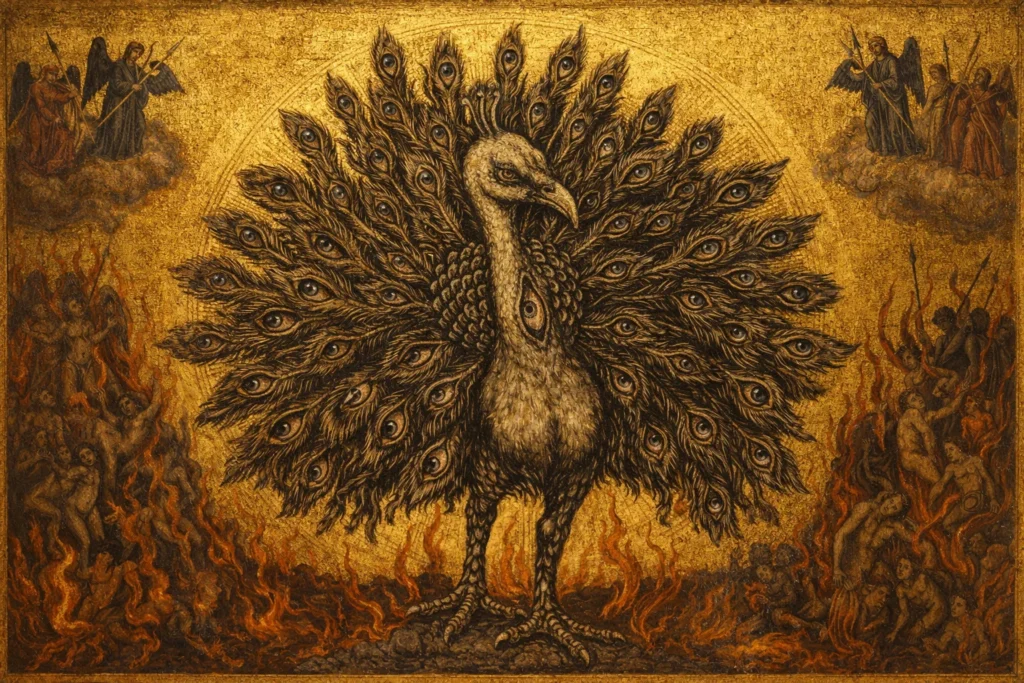
The peacock, with its “hundred eyes” (the oculi), was a strong symbol for the starry sky. Each feather tip stood for a star, so studying the peacock was like studying the careful order of the universe.
This colorful form comes from Greek mythology, especially the story of Argus Panoptes. After the hundred-eyed giant was killed, Hera put his eyes in the tail of her sacred bird, making the peacock a symbol of all-seeing wisdom and watching the skies.
In Renaissance occultism, this link turned Andrealphus from just a teacher of “lines and circles” into a guardian of higher vision. He stands for the meeting point between strict geometry and the amazing beauty of the universe, showing that for Renaissance magicians, deep mathematical truths were often hidden in nature’s most stunning sights.
“Andrealphus” Meaning
The origin of the name Andrealphus is not certain. Still, researchers often look to Greek and Latin roots found in medieval and Renaissance texts. The prefix Andro- or Andre- comes from the Greek word for man and is often used in demonology to show that an entity has a human-like side, even if it also has strange features.
The meaning of the second part, -alphus, is less certain. Some researchers believe it comes from the Greek word alpha, meaning “leader” or “first.” It might also be a variation of the name Andreafus, as seen in Johann Weyer’s Pseudomonarchia Daemonum.
Earlier Latin texts used the name “Andreafus,” but “Andrealphus” became the usual English spelling after the Lesser Key of Solomon was translated in the 17th century. This change shows how the name shifted from academic Latin sources to popular English occult books.
How to Pronounce “Andrealphus” in English
In English, Andrealphus is usually pronounced an-dree-AL-fus, with the stress on “AL.” The first part sounds like “pan,” the second has a long “e,” and the last part uses a soft “u” like in “bus.”
What Does Andrealphus Look Like?
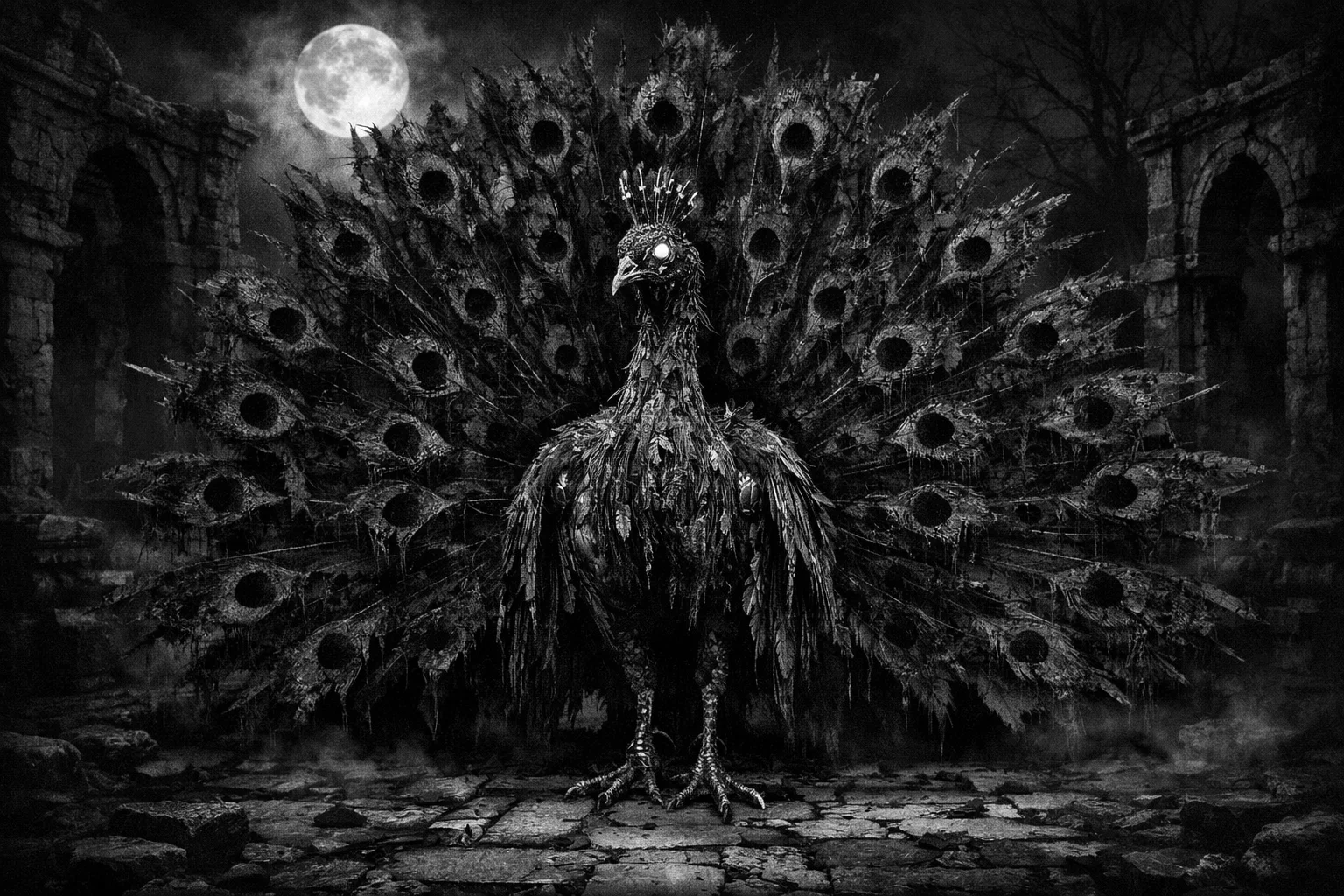
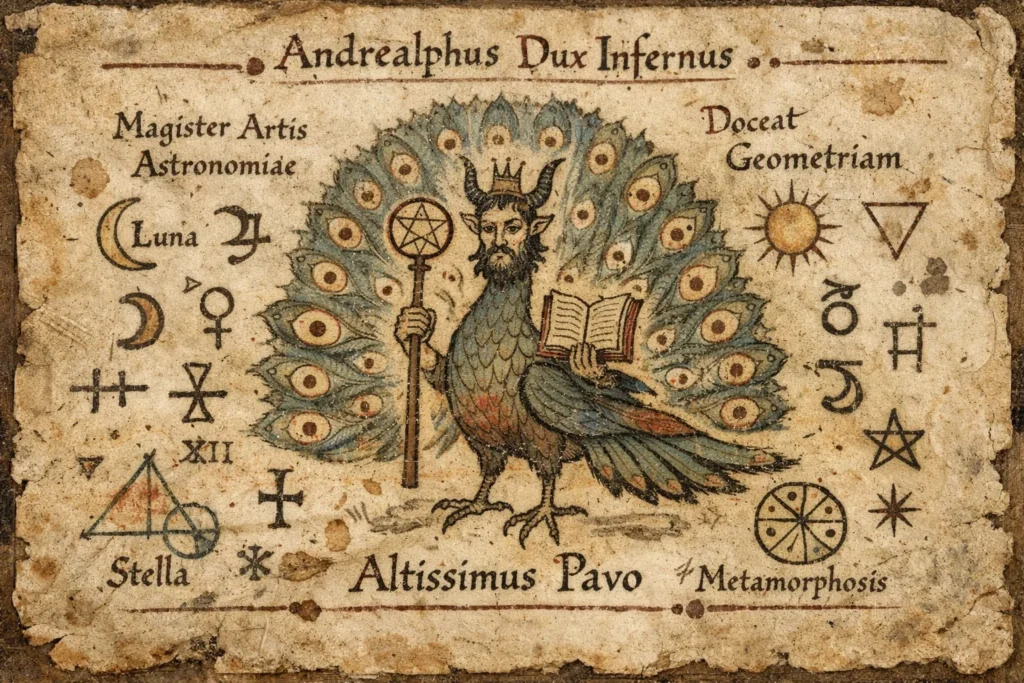
Andrealphus is said to appear in two main forms. First, he appears as a peacock, often making a lot of noise or a “great clamor.” The peacock stands for pride and “many eyes,” showing his broad knowledge of the stars and the world.
After being summoned, Andrealphus can be asked to take a human form. In this shape, he looks human but keeps a tricky quality that helps him teach his sciences. Even then, his bird-like side is important, shown by his power to turn others into birds. Unlike many demons, he is not described with horns or hooves, but with peacock features, marking his rank in the infernal order.
You may also enjoy:
Vritra: The Dragon Who Swallowed the Sky in Hindu Mythology
October 7, 2025
Ancient Demons: The Real Origins of the Setcheh Myth
November 11, 2025
What Is a Rakshasa? Meaning, Origins, and Dark Powers
January 23, 2026
Who Is Abalam in Demonology? The Demon King That Serves Paimon
September 30, 2025
Who Is Arioch, the Demon of War and Vengeance?
January 21, 2026
What Is Baku? The Bizarre Yōkai That Eats Nightmares
January 28, 2026
Historical & Grimoire Records of Andrealphus
Andrealphus does not appear in the Bible or early Christian writings. His history dates back to the 16th century in important European grimoire catalogs.
Original:
Andrealphus Marchio magnus, videtur specie pavonis, edit sonos magnos. In humana specie docet perfectè geometriam & omnia ad mensuram spectantia: item astronomiam: homines reddit ad avium speciem similes. [Pseudomonarchia Daemonum, Johann Weyer, 1577]
Translation:
Andrealphus is a great Marquis, he appears in the form of a peacock, he emits great noises. In human form he teaches geometry perfectly and all things regarding measurement: likewise astronomy: he renders men similar to the form of birds.
This Latin entry is the basis for Andrealphus’s place in the infernal hierarchy. Weyer, a doctor and occultist, calls him a Marchio magnus (Great Marquis). The use of the word “mensuram” is important because it defines Andrealphus by his strict use of measurement, not by moral corruption.
In the 16th century, the growing Scientific Revolution created tension between spiritual mystery and mathematical proof. Andrealphus shows this anxiety by appearing as a proud peacock while teaching geometry and astronomy, the tools used to “measure” the heavens.
A key difference here is the sound: edit sonos magnos (he emits great noises). This shows that the original idea of Andrealphus included a loud, possibly unsettling presence along with his flashy appearance, a detail often left out in later English versions.
The Sixty-fifth Spirit is Andrealphus. He is a Mighty Marquis, appearing at first in the form of a Peacock, with great Noises. But after a time he putteth on Human shape. He can teach Geometry perfectly. He maketh Men very subtle therein; and in all Things pertaining unto Mensuration or Astronomy. He can transform a Man into the Likeness of a Bird. [The Goetia: The Lesser Key of Solomon, S.L. MacGregor Mathers & Aleister Crowley, 1904]
This early 20th-century version shows the “Golden Dawn” view of the spirit. While it mostly translates earlier Latin texts, Mathers and Crowley added the word “subtle.” By saying he makes men “very subtle” in geometry, the text shifts his influence from just teaching to encouraging cleverness or cunning.
This change aligns with the “Modern Occult” era’s focus on altering the practitioner’s mind. The power to turn someone into a “bird” is seen less as a real change and more as a way for the magician to gain a new, higher perspective. In this version, Andrealphus is less about old fears and more about helping individual occultists reach new levels of understanding.
Original:
Andrealphus, marquis de l’empire infernal; il paraît sous la figure d’un paon à la voix éclatante. Quand il se montre sous une figure humaine, il enseigne avec succès la géométrie, l’astronomie et tout ce qui a rapport à la mesure. Il a le pouvoir de donner aux hommes la figure d’un oiseau. [Dictionnaire Infernal, Collin de Plancy, 1863]
Translation:
Andrealphus, marquis of the infernal empire; he appears under the figure of a peacock with a brilliant [piercing] voice. When he shows himself under a human figure, he successfully teaches geometry, astronomy and everything related to measurement. He has the power to give men the figure of a bird.
De Plancy’s 19th-century French entry connects Renaissance grimoires to modern demonology. While it keeps Weyer’s original traits, the Dictionnaire Infernal aimed to give a semi-scientific, encyclopedic view of the supernatural for readers after the Enlightenment. Calling the peacock’s voice éclatante (brilliant or piercing) highlights the overwhelming sensory effect of Andrealphus’s appearance.
This source is important because it was published during French Romanticism and a renewed interest in the “Gothic.” By keeping the Marquis’s rank and his skill in measurement, De Plancy shows the lasting idea of the “Mathematical Demon”—an entity that warns pure logic, without soul, can become flashy but empty.
“Andrealphus, a great Marquis, appears as a Peacock with a terrible voice. He can transform a man into the likeness of a bird, and makes him very subtle in the knowledge of the stars and the lines of geometry. He hath under his command thirty legions of spirits.” [The Magus, Francis Barrett, 1801]
Francis Barrett’s The Magus is an important link between older and newer texts. While it draws from Agrippa and Weyer, Barrett helped bring these entities back during the Romantic period. This entry stands out for highlighting the frightening sound of Andrealphus’s voice—a detail often downplayed in modern descriptions.
In the early 19th century, there was a move toward “Natural Magic.” Barrett’s mention of Andrealphus shows the demon as a symbol of unnatural knowledge.
By then, “mensuration” meant more than land surveying; it was linked to the rise of industry. Andrealphus came to represent the “arrogance of the architect”—the idea that the world can be fully controlled by calculation.
“Andrealphus (65). A Marquis of the Order of Marquis. He appears as a Peacock, but being commanded, he takes the form of a man. He is a teacher of the sciences of the Heavens and the Earth, and he who serves him shall have the power to fly as the eagle, though his body remains on the earth.” [The Grand Grimoire (Le Dragon Rouge), Anonymous/Various Editions, 18th-19th Century]
This version from some editions of the Grand Grimoire gives new insight into his transformation. Unlike the Ars Goetia, which suggests a real change into a bird, this text points to an astral or mental transformation. The person gains the power to fly in spirit, while their body stays on the ground.
This difference is important for mythologists. It means Andrealphus is not just a “shapeshifter,” but a demon linked to Out-of-Body Experiences (OBE) and remote viewing. This ties him to the idea of the “Astral Gaze” and strengthens the peacock’s “eyes” as a symbol for seeing more. In 18th-century “Low Magic,” this made him appealing to those looking for spiritual exploration, not just learning.
Is Andrealphus a Corruption of Adramelech?
One of the most compelling theories in comparative demonology is that “Andrealphus” is a late-medieval linguistic corruption of the ancient Assyrian deity Adramelech (Adrammelech).
- Linguistic Link: Adram-melech (“Magnificent King”) → Andra-melech → Andrealphus.
- Iconographic Link: Adramelech was often depicted as a man-mule or with bird features (specifically the peacock in later occult interpretations, such as those of Collin de Plancy).
- Domain Overlap: Adramelech was a celestial deity associated with the sun and fire; Andrealphus’s mastery of “the stars” and “astronomy” represents the specialized, demonized remnant of this ancient solar/celestial worship.
Seen this way, Andrealphus is not just a “random” creature from the 16th century. He becomes a reflection of Mesopotamian solar logic—the old practice of using the stars to guide human laws, now turned into a “Marquis of Hell” who teaches geometry.
Powers and Abilities
Andrealphus has special powers related to knowledge and transformation. His main role is to teach geometry and astronomy completely. He does more than just give information; he makes the student “subtle” or “arguable,” meaning he sharpens their skill in using math and logic, sometimes for tricky or prideful purposes.
His second main power is the ability to change into a human form. Andrealphus can make a person look and act like a bird. This is not just an illusion, but a real change in how they seem and behave.
This power lets a person fly and escape normal physical limits, taking them out of regular human experience and putting them under a “demonic” set of rules. All of Andrealphus’s abilities center on mastering the physical and celestial worlds through a dark, mathematical lens.
You may also enjoy:
What Is a Dīv? The Terrifying Giant Demon of Persian Myth
January 22, 2026
What Is a Yūrei? The True Meaning of Japanese Ghosts
January 30, 2026
Who Was Hiranyaksha, the Golden-Eyed Asura?
October 7, 2025
What Is the Akkorokamui, Japan’s Colossal Sea Monster?
November 14, 2025
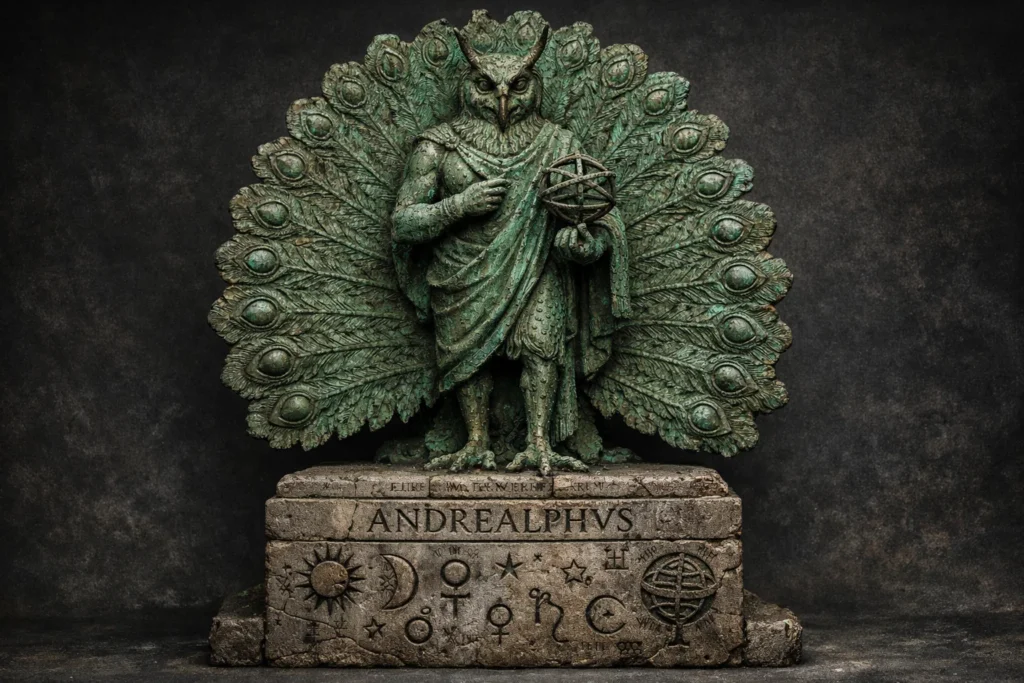
Mensuration as a Tool of Dehumanization
The Ars Goetia highlights Andrealphus’s skill in teaching formal sciences, but a closer look shows him as the patron of the “Scientific Revolution’s Shadow.” In the late Renaissance, the shift from natural philosophy to mathematical proof led to a major change in how people saw the world.
As a master of measurement, Andrealphus shows the fear that if everything is measured, the world loses its magic. By turning the stars into simple coordinates, he stands for the “cold gaze” of early modern rationalism, making the universe predictable but empty of spirit.
The power to “transform men into birds” is a metaphor for feeling cut off by too much intellect. In Neoplatonic thought, birds stood for the soul rising higher. Still, with a demon focused on strict geometry, this change hints at an empty kind of transcendence.
This is like the “Icarus of Logic”—someone who gains a high view of the world through math but loses touch with everyday life. It reflects how focusing too much on big ideas or star maps can make a person feel separate from real, messy life.
The peacock image also warns against the vanity of the know-it-all. In the 16th century, calling someone a “peacock” was a way to mock intellectuals who used fancy words and math to show off, not to seek the real truth.
Andrealphus acts as a guardian of this intellectual trap: he gives the “eyes” of the universe to those who want to see everything, but the price is becoming something that can’t connect with others. He is the patron of the scholar who knows every star’s distance but can’t close the gap between people.
Andrealphus vs Other Christian Demons
| Demon Name | Associated Sin/Temptation | Rank/Origin | Key Traits/Powers |
| Asmodeus | Lust | King (Ars Goetia) | Breaks marriages, teaches arithmetic |
| Belial | Lawlessness | King (Dead Sea Scrolls) | Deception, grants high titles |
| Paimon | Pride | King (Ars Goetia) | Teaches all arts and sciences |
| Marchosias | Sloth/False Hope | Marquis (Ars Goetia) | Fights bravely, spits fire |
| Astaroth | Sloth/Vanity | Grand Duke (Ars Goetia) | Knows all secrets of the past/future |
| Leraje | Conflict/Envy | Marquis (Ars Goetia) | Causes gangrenous wounds from arrows |
| Naberius | Loss of Honor | Marquis (Ars Goetia) | Restores lost dignities/prestige |
| Glasya-Labolas | Murder | President/Earl (Ars Goetia) | Teaches arts, causes bloodshed |
| Foras | Avarice | President (Ars Goetia) | Makes men invisible and long-lived |
| Furcas | Cruelty | Knight (Ars Goetia) | Teaches rhetoric and philosophy |
| Buer | Gluttony (of mind) | President (Ars Goetia) | Heals distempers, teaches logic |
| Ronove | Knowledge of tongues | Marquis/Earl (Ars Goetia) | Teaches languages, grants favors |
| Stolas | Corruption of Nature | Prince (Ars Goetia) | Teaches astronomy and herbs |
| Phenex | False Poetry | Marquis (Ars Goetia) | Sings sweet notes, teaches sciences |
Rank in the Hierarchy of Hell
Andrealphus has the rank of Marquis, putting him in the middle-upper level of the Goetic order. Marquises are usually linked to the moon and have special jobs in teaching and management. Andrealphus commands 30 legions, showing he has a strong and stable role in the infernal system.
His connections with other demons are mostly about work. He shares a teaching role with spirits like Stolas, who also teaches astronomy, and Paimon, who teaches all sciences. As a Marquis, he answers to the Kings of Hell, like Asmodeus or Bael.
He follows the strict rules of the infernal court, acting as an expert in measurement and star calculations. He may serve as a navigator or architect for the infernal realms when his superiors ask.
Mystical Correspondences
| Attribute | Details |
| Planet | Moon |
| Zodiac Sign | Capricorn/Aquarius |
| Element | Air |
| Direction | East |
| Color | Violet/Silver |
| Number | 65 |
| Crystal/Mineral | Amethyst/Moonstone |
| Metal | Silver |
| Herb/Plant | Lotus/Mandrake |
| Animal | Peacock |
Andrealphus’s cosmic links tie him to the night sky, with the Moon as his main celestial body, fitting his Marquis rank. This lunar energy helps him change shapes and control subtle sciences. Occult texts say rituals during certain moon phases make his presence stronger. His link to the Air element gives him power over flight and abstract math.
This setup means his influence is strong in both the mind and the spirit. The peacock, his main animal symbol, stands for pride and the “all-seeing” quality of his knowledge of the stars. His sigil is made from silver, which channels his lunar power.
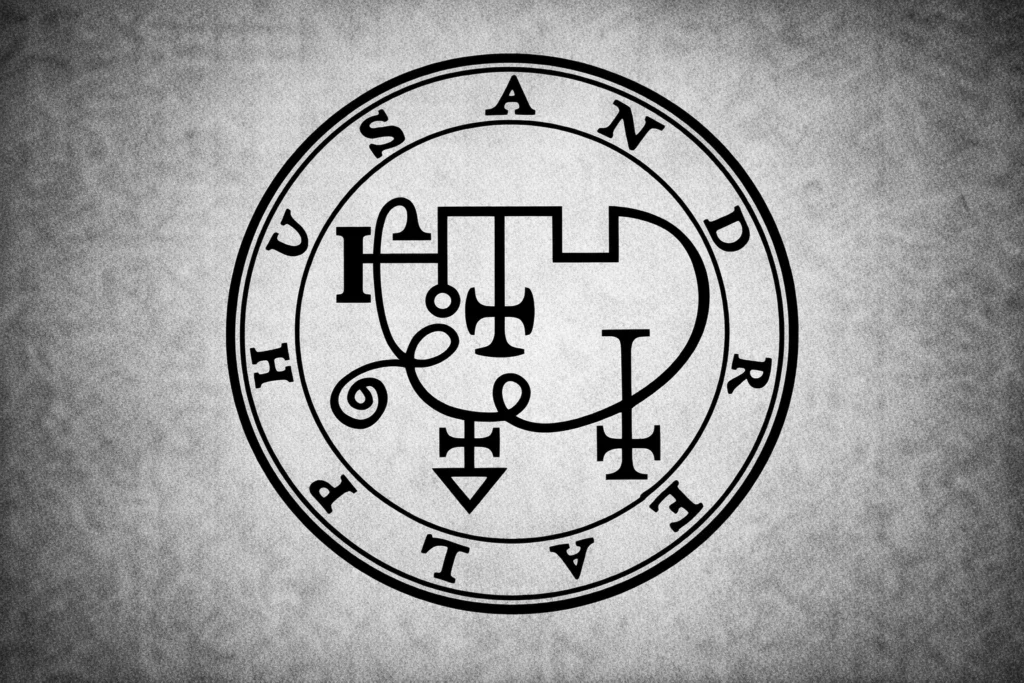
Andrealphus’ Sigil
Andrealphus’s sigil is a complex design of math and geometry found in the Ars Goetia. It is seen as his unique signature.
In the past, the sigil was important because people thought it showed the demon’s true nature. It was usually carved on a silver plate worn on the chest to protect the user and make the demon appear. Without the sigil, the demon might not show up or could give false information.
You may also enjoy:
Abura-sumashi: The Potato-Headed Yōkai That Punishes Greed
October 23, 2025
What Is Jorōgumo? The Deadly Spider Woman of Japanese Myth
February 2, 2026
Banasura: The Thousand-Armed Demon King
October 10, 2025
Amdusias in the Ars Goetia: The Demon of Dark Music
December 2, 2025
Mahabali (Bali): The Benevolent Asura King
October 10, 2025
Bibliography
Author’s Note: While working on this demon profile, I noticed a strong contrast between the strict math focus in Weyer’s Pseudomonarchia Daemonum and the more dreamlike “astral flight” in later texts like the Grimoirium Verum. It was a challenge to connect Andrealphus’s precise geometry with the wild, noisy image of the peacock. This suggests he represents the point at which human logic turns into sensory overload. Looking at these old texts through the lens of the Icarus story, it’s clear that Andrealphus is less a classic tempter and more a symbol of the “high” that comes from total intellectual mastery. His shift from a teacher of “lines and circles” to a force for spiritual disconnection is the most interesting part of his story.
- McCown, Chester Charlton, editor. The Testament of Solomon. J. C. Hinrichs’sche Buchhandlung, 1922. Internet Archive. Edited from manuscripts at Mount Athos, Bologna, Holkham Hall, Jerusalem, London, Milan, Paris, and Vienna.
- De Laurence, L. W. The Lesser Key of Solomon, Goetia. Project Gutenberg, 7 Nov. 2023. Originally published by De Laurence, Scott & Co., 1916.
- Weyer, Johann. Pseudomonarchia Daemonum. Edited and translated by Joseph H. Peterson, digital edition, 2000. Twilit Grotto: Esoteric Archives.
- Collin de Plancy, Jacques. Dictionnaire infernal: répertoire universel des êtres, des personnages, des livres, des faits et des choses qui tiennent aux esprits. 6th ed., Henri Plon, 1863. Internet Archive.
- Solomon, King of Israel (attributed). The Key of Solomon the King (Clavicula Salomonis). Translated and edited by S. Liddell MacGregor Mathers, George Redway, 1889. Internet Archive.
- Plangiere, Jesuit Dominicane, translator. Grimoirium Verum (or The True Grimoire). Edited by Phil Legard, digital edition, 1999. Internet Archive.
- Barrett, Francis. The Magus, or Celestial Intelligencer; Being a Complete System of Occult Philosophy. Printed for Lackington, Allen and Co., 1801. Internet Archive. Including works by Johannes Trithemius.
- Trithemius, Johannes. Steganographia: Hoc Est: Ars Per Occultam Scripturam Animi Sui Voluntatem Absentibus Aperiendi Casu. Published by Ioannis Alberti, 1608. Internet Archive.
- Karaca Kucuk, Seyma. Icarus as a Mythological Pattern in the Candle and the Moth and a Portrait of the Artist as a Young Man. Academia.edu, 2019.