Most adversaries in Puranic stories are driven by greed or strength. Still, Mahishasura stands out for showing how a loophole can seem impossible to overcome. He represents what happens when the ego uses the letter of divine law to avoid moral responsibility, causing the cosmic order to stall.
Looking at the gender-based exception in his boon, we see a twist on traditional power structures. The ‘unconquerable’ is defeated not by greater strength, but by a group he had overlooked.
This research uses translations of the Devi Mahatmya and Devi Bhagavata Purana to trace how Mahishasura’s story and meaning changed from ancient times to the Puranic era. [View Full Bibliography ↓]
Summary
Key Takeaways
| Attribute | Details |
| Names | Mahishasura, Mahisha, Buffalo Demon |
| Title | King of Asuras, Conqueror of the Three Worlds |
| Gender | Male |
| Role | Cosmic oppressor, shape-shifting conqueror, antagonist of the Devi |
| Clan | Asura (specifically of the lineage of Karambha and Rambha) |
| Followers | Chiksura, Chamara, Asiloma, Vidalaksha, and vast Asura armies |
| Powers | Shape-shifting (Mahishasura-mardini), near-invulnerability, martial expertise |
| Appearance | Often depicted as a buffalo-headed human or a massive black water buffalo |
| Etymology | Derived from ‘Mahisha’ (Buffalo) and ‘Asura’ (Non-god/Titan) |
| Associated Figures | Rambha (father), Durga (slayer), Brahma (boon-giver), Indra (rival) |
| Weaknesses | Arrogance, vulnerability to female warriors |
| Opposing Deva/Avatar | Durga (Mahishasura Mardini) |
| Pantheon | Hindu (Puranic) |
| Primary Sources | Devi Mahatmya (Markandeya Purana), Devi Bhagavata Purana, Vamana Purana |
Who or What is Mahishasura?
Mahishasura is a powerful Asura who plays an important role in the Shakta tradition of Hinduism. He was born from an Asura and a princess who had been turned into a water buffalo. Through intense penance, he gained a promise that no male could harm him, thinking no woman would ever be strong enough to defeat him.
He took over Indra’s throne and drove the Devas out of the heavens, upsetting the cosmic balance. This crisis led the gods to combine their powers to create a single female form. As the main opponent of the Goddess, he shows that only the divine feminine can truly overcome unchecked ego and those who twist the rules.
Mahishasura Meaning
The name comes from the Sanskrit word Mahisha, meaning ‘buffalo.’ In ancient Indian symbolism, the buffalo stands for strength, stubbornness, and darkness (tamas). ‘Asura’ refers to a group of powerful beings often at odds with the Devas. So, his name, ‘Buffalo Demon,’ reflects both his origins and his nature.
Different Indian languages have their own versions of the name, but the meaning stays the same. Some tantric traditions connect the name to ‘Mahas,’ meaning great power, but used destructively.
Over time, the term shifted from describing buffalo-like spirits in general to naming the main villain in the Devi Mahatmya. The ‘buffalo’ image is always retained, showing how he shifts between animal and human forms and highlighting the unstable nature of the ego.
How to Pronounce “Mahishasura” in English
The name is pronounced muh-HEE-shuh-SOO-ruh. Say ‘muh’ quickly, stress ‘HEE’ with a long ‘e,’ use a soft ‘sh’ in ‘shuh’ like in ‘ship,’ and let ‘SOO-ruh’ flow together with a long ‘u’ sound.
What Does Mahishasura Look Like?
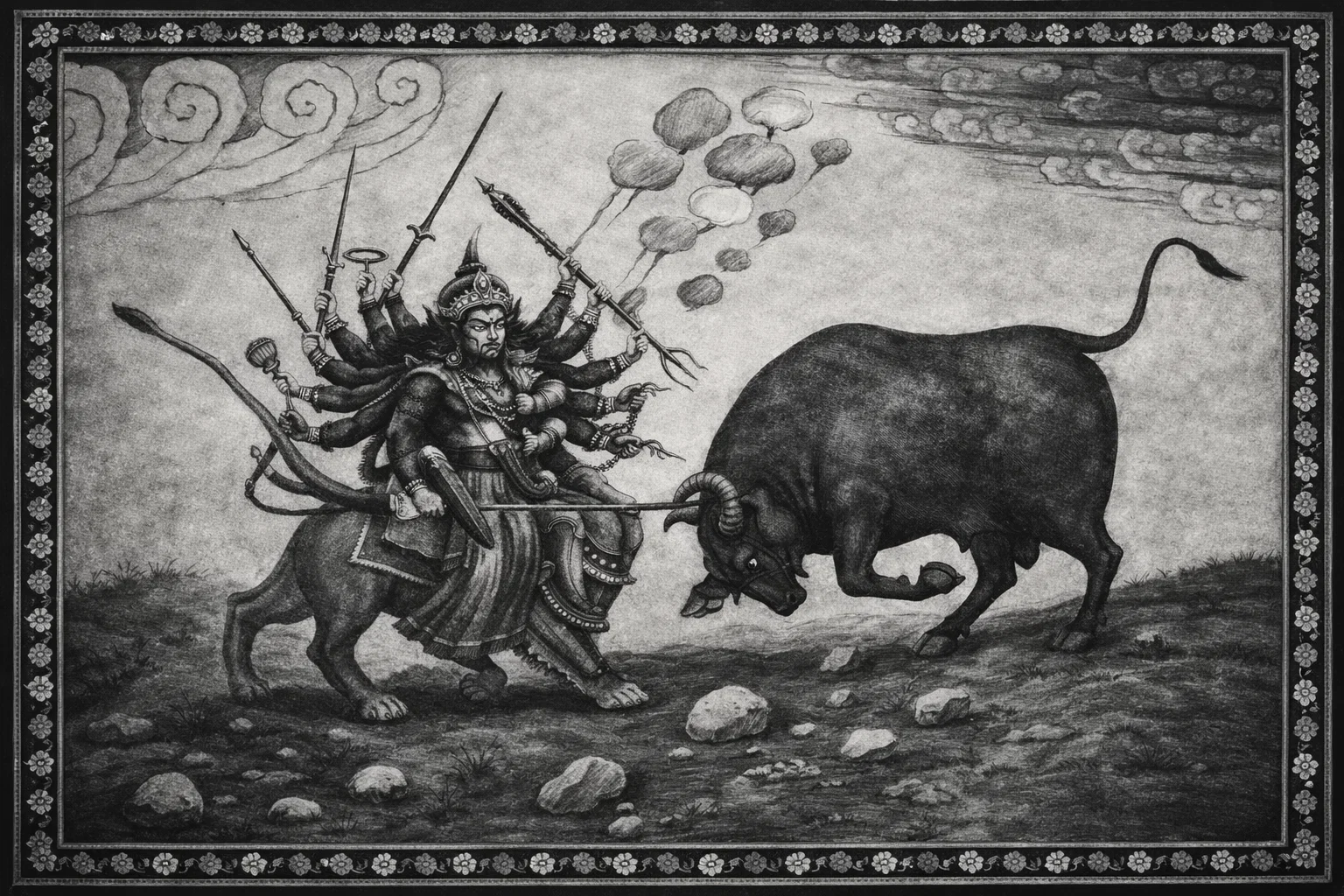
Descriptions of Mahishasura’s appearance change depending on the story. At first, he is often shown as a huge, jet-black water buffalo with glowing eyes and horns strong enough to uproot mountains. His breath creates storms, and his hooves shake the earth, showing his wild and untamed power.
As a shapeshifter, Mahishasura’s form changes quickly. In his last battle, he turns into a lion, then a sword-wielding warrior, then an elephant, and finally returns to his buffalo shape to try to escape the Goddess.
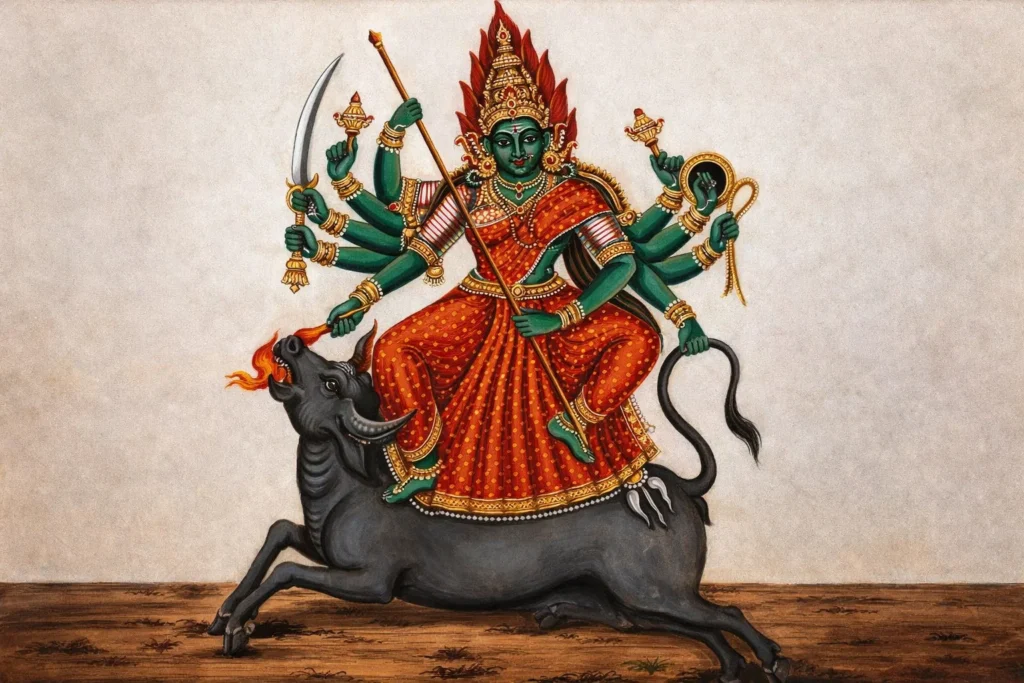
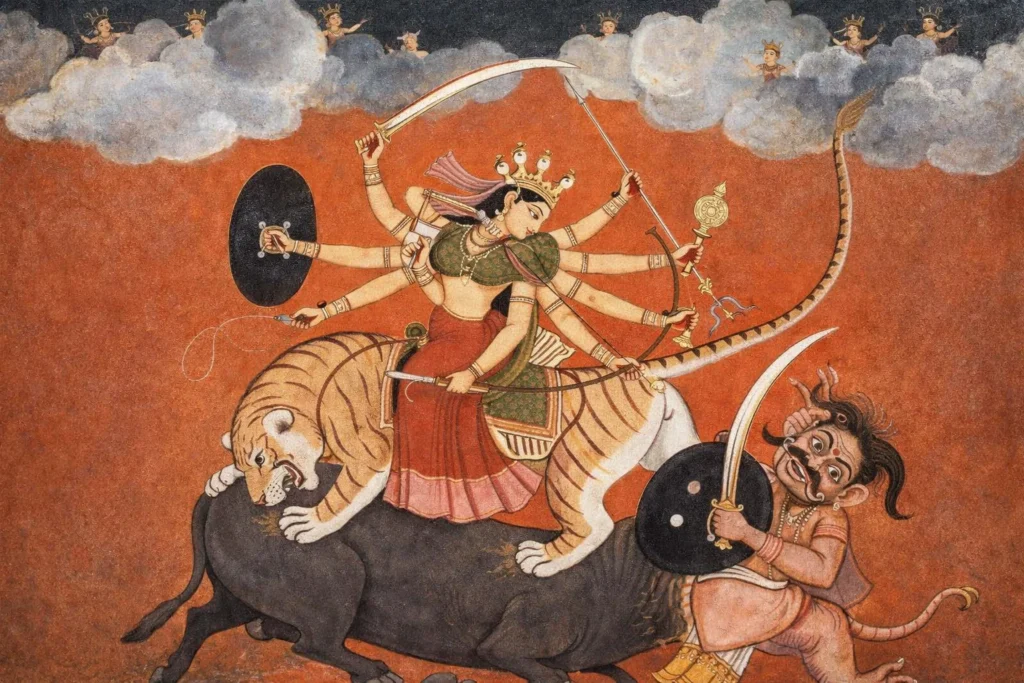
Art usually shows the moment of his defeat: Mahishasura is pictured coming out in human form from the neck of the slain buffalo, holding a sword and looking up in fear at the Goddess. This image of a human emerging from a beast shows the mix of his clever mind and his wild, animal instincts.
You may also enjoy:
Aamon: The Infernal Marquis of Lust, Feuds, and False Prophecies
September 29, 2025
Who Were the Hinn, the First Spirits of Creation?
November 12, 2025
Andrealphus: The Peacock Demon Who Twists Minds and Bodies
January 19, 2026
Si’la: The Seductive Jinn Who Lures Travelers to Their Doom
October 9, 2025
Origins
Mahishasura’s story starts with a long-standing rivalry with the gods. His father, Rambha, was a strong Asura king who prayed to Agni, the fire god, for a son who couldn’t be killed by any man or god.
On his travels, Rambha fell in love with a female buffalo, who was really a cursed princess. Their child, Mahishasura, inherited both sharp intelligence and great strength.
The first stories about Mahishasura appear in the Markandeya Purana, especially in the Devi Mahatmya section from the 5th or 6th century CE. Over time, his story grew from a simple tale of conquest into a deeper message about the need for Shakti, or creative energy, to keep the universe in balance.
Birth
Mahishasura was born from Rambha and a she-buffalo. The Devi Bhagavata Purana says Rambha was devoted to penance. She fell in love with a buffalo who was actually a cursed princess. Their child was half-human, half-buffalo, with his mother’s strength and his father’s ambition.
Soon after Mahishasura was born, his father Rambha was killed by another jealous buffalo. After his father’s death, Mahishasura became king and started his own penance, focusing his devotion on Brahma, the creator god.
Impressed by his dedication, Brahma appeared to Mahishasura. Mahishasura asked for immortality, but Brahma said that everyone born must die. So, Mahishasura cleverly asked for a boon that only a woman could kill him, thinking no woman could ever defeat him.
Family
Mahishasura’s family comes from the Daitya line of Asuras. His father, Rambha, and uncle, Karambha, both tried to rule the three worlds with the help of divine boons. Karambha was killed by Indra, but Rambha’s legacy continued through Mahishasura. He didn’t have a typical family; instead, his generals and ministers acted as his closest allies.
| Relation | Name |
| Parents | Rambha (Father) and a Cursed Buffalo Princess (Mother) |
| Children | Gajasura (in some regional oral traditions) |
Historical & Folkloric Records
Mahishasura isn’t mentioned by name in the earliest Vedic texts, but his story becomes clear in the early Puranic era. This marks a shift from the general idea of Asuras in the Rigveda to a more detailed character.
“Mahishasura, the lord of the Asuras, having defeated the Devas in a battle that lasted for a hundred years, became the Indra (ruler) of the heavens. The defeated Devas, led by Brahma, went to the place where Shiva and Vishnu were… From the faces of Vishnu, Shiva, and Brahma, a great light (Tejas) emerged, and from the bodies of other Devas, a similar light came forth, unifying into a single mass like a mountain of fire.” [Devi Mahatmya (Markandeya Purana), c. 5th–6th Century CE]
The Markandeya Purana is the main source for Mahishasura’s story. Earlier Vedic figures often stood for natural forces, but here, Mahishasura is shown as a well-organized political threat. The ‘hundred-year war’ shows a breakdown in the gods’ system.
One key detail is the ‘mountain of fire,’ which marks Durga’s birth. Mahishasura had become so powerful that no single god could stop him. It took all the gods joining together to create a new, supreme feminine power, showing a shift in the tradition.
“Then that Mahisha, of the form of a buffalo, seeing his army being destroyed by the Devi, ran to terrify her… He struck the earth with his hooves, tossed mountains with his horns, and bellowed terribly. Under the speed of his movement, the earth broke apart; lashed by his tail, the ocean overflowed in every direction.” [Devi Bhagavata Purana, c. 9th–12th Century CE]
In this source, Mahishasura’s powers are shown on a much larger scale. While the earlier Devi Mahatmya focused on the meaning of the battle, the Devi Bhagavata Purana makes the ‘Buffalo’ image even bigger. His tail, causing the oceans to overflow, connects him to the idea of cosmic destruction, or Pralaya.
This version highlights Mahishasura’s heavy, stubborn nature. The buffalo, an animal of earth and mud, is shown breaking the ground beneath it. This contrasts with the Goddess, who is seen as light and airy. The story shows Mahishasura as the ultimate symbol of material ego trying to overpower spiritual truth.
“He changed his form and became a lion. As the Ambika cut off its head, he emerged as a man with a sword in hand. As soon as the Devi pierced the man with her arrows, he became a huge elephant. When the elephant pulled at the Devi’s great lion with its trunk and roared, the Devi cut off that trunk with her sword. Then the great Asura again took the form of a buffalo.” [Vamana Purana, c. 9th–11th Century CE]
This passage gives insight into Mahishasura’s skill at illusion and transformation. The Vamana Purana describes his many transformations, a theme also found in other cultures, like the Greek myth of Proteus.
The cycle of changing from buffalo to lion to man to elephant and back to buffalo shows how unstable the ego becomes when facing the ultimate truth. Each new form is an attempt to find a way the Goddess cannot defeat.
Returning to the buffalo form at the end shows that, despite all his efforts to become something greater, Mahishasura’s true nature is still tied to stubborn ignorance, symbolized by the buffalo. This idea inspired the classic ‘Mahishasura Mardini’ images in temples, where he is shown half-emerged from the beast’s neck.
Role in Hindu Cosmology
In the cycle of Dharma, Mahishasura acts as the trigger for restoring order. He stands for Adharma, or peak unrighteousness, when the gods are stuck because of a loophole. Without his actions, the Goddess’s full power would never appear.
Mahishasura is seen as a villain, but his devotion to Brahma shows he still followed the Vedic path of earning merit. He had such an impact that even Brahma, Vishnu, and Shiva had to admit their limits. This marks a change in Hindu thought, showing that true power comes from the feminine energy they all share.
You may also enjoy:
Aamon: The Infernal Marquis of Lust, Feuds, and False Prophecies
September 29, 2025
Who Is Azazel, the Demon Blamed for Human Corruption?
February 24, 2026
Al-Ahmar: The Tuesday King of the Seven Jinn
February 13, 2026
Who Is Ariton (Egyn), the Infernal King of the Eastern Gate?
February 17, 2026
Ammit: Devourer of the Dead in Ancient Egyptian Mythology
November 10, 2025
Who Was Hiranyaksha, the Golden-Eyed Asura?
October 7, 2025
The Buffalo Paradox
Mahishasura’s role in Puranic stories is a clever critique of following rules too literally and the limits of male power. Most Asuras use brute force, but he found a new way to rebel by using a loophole in the gods’ rules. By making sure his protection excluded women, whom he thought didn’t matter in battle, he stopped the gods from acting.
This story reflects a time in history when Vedic rituals and laws became very detailed, and people focused more on the exact wording than the true meaning. Mahishasura doesn’t just stand for chaos; he shows what happens when a system is so tied up in its own rules that it can’t protect itself from someone who knows how to use those rules against it.
In world mythology, Mahishasura is similar to figures such as Fenrir in Norse mythology or Cronus in Greek mythology. However, while Greek myths often show a son defeating his father, Mahishasura’s story is about a hidden or ignored force rising up.
By ignoring Shakti, the core energy of the universe, Mahishasura shows the dangers of an ego that thinks its own view is the only reality. His buffalo form isn’t just animal-like; it stands for a heavy, stubborn way of thinking that can’t see new or hidden forces coming.
The key lesson is that Mahishasura’s defeat wasn’t divine trickery, but a way to restore balance. The gods had to join their powers and give up their separate identities to create the Goddess, since none of them could solve the problem alone.
Mahishasura’s rule is an important step in Hindu cosmology. He creates the conflict needed to move from a divided, male-led system to a united, balanced power. He is the link between the time of individual gods and the rise of the Supreme Mother, pushing the divine to face its own hidden side.
Myths, Legends, and Stories
The Conquest of Heaven
As leader of the Asura armies, Mahishasura fought the gods for a hundred years. He led many warriors, including generals Chiksura and Chamara. Thanks to his boon, he couldn’t be stopped, and he finally defeated Indra and drove the gods out of Heaven.
He made himself the new Indra, forcing the gods to live as mortals on earth. This time is described as an age of spiritual darkness, when sacrifices stopped, and the universe’s laws were twisted to serve his ego.
The Manifestation of Durga
After being exiled, the gods, led by Brahma, went to Vishnu and Shiva for help. When they heard about Mahishasura’s actions and his special boon, a great light came from the faces of the three main gods. This light joined with the energy of all the other gods to create the Goddess Durga.
Each god gave Durga a weapon: Shiva his trident, Vishnu his disc, Indra his thunderbolt, and Himavat a lion to ride. This story shows that the Goddess is the combined power of all the gods, created to get around Mahishasura’s protection against men.
The Final Battle
The battle between the Goddess and Mahishasura is the main event in the Devi Mahatmya. When he heard a woman was challenging him, he first sent his generals to capture her. After she defeated his armies, he fought her himself. The battle was epic, with Mahishasura using magic to change forms. He started as a buffalo, throwing mountains at the Goddess with his horns.
When the Goddess trapped him with a noose, Mahishasura turned into a lion. After she cut off the lion’s head, he became a man with a sword, then an elephant, and finally a buffalo again. This shows how the ego tries to hide behind different forms but can’t escape the truth.
The Death of the Buffalo Demon
The story’s climax comes when the Goddess, strengthened by divine drink, pins Mahishasura down with her foot and pierces his chest with her trident. As he tries to escape his buffalo body by turning human, she quickly cuts off his head with her discus. His death restores the gods to their places and clears the skies, showing the victory of knowledge over ignorance.
Mahishasura vs Other Asuras
| Asura Name | Associated Trait/Role | Clan/Origin | Key Traits/Powers |
| Ravana | Ego and Knowledge | Rakshasa | Ten heads, Vedic scholar |
| Bali | Sacrifice/Dharma | Daitya | Boon of 3 steps, King of Patal |
| Hiranyakashipu | Hatred of Vishnu | Daitya | Near-immortality boon |
| Tarakasura | Ambition | Daitya | Vulnerable only to Shiva’s son |
| Raktabija | Multiplication | Asura | Clones from blood drops |
| Vritra | Drought/Obstruction | Asura | Dragon/Serpent form |
| Narakasura | Tyranny | Bhauma | Son of Bhumi, held 16k women |
| Shumbha | Pride | Asura | Brother of Nishumbha |
| Bhasmasura | Destructive greed | Asura | Ash-turning touch |
| Andhaka | Blind passion | Asura | Every drop of blood creates a copy |
| Madhu | Primal chaos | Asura | Born from Vishnu’s earwax |
| Kaitabha | Primal chaos | Asura | Brother of Madhu |
Rank Among Asuras
Mahishasura is like an emperor among the Asuras. Unlike lesser demons who cause small problems, he ruled over Earth, Sky, and Heaven. He led not just by fear, but by actually defeating the gods in battle, something few others managed.
He was the top leader among the Asuras, commanding a complex army. While others, like Ravana, had special powers, Mahishasura was unique because his strength was so great that all the gods had to work together to create a new goddess to defeat him.
Mystical Correspondences
| Attribute | Details |
| Planet | Mars (Angaraka) |
| Zodiac Sign | Taurus (Vrishabha) / Scorpio |
| Element | Earth (Prithvi) |
| Direction | South (Direction of Yama) |
| Color | Black and Blood Red |
| Number | 9 (linked to Navaratri) |
| Crystal/Mineral | Black Onyx |
| Metal | Iron |
| Herb/Plant | Mustard seeds / Neem |
| Animal | Water Buffalo |
| Trait/Role | Tamasic Ego, Obstruction |
Mahishasura’s nature is linked to the heavy, grounding forces of the universe. Mars is his ruling planet, which explains his aggressive and warlike behavior. This influence shows in his constant drive to conquer and his refusal to give up. His connection to the Earth element matches his stubbornness, like a buffalo that won’t move.
Symbolically, Mahishasura is linked to the South, which is connected to Yama, the god of death, and the world of ancestors. This fits his role as a destroyer and a being from the lower realms.
The number 9 is tied to him because of the nine nights of Navaratri, when his battle with the Goddess is celebrated. His colors, black and red, stand for the darkness of ego and the violence of war.
You may also enjoy:
Mahakala: The Dark Guardian Who Consumes Evil
October 16, 2025
Who Is Ambolin, the Demon of Nighttime Dread
December 1, 2025
What Is a Bhuta? The Backward-Footed Ghosts of Hindu Horror
February 5, 2026
Mara: The Buddhist Demon King of Desire and Death
October 13, 2025
Who Is Hariti, the Mother of Ogres in Buddhist Mythology?
December 8, 2025
Abadir: The Demon Servant of Chaos and Dispersion
September 30, 2025
Bibliography
Author’s Note: While studying these texts, I noticed how the vivid image of the water buffalo in the Devi Mahatmya connects ancient symbols to the dramatic stories of the Puranic era. It was challenging to balance the detailed rituals in the Garuda Purana with the poetic style of the Ramayana, making sure Mahishasura’s deeper meaning wasn’t lost. I found that the main Sanskrit sources give the basic story. At the same time, later translations by Ganguli and Dutt add important psychological depth.
- Ganguli, Kisari Mohan, translator. The Mahabharata of Krishna-Dwaipayana Vyasa. Edited and published by Pratap Chandra Roy, Bharata Press, 1883-1896. Internet Archive.
- Bhaarati, Vijaya. Significance Of The Water Buffaloe In Ancient Seals. Academia.edu.
- Dutt, Romesh C., translator. The Ramayana: The Epic of Rama, Prince of India. Condensed into English Verse, 1899. Ancient Buddhist Texts, edited by Ānandajoti Bhikkhu, 2018.
- Naunidhirâma. The Garuda Purâna (Sâroddhâra). Translated by Ernest Wood and S. V. Subrahmanyam, edited by Major B. D. Basu, AMS Press, 1974. Internet Archive.
- Sivananda, Swami, translator. The Devi Mahatmya: In Sanskrit Original with a Lucid Running Translation in English. By Rishi Markandeya, 5th ed., Divine Life Society, 2011. Internet Archive.
- Vijnanananda, Swami, translator. The S’rimad Devi Bhagawatam. By Veda Vyasa, Global Grey, 2018. Internet Archive.