Many household spirits warn against wasting resources, but the Abumi-guchi is a powerful symbol of martial loyalty and spiritual loss. It is not born from neglect or untidiness, but from the broken connection between a fallen warrior and his gear.
Looking at its origins as abandoned cavalry equipment, we notice a clear difference: while most tsukumogami are playful or even harmful, this spirit shows quiet, mournful loyalty as it waits for a rider who will never return.
My research examined how the entity evolved from a vague omen to a specific martial spirit by examining historical changes recorded in the Nihon Shoki and late-Edo-period Yōkai emaki. This helps keep the timeline accurate and avoids modern misunderstandings. [View Full Bibliography ↓]
Summary
Key Takeaways
| Attribute | Details |
| Names | Abumi-guchi (Stirrup-mouth) |
| Translation | The name translates literally to “stirrup mouth,” referencing the opening where the rider’s foot is inserted. |
| Title | The Guardian of the Empty Saddle; The Lost Stirrup. |
| Type | Tsukumogami (Tool Spirit). |
| Spirit Classification | Nigi-mitama (Gentle spirit); Tsukumogami (Object spirit). |
| Origin | A stirrup that belonged to a soldier who died in battle; it gains sentience after being left behind on the battlefield. |
| Gender | Commonly depicted with ambiguous or neutral features, though its martial history suggests a male association. |
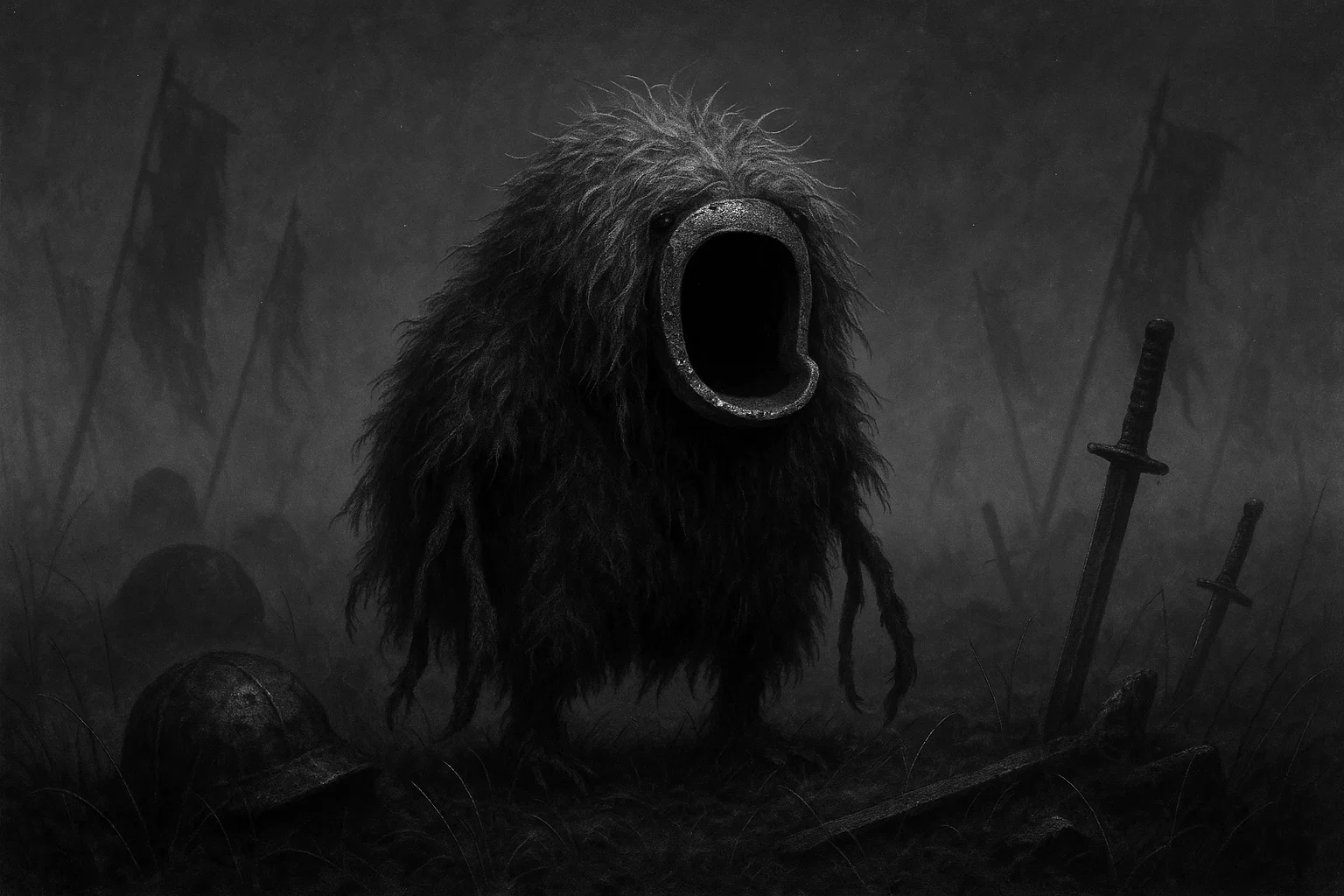
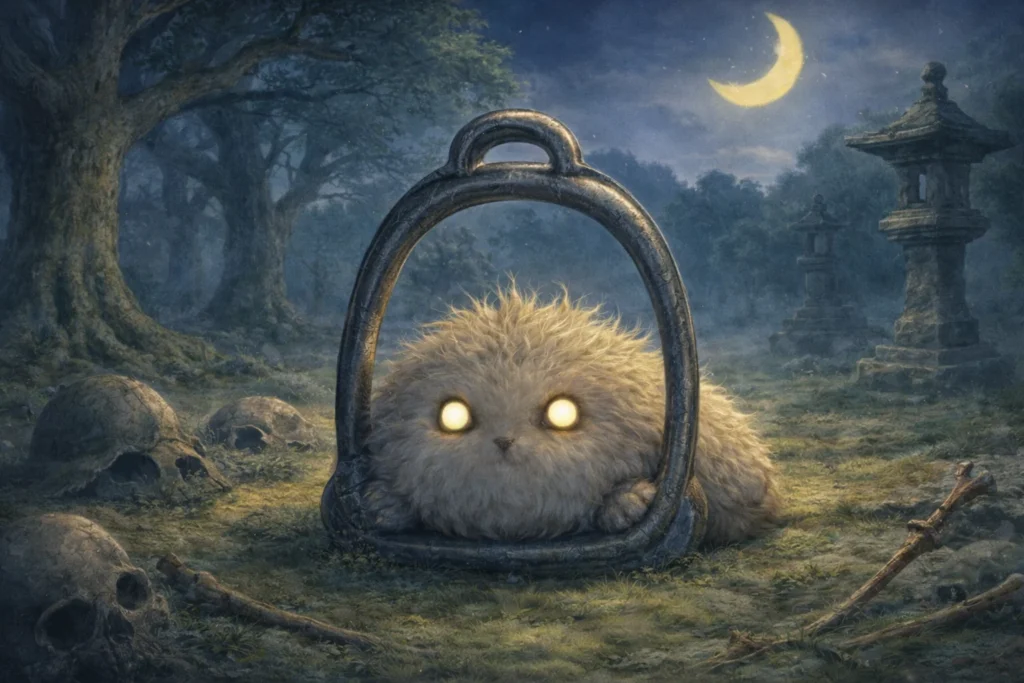
| Appearance | A furry, four-legged creature whose body is formed by a traditional Japanese stirrup, featuring a wide “mouth” and a coat of thick hair. |
| Kehai (Aura/Presence) | A feeling of heavy stillness; the faint, metallic scent of rusted iron and old leather; the rhythmic sound of a horse’s phantom gait. |
| Powers/Abilities | Sentience; limited locomotion; the ability to manifest in a furry form to wait for its master. |
| Methods of Pacification | Proper burial or ritual purification of the remains of the soldier; returning the stirrup to a shrine or family altar. |
| Habitat | Ancient battlefields, overgrown plains, or abandoned armories. |
| Diet/Prey | Does not consume food; it feeds on the hope of its master’s return. |
| Symbolic Item | The stirrup (abumi) itself. |
| Symbolism | The tragedy of war, unrequited loyalty, and the lingering attachment of inanimate objects. |
| Associated Kami | None specifically, though it is indirectly linked to Hachiman (God of War) through its martial context. |
| Sources | Gazu Hyakki Tsurezure Bukuro (The Illustrated Bag of One Hundred Random Demons) by Toriyama Sekien. |
The Fundamental Identity of Abumi-guchi
The Abumi-guchi is a special type of tsukumogami, or “tool spirit,” that comes from a traditional Japanese military stirrup (abumi). Unlike aggressive spirits that haunt homes to punish careless owners, this one is born of battlefield sadness. It usually forms from the stirrup of a mounted warrior who died in battle.
When the soldier falls, and the horse runs off or is also killed, the stirrup is left behind on the ground.
Because it is tied to lingering attachment, the Abumi-guchi is usually seen as harmless. Its main trait is waiting. It turns into a small, furry creature that looks like an odd dog or squatting animal, but its body remains shaped like an iron stirrup. It shows the ninjo (human feeling) or shonen (strong thought) of its former owner, remaining in the world because its purpose of supporting the rider was suddenly cut short.
Semantic Origins
The name Abumi-guchi comes from Japanese horse-riding terms. Abumi (鐙) means stirrup, which became very decorative during the Edo period. The ending kuchi or guchi (口) means “mouth.” Literally, this is the opening where the boot goes, but in folklore, it is seen as the spirit’s real mouth.
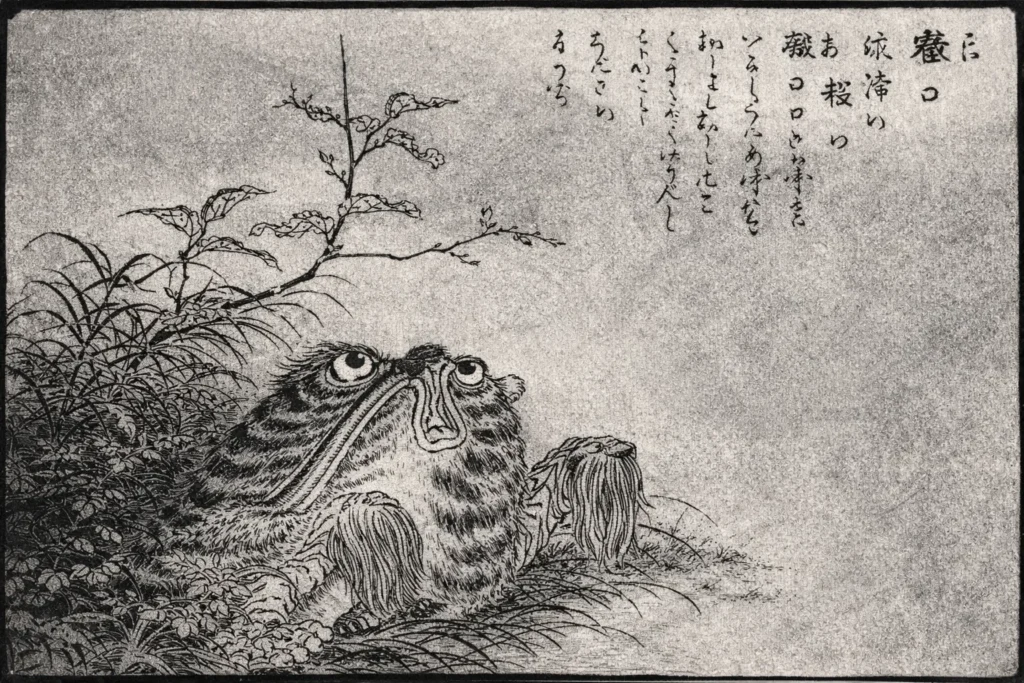
Historical records, especially those by Toriyama Sekien, show that the name is a pun. In his 1784 book, Gazu Hyakki Tsurezure Bukuro, Sekien connected the spirit to a poem about a man waiting for his lover, using the stirrup as a symbol of endless patience.
Over time, the word changed from a technical term to the name of a supernatural being as tsukumogami became popular in city folklore. The “mouth” of the stirrup became the “voice” of forgotten history.
How to Pronounce “Abumi-guchi” in English
The name is pronounced ah-boo-mee-goo-chee. Say “ah” as in “father,” “boo” like the word “boo,” “mee” like “me,” “goo“ rhymes with “too,” and “chee” as in “cheese.” Keep the stress even across all syllables.
What Does Abumi-guchi Look Like?
The Abumi-guchi has a unique look among tsukumogami, thanks to Toriyama Sekien’s drawings. It is small and compact, with a furry, animal-like body. Thick, dark fur covers it, making it look like a small dog or wild animal. Still, its skeleton is clearly a traditional Japanese stirrup.
The creature’s face is where the rider’s foot would go. The open front of the stirrup forms a wide mouth, usually without teeth or a tongue. Above the mouth, two eyes look out from the thick fur, often appearing sad and watchful. It usually has four short legs that let it move across the battlefield.
The metal parts of the stirrup, often made of iron and decorated with silver or lacquer from the Muromachi or Edo periods, make up the creature’s shell or back. This mix of hard iron and soft fur shows a tool trying to become alive.
You may also enjoy:
What Is the Abumi-guchi Yōkai and Why Does It Wait Forever?
October 22, 2025
Hitotsume kozō: One-Eyed Yōkai of Japanese Folklore
February 4, 2026
What Is a Dīv? The Terrifying Giant Demon of Persian Myth
January 22, 2026
Who Is the Jann in Islamic Mythology and Why Is He Feared?
October 2, 2025
Rāga: The Seductive Demon of Passion and Desire in Buddhist Lore
October 16, 2025
Who Is Adrammelech in Demonology and the Bible?
October 1, 2025
Origins and History
The Abumi-guchi emerged as a recognized entity during the late 18th century, a period when Japan was experiencing a massive cultural fascination with the supernatural.
While folklore about “transformed objects” had existed for centuries, the specific codification of the stirrup spirit is largely attributed to the artist Toriyama Sekien. The historical “trigger” for such a spirit is deeply tied to the Genpei War and subsequent feudal conflicts that left countless warriors dead in remote fields.
In the peaceful Edo period, memories of the violent Sengoku era still shaped people’s minds. As Japan became more urban, stories about abandoned war gear connected people to that past.
I think the Abumi-guchi reflects the survivor’s guilt felt by families of fallen samurai. It is also interesting that the first reports of this spirit appeared as artists began using tsukumogami to comment on the throwaway culture of the growing merchant class.
This spirit stands for a “broken promise.” A stirrup is useless without a rider, and in Japanese feudal times, the bond between a warrior and his gear was sacred. Leaving a stirrup behind was seen as a spiritual failure. The stirrup becomes a spirit not out of evil, but because it is left empty. It holds the martial spirit with nowhere to go after the soldier’s death.
Habitat
This spirit prefers places marked by stillness and old trauma. Most stories place it in the tall grass of old battlefields like Sekigahara or Musashino. These are places where fierce fighting once raged and where old gear may still lie hidden and forgotten.
People also say it haunts old, crumbling armories or the storage rooms of noble families who have lost their power. In these dark, dusty places, the spirit waits among armor and rusted swords. It likes to stay hidden and does not seek out people. It is drawn to places where life and death meet suddenly, preferring to remain in these quiet, forgotten spaces.
Famous Abumi-guchi Legends and Stories
The Stirrup of the Fallen Warrior
In the classical lore established by Toriyama Sekien in his 1784 treatise, Gazu Hyakki Tsurezure Bukuro, the narrative of this entity is inextricably linked to the aftermath of war. On the desolate plains of a former battlefield, where the grasses grow tall and the soil remains stained by history, a warrior was struck down during a chaotic cavalry charge.
As the horse ran away in fear, one of its stirrups broke off and was pressed into the mud. Over the years, the metal did not rust away. Instead, it absorbed the warrior’s strong, lasting thoughts in his last moments.
In time, the stirrup changed. It grew thick fur to protect itself from the cold dew of the plains and developed four small legs.
People say that on moonlit nights, travelers in the old battlefields of the Kantō region might see a small, animal-like figure sitting still in the middle of the path. It does not make a sound or run away. It just waits, its mouth open as if hoping for a boot that will never come.
The legend says the spirit is so focused on its purpose that it does not notice the passing years, staying in the same place where it last felt its rider.
The Haunted Tack
Another tradition associated with this creature stems from the poetic allusions used by Edo-period scholars to explain its existence. The story tells of a specific stirrup that belonged to a high-ranking commander.
After the commander perished, his equipment was gathered and stored in a dark, forgotten corner of a castle’s armory. While the swords and spears were periodically polished, the stirrups were dismissed as mere accessories and left to gather dust.
As time passed, the forgotten stirrup started to move. It was not angry like a ghost, but filled with deep sadness. Castle servants reported hearing something small and metal moving across the wooden beams at night, making a clinking sound. When a guard finally checked the storehouse with a lantern, he saw a strange, furry creature sitting on a saddle.
The creature had a stirrup-shaped face and a dog-like body. It did not attack, but looked at the guard with such longing that the guard felt sudden sadness. The story ends with the spirit searching the armory for the rest of its master’s armor, hoping to be whole again with the warrior it once served.
The Urban Legend of the Crimson Field
In more recent folk tradition, particularly those influenced by the ghost stories of the Meiji era, the entity is said to appear near “dead spots” in the landscape—areas where nature refuses to reclaim the land. A local legend from the outskirts of old Kyoto speaks of a small patch of earth where the grass always grows in a circular pattern, as if stepped upon by a heavy hoof.
Local children were told never to step into the center of the circle after dark. People whispered that the “Stirrup-mouth” lived there, unseen by day but real at night.
Unlike noisy household spirits, this one was called a “thief of time.” Anyone who saw the furry stirrup and felt sorry for it would be unable to leave, trapped in endless waiting. They might think only minutes had passed, but hours would go by, their sense of purpose drained by the spirit’s lonely obsession.
How the Stirrup-Mouth Personifies Post-War Abandonment
In my research on the change from the Heian to the Edo period, I found that the Abumi-guchi reflects the fading role of the warrior class. While many tsukumogami are shown as playful household items, like singing sandals or dancing umbrellas, this spirit is different because it comes from the broken ties of the battlefield.
What stands out to me is that this spirit does not show anger from being neglected, but sadness from being unneeded. In a society where a samurai’s gear was seen as part of his soul, seeing a stirrup transform into a creature hints at a deep concern about the waste of human and material potential after Japan became peaceful in the Edo era.
I believe the spirit’s mix of iron and fur shows the “domestication of violence.” The iron stirrup, once a weapon of war, tries to become alive by growing fur, much like a loyal dog.
This change from a hard tool to a soft, waiting creature matches the Edo-period trend in yōkai art. Monsters were no longer just vague signs of disaster; they became specific, sad figures that expressed mono no aware (the pathos of things). The Abumi-guchi does not harm the body, but touches the heart, reminding us of people and things left behind by history.
I also found in early glossaries and Sekien’s notes that the spirit may come from the stirrup of a soldier who was shot in the leg, trapping his limb to the saddle as he fell. This detail adds a sense of horror, as the spirit becomes a witness to the moment when a person and his tool were joined by violence.
By telling the story of a stirrup that will not “die” but becomes a guardian of memory, mythologists may have been quietly criticizing a world that valued new things over loyalty. The spirit acts as a “necessary evil” of memory, haunting battlefields not to punish the living, but to make sure the memory of the fallen is never forgotten.
You may also enjoy:
What Is Akaname, The Filth-Licking Yōkai?
October 28, 2025
Who Is Ariton (Egyn), the Infernal King of the Eastern Gate?
February 17, 2026
Ancient Demons: The Real Origins of the Setcheh Myth
November 11, 2025
What Is a Tengu? Origins, Powers, and Dark Folklore
January 29, 2026
Abumi-guchi Powers and Abilities
The Abumi-guchi is not one of the strongest yōkai. Its power comes from its persistence and toughness. Made of iron, it is hard to damage, but its supernatural effect is gentle, changing the mood around it rather than harming people.
- Sentience: The ability to think and feel, specifically centered around the concepts of loyalty and waiting.
- Movement: Despite its mechanical origins, it can move autonomously using its four furry limbs.
- Atmospheric Influence: Its presence creates a “Kehai” of sadness and heavy stillness, leaving travelers feeling profound melancholy.
- Invisibility to the Indifferent: It is often said that only those who respect the martial arts or those who are themselves grieving can see the entity clearly; to others, it appears as a mere rusted scrap of metal.
Traditional Defenses Against Abumi-guchi
Because the Abumi-guchi is a non-aggressive spirit, “defending” oneself is rarely a matter of life and death. Instead, the goal is typically to pacify the spirit so it may move on from its state of limbo.
- Ritual Cleaning: As with many tsukumogami, cleaning and restoring the object to its proper function can sometimes appease the spirit.
- Buddhist Prayers: Reciting sutras for the “rest of the tools” (kuyo) is a common practice. This acknowledges the service the object provided and allows its energy to dissipate.
- Returning to the Grave: If the owner’s grave is known, bringing the stirrup to the site and burying it alongside the warrior is the most effective way to end its vigil.
- Salt and Purification: If the spirit’s presence becomes too heavy or depressing, scattering sacred salt (mori-shio) can create a barrier that the spirit will not cross, as it dislikes the “purity” that conflicts with its battlefield origins.
Abumi-guchi vs Similar Spirits
| Name | Category | Origin | Threat Level | Escape Difficulty |
| Bake-zōri | Tsukumogami | Discarded straw sandal | Low | Easy; just ignore its singing. |
| Karakasa-obake | Tsukumogami | Old paper umbrella | Low | Easy; it is mostly just a prankster. |
| Morinji-no-okama | Tsukumogami | Possessed tea kettle | Medium | Moderate; it can be heavy and stubborn. |
| Chōchin-obake | Tsukumogami | Old paper lantern | Low | Easy; it only seeks to startle. |
| Koto-furunushi | Tsukumogami | Ignored koto (harp) | Low | Easy; it only plays music in empty rooms. |
| Biwa-bokuboku | Tsukumogami | Lute with a life of its own | Low | Easy; it behaves like a wandering priest. |
| Ungaikyō | Tsukumogami | Possessed mirror | High | Hard; it can trap souls in the reflection. |
| Ittan-momen | Tsukumogami | Roll of flying cotton | High | Very Hard; it attempts to strangle victims. |
| Zorigami | Tsukumogami | Clocks or timing tools | Medium | Moderate; it causes confusion of time. |
| Bura-bura | Tsukumogami | Old paper lantern (burning) | Medium | Moderate; poses a fire hazard. |
| Kameosa | Tsukumogami | Old sake jar | None | N/A; it produces infinite liquid. |
Symbolism
| Attribute | Details |
| Element | Metal (Iron). |
| Animal | Dog (based on its small, furry, four-legged form). |
| Cardinal Direction | West (associated with the Pure Land and the direction of the setting sun/death). |
| Color | Rusty brown and black. |
| Plant | Susuki (Silver grass), which grows on abandoned battlefields. |
| Season | Autumn (the season of decline and memory). |
| Symbolic Item | The stirrup (abumi). |
In Japanese culture, the Abumi-guchi symbolizes the sadness of unacknowledged service. It shows mono no aware (the pathos of things)—an awareness that everything passes and a gentle sadness about it.
While many yōkai are seen as external dangers, like storms or wild animals, this spirit embodies the fear of being forgotten after giving everything for a cause.
In art and stories, the Abumi-guchi reminds us that weapons are not just for fighting, but are part of a warrior’s identity. This spirit adds a gentle example to yōkai legends, showing that objects with feelings are not always harmful. It is still popular in modern media, often used to create a sense of nostalgia or quiet eeriness in tales about the samurai era.
You may also enjoy:
Erinyes: The Chthonic Goddesses Who Enforced Blood-Guilt
November 20, 2025
Andhaka: The Blind Demon Born From Cosmic Darkness
February 6, 2026
What Is Akaname, The Filth-Licking Yōkai?
October 28, 2025
Bakeneko: A Supernatural Cat Yōkai in Japanese Folklore
January 27, 2026
What Is the Akkorokamui, Japan’s Colossal Sea Monster?
November 14, 2025
Mara: The Buddhist Demon King of Desire and Death
October 13, 2025
Bibliography
Author’s Note: In my article, I compared Toriyama Sekien’s playful art with the serious martial values in the Hōgen Monogatari to look past the idea of the creature as just a “funny” monster. By studying the poetic images in the Shūi Wakashū and the physical details in the Wakan Sansai Zue, I saw that this spirit stands at the crossroads of literary sadness and physical horror. I also focused on early Edo and medieval sources rather than modern views to show that Abumi-guchi is truly a guardian of post-war loss, not just a household ghost.
- Davisson, Zack. (2026). The Persistence of Yōkai. Education About Asia. 29. 10.65959/eaa.1847. ResearchGate.
- Cucinelli, Diego. Windows Onto The Supernatural In The Second Half Of The Edo Period: From The Gazu Hyakki Yagyō (1776) By Toriyama Sekien To The E-Hon Hyaku Monogatari (1841) By Takehara Shunsen. Ming Qing Studies 2015, 2015. Academia.edu.
- Marks, Andreas. Japanese Yōkai and Other Supernatural Beings: Authentic Paintings and Prints of 100 Ghosts, Demons, Monsters, and Magicians. Tuttle Publishing, 2023.
- Wilson, William R., translator. Hōgen Monogatari: Tale of the Disorder in Hōgen. Cornell University East Asia Program, 2001. Cornell East Asia Series 99. Internet Archive.
- Kelsey, W. Michael. Konjaku Monogatari-shū. Twayne Publishers, 1982. Twayne’s World Authors Series 621. Internet Archive.
- Aston, W. G., translator. Nihongi: Chronicles of Japan from the Earliest Times to A.D. 697. Kegan Paul, Trench, Trübner & Co., 1896. Internet Archive.
- Terajima, Ryōan. Wakan Sansai Zue. 1712. Internet Archive.
- Bradt, Aaron. The Role of Yokai in Japanese Myth. 2016. Academia.edu.
- Hirota, Ryuhei. (2022). Traversing the Natural, Supernatural, and Paranormal: Yōkai in Postwar Japan. Japanese Journal of Religious Studies. 48. 321-339. 10.18874/jjrs.48.2.2021.321-339. ResearchGate.