Most fallen beings are known for their ancient rebellion, but Abezethibou is a rare political antagonist in demonology. His actions are closely tied to the fate of a human empire. Instead of being seen as a tempter, he is portrayed as a spirit who hardens nations, and the Testament of Solomon credits him with strengthening Pharaoh’s resistance during the Exodus. Looking at his imprisonment beneath the Red Sea helps us see him not as a generic evil figure, but as a demon focused on statecraft—an angel who fell during a specific historical conflict between divine will and human power.
This article compares the Testament of Solomon with earlier fragments of the Exodus story to show the differences between original Solomonic traditions and modern occult interpretations of the demon Abezethibou.] [View Full Bibliography ↓
Summary
Key Takeaways
| Attribute | Details |
|---|---|
| Names | Abezethibou, Abezethibod, Abezi-Thibod, Abez, Abezi |
| Title | Prince of Hell, Demon of the Red Sea, Warden of Tartarus, Spirit of Hardened Hearts |
| Gender | Male |
| Role | Tempter who hardens hearts against divine will; provider of forbidden magic to oppose prophets; controller of imprisoned souls in the abyss; inciter of pursuit and destruction |
| Hierarchy | Prince under the Seven Princes of Hell; advisor and strategist to Beelzebub; member of the Stygian Council |
| Servitors | Twelve lesser demons (eight named: unspecified in primary texts) |
| Superior Demon | Beelzebub (father and lord) |
| Powers | Performs signs, wonders, and miracles superior to human prophets; grants magical abilities to summoners; manipulates thoughts to lead astray; controls winds over the Red Sea; hardens hearts to foster rebellion and cruelty |
| Appearance | One red wing (torn from the other during fall); charred, mutated skin; angelic form twisted into demonic shape with blood-red remnants |
| Etymology | Hebrew origins, possibly “Father Devoid of Council,” implying foolish rebellion or separation from wisdom |
| Associated Figures | Beelzebub (father); Ephippas (ally in release); Jannes and Jambres (summoners); Moses (adversary); Pharaoh (influenced victim); Ornias, Asmodeus (fellow demons in Solomon’s bindings) |
| Weaknesses | Bound by divine rings and names like those on Solomon’s seal; trapped by holy waters and pillars; repelled by archangels like Michael and Azrael; frustrated by prayers invoking God’s authority |
| Opposing Angel/Saint | Archangel Michael (bestower of binding ring); Archangel Azrael (drowner in Red Sea); Archangel Uriel (ruler of Tartarus in some lore) |
| Pantheon | Judaic-Christian, with Egyptian influences from the Exodus events |
| Legions | None (focuses on personal dominion over Tartarus souls rather than commanding legions) |
| Element | Water (imprisoned in the Red Sea; controls sea winds) |
| Planet/Zodiac | Mars/Pluto; Scorpio (intensity, transformation, depths of psyche) |
| Color(s) | Blood red (wing and fury); black (shadowy form) |
| Number(s) | 12 (servitors); 7 (under Seven Princes) |
| Crystal(s)/Mineral(s) | Modern occult links the demon to obsidian (for abyss gazing) or red jasper (blood ties) |
| Primary Sources | Testament of Solomon (pseudepigrapha); Old Testament Pseudepigrapha (Charlesworth ed.); Dictionnaire Infernal (Collin de Plancy); Encyclopedia of Demons and Demonology (Guiley); Black Witch Coven grimoires |
“Abezethibou” Meaning
The name “Abezethibou” is connected to ideas of rebellion and lost wisdom. It likely comes from “Abeze,” meaning a fatherly or foundational force, and “Thibou,” which suggests separation or emptiness. Some interpret the name as “Father Devoid of Council,” highlighting the mistake of ignoring divine advice.
This meaning shows Abezethibou as someone cut off from heavenly guidance, left alone in his pride. The harsh sounds in his name, ab-ez-eth-i-bou, are said to echo the tearing of wings, hinting at his fall. Researchers often link the name to Semitic roots, in which names often convey moral lessons. Abezethibou’s story warns against ignoring good advice.
The name “Abezethibou” likely comes from Semitic roots, combining “ab” (father), “zeth” (without), and “ibou” (counsel or assembly). This fits with Jewish ideas of fallen beings as those who reject advice.
Over time, the name appears in different forms. In Greek texts like the Testament of Solomon, it is shortened to “Abezi” for invocation. Latin grimoires change it to “Abezethibod,” adding a suffix to highlight his changed form.
Symbolically, Abezethibou represents moral corruption caused by turning away from wisdom. As “Father Devoid of Council,” he represents pride that breaks the connection with God, as Pharaoh did when to refused to listen.
In Christian tradition, his story becomes a warning against pride. The emptiness in his name suggests a throne in Hell that has power but no real purpose.
How to Pronounce “Abezethibou” in English
To pronounce Abezethibou in English, say it as Ah-bez-eth-ih-boo, with the main stress on “eth.” The “A” is like in “father,” “bez” rhymes with “fez,” “eth” sounds like “beth” with a soft “th,” “ih” as in “bit,” and “boo” like the word for a ghost sound.
Some people pronounce it as Ah-buh-zee-thih-bow, but the usual way keeps the hard “z” and smooth vowels.
What Does Abezethibou Look Like?
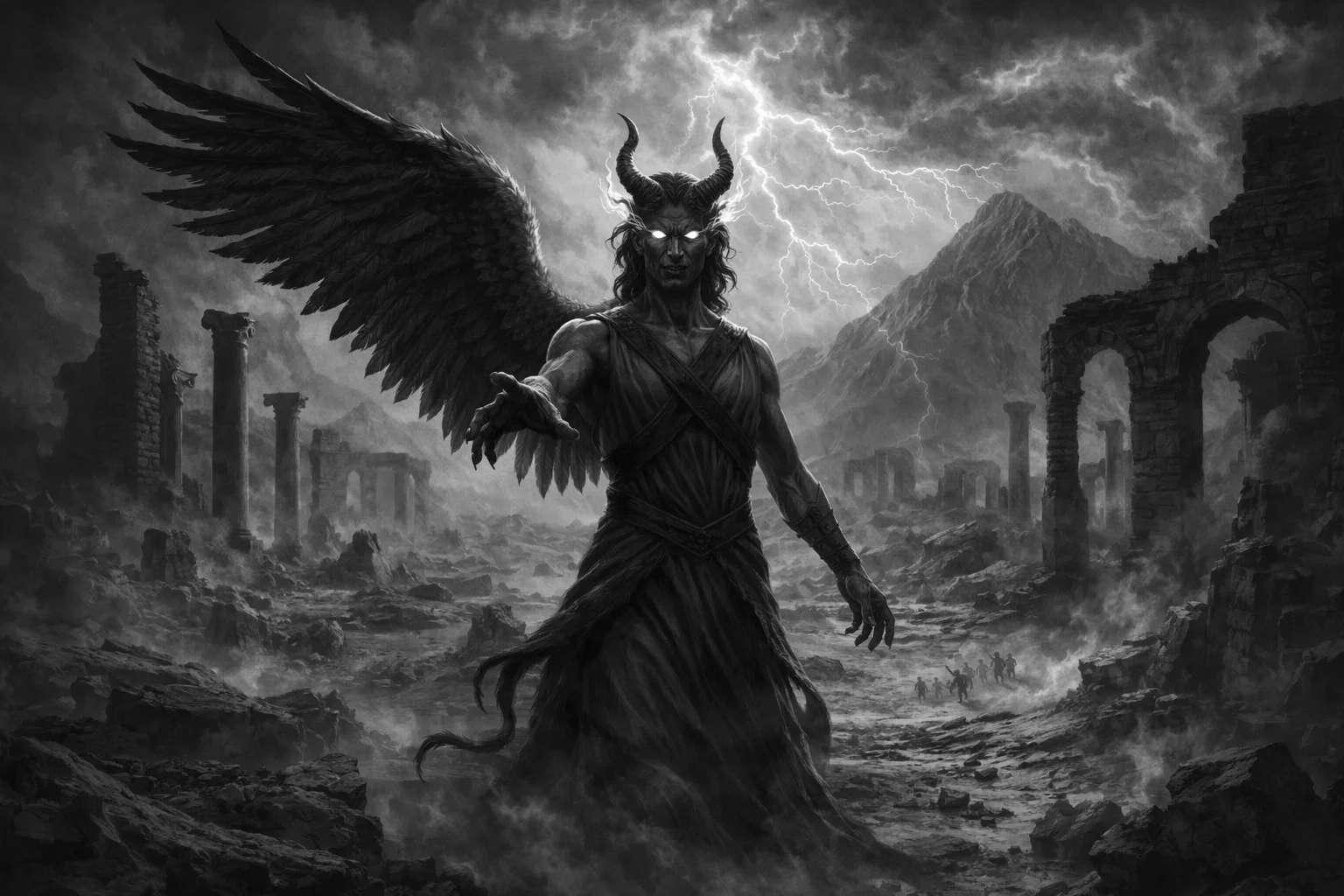
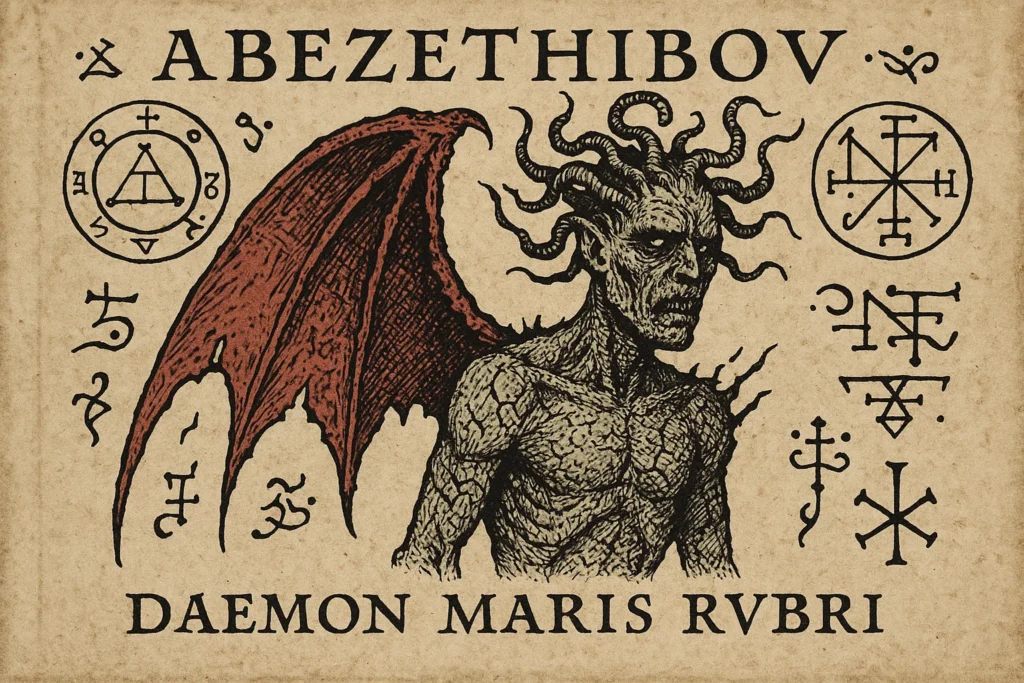
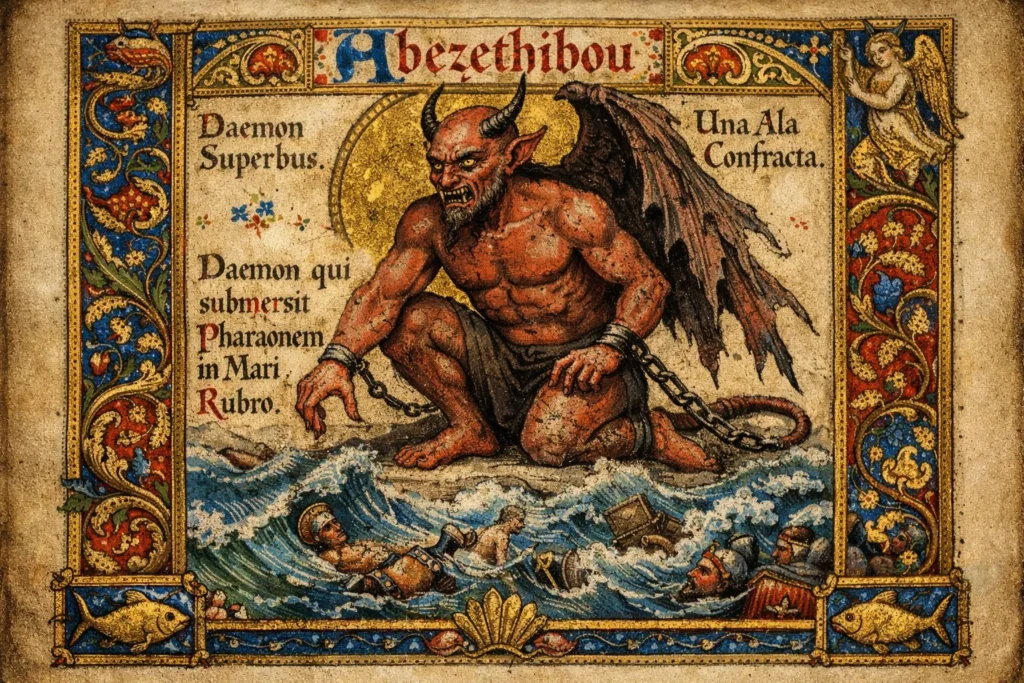
Abezethibou is shown as an uneven monster, mixing angelic and demonic features. In the Testament of Solomon, he is a one-winged being whose blood-red wing was torn off during his fall, leaving him with burned, twisted skin. This half-angel, half-demon look makes him both fascinating and frightening.
He has a greenish face and messy hair that looks like snakes, showing envy and a sense of being trapped. Covered in darkness, he represents his rule over the prisoners of Tartarus. When called on, he acts like a creature of the night, with eyes full of pride. Some images show him with insect-like limbs, while others depict him as mostly human, with a red wing that drips ichor.
The single wing symbolizes his failed rebellion and his exile in Hell. Old drawings often show him in black and white, highlighting his twisted form. Byzantine art sometimes shows him chained under pillars, warning about the dangers of losing one’s way.
Origins
Abezethibou’s story begins in ancient Near Eastern myths, where rebellious angels clashed with the rise of belief in one God.
The earliest references to Abezethibou are found in texts such as the Testament of Solomon, a Greek work from the 1st to 4th centuries that blends Jewish stories with Hellenistic magic. In these stories, he is not a creature of chaos but a top angel from the first Heaven, Amelouth, who joins Beelzebub in the War in Heaven.
During this great revolt, described in Isaiah 14 and Revelation 12, Abezethibou is attacked as he falls, with loyal angels tearing off his wing. This idea is similar to Mesopotamian stories about the Igigi, the angels who rebelled against Enki.
Some stories say he was born from Beelzebub and Naamah, a succubus, to be used as a weapon against Heaven. His existence is part of larger infernal plans.
Egyptian myths connect him to Set, the God of chaos, who killed Osiris and caused storms. This links to Abezethibou’s control over wind and his opposition to figures like Moses.
In the Hellenistic period, Abezethibou became part of Solomonic magic. His name was changed to sound like “abyssos,” connecting him to the Greek underworld, Tartarus, as a keeper of souls. Stories of him consuming angelic energy in battle are similar to Babylonian myths, where gods gain power by defeating others.
Origen (one of the early Church Fathers) hints in his work Contra Celsum at powerful entities called the “fallen watchers”, grouping Abezethibou and others with the Grigori, who corrupt humanity through forbidden arts—much like their aid to Jannes and Jambres. Medieval grimoires, such as the Grand Grimoire, raise him to Hell’s strategist, advisor to Beelzebub amid the Seven Princes’ court.
In Pseudomonarchia Daemonum (1577), Johann Weyer classifies him loosely under the category of gluttony princes, tying his hunger for Tartarus souls to Beelzebub’s fly-swarm. This evolution reflects Christianity’s assimilation: Jewish exodus adversary becomes universal tempter, his prison a baptismal inversion.
Abezethibou in Grimoires and Other Texts
Although Abezethibou is not named in the Bible, he appears in occult texts, where he is portrayed as more threatening through stories of magical bindings and demon rankings.
For example, Collin de Plancy’s Dictionnaire Infernal (1818) describes him as a demon who stirs up winds over the Red Sea and connects him with Kabbalistic watcher spirits.
Another example is The Grand Grimoire, a 19th-century French book, where Abezethibou is shown as a master of demonic deals, and people call on him for magical feats.
| Source | Quote |
|---|---|
| Testament of Solomon (Beelzebub’s confession) | And the other engine, which I have, is Abezethibou, who accompanied me from the beginning. He it is who is in the Red Sea, drowned with the Egyptians. And he will come up in conquest against the body of Christ, when he is ready. |
| Testament of Solomon (Abezethibou‘s speech) | I am Abezethibou, and I sit in the first heaven, which is called Amelouth. I was sent to oppose Moses in the signs wrought by him. I hardened Pharaoh’s heart. I am he who fought against thee, O Solomon, with signs and wonders. |
You may also enjoy:
Iblis, the Jinn King of Darkness and Deception
September 29, 2025
Kuchisake-onna: Folklore, Origins, and Urban Legend History
February 10, 2026
Who Was Abezethibou, the Fallen Angel Who Opposed Moses?
October 1, 2025
Who Is Ariton (Egyn), the Infernal King of the Eastern Gate?
February 17, 2026
Aim (Aym): The Great Duke of Hell in the Ars Goetia
November 11, 2025
Who Is Al-Abyad? The White King Jinn Who Rules Love and Chaos
January 26, 2026
Powers and Abilities
Abezethibou has many dark powers, all used to create chaos and oppose the divine. These abilities come from his angelic origins but have been turned into tools for temptation and destruction:
- Heart-Hardening Influence: He manipulates wills to encourage stubborn cruelty, as seen in the stiffening of the Pharaoh’s resolve against mercy.
- Bestowal of Magic and Wonders: Grants summoners signs, miracles, and sorcery surpassing prophets; aided Jannes and Jambres in Exodus duels, but was overpowered by God’s superior might.
- Leading Astray: He subtly influences people’s thoughts to encourage pride and rebellion, pulling those who are unsure away from doing what is right.
- Wind and Sea Control: He can control winds over the Red Sea, creating storms and helping with pursuits.
- Dominion over Tartarus Souls: He rules over the souls trapped in the abyss and feeds on their suffering, which keeps his hunger going.
- Signs and Adversarial Deeds: He performs tricks and false miracles to mock divine acts.
Abezethibou Myths, Legends, and Stories
Stories about Abezethibou often focus on his fall, his binding, and his quest for revenge. These tales come from Solomonic texts and are repeated in demonology books.
The Fall from Amelouth
Amelouth, the first Heaven, was a wonderful place. There, Abezethibou was a trusted and powerful seraph, his wings pristine and his eyes always fixed on celestial glories.
But trouble began when Beelzebub led a rebellion against God. Abezethibou was one of the angels who joined him. He promised to follow Beelzebub, filled with pride at the idea of having freedom and power.
When war broke out, the rebel angels rushed down from Heaven, breaking through its gates. Abezethibou fought hard, taking energy from fallen angels to make himself stronger as the battle raged.
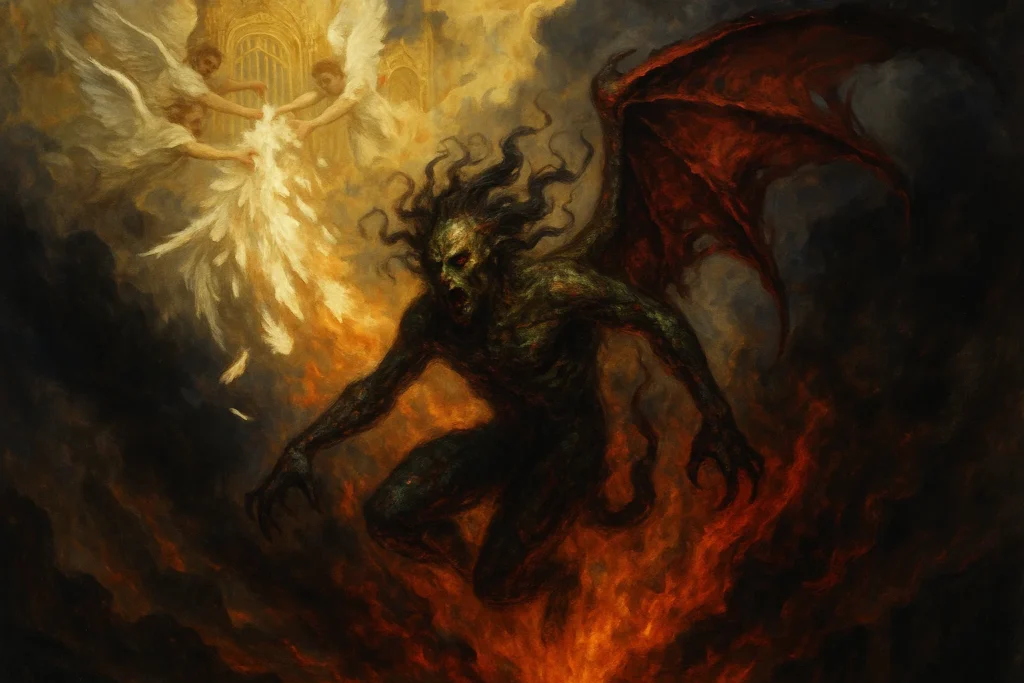
After a long fight, the loyal angels, led by Michael, caught up with the rebels. They attacked Abezethibou, grabbing his left wing and trying to pull him back. He struggled until his wing tore off, and feathers scattered everywhere.
He fell, his torn wing turning to ash, and his other wing burned red from divine fire. Hurt and changed, he landed in Hell, where Beelzebub gave him a throne instead of comfort.
In Hell, surrounded by suffering, Abezethibou held onto his anger and promised to seek revenge.
Summoning by Jannes and Jambres Against Moses
In the court of the Pharaoh, two chief sorcerers, Jannes and Jambres, engaged in occult practices amid a setting filled with incense and snake-like imagery. They confronted Moses, who arrived with a rod that transformed into a snake, challenging their magical capabilities. In response, Jannes and Jambres traced complex circles in the sand while reciting names from forbidden texts, attempting to invoke their own form of magic.
During their incantations, a demon named Abezethibou appeared from the ether, manifesting as a being of immense power. He asked the sorcerers about their intentions, and they expressed a desire for power rivaling that to the God of the Hebrews.
Abezethibou, filled with pride and confidence in his superiority over divine figures, agreed to assist them. He augmented their magic, allowing them to transform rods into serpents, turn water into blood, and summon swarms of frogs to fortify their claims. These miraculous feats initially dazzled the court, causing Pharaoh to doubt Moses’ authority.
However, as the plagues intensified—devouring locusts and killing the firstborn—Abezethibou’s power began to wane under the strength of Moses’ divine influence. The demon eventually retreated, frustrated and weakened, proclaiming that the failure of Jannes and Jambres would haunt him, binding him in a cycle of insatiable desire for vengeance against the Hebrew God and his prophet.
Conflict with Angels in Egypt
During his journey through Egypt, Abezethibou encountered Dumah (the angelic guardian associated with silence and death), who was tasked with overseeing the land.
Abezethibou tempted Dumah and weakened his resolve, leading him to descend to chaos and ignore his responsibilities. This led to trouble in Egypt, with plagues and growing unrest among the people.
As things got worse, Azrael, the Angel of Death, stepped in. He faced Abezethibou by the Nile, and they fought. Abezethibou tried to defend himself with storms and tricks. Still, Azrael used his scythe to break through and pushed Abezethibou toward the Red Sea.
Abezethibou Faces Moses
After his fall, Abezethibou wandered the deserts of Egypt, hiding near the pyramids with his red wing dragging behind him. This was when Moses came to Pharaoh to ask for his people’s freedom.
According to the story, the Pharaoh initially agreed to grant Moses’s request. But Abezethibou hissed in his royal ears: “Why yield to slaves?”
Because of Abezethibou’s influence, the Pharaoh decided not to let the Israelites go and ordered them to be held more tightly. As the Israelites escaped through the parted sea, Abezethibou encouraged the Egyptians to chase after them, using his power over the wind to speed up their chariots. He led the charge, urging the soldiers on and promising them victory.
But when the army entered the sea, divine punishment struck both them and Abezethibou. The waters closed in, drowning the Egyptians.
Although he drowned, Abezethibou did not die. He remained trapped, promising to return for revenge when the time was right.
The Architect of Bureaucratic Hardening
Most stories about the Exodus highlight its miracles, but the Testament of Solomon’s focus on Abezethibou shows an early and complex idea of ‘Statecraft as Sorcery.’
Unlike other fallen angels who encourage sin or heresy, Abezethibou works through the heart of administration. His claim that he “hardened Pharaoh’s heart” suggests he represents the stubbornness of institutions and the pride of empires.
Seen this way, Abezethibou is more than a tempter. He stands for the ‘Echo Chamber,’ where power becomes so self-absorbed that it cannot see what is happening around it. This blindness can lead to the downfall of the state, both in reality and as a symbol.
This ‘national hardening’ relates to the Egyptian idea of Isfet, meaning chaos or injustice, as the opposite of Ma’at, meaning order or truth. The Pharaoh was supposed to protect Ma’at, but Abezethibou’s actions show how this duty can be overturned.
By joining with the Egyptian sorcerers Jannes and Jambres, Abezethibou becomes a spirit of ‘Competitive Magic.’ He values showing earthly power over seeking higher truth. This makes him more than just an enemy; he becomes a symbol of political downfall, showing how an empire’s own ways can lead to its end.
Abezethibou’s unusual fate, trapped under the Red Sea by a pillar of cloud, is a strong symbol of ‘Suspended Judgment.’ While most demons in the Solomonic tradition are either free in the air or locked away in the abyss, Abezethibou is stuck in between, held in a specific place.
This points to a missing piece in theology about local evil. Abezethibou is the ‘Ghost of the Empire,’ showing that the forces behind Egypt’s defiance are not gone, just hidden. His return at the end of time to ‘be led into the place of the foundation’ suggests that history repeats itself, and the state’s pride will have to be faced and released.
You may also enjoy:
Who Is Ahriman, and Why Is He Pure Evil Incarnate?
January 8, 2026
Who Is Aka Manto, Japan’s Terrifying Red-Cloaked Yōkai?
October 24, 2025
Who Is Shiva, the Destroyer and the Lord of the Universe?
November 12, 2025
Andhaka: The Blind Demon Born From Cosmic Darkness
February 6, 2026
Who Is Futakuchi-onna, the Two-Mouthed Woman?
March 9, 2026
Abezethibou vs Other Similar Demonic Entities
| Demon Name | Associated Sin/Temptation | Rank/Origin | Key Traits/Powers |
|---|---|---|---|
| Asmodeus | Lust and wrath | King; Book of Tobit, Ars Goetia | Commands 72 legions; slays husbands, induces rage; bound by fish gall and prayers |
| Belial | Lawlessness and worthlessness | Prince; Dead Sea Scrolls, Testament of Solomon | Deceitful advisor; corrupts leaders; invisible influences, repelled by divine names |
| Lilith | Envy and infant mortality | Night hag; Jewish folklore, Alphabet of Ben Sira | Strangles newborns; shape-shifts to seductress; warded by amulets and angels |
| Ahriman | Pride and destruction | Supreme evil; Zoroastrian Avesta | Opposes light; spreads lies and decay; countered by Ahura Mazda’s fire |
| Mastema | Testing faith through trials | Prince of evil; Book of Jubilees | Incites sin in elect; requests demon hordes; limited by God’s mercy post-flood |
| Samael | Poison of God, accusation | Accuser; Talmud, Apocalypse of Moses | Venomous tempter; rides serpent; blinded by holy oil in some rites |
| Azazel | Rebellion and scapegoating | Fallen watcher; Leviticus, Book of Enoch | Teaches forbidden weapons; exiled to desert; atoned via Yom Kippur rites |
| Pazuzu | Winds and plague | King of winds; Mesopotamian exorcism tablets | Brings famine storms; protects against kin; clay figurines repel his gales |
| Abaddon | Destruction and locusts | Angel of the Abyss; Revelation 9 | Unleashes plagues; bottomless pit lord; sealed by trumpets’ woe |
| Ornias | Theft and vitality drain | Vampire spirit; Testament of Solomon | Sucks life via thumbs; shape-shifts; bound by Solomon’s ring to labor |
| Ephippas | Desert tempests | Wind demon; Testament of Solomon | Raises pillars; aids pursuits; yoked eternally to abyssal kin |
| Abyzou | Miscarriages from envy | Infertile hag; Late antique amulets | Causes child loss; legless wanderer; iron rings and chants dismiss her |
| Agrat bat Mahlat | Seduction and magic | Succubus queen; Jewish demonology | Rules Lilith’s dance; spreads illness; midnight flights halted by rooster crows |
| Naamah | Fornication and music | Seductress; Genesis midrash | Lures with harps; forges metals; averted by Sabbath lamps |
| Obyzuth | Strangling newborns | Child-killer; Testament of Solomon | Legless, wild-haired; envies mothers; Solomon’s chain binds her wildness |
Rank in the Hierarchy of Hell
Abezethibou has a unique place in Hell’s hierarchy. He is a prince among the Seven Princes and works closely with Beelzebub. Unlike other demon leaders, he does not command armies but is in charge of many damned souls.
The demon is known as a skilled planner and participates in Hell’s councils, advising leaders such as Lucifer. Because he is the child of Beelzebub and Naamah, he has a place at the Stygian Council. He helps plan invasions and acts of corruption.
His relationships are important to his position. His link to Beelzebub forms a complicated partnership, and his change toward insect-like traits shows his personal struggles.
Abezethibou is not as powerful as Lucifer but is stronger than lesser demons like Ornias. He controls fallen watchers and expects tribute from the Grigori. He has made deals with wind spirits like Ephippas and plans to take revenge on Michael’s angels, who have hurt him before.
Associations
Abezethibou is linked to the calm but tricky nature of water and is often shown trapped among the pillars of the Red Sea.
In astrology, Abezethibou is connected to Scorpio and influenced by Mars and Pluto, which give him changing and dangerous traits. He uses the elements to tempt others, with sea winds pushing people’s ambitions and the deep waters holding onto old grudges.
In numerology, Abezethibou is linked to 12 helpers, matching the zodiac’s cycles, and to the 7 princes, which symbolize complete sin.
His main colors are blood-red and black, which are used by occultists who want to call on his trickery.
Zodiac and Astrological Links
Abezethibou is associated with the sign of Scorpio (and the months of October to November), symbolized by the scorpion, which is ruled by Mars, signifying aggressive action, and Pluto, representing deep psychological exploration.
Scorpio’s fixed nature reflects Abezethibou’s pride. This trait has contributed to his ambitions and rebellions against divine order, especially in his conflicts with angelic beings such as Uriel.
Additionally, Pluto’s life-changing power relates to his role as a warden in Hell, where cycles of destruction and renewal operate through malicious intent. Horary astrology indicates that his influence peaks during Scorpio moons, making these times suitable for spells either of deception or rebellion.
Elements
Abezethibou is primarily associated with the element of water, which reflects his connection to the Red Sea and symbolizes his prison-like throne. He can summon floods or control water currents, highlighting a duality in which freedom is both a lure and a trap for others, much as the Egyptian chariots’ fate.
In grimoires, the flow of water is noted to counterbalance his winds, intensifying emotional manipulations that can drown rational thought. Water’s adaptability reflects its transformation from a heavenly seraph to an abyssal guardian.
Colors, Numbers, and Crystals
Abezethibou’s color symbolism is dominated by blood-red, representing rage and loss, making it ideal for rites centered on envy and betrayal. This shade evokes the imagery of ichor spilled from celestial wounds, symbolizing tragic falls and unending fury. It is often used in talismans intended to channel hardening influences. Black is another significant color, reflecting the voids of Hell and serving well for invisibility spells or materials that bind the soul.
His numerological significance includes the number 12, symbolizing the cyclical nature of sin; the solitary 1, representing isolated pride; and the number 7, which connects to the structured completeness of evil in Hell.
Crystals associated with him include red jasper and bloodstone, both of which symbolize his ichor and are used in talismans to improve resolve. Obsidian offers insights into its abyssal nature but can shatter under holy light, indicating vulnerabilities.
Rubies boost anger, aligning with Mars and aiding in combat-related incantations. At the same time, bloodstone serves to mimic the consumption of essence. Black tourmaline provides grounding and protection against negative repercussions during rites.
Other Correspondences
In terms of metals, iron is significant for its binding qualities, symbolizing strength and resilience, and is often used in sigils that capture grudges. Copper represents malice and conducts deceptive energies, linking back to Abezethibou’s Egyptian roots.
Herbs such as nightshade, known for their toxicity, can mislead individuals, making them useful in brews for divination, potentially leading to malice. Mandrake, a powerful yet dangerous herb, is also referenced for its magical properties and should be used with caution.
Animals that symbolize Abezethibou include scorpions, which represent stinging betrayal, and one-winged ravens, considered omens of misfortune. Flies, reminiscent of Beelzebub, highlight his connection to swarms and their potential to aid deceptive pursuits.
Abezethibou’s Sigil and Symbols
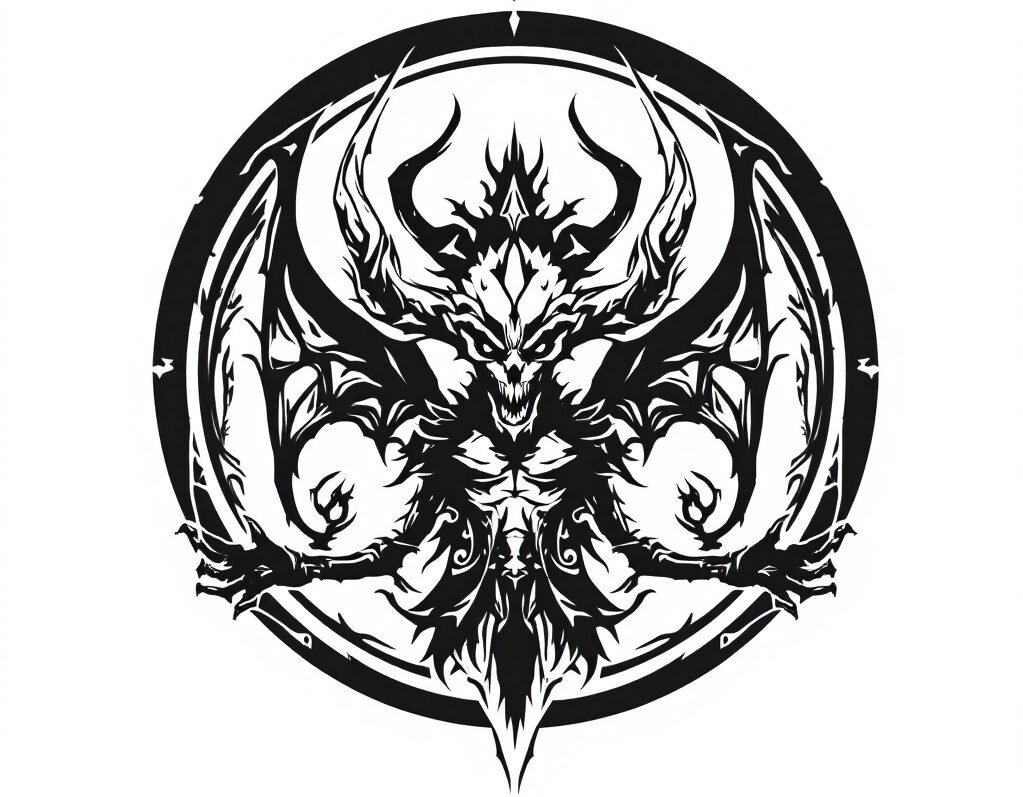
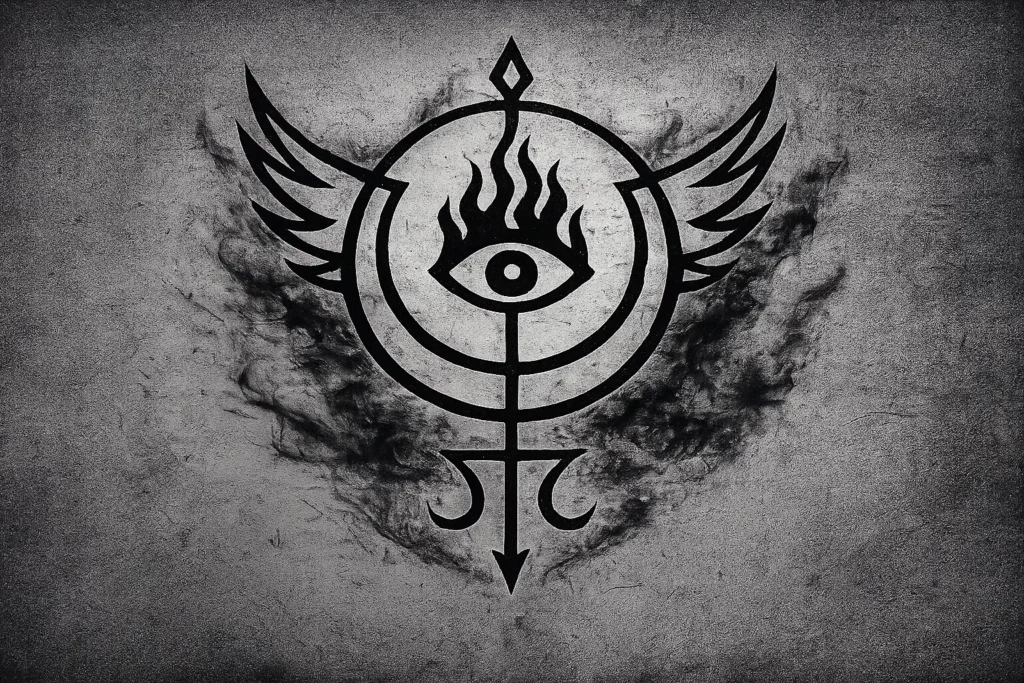
Abezethibou’s sigil (although absent from classic Goetia seals) is sometimes used in modern occult adaptations as a jagged glyph: a central crimson wing arched over wavy lines evoking the Red Sea pillars, bisected by an arc of a torn feather. Crossed by thorny vines symbolizing pride’s barbs, it curls into an abyss-hook, pulling downward like Tartarus’ maws.
Historically, Solomonic evokers sketched it on vellum with blood-mixed inks, placing it in circles to focus his windy summons—without steps, just intent to bind his boasts. Asymmetrical design mirrors his one-winged form, with swirling abyssal patterns that represent a watery prison and wind control.
Symbols extend to the solitary wing, red as arterial spill, etched on amulets to ward his influences or invoke for magic’s edge. The pillar of water stands as an emblem, a vertical torrent cradling chains, referenced in Byzantine talismans against Egyptian curses—dipped in salt to mimic his prison.
In grimoires like Black Witch Coven’s, his seal incorporates scorpion tails to evoke the sting of Scorpio, used in night altars to channel heart-hardening whispers.
Bibliography
Author’s Note: During my research on this lesser-known demon, I noticed an interesting contrast between the straightforward, list-like descriptions in Weyer’s Pseudomonarchia Daemonum and the more story-driven, oppositional role shown in the Testament of Solomon. De Plancy and recent academic sources usually describe Abezethibou as a fixed fallen angel, but when I looked at the McCown and Charlesworth translations, I saw a more active figure whose identity is closely tied to the Red Sea. I focused on these main pseudepigraphal sources to show how this demon shifts from being a general tempter to a specific historical opponent, a detail that is often overlooked in modern demonology encyclopedias.
- Juanita Feros Ruys – Demons in the Middle Ages. Arc Humanities Press, 2017.
- James H. Charlesworth – The Old Testament Pseudepigrapha, Vol. 1 Apocalyptic Literature And Testaments. Duke University, 1983.
- Gary St. M. Nottingham – Ars Theurgia-Goetia. Published by Avalonia, 2012.
- Johann Weyer – Pseudomonarchia Daemonum. Digital edition by Joseph H. Peterson, 2000.
- Chester Charlton Mc – The Testament of Solomon. Edited from manuscripts at Mount Athos, Bologna, Holkham Hall, Jerusalem, London, Milan, Paris, and Vienna. Leipzig J. C. Hinrichs’ Sche Buchhandlung, 1922.
- Collin de Plancy – Dictionnaire infernal; répertoire universel des êtres, des personnages, des livres, des faits et des choses qui tiennent aux esprits. 1863
- Jennifer Reed – Christian Demonology | Origin, Demons & Importance. Study.com.
You may also enjoy:
Rokurokubi: The Yōkai That Looks Human Until Midnight
February 3, 2026
Amdusias in the Ars Goetia: The Demon of Dark Music
December 2, 2025
Who Is Futakuchi-onna, the Two-Mouthed Woman?
March 9, 2026
Aži Dahāka: The Three-Headed Dragon of Zoroastrian Mythology
January 14, 2026
What Is a Pishacha, the Flesh-Eating Demon of the Dead?
February 11, 2026
What Is a Rakshasa? Meaning, Origins, and Dark Powers
January 23, 2026