The Ghul stands for deep cultural fears about respecting the dead and the dangers of the desert, going far beyond the usual ideas found in modern horror stories. Later stories portrayed the creature as a simple scavenger. Still, in early Arabian tales, it was a clever shapeshifter that used hospitality as a trap for travelers. Living on the edges of society, the Ghul was more than just a flesh-eater; it became a symbol of social and natural decay.
In this article, I used several key translations of The Meadows of Gold (Mas’udi) and Kitab al-Azmat to keep the creature’s description true to its cultural roots. By excluding modern horror elements, I preserved its original place in Arabian demon stories. [View Full Bibliography ↓]
Summary
Key Takeaways
| Attribute | Details |
|---|---|
| Names | Ghul (male), Ghula (female), Ghūl, Ghilan (plural), Ghul-e Biyaban (wilderness variant), Namnam or Namaanim in some regional tales. |
| Type | A diabolical class of jinn focused on grave-haunting and shape-shifting to prey on humans. |
| Title | None specified; often called a desert demon or flesh-eater in folklore. |
| Gender | Both male (Ghul) and female (Ghula); the female form is common in luring tales. |
| Servitors | None specified; acts as a solitary predator or in loose packs in some stories. |
| Superior Jinn | Offspring of Iblis, the prince of darkness, reports loosely to him in the jinn hierarchy. |
| Powers | Shape-shifting into animals or humans; luring victims with illusions; digging up graves; consuming flesh and blood; causing travelers to lose their way; stealing unattended items. |
| Appearance | Shapeshifts often; true form is a hideous, dog-faced humanoid with ass’s hooves; grotesque features, foul smell; may appear as an attractive woman or hyena-like beast. |
| Etymology | From Arabic غُول (ghūl), rooted in غَالَ (ghāla) meaning “to seize” or “to kill”; possible ties to ancient Mesopotamian gallu demons. |
| Associated Figures | Iblis (father figure); Ta’abbata Sharra (poet who fought one); Umar ibn al-Khattab (who slew one in Hadith); Si’lat (related shape-shifting jinn). |
| Weaknesses | Repelled by reciting the adhan (call to prayer) or Ayat al-Kursi (Throne Verse); must be struck once fatally—second blow revives it; vulnerable to iron weapons or sunlight in some tales. |
| Opposing Holy Figure | Prophet Muhammad (advises banishment via Quran verses); angels like Jibril; saints and prophets who invoke Allah’s name. |
| Social Structure or Tribe | Solitary or small desert packs; part of rebellious jinn tribes exiled to the wilderness by Allah. |
| Followers/Tribe Size | Loose groups in folklore; no large commanded tribes often act alone in hunts. |
| Element | Earth (graves and deserts); ties to darkness and decay. |
| Planet/Zodiac | Saturn (for isolation and death); Capricorn (earth sign linked to hidden realms). |
| Color(s) | Black (for night and graves); red (for blood consumption); gray (desert dust). |
| Number(s) | 3 (trinity of deception: lure, attack, devour); 7 (nights of wandering). |
| Crystal(s)/Mineral(s) | Obsidian (sharp edges for grave-digging); onyx (black stone for hidden evil); iron (used in weapons against it). |
| Primary Sources | Hadith collections (e.g., Sahih Muslim, reports of Umar); pre-Islamic Arabic poetry (Ta’abbata Sharra); “One Thousand and One Nights”; Al-Dimashqi’s writings; Shams al-Ma’arif (occult mentions of jinn types); folklore compilations like those by Al-Masudi. |
“Ghul” Meaning
The meaning of the term “Ghul” runs deep in Arabic roots, pulling from words that evoke sudden grabs and brutal ends. Basically, the term originates from the Arabic verb ghāla, meaning “to seize” or “to take by force.” This link fits the creature’s habit of snatching travelers off lonely paths or ripping open fresh graves.
Some old texts link it further to ideas of murder or deep despair, painting the monster as a thief of life itself.
Over time, the name changed slightly across dialects, becoming ghūl in classical Arabic. Still, it always retained the idea of a hidden danger that attacks suddenly. In some regions, it is linked to ghawala, a word meaning “confusing” or “misleading,” which fits the creature’s habit of tricking people who get lost in the desert.
Interestingly enough, the name’s etymology traces back even further, perhaps to ancient Mesopotamia’s gallu—demons that were believed to drag souls underground. As Arab traders crossed paths with those old cultures, the idea likely crossed over as well, morphing into the desert-haunting Ghul.
How to Pronounce “Ghul” in English
In English, pronounce Ghul as “gool,” using a hard “g” like in “go” and a short “oo” as in “book.” If possible, roll the “gh” a bit, like a gentle throat sound, to match the Arabic ghūl. Think of it as “ghoo-l.”
For the female form, Ghula, add a soft “ah” at the end: “gool-ah.” Highlight the first sound to give it a sharp, grabbing feel. Try saying it while telling stories; it should sound quick and a little haunting, like a desert wind.
What Does Ghul Look Like?
In stories, the creature often hides behind clever disguises, but most sources agree it is truly ugly and frightening underneath.
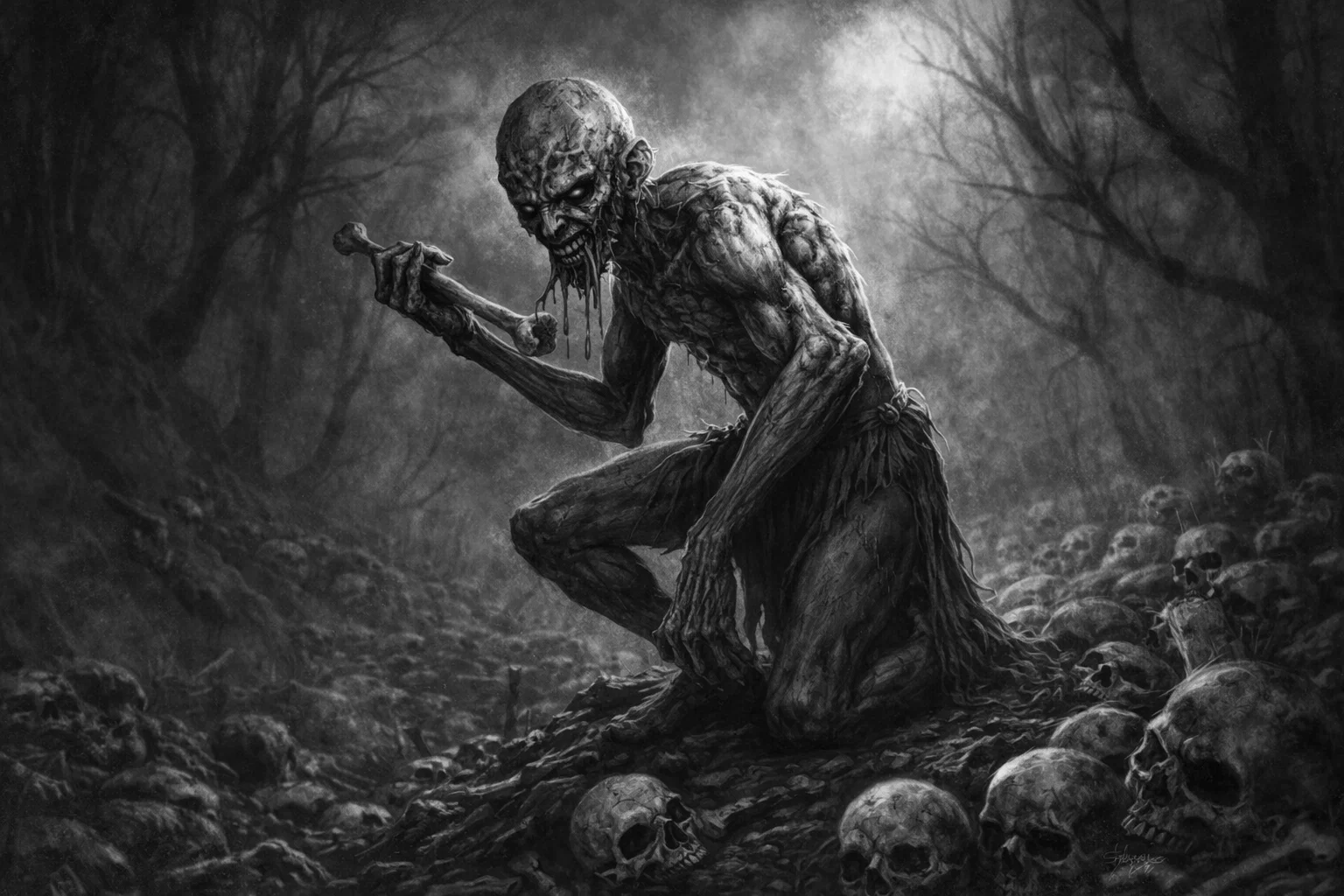
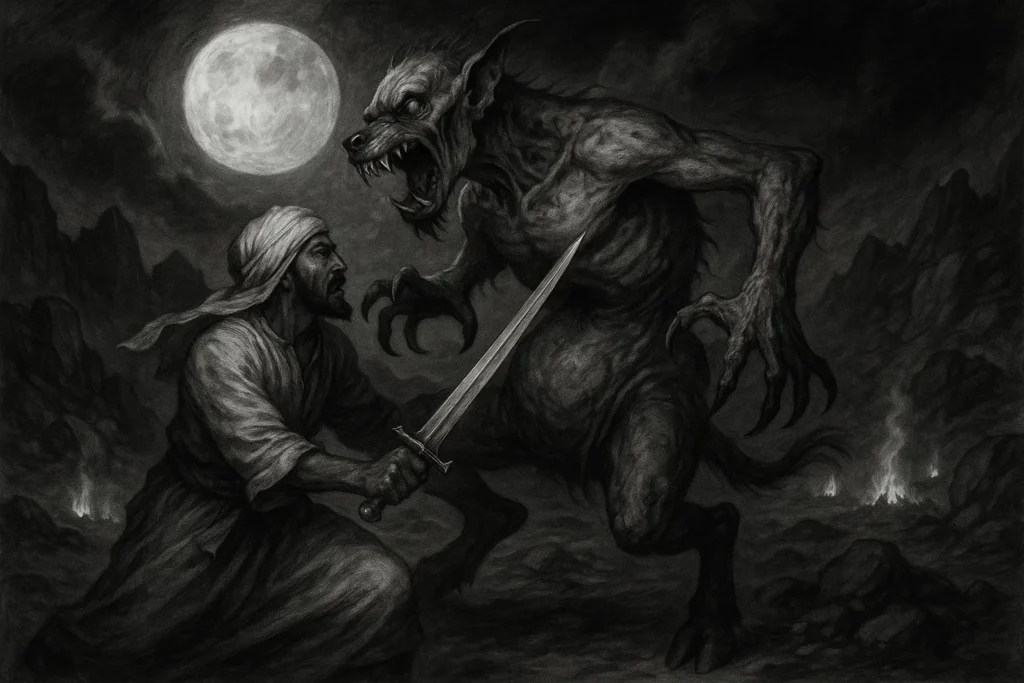
Usually, the monster appears as a large, human-like entity with a dog’s snarling mouth and sharp teeth ready to tear flesh. Its skin is loose and gray, like old grave stones, stretched over twisted bones. Its eyes glow dull red in the dark, always hungry for prey. Its feet end in ass’s hooves, which is its one constant feature, making a clacking sound on rocks as it moves. It also gives off a foul smell, like rot mixed with desert dust, warning anyone nearby.
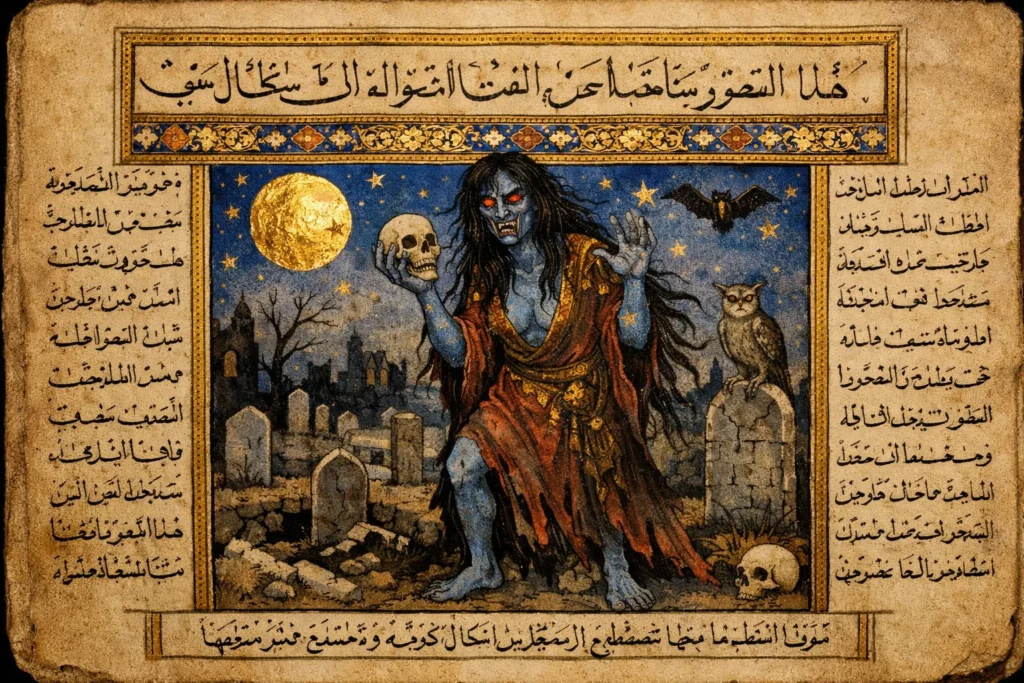
The female Ghula often appears as a beautiful woman in flowing robes, with smooth skin and warm eyes, like someone from a distant memory. But up close, the disguise fails: her nails become long and black, ready to scratch, and her breath smells as bad as an open tomb.
Some stories say the Ghul grows very large after eating, its belly swollen from stolen coins and bones. When it takes animal form, it moves like a hyena or jackal, close to the ground, with matted fur and eyes that seem too clever for an animal.
Origins
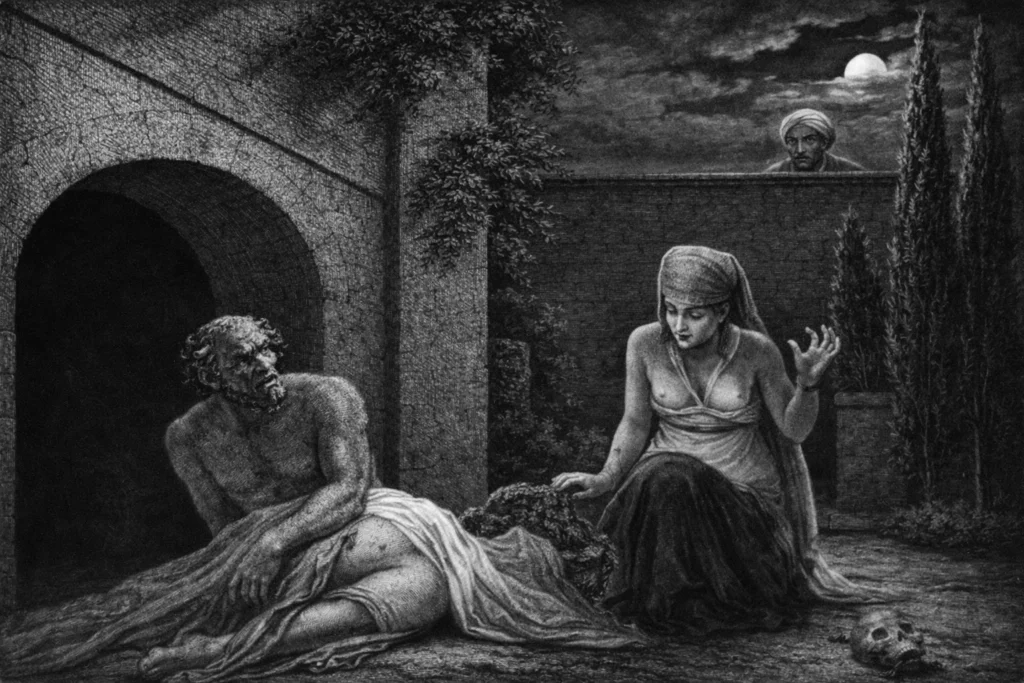
The Ghul’s story begins in pre-Islamic Arabia, where it was a nightmare for nomads. Before the Prophet’s time, Bedouin poets described these Jinn as desert hunters, made from the same smoky fire as other Jinn but drawn to graves and flesh.
Ta’abbata Sharran, a rogue poet from the 6th century, bragged in verse about spearing a Ghul through its tricks, turning its hide into a wineskin. His story spread, painting the creature as a shapeshifter of the wastes, luring men with false lights or lovers’ calls, only to feast on their bones.
The Ghul matched the harsh desert, where endless dunes made a single mistake deadly, and stories filled the emptiness with danger. Back then, tribes saw it as a wild spirit, connected to old ruins and dry wells, punishing anyone who left the safety of the camp.
Its roots may go back to ancient Mesopotamia, where Akkadian demons called gallu took souls to the underworld. These gallu were feared in Sumerian and Babylonian myths, dragging people to dark places, much like the Ghul’s habit of pulling the dead from graves.
As Arab caravans traded silks and spices along routes like the Incense Road, these ideas mixed together, turning the gallu into the Arabic Ghul. This creature seizes not only spirits but also flesh.
You may also enjoy:
Rokurokubi: The Yōkai That Looks Human Until Midnight
February 3, 2026
Empusa: The Blood-Drinking Wraith of Greek Mythology
November 20, 2025
Marid: The Ocean Jinn That Defies Heaven and Earth
September 30, 2025
Andhaka: The Blind Demon Born From Cosmic Darkness
February 6, 2026
Kuchisake-onna: Folklore, Origins, and Urban Legend History
February 10, 2026
Who Is Futakuchi-onna, the Two-Mouthed Woman?
March 9, 2026
The Ghul as a Failure of Social Reciprocity
The Ghul is so frightening in Arabian culture because it pretends to follow the rules of the “Social Contract,” only to break them in violent ways. In the tough pre-Islamic desert, people survived by sticking together and honoring hospitality. It turns these important values upside down.
The monster often appears as a woman in trouble or someone familiar, using people’s sense of duty to help others as a way to hunt. This makes it a symbol of “Social Entropy,” showing the fear that the empathy needed for survival could actually lead to one’s downfall.
The word gh-l means ‘to seize or destroy,’ which accentuates the Ghul’s quick and predatory behavior. This is different from the more deliberate rebellion of the Ifrit or the Marid. While the Marid represents cosmic pride, the Ghul is about desperate survival and the defense of its territory. It scavenges in the ‘Liminal Space’—the empty desert—where heat and loneliness make it hard to tell life from death.
Here, when the Ghul eats the dead, it is not just about food. It is a ritual that denies the person the chance to return to their community. By devouring the body, the Ghul stops the proper funeral rites that would let the dead join their ancestors, making the victim’s death even more final.
When compared to other myths, the Ghul is similar to the Wendigo from Algonquian stories or the Greek Lamia. However, it is unique because it focuses on being a ‘failed mimic.’ Unlike Western demons that promise secret knowledge or power, the Ghul only gives a false image of human weakness.
The Ghul can be seen as the ‘Antibody of the Desert,’ showing how the desert pushes people away. Learning about the Ghul reveals old fears travelers had: in the deep desert, the person sitting across the fire might not be a real guest, but something dangerous pretending to be human.
Historical & Folkloric Records
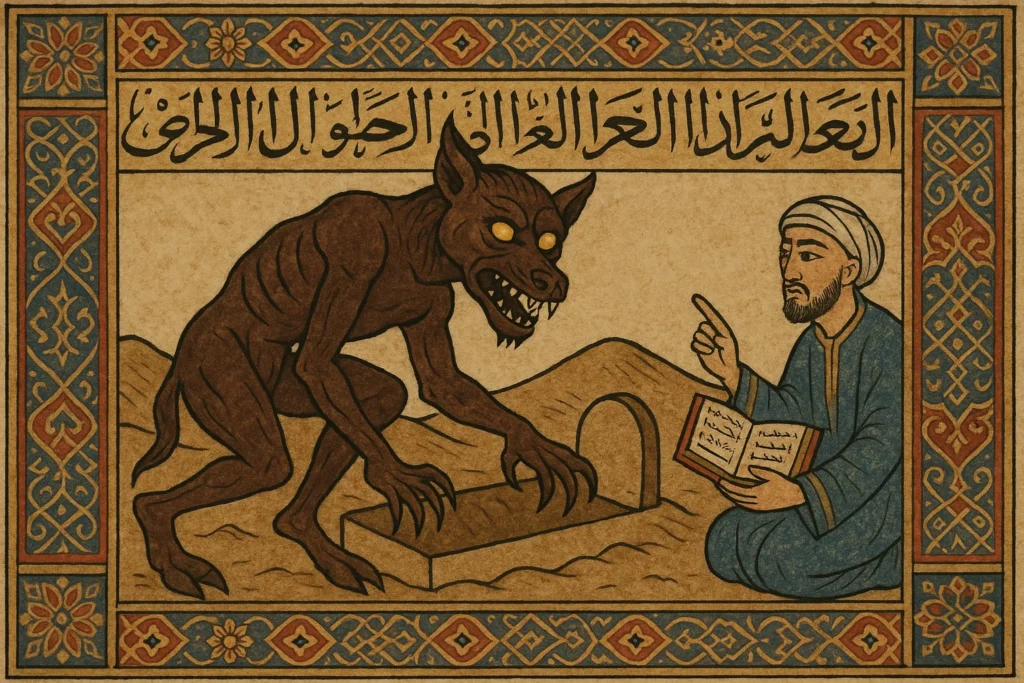
While the monster does not appear in the Quran, its historical record dates back to the Pre-Islamic era in the oral traditions of the Arabian Peninsula, later codified in the early Islamic centuries.
“The Ghul is a type of Jinn that appears to travelers in the desert. It is said that they are the ‘wizards’ of the Jinn, possessing the ability to change their shape. When they appear, one should pronounce the Adhan (the call to prayer) to repel them, for they cannot maintain their deception in the presence of the divine name.” [Hadith recorded in Sahih Muslim, 9th Century (referencing 7th Century traditions)]
This 9th-century record shows that early Islamic scholars tried to fit the pre-Islamic monster into a monotheistic worldview. By calling the Ghul’ the wizards of the Jinn,’ the text explains their metamorphosis as a spiritual rather than a physical ability.
This difference is important. Pre-Islamic poets saw the Ghul as a physical predator in the wilderness. Still, early Islamic scholars changed their image to that of a creature that could be defeated by sacred words, shifting the threat from the physical world to the spiritual one.
“The Ghul is a creature that inhabits ruined places and the desert. It is a shape-shifter that lures travelers off the path by calling out their names or appearing as a beautiful woman. When the traveler follows, the Ghul kills them and devours their flesh. It is said that if you strike a Ghul, you must strike it only once; a second blow will bring it back to life.” [Al-Jahiz, Kitab al-Hayawan (The Book of Animals), 9th Century]
Al-Jahiz, a scholar from the Abbasid era, was among the first to describe the Ghul using both scientific and folklore ideas. He included the ‘Single Blow’ story, a local tale that makes the Ghul different from other Jinn. This suggests the Ghul has unnatural strength and feeds on violent energy.
Al-Jahiz describes the Ghul as a real animal, even though it is supernatural. This fits with the ‘Naturalist’ period in Islamic scholarship, when myths and facts about animals were recorded together to create a complete view of the world, both seen and unseen.
“The Ghul (الغُول) is a species of the Jinn that appears to people in the form of various animals or as a person of beautiful countenance. They are characterized by their extreme treachery and their hunger for human flesh. They are most often found in the ‘wastelands’ (al-mafawiz) and among graves, where they dig up the dead.” [Al-Mas’ūdī, Muruj al-Dhahab (The Meadows of Gold), 10th Century]
Al-Mas’ūdī’s 10th-century account shows the Ghul turning into a grave-eater. Earlier stories described the Ghul as a desert hunter of the living. Still, this later source shows it moving into graveyards.
This change in belief happened as cities grew during the Islamic Golden Age. As the wilderness became more distant from city life, people started to picture the Ghul moving from the desert into cemeteries.
This created the link between ‘Ghouls and Graveyards,’ which later spread to the West through translations in the 18th century.
“In the time of the Caliph Harun al-Rashid, there was a man who encountered a Ghul in the form of a woman. She was sitting by the side of the road, weeping. When he offered her help, her feet were revealed to be those of an ass. This is the mark by which the Ghul may always be known, no matter what beauty they project.” [One Thousand and One Nights (Alf Layla wa-Layla), 14th-15th Century (Gallicand/Maclean Recensions)]
This late-medieval source introduces the ‘Ass’s Hooves’ detail, which became the main way to recognize a Ghul in local stories. It shows that even the best demonic disguise must have a flaw that reveals its true, evil nature.
By the time these stories were written down, the Ghul had changed from a frightening desert spirit into a character used to check out ideas about appearances versus reality and the dangers of the unknown woman in a male-dominated society.
Powers and Abilities
The Ghul wields dark gifts drawn from graves and shadows, all bent on harm:
- Transformation: Changes into animals like hyenas or humans, often a tempting woman, to draw victims close before the strike.
- Illusion-casting: Weaves false lights or voices in the desert, making travelers stray into traps or lose their path for days.
- Grave-digging strength: Claws through earth and stone with ease, unearthing bodies for feasts or stealing burial goods.
- Flesh consumption: Devours living and dead alike, gaining size and vigor from blood and bone; some tales say it drinks life-force too.
- Luring glamour: Appears as lost kin or helpers, using sweet words to disarm suspicion until the kill.
- Night vision and stealth: Sees clearly in pitch black, moves silently as wind over sand, stalking unseen till the pounce.
- Regeneration trick: If struck twice, revives from a single blow’s miss; demands one perfect hit to end it.
- Coin-stealing curse: Snatches unattended wealth, leaving owners broke and haunted by bad luck.
Influence on Humans and Possession
The Ghul is a haunting creature whose influence is not limited to physical attacks. It can also invade people’s minds, twisting their thoughts and causing confusion.
In old stories, the Ghul’s effect often starts subtly. A whisper might lead someone off a safe path during a walk alone. Travelers may feel drawn away, seeing strange visions, like a campfire that leads to danger, or hearing a child’s cry in the empty desert.
This mental trap, sometimes called the ‘ghul’s veil,’ targets tired people, turning their fears into something that paralyzes them. Once someone is caught, they wander until they are exhausted, making them easy prey for the Ghul. Some stories even say whole caravans disappeared this way, leaving only bones behind.
Being possessed by a Ghul is even more frightening. When a Ghul takes hold, it slowly takes over the person’s body. Signs of possession appear over time, such as chills that never go away and a strong hunger for raw meat or even dirt from graves.
People who are possessed become pale, their eyes look sunken, and their breath smells of decay. Their voices may change, becoming harsh and growling, and they might speak strange curses in old languages.
A Ghul can also copy the voices of friends to trick people or cause confusion. Sufi texts describe disturbing events, like people having convulsions under the moonlight and scratching at their own skin as if trying to escape their suffering.
Possession can also bring out dark urges, like endless greed or sudden anger. For example, a man might search for food at night, or a woman might trick her family into danger, only realizing what happened after the chaos.
An ancient scholar, Al-Masudi, recorded instances in Syria of individuals possessed by spirits who dreamt of robbing graves and woke up with soil under their fingernails.
Children often suffer the most. The Ghul seem to target them, leaving children weak and filled with nightmares. Islamic healers see this as a rebellion of Jinn, with the Ghul feeding on human weaknesses such as pride or neglect of faith.
In many cultures, the signs are similar: people cannot sleep, dream of eating with loved ones, and sometimes find faint bruises on their skin that look like hoofprints.
In Berber stories, the Ghul can drive people mad, making them howl until morning. Even today, some rural areas have stories about relatives who are ‘Ghul-touched,’ avoiding sunlight and feeling drawn to old graveyards.
Ghul Myths, Legends, and Stories
Ta’abbata Sharran’s Battle with the Ghul
In the arid lands before the rise of Islam, a bandit and poet named Ta’abbata Sharran traveled with his family, always ready to fight or create poetry. One evening, as stars lit up the sky, his group set up camp near some sharp rocks where the wind howled like souls in distress. They were hungry, but there was no game to hunt.
Ta’abbata, brave both in words and in battle, decided to go out alone in search of food. As night fell, he spotted a creature in the distance—a woman in ragged clothes, hunched over as if she had traveled a long way, waving a weak hand towards a distant light.
Her voice was soft as she pleaded, “Brother, please help me; I’ve wandered far, and my family has been scattered by a storm.”
Ta’abbata felt a tug of sympathy, but doubts crept in. Her footsteps were strange, leaving odd prints in the sand. The air grew stale and foul, and her eyes glowed a sinister red. He hesitated, sensing a trick behind her sad tears.
Suddenly, she lunged at him, transforming into a monstrous creature with a dog-like mouth and hooves like an ass, claws aiming for his throat. Ta’abbata dodged and released an arrow that struck her side; she let out a howl, twisting back into her woman form, her blood dark as pitch.
“Foolish poet,” she screeched, “you’ll become part of my endless night.” But Ta’abbata wouldn’t give up. His sword glimmered in the moonlight as he pinned her to the ground.
Her disguise vanished completely—her gray skin stretched tight, and her teeth snapped at the air. One swift thrust to her heart silenced her forever; she turned to dust and bone, leaving behind only a tattered skin. Careful not to touch the remnants, Ta’abbata gathered the hide and made his way back to his camp under the cold stars.
When dawn arrived, he returned triumphantly, the hide draped over his shoulder. His tribe was amazed as he shared his tale around the crackling fire, singing, “I defeated the Ghula of the dunes; her tricks were no match for my sharp eye. From her remains flows a victory as rich as wine.”
Umar’s Sword Against the Desert Fiend
On a journey toward Syria, Umar ibn al-Khattab rode purposefully, accompanied by his loyal friends, all dedicated to spreading their faith. The hot, dusty trail wound through barren hills, where the sound of their horses’ hooves bounced off the rocks.
As the sun began to set, they noticed a shadow up ahead—a monster slumped by some stones, dressed in white, with a hand raised as if asking for help. The group slowed down, cautious of potential bandits in the deserted area. Still, Umar felt a strong sense of responsibility that urged him to approach.
Umar stopped and looked at the creature with compassion. “Traveler, what troubles you in this wasteland?” he asked. The creature stirred slowly, speaking with a voice rough and gravelly, “I beg for mercy, my lord; I have fallen and broken my legs on hidden rocks.”
His companions encouraged him to keep moving, but Umar dismounted and offered his water. As he got closer, something felt off. The air was foul, and he noticed something strange about the beggar’s feet— they were split like hooves. The beggar’s eyes opened suddenly, revealing glowing embers, and the creature transformed into a terrifying creature known as a Ghul. Its wide mouth opened, and sharp claws seemed ready to strike.
Umar’s companions cowered in shock, reaching for their swords as the beast’s dreadful smell filled the air. The Ghul lunged forward, aiming to take down Umar and feast on his flesh. Although his friends shouted warnings, Umar stood his ground, gripping his sword tightly, which had been blessed by the Prophet. “By the power of Allah, I command you to leave, foul creature!” he shouted, unsheathing his blade and swinging it in a swift motion.
The Ghul let out a deep, mocking laugh, shifting forms like an illusion of a pack of hyenas circling him. But Umar was determined. He struck true, his sword deep in the creature’s neck, and dark blood sprayed onto the sand as the Ghul screamed, revealing its true, twisted form—like a monstrous dog. It clawed at him desperately, trying to distract him with visions of its kin, but Umar remained focused.
Once more, the beast attempted to strike, but Umar spoke a powerful verse: “Ayat al-Kursi binds you, rebel creature!” The words echoed from his lips like thunder in the calm dusk, and the Ghul began to shrink, smoke billowing from its wound. With a final thrust, Umar pierced its heart, causing it to burst into ash that scattered away like a fading nightmare.
His companions knelt in gratitude, the road ahead now clear to Syria. Umar continued on his journey, and stories of his bravery were told in mosques, reminding everyone that even the mightiest leaders face challenges in the dark, but faith can conquer all.
The Woodcutter’s Deceptive Kin
In the heart of the Syrian woods, where the oak trees whispered to the streams, there lived a woodcutter named Hasan. He chopped down trees to feed his family, while his wife Fatima wove baskets by the fire. Over the years, they were blessed with a daughter named Aisha, who was as bright as the morning sun. But life was tough, and they often struggled to make ends meet.
One evening, while Hasan was stacking logs, he heard a gentle knock at the door, almost like the sound of a long-lost family member returning home. The family paused, curious about the visitor. When they opened the door, they found a woman in a tattered silk veil, her face marked by the hardships of her travels.
“Brother Hasan,” she cried, opening her arms, “it’s me, your sister Layla! I’ve come back to you after being married and then widowed. A harsh journey brought me here; please shelter me for old times’ sake.”
Fatima felt uneasy. She remembered the stories of Layla, who was said to have drowned in her youth. But Hasan, moved by emotion, welcomed her in. They enjoyed hearty meals together, sharing lamb stew and singing songs from their past, while Aisha slept soundly upstairs. Layla entertained them with tales from distant lands, her voice as sweet as honey, making the family’s hardships feel lighter.
As nights turned into days, strange things began to happen. The milk never spoiled, the fires in the hearth burned bright, and their purse seemed to fill with coins from the “gifts” Layla brought. However, Fatima had unsettling dreams filled with ominous imagery.
On the fourth morning, worried about her sister, Fatima decided to follow Layla into the cellar. What she discovered chilled her to the bone: Layla had shed her human appearance to reveal a gray pelt and long claws, digging for something buried while keeping an eye on Aisha’s bed upstairs.
In that moment, Layla’s charm faded, and she transformed into a terrifying creature, hissing, “Foolish wife, join us for dinner; your man will be next, and then the girl.” Fatima knew she had to act quickly. She sprinted upstairs, slamming the door shut and barricading it with an iron poker while calling out prayers. The creature raged against the door, its illusions flashing before her eyes, but Fatima held firm, her words acting like a shield.
Just then, Hasan burst through the door with his axe raised. One swift swing struck the creature down, its monstrous form collapsing into dust and claws.
Aisha woke up unharmed, but their coin purse was empty, replaced with pebbles. The family gathered the remnants of what once was Layla and burned them at a crossroads, reciting blessings until the ashes cooled, united in their victory over the dark force that had invaded their home.
You may also enjoy:
Who Is Azazel, the Demon Blamed for Human Corruption?
February 24, 2026
Who Is Astaroth in Demonology and the Ars Goetia?
February 20, 2026
Who Is Agares, the Demon of Earthquakes and Deception?
October 13, 2025
Nasnas: The Monstrous Demon Hybrid That Haunted Pre-Human Earth
November 12, 2025
Mahabali (Bali): The Benevolent Asura King
October 10, 2025
Who Is Asmodeus in Demonology and the Bible?
February 18, 2026
Ghul vs Other Jinn
| Jinn Name | Associated Traits/Influence | Rank/Origin | Key Traits/Powers |
|---|---|---|---|
| Ifrit | Rebellious fire and vengeance; incites wrath in battles. | High warrior in jinn courts; Quran (Surah 27). | Commands flames to burn foes; superhuman strength; shape-shifts to giants. |
| Marid | Stubborn pride and storms; stirs chaos in seas. | Noble sea-lord; Arabian folklore and Hadith. | Controls waves and winds; grants boons but demands oaths; water illusions. |
| Si’la | Deceptive seduction; fuels lust and betrayal. | Shape-shifter kin to Ghul; One Thousand and One Nights. | Mimics lovers perfectly; drains vitality through touch; night invisibility. |
| Qareen | Whispered doubts; promotes envy and inner strife. | Personal shadow-jinn; Quran (Surah 43:36). | Binds to one soul; sows bad habits; whispers secrets of the heart. |
| Nasnas | Half-formed madness; causes disorientation and fear. | Crippled wanderer; pre-Islamic poetry. | Hops on one leg; half-body attacks; induces vertigo in victims. |
| Palis | Illness-bringer; spreads despair through plagues. | Desert healer gone foul; Hadith collections. | Breathes miasma sickness; mimics doctors to poison; fog-summoning. |
| Shaytan | Core temptation drives all sins from pride to greed. | Iblis’s lieutenant; Quran (Surah 7). | Whispers global discord; possesses crowds; eternal grudge against man. |
| Ammar | Buried treasures’ guard; greed that buries wealth. | Earth-bound hoarder; Shams al-Ma’arif. | Hides gold in illusions; crushes diggers; earthquakes on command. |
| Hinn | Beast-like fury; animalistic rages and hunts. | Low proto-jinn; Mesopotamian influences. | Shifts to wolf-packs; heightened senses; pack-calls that madden. |
| Jann | Garden tempters; envy of paradise lost. | Earthly dwellers; Quran (Surah 55). | Grows thorny snares; poisons fruits; dreams of forbidden bliss. |
| Zar | Possession dances; hysteria and false joys. | Sea-wind spirit; African-Arab blends. | Forces ecstatic trances; wind-whips for pain; mimics music to bind. |
| Ababil | Swarm destruction; petty vengeances in flocks. | Bird-jinn horde; Quran (Surah 105). | Calls pest-birds; overwhelms in numbers; air currents to scatter. |
| Dunnamun | Forgotten oaths; binds with unseen chains. | Oath-breaker; folklore oaths. | Locks limbs in sleep; echoes broken vows; thread-webs of force. |
| Vetala | Corpse wisdom; dark knowledge from the dead. | Grave-sage; Indian-Arab crossovers. | Rides hanging bodies; riddles that curse; corpse-animation. |
Position Among Jinn
The Ghul usually has a low place in the world of Jinn. It is not a ruler or a wise figure, but a scavenger that hides in the shadows. The Ghul stays on the edges of Jinn society, as part of the shayatin, Iblis’s cursed followers who were cast out for refusing to honor Adam. Unlike the powerful leaders, the Ghul is a loner, wandering the deserts in small groups and trading its kills for scraps. Its constant hunger connects it to stronger Jinn.
In Islamic traditions, it’s seen as lower than Shaytan—the tempter—acting as a tool for simple traps and deception, especially where finesse might fail. It is described as being bound to the earth in Shams al-Ma’arif, unlike the free-flying Si’lat (Si’la) or the water-controlling Marids, which limit its abilities to engage in spiritual practices.
However, having such a lowly rank gives the Ghul a crafty edge; without the need to play courtly games, it thrives in chaos, using metamorphosis abilities to deceive even the wariest of Jinn.
Associations
The Ghul is linked to Saturn, which stands for boundaries and a patient, deceptive nature. This is shown by Capricorn’s hidden caves and lonely places, where dreams can turn into greed.
The number three symbolizes a cycle of promise, betrayal, and devourment, trapping victims in darkness. Black stands for darkness, while red warns of bloodshed and leaves lasting marks.
Crystals add to the theme: obsidian is said to reveal illusions, onyx offers protection but also hints at hidden sins, and iron is used as a defense against the Ghul’s tricks.
Zodiac and Astrological Links
Astrology connects the Ghul to Saturn, a distant planet known for its rings and its link to limits and bones. Saturn moves slowly, which matches the Ghul’s patient waiting, like the desert slowly wearing down stone. This fits with Capricorn, an earth sign that symbolizes ambition and overcoming obstacles.
Scorpio, a water sign, stands for mystery and hidden feelings, where secrets can become painful. In this sign, the Ghul’s hunger for blood increases, influenced by Pluto. In astrology, Saturn gives the base, and Scorpio adds intensity.
Some believe that certain times of year, especially the winter solstice, can awaken the Ghul’s presence. The best way to fight this is with the light of dawn.
Elements
The Earth hides the Ghul deep underground, where its body is made of dust and rests quietly in the soil. It hides in the ground, easily digging graves, while the desert covers its tracks with sand.
This link to the Earth gives the Ghul power, making it strong and able to persist. It waits patiently beneath the surface, blending into rocks and ruins and setting traps for the unwary.
The air also plays a role, sending dry breezes that carry false sounds and mix scents to confuse travelers. These tricks create illusions that make lost paths seem safe, until it is too late to turn back.
Fire adds another element, seen in the Ghul’s glowing red eyes or its warmth. Fire gives the Ghul quick bursts of energy for sudden attacks after long periods of waiting, like embers flaring up after being quiet.
Colors, Numbers, and Crystals
The Ghul is often shown in deep black, a color that stands for the darkness of graves and hidden dangers. It blends into gray dust, matching the lifelessness of barren land and evoking lost hopes.
The Ghul is also linked to bright red, like fresh blood on sand, which draws attention to violent events. This red symbolizes the harsh end of a feast, when excitement turns to chaos.
In number symbolism, 3 stands for a trap with three steps: watch, catch, and devour. This cycle shows the tricks found in stories. The number 7 is linked to nights when the Ghul is active, especially when the moon is weak.
Crystals add to the story: obsidian is sharp and black, said to cut through illusions and catch the eye. Onyx has deep veins that hide secrets, like buried treasure, and its polished surface hides flaws, much like the Ghul’s deceptive look.
You may also enjoy:
Mara: The Buddhist Demon King of Desire and Death
October 13, 2025
Yuki Onna: The Terrifying Bride Who Feeds on Travelers
December 9, 2025
Amdusias in the Ars Goetia: The Demon of Dark Music
December 2, 2025
What Is a Yūrei? The True Meaning of Japanese Ghosts
January 30, 2026
What Is a Bhuta? The Backward-Footed Ghosts of Hindu Horror
February 5, 2026
Rāga: The Seductive Demon of Passion and Desire in Buddhist Lore
October 16, 2025
Bibliography
Author’s Note: While researching this topic, I noticed a big difference between the realistic, almost biological descriptions in al-Mas’ūdī’s Meadows of Gold and the later, more dramatic stories in Al-Shaykh’s versions of One Thousand and One Nights. Early Hadith literature in Sahih Muslim focuses on spiritual means to defend against these beings. At the same time, Ahmed Al-Rawi’s modern analysis shows how the Ghul evolved from a desert monster to a Western Gothic creature. I was especially interested in how the ‘ass’s hoof’ detail stayed the same in many stories, acting as a rare, steady point in a changing oral tradition. This research shows how difficult it is to connect the Ghul’s pre-Islamic roots with its later Islamic image, revealing as much about human fears as about the creature itself.
- Ali, Abdullah Yusuf (translator). The Holy Qur’an: English Translation and Commentary. 1934. Internet Archive.
- al-Mas‘ūdī, ‘Alī ibn al-Ḥusayn. Historical Encyclopaedia: Entitled “Meadows of Gold and Mines of Gems”. Translated by Aloys Sprenger, Oriental Translation Fund of Great Britain and Ireland, 1841. Internet Archive.
- Abdul Hamid Siddiqui (translator). al-Hajjaj, Muslim ibn. Sahih Muslim. Islamic Book Service, 2004. Internet Archive.
- Al-Shaykh, Hanan. One Thousand and One Nights: A Retelling. Pantheon Books, 2013. Internet Archive.
- Al-Rawi, Ahmed. The Mythical Ghoul in Arabic Culture. Cultural Analysis, vol. 8, 2009, pp. 45–69. University of California, Berkeley.
- Al-Rawi, Ahmed K. The Arabic Ghoul and Its Western Transformation. Folklore, vol. 120, no. 3, 2009, pp. 291–306. JSTOR. Accessed 1 Apr. 2026.
- Meri, Josef W. (editor). Medieval Islamic Civilization: An Encyclopedia. Routledge, 2006. Internet Archive.
- Volkan, Kevin. The Jinn: Islam, Exorcism, and Psychology. Journal of Social and Political Sciences, 2023. 6. 1-14. 10.31014/aior.1991.06.03.425.