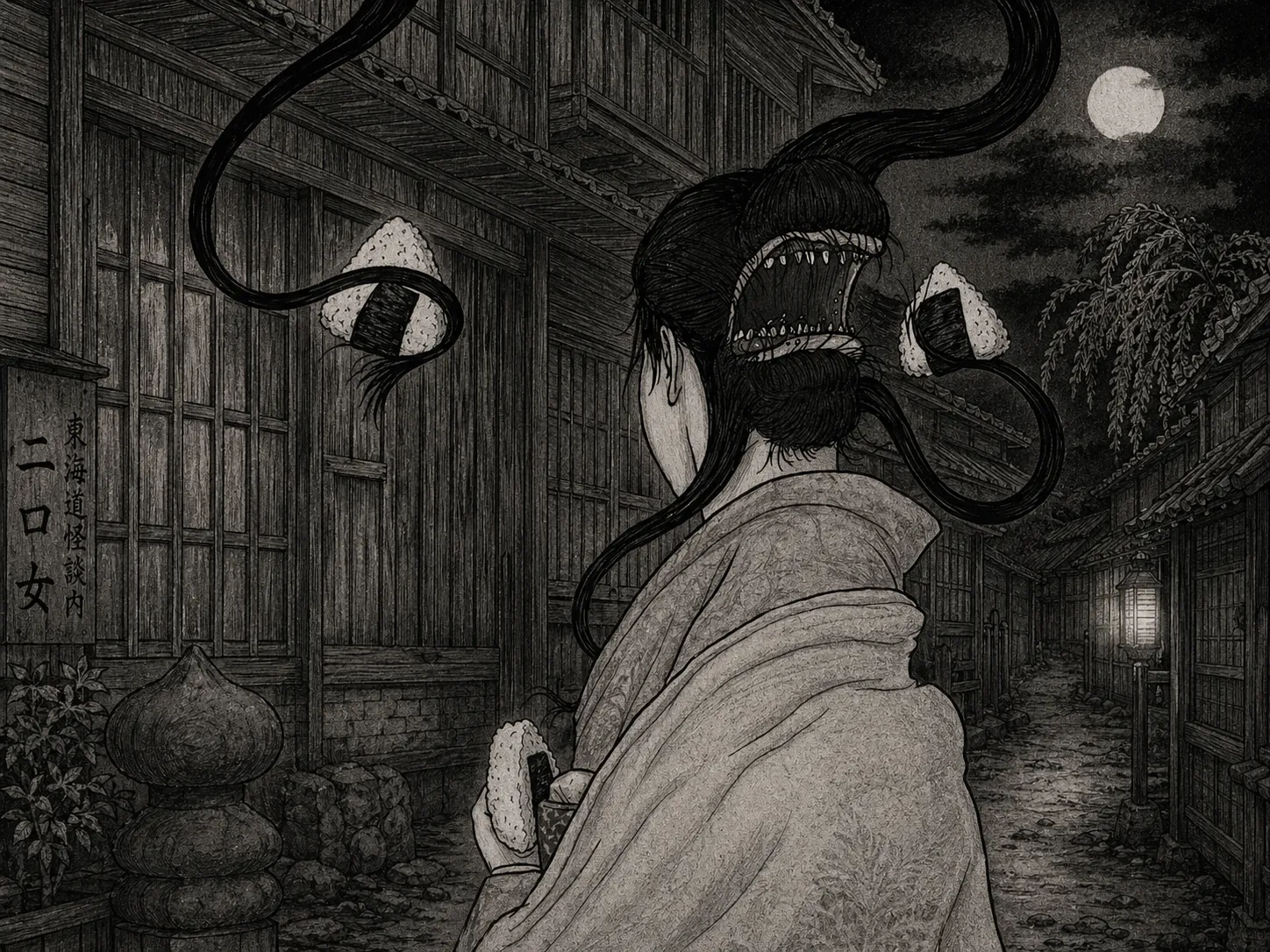
Most female entities in Japanese folklore are seen as threats from the wild. However, Futakuchi-onna is remarkable because she belongs to the home. She represents how hidden needs and cruelty can quietly damage family life.
The Futakuchi-onna’s story centers on the struggle between a wife’s expected self-control and the body’s natural needs. Unlike general yōkai, like Yuki-onna or Rokurokubi, are monsters by nature or through physical transformation. In contrast, the Futakuchi-onna becomes a monster as punishment, with her strange features showing the moral problems inside a family.
My research is focused on the original descriptions in the Konjaku Monogatarishū instead of modern versions. This helps me find the real cultural reasons behind the creation of this hunger curse story. [View Full Bibliography ↓]
Summary
Key Takeaways
| Attribute | Details |
| Names | Futakuchi-onna (Two-mouthed woman) |
| Translation | The name is translated literally as “two-mouthed woman” from the Japanese components futa (two), kuchi (mouth), and onna (woman). |
| Title | The Double-Mouthed Woman; The Gluttonous Wife. |
| Type | Yōkai; Obake (Transforming creature). |
| Spirit Classification | Typically classified as an Ara-mitama due to its violent and disruptive nature, though it is often considered a transformed human (Kanashibari or cursed human) rather than a pure spirit. |
| Origin | Most commonly described as a human woman cursed by the neglect of a stepchild or by her own extreme stinginess and refusal to eat, leading to a physical mutation. |
| Gender | Female. |
| Appearance | A woman who appears normal from the front, but possesses a second, fully functional mouth hidden at the back of her skull beneath her hair, often with prehensile hair that acts like tentacles. |
| Kehai (Aura/Presence) | The primary sensory warning is the sound of muffled chewing or mechanical grinding coming from an empty room, often accompanied by the smell of rotting food or a sudden depletion of the household grain stores. |
| Powers/Abilities | Prehensile hair capable of independent movement; a secondary mouth with an insatiable appetite; the ability to consume vast quantities of food in secret. |
| Methods of Pacification | The entity is traditionally repelled by Buddhist sutras or by the discovery of its secret, which often causes the spirit to flee or the curse to intensify. In some regional tales, the use of a wooden rice paddle or specific prayers can offer temporary protection. |
| Habitat | Private residences, particularly the kitchen and storage areas (kura) of rural Japanese homes. |
| Diet/Prey | Vast quantities of rice, grain, and general food stores; in darker variations, it consumes the life force or food intended for others. |
| Symbolic Item | Rice Tub (Ohitsu); Chopsticks; Ornate Hairpins. |
| Symbolism | Represents the consequences of domestic neglect, the danger of repressed desires, and the cultural anxiety surrounding the “stingy wife” archetype. |
| Associated Kami | None directly, though the entity is often viewed as a corruption of the domestic harmony overseen by Kojin (the Kitchen God). |
| Sources | Ehon Hyaku Monogatari (1841); various Edo-period kaidan collections. |
The Fundamental Identity of Futakuchi-onna
The Futakuchi-onna is a warning creature in Japanese folklore. She is a woman who, because of cruelty or being too stingy, grows a second mouth on the back of her head.
Unlike most Japanese ghosts, she starts as a human and transforms into an obake. The second mouth is usually a punishment, making her feed an appetite twice as big as the one she tried to hide or deny others.
As a woman, she reflects Edo-period worries about a wife’s role in managing the family’s resources. If a woman fails—by starving a stepchild or being so stingy she won’t feed herself—the supernatural steps in. The woman then becomes trapped by her own body. Her hair acts on its own to feed the hungry second mouth, which never stops demanding food.
Semantic Origins
The name Futakuchi-onna comes from three Japanese kanji: futa (二) for “two,” kuchi (口) for “mouth,” and onna (女) for “woman.” This kind of straightforward naming is common in Japanese folklore, highlighting the creature’s main feature. The term became well-known in the mid-Edo period, especially in the Ehon Hyaku Monogatari (Picture Book of a Hundred Stories) from 1841.
There are a few variations in the language for this creature because her description is so specific. In some Tohoku dialects, people mix her up with the Yamanba, or mountain hag. Still, researchers believe they are different because the Futakuchi-onna comes from city and home life. The name also points to a taboo against greed and challenges the idea of the ‘modest woman.’
Having two mouths shows the idea of hidden intentions or ‘double-speaking,’ but in most stories, the focus is on eating rather than trickery.
How to Pronounce “Futakuchi-onna” in English
The name is easy to say if you break it down: foo-tah-koo-chee ohn-nah. The ‘u’ sounds are short, like the ‘oo’ in ‘foot,’ not like the long ‘oo’ in ‘boot.’ Try to say each part evenly, without stressing any one syllable.
What Does Futakuchi-onna Look Like?
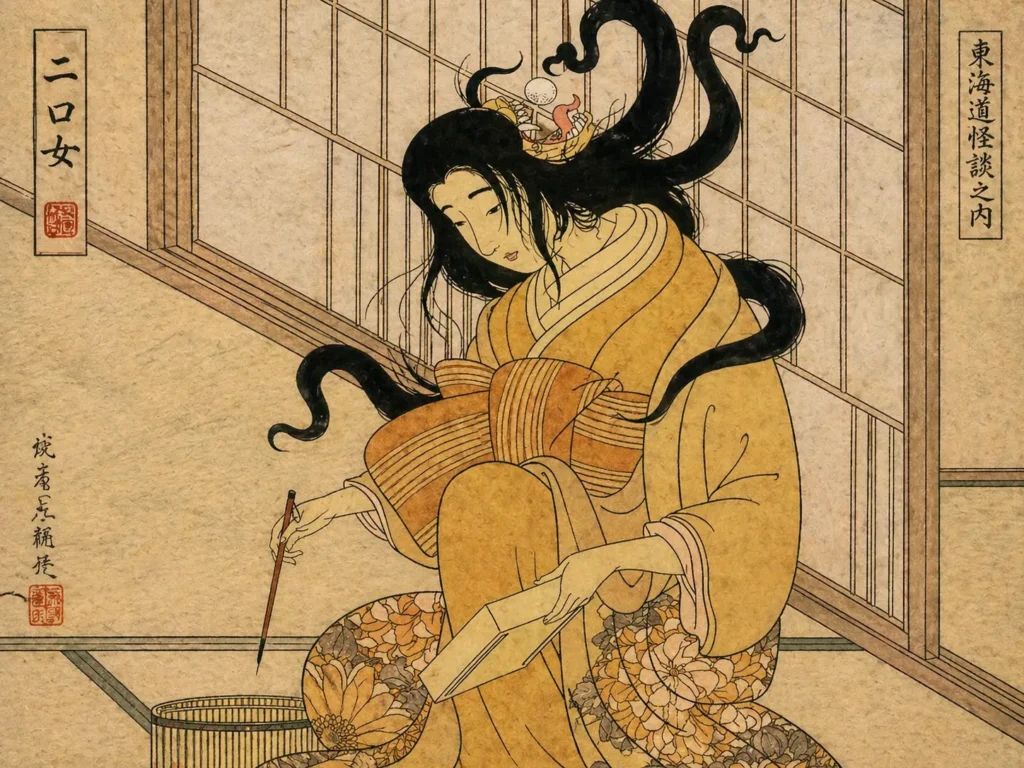
A clear contrast marks the Futakuchi-onna’s appearance. From the front, she looks like a normal woman, often beautiful or modest. She usually wears a kimono and styles her hair to hide the back of her neck and the back of her head. This normal look helps her fit in at home.
The real horror is at the back of her head. Under her thick, dark hair is a large second mouth that stretches across her skull. This mouth has sharp, jagged teeth and a strong tongue. While her main mouth might stay closed or eat very little, the second mouth is always busy.
The most unsettling feature is her hair, which acts like extra arms. The long strands can grab chopsticks, rice paddles, or food and bring them to the back of her mouth.
In art, especially Ukiyo-e prints, her hair is often shown as two thick ‘arms’ feeding the mouth while her real hands do other things. Her eyes often look tired and sunken because the second mouth drains her energy.
You may also enjoy:
Who Is Arioch, the Demon of War and Vengeance?
January 21, 2026
Who Is Asmodeus in Demonology and the Bible?
February 18, 2026
Who Is the Demon Andras, The Great Marquis of Discord?
January 15, 2026
Who Is the Infernal King Balam? Origins, Powers, and Occult History
February 26, 2026
Barbas: The Lion Demon Who Spreads Disease
March 3, 2026
Al-Ahmar: The Tuesday King of the Seven Jinn
February 13, 2026
Origins and History
The Futakuchi-onna became a well-known creature during the Edo period (1603–1868), a time of fast-growing cities and strict social rules. The ‘ie’ or household system was central, and wives were always watched for how they managed the home.
Famines like the Great Tenpō Famine put huge pressure on families, making food sharing a matter of survival. This likely led to the creation of this yōkai.
From my research, I think the Futakuchi-onna is a version of the ‘wicked stepmother’ idea, made even stronger by times of food scarcity. I noticed that stories about her appeared in popular books (kusazōshi) as they became common. She became a symbol of the fear that a woman could secretly harm a family’s well-being while pretending to be good.
I believe this story is more about strict rules than the supernatural. In a society where women had to eat last and least, the ‘Two-mouthed woman’ shows what happens when that pressure becomes too much. The myth warns women to be generous and not hide their hunger, and it warns men to look out for what their wives might be hiding behind a calm appearance.
Habitat
The Futakuchi-onna lives only in the home. Unlike spirits found in forests or on bridges, she stays in the center of family life. She is linked to the kitchen and the grain storehouse. Since she needs to eat in secret, she prefers homes where she can easily reach the pantry.
In many stories, she lives in rural villages, staying with farmers or small shop owners. She likes places where she can keep her secret, often with a husband who doesn’t notice much or is happy with her ‘frugality.’ She doesn’t haunt the home like a ghost, but instead lives there like a parasite, turning a place meant for feeding into one of loss.
Famous Futakuchi-onna Legends and Stories
The Stingy Wife of the Rice Merchant
In this well-known story, a stingy man who didn’t want to pay for a wife’s food found a woman who said she never needed to eat.
Happy to save money, he married her. For months, his grain stores stayed full, and his wife looked healthy even though she never ate in front of him. But soon, he noticed his rice was disappearing much too quickly.
One day, he pretended to go to work but hid on the rafters in the storehouse to watch his wife. To his shock, he saw her let down her hair, revealing a huge, toothy mouth at the back of her head. Her hair acted like hands, grabbing large amounts of rice and feeding the hungry second mouth, which chewed loudly.
The merchant tried to leave her, but she turned completely into a monster and tried to carry him off in a tub. He managed to escape by hiding in a pond full of lilies.
The Curse of the Stepchild
Another well-known story is about a woman who married a widower with a child. She soon had her own child and started to resent the first one, thinking he used up too many resources. She fed her own child well but slowly starved the stepchild, who eventually died from hunger.
Forty days after the child died, the woman was chopping wood when her husband’s axe accidentally hit the back of her head. The wound wouldn’t heal.
Over time, it turned into lips and teeth. The wound started to demand food, screaming in the dead child’s voice if it wasn’t fed. The woman had to feed the back of her head for the rest of her life to keep the spirit quiet.
Futakuchi-onna Powers and Abilities
The Futakuchi-onna’s abilities are mostly physical, not magical. She can’t alter reality like powerful yōkai such as the Tengu. Still, she is very dangerous up close because of her unusual body.
- Prehensile Hair Manipulation: The ability to control individual strands or bunches of hair as if they were muscular limbs, capable of fine motor skills like using utensils.
- Insatiable Consumption: The secondary mouth can consume food at a rate ten times faster than a human, and it has teeth strong enough to grind through bone or hard grain.
- Auditory Mimicry: In some versions of the lore, the second mouth can speak, often mimicking the voices of those the woman has wronged or demanding food in a raspy, guttural tone.
- Autonomous Awareness: The second mouth often acts on its own, allowing the entity to “see” or react to threats from behind.
You may also enjoy:
Who Is Andromalius, and Why Is He the Last Demon of the Goetia?
January 20, 2026
Who Was Hiranyaksha, the Golden-Eyed Asura?
October 7, 2025
What Is Baku? The Bizarre Yōkai That Eats Nightmares
January 28, 2026
Aži Dahāka: The Three-Headed Dragon of Zoroastrian Mythology
January 14, 2026
Banasura: The Thousand-Armed Demon King
October 10, 2025
The Hunger of the Hearth
The Futakuchi-onna became a clear example of domestic horror during the mid-Edo period, showing how food shortages and strict household rules created this type of story.
While modern versions often focus on how she looks, I found that her first appearance in books like the Ehon Hyaku Monogatari (1841) matched a time when people were very worried about how families managed food.
In the early 1800s, Japan was dealing with the effects of the Great Tenpō Famine (1833–1837), when many vulnerable people, like stepchildren or the elderly, starved. The ‘Two-mouthed woman’ was not just a random monster, but a symbol that revealed the hidden sin of keeping food from others.
In my research, I saw that this story transformed from a loose oral tale to a formal yōkai as rural guilt moved into city life. I also noticed that the ‘miserly husband’ version focuses on a man obsessed with a wife who ‘eats nothing,’ showing a deep Edo-period fear of families that only look perfect on the outside.
Wives were supposed to be models of thrift. Still, the Futakuchi-onna shows that too much restraint is unnatural and will eventually come out in other ways. The second mouth, hidden at the back of the head, is a strong symbol of the ‘ura’ or hidden side of Japanese life, where private, secret needs betray the public image of goodness.
I think the most important symbol is her prehensile hair, which stands in for the woman’s lost control over her own actions. At a time when women’s hands were limited by housework and strict rules, the hair—usually a sign of a woman’s spirit and status—becomes the tool for stealing.
This shows a key psychological struggle: the more a family hides its true needs to appear perfect, the more likely it is to develop a ‘second mouth’ that will secretly undermine its wealth and reputation. The Futakuchi-onna is not just a glutton, but a sad warning about the dangers of trying to be perfect.
Traditional Defenses Against Futakuchi-onna
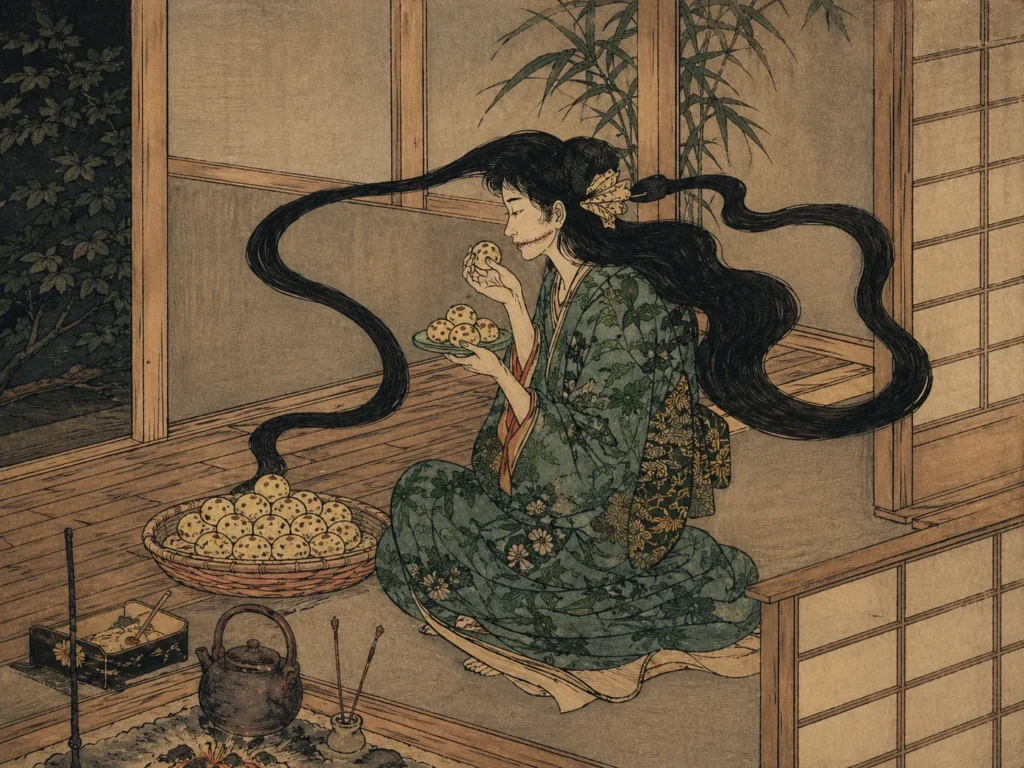
To protect against a Futakuchi-onna, you need to be alert and reveal her secret. Stories say that if someone sees her true nature, she loses her hold on the home and often runs away to the mountains. If she turns violent, people use spiritual charms called ofuda near the food stores to keep her away from the grain.
In more dangerous cases, like in the merchant’s story, nature can help. The merchant escaped by hiding in a swamp with sweet flag and lilies. The smell or purity of these plants is said to keep the Futakuchi-onna away.
People also use Buddhist chants or ask a priest to perform an exorcism on the ‘wound’ to silence the second mouth for good.
Futakuchi-onna vs Similar Spirits
| Name | Category | Origin | Threat Level | Escape Difficulty |
| Rokurokubi | Obake | Human cursed by karma | Low | Easy; they are often unaware of their state. |
| Yamanba | Yūrei/Oni | An old woman abandoned in the mountains | High | Hard; she is a powerful predator and sorceress. |
| Kuchisake-onna | Urban Legend | Vengeful spirit of a mutilated woman | Extreme | Very Hard; requires specific verbal riddles. |
| Hone-onna | Yūrei | A deceased woman seeking her lover | Medium | Moderate; requires holy sutras on the door. |
| Ohaguro-bettari | Yōkai | Spirit of an unmarried woman | Low | Easy; she only seeks to startle. |
| Kerakera-onna | Yōkai | Spirit of a giant, laughing woman | Low | Easy; she is a psychological nuisance. |
| Taka-onna | Yōkai | A woman who can stretch her body | Medium | Moderate; she targets the second floors of buildings. |
| Aka-onna | Yōkai | Red-skinned woman of the bath | Low | Easy; she primarily licks filth. |
| Ubume | Yūrei | A woman who died in childbirth | Medium | Moderate; requires helping her child. |
| Harionago | Yōkai | Woman with barbed hair | High | Hard; her hair hooks into victims. |
Symbolism
| Attribute | Details |
| Element | Earth (linked to grain, food, and the physical body). |
| Cardinal Direction | West (associated with the setting sun and the domestic hearth). |
| Color | Black (representing her hair) and White (representing the deceptive purity of her face). |
| Plant | Shobu (Sweet Flag) used for protection. |
| Season | Autumn (the time of harvest and food storage). |
| Symbolic Item | Rice tub (Ohitsu). |
The Futakuchi-onna represents the danger of hiding your true self in Japanese culture. She shows the taboo of ‘stinting,’ or keeping food from those who need it. In a society that values harmony and selfless mothers, she is a harsh reminder of what happens when private greed takes over public responsibility.
She also shapes yōkai stories by connecting human tragedy to the transformation into a monster. She symbolizes karmic payback, showing that private sins at home will eventually show up in real life. In art and festivals, she teaches children a lesson and reminds adults that real character is shown not by what you say, but by what you do in secret.
You may also enjoy:
Who Is the Infernal King Balam? Origins, Powers, and Occult History
February 26, 2026
Vritra: The Dragon Who Swallowed the Sky in Hindu Mythology
October 7, 2025
Who Is Astaroth in Demonology and the Ars Goetia?
February 20, 2026
Chort: The Sinister Slavic Demon of Chaos and Bad Luck
March 10, 2026
The Ghul: The Flesh-Eating Demon of Arabian Folklore
October 1, 2025
Who Is Aka Manto, Japan’s Terrifying Red-Cloaked Yōkai?
October 24, 2025
Bibliography
Author’s Note: During my research, I noticed an interesting evolution in how people viewed monsters over time. In the past, artists like Toriyama Sekien and stories from the “Ehon Hyaku Monogatari” used to see monsters as signs of something bad coming. However, they later started to be viewed more as lessons about morality. This evolution made me think about the wild and chaotic tales in the “Konjaku Monogatarishū” compared to the strict family norms during the Edo period in Japan. I chose to focus on the Futakuchi-onna, a mythical creature known for her dual mouths, as a symbol of poor resource management.
- Shunsen, Takehara. Ehon hyakumonogatari [One Hundred Illustrated Tales (of Monsters and Ghosts)]. Kinkadō, 1831.
- Sekien, Toriyama. Gazu hyakki yagyō [The Illustrated Night Parade of a Hundred Demons]. 1776. Internet Archive.
- Night Parade of a Hundred Demons. Yōkai Senjafuda, Mellon Projects, University of Oregon, glam.uoregon.edu.
- Kelsey, W. Michael. Konjaku Monogatarishū. Twayne Publishers, 1982. Twayne’s World Authors Series 621. Internet Archive.
- Davisson, Zack. (2026). The Persistence of Yōkai. Education About Asia. 29. 10.65959/eaa.1847. ResearchGate.
- Terajima, Ryōan. Wakan Sansai Zue. 1712. Internet Archive.
- Kyōkai. Miraculous Stories from the Japanese Buddhist Tradition: The Nihon Ryōiki of the Monk Kyōkai. Translated and edited by Kyōko Motomochi Nakamura, Harvard University Press, 1973. Harvard-Yenching Institute Monograph Series 20. Internet Archive.
- Ortabasi, Melek. Reading Tōno monogatari as Literary Realism: Yanagita Kunio’s Modernist Experiment. The Journal of Japanese Studies, vol. 30, no. 2, 2004.