
Lamia is a fascinating mythological creature symbolizing both maternal loss and divine punishment. Unlike other Greek underworld entities who act only as forces of chaos, she connects humans and gods, showing the shift from a rightful queen to an outcast.
Most sirens are known for their enchanting songs, but Lamia is different. Her threat comes from her closeness to the home and her attacks on children.
By comparing Diodorus Siculus’s historical accounts with Aristophanes’ satirical play The Wasps, this article distinguishes Lamia’s original tragic story from how later writers turned her into a demon. [View Full Bibliography ↓]
Summary
Key Takeaways
| Attribute | Details |
| Names | Lamia, Sybaris |
| Title | Child-devourer, Queen of Libya |
| Origin | Ancient Greece |
| Gender | Female |
| Genealogy | Daughter of Belus and Libya |
| Role | Predatory spirit, bringer of night-terrors |
| Associated Deity | Zeus (lover), Hera (adversary) |
| Brings | Infant mortality, madness, night-terrors |
| Weaknesses | Divine intervention, protective charms, exposure of true form |
| Realm/Domain | Libya (the wilder, uncultivated lands) |
| Weapon/Item | Shape-shifting ability, detachable eyes |
| Symbolism | The perversion of maternity, the jealousy of the gods |
| Sources | Diodorus Siculus, Aristophanes, Plutarch, Apuleius |
Who or What is Lamia?
In classical mythology, Lamia is a creature of deep sorrow who becomes a monster. She was once a queen of Libya and caught Zeus’s attention, which made Hera jealous. Hera killed all of Lamia’s children, and in her grief, Lamia grew to hate the children of others.
After this, Lamia withdraws into the wild and takes on a mixed form. She is known for her endless hunger for children and her skill at tricking men by looking beautiful before showing her true, monstrous self. Later stories turned her from a single myth into a type of female night-spirit who targets young men and babies.
“Lamia” Meaning
Researchers still debate where the name comes from. Some think it is linked to the Greek word laimos, meaning throat, which fits Lamia’s hunger and need to consume. Others believe it comes from the Semitic word lamash, which refers to night spirits in Mesopotamian stories.
Over time, the name Lamia shifted from referring to a single mythological queen to a general term. By the Hellenistic and Roman eras, writers used it to refer to any ghostly woman who seduced men and drained their strength.
This transition reflects a broader trend in classical literature, in which unique mythological characters became general symbols in stories warning against excess and forbidden desires.
How to Pronounce “Lamia” in English
In English, Lamia is usually pronounced as lay-mee-uh, with the stress on the first syllable and a long ‘a’ sound. The middle syllable sounds like ‘ee,’ and the last is a soft ‘uh.’ Some use a Latin-style pronunciation, but the English version is most common in literature and academia.
You may also enjoy:
Who Is Aka Manto, Japan’s Terrifying Red-Cloaked Yōkai?
October 24, 2025
Vaisravana: The Golden Guardian King Who Rules the North
October 16, 2025
Akateko: The Bloody Hand Yōkai That Guards a Cursed Temple Tree
November 14, 2025
Agubanba: The Blind Yōkai That Preys on Young Women
October 23, 2025
Tarakasura: The Dark Demon Who Ruled Hell on Earth
December 4, 2025
What Is a Bhuta? The Backward-Footed Ghosts of Hindu Horror
February 5, 2026
Origins
Lamia’s story goes back to the earliest Greek myths and appears in literature as early as the 6th century BCE.
Early stories, like those from the poet Stesichorus (c. 630–555 BCE), say Lamia was Poseidon’s daughter. However, Diodorus Siculus describes her as a mortal queen of Libya and daughter of Belus. This shows her dual nature: she is both a sea monster tied to ancient dangers and a tragic queen whose fall warns of grief and the gods’ anger.
Lamia’s story developed alongside other Greek ‘bogey-women’ like Mormo, Gello, and Empusa. These figures represented fears about the safety of infants and worries about women who did not follow traditional roles at home.
During the Classical period (c. 490–323 BCE), Lamia was often used as a threat to scare children into behaving, especially by Athenian mothers. Art from this time, like Attic black-figure vases (c. 500 BCE), shows her as a scary, sometimes hairy woman with large breasts and claws.
Many researchers see the Mesopotamian demon Lamashtu as a close cultural match, or even a source, for Lamia. Both focus on attacking newborns and pregnant women, and the name ‘Lamia’ may be related to the word lamash, which refers to night spirits in the Ancient Near East.
In the Hellenistic and Roman periods, Lamia’s image transformed a lot. According to the 1st-century CE Life of Apollonius of Tyana by Flavius Philostratus, she became more like a vampire—a beautiful, metamorph woman who preyed on young men.
Genealogy
Lamia’s family ties connect her to the royal families found in North African myths.
| Relationship | Details |
| Parents | Belus (King of Egypt) and Libya (daughter of Epaphus) |
| Siblings | Agenor, Aegyptus, Danaus |
| Spouse | None (Zeus is documented as a lover) |
| Children | All original children were destroyed by Hera |
What Does Lamia Look Like?
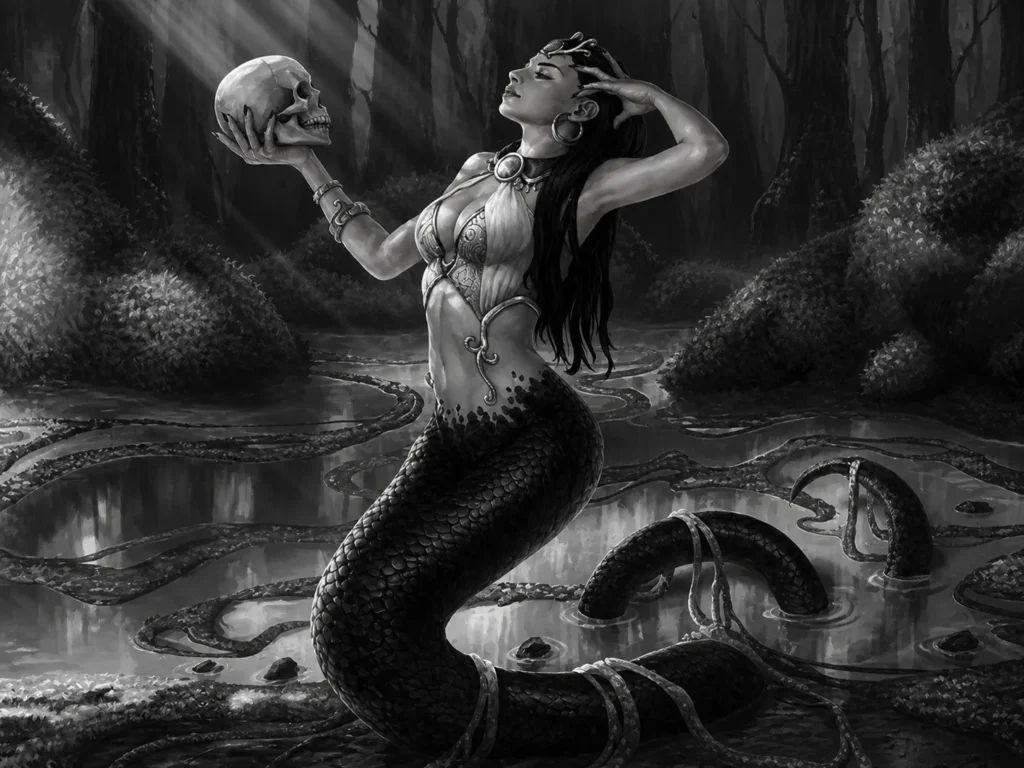
Lamia’s appearance is always changing, which fits her deceptive nature. She is usually described as having a beautiful human face and upper body to attract victims.
Still, her lower half is often shown as snake-like or scaly, showing her break from human society. One detail that appears often is her ability to take out her own eyes and put them in a jar, suggesting her sight is supernatural.
I believe that Lamia’s act of removing her eyes represents turning away from reality. By giving up her sight, she loses empathy and can no longer see her victims as people.
Connections to Other Ancient Demons
| Name | Genealogy | Type | Appearance |
| Lamashtu | Mesopotamian | Disease spirit | Lion-headed, donkey teeth, bird claws |
| Lilith | Mesopotamian/Hebrew | Night-spirit | Human female, often with wings or talons |
| Empusa | Greek | Shape-shifter | Bronze leg, donkey leg, human female |
| Gello | Greek | Child-snatcher | Pale, emaciated, ghostly woman |
| Strix | Roman | Night-bird | Owl-like, feathered, predatory bird |
| Succubus | Medieval/Folklore | Tempter | Beautiful woman, sometimes with demonic features |
| Onoskelis | Greek | Tempter | Human female with donkey legs |
| Hecate | Greek | Underworld deity | Three-headed, torch-bearing |
| Ereshkigal | Sumerian | Underworld queen | Majestic, winged, human-like |
Lamia Powers and Abilities
Lamia relies on psychological and physical tricks instead of raw power. She can alter her appearance to look like a human, allowing her to enter private places. Her main danger is upsetting family life, especially by harming nursing mothers and eating their children.
- Transformation: The ability to assume a pleasing human appearance to deceive victims.
- Supernatural Senses: Possession of removable eyes, allowing for surveillance beyond the physical body.
- Psychological Manipulation: The ability to influence the emotions of her targets to lure them into isolation.
- Speed: The capacity to move unseen through the night to snatch infants from their cradles.
You may also enjoy:
Empusa: The Blood-Drinking Wraith of Greek Mythology
November 20, 2025
Who Were the Hinn, the First Spirits of Creation?
November 12, 2025
Mahakala: The Dark Guardian Who Consumes Evil
October 16, 2025
Who Was Abezethibou, the Fallen Angel Who Opposed Moses?
October 1, 2025
Who Is the Demon Andras, The Great Marquis of Discord?
January 15, 2026
Ammit: Devourer of the Dead in Ancient Egyptian Mythology
November 10, 2025
The Displaced Grief
In my research, I noticed that turning the Libyan Queen into a child-eating ghost reflects a shift in how ancient Greeks viewed the ‘ideal’ mother.
While the myth blames Hera’s jealousy, the way people used Lamia’s name in stories was more practical: it helped set limits on women’s roles at home. By calling a grieving mother a ‘monster,’ society turned her pain into a threat to the family’s stability.
I think Lamia’s removable eyes are more than just a strange detail—they symbolize the dangers of seeing too much. In ancient times, women’s actions and even their gaze were tightly controlled. A monster who could take out her eyes and watch unseen broke all the rules about privacy at home.
When Lamia puts her eyes in a box, she turns the idea of the ‘guardian’ mother upside down. Instead, she secretly watches the home she once protected. I think this is why stories say she must be blinded or controlled—she represents the fear of a woman who sees beyond her expected role and refuses to be limited by her loss.
It is also worth considering that Lamia may have been a way for people to deal with fears about infant death in ancient times. While official religion asked the gods for help, families at home needed a clear ‘scapegoat’ to explain the sudden loss of children.
By blaming these deaths on a figure like the ‘Queen of the Wild,’ communities gave families a way to cope. The loss was not seen as a failure at home or a medical problem, but as the work of an outsider. Lamia became a symbol of fears too hard to face, turned into a monster so people could move on.
In the end, Lamia’s story shows how ancient societies dealt with trauma. I see a pattern in myths where a ‘demon’ is really just a human weakness—here, the wild grief of a parent—taken out of context and made into a legend.
By making the queen a wild creature, people were not just talking about a real threat, but showing the gap they created between ‘normal’ motherhood and the painful reality of losing a child.
Rituals, Amulets, and Protective Practices
In classical and Hellenistic times, people used defensive measures to protect against Lamia, aiming to stop her from taking babies or draining men’s strength.
They tried to create both physical and spiritual barriers around the home, making it a place where she could not enter. Since she was seen as a night-stalker who liked darkness and quiet, these protections often used noise, light, and special objects to keep her away.
Incantations and Ceremonies
There are few records of large public ceremonies against Lamia, since she was seen as a threat at home rather than in the city.
However, the Greek Magical Papyri show how people used special words and spells to drive her away. Healers at home would use ‘binding’ spells, calling on powerful gods and telling Lamia to leave or go back to the wild, showing she did not belong in the home.
People often used soot mixed with oils to mark doors and windows, hoping to make a barrier that Lamia could not cross. If a child seemed affected by her, families would burn things like frankincense or myrrh to cleanse the space, believing the smell would drive away the spirit because demons disliked these scents.
Amulets and Talismans
Amulets were important in nurseries, acting as constant protectors. They were often made from materials believed to have special powers, such as bronze and hematite. Bronze was prized because its sharp sound was believed to break Lamia’s focus and stop her from keeping her disguise.
Hematite, a dark iron-rich stone, was used because people thought its weight and coldness would ‘anchor’ a child’s soul, making it harder for Lamia to take it. These amulets often featured images of protective gods, such as the Gorgoneion, the head of Medusa.
The Gorgon’s gaze was seen as a ‘mirror of truth’ that would show Lamia’s real, monstrous form and make her run away. These charms were not worn by Lamia, but hung over cradles or pinned to babies’ clothes, creating a protective space stronger than her power.
Professional Practitioners
Most families handled simple protective rituals themselves, but serious problems like repeated child sickness or sudden male weakness needed experts called goetes or kathartai. These specialists knew a lot about Lamia’s supposed habits and weaknesses and used sympathetic magic to fight her.
A kathartes would typically perform a multi-stage process involving:
- The Inspection: Identifying the points of ingress (doors, windows, or cracks in the masonry) where the spirit gained entry.
- The Purification: Using water drawn from a sacred spring to wash the threshold, followed by the strategic placement of iron nails or charms at these points.
- The Invocation: Calling on chthonic deities to seal the home.
The practitioner acted as a go-between, ordering Lamia to leave by calling on the gods. This process was meant to restore the home to the family.
You may also enjoy:
Marid: The Ocean Jinn That Defies Heaven and Earth
September 30, 2025
Allocer: Great Duke of Hell and the 52nd Spirit of the Ars Goetia
November 17, 2025
Agubanba: The Blind Yōkai That Preys on Young Women
October 23, 2025
Bibliography
Author’s Note: While looking into the story of Lamia, I found a fascinating difference between the way ancient historian Diodorus Siculus described her and how later stories portrayed her. Diodorus presented her as a tragic queen from Libya, while later tales painted her as a wicked monster. By paying attention to these older accounts, I was able to move beyond the idea of Lamia simply being a “monster” and instead look at the deeper fears people had about losing their children and the importance of having safety in their homes. I also compared these stories with how playwright Aristophanes humorously used Lamia’s name, which helped me understand her transformation from a local legend into a broader symbol of fear within communities.
- Diodorus Siculus. Library of History. Translated by C. H. Oldfather, Loeb Classical Library, Harvard University Press, 1933–1967. Internet Archive.
- Plutarch. On Being a Busybody. Moralia. Vol. 6, translated by W. C. Helmbold, Loeb Classical Library, 1939. LacusCurtius.
- Apuleius. The Metamorphosis, or, Golden Ass, and Philosophical Works of Apuleius. Translated by Thomas Taylor, Robert Forder, 1893. Platonic Philosophy.
- Horace. Satires, Epistles and Ars poetica. Translated by H. Rushton Fairclough, Loeb Classical Library, William Heinemann / G. P. Putnam’s Sons, 1926. Internet Archive.
- Gould, John. Law, Custom and Myth: Aspects of the Social Position of Women in Classical Athens. The Journal of Hellenic Studies 100 (1980): 38–59. Web.
- González-Rivas Fernández, Ana. (2018). Reconstructing the Myth of Lamia in Modern Fiction Stories of Motherhood, Miscarriage, and Vengeance. International Journal of the Humanities. 16. 25-38. 10.18848/1447-9508/CGP/v16i01/25-38. ResearchGate.