Moving from the human world to the state of the Preta is considered a profound failure in the cycle of Samsara. The Jikininki is a clear sign of moral decline, where greed blurs the line between a spiritual leader and a scavenger.
Note: You can also find this entity in Japanese folklore; for more on their classification in Shinto-influenced traditions, see the Yōkai category.
By comparing stories from the Uji Shūi Monogatari with theological notes from the Kanjin Kakumu-shō, I have put together this article to separate the entity’s true Buddhist karmic roots from later, more commercialized folklore. [View Full Bibliography ↓]
Summary
Key Takeaways
| Attribute | Details |
| Names | Jikininki, Shokujinki, Gaki, Rakshasa (in certain syncretic contexts) |
| Title | Human-Eating Ghost |
| Region | Japan |
| Type | Buddhist demon / Yōkai |
| Gender | Typically male, though the class is technically gender-ambiguous |
| Realm | Preta-gati (Hungry Ghost Realm) |
| Obstacle/Threat | Necrophagy and the desecration of the deceased |
| Associated Figures | Musō Soseki, Gautama Buddha (canonical framework) |
| Weaknesses | Sutra recitation, offerings of food/incense, Segaki rituals |
| Associated Deity/Figure | Kannon Bodhisattva, Musō Soseki |
| Pantheon | Japanese Buddhist |
| Primary Sources | Uji Shūi Monogatari, Akutagawa Ryūnosuke’s modern interpretations |
Who or What is a Jikininki?
The Jikininki is a special type of hungry ghost, or gaki, known for its uncontrollable urge to eat the flesh of the recently dead. Unlike other spirits who might seek emotional closure, these beings are trapped by a karmic curse originating from lifetimes of selfishness, hypocrisy, or greed, often while serving as religious figures.
The Jikininki exist in a space between worlds, present in the human world but invisible to most people. During the day, they can sometimes appear as ordinary humans.
Still, at night, their real nature drives them to graveyards to scavenge. Their lives are filled with constant suffering, since eating brings no real relief or pleasure, only a brief break from intense hunger.
Jikininki Meaning
The name comes from Japanese kanji: jiki (食) means “to eat,” nin (人) means “person,” and ki (鬼) means “demon” or “spirit.” Together, the name means “human-eating ghost.” In Buddhist terms, they are sometimes called Rakshasa when referring to man-eaters, or, more accurately, seen as a type of Preta.
The way the name has changed over time shows how Indian Buddhist ideas blended into Japanese culture. In early Buddhist texts, the Preta suffered from internal fires or a very thin throat. Still, in Japan, the idea became more about a physical threat, especially the violation of funeral customs.
This change in language and ideas shows a shift from a spiritual punishment to a real social taboo: eating other humans became the ultimate penalty for living without true compassion or charity.
You may also enjoy:
Mahabali (Bali): The Benevolent Asura King
October 10, 2025
What Is Baku? The Bizarre Yōkai That Eats Nightmares
January 28, 2026
Who Was Hiranyakashipu, the Demon King of Hindu Mythology?
October 6, 2025
Tarakasura: The Dark Demon Who Ruled Hell on Earth
December 4, 2025
Hitotsume kozō: One-Eyed Yōkai of Japanese Folklore
February 4, 2026
Abura-akago: The Bizarre Oil-Licking Yōkai
October 22, 2025
How to Pronounce Jikininki in English
The name is pronounced JEE-kee-neen-kee. In English, all the vowels are short and clear. The stress is mostly even across the four syllables, with a bit more emphasis on the first and third. There are no silent letters or tricky sounds in the usual spelling.
What Does Jikininki Look Like?
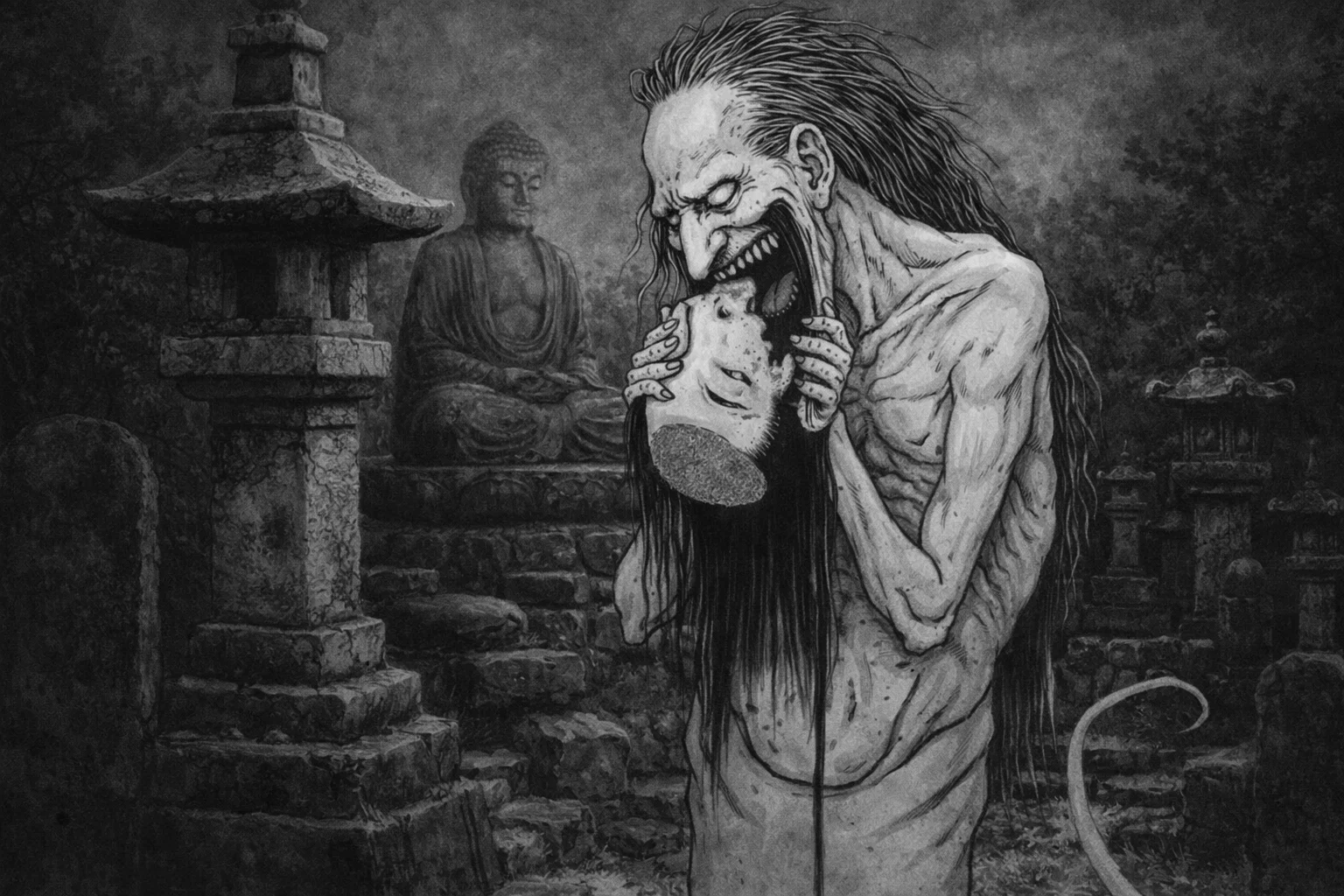
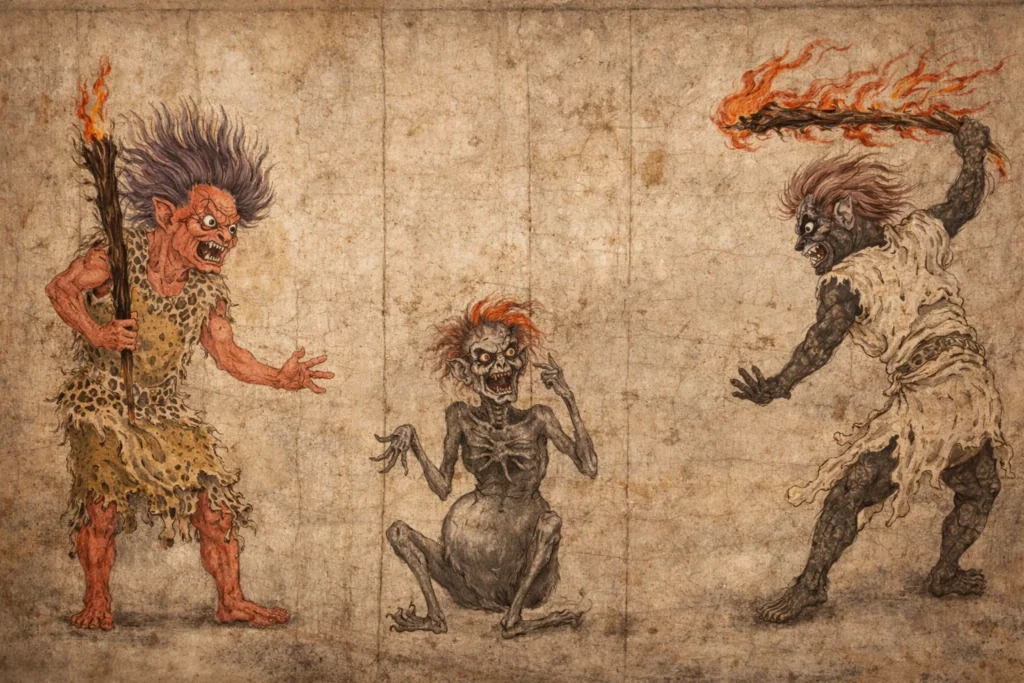
The Jikininki appears to symbolize both physical and spiritual decay. They are usually described as very thin, with skin stretched tightly over their bones, looking like parchment or dull leather. Their eyes often glow with a weak, sickly light or “phosphorescence,” helping them find bodies in dark cemeteries.
They are known for their sharp, jagged teeth and long, claw-like fingernails, which help them dig up graves and tear flesh. Many stories say they are very tall, over six feet, but always hunched over.
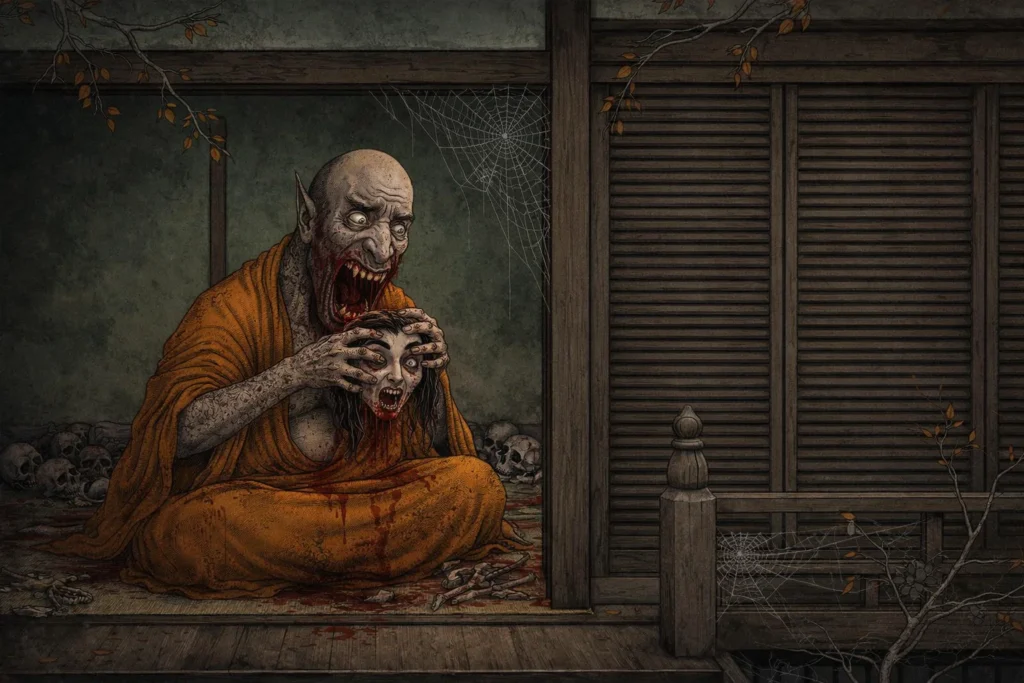
Some traditions say that a Jikininki can look like a normal person, often a priest, during the day to fit in. However, their real form is that of a decaying, monstrous scavenger.
Origins
The Jikininki come from Buddhist ideas about Karma and the Six Realms of Existence. The Kanjin Kakumu-shō and other commentaries say they were once people, often corrupt priests or monks, who did funeral services for money instead of faith. This kind of hypocrisy and lack of real belief creates a karmic burden that sends the soul into the Preta-gati after death.
This idea became popular during Japan’s Heian and Kamakura periods, when death rituals were very important to society. These stories warned the clergy that what mattered most was their true intentions, not just the outward rituals.
When someone fails to help the souls of the dead and only cares about money, they become a reflection of their own greed. Instead of praying for the dead, they can only interact with them by consuming them.
Powers and Abilities
Unlike other spirits, the Jikininki are strong in body yet spiritually trapped. They do not have the cosmic power of a Mara or the protective role of a Yaksha. Instead, they are lower in the demonic order, driven by instinct rather than careful planning.
- Illusion Projection: The ability to disguise themselves as ordinary humans or to make a desolate graveyard appear as a well-maintained temple.
- Invisibility: Remaining hidden from the sight of the living, appearing only to those with high spiritual sensitivity or those they intend to terrify.
- Superhuman Strength: Necessary for uprooting heavy gravestones and tearing through coffins.
- Paralysis: In some folk accounts, the mere sight of the creature can freeze a human in place through a form of spiritual dread.
Jikininki Myths, Legends, and Stories
The Encounter of Musō Soseki
One of the best-known stories about these creatures features the Zen master Musō Soseki. While traveling through the mountains in Mino Province, Soseki lost his way and sought shelter at a small hermitage.
The priest living there, who seemed lonely, told him to go to a nearby village instead. When Soseki arrived, the villagers told him their headman had just died. They were leaving the village for the night, as they always did after a death, because a strange being would come to eat the corpse.
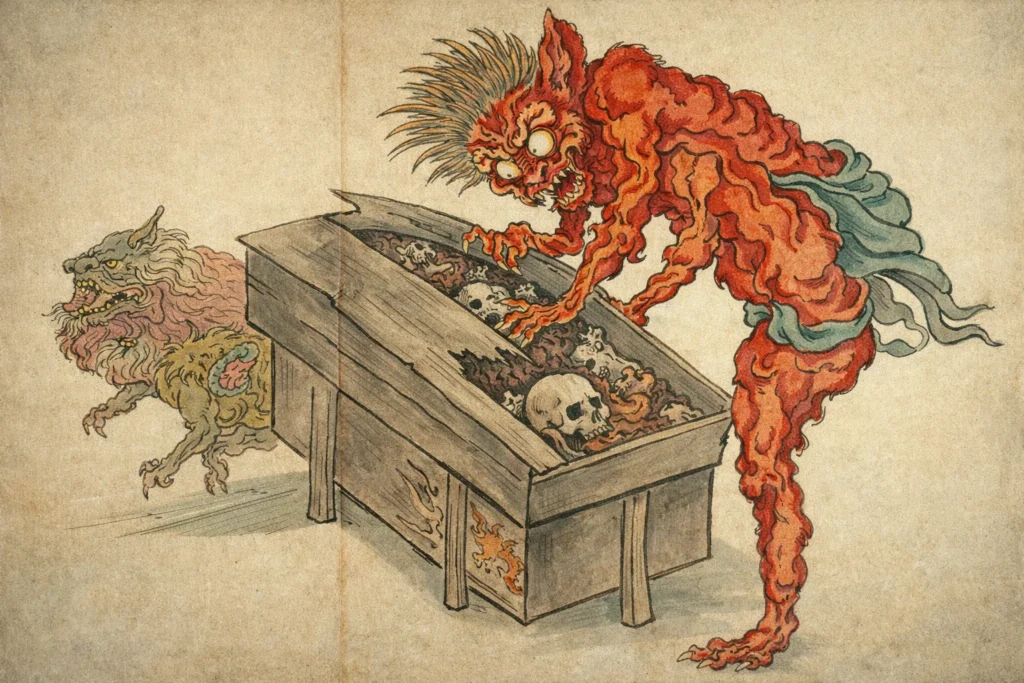
Soseki, known for his strong spiritual resolve, chose to stay and perform the funeral rites. As he meditated beside the body, a tall, monstrous figure entered the room. The creature quickly ate both the corpse and the offerings.
Soseki stayed calm in meditation, showing no fear. The next morning, the monster approached him and spoke, revealing that it was the same priest who had sent Soseki to the village.
The Jikininki explained that in its past life, it had been a monk who performed rituals solely for money, and was cursed to live in this form as a result. It begged Soseki to perform a Segaki ritual to free it from suffering. When Soseki agreed, the monster disappeared, leaving only an old gravestone behind.
The Priest of the Ruined Temple
In many rural folktales, the Jikininki are linked to old, abandoned temples. Often, a traveler finds a hidden temple where a quiet, thin monk gives him food. At night, the traveler sees the monk turn into a gray-skinned beast that slips away into the temple’s graveyard.
The next morning, when the traveler looks around, he finds the monk crying and talking about the “unspeakable hunger” that makes him break his vows every night. These stories highlight the creature’s struggle: it still feels human emotions and shame, but cannot stop itself from eating the dead.
You may also enjoy:
What Is a Rakshasa? Meaning, Origins, and Dark Powers
January 23, 2026
What Is Jorōgumo? The Deadly Spider Woman of Japanese Myth
February 2, 2026
Ambri: The Imperial Duchess of Caspiel’s Empire
December 1, 2025
Ammit: Devourer of the Dead in Ancient Egyptian Mythology
November 10, 2025
What Is a Pishacha, the Flesh-Eating Demon of the Dead?
February 11, 2026
Al-Ahmar: The Tuesday King of the Seven Jinn
February 13, 2026
Jikininki as a Critique of the Sacred
In my research, I found that the human-eating ghost reflects a cultural crisis during Japan’s medieval period. At that time, Buddhist funerals became more professional, but people still worried about dishonest priests.
While many people see these beings as just monsters, I believe their main role in the Uji Shūi Monogatari and later Zen stories is to act as a mirror for the clergy.
The main issue is not just eating flesh, but also using Buddhist teachings for personal gain. By turning a priest into a scavenger, the story shows how the line between sacred and ordinary can break down. The same hands that once performed rituals for freedom now dig in the dirt.
I find it interesting that these beings share language and symbols with the Indian Pishacha. But unlike the Pishacha, a wild forest demon, the Japanese version comes from within the temple. This shows a deep worry in society about the honesty of the Buddhist community.
During the 13th and 14th centuries, temples gained wealth and land. People began to fear that religious rituals were becoming empty and done only for money. The image of a priest feeding on the dead he was meant to help is not just a punishment for one person, but a criticism of the whole institution.
The way rituals for these spirits changed over time shows how Japanese Buddhism shifted its focus. In earlier times, as in the Gaki-zōshi (Hungry Ghost Scrolls), people performed the Segaki ritual for all wandering spirits.
But in Zen stories, especially those about Musō Soseki, the exorcism happens through a direct meeting between a true practitioner and a false one. The spirit is not forced out, but disappears when it recognizes its own shame.
This change signals a move toward genuine inner spirituality rather than mere ritualism, making the creature a symbol of the ‘shadow self’ on the path to enlightenment.
Jikininki vs Other Similar Entities
| Demon Name | Associated Obstacle/Role | Origin/Source | Key Traits/Powers |
| Mara | Temptation/Delusion | Pali Canon | Illusion, mental corruption |
| Gaki | Starvation/Greed | Abhidharma | Distended bellies, invisible |
| Yaksha | Nature Protection | Vedic/Buddhist | Superhuman strength, wealth |
| Kumbhanda | Vitality draining | Sutra literature | Energy vampirism |
| Oni | Punishment/Wrath | Japanese Folklore | Brute force, iron clubs |
| Preta | Eternal Thirst/Hunger | Samyutta Nikaya | Spiritual suffering |
| Pishacha | Eating raw flesh | Hindu/Buddhist | Possession, madness |
| Kappa | Drowning/Mischief | Shinto/Buddhist | Water manipulation |
| Rokurokubi | Social transgression | Japanese Folklore | Elongating necks |
| Yurei | Unfinished business | Edo Period lore | Haunting, curse-laying |
Mystical Correspondences
| Attribute | Details |
| Planet | Saturn (associated with decay and limitation) |
| Zodiac Sign | Scorpio (associated with death and the underworld) |
| Element | Earth (specifically cold, damp soil) |
| Direction | North-East (the Kimon or Demon Gate) |
| Color | Lead Gray or Ash White |
| Number | 6 (corresponding to the six realms of Samsara) |
| Crystal/Mineral | Obsidian (for grounding and protection) |
| Metal | Lead |
| Herb/Plant | Shikimi (Japanese star anise used in funerals) |
| Animal | Hyena or Vulture |
| Trait/Role | Necrophagy and Karmic Retribution |
The Jikininki are closely linked to ideas of decay and the stillness of graveyards. Saturn is their ruling planet, symbolizing the strict, unbreakable nature of their karmic punishment, like the walls of a spiritual prison.
In Japanese tradition, the North-East direction, called Kimon, is where demonic energy enters the world, matching their role as intruders from the Preta realm.
In rituals, Shikimi is important because it is a plant placed at Japanese graves to keep away scavengers, both animals and spirits. The dull color and metal links also highlight the heavy feeling of a soul that could not rise, weighed down by its past greed.
You may also enjoy:
Who Is the Jann in Islamic Mythology and Why Is He Feared?
October 2, 2025
Who Was Hiranyaksha, the Golden-Eyed Asura?
October 7, 2025
Palis: The Foot-Licking Desert Jinn That Drinks Your Blood
December 3, 2025
Gandharva: God, Spirit, or Demon?
November 13, 2025
Who Is Agares, the Demon of Earthquakes and Deception?
October 13, 2025
Who Are the Yaksha, and Why Did Buddhists Fear Their Wrath?
October 20, 2025
Bibliography
Author’s Note: What’s interesting about the Jikininki is the mix of vivid images from the Gaki-zōshi and the warnings in the Shasekishū, which made the story more than just a ghost tale. By focusing on the Uji Shūi Monogatari, I could look beyond the creature’s hunger to the deeper concerns it expressed about medieval Japanese priests. My research suggests this being is less a monster and more a symbol of karmic fate. This view comes from balancing strict Buddhist texts with the flexible oral stories of the time.
- Muller, A. Charles, translator. Yongjia’s Song of Actualizing the Way and Observing the Mind, Awakening from a Dream. BDK America, Inc., 2021. BDK English Tripiṭaka Series.
- Jones, S. W., translator. Ages Ago: Thirty-Seven Tales from the Konjaku Monogatari Collection. Harvard University Press, 1959. Scribd.
- Vasubandhu. Abhidharmakośabhāṣyam. Translated by Louis de La Vallée Poussin, translated from French by Leo M. Pruden, vol. 1, Asian Humanities Press, 1988. Internet Archive.
- Triplett, Katja. Buddhism and Medicine in Japan (31 Aug. 2021), in John Barton (ed.), Oxford Research Encyclopedia of Religion (New York, NY, online edn, Oxford Academic, 1 Oct. 2014 – ).
- Susanne Formanek, William LaFleur. Practicing the Afterlife: Perspectives from Japan. Vienna: Verlag der Österreichischen Akademie der Wissenschaften, 2004.
- Natali Cavanagh, Sarah James, & Shannon Walter. The Fate of a Materialistic Buddhist: A Cultural Edition of ‘Jikininki’ by Lafcadio Hearn. Digital Literature Review, vol. 8, 2021, pp. 116-27. Ball State University Open Journals.