
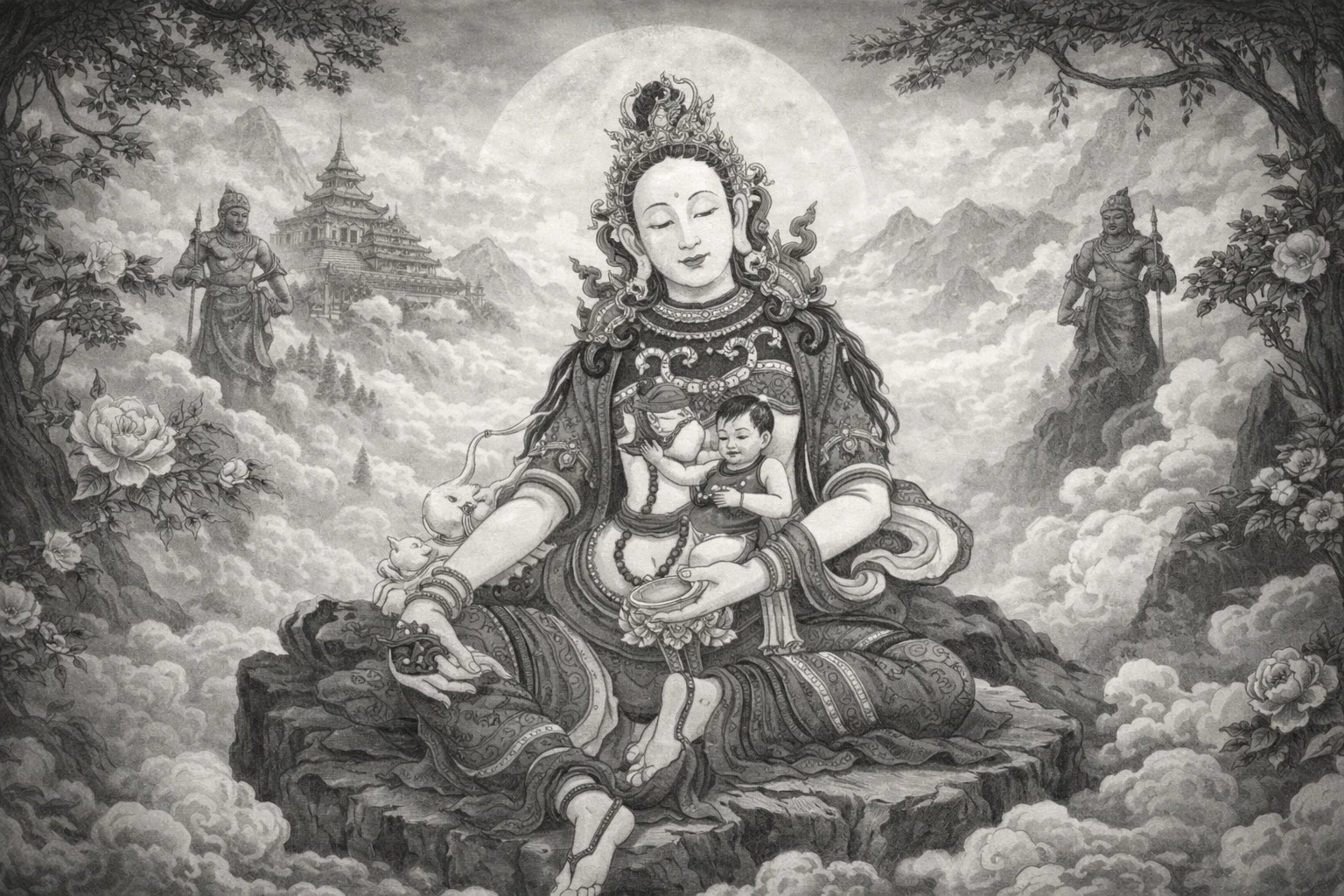
Hariti, the Mother of Ogres, is a key entity in Buddhist stories, showing a major moral transition from being a predator to becoming a protector. She represents the struggle between natural instincts and spiritual discipline, especially how fierce maternal energy can shift from harming others to supporting the Buddhist faith.
Her story is a classic example of how Buddhism incorporated local earth spirits into its religious system. Her change from a child-eating Yaksha to a protector of childbirth shows how Buddhism could adapt and transform local fears.
To keep this article accurate and based on verifiable sources, I focused on early sources, especially the Mulasarvastivada Vinaya, and compared later versions to these rules. This way, the main story of her transformation from predator to protector aligns with early Buddhist law. [View Full Bibliography ↓]
Summary
Key Takeaways
| Attribute | Details |
| Names | Hariti, Kishimojin (Japan), Guizimu (China), Nanda |
| Title | Mother of Demons, Protector of Children, Giver of Easy Delivery |
| Region | Gandhara, India, Tibet, China, Japan |
| Type | Yakshini, Dharma Protector (Dharmapala), Fertility Goddess |
| Gender | Female |
| Realm | Desire Realm (Kamadhatu), specifically the Yaksha division of the Four Heavenly Kings |
| Obstacle/Threat | Smallpox, infant mortality, and the abduction of children |
| Associated Figures | Gautama Buddha, Panchika (Consort), her five hundred children |
| Weapon/Item | Pomegranate, cornucopia, or a child held to the breast |
| Weaknesses | Attachment to her own offspring, subjugation through the Buddha’s wisdom |
| Associated Deity | Gautama Buddha |
| Pantheon | Buddhist (Mahayana and Vajrayana) with significant Vedic/Hindu Yaksha influences |
| Primary Sources | Samyukta Ratna Pitaka Sutra, Vinaya of the Sarvastivadin school, Lotus Sutra |
Who or What is Hariti?
In Mahayana and Vajrayana Buddhism, she is seen as a Yakshini, a type of semi-divine being found in nature.
At first, she was a harmful spirit who fed her many children by eating the children of Rajgir. After meeting the Buddha, her nature changed. She became a Dharma Protector, responsible for looking after monks and lay people, especially women and children.
Today, she is often called on as a kind goddess of fertility. Because she was once a demon and is now a saint, she is important in Buddhist rituals for safe childbirth and protecting children. She also appears as a demon in Hindu stories. For more about her earlier roots, see the Hindu Demons or Yakshas categories.
Hariti Meaning
Her name comes from the Sanskrit root “hr,” meaning “to seize” or “to steal.” This points to her original role as the “Stealer of Children.” In Sanskrit texts, her name describes her actions before she changed. In the Pali Canon and similar works, she is sometimes called Nanda. Still, that name is more general and used for other female spirits, too.
As Buddhism spread through Asia, her name changed in both sound and meaning. In China, she is called Guizimu, which means “Ghost Mother Spirit” or “Mother of Demon Children.” This name highlights her role as the leader of a group of demons.
In Japan, her name became Kishimojin. The characters still mean “Demon Mother Goddess.” Still, in Japanese Buddhism, especially in the Nichiren tradition, she is seen more as a protector. She is one of ten demon daughters who promise to protect the Lotus Sutra.
How to Pronounce Hariti in English
The Sanskrit name is pronounced HAH-ree-tee, with the stress on the first part and a short ‘i’ at the end. In Japanese, Kishimojin is said as KEE-shee-moe-jin, with a soft ‘j’ like in “judge.” In Chinese, Guizimu is pronounced GWAY-tzee-moo.
You may also enjoy:
Vaisravana: The Golden Guardian King Who Rules the North
October 16, 2025
What Is a Qareen and Why Does It Follow Every Human Being?
October 8, 2025
Aamon: The Infernal Marquis of Lust, Feuds, and False Prophecies
September 29, 2025
Marid: The Ocean Jinn That Defies Heaven and Earth
September 30, 2025
Who Was Ravana in Hindu Mythology and Why Was He Feared?
October 3, 2025
Who Is the Jann in Islamic Mythology and Why Is He Feared?
October 2, 2025
What Does Hariti Look Like?
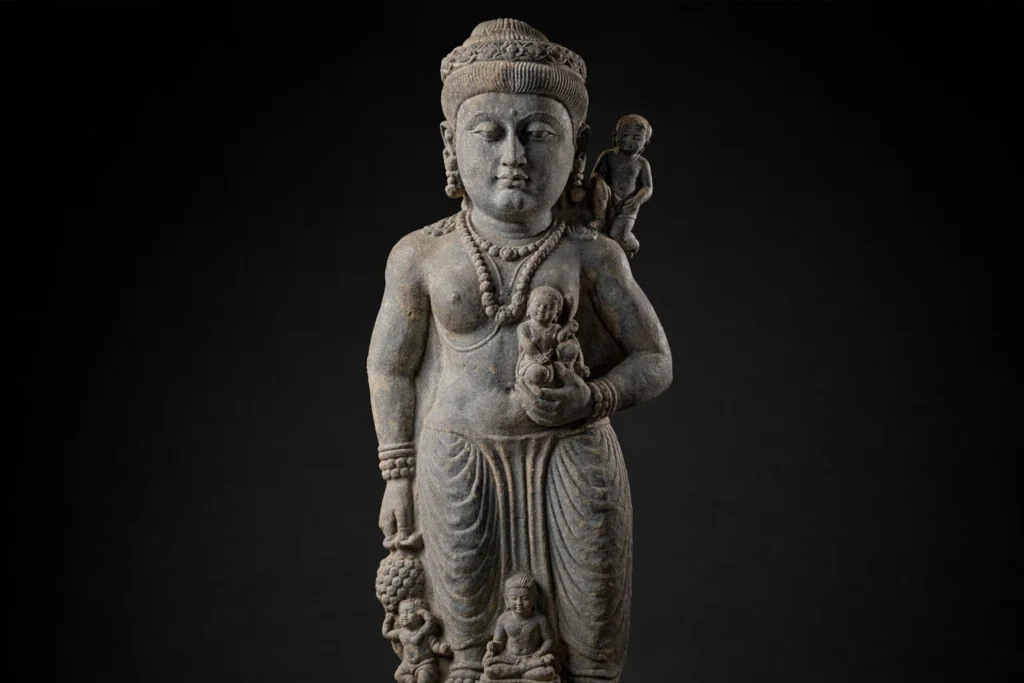
After her conversion, the way she was shown in art changed a lot. In early Gandharan and North Indian art, she appears as a dignified mother, sitting with several children around her. The children might be climbing on her, sitting in her lap, or playing at her feet.
She usually looks calm, which hides her scary past. In many statues, she has a pomegranate, a fruit with many seeds that stands for fertility and, according to legend, replaced human flesh in her diet.
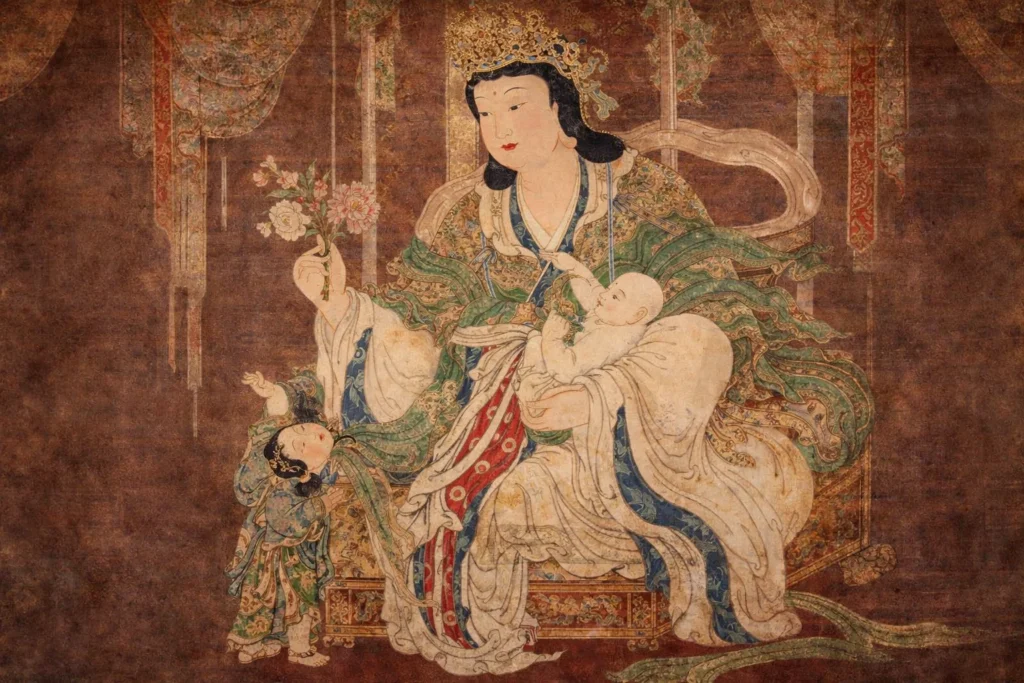
In East Asia, especially in Japanese Kishimojin statues, she can look peaceful or fierce. The peaceful form resembles a bodhisattva or a noblewoman holding a child. The fierce form might have claws, fangs, or a scary face, showing her hidden power and her past as a child-eater.
In Tibetan paintings, she is often shown in red or gold, sometimes holding a mongoose or a child, which shows her as a giver of wealth and life.
Origins
The first records of her appear in the Vinaya (monastic rules) and early Sutras from Northwest India, especially in the Sarvastivada tradition. She probably started as a local guardian spirit or as a symbol of childhood diseases like smallpox. As Buddhism grew in Magadha, stories about the Buddha helped turn these local spirits into part of the Buddhist tradition.
The story says she was first the daughter of a Yaksha in Rajgir. After a series of bad events and a vow for revenge, she became a demon who attacked people. When she joined the Buddhist pantheon, it marked her change from wild to civilized, as her great power was now controlled by Buddhist rules.
By the 7th century, the Chinese traveler I-Tsing wrote that her image was often seen in the porches or dining halls of Indian monasteries. People gave her food offerings to help keep the community safe and well-fed.
Sources
While Hariti does not appear in the early Pali Nikayas as a major deity, her historical record begins in the early centuries of the Common Era within the monastic codes and Mahayana scriptures of Northwest India.
“The Buddha said: ‘O Hariti, because you had five hundred children, you loved them dearly. But you ate the children of others. If someone were to take one of your children, would you not be grieved?’ She replied: ‘I would be exceedingly grieved.’ The Buddha said: ‘If you, with so many children, feel such grief, how much more must those feel who have only one or two?’ Hariti was then converted and received the five precepts.” [Mulasarvastivada Vinaya, approx. 2nd–3rd Century CE]
This early Sarvastivada text is the first organized attempt to bring the local Yakshini under Buddhist control. At this point, she is not yet a goddess of mercy but a subdued predator. The story uses reason and empathy, which is common in early Buddhist tales, to turn a wild spirit into a protector.
This version focuses on her as a Yakshini from Rajgir. Unlike later stories in which she is a heavenly protector, here she is tied to the real city, suggesting she was once a local plague goddess or a symbol of infant mortality. By having her follow the Five Precepts, the writers brought local fears under Buddhist control.
“There is an image of Hariti at the porch or in a corner of the dining-hall of all Indian monasteries depicting her as holding a babe in her arms, and with several children around her knees. Every day a plate of food is offered to her… She was originally a Yakshini of Rajagriha… The Buddha converted her, and she became the protectress of children.” [A Record of the Buddhist Religion as Practiced in India and the Malay Archipelago by I-Tsing, 691–692 CE]
This 7th-century source shows how she became part of daily monastic life. By I-Tsing’s time, she was no longer just a figure in texts but part of real rituals. The way she is described—holding a baby and surrounded by children—matches Gandharan art, which mixed Greco-Roman and Indian images.
This source shows the idea of a deal between monks and the spirit. The monks gave her food, and she protected the monastery. Feeding her, even after her change, suggests people still feared her hunger. This marks her shift from a monster to a guardian of the kitchen and health.
“There were rakshasis, the first named Lamba… the ninth named Kunti, and the tenth named Hariti, the mother of demon children… These ten rakshasis, together with the Mother of Demon Children, her children and followers, all went to the place where the Buddha was… and said: ‘World-Honored One, we too would protect those who read, recite, accept, and uphold this sutra.'” [Saddharma Pundarika Sutra (The Lotus Sutra), Chapter 26 (Dharani), translated by Burton Watson from Kumarajiva’s 5th-century Chinese version]
In the Lotus Sutra, her status varies a lot. She is no longer just a local spirit being corrected for her actions. Instead, she is one of ten demonesses who protect the highest Buddhist teachings. This raises her from a local fertility spirit to an important guardian in Mahayana Buddhism.
The use of Dharani (mystical chants) in this chapter shows that by the 5th century, people thought her name had protective power. The main issue here is guarding the scripture. If anyone attacked a teacher of the Lotus Sutra, these former demons would punish them harshly. This shows that, even though her role varied, her fierce nature remained useful to Buddhism.
“The deity of the Kishimojin-do is the Mother of Demon Children. In her right hand she holds a pomegranate, and in her left she cradles a child. She is the protector of the Hokke (Lotus) believers. Because the pomegranate resembles human flesh in taste and appearance, the Buddha gave it to her to satisfy her cravings after she vowed to stop eating infants.” [Edo-period temple record/folk tradition, codified in ‘Shinshu Honzo‘, 17th-18th Century]
This later Japanese source brings in the pomegranate, which is not found in the earliest Indian texts. This is an example of folklore changing the story. To explain Hariti’s shift from child-eater to protector, Japanese tradition linked the fruit to her past. The pomegranate’s red juice and many seeds stood in for the life she once took.
In Japan, especially in the Nichiren school, her role is more detailed. She is shown in two ways: as angry or as kind. This shows the mother figure’s power to both care for and harm. The pomegranate may also come from a mix-up with the citron fruit, which Yakshas often hold in Indian art, but was seen as a pomegranate as the story moved east.
You may also enjoy:
Palden Lhamo: The Black Goddess of Blood and Protection
October 20, 2025
Apophis: The Great Serpent of Egyptian Chaos
November 11, 2025
What Is a Yūrei? The True Meaning of Japanese Ghosts
January 30, 2026
What Is a Qareen and Why Does It Follow Every Human Being?
October 8, 2025
Bakeneko: A Supernatural Cat Yōkai in Japanese Folklore
January 27, 2026
What Is the Akkorokamui, Japan’s Colossal Sea Monster?
November 14, 2025
Powers and Abilities
Unlike Mara, who works on a cosmic level, this Yakshini’s power is more down-to-earth and focused on daily life. She has control over birth, growth, and death. Her powers are stronger than regular spirits (Pretas) but less than those of Buddhas and top Bodhisattvas.
- Fecundity Manipulation: She can either grant or withhold conception and successful childbirth.
- Protection from Malignancy: As a reformed demon, she has the authority to command lower-ranking spirits and ghosts to refrain from harming humans.
- Disease Control: Historically associated with the spread and cure of infectious childhood illnesses.
- Abundance Manifestation: Through her association with her husband, Panchika (a god of wealth), she is credited with the power to provide material prosperity to her devotees.
Hariti Myths, Legends, and Stories
The Hiding of the Youngest Son
The main story about Hariti tells of her encounter with Gautama Buddha in Rajgir. The legend says she had five hundred children, or even thousands in some versions, but still took and ate the children of the city. The desperate parents asked the Buddha for help.
The Buddha saw that Hariti acted out of a wild maternal instinct, so he chose not to use force. Instead, he used his powers to hide her youngest and favorite son, Priyankara, under his begging bowl. When Hariti came back and found her child gone, she was so heartbroken that it seemed to shake the earth. She searched everywhere for seven days but could not find him.
Tired and hopeless, Hariti finally went to the Buddha for help. The Buddha asked her, “If you, who have five hundred children, feel such agonizing pain at the loss of only one, can you imagine the suffering of the parents in Rajgir who had only one or two children, whom you have killed?”
When Hariti recognized her own cruelty by feeling the pain herself, she underwent a profound transformation. She repented and accepted the Five Precepts. The Buddha then returned her son. Still, she worried about how she and her children would survive without eating human flesh.
The Buddha promised that monks in every Buddhist monastery would offer part of their daily meals to her and her children, so they would never go hungry.
The Ten Demon Daughters
In the Lotus Sutra, especially in the Dharani chapter (Chapter 26), Hariti appears with ten Rakshasi, or demonesses. Together, she and the ten daughters go to the Buddha and promise to protect anyone who teaches or follows the Lotus Sutra.
She declares, “World-Honored One, we too would protect those who read, recite, accept, and uphold this sutra, and deliver them from decline and harm. Should anyone look for the shortcomings of these teachers of the Law, they shall not be able to take advantage of them.”
This story is important because it transforms Hariti from a local fertility spirit into a universal guardian of Mahayana scriptures. In Japan, this legend made her a key entity in Nichiren Buddhism, where she is seen as a strict yet caring protector of believers.
The Conversion of the Ogres
This version of her story focuses on the karmic reasons for her becoming a demon. It says that in a past life, Hariti was a pregnant woman forced to dance at a festival, which caused her to lose her baby. No one showed her any kindness, so she made a dark vow to be reborn as a being who would eat the children of that city.
This story shows the Buddhist idea of Vimana, where suffering leads to a twisted will. Hariti became a Yakshini because of her vengeful vow. The Buddha’s help was not just about saving the children of Rajgir, but also a “Karmic Intervention” that stopped her from falling further into lower states of existence.
By giving her the “Sweet Dew” of the Dharma and pomegranates as a new food, the Buddha ended the cycle of revenge.
Hariti vs Other Similar Entities
| Demon Name | Associated Obstacle/Role | Origin/Source | Key Traits/Powers |
| Mara | Spiritual distraction and death | Pali Canon | Illusion and emotional manipulation |
| Arakavata | Disease and drought | Central Asian texts | Control over atmospheric moisture |
| Pishachas | Consumption of flesh/energy | Vedic/Buddhist texts | Invisibility and madness induction |
| Pretas | Unquenchable hunger/attachment | Abhidharma | Manifestation of insatiable desire |
| Rakshasas | Chaos and physical violence | Ramayana/Sutras | Shapeshifting and immense strength |
| Kumbhandas | Vitality drainage | Mahayana Sutras | Draining the ‘essence’ of humans |
| Dakinis | Testing of spiritual ego | Vajrayana Tantras | Flight and transformative wisdom |
| Vetala | Possession of corpses | Indian Folklore | Necromancy and riddles |
| Yama | Judgment and mortality | Vedic/Buddhist | Soul adjudication and time control |
| Jurei | Haunting and vengeance | Japanese Folklore | Psychological terror |
| Gaki | Specific karmic hunger | Japanese Buddhism | Transformation of food into fire |
| Vinayaka | Obstruction of tasks | Early Tantras | Creation of minor calamities |
Mystical Correspondences
| Attribute | Details |
| Planet | Moon (associated with cycles and motherhood) |
| Zodiac Sign | Cancer (the maternal protector) |
| Element | Earth (chthonic origins and fertility) |
| Direction | North (often associated with the Yaksha kingdom) |
| Color | Red (vitality) and Gold (divinity) |
| Number | 500 (representing her children) |
| Crystal/Mineral | Carnelian (associated with the womb and blood) |
| Metal | Copper |
| Herb/Plant | Pomegranate (Punica granatum) |
| Animal | Lion (as a vehicle) or Mongoose |
| Trait/Role | Fierce Protection and Prolific Fertility |
Her mystical links focus on her shift from destruction (blood) to caring (milk). She is connected to the Moon and the sign Cancer, showing her rule over birth cycles and the strong, protective side of motherhood. In rituals, the pomegranate is the main symbol. It is offered to her as a stand-in for what she once craved, representing new life instead of real flesh.
She is also linked to the Earth element, which fits her roots as a Yakshini, a spirit tied to the land’s fertility and hidden riches. After joining the Buddhist faith, her powers transformed. She stopped guarding real treasures and started protecting the “Jewels of the Dharma” and children. She is also connected to copper, a metal often used in old medicine and home items.
You may also enjoy:
Who Is Ariton (Egyn), the Infernal King of the Eastern Gate?
February 17, 2026
Arāti: The Beautiful Demon of Aversion in Buddhist Mythology
October 15, 2025
What Is Baku? The Bizarre Yōkai That Eats Nightmares
January 28, 2026
Vaisravana: The Golden Guardian King Who Rules the North
October 16, 2025
What Is a Rakshasa? Meaning, Origins, and Dark Powers
January 23, 2026
Who Is Ahriman, and Why Is He Pure Evil Incarnate?
January 8, 2026
Bibliography
Author’s Note: To put this research together, I focused first on the Mulasarvastivada Vinaya to show her early role as a threat, then added the cosmic role from the Lotus Sutra. This helped me trace her transition from a local child-stealer to a guardian of the faith. By comparing I-Tsing’s travel notes with Japanese folklore, I confirmed that her image—changing from holding a cornucopia to a pomegranate—came from her journey across regions and cultures. This mix of scripture and real-life practice shows how she survived as both a former demon and a current protector.
- De Nebesky-Wojkowitz, René. Oracles and Demons of Tibet: The Cult and Iconography of the Tibetan Protective Deities. Mouton & Co., 1956. Internet Archive.
- Kern, H., translator. Saddharma-Puṇḍarīka; or, The Lotus of the True Law. Dover Publications, 1963. Internet Archive.
- Buswell, Robert E., Jr., and Donald S. Lopez, Jr. The Princeton Dictionary of Buddhism. Princeton University Press, 2014. Internet Archive.
- Kubo, Tsugunari, and Akira Yuyama, translators. The Lotus Sutra. 2nd ed., Bukkyō Dendō Kyōkai and Numata Center for Buddhist Translation and Research, 2007. BDK English Tripiṭaka Series. BDK America.
- I-ching. A Record of the Buddhist Religion as Practised in India and the Malay Archipelago (AD 671–695). Translated by J. Takakusu, Clarendon Press, 1896. Internet Archive.
- Lee, So Tju Shinta & Lee, Salim. (2025). Reflections on The Maitrakanyaka-Avadana at Candi Borobudur: The Teaching of Exchanging and Equalizing. AMERTA. 43. 1-20. 10.55981/amt.2025.4907. ResearchGate.
- YUAN, Quan. Praying for Heirs: The Diffusion and Transformation of Hāritī in East and Southeast Asia. Academia.edu.
- Bagchi, Pallabi. Demoness Hariti: Mythology, Art and Dissemination in South and Southeast Asia. Heritage: Journal of Multidisciplinary Studies in Archaeology 11.2 (2023-24): 648-661.