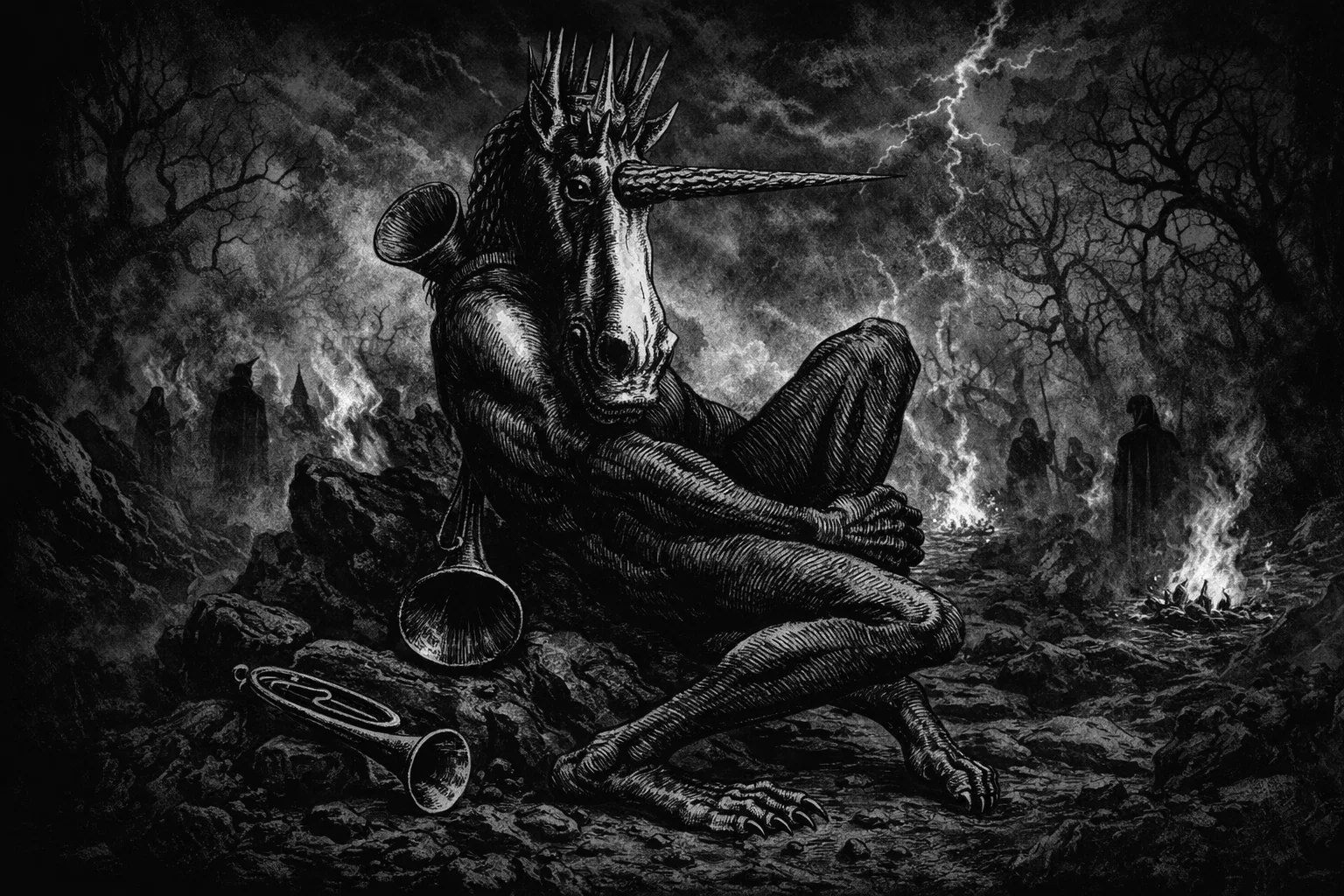
Unlike many Goetic entities known for causing physical or moral harm, Amdusias is remarkable for his control over atmospheric disturbances. He is more than just a spirit of noise; he leads the “invisible cacophony,” making the sound of trumpets and the movement of trees sensed before they are actually heard.
As his image shifts from a unicorn to a master of infernal music, Amdusias becomes a symbol of nature’s awe-inspiring power. He connects the wild noise of storms with the organized force of military music.
This article analyses modern depictions of the demon. It compares them with the original depictions of the Ars Goetia and the Pseudomonarchia Daemonum to provide an evidence-based historical profile. [View Full Bibliography ↓]
Summary
Key Takeaways
| Attribute | Details |
| Names | Amdusias, Amdukias, Ambuscias |
| Title | Duke, Great Duke |
| Gender | Male |
| Role | Distortion of nature, particularly trees; creating musical noise and disharmony; providing familiar spirits |
| Rank | Duke of Hell |
| Hierarchy | Commands twenty-nine legions of spirits |
| Legions | 29 |
| Powers | Causing trees to fall and bend against the will of the summoner; producing music and sound of all kinds; granting excellent familiar spirits |
| Associated Figures | King Solomon (who bound him), the 72 Spirits of the Ars Goetia |
| Weaknesses | Bound by the authority of the magician; subject to the divine powers invoked during the ritual (e.g., holy names) |
| Opposing Angel/Saint | Angel assigned by the Ars Goetia: Aiael |
| Pantheon | Christian Demonology, Solomonic Cycle |
| Primary Sources | The Lesser Key of Solomon (Ars Goetia), Pseudomonarchia Daemonum, Dictionnaire Infernal |
Who or What is Amdusias?
Amdusias is a powerful demon found in several well-known grimoires from the early modern period, especially The Lesser Key of Solomon and Johann Weyer’s Pseudomonarchia Daemonum. He is always listed as a Great Duke in the infernal hierarchy, giving him major authority over many lesser demons.
Amdusias mainly controls sound and nature. He can create music, though it is often discordant. He is also known for strange abilities, like making trees bend, fall, or move. Plus, he is said to provide powerful familiars, which magicians often seek for help in their rituals.
Like other Goetic demons, Amdusias is believed to have been bound by King Solomon and made to serve the commands of human magicians.
“Amdusias” Meaning
The name Amdusias is of uncertain etymology. Its origins are obscured within the specialized tradition of Solomonic demonology.
Like many names in the Ars Goetia, it was probably created from parts of Hellenic, Hebrew, or Latin words for ritual use, rather than having a clear historical or linguistic origin outside the grimoires.
The primary forms of the name that appear in the most influential texts are Amdusias, found in The Lesser Key of Solomon, and Amdukias, which appears in Johann Weyer’s 1563 catalog Pseudomonarchia Daemonum. A third, less common variation, Ambuscias, is sometimes cited.
The slight differences between the names usually come from being recorded in different languages and contexts. Weyer’s book, published before the Lesser Key of Solomon, was often used as a source for later demon lists. This means Amdukias could be the original or older version of the name.
How to Pronounce “Amdusias” in English
In English, the most common way to say the name is with four syllables: Am-doo-zee-ahs, with the stress on the second syllable: Am-DU-si-as. Another version, based on Amdukias, is Am-doo-key-as, also with the stress on the second syllable.
What Does Amdusias Look Like?
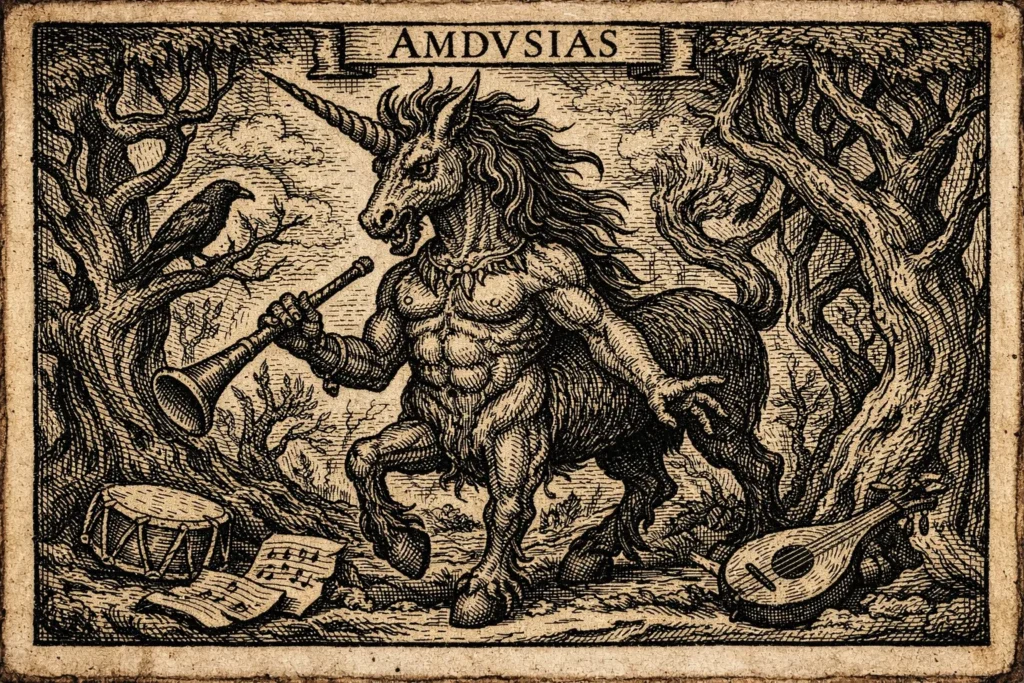
The main sources on Solomonic demonology describe Amdusias’s appearance in detail. The Lesser Key of Solomon says he first appears as a unicorn. This form is common in demonology and may stand for wild power or false purity. After the sorcerer commands him, he changes into the shape of a human man.
Even in his human form, Amdusias is not fully disguised because he is described as holding a trumpet. The trumpet clearly shows its main power: control over sound and music.
The unicorn form and the trumpet in his human shape appear in all the main grimoires. Collin de Plancy’s Dictionnaire Infernal also describes him this way, often showing Amdusias as a man with a unicorn’s head or riding a unicorn while holding a trumpet.
You may also enjoy:
Mahabali (Bali): The Benevolent Asura King
October 10, 2025
Amdusias in the Ars Goetia: The Demon of Dark Music
December 2, 2025
Who Is the Jann in Islamic Mythology and Why Is He Feared?
October 2, 2025
Barbas: The Lion Demon Who Spreads Disease
March 3, 2026
Erinyes: The Chthonic Goddesses Who Enforced Blood-Guilt
November 20, 2025
Ammit: Devourer of the Dead in Ancient Egyptian Mythology
November 10, 2025
Origins
The main demonology texts do not explain where Amdusias originally came from. Unlike more powerful demons like Belial or Asmodeus, who may have roots in older myths or religious stories, Amdusias comes from the Solomonic magical tradition, which was most popular in the 16th and 17th centuries.
As a result, the earliest confirmed mention of Amdusias is in Pseudomonarchia Daemonum (1563). Weyer’s text already says he can create music and bend trees, which means these traits were part of his story even before 1563.
Historical & Grimoire Records
Amdusias does not appear in the Bible or early Christian writings. His history starts in the late Middle Ages and early Renaissance, in the main grimoires of the Western mystery tradition.
Original:
“Amduscias magnus Dux: Procedit ut unicornu: Tubarum sonitus adest, si jubeatur: sonitus autem (ut omnia musica instrumenta) exauditur, sed nihil cernitur. Ad præceptum arbores se inclinant.” [Pseudomonarchia Daemonum, Johannes Wierus, 1577]
Translation:
“Amduscias a great Duke: he commeth foorth like an unicorne: the sound of trumpets is present, if he be commanded: also the sound (as of all musical instruments) is heard, but nothing is seene. At his commandement the trees doo bend.”
Weyer’s account is the main source that defines Amdusias, giving him the title of “Grand Duke” and describing the strange sounds linked to him. The key detail is the sensory paradox: the sound is “heard, but nothing is seen.”
This shows that Amdusias was first seen not as a physical danger, but as a master of atmospheric pressure and psychological tactics. In the late 1500s, the unicorn shape had two meanings: it usually stood for purity, but in Goetic magic, it meant wild, untamed power that only an exorcist could control.
The idea that Amdusias can make trees bend sets him apart from other spirits of the time. It suggests he has special control over the spiritus mundi, the invisible breath of the world, linking him to the growing interest in natural magic and the use of sound to affect the physical world.
“The Sixty-seventh Spirit in Order is Amdusias, or Amdukias. He is a Duke Great and Strong, appearing at first like a Unicorn, but at the request of the Exorcist he standeth before him in Human Shape, causing Trumpets, and all manner of Musical Instruments to be heard, but not soon or immediately.” [The Goetia: The Lesser Key of Solomon, S.L. MacGregor Mathers & Aleister Crowley edition, 1904]
This early 20th-century update to the 17th-century manuscript adds an important detail: “Amdukias” as another name. This shows how Victorian occultists cared about exact pronunciation in magical names. Unlike Weyer’s version, this text clearly lets the magician demand a “Human Shape,” showing a shift in demonology where the magician’s will controls the spirit’s form.
The detail that the music is heard “not soon or immediately” adds a sense of ritual timing and delay not seen in earlier texts. This shows a more complex view of how the spirit appears, treating the summoning as a slow process instead of something instant. This era marks the shift from religious exorcism to ceremonial “High Magic.”
Original:
“Amduscias, grand-duc aux enfers. Il a la figure d’un licorne; mais quand il est invoqué, il se montre sous une forme humaine. Il donne des concerts si on le lui commande; on entend alors, sans rien voir, le son des trompettes et des autres instruments de musique. Les arbres s’inclinent à sa voix. Il commande vingt-neuf légions.” [Dictionnaire Infernal, J.A.S. Collin de Plancy, 1863]
Translation:
“Amduscias, grand duke in hell. He has the figure of a unicorn; but when he is invoked, he shows himself under a human form. He gives concerts if he is commanded; one hears then, without seeing anything, the sound of trumpets and other musical instruments. The trees bow at his voice. He commands twenty-nine legions.”
The 1863 edition of the Dictionnaire Infernal is especially well-known for its detailed woodcut illustrations by Louis Le Breton. Earlier editions from 1818 had the text, but the 1863 version set the standard image of Amdusias as the upright, human-like unicorn that most modern occultists know.
In Planché’s 19th-century French play, the infernal bureaucracy becomes more formal. While Amdusias’s powers are the same as in Weyer’s account, the “Grand Duke” title is now part of a real “Hellish Court,” reflecting the era’s interest in strict hierarchies and military ranks. The phrase “He gives concerts” makes Amdusias seem less frightening and more like a spirit of the arts than the terrifying entity from the 16th century.
The number of legions Amdusias commands changes between 29 and 30 in different editions, showing how details about demons often changed as books were copied and illustrated. In this context, Amdusias becomes a figure of Gothic imagination, with a focus on the contrast between the elegant unicorn and the noisy, unseen orchestra.
Powers and Abilities
Amdusias has very specific powers, mainly focused on creating sounds and controlling nature. These abilities are usually described when it comes to being commanded by a magician:
- Can Force Trees to Bend and Fall: His most unique power is controlling the natural world, especially plants. He can make trees bend and fall, even if it goes against their nature or the wishes of those watching, just by the magician’s command. This shows he can cause changes or destruction in nature.
- Can Produce Music and Sound of All Kinds: Amdusias is known for his musical abilities. He can make music heard, often not right away or from a clear source, and sometimes in a way that sounds strange or hidden. This lets the magician create confusing or unsettling sounds. He causes all kinds of music to be heard.
- He Can Grant Familiars: Amdusias is known for giving the summoner powerful familiars. These are lesser demons or magical beings that help the magician in different ways, such as acting as spies or assistants in rituals. This makes him especially useful in magic.
- Assuming a Human Form: Amdusias can change from his main unicorn form into a human shape, but he still has a trumpet. This ability to transform is common among high-ranking Goetic demons and helps them interact in ways people can understand.
- Commands Legions: Amdusias leads more than twenty-nine legions of lesser demons, giving him great organizational and military power in the infernal hierarchy.
Amdusias and the Martial Architecture of Sound
Most Goetic catalogs focus on how the demon appears as a unicorn or a human, accompanied by loud music. Still, they often miss his role as a psychological weapon on late medieval and early Renaissance battlefields.
When the Ars Goetia was written, warfare was changing from hand-to-hand combat to gunpowder weapons, creating new kinds of fear on the battlefield. As the master of “trumpets and loud musical instruments,” Amdusias became the infernal patron of military signals and command in that era.
His power to make trees “incline” or “bend” is more than just moving objects with his mind. It is a metaphor for the strong pressure waves from loud sounds, similar to the effects of heavy artillery or large brass bands used to weaken enemy morale.
In language and ideas, Amdusias stands between the Pythagorean “Music of the Spheres” and the “Chaos of the Pit.” In Renaissance occultism, music was thought to connect the soul to the divine through mathematics. Still, Amdusias turns this on its head by offering the “inverted harmony” of the infernal court.
Looking at his link to the unicorn, which usually stands for purity and the unreachable, we see a clear twist on alchemical symbols. Here, Amdusias’s horn becomes a real “sonic conduit,” turning a symbol of spiritual grace into a weapon of sound. This means he is not just a demon of chaos, but one of strict, military order who uses sound to control nature.
From a historical perspective, Amdusias’s power to bend trees aligns with the 16th-century interest in “natural magic” and in controlling the elements through secret connections. For magicians of that time, Amdusias gave them control over the spiritus mundi, or world spirit, using the power of air.
This gives Amdusias a special place in the Goetic hierarchy: he is the expert in the space where invisible things, such as sound, become visible, for example, when wood bends. He stands for the deep fear of unseen forces—the idea that even the air can become a powerful weapon. Studying Amdusias is like tracing the history of “Acoustic Terror,” from the trumpets of Jericho to early modern psychological warfare.
Amdusias vs Other Christian Demons
| Demon Name | Associated Sin/Temptation | Rank/Origin | Key Traits/Powers |
| Bael | Idolatry, Pride, Deceit | King of Hell (Ars Goetia) | Power of invisibility; appears with three heads (man, toad, cat) |
| Paimon | Knowledge of Arts and Sciences | King of Hell (Ars Goetia) | Teaches all arts, sciences, and secret things; appears riding a dromedary |
| Bifrons | Necromancy, Witchcraft | Earl (Ars Goetia) | Teaches astrology and geometry; illuminates tombs and changes the position of dead bodies |
| Murmur | Philosophy, Coercion | Duke/Earl (Ars Goetia) | Teaches philosophy; compels souls of the dead to answer questions; appears riding a Gryphon |
| Gremory | Knowledge of Past, Present, Future | Duke (Ars Goetia) | Reveals treasures; procures the love of women; appears as a beautiful woman riding a camel |
| Orias | Transformation, Divination | Marquis (Ars Goetia) | Teaches the virtues of the stars; transforms men into any shape; appears as a lion riding a horse |
| Vine | Construction, Discovery of Secrets | King/Earl (Ars Goetia) | Builds towers and throws down walls; discovers hidden things and witches; appears as a lion on a black horse, holding a serpent |
| Purson | Hidden Secrets, Divination | King (Ars Goetia) | Reveals all things hidden, past, present, and future; appears as a man with a lion’s face, riding a bear |
| Valefar | Theft, Temptation | Duke (Ars Goetia) | Leads men to steal; appears as a lion with the head of a man, or a winged lion |
| Zagan | Transmutation, Wit | King/President (Ars Goetia) | Can change wine into water, blood into wine, and lead into gold; appears as a bull with Gryphon’s wings |
| Andromalius | Retrieval of Stolen Goods | Earl (Ars Goetia) | Brings back stolen goods and punishes thieves; appears holding a great serpent |
| Asmodeus | Lust, Gambling, Extravagance | King (Talmud, Grimoires) | Architect; appears with three heads (bull, man, ram); one of the Seven Deadly Sins |
| Belial | Lawlessness, Treachery | King (Biblical, Grimoires) | Incites sin and guilt; commands over fire; one of the first demons created after Lucifer |
| Mammon | Greed, Earthly Riches | Demon of Avarice (Biblical, later works) | Incarnation of wealth; not listed in the Ars Goetia |
Rank in the Hierarchy of Hell
Amdusias is always recognized as a Great Duke in Hell’s hierarchy. This rank places him among the top commanders listed in the Ars Goetia, and grants has military authority over many subordinates.
Because he is a Duke, Amdusias has a different role from that of the Kings of Hell, such as Bael or Paimon, who are his superiors. There are no records of direct alliances, but his rank means he would work with other Dukes and high-ranking demons, such as Marquises or Princes, to organize and command their legions.
Amdusias’s special powers mean his area of control is different from demons who focus on temptation, like Asmodeus, or lawlessness, like Belial. This likely reduces direct rivalry. Still, in the competitive Goetic system, all Dukes compete for power and influence.
Since he provides excellent familiars, Amdusias might help lower-ranking demons, such as Presidents or Earls, who need support with their magic. However, these relationships would still be under his higher authority as a Duke.
The system means that the many spirits under Amdusias’s command must follow his orders. They provide the force behind his destructive powers over nature and help spread his discordant music throughout the human world.
Mystical Correspondences
Amdusias is mainly linked to the energies of Saturn and the Earth element. Saturn, as his ruling planet, gives him qualities such as structure, boundaries, and seriousness. These traits fit his strict control over legions and his strong effect on nature, such as making trees fall.
His link to the astrological sign Capricorn, which is ruled by Saturn, also shows his connection to the Earth element and the North. These are traditional symbols of stability, structure, and the physical world.
These cosmic connections root Amdusias’s evil nature in the physical world. His control over trees and his ability to give familiars, which are physical helpers, show this Earth and Saturn influence.
Colors such as black and deep blue, and the metal lead, are also linked to Saturn. They are often used in rituals to channel Amdusias’s great but slow and heavy destructive power.
Amdusias’s Sigil
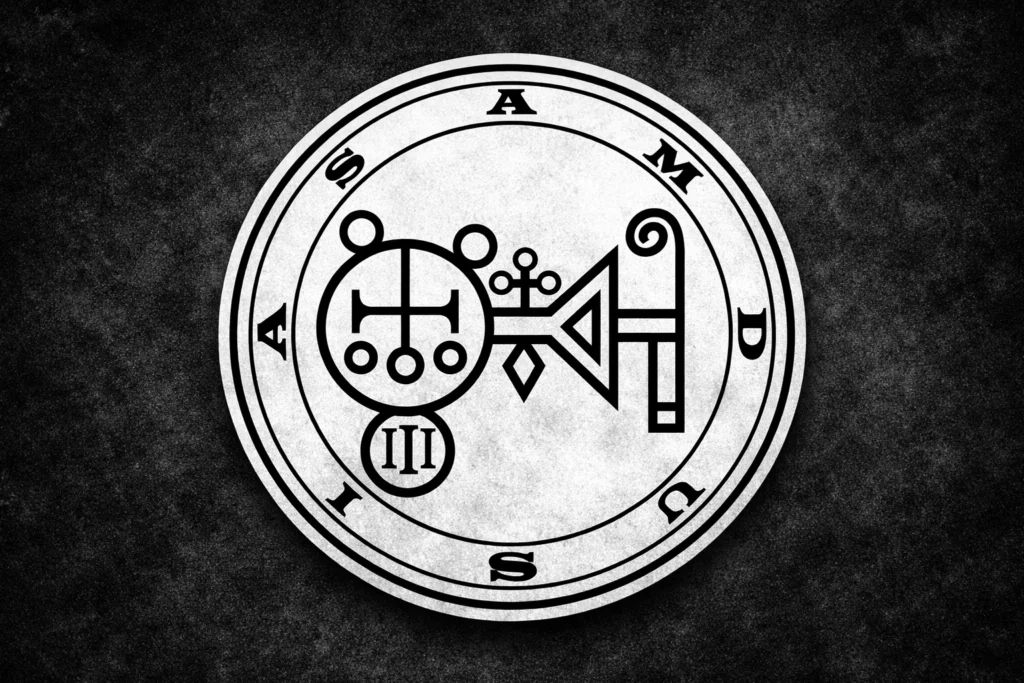
Amdusias’s sigil is a special symbol found in old magic texts. It is an important part of any ritual meant to summon or control Amdusias.
The sigil is a complex design made of angles, straight lines, and different symbols. Its look can change depending on the book. Still, it usually has a unique geometric style meant to show the essence of Amdusias’s name and power.
In the past, this sigil was seen as more than just a drawing; it was believed to focus the demon’s energy. For a ritual to work, the magician had to make the sigil exactly, often by carving it into metal, such as lead or tin, or by drawing it on parchment. Sometimes, they wore it as an amulet called a Lamen or placed it in a protective area called the Triangle of Art.
The sigil had two main uses: it was a command to summon the demon. Also, it served as a safeguard to ensure the demon would obey and not harm the person performing the ritual.
Summoning and Rituals
People usually called on Amdusias using Solomonic magic. This group included magicians, exorcists, and ritualists, many of whom were once linked to witches or warlocks. People did these rituals mainly to make Amdusias appear and use his special powers, such as making trees fall or giving magical familiars to help the magician.
To succeed in these rituals, magicians had to prepare carefully and follow strict rules to stay safe and in control. This usually meant making a protective circle on the ground, drawing the sigil on parchment or metal, and wearing a Lamen with the name of Amdusias’s controlling angel, Aiael.
The magician did not ask politely but used powerful names and special prayers to force Amdusias to appear, first as a unicorn and then as a human. The summoner would then give commands, believing Amdusias was bound by the same authority King Solomon used.
The whole process was formal and structured, designed to control the spirit for practical reasons, which were often manipulative or even harmful.
You may also enjoy:
Abadir: The Demon Servant of Chaos and Dispersion
September 30, 2025
What Is a Dīv? The Terrifying Giant Demon of Persian Myth
January 22, 2026
Ambri: The Imperial Duchess of Caspiel’s Empire
December 1, 2025
Iblis, the Jinn King of Darkness and Deception
September 29, 2025
Who Is Asmodeus in Demonology and the Bible?
February 18, 2026
Bibliography
Author’s Note: While putting together this demon profile, I noticed a strong contrast between the straightforward lists in Weyer’s Pseudomonarchia Daemonum and the more vivid, sensory descriptions in later 18th-century French texts. Comparing these grimoires with Gasdia’s study of religious feelings shows that the “auditory terror” of Amdusias likely reflected real Renaissance fears about invisible forces in the air. The main research challenge was matching the changing troop numbers between the Lemegeton and the Dictionnaire Infernal, which may point to a 19th-century effort to make the infernal hierarchy more organized. My analysis shows that Amdusias is not just a spirit of music, but a symbol of the shift from natural chaos to the structured violence of early modern warfare.
- Henson, Mitch, and Jeff Wellman, editors. Lemegeton: The Complete Lesser Key of Solomon. Metatron Books, 1999. Internet Archive.
- Solomon, King of Israel (attributed). The Key of Solomon the King (Clavicula Salomonis). Translated and edited by S. Liddell MacGregor Mathers, George Redway, 1889. Internet Archive.
- Weyer, Johann. Pseudomonarchia Daemonum. Edited and translated by Joseph H. Peterson, digital edition, 2000. Twilit Grotto: Esoteric Archives.
- Collin de Plancy, Jacques. Dictionnaire infernal: répertoire universel des êtres, des personnages, des livres, des faits et des choses qui tiennent aux esprits. 6th ed., Henri Plon, 1863. Internet Archive.
- Collin de Plancy, Jacques.Dictionnaire infernal: répertoire universel des êtres, des personnages, des livres, des faits et des choses qui tiennent aux esprits. 6th ed., Henri Plon, 1863. Internet Archive.
- Gasdia, Russell. Frightful Demons and Faithful Prayer: Possession, Exorcism, and Religious Sentiments in Johann Weyer’s De Praestigiis Daemonum and Reginald Scot’s The Discoverie of Witchcraft. Academia.edu.
- Tourtounis, Paraskevas-Marios. The Trumpet as a Medium of Communication in Military Life: A Philosophical Analysis through the Lens of Thomas Aquinas. International Journal of Music, 2021. IJM Education.
- Walden, Justine. The Devil in the Renaissance, or, Diabolizing the Political in Fifteenth-Century Florence. Renaissance Society of America Annual Meeting, Berlin, 26–28 March 2015.