Unlike many Japanese spirits that haunt specific places or carry out single acts of revenge, the Tengu really stand out. They close the gap between bird-like monsters and human-like masters of martial and spiritual skills.
These mountain spirits do more than haunt—they rule the mountain wilderness. They show the struggle between the strict Buddhist order and the wild, unpredictable force of nature. Unlike the oni, who punish with brute force, these winged beings challenge the pride of monks and warriors.
In this article, I analyze the idea of how the Tengu shifted from a sign from the heavens in the Nihon Shoki to a more complex creature associated with martial prowess in the Gikeiki. [View Full Bibliography ↓]
Summary
Key Takeaways
| Attribute | Details |
| Names | Tengu, Amatsukitsune, Kotengu, Karasu Tengu, Hanatake Tengu, Daitengu |
| Translation | Heavenly Dog (derived from the Chinese Tiāngǒu) |
| Title | Mountain Spirit, King of the Peaks, Patron of Martial Arts |
| Type | Yōkai / Kami / Yoshibu |
| Spirit Classification | Ara-mitama (rough spirit), though some are enshrined as protective Nigi-mitama; occasionally viewed as Goryō of arrogant monks. |
| Origin | Evolved from the Chinese meteor-dog; later identified as the reborn souls of arrogant priests or fallen warriors. |
| Gender | Predominantly male; rarely depicted as female in classical iconography. |
| Appearance | Avian-humanoid hybrids; earlier forms resemble crows (Karasu Tengu), while later forms are red-faced humanoids with exceptionally long noses. |
| Kehai (Aura/Presence) | Whirlwinds (Tengu-daoshi), the sound of giant trees falling in silence, phantom laughter, or the smell of mountain cedar and ozone. |
| Powers/Abilities | Aerokinesis, teleportation, shape-shifting, master swordsmanship, and possession (Tengu-tsuki). |
| Methods of Pacification | Offerings of rice (matsuri), Shinto ofuda charms, and the recitation of Buddhist dharanis to counter their prideful delusions. |
| Habitat | High mountain ranges, ancient cedar forests, and remote peaks such as Mount Kurama and Mount Takao. |
| Diet/Prey | Spiritually arrogant monks, lost travelers, or those who disrespect the sanctity of the mountain. |
| Symbolic Item | Hauchiwa (feather fan), Shakujō (Buddhist ringed staff), and Tokin (small black hat). |
| Symbolism | The danger of pride (hubris), the mastery of martial arts, and the bridge between human law and mountain law. |
| Associated Kami | Often associated with Sarutahiko Okami or serving as guardians for various mountain deities. |
| Sources | Nihon Shoki, Konjaku Monogatari, Taiheiki, Shasekishū |
The Fundamental Identity of the Tengu
The Tengu has a special place in Japanese folklore, acting both as a troublemaker for Buddhist law and a sacred guardian of mountain peaks.
They are not just one type of ghost, but a group of beings living between Heaven and Earth. Early stories describe them as bird-like creatures who kidnapped children and bothered monks. Still, over time, they became respected sword masters and protectors of holy places.
The Tengu are closely tied to the idea of Ma-en, or the ‘Demon-border.’ This place is for disciplined people like monks or samurai who cannot let go of their pride.
After death, they become winged beings, keeping their knowledge and power but unable to be reborn. They reflect human pride, appearing as red-faced, long-nosed figures dressed like mountain hermits.
Semantic Origins
The name comes from the Chinese characters 天 (ten) for ‘heaven’ and 狗 (gu) for ‘dog.’ It refers to the Chinese Tiāngǒu, a sky dog thought to eat the sun during eclipses.
In old Japanese texts like the Nihon Shoki (720 CE), the word described a shooting star that a Chinese priest called the ‘Heavenly Dog,’ whose bark was seen as a sign of war.
During the Heian period, the Japanese view changed a lot. The dog image faded and was replaced by bird-like features, likely due to the Buddhist Garuda, a giant mythical bird. The name stayed the same, but the spirit became known as the Karasu Tengu, or Crow Tengu.
In the Edo period, the spirit’s appearance changed again to that of the Hanatake Tengu, or Long-nosed Tengu. Researchers believe the long nose grew from the bird’s beak and represents pride, as the Japanese phrase hana ga takai, or’high nose,’ means arrogance. So, the name shifted from a sign in the sky to a symbol of ego.
How to Pronounce “Tengu” in English
To say the name in English, pronounce it as TEN-goo. ‘Ten’ sounds like the number 10, and ‘goo’ rhymes with ‘shoe’ or ‘blue.’ Use a hard ‘g’ as in ‘goat,’ not a soft’ j.’ Stress both syllables equally or slightly more on the first.
What Does the Tengu Look Like?
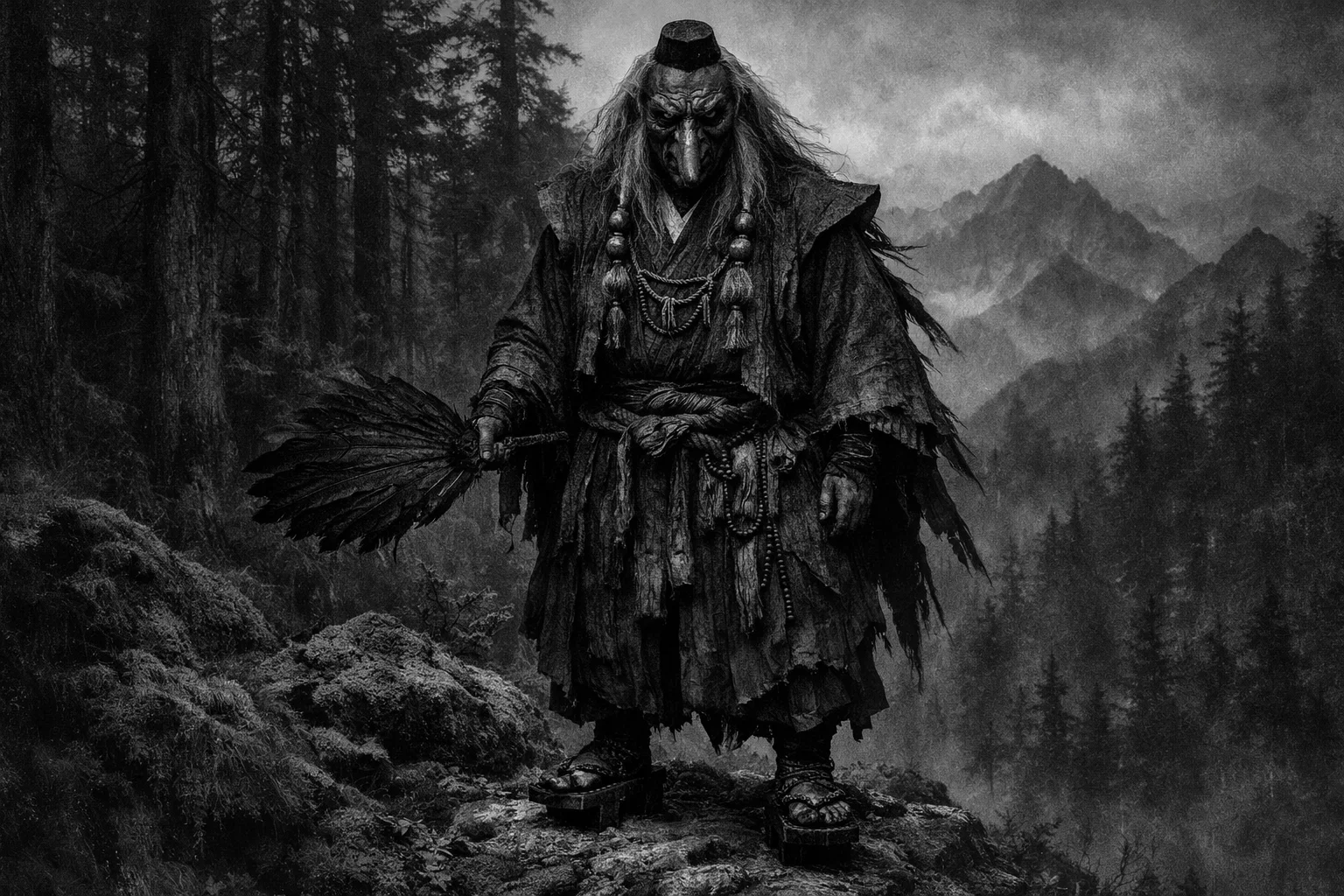
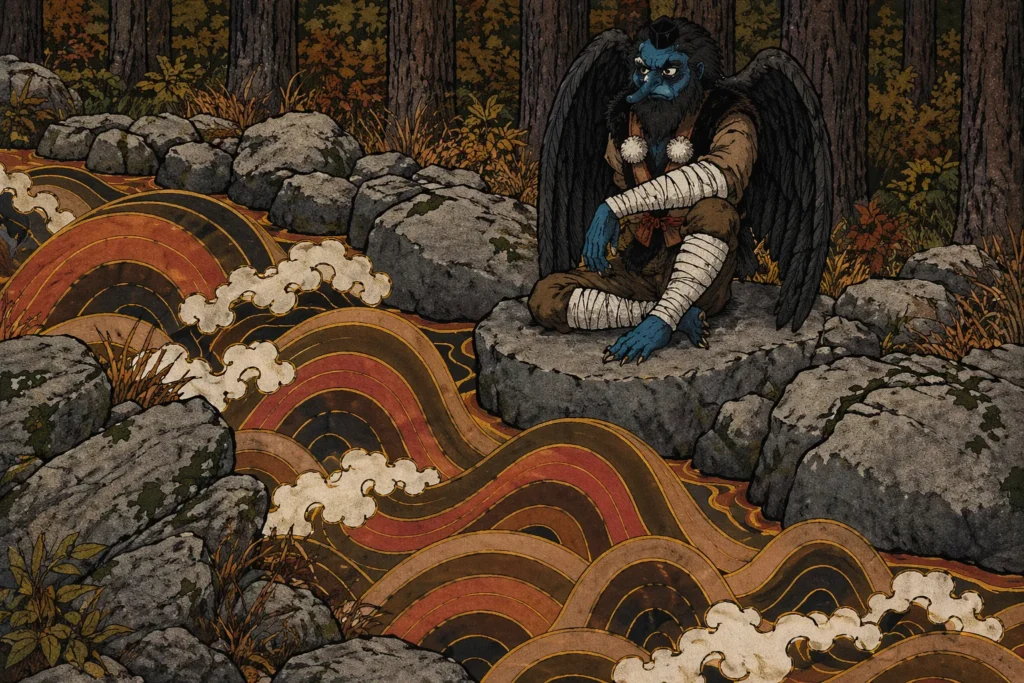
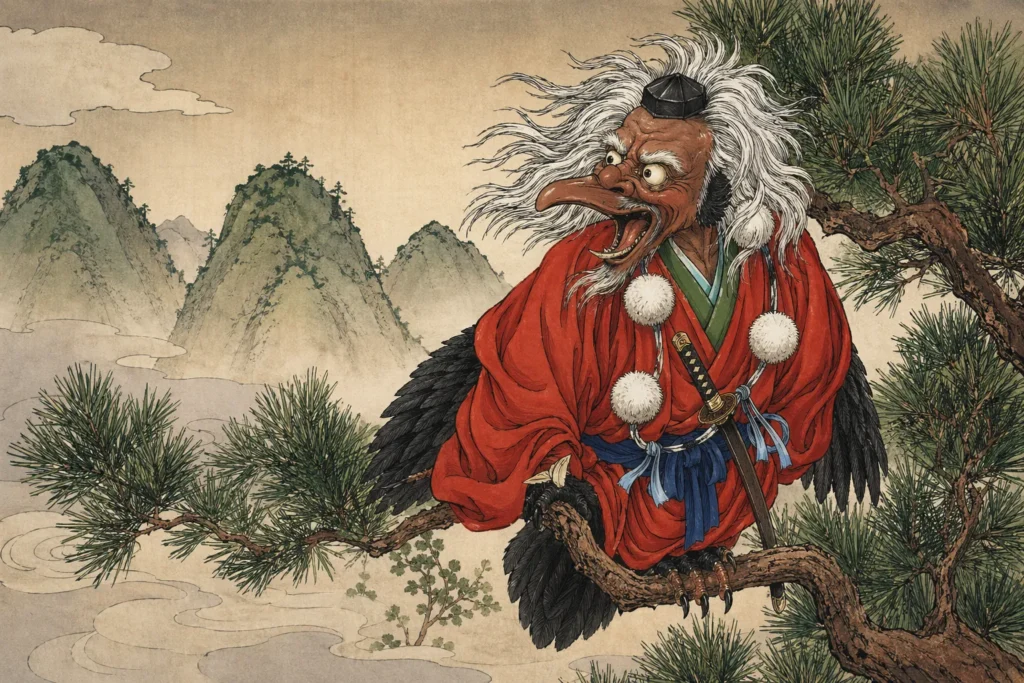
The way a Tengu looks varies a lot depending on the time period. The main form, called the Karasu Tengu, has a human-like body covered in feathers, a sharp bird beak, and large wings that work.
This form is usually shown wearing the robes of Yamabushi, or mountain monks, with a small black hat called a tokin on the forehead and a sash with pompoms. Their feet look like bird claws or wear single-toothed wooden sandals, helping them stand on rough mountain rocks.
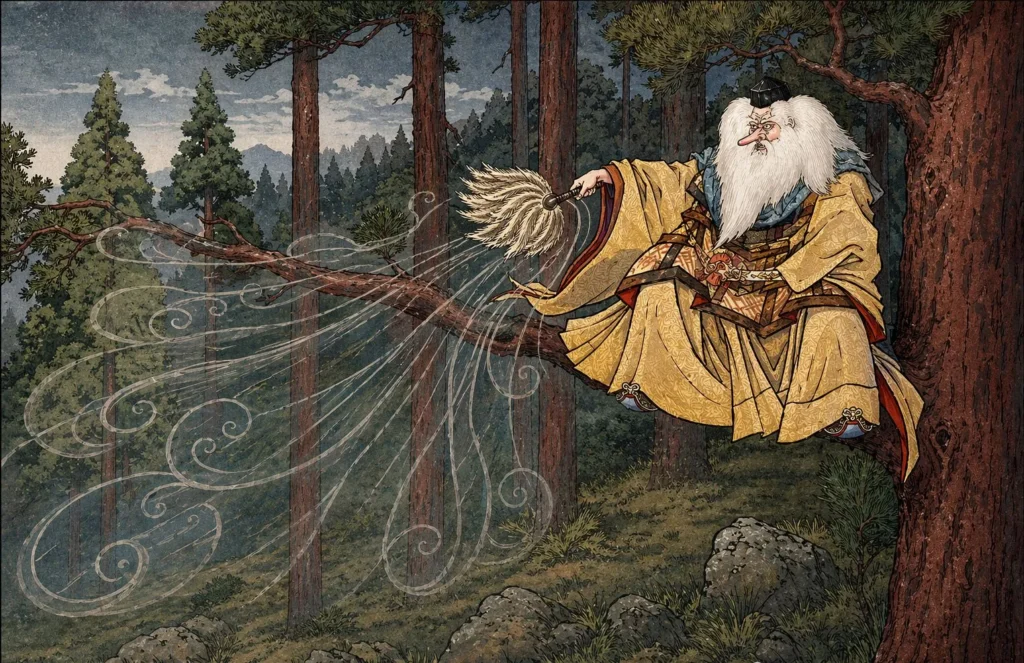
The stronger and more advanced form is the Daitengu, or Hanatake Tengu. This spirit has a human face with a bright red color and a long, thick nose. They are usually shown as old but strong men with long white beards.
They almost always hold a hauchiwa, a fan made from seven or nine feathers of a bird of prey. This fan is not just for show—it can create strong winds. They also carry a shakujō, a Buddhist staff with metal rings that make noise, showing their mix of demon and holy man.
You may also enjoy:
Vaisravana: The Golden Guardian King Who Rules the North
October 16, 2025
Who Is Adrammelech in Demonology and the Bible?
October 1, 2025
Who Is Andromalius, and Why Is He the Last Demon of the Goetia?
January 20, 2026
Lamia: The Queen Cursed to Devour the Children of Others
January 7, 2026
Mara: The Buddhist Demon King of Desire and Death
October 13, 2025
Origins and History
The Tengu appeared during the religious and social struggles of the Heian (794–1185) and Kamakura (1185–1333) periods. Buddhism was the main religion, but it often faced corruption. Many top monks got involved in politics and wealth.
Folklore experts say the first big stories about these winged spirits appeared when the Yamabushi rose to prominence. Yamabushi practiced Shugendō, a religion that mixed mountain worship, Taoism, and secret forms of Buddhism.
Looking at the timeline, I think this spirit symbolized the ‘Failed Ascetic.’ In the Sengoku period (1467–1615), when constant war raged, the mountains became safe havens for defeated warriors and wandering priests. Interestingly, the first stories of the ‘martial’ spirit appeared when people needed protectors the most.
The Tengu transformed from a child kidnapper to a famous sword teacher, especially known for teaching the hero Minamoto no Yoshitsune. This shows the spirit became a symbol of ‘hidden wisdom’ found in wild places, far from the corrupt city.
The evolution from a bird-like monster to the long-nosed ‘King of the Mountain’ matches the urban growth of the Edo period. As mountains became less mysterious and more controlled, the spirit became part of an organized folklore, with kings like Sōjōbō and set territories. This mirrored the Shogunate’s wish to control all parts of life, even the supernatural.
Historical & Folkloric Records
While the Tengu does not appear in the Kojiki or early Shinto foundational liturgies as a specific entity, its historical record begins in the Nara and Heian periods within the Nihon Shoki and later Buddhist didactic literature.
Original:
九年春二月丙寅朔戊辰。大星從東流西。便有音似雷。時人曰。流星之音。亦曰。地雷。於是。僧旻奏曰。非流星。是天狗也。其吠聲似雷耳。[Nihon Shoki (The Chronicles of Japan), 720 CE]
Translation:
Ninth year, Spring, second month… A great star floated from the East to the West, and there was a noise like thunder. The people of the time said: “It is the sound of a meteor,” or “It is earth-thunder.” Thereupon, the Priest Minomin reported to the Emperor: “It is not a meteor. It is the Heavenly Dog. Its barking sound is merely like thunder.
This record is the earliest mention of the Tengu in Japanese history. At this point, it had no human or bird form. It was seen as a sky event—a ‘Heavenly Dog’ from Chinese beliefs. The ‘barking’ Priest Minomin described was a sign of war, connecting the spirit to the Chinese idea of a meteor that brings disaster.
At this time, the name was only about astronomy. The spirit was a warning sign for the state, not a mountain being. There was no ‘Mountain Priest’ or ‘Bird-man’ image yet. The Tengu began as a formless cosmic force rather than a local ghost.
Original:
此ハ皆、平生、智解・勝徳アリテ、慢心深キ人ノ落ル道也。…其形ハ、擧体ハ人間ニ似テ、顔ハ鳥ノ如ク、左右ニ翼アリテ、虚空ヲ飛歩ス。[Konjaku Monogatari Shū (Anthology of Tales from the Past), Early 12th Century]
Translation:
These are all people who, in their ordinary lives, possessed intellectual understanding and superior virtue, but fell into this path due to their great pride… As for their form, the body resembles a human, the face is like a bird, and they have wings on both sides to fly through the void.
This source shows the big shift from a ‘Celestial Dog’ to a bird-like human. By the late Heian period, the spirit became Buddhism’s main enemy. The mention of ‘deep pride’ (manshin) sets the theme: these spirits are the reborn souls of proud, corrupt monks.
Unlike the Nihon Shoki, this text gives the first clear look at the Karasu (Crow) type. This transformation probably happened by mixing local mountain spirits with the Buddhist Garuda. It shows a time when Buddhist leaders struggled with pride, and the Tengu served as a warning to those who knew the law but could not control their egos.
Original:
鞍馬ノ奥、僧正ヶ谷ト云所ニ、究竟ノ大力ノ天狗共多集テ、晝夜ニ兵法ヲ修行シ、武芸ヲ練ル。[Gikeiki (Chronicle of Yoshitsune), Late 14th Century]
Translation:
In the depths of Kurama, at a place called Sōjō-ga-tani, many Tengu of supreme and great strength gather together, practicing the laws of war day and night, and honing their martial arts.
This source shows how the Tengu became a patron of martial arts. In the Muromachi period, it shifted from merely bothering monks to becoming a skilled warrior. Mount Kurama is still the most famous place linked to these spirits.
The idea of ‘practicing the laws of war’ shows a shift toward the interests of the Samurai. The spirit is now seen as a secret teacher, outside the Shogunate’s social order. This connects the spirit to the Yamabushi, whose forest training seemed magical to people in the lowlands. The spirit now represents hidden knowledge and ‘forbidden’ tactics needed in times of war.
Original:
「日本四十八天狗」其一、山城国愛宕山太郎坊。其二、近江国比良山次郎坊。其三、鞍馬山僧正坊。[Tengu Meigikō (Inquiry into the Names of Tengu), 1805 (Edo Period)]
Translation:
“The Forty-Eight Tengu of Japan.” Number one: Tarōbō of Mount Atago in Yamashiro Province. Number two: Jirōbō of Mount Hira in Ōmi Province. Number three: Sōjōbō of Mount Kurama.
This regional source shows the ‘Administrative Turn’ of the Edo period. The spirit is no longer just a wild monster but now has a rank in a supernatural order. Naming forty-eight lords and their mountains reflects the Edo era’s focus on organization and mapping.
Titles like Tarōbō (First-born boy) or Sōjō (High Priest) show that these spirits were now seen as local guardians or minor gods (Kami). This transformation happened during peaceful times, when people wanted spiritual order instead of fearing the mountains. It also marks the rise of the Daitengu (Great Tengu) as a higher rank than the Karasu types, similar to the strict classes of the Tokugawa Shogunate.
Original:
突然、杉の巨木の梢から、目もくらむような真っ赤な顔をした、鼻の長い男が飛び出してきた。[Notes on Tōno Lore (Yanagita Kunio collection), 1910]
Translation:
Suddenly, from the treetops of a giant cedar, a man with a long nose and a face so bright red it was dizzying to look at, jumped out.
This early 20th-century story shows the last stage of the spirit’s look: the Hanatake Tengu, or Long-nosed Tengu. The bird beak is gone, replaced by a red face and long nose. Yanagita Kunio, a key creature in Japanese folklore, recorded these stories to keep the ‘Kehai’ (presence) of the wild before industrialization.
The transition from a beak to a nose connects to the Japanese saying hana ga takai, meaning ‘to be proud.’ This physical feature turns the old idea of pride into something you can see. In this form, the spirit is less a teacher and more a guardian of the last wild forests, showing the final wild part of Japan before modern times.
You may also enjoy:
Who Is Ambolin, the Demon of Nighttime Dread
December 1, 2025
Who Were the Hinn, the First Spirits of Creation?
November 12, 2025
Agubanba: The Blind Yōkai That Preys on Young Women
October 23, 2025
Gandharva: God, Spirit, or Demon?
November 13, 2025
Empusa: The Blood-Drinking Wraith of Greek Mythology
November 20, 2025
Who Is Aka Manto, Japan’s Terrifying Red-Cloaked Yōkai?
October 24, 2025
Habitat
The Tengu traditionally live in deep, hard-to-reach mountain forests, especially in old, high places. Stories often place them on peaks like Mount Kurama near Kyoto, Mount Takao in Tokyo, and Mount Akiba. These spots are seen as borders between human life and the unknown.
They like to stay in the tops of giant cedar and pine trees. The thick leaves hide their flying, and the high mountains show their status—above people, but not quite in the heavens.
Their homes are often called invisible palaces or far-off shrines, seen only by people who have been ‘spirited away’ (kamikakushi). Living in the mountains fits their role as forest guardians, punishing those who cut trees or hunt too much.
Famous Tengu Legends and Stories
The Training of Minamoto no Yoshitsune
One of the most long-lasting accounts involves the young Ushiwakamaru (later known as the legendary general Minamoto no Yoshitsune). Following the defeat of his clan, the boy was sent to the Kurama-dera temple.
Consumed by a desire for revenge against the Taira clan, he stole away into the forest of Mount Kurama every night. There, he encountered Sōjōbō, the king of the mountain spirits. Recognizing the boy’s potential and his noble lineage, the red-faced king decided to train him.
Under the moonlight, the spirit and his winged subordinates taught the boy the secrets of swordsmanship, tactics, and superhuman agility. According to lore, Yoshitsune’s later ability to leap across boats at the Battle of Dan-no-ura was a direct result of these supernatural lessons.
The Abduction of the Priest of Kōfuku-ji
In the Konjaku Monogatari, a collection from the 12th century, a story is told of a certain high-ranking priest who was known for his extreme vanity.
One day, while he was traveling, he was suddenly snatched up by a great bird-like creature and carried to the top of a tall tree. For days, the monks of his temple searched for him until they heard a strange chirping from a high cedar. They found the priest sitting on a branch, covered in feathers and eating raw fish, believing he was attending a grand banquet with the Buddha.
This story shows the spirit’s power to create illusions, using the priest’s pride to drive him into madness and turn him into an animal.
The Tengu’s Invisibility Cloak
A popular folktale involves a clever human named Hikoichi and a young, gullible spirit. Hikoichi possessed a piece of bamboo that he claimed was a “heavenly telescope” that could see into the capital.
The curious spirit, wanting to see the city, offered to trade his takarabako (treasure box) and his kakuremino (invisibility cloak). Hikoichi agreed, took the cloak, and immediately became invisible.
He used the cloak to play tricks and steal food from the village. This story is one of the few in which a human outsmarts the spirit, but it also warns that using the spirit’s tools for selfish ends can lead to trouble.
Powers and Abilities
The Tengu are very powerful and are often ranked at the top of the yōkai world. They are seen as demigods of the wild, able to control the mountain’s forces. Unlike Kappa or Kitsune, who use tricks or water, these spirits use raw power and skilled fighting.
- Aerokinesis: Using their feather fans (hauchiwa), they can generate powerful gusts of wind, tornadoes, and “mountain gales” that can uproot trees or blow away entire buildings.
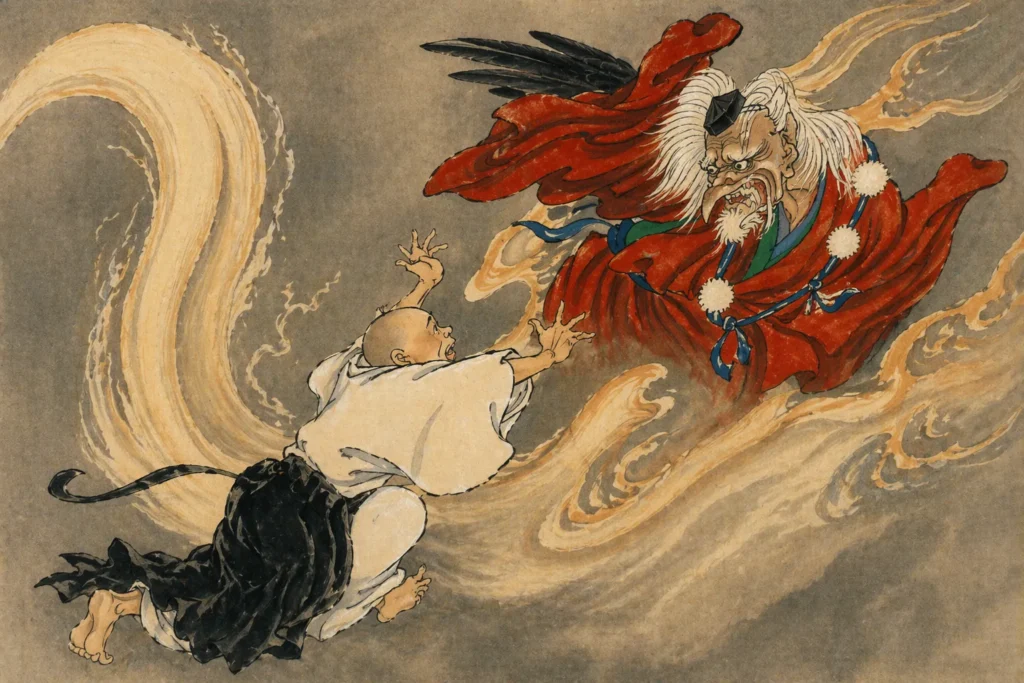
- Spirit Possession (Tengu-tsuki): They can enter the bodies of humans, particularly those who are spiritually weak or arrogant, causing them to speak in tongues, display sudden martial prowess, or fall into a state of prophetic madness.
- Metamorphosis: They frequently disguise themselves as wandering monks, elderly hermits, or large birds of prey to test the character of travelers.
- Teleportation: Known as Tengu-tsubute, they can move instantly through the forest or cause objects (like stones) to fly through the air and strike targets from invisible sources.
- Martial Mastery: They are considered the originators of many secret techniques in kenjutsu (swordsmanship) and jujutsu.
Traditional Defenses
The best way to protect yourself from a Tengu is to be humble and religious. Since they are attracted to pride, travelers who are humble and make the right offerings are usually safe. People also use Shinto ofuda (paper charms) or Buddhist sutras on wood, placing them at forest entrances or on doors.
If you face the spirit’s illusions, saying the Heart Sutra or the Dharani of the Victorious Buddha Crown is believed to break the spell. In the countryside, people scatter roasted soybeans or salt to purify the area, a method also used against oni.
Because these spirits follow a kind of ‘mountain law,’ making a formal agreement or leaving offerings like mochi (rice cakes) or sake at a shrine can calm an angry spirit. Most importantly, never boast about your achievements in the deep woods, as this attracts the spirit.
Tengu vs Similar Spirits
| Name | Category | Origin | Threat Level | Escape Difficulty |
| Oni | Oni | Transformed wicked humans | Very High | Moderate; can be outsmarted or repelled by beans. |
| Kitsune | Obake | Magical fox living 100+ years | Moderate | Hard; their illusions are near-perfect. |
| Kappa | Yōkai | Water deity that fell from grace | Moderate | Easy; bow to them so they spill their water. |
| Yuki-onna | Yūrei | The spirit of a woman died in the snow | High | Very Hard; she freezes victims instantly. |
| Tsuchigumo | Yōkai | Ancient earth-dwelling spiders | High | Hard; they use webs and poison. |
| Nurarihyon | Yōkai | Embodiment of the ‘slippery’ leader | Low | Impossible; he simply leaves when he wants. |
| Gashadokuro | Yōkai | Bones of unburied war victims | Extreme | Very Hard; they are massive and relentless. |
| Jorōgumo | Obake | A spider that lived 400 years | High | Hard; uses seduction and silk traps. |
| Kamaitachi | Yōkai | Dust devils/wind weasels | Moderate | Hard; they strike faster than the eye. |
| Daidarabotchi | Kami | A giant that shaped the terrain | Neutral | N/A; they are too large to escape or fight. |
Symbolism
| Attribute | Details |
| Element | Air (representing the wind and flight) |
| Animal | Crow / Bird of Prey |
| Cardinal Direction | North (associated with the cold mountain winds) |
| Color | Red (representing the Daitengu’s face and vital energy) |
| Plant | Japanese Cedar (Sugi) |
| Season | Autumn (the season of mountain winds and harvest festivals) |
| Symbolic Item | Hauchiwa (Feather Fan) |
In Japanese culture, a Tengu warns about the dangers of intellect. While the Kappa represents physical dangers in water, the mountain spirit shows the risks of knowledge without wisdom. They support those seeking mastery in arts, sword, or spirit, but also remind us that too much pride can cut us off from others.
In art and festivals, these spirits are often shown as protectors. The Tengu-mai dance is performed in many places to drive away evil and bring a good harvest, showing how they became helpful when respected.
In yōkai stories, the Tengu are seen as a higher kind of spirit—not just monsters, but complex beings who require respect and humility.
You may also enjoy:
What Is a Pishacha, the Flesh-Eating Demon of the Dead?
February 11, 2026
Kuchisake-onna: Folklore, Origins, and Urban Legend History
February 10, 2026
What Is a Rakshasa? Meaning, Origins, and Dark Powers
January 23, 2026
Who Are the Yaksha, and Why Did Buddhists Fear Their Wrath?
October 20, 2025
Who Is Adrammelech in Demonology and the Bible?
October 1, 2025
Bibliography
Author’s Note: While working on this article, I realized that comparing two important texts, the Nihon Shoki and the Konjaku Monogatarishū, was essential for understanding the true nature of a spirit. The Nihon Shoki describes the spirit as a mysterious and powerful force. At the same time, the Konjaku Monogatarishū presents it as a bird-like human. This shift highlights a difference in how people viewed the unknown. By examining these older stories rather than focusing solely on modern tales, I aimed to show that the spirit is a warning against arrogance rather than merely a creature of the forest. This perspective allows us to understand the spirit as a thoughtful critique of human pride and the way society is structured.
- Kelsey, W. Michael. Konjaku Monogatarishū. Twayne Publishers, 1982. Twayne’s World Authors Series 621. Internet Archive.
- Davisson, Zack. (2026). The Persistence of Yōkai. Education About Asia. 29. 10.65959/eaa.1847. ResearchGate.
- Foster, Michael Dylan. The Book of Yokai: Mysterious Creatures of Japanese Folklore. University of California Press, 2015. Internet Archive.
- Night Parade of a Hundred Demons. Yōkai Senjafuda, Mellon Projects, University of Oregon, glam.uoregon.edu.
- Hearn, Lafcadio. Kwaidan: Stories and Studies of Strange Things. Houghton, Mifflin and Company, 1904. Internet Archive.
- Aston, W. G., translator. Nihongi: Chronicles of Japan from the Earliest Times to A.D. 697. Kegan Paul, Trench, Trübner & Co., 1896. Internet Archive.
- McCullough, Helen Craig, translator. Yoshitsune: A Fifteenth-Century Japanese Chronicle. Stanford University Press, 1966. Internet Archive.
- Hansen, Wilburn. When Tengu Talk: Hirata Atsutane’s Ethnography of the Other World. University of Hawai’i Press, 2008.
- Ortabasi, Melek. Reading Tōno monogatari as Literary Realism: Yanagita Kunio’s Modernist Experiment. CrossAsia Repository, 2010.
- Mujū, Ichien. Shasekishū: Collection of Stone and Sand. Translated by Sita Vala, Digital Library of India. Internet Archive, 2020.
- Solloway, Hannah. The Tengu and Their Role in Japanese Society. 2018. Academia.edu.
- Sari, Ida Ayu Laksmita. (2020). The Figures and Meanings of Tengu: Semiotic Study of Mythological Creatures in Japanese Folklore. Humanus. 19. 217. 10.24036/humanus.v19i2.109943. ResearchGate.