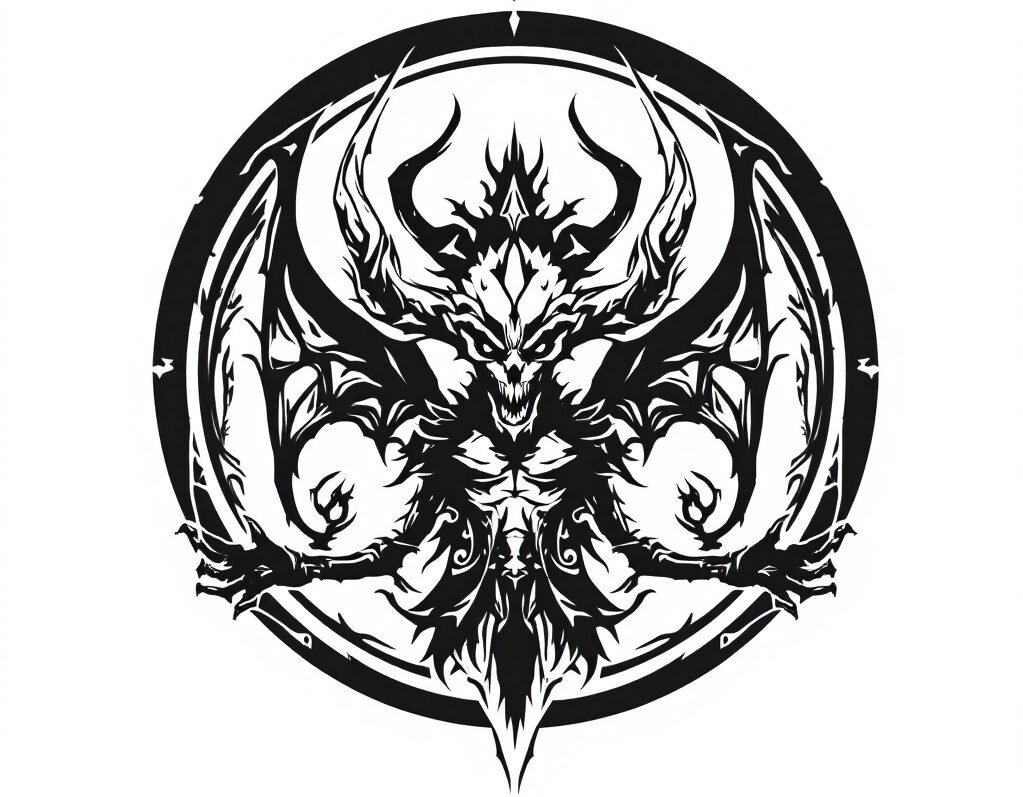
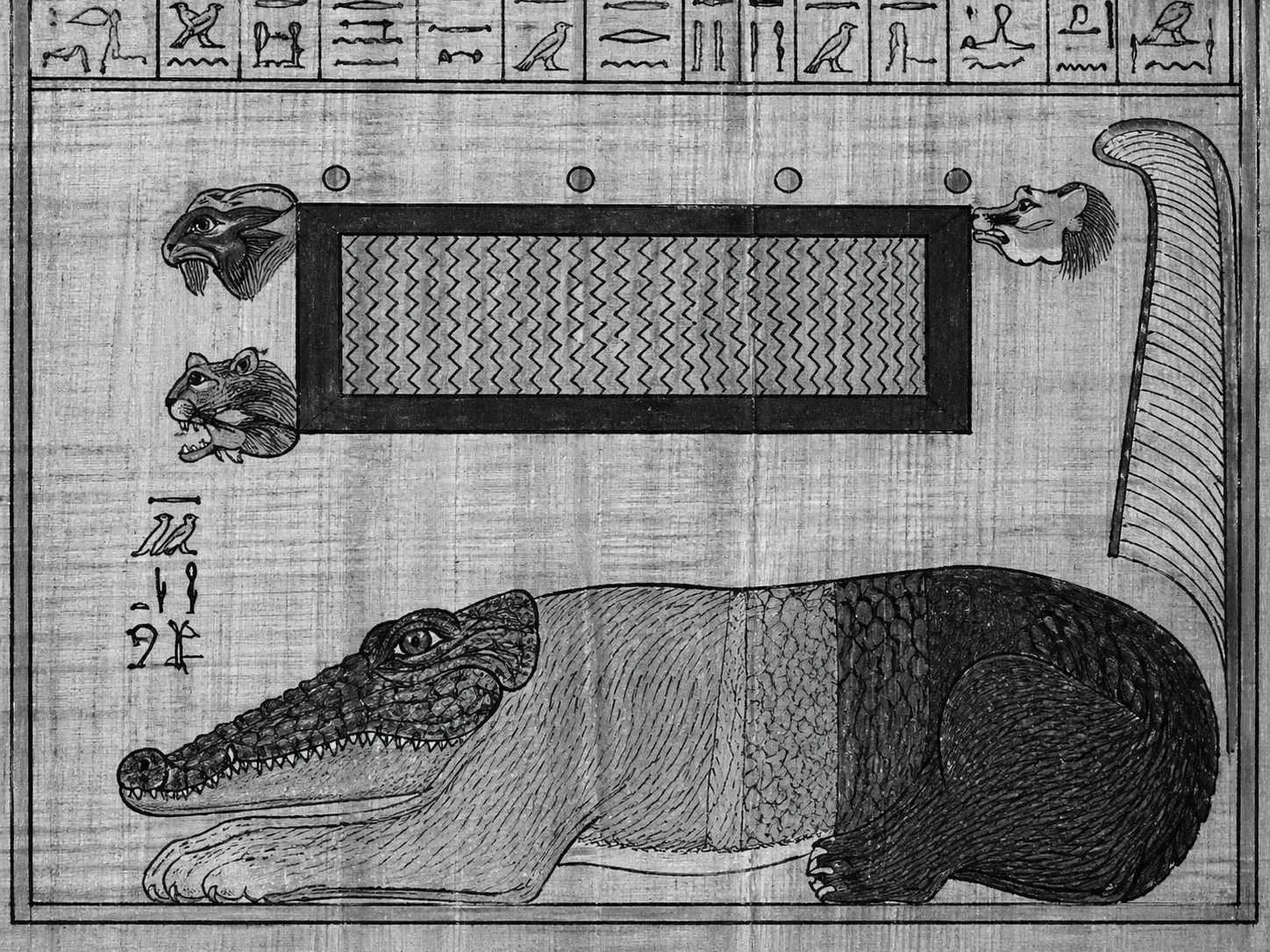
Most Egyptian deities were worshipped through formal cults. However, Ammit is a symbol of the end of existence. She acts as the last line of defense in the Hall of Ma’at, embodying the idea of moral decay.
In bizarre contrast to Seth, who represents chaos in the universe, Ammit exists to remove the unworthy from that cycle for good. Most underworld spirits cause only brief suffering, but she is different because she brings about the second death. This means the soul does not suffer forever but simply ceases to exist.
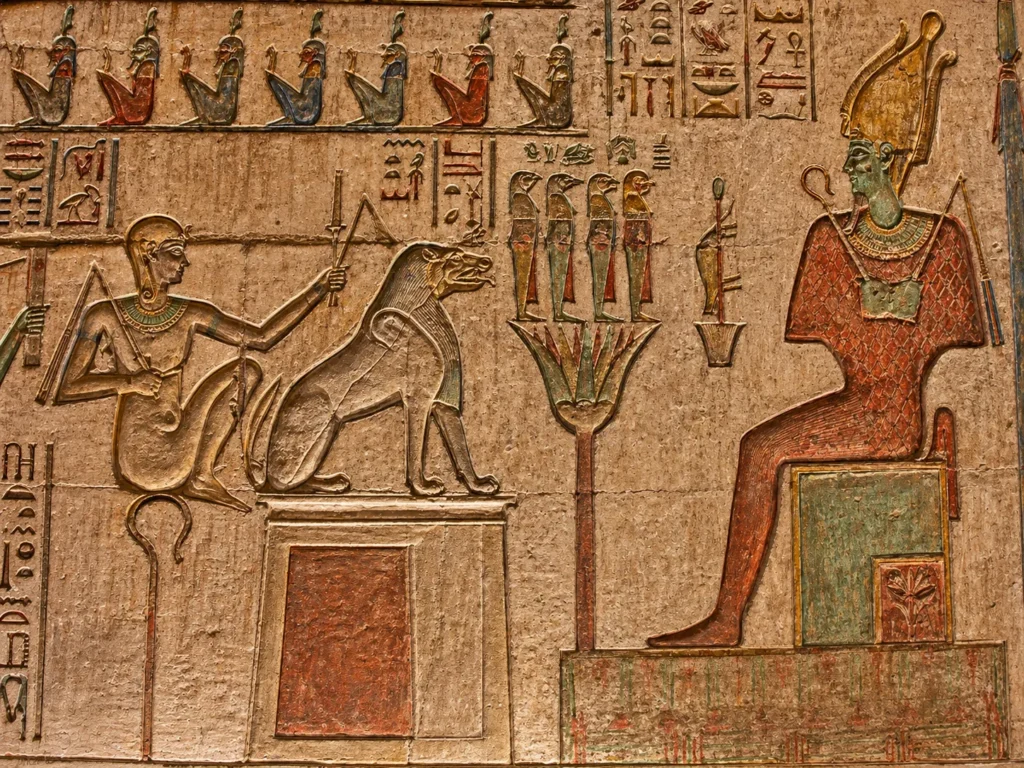
My article below is based on a comparison of the Book of the Dead (The Pert em Heru) and images from the Tomb of Horemheb. These sources show how Ammit transformed from a vague threat to a clear executioner in the afterlife. [View Full Bibliography ↓]
Summary
Key Takeaways
| Attribute | Details |
| Names | Ammit, Ammut, Ahemait, Amemet |
| Title | Devourer of the Dead, Eater of Hearts, Great of Death |
| Origin | Ancient Egypt, primarily the New Kingdom (c. 1550–1070 BCE) |
| Gender | Female |
| Role | Executioner of the unworthy soul in the afterlife |
| Associated Deity | Anubis (custodian), Thoth (scribe), Ma’at (legal standard) |
| Brings | Oblivion, total annihilation of the spirit (Sekhem) |
| Weaknesses | A heart that balances perfectly with the Feather of Truth |
| Realm/Domain | The Hall of Two Truths (Duat) |
| Weapon/Item | Jaws and digestive fire |
| Symbolism | Divine retribution, the weight of sin, ultimate justice |
| Sources | The Papyrus of Ani, The Book of the Dead, and various tomb wall reliefs |
Who or What is Ammit?
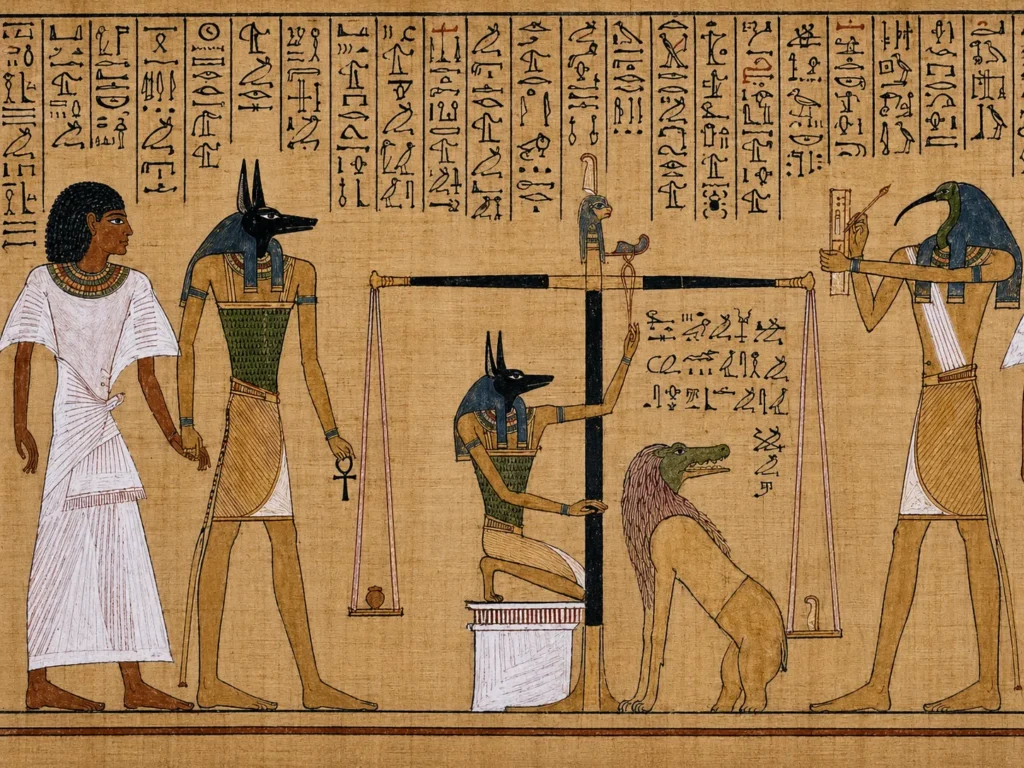
Ammit is a funerary beast from Ancient Egyptian mythology, shown during the “Weighing of the Heart” ceremony. She is not a goddess in the usual sense because she had no temples, priests, or followers. Instead, she is a demon and executioner who waits by the Scales of Justice in the Duat.
Her role is strictly legal: if the heart of the dead person is heavier than the Feather of Ma’at, showing wrongdoing, she eats it right away. This act causes the “Second Death,” meaning the person cannot enter Aaru (the Reed Fields) and instead disappears into nothingness. She shows that the afterlife is not promised to everyone, but must be earned by living a life of Ma’at (order and truth).
“Ammit” Meaning
The name comes from the ancient Egyptian verb am, which means “to devour” or “to swallow.” The full name translates to “The Devourer” or “The Eater.” In some religious texts, she is called Am-mut, which highlights her role as the “Eater of the Dead.”
Over time, her name stayed mostly the same because her role was very specific. While other gods transformed as they mixed with Greek or Roman beliefs, she stayed a constant and frightening entity in Egyptian texts.
Her name is all about her function—eating. There are no titles that suggest kindness or complexity, since her name simply describes what she does in the underworld.
How to Pronounce “Ammit” in English
People usually say her name as “AM-mit” or “AH-mit.” The first part is stressed and sounds like the ‘a’ in “apple.” The second part uses a short ‘i’ like in “it.” Some researchers stress the final ‘t’ more to match the feminine ending in Egyptian writing.
Origins of the Devourer
Ammit is closely tied to the religious and social changes of the New Kingdom, especially the 18th Dynasty (about 1550–1070 BCE). Earlier texts from the Old Kingdom mention “aggressive spirits” that the King had to fight off. Still, the image of the beast by the scales only became clear when the afterlife became available to more people.
In earlier times, only royalty could expect an afterlife. By the New Kingdom, though, the Book of the Dead (Pert em Heru) was available to any official or citizen who could pay for it. This shift meant there needed to be a clear, moral gatekeeper to keep order (Ma’at) for everyone.
Egyptians did not see death as simply the end of life, but as a risky transition. To get through it, the dead had to pass through the Hall of the Two Truths. The presence of this entity there shows the Egyptian fear of Isfet, or chaos and injustice.
In contrast to the modern Western idea of “hell” as endless suffering, the Egyptian version meant being wiped out. The soul had several parts, such as the Ka (life force) and Ba (personality), and these could only survive if the Ib (heart) remained safe and spiritually light.
If the heart was heavier than the Feather of Truth because of sin, Ammit would eat it. The act of devouring the heart would erase the person from the cosmic record, a state called the Second Death. Egyptians saw this as the worst fate, since it kept the soul from joining the stars or traveling with Ra.
Her first clear appearance is in the Papyrus of Ani (about 1250 BCE), though hints of her role show up in the earlier Coffin Texts. Ammit was created to serve a purpose in the weighing ritual, not as a being with a backstory. At this time, the afterlife was seen as very organized, much like the Egyptian legal system.
She acted as the court’s executioner, standing between the scales and Osiris, the Lord of the Underworld. Her position showed the finality of the judgment—once the heart was weighed, she was the last stop for those who upset the balance of society and the gods.
You may also enjoy:
Agubanba: The Blind Yōkai That Preys on Young Women
October 23, 2025
Aim (Aym): The Great Duke of Hell in the Ars Goetia
November 11, 2025
Mahabali (Bali): The Benevolent Asura King
October 10, 2025
Who Were the Hinn, the First Spirits of Creation?
November 12, 2025
Marid: The Ocean Jinn That Defies Heaven and Earth
September 30, 2025
Arāti: The Beautiful Demon of Aversion in Buddhist Mythology
October 15, 2025
The Biological Engine of Justice
Ammit looks very different from the usual human or animal-shaped gods of the Egyptian New Kingdom. She is not just a monster that hunts, but a unique creature in a world focused on preserving life.
I believe her unique body was a cultural answer to the First Intermediate Period, a time when Egypt faced major social problems. People stopped believing that the gods would protect everyone. As a result, religion adjusted to include a kind of backup system. She became the physical form of a moral gatekeeper, making sure chaos from the world could not enter the order of the afterlife.
I think the choice of her three animals—the crocodile, lion, and hippopotamus—was not only about fear, but about making sure nothing could be recovered. In Egypt, these were the only animals that could eat a body so completely that nothing was left for burial. Since Egyptians believed mummification was needed for immortality, being eaten by this creature meant total erasure.
For ancient Egyptians, Ammit was the ultimate source of fear. She set a clear boundary that the State and Priesthood used to keep society together. As the “Scarecrow of the Duat,” she was the only thing stopping a person’s hidden crimes from ruining their chance at eternal life.
Many people miss her link to the goddess Taweret. Taweret is a protective goddess shown as a hippopotamus, and she also has a mixed-animal form. This shows an interesting split in Egyptian beliefs: Taweret guards the start of life (childbirth), while Ammit guards the start of eternity.
Ammit seems like the “shadow-twin” of the protective hippo-goddess. While the main religion focused on Osiris, regular people probably saw her with both fear and respect. She could not be bribed, flattered, or beaten—she was the hard truth of a person’s own conscience. She was not evil, but a force of strict fairness, making sure the universe stayed in order.
What Does Ammit Look Like?
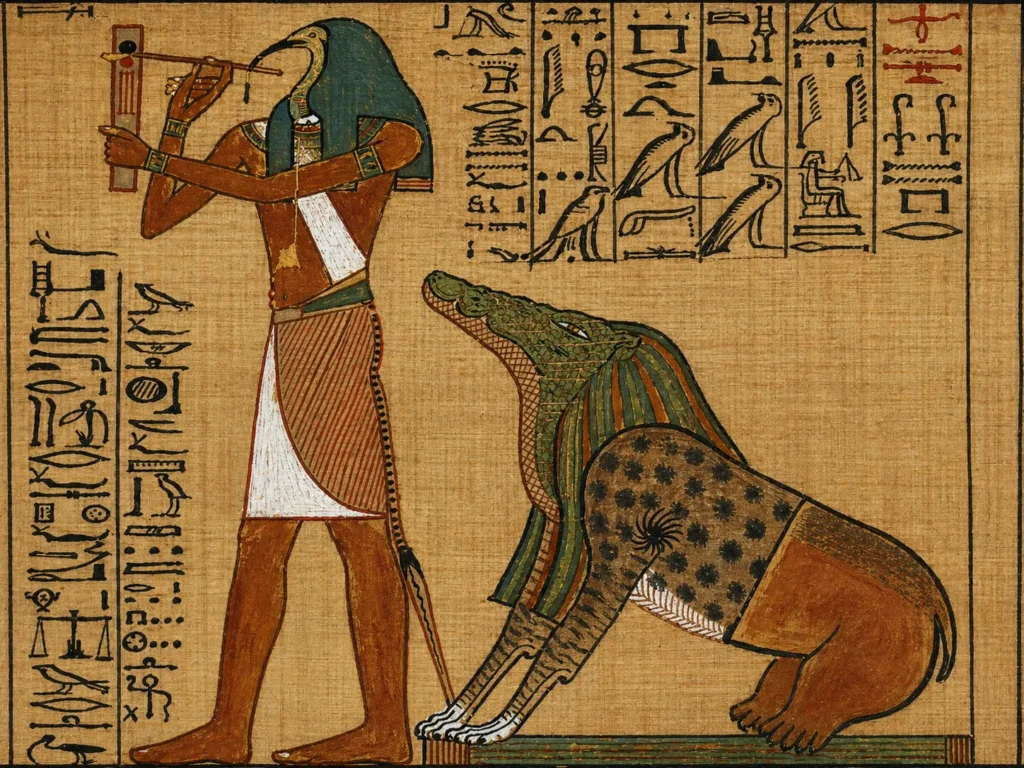
She is a mix of the three biggest “man-eating” animals known to ancient Egyptians. She has the head of a crocodile, the front legs of a lion (or sometimes a leopard), and the back of a hippopotamus.
Each animal part was chosen on purpose. The crocodile head represents the sudden danger of the Nile. The lion’s body shows strength and the desert’s hunting nature. The hippo’s back represents an unstoppable force, since hippos were seen as very aggressive in Egypt.
Observation: Looking at the Papyrus of Ani, I noticed she is usually shown crouching and waiting. Most Egyptian monsters are drawn in action, but she is almost always sitting still. This calm pose shows she is not hunting, but waiting for justice to be done.
Connections to Other Ancient Demons
| Name | Genealogy | Type | Appearance |
| Apep | Egyptian | Chaos Serpent | A massive snake/serpent |
| Lamashtu | Mesopotamian | Disease Demon | Lion head, donkey teeth, hairy body |
| Pazuzu | Babylonian | Wind Demon | Humanoid body, eagle wings, lion face |
| Garmr | Norse | Underworld Hound | A blood-stained four-eyed dog |
| Cerberus | Greek | Underworld Guard | Three-headed dog with a snake tail |
| Babi | Egyptian | Underworld Entity | A ferocious red-eared baboon |
| Ekimmu | Sumerian | Vampiric Spirit | Shadowy, incorporeal humanoid |
| Humbaba | Akkadian | Forest Guardian | Face made of coiled intestines |
| Qutrub | Arabian | Ghoul | Wolf-like therianthrope |
| Keres | Greek | Death Spirits | Dark-winged female entities with talons |
| Resheph | Levantine | Plague God | Warrior with a gazelle head on his crown |
| Tiamat | Babylonian | Primordial Chaos | Multi-headed dragon or sea serpent |
Powers and Abilities
As an executioner, Ammit’s powers are all about destroying the soul completely. She does not threaten the living, but is a danger to the dead.
- Soul Consumption: She can eat the Ib (heart), which Egyptians thought held intelligence and memory. Once she eats it, the soul cannot come back.
- Dimensional Anchoring: She exists only in the Duat and has the right to be with the gods during judgment.
- Immortality: As the symbol of justice, she cannot be killed in any normal way. She will exist as long as the Hall of Ma’at does.
You may also enjoy:
Who Is the Jann in Islamic Mythology and Why Is He Feared?
October 2, 2025
Agubanba: The Blind Yōkai That Preys on Young Women
October 23, 2025
Andrealphus: The Peacock Demon Who Twists Minds and Bodies
January 19, 2026
What Is a Yūrei? The True Meaning of Japanese Ghosts
January 30, 2026
Amaymon: The Infernal King Who Commands Death and Decay
November 17, 2025
Arāti: The Beautiful Demon of Aversion in Buddhist Mythology
October 15, 2025
Rituals, Amulets, and Protective Practices
Ancient Egyptian funerary practices were meant to protect against her, using magic and legal tricks to stop her from acting as executioner. Since the afterlife was seen as a trial, the rituals were not about fighting her, but about making sure the dead were never found guilty.
The main goal for the dead was to keep their Ib (heart) pure. The family’s job was to give the right spiritual tools to help their loved one avoid the Devourer.
The Heart Scarab
The most important defense was the Heart Scarab, a big amulet made from green jasper, basalt, or schist. These stones stood for new life and Osiris’s return. The scarab was put inside the mummy’s wrappings, right over the heart.
Spell 30B from the Book of the Dead was carved on the bottom of the scarab. This spell told the heart not to speak ill of the dead. By magically tying the heart, the family ensured it would not reveal any sins that could prompt the Devourer to act.
Spell 30B from the Book of the Dead:
“O my heart of my mother! O my heart of my mother! O my heart of my different forms! Do not stand up as a witness against me, do not be opposed to me in the tribunal, do not be hostile to me in the presence of the Keeper of the Balance.”
This is a rare case of transference magic, where a stone was meant to take over the heart’s spiritual “memory” during the weighing ceremony.
In these rituals, the Devourer is an automatic form of punishment. She is not the judge or the accuser, but the punishment itself. From my study of the Papyrus of Ani and the Papyrus of Hunefer, she is always shown behind the scales, showing she is the last step in the process.
I think her role motivated people to live rightly. These protective rituals were not just superstitions, but a key part of Egyptian society. By doing them, families and priests showed how important Ma’at (Order) was.
If someone needed too many magical heart scarabs, it meant they had not lived well. In this way, the Devourer acted as a hidden enforcer of the law, making sure people took the journey to the afterlife very seriously.
Professional Practitioners and the Opening of the Mouth
The Lector Priest (Kher-heb) led the rituals and connected the living with the dead. In the Opening of the Mouth ceremony, the priest used a tool called an adze to touch the mummy’s or statue’s face. This act restored the senses and allowed the dead to speak the Negative Confession.
For the family, the Feeding the Ka ritual was very important. If they did not give offerings of bread, beer, and oxen, the soul could become weak and weighed down by hunger and sadness, making it more likely to get a bad judgment. The family’s job was to keep the soul strong so it could face the 42 Judges of Ma’at with confidence.
I find it remarkable that no offerings were made to her. Unlike Mesopotamian demons who could be calmed with gifts, Ammit could not be bribed. This made the rituals around her unique—they focused on self-improvement and silencing the conscience, not on pleasing the monster. This shows she was not a goddess to worship, but a law of nature to deal with.
You may also enjoy:
Akateko: The Bloody Hand Yōkai That Guards a Cursed Temple Tree
November 14, 2025
Aži Dahāka: The Three-Headed Dragon of Zoroastrian Mythology
January 14, 2026
Demon Alastor: The Grand Executioner of Hell
November 17, 2025
Banasura: The Thousand-Armed Demon King
October 10, 2025
Palden Lhamo: The Black Goddess of Blood and Protection
October 20, 2025
Bibliography
Author’s Note: For this article, I decided to focus on scenes from the Papyrus of Ani and the Papyrus of Hunefer to show her mixed-animal form as it appeared in 18th-Dynasty art. My study of Spells 30B and 125 helped show the balance between her hunger and the magical tricks priests used. By comparing the Coffin Texts and the Book of the Dead, I traced how she transition from a vague threat to a clear executioner. These sources show that the “Second Death” was more than a myth—it was a real way to keep order in ancient Egypt.
- Budge, E. A. Wallis. The Egyptian Book of the Dead: The Papyrus of Ani in the British Museum. 1895.
- King, Maiken M. Spells from the Book of the Dead. Kemet Klub, 2023.
- Stadler, Martin Andreas. The Funerary Texts of Papyrus Turin N. 766. The Journal of Egyptian Archaeology, vol. 85, 1999, pp. 113–125.
- Vongdip, Stephen & Jock, Agai. (2025). Journal of Culture, History and Archaeology A Conceptual Study of the Judgment of the Dead in Ancient Egypt. 5. 2971-7752. ResearchGate.
- Taylor, John H. Death and the Afterlife in Ancient Egypt. British Museum Press / University of Chicago Press, 2001. Internet Archive.
- Forshaw, Roger. The Role of the Lector in Ancient Egyptian Society. Archaeopress Egyptology 5, 2014.
- Fekri, Magdi. (2020). Archeological Study of Wild Animals in the New Kingdom. Vol. 2. ResearchGate.
- Dr. Amy Calvert. Ancient Egyptian religious life and afterlife. Reframing Art History, Smarthistory, August 2, 2022.
- Wilfong, T. G. Life, Death, and Afterlife in Ancient Egypt: The Coffin of Djehutymose in the Kelsey Museum of Archaeology. Kelsey Museum of Archaeology, 2013.