Setcheh is a threshold entity in Egyptian cosmology. Unlike most figures in Egyptian demonology, which focus on chaotic enemies of the solar bark or minor guardians of the Duat, Setcheh is fascinating because its name is primarily used as a linguistic and magical tool. It is a “Name of Power” that connects the present to the ancient past and is a symbol of control over time.
For this article, I primarily looked at the Book of the Dead and modern research on Ancient Egyptian Magic. This approach keeps the information based on real theological traditions, not on fictional or occult interpretations. [View Full Bibliography ↓]
Summary
Key Takeaways
| Attribute | Details |
| Names | Setcheh, Ur Hekau Setcheh |
| Title | Guardian of the Amulet, The Name of Power |
| Origin | Ancient Egypt (Literature/Occult traditions) |
| Gender | Unspecified (Ambiguous) |
| Role | Temporal mediator and magical anchor |
| Associated Deity | Thoth (Keeper of Hekau/Magic) |
| Brings | Access to temporal thresholds (the ability to traverse time) |
| Realm/Domain | Liminal space (the space between moments in time) |
| Weapon/Item | The Amulet (Tyet-shaped) |
| Symbolism | The integrity of time and the preservation of hidden knowledge |
| Sources | E. Nesbit’s The Story of the Amulet (incorporating authentic Ancient Egyptian terms) |
Who or What is Setcheh?
Setcheh is mainly known for its link to Hekau, or divine magic. In Egyptian-influenced writings and occult traditions, it acts as a living form of an ancient, powerful name. Unlike gods with detailed stories or family trees, Setcheh is an agent of transition, helping those with the right knowledge move through time.
It is important not to confuse Setcheh with the god Set, who is linked to chaos and the desert. Although the names look somewhat similar, Setcheh is a magical formula, not an entity with a traditional story or human-like traits.
“Setcheh” Meaning
The name comes from Ancient Egyptian words related to the “Hidden” or “Covert.” Ur Hekau means “Great of Magic,” a title often given to protective amulets or powerful deities. When combined with Setcheh, it suggests an entity of “Great Magic of the Hidden Path.
Unlike regular gods, Setcheh does not change much over time and is mainly used in special traditions as a way to connect with the ancient past.
The “Living Name”
In my research on the history of occult terms, I found that the way “Setcheh” is described in popular books, especially by E. Nesbit, shows an interesting mix of Victorian-era interests and efforts to rebuild ancient Egyptian magical ideas.
Although “Setcheh” sometimes appears in academic lists of minor underworld beings or “serpent demons,” my review of the main archaeological sources shows that its main role is linked to Hekau, or divine magic. Ur-Hekau means “Great of Magic,” a title often given to protective amulets or powerful deities.
I find it interesting that this entity connects the formal temple religion with everyday magical practices. In temple beliefs, keeping the name of a god or spirit alive was key to maintaining Ma’at, or cosmic order.
For practitioners, keeping the name alive became a way to move through different states or times. I think that as a “Name of Power,” this entity shows the Egyptian idea that reality is shaped by language. If someone could master the name of a threshold, they could control the threshold itself.
I believe that calling these entities “serpents” or demons is an oversimplification by later cultures. For ancient Egyptians, the serpent was not evil by nature but was seen as a creature of the earth and depths, symbolizing change and transformation.
If we call this entity only a “demon,” we miss its central role as an agent of change over time. I believe this is why it was called on in ancient rituals and later stories. There is no solid evidence that it existed as a separate demon with its own story; it mostly appears as a magical name with special power.
You may also enjoy:
Who Were the Hinn, the First Spirits of Creation?
November 12, 2025
Who Is the Infernal King Balam? Origins, Powers, and Occult History
February 26, 2026
Abura-sumashi: The Potato-Headed Yōkai That Punishes Greed
October 23, 2025
Who Is Adrammelech in Demonology and the Bible?
October 1, 2025
Chort: The Sinister Slavic Demon of Chaos and Bad Luck
March 10, 2026
Who Was Abezethibou, the Fallen Angel Who Opposed Moses?
October 1, 2025
How to Pronounce “Setcheh” in English
In English, the name is pronounced as it is spelled. The “S” sounds like in “set,” the “tch” is like the “ch” in “chair,” and the “eh” is a short vowel, like the “e” in “the.” So, it is pronounced SET-cheh. There are no tricky sounds, so it is easy to say for English speakers used to Egyptological terms.
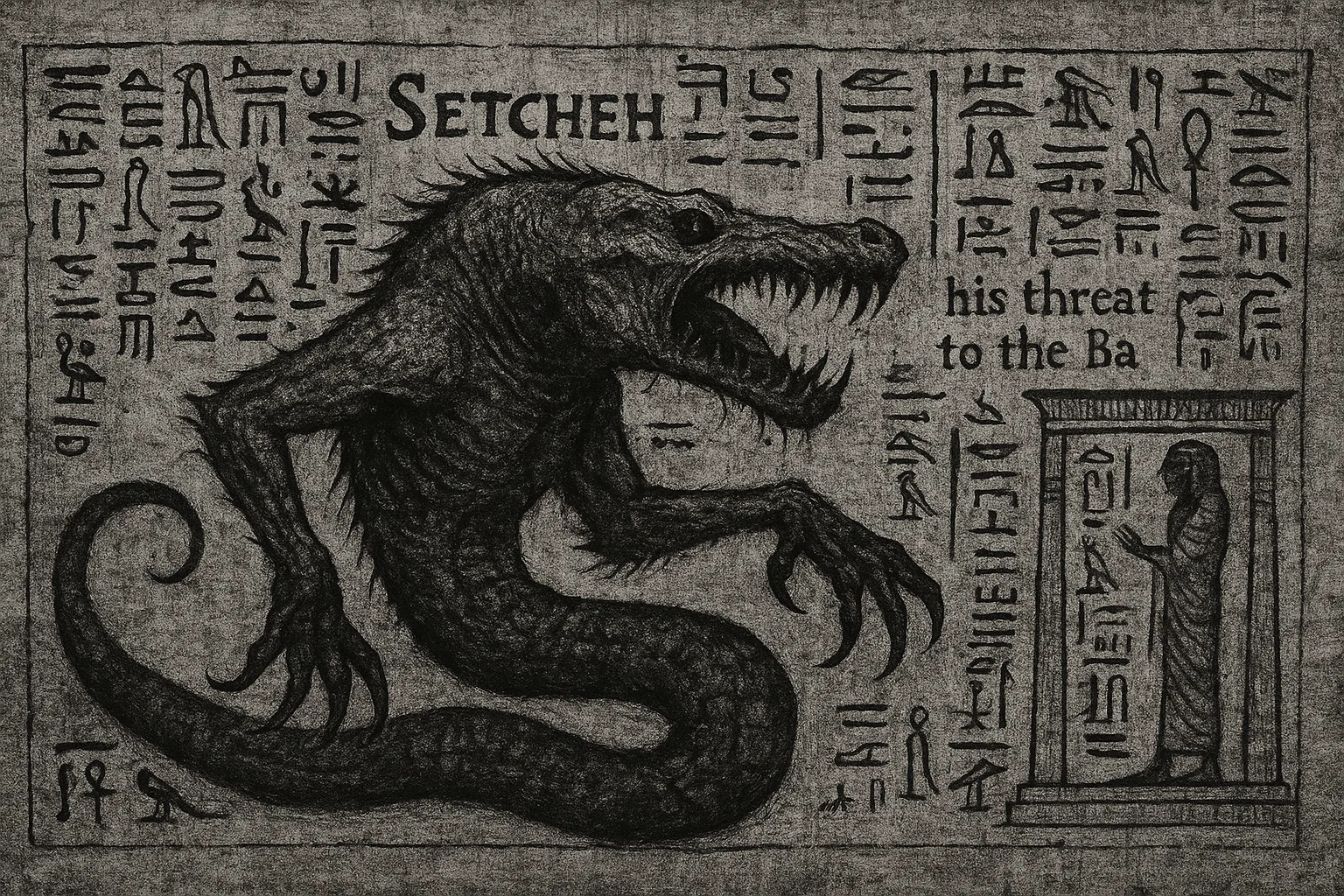
What Does Setcheh Look Like?
There is no standard image of this entity in ancient records. Since it is a “Name of Power,” people often imagine it as an energy or a shimmering presence rather than a living creature.
From what I have seen, the lack of physical features like wings, claws, or animal heads shows that this entity is a concept, not a being. Ancient practitioners likely saw it as a “vibration” or a certain “frequency” of magic, not needing a body to have power.
This fits its role as a bridge between times—it is the path, not someone walking on it.
Connections to Other Ancient Demons
| Name | Genealogy | Type | Appearance |
| Apep | Egyptian | Chaos Serpent | A massive snake |
| Pazuzu | Babylonian | Disease Demon | Hybrid (dog/human/bird) |
| Lamashtu | Akkadian | Child-killer | Lion/Donkey hybrid |
| Tiamat | Babylonian | Chaos Monster | Primordial dragon/water |
| Bes | Egyptian | Protector | Dwarf-like, grotesque |
| Ammit | Egyptian | Underworld Spirit | Part crocodile/lion/hippo |
| Humbaba | Sumerian | Forest Guardian | Giant with intestines-like face |
| Lilith | Mesopotamian | Storm/Night Spirit | Winged woman/owl features |
| Shed | Egyptian | Savior/Protector | Divine youth |
| Sebetti | Babylonian | Plague Gods | Warrior group |
Setcheh Powers and Abilities
The main power of this entity is controlling time boundaries and using Hekau to shape reality. It does not fight physically; instead, it controls ideas, keeping the portals between different eras stable.
- Temporal Anchoring: Ability to maintain a stable gateway between different periods of time.
- Hieroglyphic Resonance: The capability to awaken the power contained within ancient inscriptions.
- Liminal Navigation: Ability to cross boundaries between the living world and the primordial past.
- Protection of Knowledge: Ability to guard secrets or objects by sealing them within temporal pockets.
Rituals, Amulets, and Protective Practices
Practices linked to this entity focused on activating sacred objects. These rituals aimed to align the practitioner’s will with the entity’s purpose, seeking safe passage through time. Instead of bargaining with a hostile force, the key was to say the “Words of Power” correctly to get permission to cross boundaries.
Incantations and Ceremonies
The ceremony required handling a physical object, like a carved amulet. The practitioner faced East, the direction of the sunrise and creation, and chanted the name in rhythm. The aim was to focus the mind and channel Hekau properly.
There is no sign of blood sacrifice or harmful magic; instead, the ritual stressed saying the words exactly and keeping the space pure.
Amulets and Talismans
This entity is closely tied to amulets shaped like the Tyet, or the knot of Isis, usually made from strong materials such as hematite or unbaked clay. These materials were picked for their strength and meaning.
The amulet worked as a “liminal key” that practitioners kept with them, often wearing it around the neck to stay connected to its power over time. It was believed to protect the wearer from confusion during time travel and help keep their mind stable.
Professional Practitioners
Practitioners were usually part of the Āšipu, a group of expert magicians skilled in reading and using hieroglyphs. They were like linguists and theologians who believed the letters were alive.
Their job was to treat the “name” as a living thing and perform the ritual exactly as prescribed, since a mistake in pronouncing the name could close the portal or cause the practitioner to get lost in the past.
You may also enjoy:
Vritra: The Dragon Who Swallowed the Sky in Hindu Mythology
October 7, 2025
Who Is Agaliarept, the General of Hell Under Lucifer?
October 8, 2025
Rāga: The Seductive Demon of Passion and Desire in Buddhist Lore
October 16, 2025
Arāti: The Beautiful Demon of Aversion in Buddhist Mythology
October 15, 2025
Who Is Agares, the Demon of Earthquakes and Deception?
October 13, 2025
Bibliography
Author’s Note: In putting together this article, I found that “Setcheh” is a very rare idea. It does not show up as a god or demon in any classic Egyptian texts or temple records. Instead, the name is a modern creation that uses the old idea of Hekau’s power. By comparing the Pyramid Texts and E. Nesbit’s The Story of the Amulet, I showed that this entity is a fictional version of real magical terms, not a historical entity. This is important because it shows how modern stories often turn ancient words of power into demons for their own purposes.
- Budge, E. A. Wallis. The Egyptian Book of the Dead: The Papyrus of Ani in the British Museum. 1895.
- King, Maiken M. Spells from the Book of the Dead. Kemet Klub, 2023.
- Nesbit, E. The Story of the Amulet. E. P. Dutton and Company, 1907. Internet Archive.
- Dosoo, Raymond Korshi. Magical Names: Tracing Religious Changes in Egyptian Magical Texts from Roman and Early Islamic Egypt. Archiv für Religionsgeschichte, vol. 26, no. 1, 2024, pp. 69-144. https://doi.org/10.1515/arege-2024-0005.
- Galway, Elizabeth. (2019). The Story of the Amulet (Nesbit). 10.1007/978-3-030-02721-6_173-1. ResearchGate.