Many Goetic entities are known for their specific domains of sin, but Abalam stands out as the one who shapes the sounds of infernal majesty. He usually appears alongside King Paimon, rarely on his own, and acts as the “herald of the presence” by creating a powerful mix of trumpets and choral noise that can overwhelm the senses. This suggests that Abalam is not just a single tempter, but more of a psychological tool meant to break a conjurer’s focus with a dramatic display of hell’s order.
This article examines various stories and mentions of the demon, using the Ars Goetia and the Pseudomonarchia Daemonum, to create a historical profile based on evidence. [View Full Bibliography ↓]
Summary
Key Takeaways
| Attribute | Details |
|---|---|
| Names | Abalam, Abalim, Abali |
| Title | King, Great Prince |
| Gender | Male |
| Role | Assistant to Paimon; incites lust, possession, and defilement; corrupts the righteous and spreads dark influence |
| Hierarchy | Subordinate king under Paimon; part of hell’s royal structure |
| Servitors | Leads portions of Paimon’s legions; specific underlings not detailed |
| Superior Demon | Paimon |
| Powers | Appears via sacrifice to aid in temptation; encourages immoral acts; manipulates through possession; corrupts priests and the faithful; creates illusions and seduces with speech |
| Appearance | No direct description; inferred as regal and terrifying, similar to Paimon’s entourage, with a focus on commanding presence |
| Etymology | Possibly from Hebrew “Abalim” meaning “vapor” or “vanity,” linked to Ecclesiastes’ theme of fleeting worthlessness; symbolizes empty desires and moral decay |
| Associated Figures | Paimon, Beball (Labal); tied to Lucifer through loyalty chains |
| Weaknesses | Bound by divine commands, it requires Paimon’s summon; repelled by holy names and protective circles in rituals |
| Opposing Angel/Saint | Archangel Michael, a general of the heavenly force that defeated fallen angels like him |
| Pantheon | Christian demonology, with possible Hebrew roots |
| Legions | Portion of Paimon’s 25 legions (when accompanying); exact count unspecified |
| Primary Sources | Pseudomonarchia Daemonum (Johann Weyer, 1577); Lesser Key of Solomon (Ars Goetia); Dictionnaire Infernal (Collin de Plancy, 1818) |
“Abalam” Meaning
The name “Abalam” appears in old texts that suggest emptiness and false promise. Researchers link the name to Hebrew roots, where “Abalim” comes from words such as “hevel” and “abel” in the Book of Ecclesiastes. In that context, “hevel” describes life as vapor, brief and without lasting value.
This meaning fits a demon who tempts people into empty pursuits, like unchecked desires that leave them feeling drained. The plural ending “im” may suggest deceit in many forms or a group of similar spirits.
In Latin grimoires, the name is spelled “Abalim.” This change keeps the same sound but adds a formal touch, which was common in 16th-century texts.
The way the name changed over time shows how early church leaders turned old gods into demons, changing neutral words into symbols of evil. For example, “Abalim” may derive from “abal,” meaning “to mourn” or “to fade,” highlighting the sadness that follows empty temptations.
As grimoires spread from the Middle East to Europe, the name changed to fit local styles. In the French versions, it took on a regal tone to match the idea of kings in Hell.
The demon’s name also has symbolic meaning in occult groups. For example, the word “Vapor” suggests something you try to hold but can’t, similar to how the demon tempts people with desires that soon turn to regret. This idea connects to Ecclesiastes 1:2: “Vanity of vanities, all is vanity,” a verse often seen as a warning against such temptations.
Over time, French texts such as the Dictionnaire Infernal adopted the name. In these works, “Abalam” is paired with Paimon, showing the empty pride of the demonic hierarchy.
How to Pronounce “Abalam”
The name Abalam is pronounced in three parts: “Ah,” as in father; “bah,” as in bar; and “lahm,” rhyming with calm. Together, it is “Ah-bah-lahm,” with the stress on the second part.
What Does Abalam Look Like?
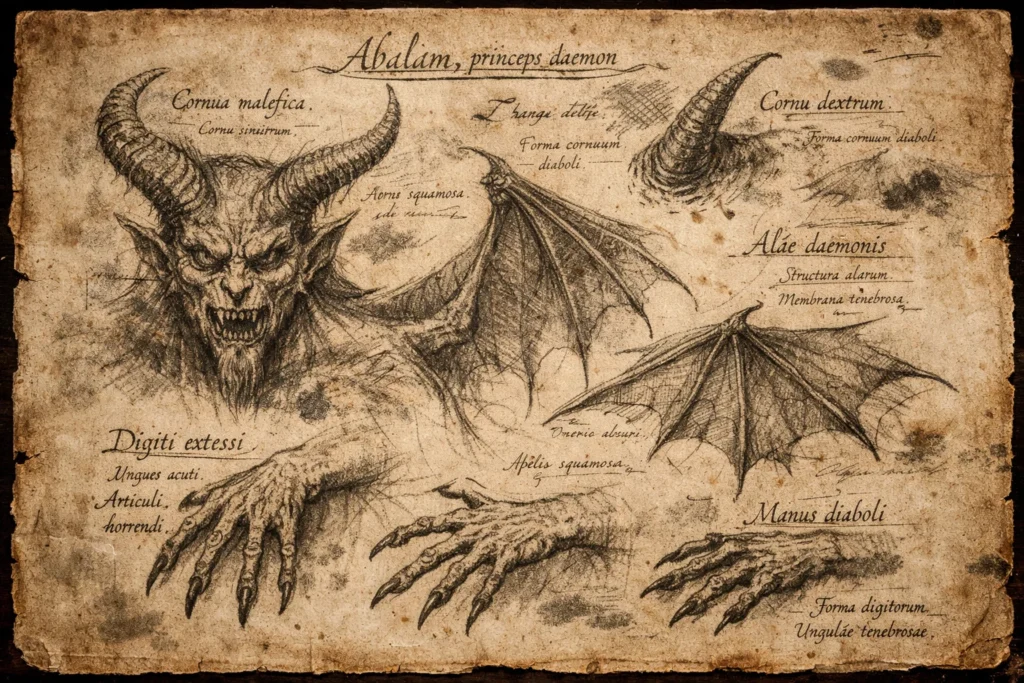
There are a few direct descriptions of Abalam in primary sources, so most details about his appearance come from his connection to Paimon.
In the Pseudomonarchia Daemonum, Abalam appears as part of a royal group, which suggests he has a kingly look: tall, imposing, and wearing a crown that shines like fake gold. No single feature is described, but later artists imagined him with fierce eyes and dark robes, creating an entity that commands attention without speaking.
In the Dictionnaire Infernal, attendants to kings like Paimon are shown wearing armor decorated with serpents or holding scepters with flames on top. While Abalam is not named directly, he could be one of these attendants.
Some images show him with mixed features, such as a man’s upper body on animal legs and horns that curl like old crowns. These traits symbolize divided loyalties in Hell.
The symbolic details add more meaning. In a rare artwork, Abalam is shown with many eyes or hands, which suggests he watches sins happen and highlights his role in tempting people.
You may also enjoy:
Who Is Abaddon, the Demon of the Abyss, in the Bible?
September 29, 2025
Rokurokubi: The Yōkai That Looks Human Until Midnight
February 3, 2026
Who Is Aka Manto, Japan’s Terrifying Red-Cloaked Yōkai?
October 24, 2025
Mara: The Buddhist Demon King of Desire and Death
October 13, 2025
Tarakasura: The Dark Demon Who Ruled Hell on Earth
December 4, 2025
Kuchisake-onna: Folklore, Origins, and Urban Legend History
February 10, 2026
Origins
Abalam comes from the complex world of Renaissance demonology, where researchers combined biblical clues and pagan ideas into a system of demons.
His first clear mention is in 1577, in Johann Weyer’s Pseudomonarchia Daemonum, a detailed list of demonic rulers. Weyer, a Dutch doctor who was cautious about witch hunts, listed Abalam as Paimon’s shadow king.
By the 15th century, as grimoires spread across Europe, Abalam became known as a servant demon. His name was changed from neutral words to fit the idea of Lucifer’s court.
Persian and Mesopotamian storm gods, who were once seen as neutral, were also turned into beings of chaos and later described as fallen angels after the war in Heaven. In Zoroastrian texts, the struggle between good and evil influenced these ideas, with figures like Ahriman representing false winds that spread lies.
Abalam became part of Christian stories through texts about Solomon’s keys, which claimed the king trapped demons for use in temples. Although Abalam is not mentioned in these texts, he fits the pattern as a mid-level demon who helps more powerful ones.
Collin de Plancy’s 1818 Dictionnaire Infernal made Abalam a well-known entity in art, pairing him with Beball as guards for Paimon.
Was Abalam Ever Mentioned in the Bible?
Abalam does not appear in the Bible. The Old and New Testaments, as well as apocryphal books such as Enoch, list many fallen angels and spirits but do not mention him.
Abalam in Grimoires and Other Texts
Outside of scripture, Abalam is briefly mentioned in several occult texts, always connected to Paimon. For example, the Grand Grimoire lists several demonic kings trapped in circles, and Abalam is included as a forced helper.
| Source | Quote |
|---|---|
| Pseudomonarchia Daemonum (Johann Weyer, 1577) | If Paimonis be cited alone, let an offering or sacrifice be made unto him, & he will accept thereof: then two kings, Abalam & Bebal, will come unto him with other spirits, to wit, 25. legions… |
| Lesser Key of Solomon (Ars Goetia, 1904 edition) | Note that if Paimon be cited alone by an offering or sacrifice made unto him, two Kings do always come with him, to wit, Bebal and Abalam… and other potentates: in his host are 25 legions… |
| Dictionnaire Infernal (Collin de Plancy, 1818) | When Paimon appears alone, it is necessary to make a sacrifice to him; then two other kings, Bebal and Abalam, come with him… |
| Pseudomonarchia Daemonum (variant) | But if Paimon be cited alone by an offering or libation, two kings followe him; to wit, Beball & Abalam, & other potentates: in his host are twentie five legions… |
Powers and Abilities
Abalam has dark powers linked to his service under Paimon. He focuses on breaking people’s willpower through both subtle and direct harm:
- Manifestation through Sacrifice: Abalam only appears when offerings are made to support Paimon’s call. This means he can only enter through rituals involving blood or gifts. Without these, he remains hidden, which often leads to repeated acts of darkness.
- Inciting Lust and Defilement: He encourages unchecked desires, leading people to form immoral connections. When possessing someone, he twists their actions toward sin, and this influence only ends with death, leaving a lasting curse after the ritual.
- Corrupting the Righteous: He targets faithful people, such as priests, by planting doubt through whispers or visions. His power is weaker against strong holy protections, but he is more successful when his targets are alone.
- Manipulation and Seduction: He is skilled at using speech to control others, telling sweet lies to gain power. He hides his traps with illusions, but people who speak the truth can break through them with clear words.
- Possession and Influence: He takes over people to cause chaos, offering dark knowledge in exchange for their souls. He is limited by the summoner’s circle and cannot move freely without a connection.
- Amplifying Infernal Hosts: He can summon Paimon’s lesser demons to attack people’s minds as a group, but the number is usually limited to 25 legions unless forced to do more.
- Spreading Vanity’s Ills: He encourages empty pursuits that weaken morals, making things seem valuable but leading to regret. These temptations lose their power when people reflect and look closely at them.
Abalam vs Other Similar Demonic Entities
| Demon Name | Associated Sin/Temptation | Rank/Origin | Key Traits/Powers |
|---|---|---|---|
| Asmodeus | Lust and wrath | Prince of Hell; Ars Goetia, Testament of Solomon | Commands 72 legions; destroys marriages; reveals treasures; appears with three heads (bull, man, ram) breathing fire |
| Belial | Lawlessness and worthlessness | King; Ars Goetia, Dead Sea Scrolls | Rules 80 legions; grants favors through iniquity; formless or angelic; sows discord and false visions |
| Paimon | Knowledge and arts twisted to vanity | King; Ars Goetia, Pseudomonarchia Daemonum | Leads 200 legions; teaches sciences; rides crowned dromedary; demands sacrifices for full obedience |
| Beball | Deception and false loyalty | King under Paimon; Ars Goetia | Accompanies superiors; amplifies hosts; tied to Lucifer’s devotion; brings 25 legions in rituals |
| Bael | Invisibility and idolatry | King of East; Ars Goetia, Grand Grimoire | Heads of toad, man, cat; 66 legions; hides from sight; head of infernal powers |
| Astaroth | Laziness and rationalized evil | Duke; Ars Goetia, Dictionnaire Infernal | 40 legions; reveals past/future; foul breath; rides dragon-like beast with serpent |
| Leraje | War and destruction | Marquis; Ars Goetia | 30 legions; causes battles; archery master; appears as archer in green |
| Zepar | Lust and barren unions | Duke; Ars Goetia | 26 legions; makes women love men; alters shapes for seduction; knight on soldier mount |
| Sallos | Forbidden love and passion | Duke; Ars Goetia | 30 legions; fosters true desire turned toxic; crowned duke on crocodile with serpent staff |
| Purson | Secrets and hidden truths corrupted | King; Ars Goetia | 22 legions; reveals treasures; lion-faced man on bear; carries viper |
| Vine | Storms and ruin | King/Earl; Ars Goetia | 36 legions; builds/destroys towers; lion on black horse; discovers witches |
| Balam | Avarice and idolatry | King; Ars Goetia | 40 legions; grants invisibility; three heads (man, bull, ram) with flaming eyes on bear |
| Sitri | Lust and exposure | Prince; Ars Goetia | 60 legions; inflames desire; leopard head turning griffin; reveals naked secrets |
| Beleth | Love turned to torment | King; Ars Goetia | 85 legions; provokes passion; pale king on white horse amid trumpets |
| Gusion | Discord and false honor | Duke; Ars Goetia | 40 legions; answers queries; baboon form; stirs strife among friends |
Rank in the Hierarchy of Hell
Abalam has likely a middle-ranking entity in Hell’s hierarchy, serving as a king or great prince under Paimon’s command.
In texts like the Ars Goetia, he is listed among the royal ranks as one of nine kings, like Bael or Asmodeus, but he is always second in command. His power comes from those above him, not from ruling alone.
This structure is like a pyramid, with Lucifer (Satan) at the top, princes like Beelzebub below, and kings who command legions for various tasks. Abalam reports directly to Paimon, who rules the western domain, and works with Beball as twin enforcers during rituals.
Abalam does not lead a large army, though he may command some of Paimon’s 25 legions. This makes him powerful but still dependent on others. With about 10 to 12 legions at most, he ranks above earls like Ronove but below dukes who have much larger forces, such as Astaroth with 40 legions.
Abalam is often paired with Beball, forming a team that balances Paimon’s power. Abalam uses illusions, while Beball is known for his strong loyalty.
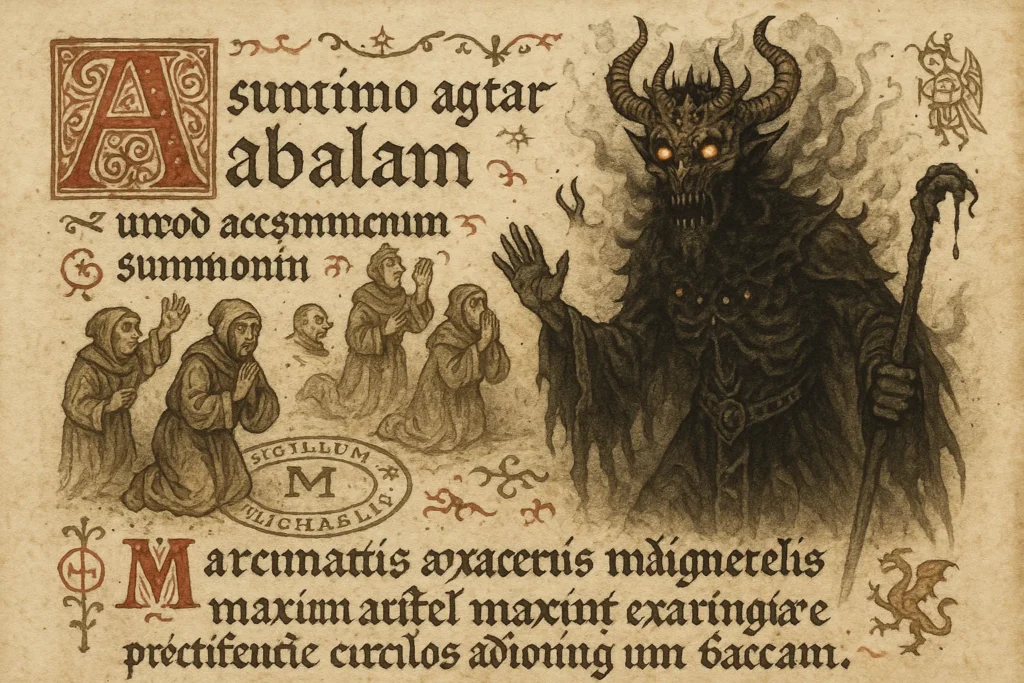
Abalam and the “Liturgy of the Infernal Court”
Abalam is often seen only as King Paimon’s subordinate in the Solomonic tradition, but a closer look at the main grimoires shows he actually shapes the entire “infernal atmosphere.”
Most Goetic entities are summoned for specific tasks, like granting honors or revealing hidden treasures. Abalam, however, serves a mostly theatrical and sensory role. He rarely acts alone and usually appears with a group, announced by loud trumpets and finger symbols.
This shows that Abalam stands for the “Liturgy of the Abyss,” which is the opposite of the heavenly order, where music and group presence support the divine. In 16th-century rituals, Abalam was meant to overwhelm the magician’s senses, turning the quiet of the ritual circle into noise and making it clear the magician was no longer in control.
Looking at it sociologically, Abalam’s appearance with Beball (or Labal) mirrors the Renaissance focus on courtly rules and displays of power. When the Pseudomonarchia Daemonum was written, kings used grand processions and heralds to show their untouchable authority.
Abalam takes this idea further in demonology. He acts as the herald who makes sure the “King” is not just seen, but also felt as a powerful presence. If we look at the shift from the “Babel” roots, linked to confusion and broken language, to the clear sounds that mark Abalam’s arrival, we see a move from chaos to strict musical order. Abalam does not impart knowledge; instead, he creates an experience in which the self is lost in sound.
This chorus effect brings a special tension to the Goetic system between the individual and the group. Most demons are seen as single beings that a sorcerer can control by name, but Abalam’s need for a group challenges this idea. He stands for the “Socialization of Evil,” in which the danger is not just one temptation but the pressure of a whole, organized, and foreign society.
Studying Abalam means looking at how people in the Middle Ages and Renaissance feared the “overwhelming crowd.” It shows that the infernal world is not just chaos, but also reflects the most strict and intimidating parts of human empires.
Mystical Correspondences
| Attribute | Details |
|---|---|
| Planet | Mars |
| Zodiac Sign | Scorpio |
| Element | Fire |
| Direction | South |
| Color | Deep Red |
| Number | 5 |
| Crystal/Mineral | Bloodstone |
| Metal | Iron |
| Herb/Plant | Nettle |
| Animal | Scorpion |
Abalam’s cosmic connections link his evil energy to Mars, the planet of war and aggression. This connection supports his role as a demon of destruction and manipulation in the Ars Goetia.
As Paimon’s servant, Abalam uses Mars’s strong energy to create conflict and discord. Rituals to summon him are often done on Tuesday nights or during Scorpio season (October 23 to November 21) for the best results.
His zodiac sign, Scorpio, makes him more secretive and vengeful. This matches his skill at finding hidden desires and using them to cause chaos and destruction.
Abalam’s fire element shows his strong desire to disrupt and control, moving from the spiritual world to the physical one.
In occult traditions, the south is linked to heat and change, which matches Abalam’s power to ignite passion and conflict. This is seen in how he tempts people into sin.
His deep red color and bloodstone crystal symbolize bloodshed and raw power. These are used in rituals to increase his destructive energy.
The number 5, which symbolizes change and instability, shows his role in causing disorder. Nettle and the scorpion are symbols of his sharp and vengeful nature.
Abalam’s Sigil and Symbols
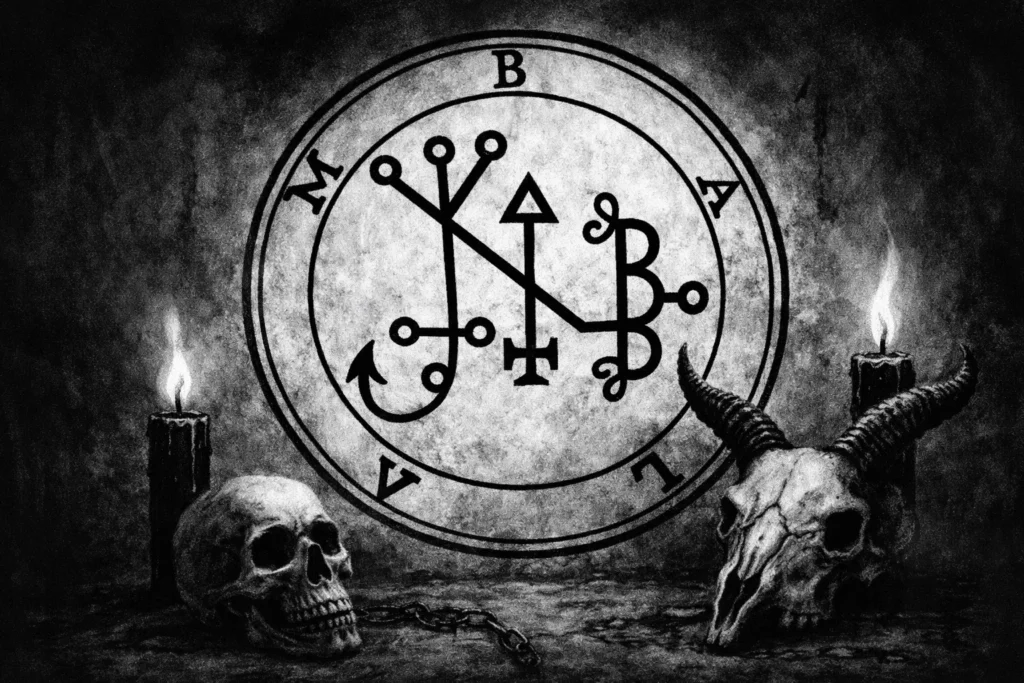
Abalam does not have a named sigil in the main texts. His seal is guessed from Paimon’s circle, shown as a tangled symbol of curves and crosses, used to bind his mist-like form. It is drawn in blood or ash during rituals and acts as a key. When placed in the center of protective circles, it brings him from the void when offerings are made.
In the past, mages drew this symbol on unused parchment to anchor Abalam from vapor to physical form. It was a tool to control him, but if the symbol was smudged, it could cause problems.
Other symbols include vapor swirls, which symbolize fleeting value and are carved in circles to summon his wind. Thorns on crowns show his painful and false rule.
Summoning and Rituals
Old grimoires describe how to summon Abalam through Paimon’s gate, using circles of salt and iron for protection.
The rituals mix Latin prayers with offerings like blood, incense, or animal parts, placed at the points of a triangle. Tools include wands with bone tips and bells to copy his vapor sound. The commands use Solomon’s ring to bind him and mention higher demons to keep him under control.
Bibliography
Author’s Note: I noticed an interesting contrast between the straightforward, ranked lists in Weyer’s Pseudomonarchia Daemonum and the more dramatic details found in the Harleian manuscripts. The Ars Goetia sets Abalam’s rank, but it was only after comparing these sources with Collin de Plancy’s 19th-century visual taxonomies that I understood the “heraldic” aspect of his appearance. What stood out to me most was that the sounds—trumpets and cymbals—were always mentioned, no matter the translation. This suggests that his unique sound was seen as just as important as his sigil.
- L. W. De Laurence – The Lesser Key of Solomon, Goetia. Original publication: Chicago: de Laurence, Scott & Co, 1916.
- Jennifer Reed – Christian Demonology | Origin, Demons & Importance. Study.com.
- Johann Weyer – Pseudomonarchia Daemonum. Digital edition by Joseph H. Peterson, 2000.
- British Museum Department of Manuscripts; Wanley, Humphrey, 1672-1726 – A catalogue of the Harleian manuscripts in the British Museum. With indexes of persons, places, and matters. 1808.
- Collin de Plancy – Dictionnaire infernal; répertoire universel des êtres, des personnages, des livres, des faits et des choses qui tiennent aux esprits. 1863
- Isaac Hershkowitz – Angels and Demons in Early Modern Musar Literature: A Big Data Analysis. The Journal of Jewish Ethics, vol. 9, no. 1, Penn State University Press, 2023.
You may also enjoy:
What Is a Pishacha, the Flesh-Eating Demon of the Dead?
February 11, 2026
Lamia: The Queen Cursed to Devour the Children of Others
January 7, 2026
Rāga: The Seductive Demon of Passion and Desire in Buddhist Lore
October 16, 2025
What Is a Rakshasa? Meaning, Origins, and Dark Powers
January 23, 2026
Who Is Arioch, the Demon of War and Vengeance?
January 21, 2026
Ancient Demons: The Real Origins of the Setcheh Myth
November 11, 2025