Adrammelech stands at the crossroads of solar power and ritual sacrifice, connecting his past as an Assyrian sun god to his later role as a fallen prince of Hell. Modern grimoires often describe him as a high-ranking official or a creature with peacock feathers. Still, his biblical roots in Sepharvaim show a much darker side: turning the Sun’s warmth into a destructive, sacrificial fire.
Looking at how he changed from a local god to the Chancellor of the Order of the Fly, we see how ancient monotheism turned the ‘glory’ of rival gods into a story of pride and downfall.
This article compares modern online stories with classic sources such as the Dictionnaire Infernal (1863) and the Pseudomonarchia Daemonum (1577) to build a historical profile grounded on evidence. [View Full Bibliography ↓]
Summary
Key Takeaways
| Attribute | Details |
|---|---|
| Names | Adrammelech, Adramelech, Adramelek, Adar-malik, Adramaleck |
| Title | Grand Chancellor of Hell, President of the Senate of Demons, Supervisor of Satan’s Wardrobe, Chief of the Order of the Fly |
| Gender | Male |
| Role | Tempter through guile and ambition, overseer of infernal politics, promoter of rebellion against divine order |
| Hierarchy | High-ranking archdemon, 8th of the 10 evil Sephiroth, under Samael in the Qliphoth |
| Superior Demon | Samael (primary overseer), Satan/Lucifer (ultimate authority) |
| Powers | Induces excessive pride and deceit, grants knowledge of hidden orders, and manipulates infernal hierarchies to sow discord |
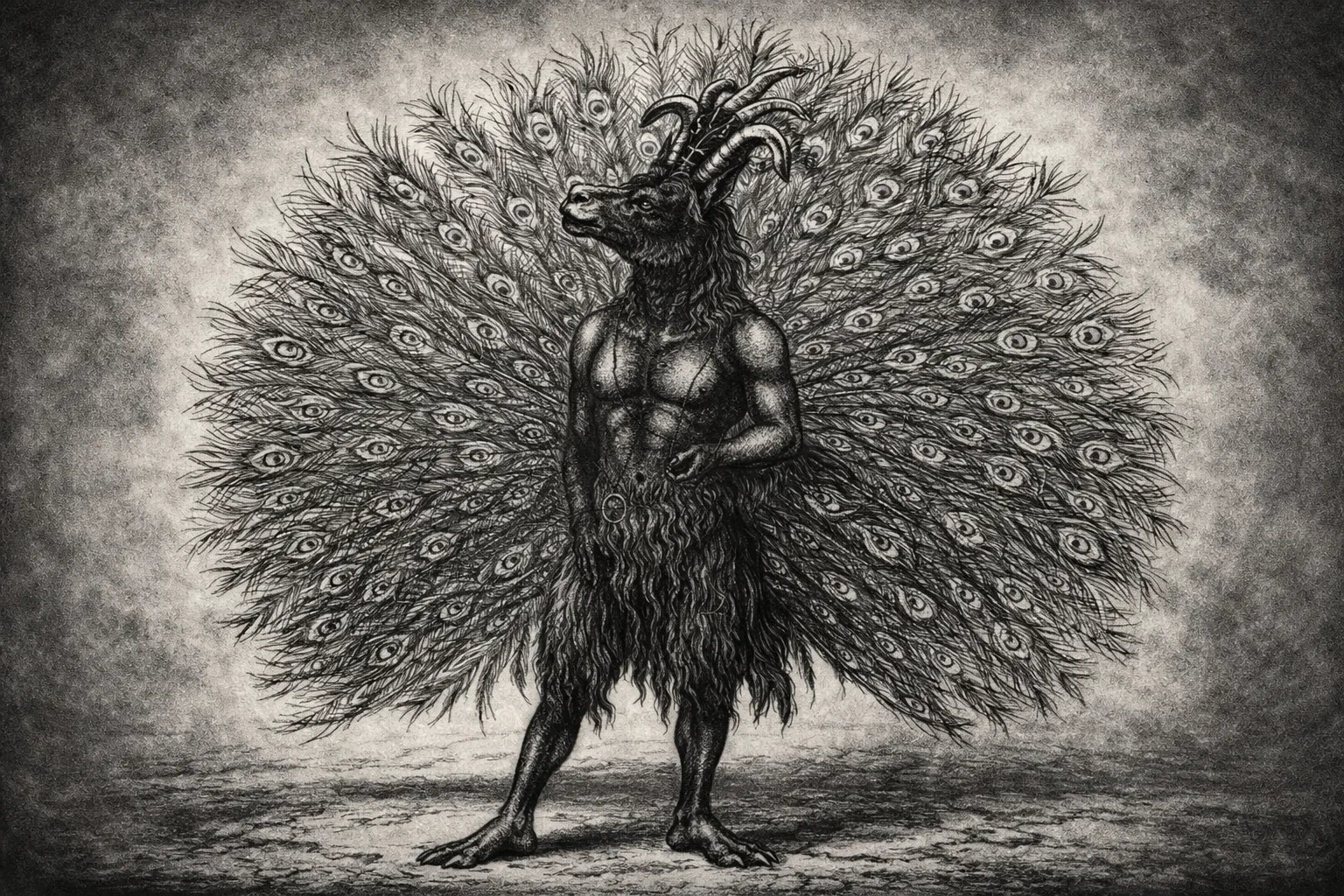
| Appearance | Human upper body with mule head, peacock tail, and mule or peacock limbs; sometimes a full peacock or ass form |
| Etymology | From Hebrew “Adir-melech” meaning “magnificent king” or “glorious one is king”; possible links to “Adar is prince” or sun god titles |
| Associated Figures | Anammelech (companion deity), Asmodeus (fellow fallen throne angel), Moloch (similar sacrifice ties) |
| Weaknesses | Vanquished by archangels like Uriel and Raphael, repelled by divine light and holy invocations |
| Opposing Angel/Saint | Uriel, Raphael (archangels who defeated him in heavenly war) |
| Pantheon | Judeo-Christian demonology with Assyrian/Babylonian influences |
| Element | Fire (primary, tied to the sun and destruction) |
| Planet/Zodiac | Sun; Capricorn (in some modern occult ties) |
| Color(s) | Black, white, purple, blue (symbolizing hidden power and vanity) |
| Number(s) | 8 (as 8th evil Sephira), 32, 47, 95 (magickal links) |
| Primary Sources | Bible (2 Kings 17:31, 19:37; Isaiah 37:38), Dictionnaire Infernal (Collin de Plancy), Paradise Lost (John Milton), Pseudomonarchia Daemonum (Johann Weyer), A Dictionary of Angels (Gustav Davidson), Der Messias (Friedrich Klopstock), Philosophie Occulte (Eliphas Levi) |
“Adrammelech” Meaning
The name “Adrammelech” comes from ancient Semitic languages, where names often revealed a being’s true nature. In Hebrew, it breaks down to “Adir-melech,” combining “adir” (meaning “magnificent” or “glorious”) with “melech” (meaning “king”).
This makes him the “magnificent king,” a title full of pride and linked to fire or the Sun’s intense light. Early scholars saw this as a sign of his past as a sun god, where glory meant a power that could both give life and cause destruction.
In Assyrian regions, names like this were often linked to gods who inspired fear through fire rituals, so Adrammelech was seen as an entity of fiery authority from the beginning.
The name also suggests royal status, since “melech” appears in other ancient titles for rulers or gods. This highlights his high position before he became known as a demon.
Over time, the name changed as different cultures took over and beliefs shifted. In Babylonian texts, it appears as “Adar-malik,” where “Adar” is a month linked to the thunder god Adad, and “malik” means “prince” or “counselor.”
This change could mean “Adar is prince,” moving the focus from open kingship to clever advice given in secret, which fits a demon known for plotting in Hell. Talmudic writers added further meaning, saying the name combines “to carry” (as in bearing the weight of sin) with “king,” suggesting he leads souls into rebellion.
Some interpretations are even darker: the “glorious” part is seen as a mockery of true divine light, turning it into a false brightness that misleads followers. In occult circles, this change marks Adrammelech as a link between pagan honor and Christian ideas of sin, with his name hinting at fallen beings who long for lost power.
Some older views connect the name to “Adadmelech” or “Hadad is king” because of letter changes in ancient scripts, linking him to storm gods with powerful, fiery traits. Others trace it to “Atra-malik” from Akkadian, meaning “exceeding king,” which suggests his downfall came from reaching too far.
The name’s history also connects to peacock feathers in Persian stories, where birds symbolized vanity. Some say the name sounds like “atra-malik,” similar to the Akkadian “exceeding king,” hinting that his pride led to his fall from Heaven. In grimoires, versions like Adramelek highlight the “lek” sound, suggesting a trickster who twists words into lies.
How to Pronounce Adrammelech in English
In English, Adrammelech is pronounced uh-DRAM-uh-lek. It breaks down as “Ad,” like “add,” “ram,” as in the animal, “me,” pronounced softly like “meh,” and “lech,” rhyming with “leck.” The stress is on the second syllable, making the name flow smoothly.
What Does Adrammelech Look Like?
Adrammelech is often shown in forms that mix human features with animal traits, based on old occult drawings and writings.
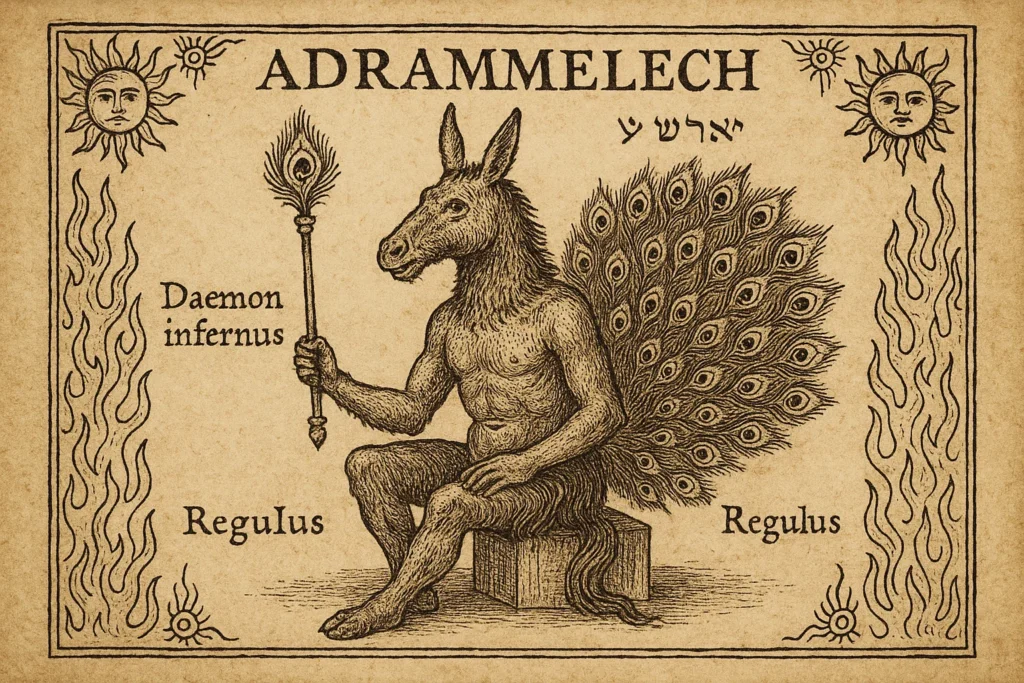
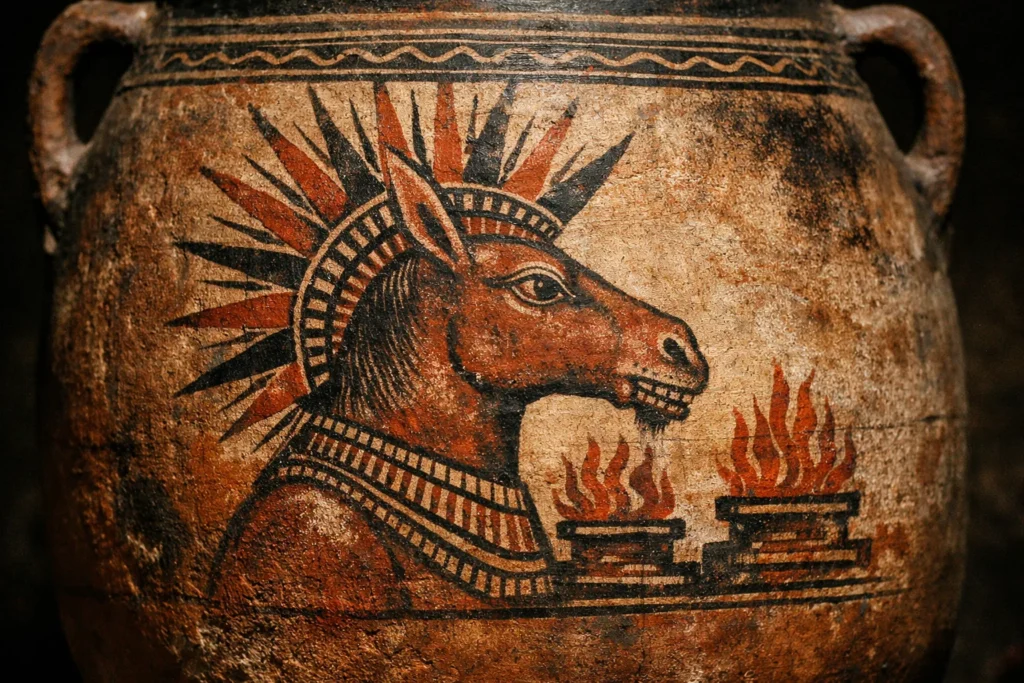
Most sources show the demon with a man’s chest and arms, but with a mule’s long face, suggesting stubbornness and cunning. He is also shown with mule legs and a wide peacock tail behind him.
The most well-known image of this demon is in Collin de Plancy’s Dictionnaire Infernal, where artist Louis Le Breton drew him with his head held high and tail spread, looking like a chancellor who serves Hell’s king but wants attention for himself.
Origins
Adrammelech’s origins go back to the ancient Near East, where gods rose from city fires and later fell under foreign rule.
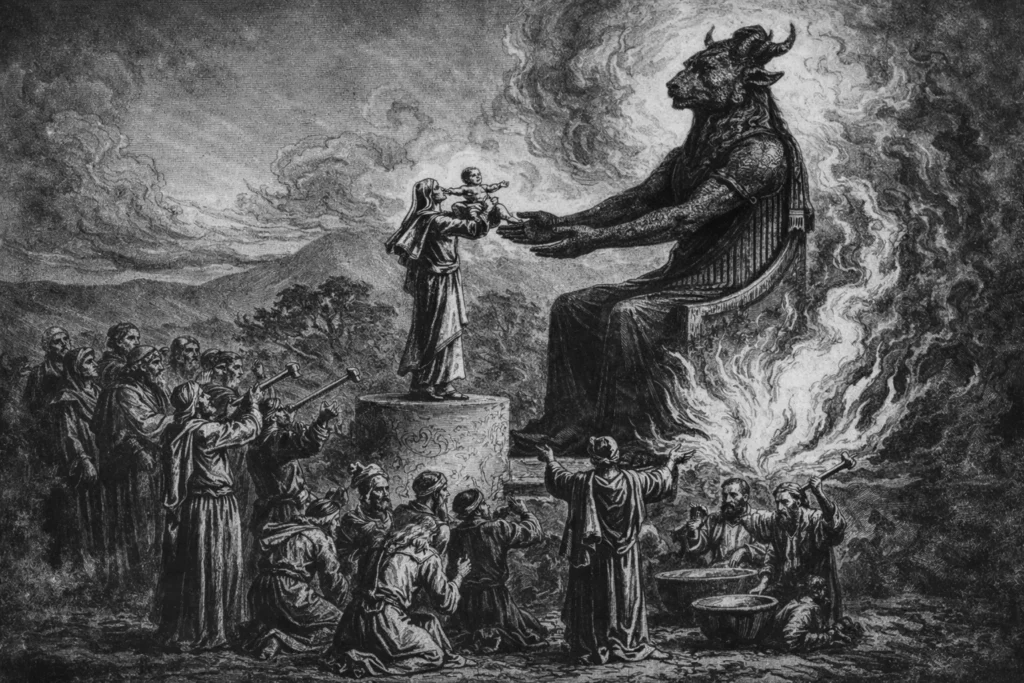
His earliest traces appeared in Assyrian and Babylonian lands around 700 BCE, as a sun deity among the Sepharvaim, likely in places like Sippar on the Euphrates, which were centers of star worship and royal power. There, he ruled over the harsh side of fertility: crops grew from the Sun’s warmth, but children were burned on altars to seek his favor.
This mix of giving life and taking it set him apart from gentler gods, and he was also linked to Adad, the storm god whose rains could help or destroy crops. As a Semitic god, he was worshiped along trade routes. It blended with local rituals in places like Hamath and Arpad, where sun kings demanded blood to keep their power.
As empires fought, Adrammelech entered the Hebrew world through Assyrian conquests of Israel. Exiled Sepharvites brought their idols to Samaria, which clashed with the worship of one God. Bible writers called him a false prophet, a sign of sin’s influence on the tribes.
By the time of the Talmud, rabbis described him as a mock-god with the shape of a donkey, a lowly animal for a proud name. In the Christian era, this change became complete: pagans were seen as devils, and sun gods became fallen stars.
You may also enjoy:
Aeshma: The Zoroastrian Demon of Wrath and Fury
January 13, 2026
Apophis: The Great Serpent of Egyptian Chaos
November 11, 2025
Vaisravana: The Golden Guardian King Who Rules the North
October 16, 2025
Who Was Ravana in Hindu Mythology and Why Was He Feared?
October 3, 2025
What Is a Bhuta? The Backward-Footed Ghosts of Hindu Horror
February 5, 2026
Was Adrammelech Ever Mentioned in the Bible?
Yes, the demon is mentioned twice in the Old Testament, both times in 2 Kings, where he is portrayed as a foreign god seen as weak.
First, in 2 Kings 17:31, he is linked to the Sepharvites’ sins, which included burning children in fire rituals after the Assyrian exile and mixing different faiths. This verse criticizes mixed worship as the source of a curse, with Adrammelech seen as a false light leading Israel away from God.
Second, 2 Kings 19:37 (also mentioned in Isaiah 37:38) refers to Adrammelech as the son of Sennacherib. This Assyrian king was killed in Nisroch’s temple by Adrammelech and his brother Sharezer.
In this story, he is not a god but a murderer who flees to Armenia. Ironically, an idol-worshipper is killed while praying.
| Source | Quote |
|---|---|
| 2 Kings 17:31 | The Sepharvites burned their children in the fire as sacrifices to Adrammelech and Anammelech, the gods of Sepharvaim. |
| 2 Kings 19:37 | It came to pass, as he was worshiping in the house of Nisroch his god, that Adrammelech and Sharezer his sons smote him with the sword: and they escaped into the land of Armenia. And Esar-haddon his son reigned in his stead. |
| Isaiah 37:38 | And it came to pass, as he was worshipping in the house of Nisroch his god, that Adrammelech and Sharezer his sons smote him with the sword; and they escaped into the land of Armenia: and Esarhaddon his son reigned in his stead. |
| 2 Kings 18:34 | Where are the gods of Hamath and Arpad? Where are the gods of Sepharvaim, Hena and Ivvah? Have they rescued Samaria from my hand? |
| Isaiah 36:19 | Where are the gods of Hamath and Arpad? Where are the gods of Sepharvaim? Have they rescued Samaria from my hand? |
Adrammelech in Grimoires and Other Texts
Outside the Bible, Adrammelech appears in occult texts as a cunning and well-dressed schemer from Hell:
| Source | Quote |
|---|---|
| Dictionnaire Infernal (Collin de Plancy) | Adramelech is the president of the devils’ general council; he is also the chancellor of hell and supervisor of the devil’s wardrobe. |
| Paradise Lost (John Milton, Book 6) | Uriel and Raphael his vaunting foe, Though huge, and in a rock of diamond armed, Vanquished Adramelech, and Asmadai, Two potent Thrones, that to be less than Gods Disdained… |
| Der Messias (Friedrich Klopstock, Book II) | First appeared Adramelech, a spirit in guile and malice exceeding Satan, against whom his bosom still boiled with indignant rage… From years immemorial, he had been considering how to raise himself to the dominion of hell… |
| Philosophie Occulte (Eliphas Levi, Serie II) | The eighth Sephira is Hod or eternal order… They have for adversaries the Samael or jugglers, whose Chief is Adramelech. |
| Pseudomonarchia Daemonum (Johann Weyer) | Adramelech is a great marquesse, and is seene as a horsse… He is under the power of Amaymon… |
The Solar Holocaust: Sepharvaim and the Theology of Transmutation
Adrammelech changed from a West Semitic sun god to a high-ranking demon in the Grand Grimoire, which shows how language and beliefs can erase the idea of the Sun as a positive force. In Assyrian and Babylonian times, his name came from Adar-Melech (“Magnificent King”), probably linked to the Sun at its strongest.
However, the Bible in 2 Kings 17:31 connects his worship to the Sepharvites, who “burned their children in fire to Adrammelech.” This moment changes the Sun’s image from life-giving to dangerous and destructive. Unlike most demons who represent darkness, Adrammelech stands for the “Blinding Light,” a kind of evil that destroys through too much exposure and sacrificial fire.
This change is similar to the “Solar Shadow” motif in mythology, where a sky god’s creative power becomes the destructive pride of a fallen monster. By the time of the Dictionnaire Infernal, he is shown as a peacock or mule-headed being, which mocks his former greatness.
The peacock, which once stood for immortality and the “thousand eyes” of the sky, becomes a symbol of empty pride and the Chancellor of the Order of the Fly in demonology. This choice is meant to mock his heavenly origins.
In medieval times, Adrammelech was seen as the patron of “Stolen Glory,” or the sin of taking divine traits and showing them off in a flashy, earthly way. Also, as “Chancellor of the Infernal Empire” and “President of the High Council,” he moves from direct violence to managing sin in a cold, organized way. He shows how “Sacrificial Fire” became a “Sacrificial System.”
In history, this change is similar to how early modern governments replaced open cruelty with the more hidden, organized harm of politics and court intrigue.
Adrammelech is the demon of appearances, reminding us that the greatest dangers can lurk behind beauty or strict order.
Powers and Abilities
Adrammelech uses dark powers based on clever control, aiming to lead souls into pride. His strengths are in tricking minds and seeking power, offering no help—only traps for those who are ambitious:
- Induces Guile and Deceit: He plants lies that fester, making hosts scheme against kin or gods.
- Grants Forbidden Knowledge of Order: Reveals Hell’s ranks and hidden laws, teaching how to climb thrones through betrayal.
- Manipulates Infernal Politics: As senate head, he sways demon votes for chaos wars, pitting lords like Satan against each other.
- Solar Fire Command: Calls sun-like blasts to scorch foes or blind with false glory.
- Vanity: He makes egos grow until leaders become tyrants who end up isolated.
- Council Binding: He forces weaker spirits to swear oaths that create groups of rebels.
Adrammelech Myths, Legends, and Stories
The Fall of Adrammelech in Paradise Lost
During the great battle in Heaven, where angels fought each other, Adrammelech was a strong fighter, wearing shining armor that sparkled like stars. He stood with Asmadai, both feeling superior to others and dreaming of thrones beyond even God’s reach.
Uriel was the first to face them, a strong warrior of light whose spear shone brightly and struck Adrammelech with holy anger. Raphael soon joined, swinging his sword and hitting Adrammelech’s armor with powerful blows.
The battle rang out across the heavens, with thrones fighting seraphs in a mix of bright light and loud noise.
Wounds appeared, and the blood of fallen angels spilled onto the holy ground, making a hissing sound. Adrammelech roared in anger, his face twisted, while his showy tail whipped around like a trickster’s weapon.
He used tricks and illusions, making weaker opponents believe they had won. However, the loyal defenders saw through his lies. Asmadai fell next to him, their armor broken and hopes of becoming gods destroyed.
Defeated and hurt, they retreated, losing their pride. The heavens shook as they left, showing that even the strongest can fall when envy causes conflict.
From their hiding places below, Adrammelech began planning his revenge, and his defeat started a new rebellion.
Meanwhile, the loyal angels chased them, their banners shining against the night, making sure no rebels escaped. After the battle, the heavens celebrated, while the defeated tended their wounds in exile, and Adrammelech’s broken armor remained as a warning.
Adrammelech’s Scheme in Der Messias
Before the stars existed, Adrammelech was a spirit in Heaven, filled with bitterness and anger even greater than Satan’s. He moved through the heavenly realms, always watching the Eternal’s throne and planning schemes that would take a long time to develop.
He was the first to think of a great rebellion. He started by whispering doubts to the seraphs, encouraging them to betray.
But he became angrier when Satan took charge of the rebellion, since Adrammelech thought he should be the main planner, not just a helper. He secretly thought of ways to take control without needing Satan.
In Hell, he surrounded himself with shadows, sometimes appearing as a peacock to show off and other times as a mule to wait patiently. “Why should we follow this newcomer?” he said to the other dark spirits, his voice calm but strong. “I’m the one who planned this rebellion and deserve to be king.”
He shared his plans: tempt Satan into attacking the throne again by promising him glory, then trap him. If that did not work, he would gather the dark forces for a chaotic battle to take power from the losers. The other spirits agreed, eager to follow Adrammelech’s clever lead.
Satan, noticing the unrest, looked into the darkness and said, “Fallen brother, your fire helps my cause, but your jealousy eats you alive.” Adrammelech bowed, his tail feathers trembling, but his eyes were sharp with anger. He kept plotting, turning others’ loyalty into doubt.
As battles broke out and the heavens shook, Adrammelech moved through the chaos to whisper to Satan: “Strike here, and the victory is yours. Just let me have my share below.” Satan paused, sensing a trick, and his followers’ loyalty returned. Adrammelech’s plans failed, and his allies scattered.
Banished deeper into Hell, he thought about his failure and kept planning to take the throne he could not have. His anger spread among the damned, and the memory of his failed rebellion kept the tension alive.
The Worship and Curse of Sepharvaim
In the ancient city of Sippar, near the Euphrates River, people built grand towers for Adrammelech. As a sun god, he could bless them with good harvests or burn their fields.
With the moon goddess Anammelech, he demanded sacrifices. Young goats were offered on burning altars at dawn, their bodies given to satisfy his desire for power.
Priests sang praises to him, with drums beating like heartbeats and smoke rising in prayer. The city enjoyed good rain and victories, but this came at a terrible cost: people screamed as blood was spilled to please the gods.
Grand temples displayed shining golden idols that caught the Sun’s light, where families brought gifts in the hope of good harvests and victories in battle.
But when the Assyrians invaded, bringing chaos, the influence of Yahweh grew. Still, old traditions continued in secret, with people quietly whispering Adrammelech’s name and hiding their rituals.
Israelite leaders noticed and warned that these “false gods” were draining their strength. Kings sent spies, but the ceremonies remained hidden, and children continued to vanish into the night.
One evening, a prophet unveiled a truth: Sennacherib’s own son, Adrammelech the prince, had fled to them after a bloody event in the temple, desperate for divine favor. In the echoes of Nisroch, he reignited sacrificial flames to reclaim lost power. These secret rituals, mingling with local beliefs, angered the divine forces with their persistence.
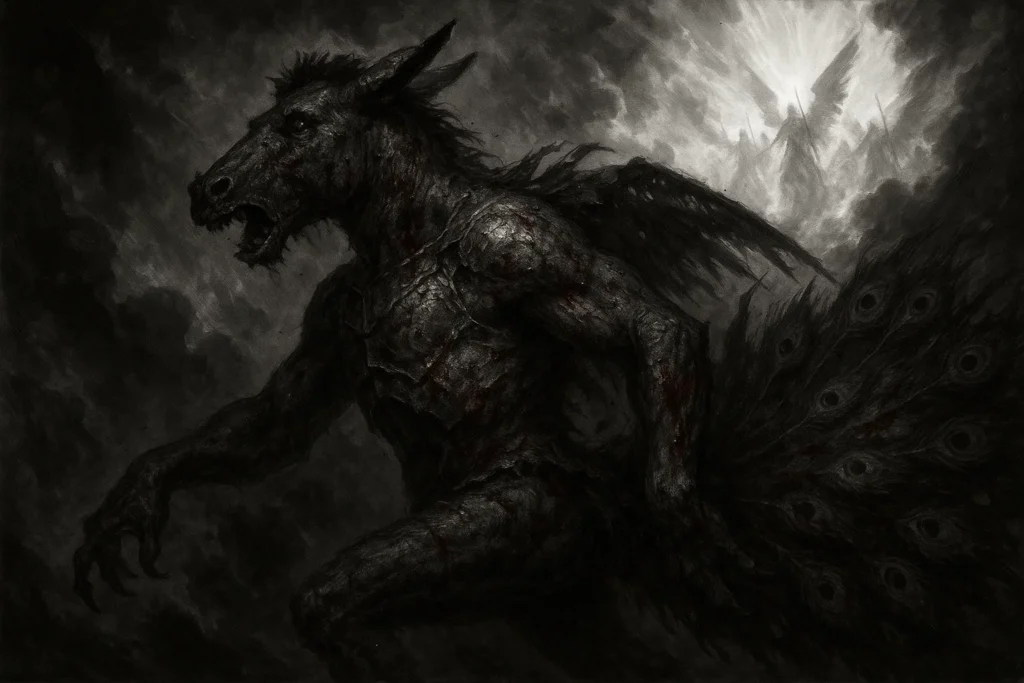
Heaven responded with anger: plagues spread, water dried up, and shadows became threatening. The exiled people trembled as their altars fell in earthquakes. Adrammelech’s frightening image appeared in smoke, shown with a mule’s head and peacock eyes, before his influence faded.
Samaria became a reminder that even the greatest sun gods can fall when the true God demands justice. The prince vanished into Armenia, leaving behind a god once honored, now viewed as a curse, and only traces of his pride.
You may also enjoy:
Who Were the Hinn, the First Spirits of Creation?
November 12, 2025
Iblis, the Jinn King of Darkness and Deception
September 29, 2025
Who Is Barqan, The Powerful Jinn King?
March 12, 2026
Who Is Aka Manto, Japan’s Terrifying Red-Cloaked Yōkai?
October 24, 2025
Palis: The Foot-Licking Desert Jinn That Drinks Your Blood
December 3, 2025
Who Is Agaliarept, the General of Hell Under Lucifer?
October 8, 2025
Adrammelech vs Other Similar Demonic Entities
| Demon Name | Associated Sin/Temptation | Rank/Origin | Key Traits/Powers |
|---|---|---|---|
| Asmodeus | Lust and wrath | King of demons; Ars Goetia, Testament of Solomon | Three-headed form (bull, man, ram); destroys marriages, teaches math and arts through rage |
| Belial | Lawlessness and lies | Prince of Hell; Dead Sea Scrolls, Ars Goetia | Commands 80 legions; appears as a beautiful angel or charioteer, sows discord in courts |
| Moloch | Child sacrifice and greed | Ammonite god demonized; Bible, Milton | Bull-headed giant; demands blood offerings, grants wealth via fire rites |
| Beelzebub | Gluttony and possession | Lord of Flies; Philistine god, Ars Goetia | Winged insectoid; rules eastern hell, exorcism foe, spreads plagues and false gods |
| Baal | Pride and idolatry | Canaanite storm god; Bible, grimoires | Horned thunder-bringer; 66 legions, reveals invisibles, incites false worship storms |
| Astaroth | Sloth and discovery | Duke of Hell; Ars Goetia, Grand Grimoire | Foul angel on dragon; teaches sciences but corrupts with lazy secrets, reveals past/future lies |
| Mammon | Greed and inequality | Treasurer of Hell; New Testament, medieval lore | Wolf-faced hoarder; tempts with riches that bind souls, divides through envy |
| Leviathan | Envy and chaos | Sea serpent; Bible (Job, Isaiah), Kabbalah | Coiled dragon of depths; guards hell’s west, floods minds with jealous waves |
| Abaddon | Destruction and locusts | Angel of the pit; Revelation, Talmud | Winged destroyer; unleashes plagues, bottomless pit lord, annihilates without mercy |
| Pazuzu | Winds and famine | Mesopotamian demon; exorcist texts, folklore | Winged lion-man; storms bring disease, protects from rivals, but starves the weak |
| Lilith | Seduction and infanticide | Night demon; Jewish folklore, Zohar | Winged seductress; steals children, tempts men in dreams, first wife’s vengeful shadow |
| Nergal | War and plague | Underworld god; Babylonian, Bible | Lion-headed warrior; rules south hell, spreads fever-arrows, gates death’s realm |
| Dagon | False prophecy | Philistine fish-god; Bible, grimoires | Half-fish merman; drowns sailors in lies, topples temples with tidal deceit |
| Eurynomos | Corpse-eating and despair | Greek underworld; Pausanias, demonology | Blue-skinned flayer; strips flesh from the dead, whispers hopelessness to the living |
| Demogorgon | Terror and duality | Chaos lord; medieval grimoires, folklore | Two-headed demon; splits minds with fear, births abominations from rifts |
Adrammelech’s Rank in the Hierarchy of Hell
Adrammelech is a high-ranking demon in Hell’s hierarchy, working behind the scenes as a clever strategist in a place full of chaos.
He is often called the Grand Chancellor, an important member of the council where demons plan against Heaven, similar to a secretary who counts votes with confidence.
Some texts say he serves under another demon named Amaymon. In contrast, others place him even higher as the leader of the council of devils, managing things quietly and carefully.
In more mystical teachings, he ranks eighth among the ten evil influences, spreading confusion and lies while overseeing the chaos from the dark side.
He works with powerful figures like Beelzebub, gathering information and using his influence to distract his enemies. His strength is not in leading armies, but in influencing and manipulating powerful people from afar.
Despite not commanding legions (like other high-ranking demons), Adrammelech has a network of rivalries and alliances.
Some demons, like Lucifuge, dislike his approach, while others, like Belial, mock him for his vanity. Still, he is strategic and often shares secrets to turn his rivals against each other, showing his patience and skill.
His alliances are constantly changing, sometimes teaming up with Moloch for fiery rituals or betraying others to shine on his own.
In this complex hierarchy, he is the clever advisor who appears friendly but secretly plots for more power, judging his success by how many powerful beings he can outsmart.
Associations
Adrammelech has a mix of traits that make him dangerous. He is driven by the Sun’s ambition and desire for glory, and he uses Mercury’s cleverness to twist the truth. Deep down, his pride is like a fire that burns anyone who gets too close to their own ambitions.
He shows traits of Capricorn, which stands for stubborn determination that can become risky. The number 8 stands for his ongoing deceit and trickery.
He is often shown with two main colors: black, which suggests hidden dangers, and purple, which stands for a false sense of royalty.
Obsidian crystals represent his sharp and untrusting nature.
Zodiac and Astrological Links
Adrammelech has the qualities of Capricorn, a zodiac sign known for ambition and determination. Like a goat climbing a mountain, he works hard to reach his goals. This sign encourages patience, helping him wait for his rivals to make mistakes.
Capricorn’s strong traits match Adrammelech’s modest appearance, showing that greatness can come from unlikely places. He is similar to a chancellor, carrying significant responsibilities while seeking greater power.
In ancient rituals, when stars like Sirius and Arcturus were at their brightest, his fiery nature grew stronger, making him more powerful in ceremonies. Mars, the planet of war, makes his strategies sharper and prepares him for conflict.
Saturn, Capricorn’s ruling planet, adds discipline to his clever plans. He creates complex traps that take time to work. In astrology, his presence warns against being too ambitious during winter, when compassion is rare.
Mercury adds an element of cleverness, enabling him to skillfully manipulate conversations and ideas.
Elemental Associations
Fire is the source of Adrammelech’s power. He was once a sun god whose rituals inspired pride, but now fire stands for his destructive side. This fire can go from warm to dangerous, like a peacock’s bright feathers that hide a threat.
He can release powerful solar blasts that harm both body and soul, stopped only by water or light. As a sun god, he demands sacrifices and destroys without mercy, causing chaos among evil beings.
Air works with fire by spreading whispers and lies, turning flames into smoke that confuses enemies. Fire gives power, while air helps spread his tricks.
Earth provides him with stability for his long-term plans, reflecting his Assyrian roots and long-lasting traditions.
In rituals, smoke from fires shows how these elements mix, rising as twisted prayers to the heavens.
Colors, Numbers, and Crystals
Black is Adrammelech’s main color, hiding secrets and blocking out light. Bright white stands for false purity, drawing people in with lies before the truth is revealed. These colors show his two sides: black for his dark nature and white for his lost glory as a sun god.
Purple shows his pride, like royal robes that compete with gold. Blue stands for his cold, careful planning, fitting for secretive actions.
Numbers are important for understanding him: 8 for pride, 32 for deceit, 47 for sudden aggression, and 95 for magical traps that catch rivals.
Crystals add to his image: obsidian for his sharp words, rubies for his fiery spirit, and onyx for his stubborn plans. These elements combine to make him powerful and draw others into his schemes.
Other Correspondences
Metals like iron give strength to Adrammelech’s mule, and his chains lock the doors of Hell. Gold tempts him, but it often loses its shine and betrays real friendships.
He is surrounded by poisonous plants like nightshade and dark berries, which match his evil plans. These plants cloud judgment and quietly remove rivals. Nightshade flowers once stood for false glory in rituals.
Animals are also important: peacocks show off their beauty while watching sins unfold, and the mule symbolizes stubbornness and reminds us of Adrammelech’s fall from godhood.
Bibliography
Author’s Note: What stood out to me was the contrast between the harsh sacrifices described in the Old Testament and the colorful bureaucracy in Collin de Plancy’s 19th-century view. Milton and Klopstock add poetic depth to the idea of a fallen being. Still, the main research challenge was to connect the ancient Sepharvite sun god to the “peacock-mule” image in modern occultism. In conclusion, I decided to focus on the Pseudomonarchia Daemonum to anchor these changing stories in the strict hierarchy of 16th-century demonology, showing Adrammelech as more of a cold, organized entity of pride than a wild monster.
- Collin de Plancy – Dictionnaire infernal; répertoire universel des êtres, des personnages, des livres, des faits et des choses qui tiennent aux esprits. 1863.
- Klopstock, Friedrich Gottlieb – The Messiah. Printed for J. Walker, London, 1811.
- Johann Weyer – Pseudomonarchia Daemonum. Digital edition by Joseph H. Peterson, 2000.
- Rodger Bufford – Demonic Influence and the Christian: Issues and Implications for Counseling. 2008.
- Jennifer Reed – Christian Demonology | Origin, Demons & Importance. Study.com.
- Gustav Davidson – A Dictionary of Angels. Published by The Free Press, 1971.
- John Milton – Paradise Lost. Originally published in 1667.
- The Church of Jesus Christ of Latter-day Saints – The Old Testament. Intellectual Reserve, Inc, 1979, 2013.
You may also enjoy:
What Is Baku? The Bizarre Yōkai That Eats Nightmares
January 28, 2026
Al-Ahmar: The Tuesday King of the Seven Jinn
February 13, 2026
Who Was Abezethibou, the Fallen Angel Who Opposed Moses?
October 1, 2025
Yuki Onna: The Terrifying Bride Who Feeds on Travelers
December 9, 2025
Ammit: Devourer of the Dead in Ancient Egyptian Mythology
November 10, 2025
Aži Dahāka: The Three-Headed Dragon of Zoroastrian Mythology
January 14, 2026