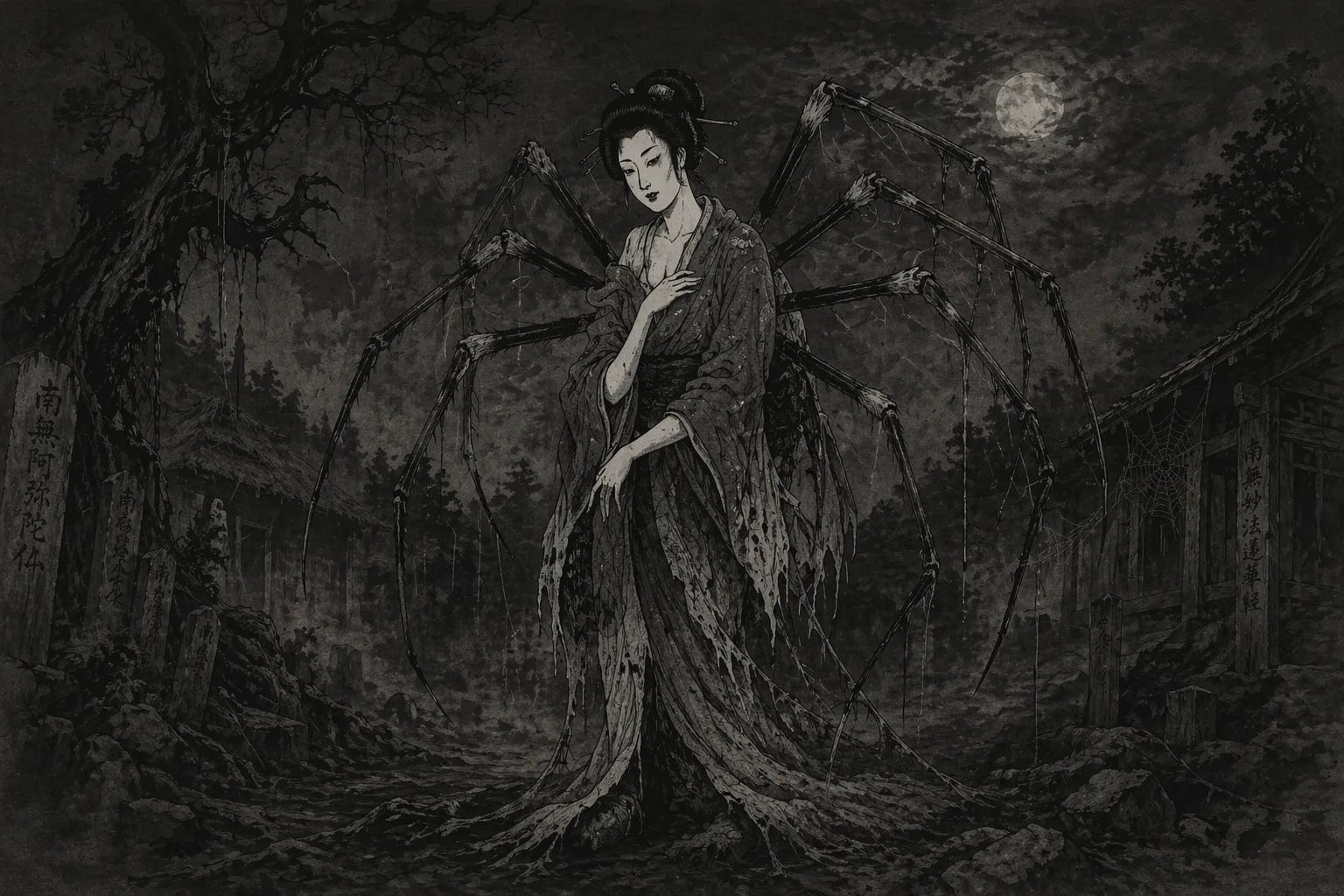
Many supernatural beings in Japanese folklore symbolize dangers from the outside world. Still, the Jorōgumo represents betrayal at home and a deadly twist on feminine hospitality. Stories about this creature focus on the shift from a caring appearance to a predatory reality, reflecting cultural worries about trusting strangers.
Most animal shapeshifters (such as the Kitsune or Tanuki) play tricks for fun or to teach lessons. This spider entity is different because it acts mainly out of predatory instinct, much like a real spider.
In my research, I focus on how this entity has transformed over time by comparing Toriyama Sekien’s detailed illustrations in Gazu Hyakki Yagyō with the social and religious notes found in Taihei Hyakumonogatari. This helps me separate artistic creativity from real folk beliefs. [View Full Bibliography ↓]
Summary
Key Takeaways
| Attribute | Details |
| Names | Jorōgumo, Entrapment Bride, Whore Spider, Maiden Weaver |
| Translation | The name translates to “Binding Bride” or “Prostitute Spider,” depending on the kanji used. |
| Title | The Golden Silk Weaver |
| Type | Obake (Shapeshifter) |
| Spirit Classification | Ara-mitama (Violent spirit) |
| Origin | A Nephila clavata spider that reaches 400 years of age and acquires supernatural intelligence and size. |
| Gender | Female |
| Appearance | A massive spider with golden markings that transforms into a beautiful, young woman typically clad in fine silk. |
| Kehai (Aura/Presence) | The presence is preceded by the scent of rotting vegetation and a sudden, unnatural stillness in the surrounding insect life. |
| Powers/Abilities | Shapeshifting, silk manipulation, command over smaller spiders, and the emission of fire-breathing spiderlings in certain accounts. |
| Methods of Pacification | Repelled by tobacco smoke, Buddhist sutras, and the cutting of her invisible silk threads with blessed blades. |
| Habitat | Caves, abandoned forest dwellings, and the areas surrounding waterfall basins. |
| Diet/Prey | Human men, specifically those who wander alone into secluded natural environments. |
| Symbolic Item | The Biwa (lute) or a silk spinning wheel. |
| Symbolism | The dangers of deceptive beauty and the predatory nature of the hidden self. |
| Associated Kami | In some local traditions, she is seen as a fallen Suijin (Water God) of the Jōren Falls. |
| Sources | Taihei Hyakumonogatari, Tonoigusa, and various Edo-period Ukiyo-e prints. |
Who or What Is the Jorōgumo?
Jorōgumo is a type of yōkai that combines animal transformation with predatory behavior. These creatures, usually modeled on the Nephila clavata spider, are believed to experience dramatic transformations after living for 400 years. At that point, they can take on a human form, often appearing as an attractive woman to help them hunt.
Unlike the Yuki-onna, who is linked to cold weather, or the Kappa, who is tied to its physical form, this creature uses psychological tricks and breaks social rules.
The Jorōgumo usually lives in remote places or on the edge of towns, where it can lure travelers into its home. Once the victim is distracted or trapped by its nearly invisible webs, the creature turns back into a spider to eat them.
Semantic Origins
The name’s origin shows how language has adjusted to match the creature’s tricky nature. It is usually written as 絡新婦, which means “binding bride” or “entrapment bride.” This choice of kanji highlights how the creature uses marriage as a way to trick people into feeling safe.
In some Edo-period texts, the name is written as 妓楼蜘蛛, meaning “prostitute spider.” This version connects the creature to the pleasure districts of old Japanese cities, where its predatory side became a symbol for the financial and spiritual dangers found there.
The name probably started with the real Nephila spider, which is known for its bright colors and golden webs. Over time, people changed the spider’s scientific name into a supernatural one through folk stories.
In some local dialects, such as those in the Izu Peninsula, the name is often mixed with Mizuchi or other water spirits. This points to a broader, older tradition of ‘female water predators’ that later gave rise to the spider creature we know today.
You may also enjoy:
Ifrit: Demon of Fire Who Serves Iblis in Islamic Tradition
September 30, 2025
Aim (Aym): The Great Duke of Hell in the Ars Goetia
November 11, 2025
Amaymon: The Infernal King Who Commands Death and Decay
November 17, 2025
Andrealphus: The Peacock Demon Who Twists Minds and Bodies
January 19, 2026
How to Pronounce “Jorōgumo” in English
To say this name in English, break it into four parts: jo-roh-goo-mo. The first sounds like “go,” the second like “row,” the third like “food,” and the last like “mo” in “morning.” Each part gets about the same stress.
What Does Jorōgumo Look Like?
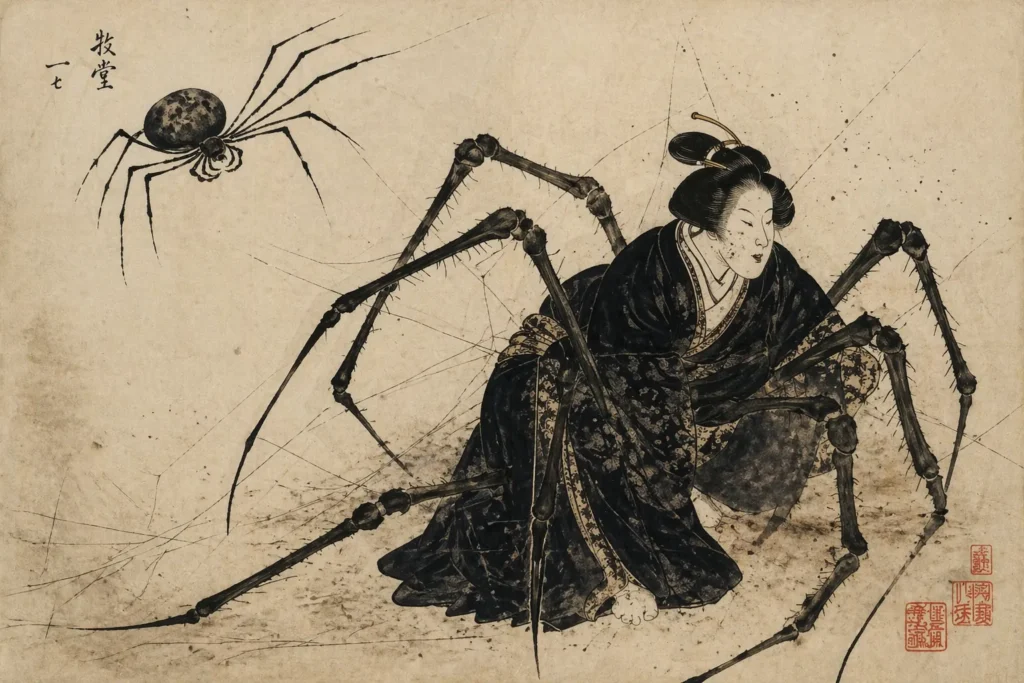
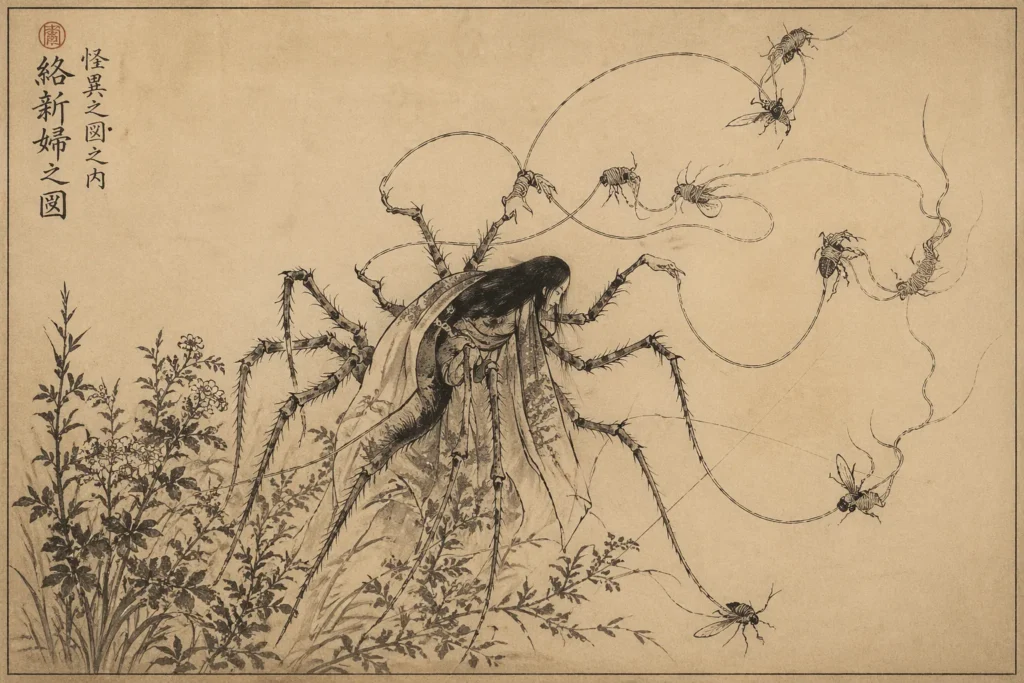
This creature has two main forms. In its true, monstrous state, it looks like a giant Nephila spider, sometimes as big as a person or even larger. Its body shows bright yellow, black, and red patterns, similar to those of the Golden Silk Orb-weaver. Its legs are long and thin, ending in sharp points that can pierce leather and bone.
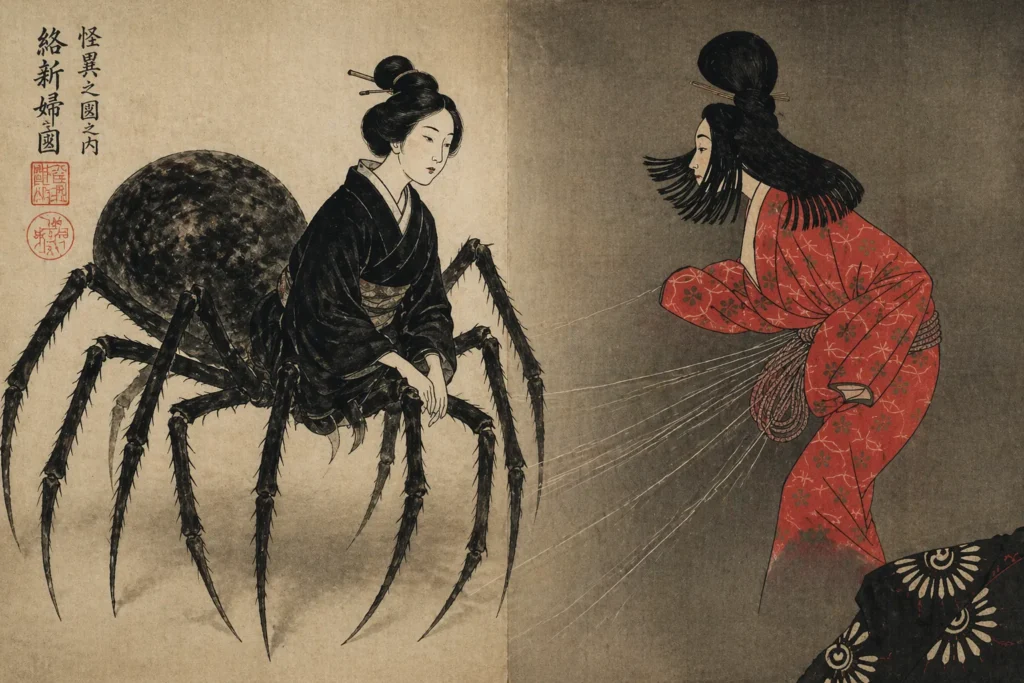
When it takes on a human form, it usually appears as a woman in her early twenties, with an almost unnatural beauty. She wears fine silk kimonos, often decorated with patterns resembling a spider’s web.
According to stories, the Jorōgumo plays a lute or a biwa to charm her victims. If you look closely at these tales, you might notice clues to her real identity: her shadow sometimes shows eight legs, or her movements are oddly stiff and unnatural.
In some newer accounts, she is even shown as a centaur-like creature, with a woman’s upper body joined to a giant spider’s body.
Origins and History
This yōkai first appeared in the mid-Edo period, when cities were growing quickly, and people often gathered to share ghost stories called Hyakumonogatari Kaidankai. At that time, society was changing: the strict samurai order was being questioned by the growing merchant class, and the entertainment districts became places of both interest and worry.
From my research, I think that the Jorōgumo represents men’s fears of the ‘femme fatale’ in the unregulated pleasure districts. It’s also interesting that the earliest accounts of it appeared when Japan’s silk trade was at its height. The spider’s skill at making valuable thread matches the importance of weaving in the economy. Still, its dangerous side hints at a fear that this social and economic ‘web’ could trap those who aren’t careful.
The creature’s link to water, especially waterfalls, suggests it has very old roots. In the past, many Japanese waterfalls were thought to belong to water goddesses called Suijin. During the Edo period, as people began to record and explain folklore, these old deities were often depicted as specific monsters.
In my opinion, changing a ‘Water Goddess’ into a ‘Spider Woman’ shows a shift in how people saw nature—from sacred to wild and risky, something that needed to be controlled.
Habitat
The Jorōgumo is usually found in secluded places with natural barriers. It is most often found to deep forests, along mountain paths, and in misty waterfall basins, such as Jōren Falls in Shizuoka. These spots are chosen because they keep victims far from help.
In city legends, the creature is said to live in old, haunted houses called obakeyashiki. Jorōgumo enjoys the dark corners near the ceiling and the dusty spaces under the floor, where it can spin its webs without being bothered.
These places suit its hunting style, since it needs strong structures to hold its huge, tough webs—webs that are said to be strong enough to catch a horse.
Famous Jorōgumo Legends and Stories
The Weaver of Jōren Falls
A woodcutter was working near Jōren Falls in Izu and stopped to rest by the water. As he sat, a small spider came out of the brush and scurried over his feet, leaving a thin silver thread behind. The spider kept looping the silk around his big toe. Feeling uneasy about this, the man gently removed the thread from his foot and tied it to an old, rotting tree stump nearby.
Suddenly, the water in the basin started to churn. A powerful force pulled hard on the silk, tearing the heavy tree stump from the ground and dragging it into the falls with a loud splash.
From the mist, a woman’s voice called out with a chilling laugh: “How clever! How clever!” Realizing the spider was part of the mistress of the falls who wanted to drown him, the woodcutter ran away and never returned to Jōren basin.
The Kashikobuchi Promise
In the Sendai region, at the deep pool called Kashikobuchi, a man was fishing when he dropped his favorite whetstone into the water. As he got ready to dive in after it, a beautiful woman rose from the depths, holding the stone.
She smiled and said, “I will return this to you, but you must promise me one thing: you must never tell anyone that you saw me here. If you speak of this encounter, your life will be forfeit.”
The man took the stone and kept the secret for years. But one night, after drinking too much sake with friends, he bragged about meeting the woman at the pool. As soon as he finished, the room felt heavy and tense.
That night, as he slept, a huge spider came down from the rafters and wrapped him tightly in silk until he could not breathe. The next morning, his family found him dead in bed, his body covered in a golden web, just as the woman had warned.
The Abandoned Temple and the Biwa
A wandering samurai, caught in a sudden storm, found an old, run-down temple in the mountains. He started a small fire in the hall and soon heard the soft sound of a biwa.
A beautiful young woman appeared from the shadows, her silk robes shining in the firelight. She sat across from him and played a tune so soothing that the samurai felt himself growing sleepy and heavy.
As he started to fall asleep, the samurai noticed something strange: the shadows of the temple pillars were moving. He looked up and saw thousands of tiny spiders on the ceiling, each lowering a strand of silk toward him.
The woman’s fingers moved quickly on the biwa, but the sound was really her spinning a huge web around him. He saw that her shadow on the wall had eight long legs.
He quickly drew his katana and slashed through the air. The woman screamed and disappeared in a cloud of black smoke, leaving behind a trail of thick green liquid that led to a hole under the floorboards, where a giant, wounded spider was curled up in the dark.
The Peasant and the Tobacco Pipe
In the village of Toyonaka, a farmer met a woman carrying what appeared to be a crying baby. She asked him to hold the child while she tied her sandal. As soon as he took the bundle, it became extremely heavy, as if it were made of lead. He looked down and saw that the ‘infant’ was really thousands of spider eggs wrapped in webbing.
The woman’s face peeled away, showing the many eyes of a giant spider. The farmer quickly grabbed his lit tobacco pipe and pressed the hot end against her arm. The creature screamed as the tobacco smoke acted like a strong poison.
The Jorōgumo lost her human form and ran into the tall grass. The farmer threw the heavy bundle into a fire, where it hissed and popped, ending the threat.
You may also enjoy:
Who Is Shiva, the Destroyer and the Lord of the Universe?
November 12, 2025
Iblis, the Jinn King of Darkness and Deception
September 29, 2025
Who Is Hariti, the Mother of Ogres in Buddhist Mythology?
December 8, 2025
Nasnas: The Monstrous Demon Hybrid That Haunted Pre-Human Earth
November 12, 2025
Al-Ahmar: The Tuesday King of the Seven Jinn
February 13, 2026
The Fallen Suijin Theory
In my research on mid-Edo-period records, especially the important works of Toriyama Sekien, I noticed a constant tension between the creature’s spider-like body and its relationship to the environment.
Today, most people see this creature as a predatory ‘spider-woman.’ However, my study of older regional stories, especially those about Jōren Falls and Kashikobuchi pool, points to a deeper origin. It seems the entity was not always a spider, but a ‘fallen’ Suijin (Water Deity) whose divine status faded as religious beliefs transformed in 18th-century Japan.
The transition from a protective river goddess to a dangerous weaver shows a wider cultural trend of turning wild spirits into demons. In the Heian and Kamakura periods, people worshipped the ‘Mistress of the Falls’ for safety and rain.
But during the Edo period, as cities grew and people sought more ghost stories, these shapeless water spirits were given frightening physical forms to suit the new taste for Kaidan.
The ‘Golden Silk Weaver’ fit this change well because the spider’s web, with its complex patterns, was a clear symbol for the dangerous, swirling waters of a waterfall basin.
Adding the biwa (lute) to later legends is clear proof of this transition in belief. In traditional art, the lute belongs to Benzaiten, the goddess of water, words, and music. By stripping her of her kind image and turning her into a spider, Edo storytellers reversed her role. They altered the idea of ‘flow’ into the ‘trap’ of the weaver.
This metamorphosis shows a deep fear of losing old rural protections. As people moved to cities, the gods of their ancestors did not simply vanish. Instead, they became the monsters haunting the empty places left behind.
Jorōgumo Powers and Abilities
This creature’s offensive and defensive skills are impressive, making it one of the most dangerous shapeshifters in Japanese folklore. Its main strength is its cleverness. Instead of using brute force, it slowly and carefully traps its victims.
Unlike an Oni, it lacks great destructive power. Still, it is more successful in hunting because it is skilled at disguise and controlling its surroundings.
- Human Metamorphosis: The ability to assume a perfect human form, usually that of a young, attractive woman, to deceive humans.
- High-Tensile Silk: The production of webbing that is nearly invisible to the human eye and has the strength of steel cables.
- Venomous Bite: A bite that delivers a paralyzing neurotoxin, keeping the victim alive but immobile during consumption.
- Arachnid Command: The ability to control and communicate with normal spiders, using them as scouts or distractions.
- Illusion Casting: The power to make a dilapidated lair appear as a comfortable, welcoming home or inn.
Traditional Defenses Against the Jorōgumo
To protect yourself from a Jorōgumo, you need both spiritual strength and physical tools.
Folklore says the best physical defense is tobacco or thick smoke. The strong toxins in tobacco are thought to be deadly to the creature’s real form, often forcing it to reveal itself and run away. In the Edo period, travelers were often told to carry a pipe (kiseru) for this reason when passing through places known for spiders.
Besides physical defenses, Buddhist sutras and Shinto charms (ofuda) are important for breaking the creature’s illusions. Reciting the Heart Sutra is said to remove the spell that hides the spider’s web, allowing people to see the trap before it is too late.
Since the Jorōgumo is linked to water, carrying a little salt or a blessed iron blade is also recommended, as these are traditional ways to ward off supernatural spirits.
Jorōgumo vs Similar Spirits
| Name | Category | Origin | Threat Level | Escape Difficulty |
| Tsuchigumo | Oni/Earth Spirit | Ancient clan of renegades | Extreme | High; requires military force. |
| Ushi-oni | Obake | Sea/Mountain hybrid monster | Extreme | Very High; lethal gaze. |
| Kitsune | Obake | Magical fox | Variable | Moderate; requires salt/dogs. |
| Yuki-onna | Yūrei-like | A woman who died in the snow | High | High; fire is required. |
| Kuchisake-onna | Urban Legend | Mutilated woman | High | Moderate; requires specific phrases. |
| Nure-onna | Obake | Serpent with woman’s head | Extreme | Very High; crushes victims. |
| Hannya | Yūrei/Oni | Woman transformed by jealousy | Extreme | High; requires holy intervention. |
| Kappa | Suijin-derivative | Water imp | Moderate | Easy; requires bowing/cucumbers. |
| Kumo-musume | Obake | Spider’s daughter | Low | Easy; usually shy. |
| Ubume | Yūrei | A woman who died in childbirth | Moderate | Moderate; involves child-carrying. |
Symbolism
| Attribute | Details |
| Element | Water and Wood |
| Animal | Spider (Nephila clavata) |
| Cardinal Direction | North-West (associated with the intersection of wilderness and home) |
| Color | Gold and Black |
| Plant | Tobacco and Kudzu |
| Season | Late Summer / Early Autumn |
| Symbolic Item | The Silk Loom |
In Japanese culture, this creature is a strong warning about the dangers of hidden threats and how appearances can be deceiving. It represents the idea of ‘the spider and the fly’ in a Japanese setting, showing how obsessive desire and forbidden attractions can lead to social ruin.
Unlike many other yōkai that show nature’s unpredictability, the spider-woman symbolizes the danger of a planned trap and the clever mind that waits for the right moment to attack.
In art, this creature appears in many Ukiyo-e prints by artists like Utagawa Kuniyoshi. It is often used as a symbol for political corruption or the tangled nature of bureaucracy.
Today, the spider-woman archetype still shapes Japanese horror stories. The Jorōgumo is a model for characters who look fragile and beautiful on the outside but hide a monster within. This keeps alive the old warning not to trust a stranger who seems friendly in a lonely place.
You may also enjoy:
Tarakasura: The Dark Demon Who Ruled Hell on Earth
December 4, 2025
Who Is Asmodeus in Demonology and the Bible?
February 18, 2026
Andrealphus: The Peacock Demon Who Twists Minds and Bodies
January 19, 2026
Hitotsume kozō: One-Eyed Yōkai of Japanese Folklore
February 4, 2026
Banasura: The Thousand-Armed Demon King
October 10, 2025
Bibliography
Author’s Note: As I worked on this article, I noticed a significant difference in Japanese beliefs reflected in the stories from different eras. For example, the early tales in the Konjaku Monogatarishū feature water-based spirits, while later works by Toriyama Sekien introduce a creature that is part spider and part human. This evolution highlights a more in-depth narrative about lost divine connections rather than just focusing on modern ideas of monsters. By exploring the Honchō Jinja Kō and well-known ghost stories, I was able to illustrate how this creature links traditional nature worship with the moral concerns people faced during the Edo period, particularly in city life.
- Night Parade of a Hundred Demons. Yōkai Senjafuda, Mellon Projects, University of Oregon, glam.uoregon.edu.
- Cucinelli, Diego. Feline Shadows in the Rising Sun: Cultural Values of Cat in Pre-Modern Japan. P. Santangelo (Ed.), Ming Ching Studies (Aracne), 2013. Academia.edu.
- Kelsey, W. Michael. Konjaku Monogatarishū. Twayne Publishers, 1982. Twayne’s World Authors Series 621. Internet Archive.
- Aston, W. G., translator. Nihongi: Chronicles of Japan from the Earliest Times to A.D. 697. Kegan Paul, Trench, Trübner & Co., 1896. Internet Archive.
- Hoebeke, E Richard et al. Nephila clavata L Koch, the Joro Spider of East Asia, newly recorded from North America (Araneae: Nephilidae). PeerJ vol. 3 e763. 5 Feb. 2015, doi:10.7717/peerj.763.
- Foster, Michael Dylan. The Book of Yokai: Mysterious Creatures of Japanese Folklore. University of California Press, 2015. Internet Archive.
- Johnson, Adam J. The Evolution of Yōkai in Relationship to the Japanese Horror Genre. 2021. University of Massachusetts Amherst, Capstone Project. ScholarWorks@UMass Amherst.
- Anjali, A. R. Yōkai and the Ethics of Eating: A Folkloric Perspective on the Japanese Food Practices. Dialog, no. 41, 2024.