Many figures in the Puranic tradition symbolize certain moral failings. Regardless, Hiranyaksha stands out as the original force that restores cosmic order. Unlike later, more subtle tempters, he physically seizes the Earth, prompting a divine response that alters the interaction between the material and spiritual worlds.
Looking at his clash with the Varaha avatar, we see a turning point where the fate of the world becomes the main struggle between the asuric and the divine.
While researching this article, I focused primarily on translations of the Bhagavata Purana and the Vishnu Purana to trace how the story and meaning of Hiranyaksha evolved from ancient times to the Puranic era. [View Full Bibliography ↓]
Summary
Key Takeaways
| Attribute | Details |
| Names | Hiranyaksha, Golden-Eyed One |
| Title | Daitya King, Lord of the Waters |
| Gender | Male |
| Role | Cosmic antagonist, conqueror of the three worlds, abductor of the Earth |
| Clan | Daitya |
| Followers | Asuras, Daityas |
| Powers | Invincibility against specific beings, supernatural strength, and manipulation of the ocean |
| Appearance | Giant anthropomorphic form with golden eyes, often depicted in martial attire |
| Etymology | Sanskrit: ‘Hiranya’ (gold) and ‘Aksha’ (eye) |
| Associated Figures | Diti (mother), Kashyapa (father), Hiranyakashipu (brother), Vishnu, Varaha |
| Weaknesses | Exclusion of boars/animals from his list of protection |
| Opposing Deva/Avatar | Lord Vishnu in the Varaha (Boar) avatar |
| Pantheon | Hindu (Puranic) |
| Primary Sources | Bhagavata Purana, Vishnu Purana, Matsya Purana |
Who or What is Hiranyaksha?
Hiranyaksha, the “Golden-Eyed One,” is a well-known Daitya prince in Hindu cosmology and is seen as the first major villain of the current cosmic cycle. He is the older brother of Hiranyakashipu and a main enemy of Vishnu, the preserver deity. His story centers on his endless desire to control the material world, which led him to move the Earth from its place.
As an Asura, he stands for ego and attachment to the material world. His actions go beyond violence; they are seen as a violation of Rta, the universal order. When he dragged the Earth goddess, Bhumidevi, into the cosmic ocean, he forced the divine to appear as a boar to resolve the crisis in a way that respected the rules of sacred boons.
Hiranyaksha Meaning
The name comes from ancient Sanskrit, combining hiranya, meaning “gold” or “precious metal,” and aksha, meaning “eye” or “vision.” Together, the name means “The One with Eyes of Gold.” In spiritual terms, gold often stands for wealth, radiance, or material greed.
Researchers see this name as both a literal and a metaphorical description. Literally, it points to his shining, metallic eyes. Metaphorically, it means he viewed the world only in terms of what he could gain or possess.
Over time, the name kept its main meaning in different regional languages. Some Puranic texts also say the “gold” refers to his golden chariot and armor during his battles in the heavens. In the story of the Jaya and Vijaya curse, the name shows a fall from pure spiritual vision to being focused only on material things.
How to Pronounce Hiranyaksha in English
The name is pronounced hee-run-YAHK-shuh. The first part sounds like “hit,” the second like “sun,” and the third, “yahk,” is stressed and sounds like “yacht” without the ‘t’. The last part, “shuh,” is soft, like the end of “ashen.”
What Does Hiranyaksha Look Like?
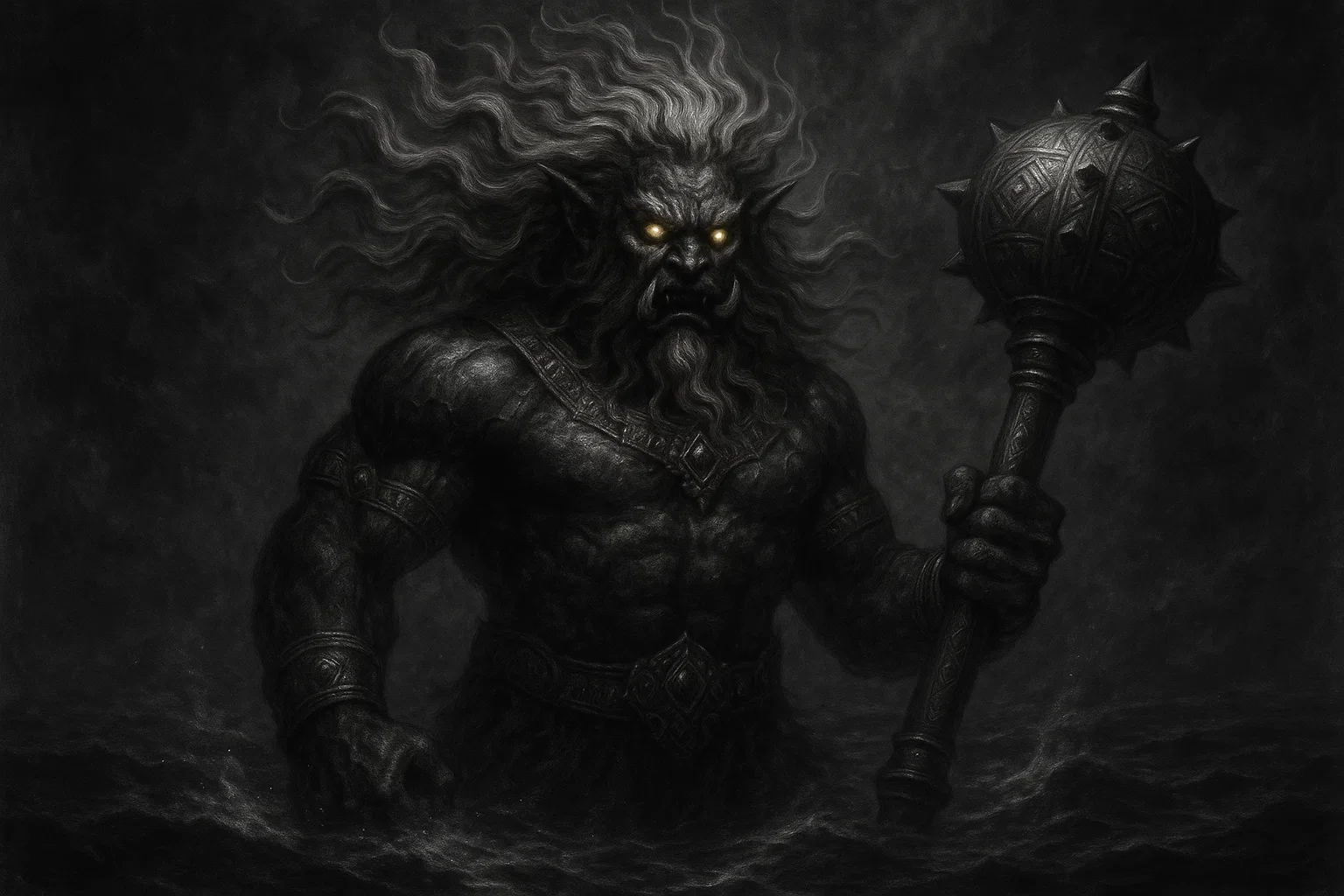
Descriptions highlight his huge size and strong warrior presence. The Bhagavata Purana says his body was almost impossible to destroy, with limbs like iron pillars. His golden eyes shone so brightly they were said to rival the sun, showing his powerful heritage as a descendant of Kashyapa.
Hiranyaksha is often shown wearing bright golden armor on his chest and shoulders, decorated with jewels taken from the heavens. His hair is described as fiery or matted, like an ascetic who has turned his spiritual strength toward gaining power in the world.
When he entered the Garbhodaka Ocean to face the divine, he carried a huge mace, a weapon that showcased his raw strength and his role as a warrior-king. In art, his face usually shows pride and a sneer, revealing his contempt for the Devas.
You may also enjoy:
What Is Jorōgumo? The Deadly Spider Woman of Japanese Myth
February 2, 2026
Who Are the Yaksha, and Why Did Buddhists Fear Their Wrath?
October 20, 2025
What Is a Qareen and Why Does It Follow Every Human Being?
October 8, 2025
Erinyes: The Chthonic Goddesses Who Enforced Blood-Guilt
November 20, 2025
Mahakala: The Dark Guardian Who Consumes Evil
October 16, 2025
Banasura: The Thousand-Armed Demon King
October 10, 2025
Origins
Hiranyaksha’s origin is linked to a break in ritual purity and a resulting curse. He was conceived at an unlucky twilight hour when the goddess Diti, filled with desire, asked the sage Kashyapa for children. Kashyapa warned her that children born at this time would be fierce and harmful, but they went ahead, leading to the birth of the twin Daityas.
Hiranyaksha gained power quickly through intense penance, focusing his efforts on Brahma, the creator. Brahma granted him a boon that made him almost impossible to kill by gods, humans, or many other beings. Confident in this protection, he set out to conquer the universe, defeating the guardians of the directions and ruling over both the underworld and the earthly world.
Birth
Hiranyaksha’s birth was marked by bad omens across all three worlds. The Bhagavata Purana says that when he and his brother were born, the earth shook, lightning flashed in clear skies, and strong winds blew. As sons of Diti and Kashyapa, and conceived at the junction of day and night, they were naturally set against the Devas.
Diti kept her sons in her womb for a hundred years, afraid of their power. When they were finally born, they grew incredibly fast, their bodies so large they blocked the horizon.
Their arrival sparked the main conflict of the Krita Yuga, as they sought to regain the status their mother believed the gods had taken from her family.
Family
Hiranyaksha stands at the heart of the Asura family tree. His father, Kashyapa, is one of the seven great sages, giving him a divine background.
In contrast, his mother, Diti, gave him the drive and ambition of the Daitya race. His closest bond was with his twin brother, Hiranyakashipu, as they fought together against the gods.
| Relationship | Name(s) |
| Parents | Kashyapa (Father), Diti (Mother) |
| Siblings | Hiranyakashipu (Twin Brother), Holika (Sister) |
| Spouse | Bhanumati (often cited in regional folklore) |
| Children | Ulka, Shakuni, Shambara (some sources vary) |
Historical & Scriptural Records
Original:
Sa eṣa ādyaḥ puruṣo’vatīrya daṃṣṭrāgra uddhṛtya dharāṃ rasātalāt
tatra-āhave daitya-kula-prasūtaṃ hiraṇyākṣaṃ pātayatād-aṇuṃ yathā. [Bhagavata Purana, 3.13.31, approx. 8th–10th Century CE]
Translation:
“May that original person, who descended as the Boar and lifted the earth from the nether regions on the tip of His tusks, strike down in battle the son of the Daitya clan, Hiranyaksha, as one would strike down a small insect.”
This passage from the Bhagavata Purana clearly defines the entity’s role in the Varaha story. It highlights the main struggle between the Earth’s heavy burden and the avatar’s divine strength. The term daitya-kula-prasūtaṃ (born of the Daitya clan) is important because it places the antagonist in a family line that represents the darker side of the Vedic sages.
The image of the “small insect” (aṇuṃ yathā) in the last line shows the religious thinking of the time. Even though the entity was strong enough to move planets, the Puranic writers wanted to show that his power was tiny compared to the “Original Person” (Adya Purusha).
This choice of words likely reassured followers that, no matter how great the forces of chaos seem, divine order can always handle them.
Original:
Tataḥ samutkṣipya dharāṃ sa daṃṣṭrayā mahāvarāhaḥ sphuṭapadmalocanaḥ
Rasātalādutthitavānmahābalaḥ salīlamuddhṛtya vasundharāṃ tām
Taṃ vīkṣya daityendramadīnasattvaṃ hiraṇyākṣaṃ nāma mahāsuraṃ ca
Gadādharo dānavamaprameyaṃ jaghāna yajñāvayavaḥ sa devaḥ. [Matsya Purana, 248.67-68, approx. 3rd–5th Century CE (Earlier Core)]
Translation:
“Then that Great Boar, with eyes like blooming lotuses, having tossed the earth onto his tusk, rose from the nether world, lifting the earth with ease. Seeing the lord of the Daityas, a great Asura named Hiranyaksha of undepressed spirit, the Lord, the personification of sacrifice and wielder of the mace, slew the immeasurable Danava.”
The Matsya Purana offers an important comparison by calling the antagonist an apraméyam (immeasurable) Danava or Asura. While the Bhagavata Purana focuses on how easily he was defeated, the Matsya Purana notes his “undiminished” spirit. This shows that earlier stories respected the “Golden-Eyed One” more as a great warrior, making his defeat a major achievement for the deity.
The title Gadādharo (Wielder of the Mace) given to the deity matches the entity’s main weapon. This kind of “mirroring” is common in old stories about demons, where the hero often uses the same weapon or form as the monster to defeat it.
The name “Golden-Eyed” here alludes to the search for Vasundhara (the Earth or wealth), suggesting that the story warns against treating the planet as just something to be collected and hidden away.
“The story of Hiranyaksha, the ‘Golden-Eyed,’ who took the Earth to the bottom of the cosmic ocean, is a perfect illustration of the Asuric nature which seeks to possess the Earth-principle for itself. It is the ego that wants to hide the Light and keep the material world in the darkness of the unconscious.” [The Secret of the Veda (Analysis of Puranic Symbols), Sri Aurobindo, 1914-1920]
In this early 20th-century source, the entity shifts from being seen as a real monster to a symbol of the mind. Aurobindo looks at the meaning of the name to explain the purpose of the myth. For modern readers, the “Golden Eyes” are not just about appearance—they show a way of seeing the world that focuses only on value and ownership.
This view connects the ancient Daitya to the idea of the Unconscious. Dragging the Earth into the water is seen as sinking the “Mother” (Bhumidevi) into ignorance.
Moving from the literal stories of the 4th-century Matsya Purana to the symbolic readings of the 20th century shows how the entity stays meaningful. He has changed from a giant who threatened the world to a symbol of forces that cloud the human mind.
Role in Hindu Cosmology
In Hindu cosmology, Hiranyaksha is the needed antagonist who causes Vishnu’s first earthly incarnation. His role is closely tied to the idea of Lila (divine play) and the cycle of Dharma. As a former gatekeeper of Vaikuntha (Jaya), cursed to be born as an Asura, is harbors a twisted form of devotion meant to let Vishnu show his greatness through battle.
He stands for the burden of material attachment that can drag the soul and the world into ignorance. By pulling the Earth into the ocean, he shows how the spirit can get trapped in matter. When the Varaha avatar defeats him, it represents lifting the soul and restoring the world to its right place, so the cycle of rebirth and growth can go on.
Myths, Legends, and Stories
The Abduction of the Earth in the Bhagavata Purana
Fueled by his endless ego and the power given by Brahma’s boon, he traveled the universe looking for someone strong enough to fight him.
Hiranyaksha challenged Indra and the other gods, but they ran from him. He then reached Varuna, the god of the oceans. Seeing his strength and wanting to avoid a pointless fight, Varuna told him that only Vishnu could give him the challenge he wanted.
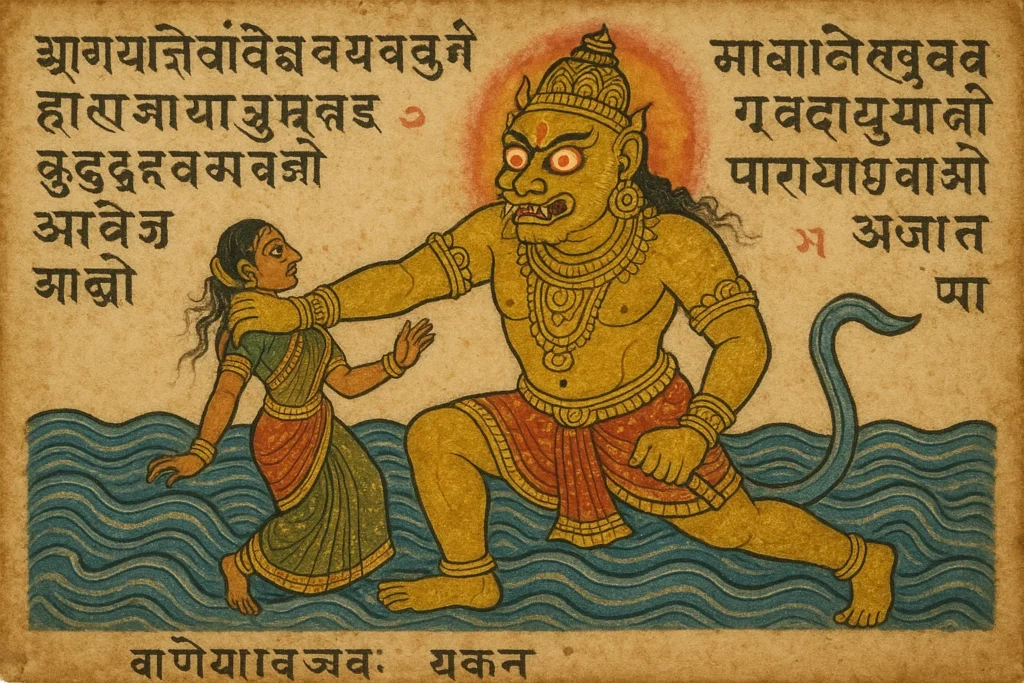
As he searched for Vishnu, he committed a bold act—he grabbed the Earth (Bhumidevi). He pulled her into the Garbhodaka Ocean, the deep waters at the universe’s bottom. This caused the world’s order to collapse, leaving all living beings frozen in darkness.
The sages and gods asked Brahma for help, and he meditated on Vishnu. A tiny boar came out of Brahma’s nostril and quickly grew as big as a mountain—this was the Varaha Avatar. Varaha jumped into the cosmic ocean to save the Earth. The entity met the divine boar in the depths and mocked him for taking on such a humble form.
A fierce battle broke out in the water. Varaha used his strong tusks to lift the Earth back up while fighting off the Daitya’s mace attacks. After putting the Earth back in her place, Varaha faced the enemy one last time and struck him behind the ear, ending the life of the “Golden-Eyed One.”
You may also enjoy:
Who Is Ambolin, the Demon of Nighttime Dread
December 1, 2025
What Is the Akkorokamui, Japan’s Colossal Sea Monster?
November 14, 2025
Edimmu: The Mesopotamian Wind Demon That Steals Life
November 6, 2025
Rokurokubi: The Yōkai That Looks Human Until Midnight
February 3, 2026
Who Is Andromalius, and Why Is He the Last Demon of the Goetia?
January 20, 2026
The Challenge to Varuna in the Padma Purana
This version of the story highlights Hiranyaksha’s pride before the main conflict. Before taking the Earth, he spent centuries hitting the ocean waves with his mace, causing tsunamis and scaring sea creatures. He went to Vibhvari, Varuna’s capital, and demanded a fight. Varuna calmly told him he was no longer fighting.
Varuna told him, “You are a great conqueror, but there is one who is the master of all, the Supreme Person. He alone can satisfy your hunger for battle.” This moment shows that the entity could not see the divine at work, missing that Varuna’s words predicted his coming defeat by the very god he wanted to fight.
Hiranyaksha vs Other Similar Entities
| Asura Name | Associated Trait/Role | Clan/Origin | Key Traits/Powers |
| Hiranyakashipu | Tyranny/Hatred of Vishnu | Daitya | Boon of conditional immortality |
| Ravana | Ego/Abduction of Sita | Rakshasa | Ten heads, mastery of Vedas |
| Mahishasura | Deception/Shape-shifting | Asura | Transformation into a buffalo |
| Bali | Generosity/Ambition | Daitya | Righteous rule, cosmic conquest |
| Bhasmasura | Self-Destruction | Asura | Ash-turning touch |
| Vritra | Drought/Obstruction | Vedic Asura | Serpentine form, sky-blocker |
| Tarakasura | Insecurity/War | Daitya | Only slayable by Shiva’s son |
| Madhu | Ignorance/Tamoguna | Asura | Born from Vishnu’s earwax |
| Kaitabha | Passion/Rajoguna | Asura | Born with Madhu, twin chaos |
| Shumbha | Pride/Domination | Asura | War against Parvati |
| Narakasura | Filth/Greed | Asura/Bhauma | Control of Earth’s treasures |
| Andhaka | Blindness/Desire | Asura | Infinite replication via blood |
Rank Among Asuras
Hiranyaksha has a top leadership role among the Daityas. As Diti’s firstborn, he set the example for challenging the gods in this cosmic era. His status comes not just from power, but from his spiritual strength—he was the first to use Vedic penance to upset the balance of the three worlds.
He ruled over the other Asuras with complete authority. Unlike later Asuras who needed alliances, he led with sheer force and won the loyalty of the Daityas. After his death, his brother Hiranyakashipu quickly took over, turning his rule into a quest for revenge for the “Golden-Eyed One’s” fall.
Mystical Correspondences
| Attribute | Details |
| Planet | Mars (Mangala) |
| Zodiac Sign | Aries (Mesha) |
| Element | Water (Primary), Earth (Target) |
| Direction | South/Nadir |
| Color | Gold and Dark Blue |
| Number | 2 (Dualism, Twins) |
| Crystal/Mineral | Pyrite (Fool’s Gold) |
| Metal | Gold/Iron |
| Herb/Plant | Mustard Seeds |
| Animal | Boar (Antagonist), Shark |
| Trait/Role | Material Obsession |
His cosmic power is linked to the planet Mars, which stands for the raw, aggressive energy he used against the gods. Mars drives his battles and shows his fiery spirit.
Being connected to Aries, he is seen as bold and ambitious, the first to try stealing the world itself. These links highlight his role as a warrior who acts without regard for consequences, even hiding his prize deep in the ocean.
He is connected to the water element, not as a source of life, but as a place to hide. Going into the Garbhodaka Ocean stands for the mind sinking into desire.
His link to the lowest point, or nadir, shows how he pulls the world away from the sun’s light. Gold, his symbolic metal, matches his name and symbolizes the false promise of material wealth that leads to his downfall at the hands of the divine boar.
You may also enjoy:
Barbas: The Lion Demon Who Spreads Disease
March 3, 2026
Who Is Ariton (Egyn), the Infernal King of the Eastern Gate?
February 17, 2026
What Is the Akkorokamui, Japan’s Colossal Sea Monster?
November 14, 2025
Alû: The Mesopotamian Demon of Malevolence and Pestilence
November 10, 2025
Ifrit: Demon of Fire Who Serves Iblis in Islamic Tradition
September 30, 2025
Bibliography
Author’s Note: One interesting aspect I noticed while writing about this entity was the strong contrast between the literal, warrior-like descriptions in the Matsya Purana and the deep, symbolic ideas from Sri Aurobindo. The Bhagavata Purana gives the main story of the Varaha encounter. Still, the details about the challenge to Varuna in the Padma Purana helped me understand the entity’s pride. Balancing these old Sanskrit texts with 19th-century translations required careful attention to keep the “Golden-Eyed” theme clear and consistent in both scripture and philosophy.
- Goyandka, C. L., editor. The Bhagavata Purana. Translated by a Board of Scholars, Gita Press, 2019. Internet Archive.
- Wilson, H. H., translator. The Vishnu Purana: A System of Hindu Mythology and Tradition. Edited by Fitzedward Hall, vol. 6 (Works by the Late Horace Hayman Wilson, vol. 1), Trübner & Co., 1864. Wikimedia Commons.
- Basu, B. D., editor. The Matsya Puranam. Translated by A Taluqdar of Oudh, vol. 17, part 1, Panini Office, 1916. Sacred Books of the Hindus. Internet Archive.
- Dutt, Romesh C., translator. The Ramayana: The Epic of Rama, Prince of India. Condensed into English Verse, 1899. Ancient Buddhist Texts, edited by Ānandajoti Bhikkhu, 2018.
- Naunidhirâma. The Garuda Purâna (Sâroddhâra). Translated by Ernest Wood and S. V. Subrahmanyam, edited by Major B. D. Basu, AMS Press, 1974. Internet Archive.
- Aurobindo, Sri. The Secret of the Veda. Sri Aurobindo Ashram Publication Department, 1998. Internet Archive.
- Shastri, J. L., editor. The Padma-Purâna: Part I. Translated by N. A. Deshpande, vol. 39, Motilal Banarsidass, 1988. Ancient Indian Tradition and Mythology. Internet Archive.