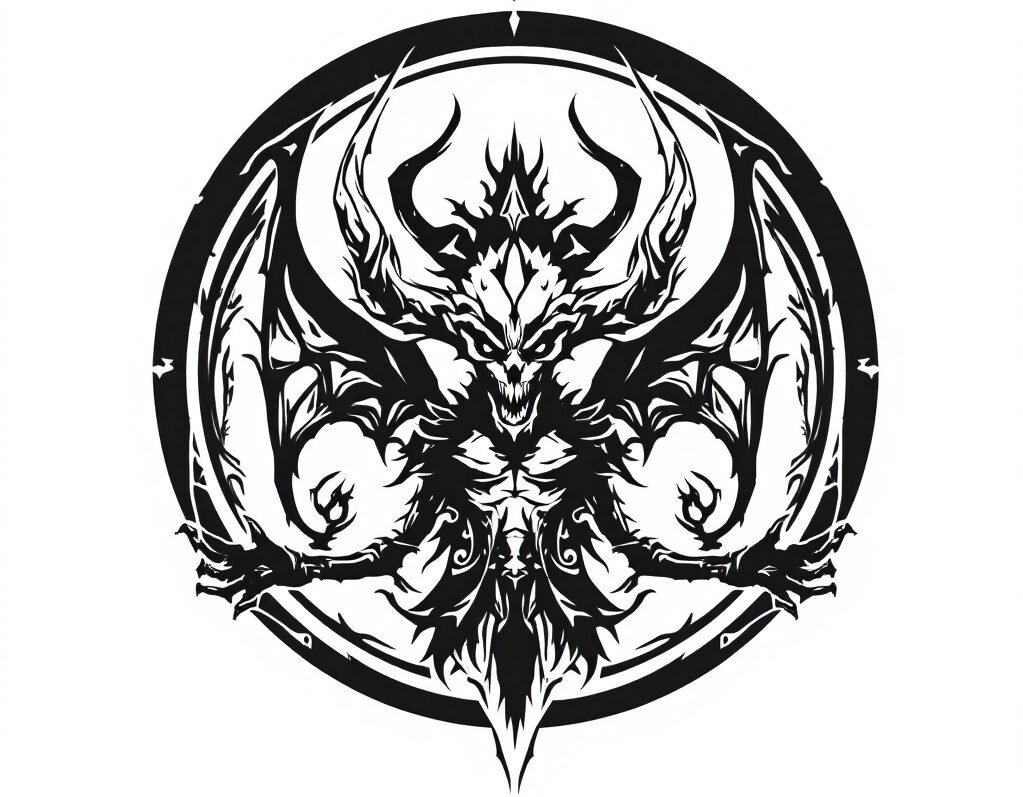

In Hindu mythology, Bhuta (Sanskrit: भूत) refers to a well-known group of supernatural beings. They are usually seen as the spirits of the dead or as types of ghosts and demons. Although often thought of as troubled or harmful spirits, they also serve as attendants to Shiva, who is called Bhutnath, meaning Lord of the Bhutas.
Sometimes, Bhuta also means the five basic elements (Mahabhuta). In demonology, though, it refers to a special group of restless spirits. In Buddhist traditions, Bhuta is also used to refer to a class of supernatural beings, often listed alongside Yakshas and Nagas.
Summary
Key Takeaways
| Attribute | Details |
| Names | Bhuta, Bhoot, Bhutam, Bhut-Pret |
| Title | Ganas of Shiva, Restless Spirit, Pretatma |
| Gender | Commonly male or female, but often appearing in a distorted or gender-neutral spectral form |
| Role | Haunters of cremation grounds, attendants of Shiva, spreaders of disease, and tormentors of the living |
| Clan | Pishachas, Pretas, or the Ganas (attendants) of Shiva |
| Followers | Lesser spirits, Pretas, and various Pishachas |
| Powers | Invisibility, possession, shape-shifting, levitation, and the ability to cause illness |
| Appearance | Pale complexion, casting no shadow, feet turned backward, and eyes without pupils |
| Etymology | Derived from the Sanskrit root “bhu” meaning “to be” or “past/become” |
| Associated Figures | Shiva, Parvati, Bhairava, and Vetala |
| Weaknesses | Iron, holy ash (Vibhuti), mantras, specialized exorcisms, and the presence of Tulsi |
| Opposing Deva/Avatar | Shiva (as their controller), Hanuman (the protector against ghosts), and Ganesha |
| Pantheon | Hindu and Folk Indian Traditions |
| Primary Sources | Garuda Purana, Atharva Veda, Shiva Purana, and Bhagavata Purana |
Who or What is a Bhuta?
A Bhuta is a supernatural being in Hindu texts, described as the spirit of someone who died but did not reach the realm of the ancestors (Pitru Loka). This usually happens after a sudden or violent death, missing funeral rites, or a strong attachment to earthly desires.
Bhutas are different from Asuras, who are powerful rivals of the gods (Devas). Bhutas are usually seen as lower-level spirits that live on earth, often found in lonely places like cremation grounds, empty houses, and forests.
They are often mentioned alongside other harmful beings, such as Pretas (hungry ghosts) and Pishachas (flesh-eaters). Even though they seem scary, these creatures have a role in the cosmic order as part of Shiva’s group of attendants, the Ganas. They are not just wild spirits but help Shiva, the Destroyer, in breaking down the material world.
Bhuta Meaning
The word Bhuta comes from the Sanskrit root “bhu,” meaning “to be,” “to become,” or “to exist.” So, Bhuta literally means “that which has been” or “the past.” This shows that a Bhuta is a being that once lived and now remains as a trace of its former life.
In philosophy, Bhuta can also mean the Mahabhutas, or Great Elements: Earth (Prithvi), Water (Japa), Fire (Tejas), Air (Vayu), and Ether (Akasha). In demonology, this link suggests Bhutas are made of basic elements but do not have the vital breath (Prana) needed for life.
Over time, the word shifted from meaning any living being or element to specifically referring to a ghost or harmful spirit in modern languages such as Hindi, Marathi, and Bengali.
How to Pronounce “Bhuta” in English
Bhuta is pronounced as “BOO-tuh.” The “Bh” is a breathy “B” sound, the “u” is short like in “put,” and the “ta” is usually pronounced as a hard “t” with a soft “uh” at the end.
What Does a Bhuta Look Like?
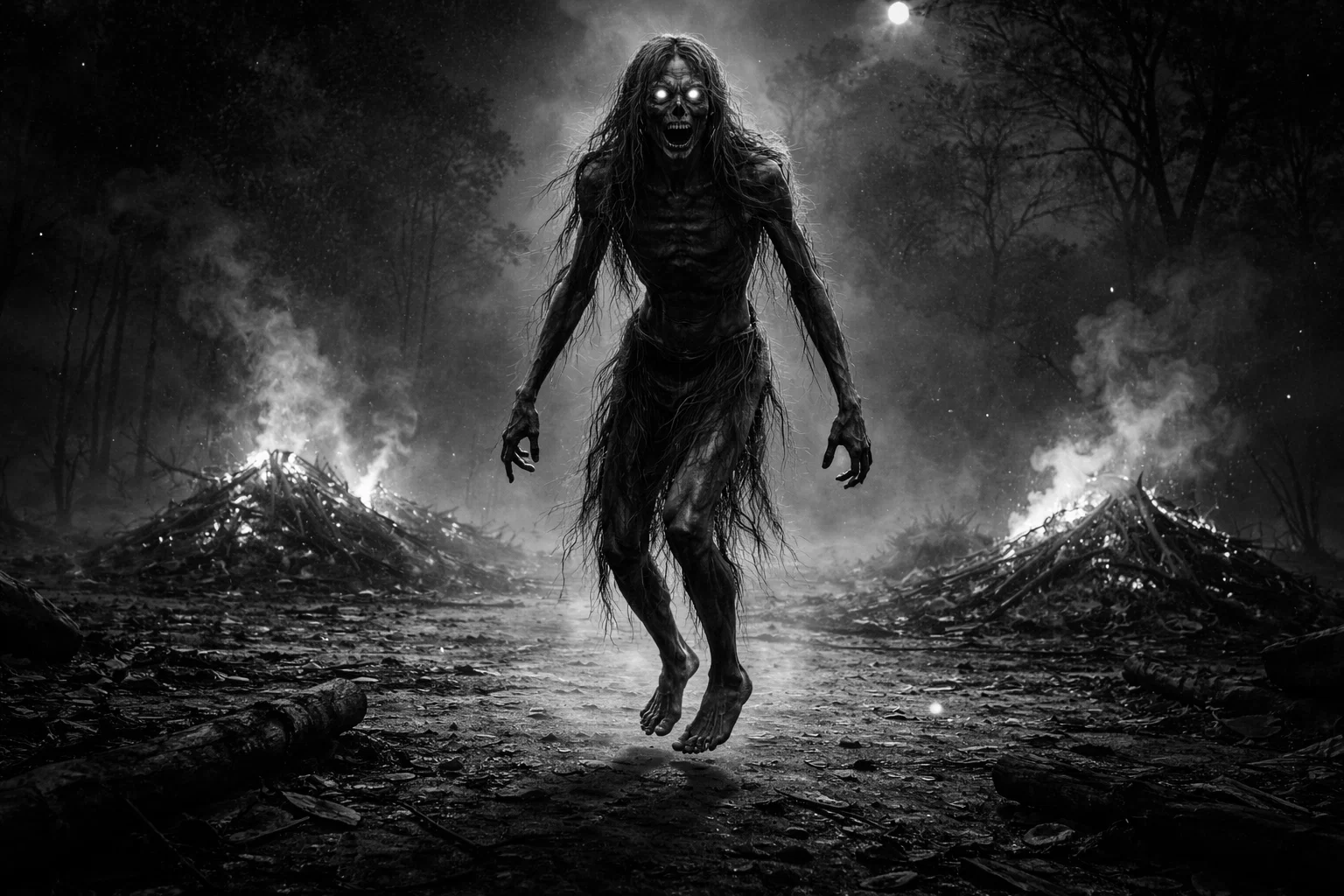
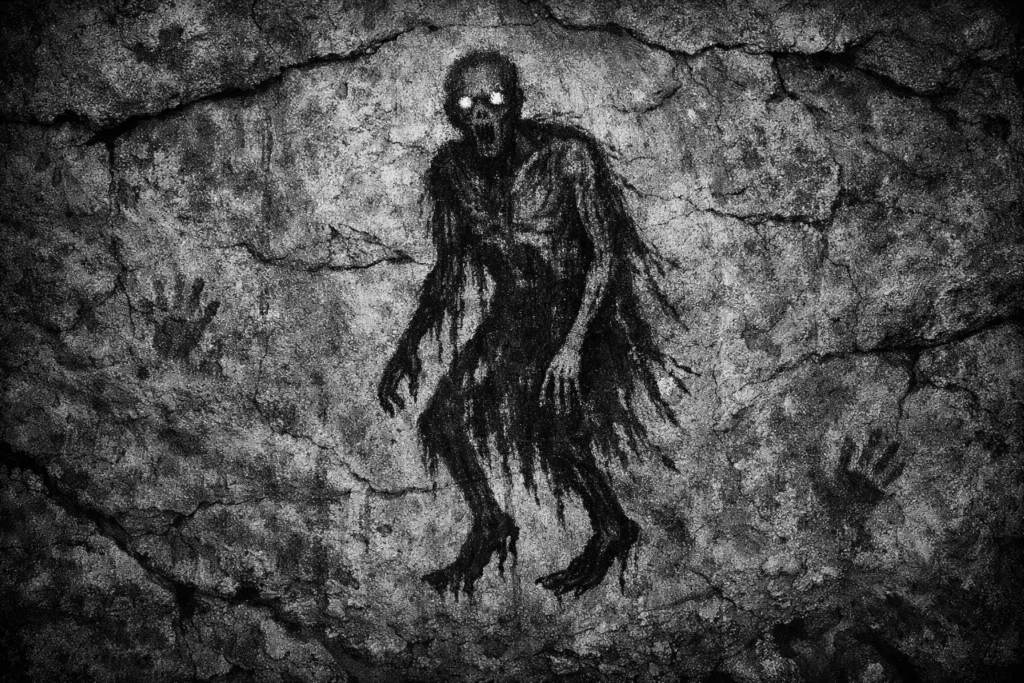
Descriptions of Bhutas differ in ancient texts and local stories, but some features are common. They are usually seen as ghostly or partly physical, with pale, ashen, or shadowy skin. A well-known trait in folklore is that their feet are turned backward, with heels in front and toes pointing back.
Bhutas are believed to cast no shadow and float just above the ground. Their eyes are often described as glowing or without pupils. They can change shape, sometimes appearing as animals like owls, black dogs, or hyenas, or even as a beautiful woman or a familiar person to trick people.
In their ghostly form, Bhutas might look bloated if they drowned or thin and wasted if they died from hunger, showing the condition of their body when they died.
Origins
The idea of Bhuta goes back to early Indian spiritual beliefs, from the Vedic period to the Puranic age. At first, Bhuta was a neutral word for any living being. As beliefs about death and the afterlife developed, Bhuta came to mean spirits who did not follow the usual cycle of reincarnation.
The Bhuta myth grew alongside the rise of Shaivism. As Shiva became part of mainstream worship, his image as the master of spirits and cemeteries helped establish Bhutas as his loyal, though frightening, followers.
1,000+ SPIRITS, GODS & GODDESSES AWAITING YOUR CALL. Limited-Time: Up to 49% OFF!
The ultimate global spirit encyclopedia – 2,000+ entries from every culture on Earth. Fairies • Djinn • Demons • Loa • Angels • Deities • Ancestors Real names • True offerings • Ancient rituals that actually work. Judika Illes’ legendary masterwork – the one book every serious witch, mage, and spirit-worker owns.
Birth
A Bhuta is not born in the usual sense but comes into being through a spiritual change. The Garuda Purana says a person becomes a Bhuta when their soul is stuck in the Bhuva Loka (an in-between world) because of an untimely death, such as suicide, murder, accident, or starvation.
A Bhuta’s existence begins when the physical body is gone, but the subtle body remains on earth. If living relatives do not offer ritual food (Pinda), the soul cannot move on and stays as a Bhuta, feeling hunger, thirst, and memories from its past life.
Family
Bhutas do not have families like humans do, but they are grouped under divine or semi-divine leaders. Their main group, or “family,” is the Ganas, who serve Shiva.
Asura-Deva Conflicts
Bhutas, unlike Daityas or Rakshasas, are not usually part of the big cosmic battles for Heaven. Their part in the fight between good (Dharma) and evil (Adharma) is more local. They stand for the wild and “unclean” forces that can harm people’s health and ritual purity.
The Bhagavata Purana says Bhutas were part of Shiva’s army that attacked Daksha’s sacrifice. They show the wild power of nature and death, which can humble even the gods (Devas).
You may also enjoy:
The Kumbhanda: Grotesque Demons of Buddhist Hell
November 13, 2025
Setcheh: Egypt’s Soul-Stealing Ancient Demon
November 11, 2025
The Ghul: The Flesh-Eating Demon of Arabian Folklore
October 1, 2025
Azhi Dahaka: The Three-Headed Dragon of Zoroastrian Mythology
January 14, 2026
Palis: The Foot-Licking Desert Jinn That Drinks Your Blood
December 3, 2025
Role in Hindu Cosmology
In Hindu beliefs about rebirth, a Bhuta shows what happens when a soul gets stuck. Bhutas remind people to follow Dharma and perform funeral rites (Shraddha). Their presence helps make sure the passage from life to death is respected.
As Shiva’s attendants, they also show that even the most frightening parts of life are under divine control.
Was Bhuta Ever Mentioned in Vedic Texts?
Yes, Bhutas are mentioned in the Atharva Veda, where the word covers many types of spirits and elemental forces. In these texts, Bhutas are often blamed for causing illness and are kept away with special charms and amulets.
| Source | Quote |
| Atharva Veda 4.37.1 | “By thee do we drive out the Apsarases, and the Gandharvas. O goat-horn (plant), drive the Rakshasa, chase all Bhutas with thy smell.” |
Bhuta in Epics and Puranas
In the Puranas, Bhutas are clearly described as part of Shiva’s group. They are featured in the Shiva Purana and Garuda Purana, which explain their traits and why they exist as spirits.
| Source | Quote |
| Garuda Purana 2.22.8 | “Those who have died by hanging, by fire, by poison, or by their own hand, certainly become Bhutas.” |
| Shiva Purana 2.2.33 | “The Bhutas, Pretas, and Kushmandas followed Virabhadra to destroy the sacrifice of Daksha.” |
Powers and Abilities
Bhutas are much less powerful than top Asuras like Ravana or Mahishasura. However, they are still stronger than regular humans because they are not physical beings.
Bhutas mainly have powers that let them affect the physical world and people’s minds:
- Possession: The ability to enter a human body, particularly those who are mentally weak, intoxicated, or ritually impure.
- Intangibility: Moving through solid objects and becoming invisible at will.
- Illusion (Maya): Changing their appearance to lure victims.
- Disease Infliction: Spreading “morbid energies” that manifest as physical ailments.
- Levitation: The ability to fly or hover, as they are not bound by the weight of a physical body.
Bhuta Myths, Legends, and Stories
The Destruction of Daksha’s Sacrifice
The most defining narrative of the Bhutas’ role in the cosmic hierarchy is found in the Shiva Purana. When the patriarch Daksha insulted his daughter Sati and her husband Shiva by excluding them from a grand sacrificial feast (yagna), Sati immolated herself in the sacrificial fire.
After hearing of her death, Shiva’s grief transformed into a terrifying rage. He tore a lock of his hair and dashed it against the ground, from which the thousand-armed warrior Virabhadra and the dark goddess Bhadrakali appeared.
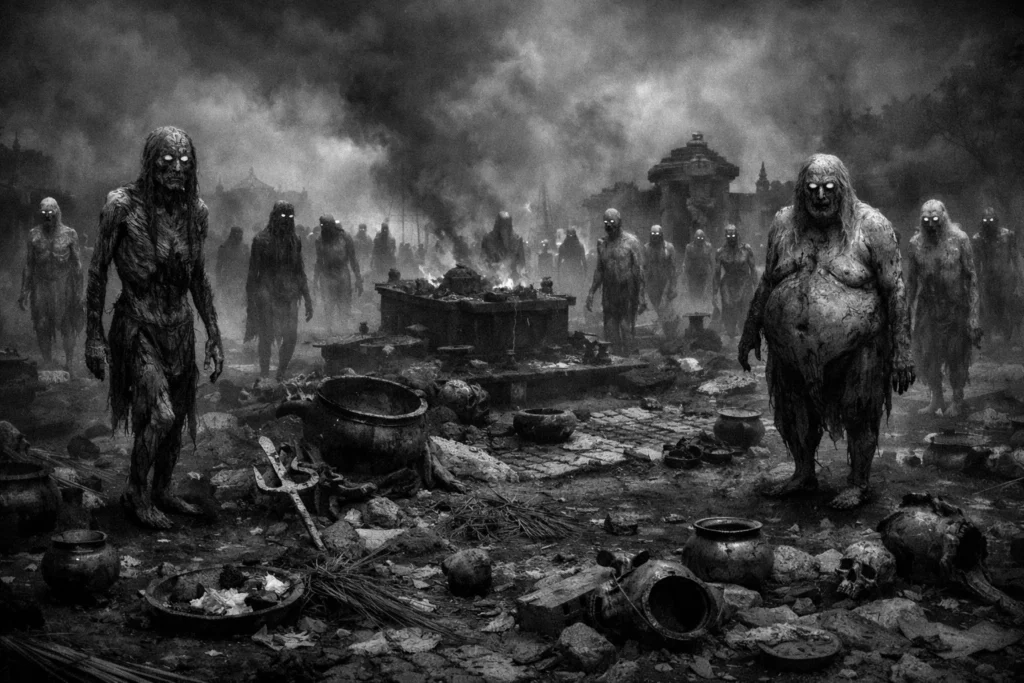
Shiva commanded them to march on Daksha’s capital, and accompanying them were the Bhuta Ganas—an army of countless spectral entities. As the story progresses, the Bhutas are described as the “frontline of chaos.”
They did not merely fight; they dismantled the very concept of ritual order. They are depicted as howling like wolves, their backward-turned feet trampling the sacred grass. They seized the sacrificial vessels, polluted the offerings, and mocked the priests.
The legend states that the Bhutas were so numerous they “blotted out the sun with their ashen forms,” proving that even the most refined Vedic sacrifice could not withstand the raw, untamed force of the spirits of the dead when commanded by the Lord of Spirits.
NAME THEM. BIND THEM. CAST THEM OUT! Limited-Time: Up to 40% OFF!
The ultimate deliverance thesaurus by Apostle John Eckhardt. Hundreds of demonic names & attributes exposed alphabetically – from Jezebel to Python, infirmity to poverty. Hundreds of demons named & defeated Identify → Bind → Cast Out!
The essential weapon for every prayer warrior, intercessor, and deliverance minister. Victory starts with identification.

The Legend of the Panjurli Bhuta
In the coastal Tulu Nadu region, there is a prominent folk legend involving the spirit of a wild boar known as Panjurli. According to the narrative, a wild boar once destroyed the earth’s crops, causing widespread famine.
When the boar was killed, its spirit did not pass on but became a restless Bhuta. Parvati, seeing the spirit’s potential for protection rather than destruction, took the Panjurli spirit under her wing and pleaded with Shiva to grant it a place among his attendants.
Shiva agreed, and the Panjurli Bhuta was transformed from a destructive ghost into a Daiva (a tutelary spirit). The story details how the spirit was then sent back to the mortal world to act as a guardian of truth and justice.
According to lore, if a farmer’s land is encroached on, they can invoke the Panjurli Bhuta. The spirit is believed to haunt the transgressor, appearing as a shadowy boar in the dead of night, until the stolen land is returned and the balance of Dharma is restored.
You may also enjoy:
Who Is Arioch, the Demon of War and Vengeance?
January 21, 2026
Pazuzu: The Demon Who Fought Evil with Evil
November 4, 2025
Apophis: The Great Serpent of Egyptian Chaos
November 11, 2025
Who Is Abaddon, the Demon of the Abyss, in the Bible?
September 29, 2025
Edimmu: The Mesopotamian Wind Demon That Steals Life
November 6, 2025
The Haunting of the Pipala Tree
A widely documented legend in the Puranas and rural folklore involves the residence of Bhutas in the Pipala (Sacred Fig) tree. The story goes that during the churning of the ocean (Samudra Manthan), the goddess of misfortune, Alakshmi, was born before Lakshmi.
Because she was a bringer of strife, she was relegated to living in places associated with death and decay. The Bhutas, being entities of the past and of “what was,” naturally gravitated toward her presence.
According to lore, Vishnu, taking pity on Alakshmi, allowed her to live in the Pipala tree, but only during the hours of darkness. Consequently, the legend warns that while the tree is a source of divine energy during the day, it becomes a spectral court at night.
Stories often recount travelers who, ignoring the warnings of village elders, slept beneath a Pipala tree. They would wake to find themselves surrounded by a “silent assembly” of Bhutas—pale, shadowless figures sitting on the branches above.
The legends claim these spirits do not always kill; instead, they “exchange” their heavy, stagnant energy with the traveler, leaving the person permanently melancholic or physically drained, a condition known as being “touched by the Bhuta.”
The Liberation of the Spirit at Gaya
In the Garuda Purana, there is a narrative focusing on the spiritual necessity of the Shraddha rites. A story is told of a merchant who, having died far from his home in a forest, became a Bhuta.
Because his body was never found and no rites were performed, he spent years wandering as a shadow, unable to eat or drink. He eventually encountered a sage who could perceive his spectral form.
The Bhuta, weeping with a “voice like dry leaves,” begged the sage for a way out of his miserable existence. The sage instructed the merchant’s living son to travel to the holy city of Gaya and perform the Pinda Daan (ritual offering).
The legend details how, as the son dropped the rice balls into the sacred Phalgu River, the Bhuta’s backward-turned feet slowly rotated to face forward, and his ashen skin regained a glow.
This story is the foundational myth for the belief that even the most wretched Bhuta can be redeemed through the devotion of the living, transitioning from a demonic entity back into a Pitri (ancestor).
Bhuta vs Other Asuras
| Asura Name | Associated Trait/Role | Clan/Origin | Key Traits/Powers |
| Ravana | Ego/Conquest | Rakshasa | Ten heads, divine boons |
| Hiranyakashipu | Tyranny | Daitya | Near-immortality boon |
| Mahishasura | Deception/Change | Asura | Shape-shifting (Buffalo) |
| Vritra | Drought/Obstruction | Danava | Serpentine, cosmic size |
| Bahasura | Gluttony | Rakshasa | Immense physical strength |
| Andhaka | Blindness/Desire | Daitya | Each blood drop creates a clone |
| Bali | Sacrifice/Pride | Daitya | Righteous ruler, massive wealth |
| Narakasura | Greed/Filth | Asura | Earth-born, heavy weaponry |
| Taraka | Ambition | Daitya | Cannot be killed except by a son of Shiva |
| Shumbha | Ego | Asura | Master of martial arts |
DEMONS ARE REAL — AND THE BIBLE PROVES IT Limited-Time: Up to 20% OFF!
No myths. No exaggeration. Just Scripture. Clinton Arnold’s landmark biblical theology of the powers of darkness. What the Old & New Testaments actually teach about Satan, demons, and spiritual warfare. Essential reading for every pastor, counselor, and believer facing the unseen battle. The book seminaries and deliverance ministries swear by.
Demons are real • Scripture is clear • Victory is yours • Clinton Arnold’s definitive biblical study.
Rank Among Asuras
Bhutas are ranked lower among supernatural beings. Asuras are powerful and can challenge the gods, but Bhutas are local spirits, often tied to a place or person. In Shiva’s court, they are seen as servants, below the Ganas. Still, ordinary people usually fear them more because they are closer to the human world.
Mystical Correspondences
| Attribute | Details |
| Planet | Saturn (Shani) – associated with death and delays |
| Zodiac Sign | Scorpio – representing the occult and the underworld |
| Element | Earth and Ether |
| Direction | South (The direction of Yama, Lord of Death) |
| Color | Black or Ash Grey |
| Number | 8 (associated with Saturn) |
| Crystal/Mineral | Black Tourmaline or Iron Ore |
| Metal | Iron |
| Herb/Plant | Bael (Aegle marmelos) or Neem |
| Animal | Owl or Jackal |
| Trait/Role | Restlessness and Attachment |
Bhutas are linked to the planet Saturn, which is connected to life changes and the results of past actions. This shows that Bhutas are stuck because of their past. They are also tied to the South, the direction of Yama, the god of death, which highlights their place between life and the afterlife.
Bhutas are closely linked to iron, which is believed in Hindu folklore to keep them away because it grounds their ghostly forms. They are also connected to the Bael tree, which is sacred to Shiva. At night, the shade of this tree is said to be where Bhutas rest, marking the line between the holy and the ghostly.
Bhuta’s Symbols
Bhuta symbols are mostly linked to Shiva. These include Vibhuti (sacred ash), which stands for the burned remains of the world, and the Skull (Kapala), carried by tantric gods who control Bhutas. In folk rituals, a backward footprint is the main sign of their presence.
Worship and Boons
In mainstream Hinduism, people rarely worship Bhutas and usually avoid them. In Tantric traditions, though, some try to please Bhutas to gain special powers or protection. This is often done by offering meat, liquor, or grain at crossroads or cremation grounds.
People usually ask Bhutas to leave or to act as protectors. More often, Hindus pray to Shiva or Hanuman for safety from Bhutas, using the Hanuman Chalisa to keep them away.
You may also enjoy:
Al-Ahmar: The Tuesday King of the Seven Jinn
February 13, 2026
Who Is Andromalius and Why Is He the Last Demon of the Goetia?
January 20, 2026
What Is Akaname, The Filth-Licking Yōkai?
October 28, 2025
Andrealphus: The Peacock Demon Who Twists Minds and Bodies
January 19, 2026
What Is the Abumi-guchi Yōkai and Why Does It Wait Forever?
October 22, 2025
Who Is Asmodeus in Demonology and the Bible?
February 18, 2026
Frequently Asked Questions
What is the difference between a Bhuta and a Preta?
While both are restless spirits, a Bhuta is generally the spirit of someone who died a violent or untimely death (Akala-mrityu). In contrast, a Preta is a “hungry ghost” that results specifically from a lack of proper funeral rites. Bhutas often serve as attendants to Lord Shiva. At the same time, Pretas are depicted as suffering from extreme physical thirst and hunger due to their needle-thin necks and large bellies.
Can a Bhuta be killed or destroyed?
In Hindu demonology, a Bhuta cannot be “killed” in the physical sense because they are already deceased and exist as subtle bodies. Instead, they are liberated or neutralized. Rituals like Narayan Bali or Sapindikarana help the spirit move to the ancestral realm. High-level protective mantras, such as the Sudarshana Chakra Mantra or the Hanuman Chalisa, are believed to drive them away rather than destroy them.
What is a Bhuta-Aradhana ritual?
Bhuta-Aradhana is a specialized form of spirit worship prevalent in Southern India, particularly in the Tulu Nadu region. Unlike the malevolent entities of the Puranas, these Bhutas are protective local deities or ancestral spirits. The ritual involves a Bhuta Kola (spirit dance), where a medium dons elaborate costumes and masks to channel the spirit, providing oracles and resolving village disputes.
Why are Bhutas associated with the Pipala (Sacred Fig) tree?
In Indian folklore, the Pipala tree (Ficus religiosa) is believed to be a residence for Bhutas, particularly at night. While the tree is sacred to Vishnu during the day, it is considered spiritually volatile after sunset. It is a common cultural taboo to sleep under or linger near a Pipala tree at night to avoid being possessed or “struck” by the heavy, stagnant energy of a resident spirit.
How do you identify a Bhuta in human disguise?
According to regional legends, a Bhuta disguised as a human can be identified by three distinct flaws: they do not blink, their feet are pointed backward (even if hidden by long clothing), and they speak with a nasal or metallic twang. What’s more, they are said to be unable to touch or cross objects made of pure iron or enter a perimeter marked with Vibhuti (sacred ash).
Are Bhutas mentioned in the Garuda Purana?
Yes, the Garuda Purana provides the most extensive details on the “ghostly state” (Preta-yoni). It describes the Bhuta as an entity trapped in the Bhuva Loka because their life force was severed before their allotted time. The text is a manual for survivors, detailing the specific 13-day ritual cycle required to prevent a family member from becoming a permanent Bhuta.
