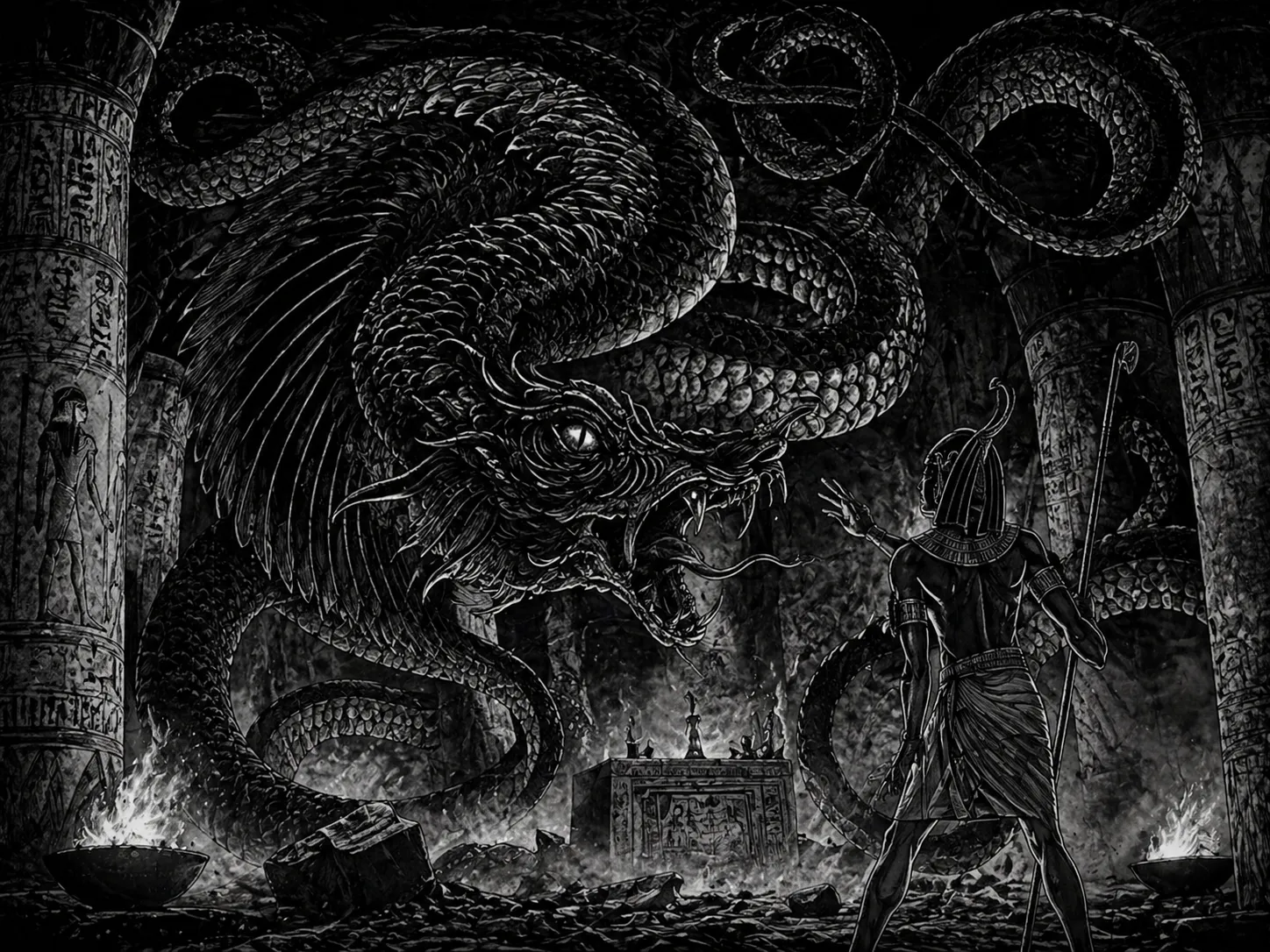
Apophis represents the opposite of creation, representing Isfet, or cosmic injustice and chaos. Unlike most Egyptian gods, even those linked to storms or deserts like Set, this serpent exists completely outside the established order.
Apophis is not just a god of evil, but a symbol of pure entropy, aiming to return the universe to the dark, watery chaos that existed before creation.
I based my article on detailed ritual descriptions from the Papyrus of Ani and the Amduat. These sources help me analyze the entity’s physical traits as symbols of cosmic entropy. [View Full Bibliography ↓]
Summary
Key Takeaways
| Attribute | Details |
| Names | Apep, Aapep, Apophis |
| Title | The Enemy of Ra, The Serpent of the Nile, The Evil Lizard, The World-Encircler |
| Origin | Ancient Egypt, prominent from the Middle Kingdom through the Ptolemaic Period |
| Gender | Male |
| Genealogy | Often described as having no parents, emerging from the umbilical cord of Ra or the primordial waters of Nun |
| Role | Cosmic adversary, devourer of the sun, personification of chaos and darkness |
| Associated Deity | Ra (arch-enemy), Set (defender/adversary), Bastet (protector of Ra) |
| Brings | Solar eclipses, earthquakes, storms, and the threat of universal annihilation |
| Weaknesses | Knives, fire, the combined execration rituals of the living, and the spear of Set |
| Realm/Domain | The Duat (Egyptian Underworld), specifically the darkness beyond the horizon |
| Weapon/Item | Snake-like coils used to constrict the solar barque |
| Symbolism | Entropy, non-existence, the void, and the constant threat to Ma’at (order) |
| Sources | The Coffin Texts, The Book of the Dead, The Book of Gates, The Bremner-Rhind Papyrus |
Who or What is Apophis?
In Egyptian cosmology, Apophis is the Sun God’s main enemy. It appears as a huge serpent living in the Underworld. Unlike other spirits that can be appeased, it is a mindless force of destruction that cannot be controlled or reasoned with. Its main goal is to swallow the sun during its nightly journey through the Duat, ending the cycle of time and casting the world into endless darkness.
As a being of non-existence, it represents the emptiness before the first sunrise. It does not have a “ka” or soul in the usual sense, and it never had a temple or followers. Instead, people aimed to destroy it through magic. Apophis is the shadow to Ra’s light, making the fight to keep the universe in order a daily challenge.
Apophis Meaning
The name’s origin is closely tied to ideas of rejection and negation. The Egyptian word ˁȝpp probably comes from a root meaning “to be spat out” or “to be rejected,” showing that this being was seen as a byproduct of creation, not a planned part of it. Some language experts also link the name to the verb ppi, which sounds like a hissing snake, highlighting its animal nature.
Over time, the name transformed from the Middle Egyptian Apep to the Greek-influenced Apophis during the Greco-Roman era. Despite these changes, the name always stood for stagnation.
In hieroglyphs, the name was often shown with a picture of a serpent being stabbed by knives, or the scribe would damage the name itself to weaken the entity’s power. This shows the belief that the name held the being’s evil force, and writing it without “killing” the signs was thought to be risky for the scribe.
How to Pronounce Apophis in English
In modern English, you usually say the name as uh-POE-fiss. The stress is on the second syllable, with a long “o” sound. The first “A” is soft, and the ending “is” sounds like the “i” in “hiss.” Don’t use a hard “A” at the start; the name should flow smoothly and end with a sharp “s” sound.
You may also enjoy:
Empusa: The Blood-Drinking Wraith of Greek Mythology
November 20, 2025
Gandharva: God, Spirit, or Demon?
November 13, 2025
What Is Baku? The Bizarre Yōkai That Eats Nightmares
January 28, 2026
Who Is Futakuchi-onna, the Two-Mouthed Woman?
March 9, 2026
Mahabali (Bali): The Benevolent Asura King
October 10, 2025
Origins
Apophis appears fairly late in Egyptian mythology, with the first clear mentions during the Middle Kingdom (around 2040–1782 BCE). Earlier texts, such as the Pyramid Texts from the Old Kingdom, mention spells against snakes and other underworld threats. Still, the idea of a single cosmic serpent named ˁȝpp (Apep) became established during the Twelfth Dynasty.
From my research, I noticed that this being’s rise happened during a time of major cultural transformation after the Old Kingdom fell. It was not part of the original group of gods, but was seen as a shadowy byproduct of the first sunset—a leftover from the original chaos (Nun) that resisted the order brought by the creator god.
By the New Kingdom (about 1550–1070 BCE), stories about this being’s origins became more detailed in texts like the Amduat and the Book of Gates. One tradition says it was born from Ra’s umbilical cord at his birth, or from the spit of the goddess Neith.
This connection to Neith, an ancient creator goddess linked to weaving and war, is important. It makes the serpent a kind of biological rejection: as Neith spat into the original waters, her divine essence, separated from her will, formed the adversary. This idea casts being as the “Anti-Sun,” a mirror of Ra, with his original power but without his creative purpose.
During the Ramesside Period, beliefs about Apophis switched again to focus on its role as an eternal “non-being.” Unlike other Egyptian gods, who appeared from unions between Shu and Tefnut or from the Ennead family, the serpent was not part of the divine family. It was an outsider to Ma’at and was thought to live in the “Waters of the Void” beyond the stars.
The Esna liturgical texts describe it as “not of the sky, not of the earth,” showing its origin in total negation. This story helped explain why “Isfet” (evil and chaos) still existed in a world meant to be ruled by divine order, blaming it on a mistake from the beginning that even the gods could not erase.
What Does Apophis Look Like?
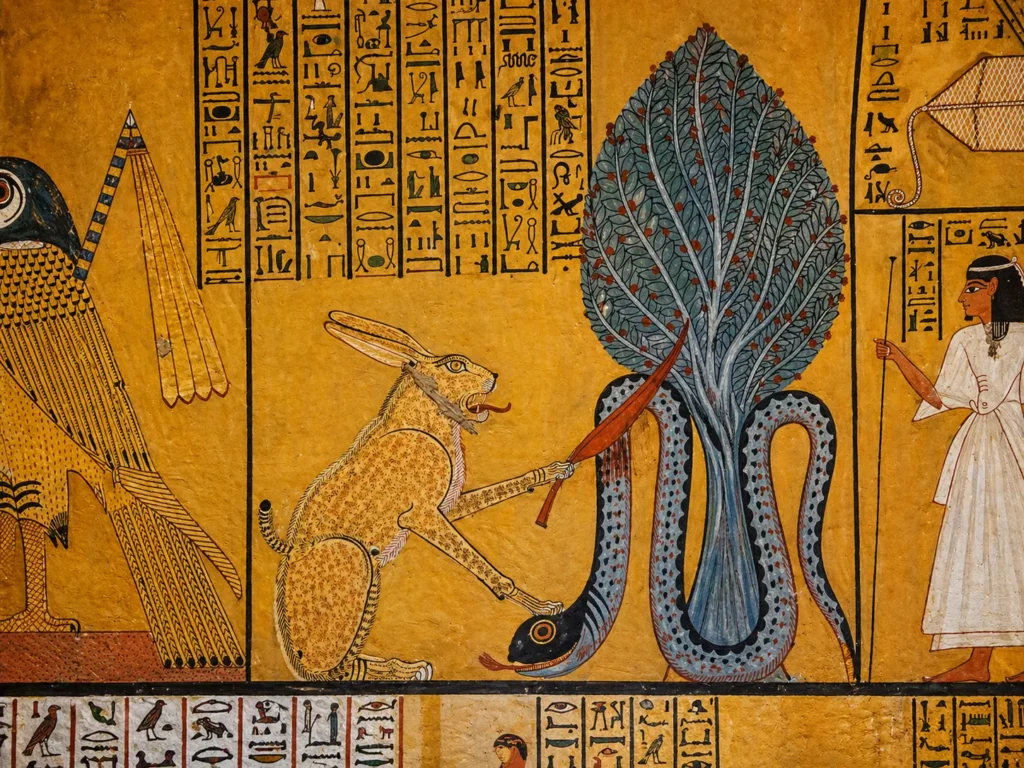
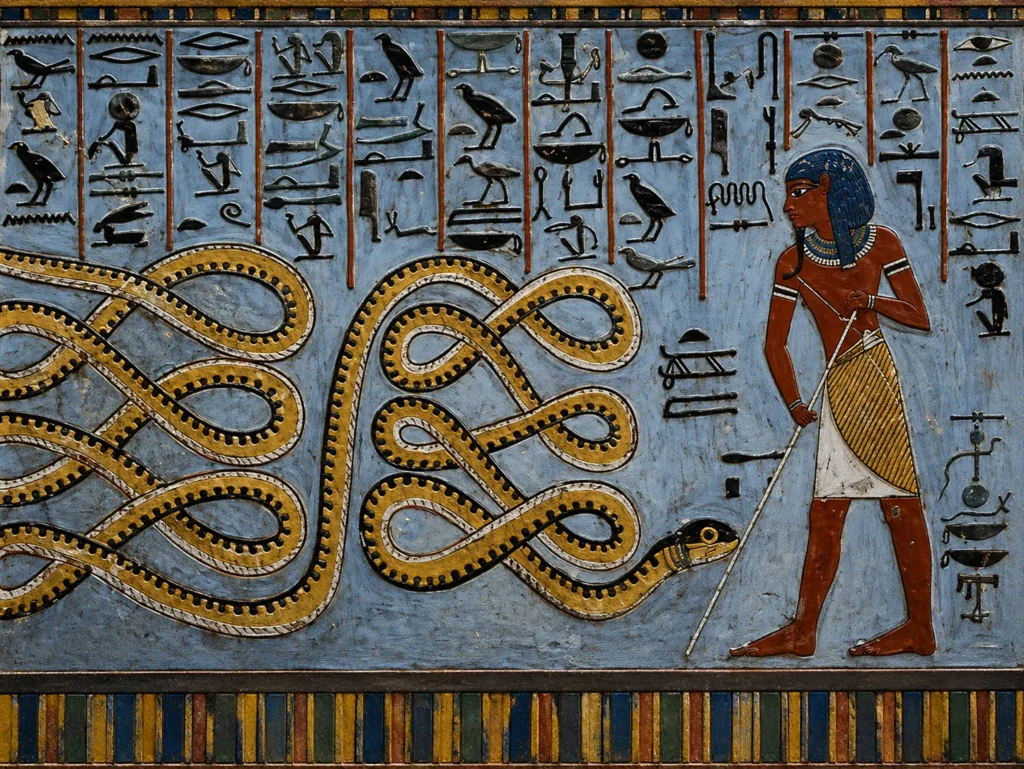
This being is almost always shown as a huge serpent, with large, twisting coils that stand for chaos itself. These coils were thought to be strong enough to “constrict the Nile” or stop the solar boat. In many tomb paintings, such as those in the Valley of the Kings, it is shown being cut apart by the Great Cat of Heliopolis (a form of Ra) or being stabbed by the gods’ spears.
The serpent shape was chosen for a reason. To ancient Egyptians, snakes could vanish into the ground and reappear, shedding their skin in a form of false rebirth. While gods used this idea for renewal, the serpent’s form stood for traps and hidden threats.
It’s important to point out that while modern media often shows this being as a dragon-like monster, ancient images never gave it limbs or wings. It was always a limbless, underground constrictor. This lack of limbs underlined its nature as a “gut” or “stomach,” a hole in reality that only wanted to consume the sun and destroy the world.
Connections to Other Ancient Demons
| Name | Genealogy | Type | Appearance |
| Tiamat | Babylonian | Primordial Chaos Mother | Often seen as a multi-headed sea dragon |
| Jörmungandr | Norse | World Serpent | A giant snake circling the world |
| Lamashtu | Akkadian | Child-snatching Demon | Lion head, donkey teeth, hairy body |
| Pazuzu | Assyrian | King of Wind Demons | Humanoid body, eagle wings, lion head |
| Typhon | Greek | Snake-like Giant | Hundreds of snake heads and fire-breathing |
| Vritra | Vedic (Hindu) | Drought Demon | A giant dragon or serpent blocking rivers |
| Leviathan | Canaanite/Hebrew | Sea Monster | Twisted, multi-headed sea serpent |
| Ereshkigal | Sumerian | Queen of the Dead | Grave-pale woman with dark tresses |
| Ammit | Egyptian | Funerary Demon | Crocodile, lion, and hippo hybrid |
| Ahzi Dahaka | Persian | Demonic Dragon | Three-headed serpent with six eyes |
| Illuyanka | Hittite | Storm-Serpent | Large, scaled lizard-like dragon |
| Ahriman | Zoroastrian | Spirit of Destruction | Often formless or a dark, smoky snake |
The Endless Void
In my study of Middle and New Kingdom funerary texts, I found that the serpent is much more than just a “god of evil.” Apophis actually represents the idea of metabolic arrest, or the stopping of life’s processes.
While Ra, the sun god, symbolizes constant transformation and energy in the universe, his enemy represents stillness and non-existence (Isfet). I believe the ancient Egyptians saw the nightly battle not just as a cosmic fight, but as a necessary struggle to stop the world from being “digested.”
The Bremner-Rhind Papyrus describes the ritual destruction of the serpent in vivid detail: spitting, trampling, and hacking. These actions show a deep human need to physically control a threat that is, essentially, not physical.
I think the key insight about Apophis is that it was created as a byproduct of divine rejection. Some traditions say the serpent always existed, but more detailed texts claim it was born from the “spittle of Neith” thrown into the original waters. This gives us a deep look into the Egyptian mindset: chaos was not just an outside enemy, but a “waste product” of creation itself. In this way, the serpent is the gods’ cosmic “excrement,” existing only because it was “cast out.” Apophis’s ongoing effort to “swallow” the sun is a powerful and frightening reversal—the rejected waste trying to consume its own source and return everything to darkness and sameness.
One hard to ignore detail in ancient images is Set’s role as the main defender. In later times, Set was demonized and sometimes mixed up with the serpent, but in the official solar beliefs of the New Kingdom, Set was the only god strong enough to face the serpent’s hypnotic, paralyzing stare.
This creates a “utility of terror”: Egyptians used one form of chaos (Set) to fight an even greater chaos. This shows their deep understanding of balance, in which only “controlled” violence could prevent destruction. The serpent became the ultimate boundary, the wall of “un-being” that defined and measured the Egyptian state and soul.
Apophis Myths, Legends, and Stories
The Nightly Battle at the Seventh Hour of the Duat
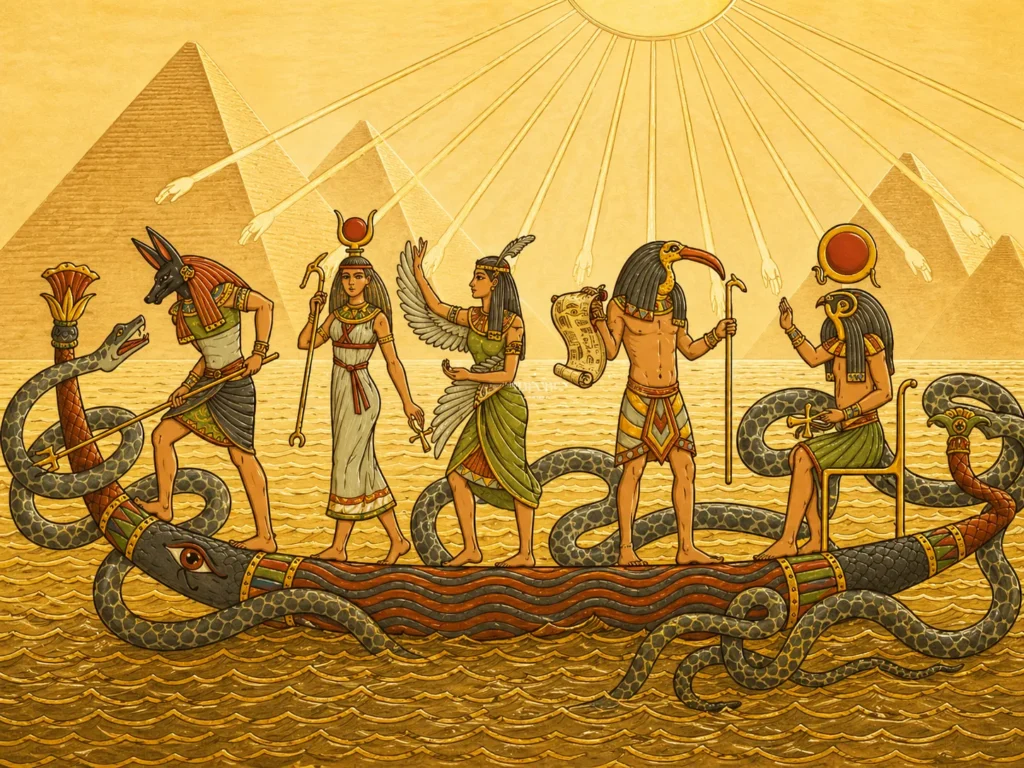
The solar barque, with the aging sun god Ra and his group of protective gods, travels deep into the Underworld. When the boat reaches the Seventh Hour of the Night, it comes close to the serpent’s hidden sandbank.
Apophis waits in the darkness of the Duat, ready to attack. It starts when the boat swallows the waters of the celestial Nile, which gets to stuck in shallow water. Then, the serpent uses its strongest weapon, a hypnotic gaze meant to paralyze the crew.
The gods on the boat feel the serpent’s evil power, but the journey continues. Set, standing at the front of the boat, is not affected by the serpent’s “evil eye.” He calls out in challenge: “Depart! Be destroyed! May you be cut into pieces! I am the one who overthrows the enemy of Ra.”
Set jumps forward and drives a harpoon made of celestial iron into the serpent’s head. At the same time, the goddess Isis raises her hands and casts strong spells that wrap around the serpent’s coils, stopping it from fighting back.
With the serpent pinned, Ra turns into the Great Cat of Heliopolis. Holding a large knife, the cat jumps onto the serpent under the sacred Ished-tree. The cat cuts the serpent’s neck, slicing through its scales. The serpent spits out the water it swallowed, and the solar barque can move again. The crew cheers: “Ra is victorious! The serpent is overthrown! The sun shall rise upon the horizon!”
You may also enjoy:
What Is the Akkorokamui, Japan’s Colossal Sea Monster?
November 14, 2025
Ammit: Devourer of the Dead in Ancient Egyptian Mythology
November 10, 2025
Arāti: The Beautiful Demon of Aversion in Buddhist Mythology
October 15, 2025
Who Is Ahriman, and Why Is He Pure Evil Incarnate?
January 8, 2026
What Is the Abumi-guchi Yōkai and Why Does It Wait Forever?
October 22, 2025
The Overthrowing of Apep
This story next describes how Apophis is destroyed again and again.
The gods of the Ennead work together to defeat this force of nothingness. The Great God says: “I have placed a fire in your limbs; I have sent a flame into your soul. You are given over to the knife; you are delivered to the fire.”
The story tells how the Children of Horus first capture the serpent, tying its head, tail, and middle with copper chains. The serpent’s secret names are read out loud and then symbolically “erased” by words. “Your name is not in the mouth of the living; your shadow is not in the hearts of the gods.”
Next, the gods take apart the serpent’s body. Ra’s spear pierces its heart, a mountain crushes its bones, and its fat melts from the Uraeus serpent’s hot breath. Even when the serpent is burned to ash, it becomes a shadow that will return in the ancient waters.
The story ends with: “He is fallen to the flame; his soul is a puff of smoke. Ra proceeds in peace, and the world is maintained in Ma’at.”
Powers and Abilities
The serpent is a powerful cosmic force that can even threaten the gods. Its strength comes not just from its body, but from its power to alter reality and control the world around it.
- Hypnosis: Known as the “Evil Eye,” the entity can paralyze its enemies with a single look, robbing them of their will to fight.
- Seismic Manipulation: Its movements are believed to cause earthquakes and tremors throughout the world.
- Atmospheric Control: It can summon thick clouds, sandstorms, and eclipses to hide the sun and create artificial darkness.
- Water Absorption: It can swallow the waters of the Underworld, effectively beaching the solar barque.
- Regenerative Immortality: Despite being cut into pieces every night, it regenerates completely by the next evening.
Rituals, Amulets, and Protective Practices
In Ancient Egypt, people aimed only to destroy and drive away this serpent. They did not build temples for it. Instead, they performed rituals to “overthrow” it. These actions were important for keeping Ma’at, or universal order, and making sure the sun would rise each day.
Incantations and Ceremonies
The most well-known ceremony was the Ritual of Overthrowing Apep, held every day in the Temple of Amun-Ra at Karnak. In this ritual, priests made wax models of the serpent. They wrote Apophis’s name on the models in green ink, wrapped them in papyrus, and then destroyed them in different ways.
The ritual included spitting on the wax figures, stepping on them with the left foot, and cutting them with flint knives. Afterward, the remains were thrown into a fire made with dried grass. The priests believed that destroying these models in the temple gave Ra the magic he needed to win the battle in the Duat.
Original:
hsf ˁȝpp m rȝ-f r-sḏt
Translation:
“Drive back the serpent from his entrance into the fire. May his shadow be burnt, may his soul be destroyed, and may his names no longer exist upon the earth.”
Amulets and Talismans
People did not wear Apophis amulets, as that would bring chaos. Instead, they wore protective charms showing the serpent’s conquerors. These were usually made from faience, carnelian, or gold.
The most common charm was the Eye of Horus (Wadjet), which stood for protection and healing. Another favorite was the scarab, which symbolized Khepri, the rising sun.
People put these items in mummy wrappings or wore them as necklaces to protect their “ka” from Apophis in the Underworld. Hematite was also used for protective seals because its dark, red color was believed to guard against the serpent’s “evil eye.”
Professional Practitioners
The Lector Priests (Khery-heb) mainly performed these rituals. They were experts in sacred texts and kept the “Book of Overthrowing Apep.” These priests led the magical defense of the state, using their voices to chant the spells that kept the universe in order.
During solar eclipses, which people saw as times when the serpent was winning, these priests held emergency ceremonies. They shouted at the sky and performed intense rituals to bring back the light.
You may also enjoy:
Who Is Asmodeus in Demonology and the Bible?
February 18, 2026
Amdusias in the Ars Goetia: The Demon of Dark Music
December 2, 2025
Amaymon: The Infernal King Who Commands Death and Decay
November 17, 2025
Who Is Agares, the Demon of Earthquakes and Deception?
October 13, 2025
Bibliography
Author’s Note: I based my article on the vivid, detailed descriptions in the Bremner-Rhind Papyrus rather than on later, more abstract ideas. By comparing the Esna Liturgical Texts and the Amduat, I noticed an important difference: funerary texts portray the serpent as a threat to navigation. At the same time, temple rituals depict him as a natural result of creation. By examining these sources together, I aimed to show Apophis as more than just an “evil” entity but as a real threat to the universe’s balance.
- Budge, E. A. Wallis. The Egyptian Book of the Dead: The Papyrus of Ani in the British Museum. 1895.
- King, Maiken M. Spells from the Book of the Dead. Kemet Klub, 2023.
- Budge, E.A.. (2012). XVI.—On the Hieratic Papyrus of Nesi-Amsu, a scribe in the Temple of Amen-Rā at Thebes, about B.C. 305. Archaeologia. 52. 393-608. 10.1017/s026134090000761x.
- Uranić, Igor. The Book of the Amduat on Papyrus Zagreb (Inv. No. 602). Journal of the Archaeological Museum in Zagreb, vol. 55, 2022, pp. 247-268.
- Mønster Jørgensen, Jesper. New Kingdom Royal Tombs Outside Thebes. Academia.edu.
- Wilkinson, Aidan. The Royal Tombs of Ancient Egypt. Amberley Publishing, 2016.
- Julian Panotopoulos. Miuti, the Cat-Headed Destroyer of the Damned Dead: Rethinking the Ancient Egyptian Supernatural World. Daily Demon. Demon Things: Ancient Egyptian Demonology. January 5, 2026.
- Morenz, Ludwig. (2004). Apophis: On the Origin, Name, and Nature of an Ancient Egyptian Anti‐God. Journal of Near Eastern Studies. 63. 201-205. 10.1086/424771. ResearchGate.