Many supernatural beings in Japanese folklore are linked to major disasters or family curses. Yet, the Akaname is a remarkable spirit tied to household cleanliness and worries about hygiene. It reflects the tension between a well-kept home and the decay that comes from neglect, serving as a reminder of what happens when chores are ignored.
Unlike more dangerous spirits like the Gashadokuro or Oni, which attack people, the Akaname simply lives off the dirt left behind by neglect. It does not harm people directly, but its presence is an unsettling sign of a dirty home.
In my research, I combined Toriyama Sekien’s records with late 18th-century regional documents to build a profile of the Akaname that focuses on its roots in social and architectural history, instead of relying on unverified stories. [View Full Bibliography ↓]
Summary
Key Takeaways
| Attribute | Details |
| Names | Akaname |
| Translation | Filth Licker |
| Title | The Bathroom Spirit |
| Type | Yōkai (Obake) |
| Spirit Classification | Nigi-mitama (generally pacified/non-violent but unsightly) |
| Origin | Spontaneous manifestation from accumulated grime and stagnant water in bathhouses. |
| Gender | Often depicted as male, though sometimes ambiguous. |
| Appearance | A small, goblin-like figure with red or mottled skin, a long prehensile tongue, and matted hair. |
| Kehai (Aura/Presence) | A moist, damp atmosphere accompanied by the faint sound of rhythmic slurping or scratching against wood. |
| Powers/Abilities | Wall-crawling, prehensile tongue for cleaning surfaces, and stealth in dark, damp environments. |
| Methods of Pacification | Rigorous cleaning of the bathhouse, regular scrubbing of wooden tubs, and maintaining dry floors. |
| Habitat | Bathrooms (furoba), abandoned washrooms, and public bathhouses. |
| Diet/Prey | Dried bath scum, human skin flakes, and stagnant mildew. |
| Symbolism | Cleanliness, the importance of domestic labor, and the aversion to neglect. |
| Associated Kami | None directly, though indirectly serves as a foil to Suijin (Water Gods), who require purity. |
| Sources | Gazu Hyakki Yagyō (Toriyama Sekien), Hyakkai Zukan (Sawaki Suushi). |
The Fundamental Identity of the Akaname
The Akaname is a unique creature in Japanese folklore, seen as a sign of neglect within the household. First recorded in the Edo period, it is considered a minor yōkai that hides in the dark, damp corners of bathrooms and bathhouses. Unlike vengeful spirits, it has no sad story or wish for revenge. Instead, it simply acts on its urge to eat the grime found in dirty washrooms.
The Akaname usually appears at night when everyone is asleep, visiting the bath area to eat leftover grime. It does not attack people, but its presence is seen as a serious warning that a home is in danger of falling into neglect. It represents the hidden, dirty parts of the house that people often overlook.
Semantic Origins
The name Akaname is simple and clearly describes its role in folklore. It comes from two words: aka (垢), which means ‘filth’ or ‘grime,’ and name (舐め), from the verb’ nameru,’ meaning ‘to lick.’ So, Akaname literally means ‘filth licker.’
In old scrolls like the Gazu Hyakki Yagyō by Toriyama Sekien, the name is written with these exact characters, making its meaning clear. Some regions in the Edo period used the name Akatori for similar spirits, but this was less common.
The fact that the name remained the same across many art scrolls shows that the Akaname was always seen as a creature that cleans by eating grime, not as a spirit with a deeper religious meaning.
How to Pronounce “Akaname” in English
To say ‘Akaname’ in English, break it into four parts: Ah-kah-nah-meh. The first part sounds like the ‘a’ in ‘father,’ the second is ‘kah,’ the third is ‘nah,’ and the last is ‘meh,’ like the start of ‘memory.’ Each part is said evenly, with no strong emphasis.
What Does Akaname Look Like?
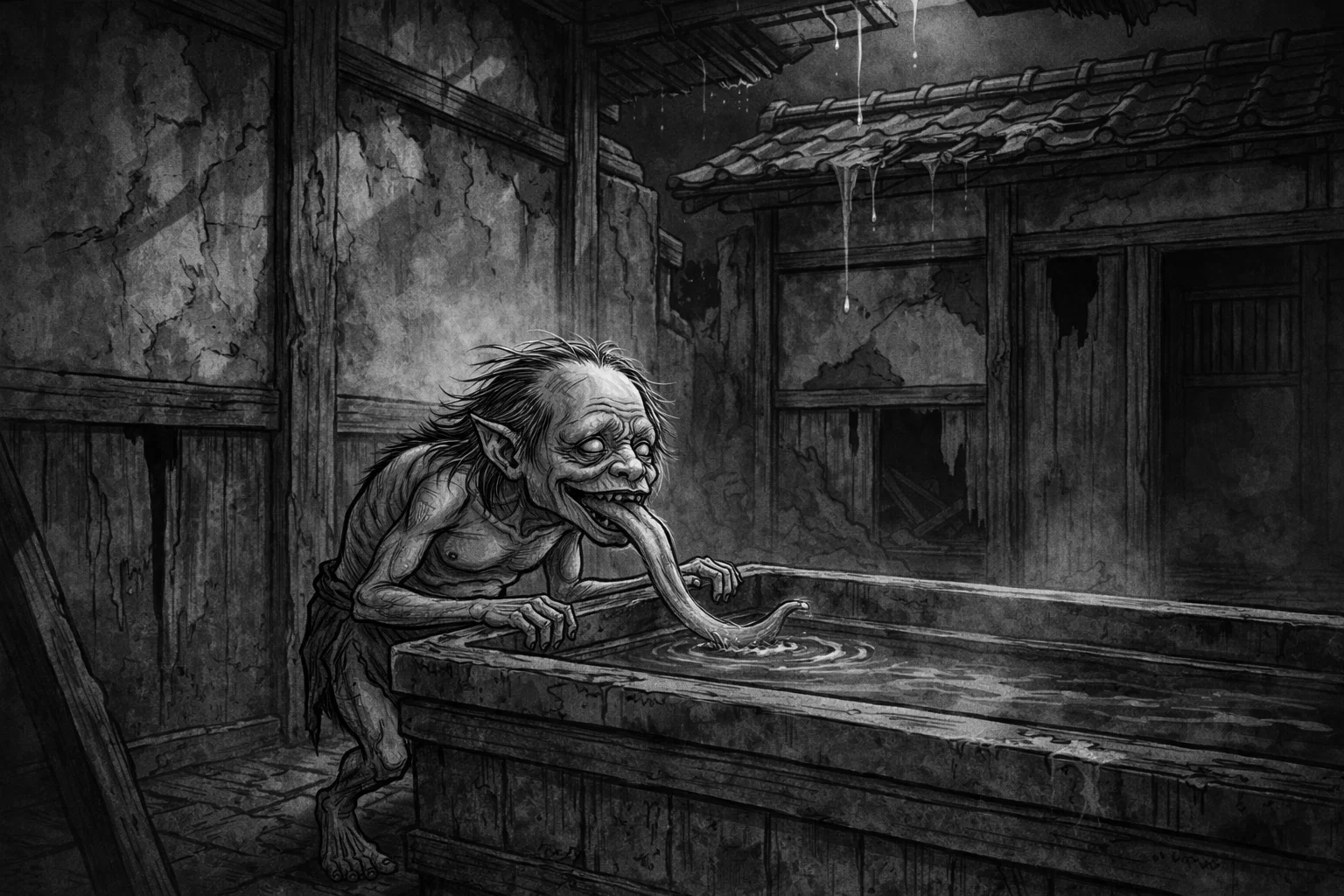
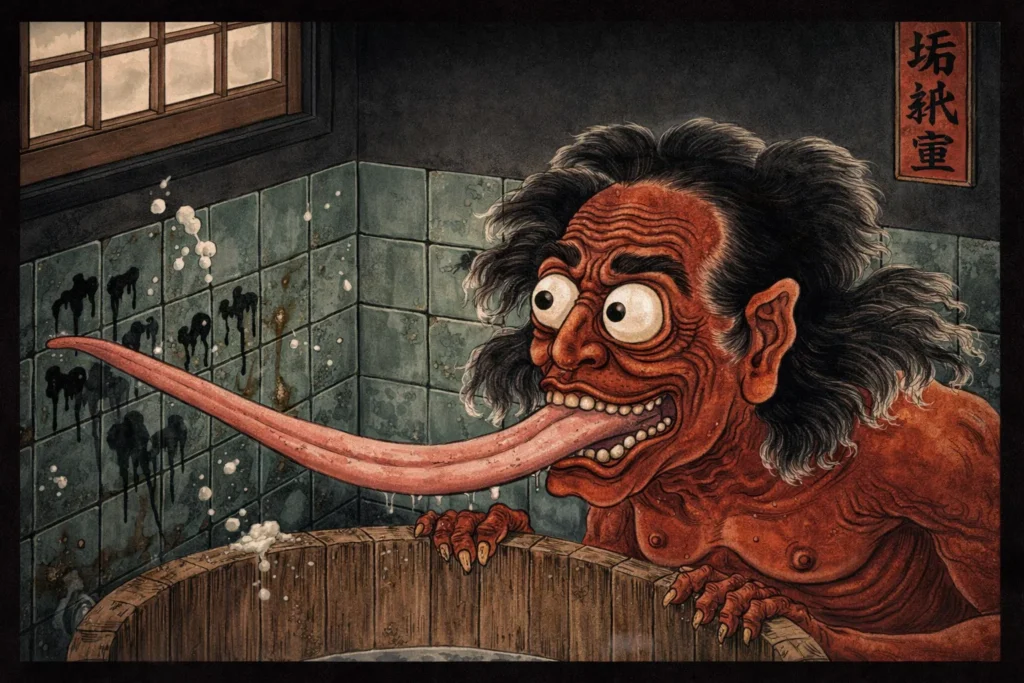
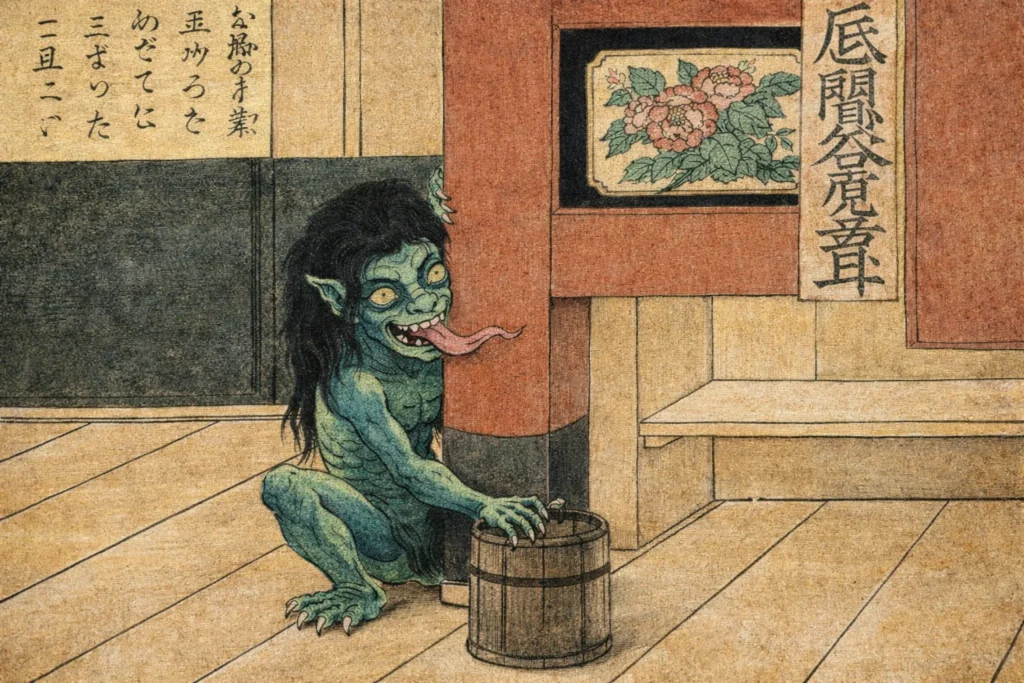
Pictures of this bizzare yōkai have looked similar for centuries, thanks in part to the artist Toriyama Sekien. It is usually shown as a small, human-like creature, about the size of a child or a big goblin. Its skin is often red or dark pink, but some old drawings show it with blotchy, earthy colors to look like mold or water stains.
The Akaname’s most noticeable feature is its long, strong tongue, which is often shown sticking out and ready to lick surfaces. The tongue is much bigger than its head. It usually has thin, greasy, tangled hair, with bulging eyes and a flat nose.
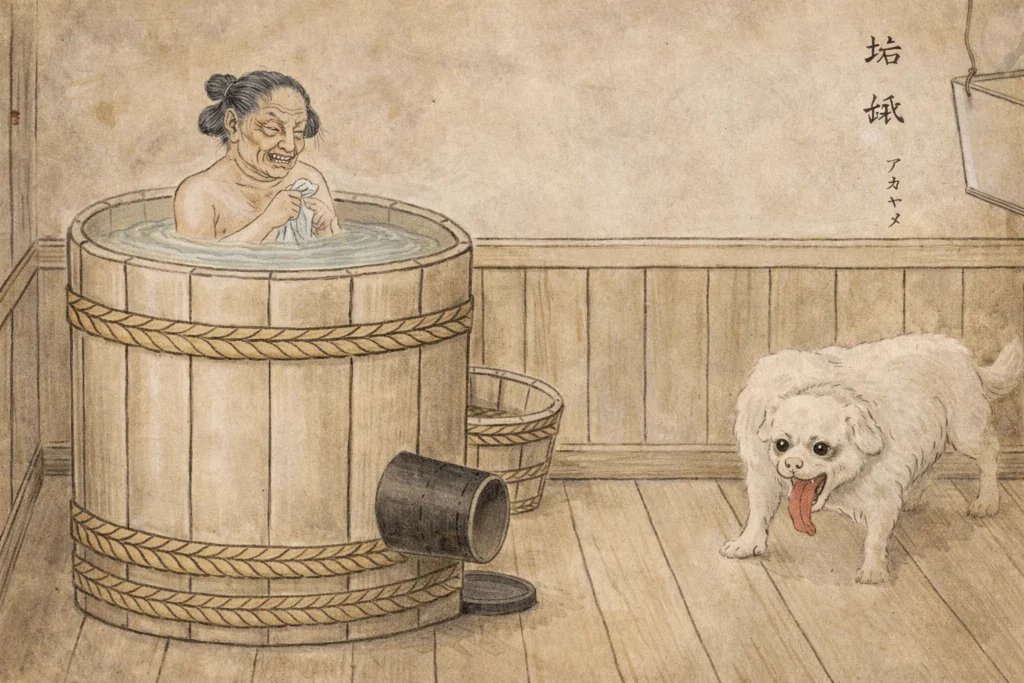
The Akaname is often drawn crouching or crawling, showing that it lives between the floor and the walls. In many old pictures, such as those in the Hyakkai Zukan, it has only one toe on each foot or claw-like fingers that help it grip the slippery wood in traditional Japanese bathhouses.
You may also enjoy:
What Is Jorōgumo? The Deadly Spider Woman of Japanese Myth
February 2, 2026
Who Were the Hinn, the First Spirits of Creation?
November 12, 2025
Who Is Arioch, the Demon of War and Vengeance?
January 21, 2026
Jikininki: The Japanese Ghost That Feeds on Human Corpses
February 9, 2026
Agubanba: The Blind Yōkai That Preys on Young Women
October 23, 2025
Origins and History
The Akaname became a well-known creature in folklore during the Edo period (1603–1868), when cities grew quickly, and public bathhouses became common.
As places like Edo (now Tokyo) became crowded, keeping things clean was very important. The first drawings of the Akaname appeared in the early 1700s, especially in the Hyakkai Zukan (1737) by Sawaki Suushi, where it was shown with other famous monsters.
From my research, I think the Akaname was a way for people to express their worries about disease and cleanliness in crowded cities. In the Edo period, bathhouses were shared by many, and dirt could easily spread sickness. By turning grime into a monster, people made the need for cleaning feel more urgent and real.
I find it interesting that the Akaname appeared around the same time Japanese bathrooms became more standardized. The use of wooden tubs and slats trapped moisture and encouraged mold, creating the perfect environment for this spirit. The Akaname was not a creature from nature, but a result of how people built their homes in growing cities.
Habitat
This spirit only lives in wet, dark, and neglected indoor places, especially those with water. In old Japanese homes, bathrooms were often built in dark corners to help with drainage, which made them ideal spots for a creature that avoids sunlight.
- Public Bathhouses (Sentō): These are the most common sites for legends, as the high volume of users leads to rapid accumulation of biological residue.
- Abandoned Homes: Legends suggest that in houses where the inhabitants have died or fled, the bathroom becomes a breeding ground for these spirits, as the stagnant water and lack of cleaning allow them to thrive undisturbed.
- Private Washrooms: In homes still lived in, any bathroom that is not cleaned regularly can attract the Akaname. According to lore, the yōkai hides under the floor or behind wooden tubs during the day, coming out only when the room is dark and damp.
How the Akaname Personifies the Entropy of the Private Sphere
Looking at the transition from the Heian period (794–1185) to the Edo period (1603–1868), I see the Akaname as a clear example of how people gave physical form to their worries about the environment. In the Heian era, most supernatural events were seen as mononoke, which were invisible forces that brought illness or bad luck.
But as cities grew during the Edo period and more people could read, these invisible omens were given clear, often strange bodies in art and books. The Akaname is a great example of this change. It turned the uneasy feeling of being in a damp, moldy room into a creature that looks both gross and a little sad.
I find it interesting that the Akaname shows a key fear: that the home could slip back into wildness. In Japanese tradition, the bathroom (or furoba) is a place where people wash away the dirt of daily life.
By creating a creature that eats leftover dirt, the folklore hints that our waste does not just disappear—it supports a hidden world. My research into early Edo scrolls suggests that the Akaname’s red skin and long tongue might symbolize the body’s natural state, once it is cleansed of social masks.
I also noticed that this spirit acts as a ‘necessary evil’ in Japanese history. Even though it is called a monster, it quietly enforces the Shinto idea of Kegare, which means impurity or a withered spirit.
Unlike the Kappa, which can harm people, the Akaname’s main ‘attack’ is making people realize their home is so dirty that even spirits notice. It stands guard at the edge of clean and dirty. Its focus on licking grime seems to reflect the never-ending work of keeping a house clean.
My research shows that the Akaname’s lack of a dramatic backstory—no tragic death or old curse—is actually important. Most yōkai are linked to the past, but this spirit is connected to how clean a room is right now. If the room is clean, it disappears. This makes it a rare kind of ghost that people can control just by cleaning.
In Japanese folklore, it is the lowest but most stubborn type of monster: one that appears simply because we do nothing.
Akaname Powers and Abilities
The Akaname is not a strong or dangerous spirit. Its abilities are similar to those of a household pest or a minor Tsukumogami. It cannot change shape or control the elements. Its powers are simply based on its biology and the environment.
- Prehensile Tongue: The entity has a tongue of extreme length and flexibility, capable of reaching into narrow cracks, pipes, and behind heavy wooden fixtures to extract grime.
- Surface Adhesion: Similar to a gecko or a frog, it can cling to vertical surfaces and ceilings, allowing it to get through the cramped, slippery environment of a washroom without falling.
- Low-Light Vision: It is perfectly adapted to the darkness, possessing sight that functions in the near-total blackness of a closed bathroom.
- Disease Vector: While not a direct attack, the saliva of the creature is often described in folklore as being “spiritually poisonous,” causing localized infections or bad luck for those who touch surfaces it has “cleaned.”
You may also enjoy:
Who Is Agares, the Demon of Earthquakes and Deception?
October 13, 2025
Who Is Futakuchi-onna, the Two-Mouthed Woman?
March 9, 2026
Aži Dahāka: The Three-Headed Dragon of Zoroastrian Mythology
January 14, 2026
Pazuzu: The Ancient Demon Who Fought Evil with Evil
November 4, 2025
Who Are the Yaksha, and Why Did Buddhists Fear Their Wrath?
October 20, 2025
Gandharva: God, Spirit, or Demon?
November 13, 2025
Traditional Defenses Against Akaname
Defending oneself against this entity is unique among yōkai because it does not require complex exorcisms, ofuda charms, or the intervention of a priest. The primary defense is manual labor.
The best way to get rid of the Akaname is to thoroughly clean the bathroom. Since it is drawn to dirt, removing its food source makes it leave or keeps it away. Folklore says that a bathroom that is dry, airy, and cleaned with salt will never attract this spirit.
Some regions believed that placing coarse sea salt in bathroom corners would harm the Akaname’s sensitive skin, or that leaving a lantern on all night would keep it away. Still, these were just extra steps. The main idea was that the spirit reflected the homeowner’s habits—a clean house gave it no place to appear.
Akaname vs Similar Spirits
| Name | Category | Origin | Threat Level | Escape Difficulty |
| Kappa | Yōkai | Water deity that fell from grace; lives in rivers. | High | Moderate; must outsmart or bow to it. |
| Toire no Hanako-san | Yūrei | Ghost of a young girl trapped in a school stall. | Moderate | Easy; simply avoid the third stall. |
| Kashima Reiko | Yūrei | Spirit of a woman severed by a train. | Very High | Extreme; requires specific verbal answers. |
| Tenjo-name | Yōkai | Ceiling licker born from ceiling stains. | Low | Very Easy; just clean the ceiling. |
| Furu-utsubo | Tsukumogami | Discarded quiver that gained a soul. | Low | Very Easy; generally harmless. |
| Baka-zōru | Tsukumogami | Neglected straw sandal. | Low | Very Easy; discard properly. |
| Nurarihyon | Yōkai | Unknown; it manifests as an old man in houses. | Low | Hard; difficult to notice his presence. |
| Mokumokuren | Tsukumogami | Eyes appearing in torn paper doors (shoji). | Low | Easy; repair the door. |
| Betobeto-san | Yōkai | Formless entity following people at night. | Very Low | Easy; step aside and let it pass. |
| Kamaitachi | Yōkai | Dust devils/wind weasels. | Moderate | Difficult; they move faster than sight. |
| Aka Manto | Yūrei | Vengeful spirit in bathroom stalls. | Lethal | Extreme; no correct answer to his choice. |
Symbolism
| Attribute | Details |
| Element | Water (specifically stagnant/polluted water) |
| Animal | Frog or Lizard (due to the tongue and skin texture) |
| Cardinal Direction | North-East (the ‘Kimmon’ or Demon Gate, often where bathrooms were placed) |
| Color | Red (representing both raw skin and the rust/grime of old wood) |
| Plant | Moss (representing the dampness of its habitat) |
| Season | Summer (the time of highest humidity and mold growth) |
| Symbolic Item | The Scrubbing Brush (its natural antithesis) |
The Akaname represents the idea of household shame in Japanese culture. It shows the line between the clean image people show others and the messy reality at home. In a society that values purity and cleanliness, having such a spirit is a sharp reminder of how important it is to keep one’s living space in order.
This spirit also shapes yōkai stories by creating a group of ‘everyday monsters.’ It shows that not all supernatural events are about danger—sometimes, they just remind us to do chores like laundry or cleaning.
The Akaname brings the supernatural into daily life, showing that even the most private and dull parts of a home are watched by spirits. In modern art and media, it is still popular because its kind of ‘horror’ is easy to relate to—everyone has a spot they have forgotten to clean, so anyone could have a ‘filth licker’ hiding there.
You may also enjoy:
Abura-sumashi: The Potato-Headed Yōkai That Punishes Greed
October 23, 2025
Rokurokubi: The Yōkai That Looks Human Until Midnight
February 3, 2026
What Is the Abumi-guchi Yōkai and Why Does It Wait Forever?
October 22, 2025
What Is Jorōgumo? The Deadly Spider Woman of Japanese Myth
February 2, 2026
Who Is Agares, the Demon of Earthquakes and Deception?
October 13, 2025
Akateko: The Bloody Hand Yōkai That Guards a Cursed Temple Tree
November 14, 2025
Bibliography
Author’s Note: To build this profile of the Akaname, I compared Toriyama Sekien’s detailed drawings with earlier Edo-period scrolls like the Hyakkai Zukan, which focused more on behavior. The main sources provided the creature’s appearance, but combining them with records on city cleanliness revealed how the Akaname reflects social anxieties. By using these early texts rather than modern summaries, I preserved the original tension between ritual purity and the actual conditions of old Japanese homes.
- Cucinelli, Diego. Windows Onto The Supernatural In The Second Half Of The Edo Period: From The Gazu Hyakki Yagyō (1776) By Toriyama Sekien To The E-Hon Hyaku Monogatari (1841) By Takehara Shunsen. Ming Qing Studies 2015, 2015. Academia.edu.
- National Diet Library. Toriyama Sekien’s Yokai Paintings. NDL Image Bank, 2023.
- Nicolae, Raluca. (2015). Shaping Darkness in hyakki yagyō emaki. Asian Studies. 3. 9-27. 10.4312/as.2015.3.1.9-27. ResearchGate.
- Davisson, Zack. (2026). The Persistence of Yōkai. Education About Asia. 29. 10.65959/eaa.1847. ResearchGate.
- Reider, Noriko T. Japanese Demon Lore: Oni from Ancient Times to the Present. University Press of Colorado, 2010. JSTOR.
- Kelsey, W. Michael. Konjaku Monogatari-shū. Twayne Publishers, 1982. Twayne’s World Authors Series 621. Internet Archive.
- Michele Druga. Terrifying Toilets: Japanese Toilet Ghosts and Sexual Liberation in the Postwar Period. Wittenberg University East Asian Studies Journal. WittProjects.