In the Ars Goetia, Agares plays a key role in causing both social and physical upheaval, focusing on the collapse of established systems. Unlike most infernal dukes known for violence, Agares works by twisting language and stopping movement. He has the rare ability to bring deserters back and to break apart the very ground itself.
Looking at how Agares changed from a classic “Old Man” monster to a bringer of earthquakes, we see a spirit that reflects medieval fears. He shows how quickly a good reputation or even the ground itself can suddenly disappear.
This article compares modern digital stories with older sources such as the Pseudomonarchia Daemonum (1577) and the Ars Goetia to provide a fact-based history [View Full Bibliography ↓]
Summary
Key Takeaways
| Attribute | Details |
|---|---|
| Names | Agares, Agarus, Agarat, Agaros, Aguares, Agreas |
| Title | Duke, Great Duke, First Duke of the East |
| Gender | Male |
| Role | Teaches immoral expressions, causes earthquakes, destroys dignities, induces flight in enemies |
| Rank | Duke |
| Hierarchy | Serves under the power of the East or Oriens; subordinate to Lucifuge Rofocale; no known lesser demons under him |
| Legions | 31 |
| Powers | Teaches languages to spread deceit, causes earthquakes to bring destruction, destroys spiritual and temporal dignities to sow chaos, stops and retrieves runaways to enforce control |
| Associated Figures | King Solomon, other Goetic demons like Bael and Vassago |
| Weaknesses | Can be opposed by certain angels, bound in rituals using specific names |
| Opposing Angel/Saint | Jelial |
| Pantheon | Christian, with possible Greek and Jewish influences |
| Primary Sources | Ars Goetia, Pseudomonarchia Daemonum, Dictionnaire Infernal, Livre des Esperitz, Book of the Office of Spirits, Grimoire of Pope Honorius, Grand Grimoire, Sloane MS 3824, The Lesser Key of Solomon |
“Agares” Meaning
The name “Agares” comes from old words connected to movement and power. Some experts think it relates to the Latin word “agar,” meaning “to move quickly” or “to drive something away.” This matches his powers, like making people run or stopping them suddenly.
In ancient times, names often reflected a being’s abilities or traits. So, Agares could mean a force that moves things out of place, like causing earthquakes or chasing after those who run away.
Over the years, his name changed in different books. One old text calls him Agarat, while others use Agaros or Aguares. These changes happened as writers copied each other across languages like Latin, French, and English.
For example, in French texts, his name becomes Aguares. It sounds similar but is spelled differently, showing how stories change and adapt over time.
Some linguists think the name comes from Greek myths. There was a creature called Argus, who had many eyes and watched everything. Agares might be a changed version of Argus, turned into a demon who sees and controls hidden things.
However, most sources follow Christian beliefs, according to which demons like Agares fell from Heaven. His name is scary because it hints at sudden change and chaos.
His name appears in various forms in old magic books known as grimoires. In one, he is Agreas; in another, Agarus. These small changes show how people in different places heard or wrote the name.
Even with these changes, the main idea stays the same: Agares is a demon connected to speed, earthquakes, and tricks with language.
How to Pronounce “Agares” in English
In English, pronounce Agares as “AH-gah-rez.” Say “AH” as in father, “gah” as in garden, and “rez” as in red with a z sound. Try to say it smoothly and evenly.
What Does the Demon Agares Look Like?
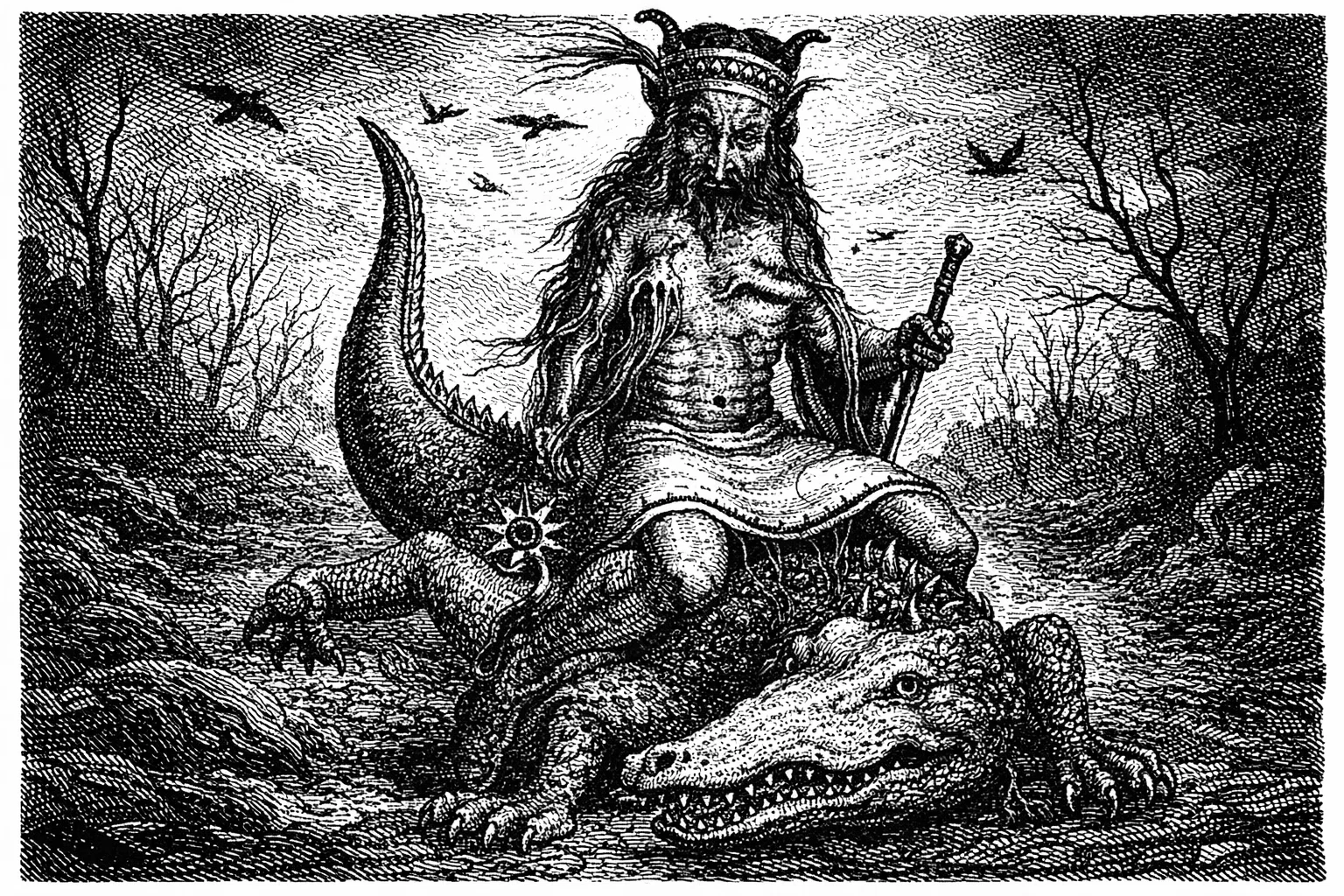
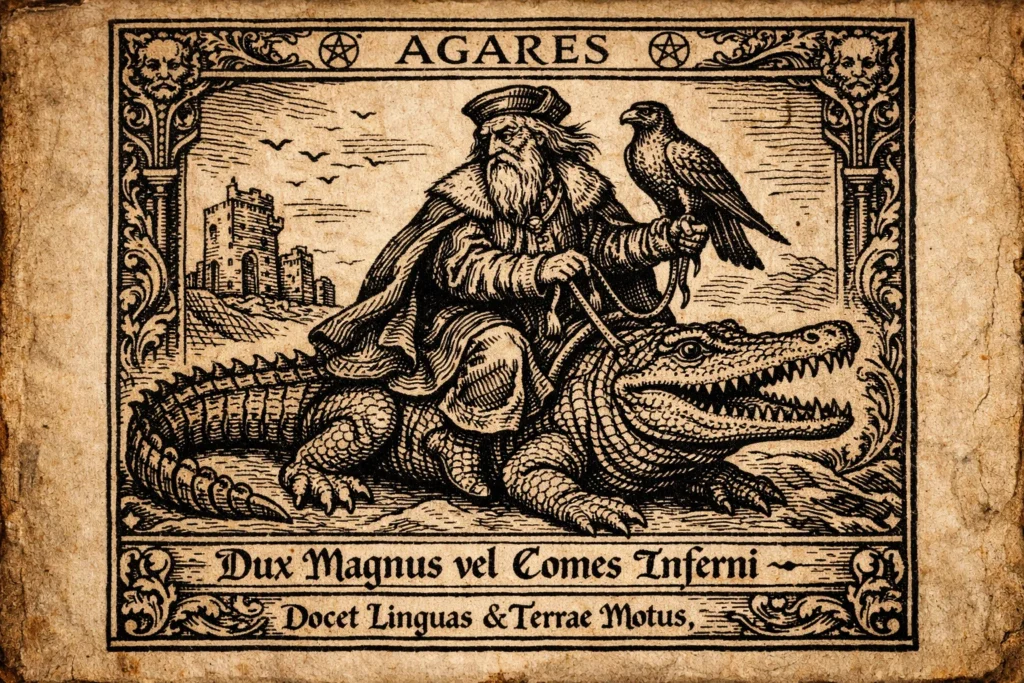
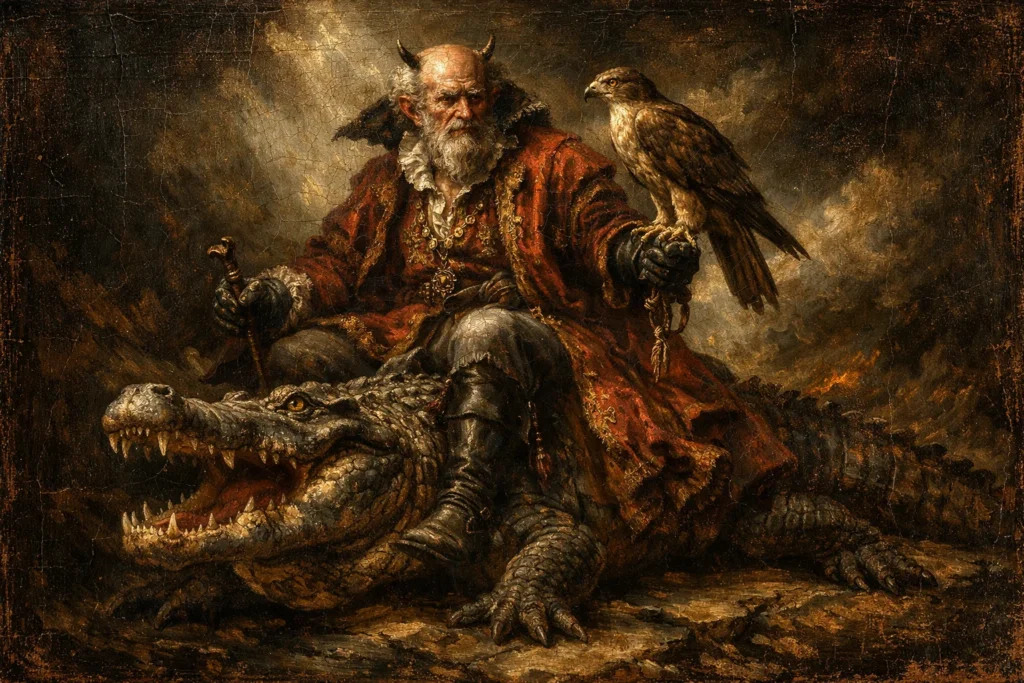
Sources describe Agares as an old man with a gentle look. He rides a crocodile, which makes him seem both odd and frightening. He also has a hawk or goshawk, ready to take flight.
This picture comes from old drawings in books like the Dictionnaire Infernal. The crocodile stands for danger and hidden strength, while the bird shows speed and keen vision.
In these drawings, he often wears robes or a crown to show his rank as a duke in Hell.
Some texts change the details a bit. In some accounts, Agares rides a cockatrice, which is part rooster and part snake, rather than a crocodile, and there is no hawk. Another grimoire describes him simply as an old man, with no animal or bird. The old man image may originate from the idea that fallen angels retain some heavenly traits but have been changed.
Why these animals? The crocodile connects to earth and water, fitting his power to cause earthquakes. The hawk is linked to air and hunting, matching his skill in tracking runaways. Together, these animals show Agares as a master of nature’s forces.
His gentle appearance is actually what fools people. He is not big or scary like some demons. Instead, he looks calm and wise, like a friendly elder. But this look hides his darker side.
You may also enjoy:
Vritra: The Dragon Who Swallowed the Sky in Hindu Mythology
October 7, 2025
What Is a Bhuta? The Backward-Footed Ghosts of Hindu Horror
February 5, 2026
Andhaka: The Blind Demon Born From Cosmic Darkness
February 6, 2026
What Is Baku? The Bizarre Yōkai That Eats Nightmares
January 28, 2026
Origins
Agares began as a fallen angel. Before his fall, he was part of the order of Virtues, angels known for courage and good deeds. When he rebelled against God, he was cast out of Heaven and became a demon lord in Hell.
Unlike some other demon lords or ancient gods, Agares doesn’t have a clear family tree.
The first known mentions of Agares are from the 1500s. The Livre des Esperitz calls him Agarat, describing him as a simple old man who teaches languages and gives titles. This book, from the 1400s or 1500s, became the basis for later descriptions.
By 1577, Johann Weyer wrote about Agares in Pseudomonarchia Daemonum. In this book, Agares is a duke of the east who rides a crocodile and carries a hawk. The text says he commands 31 legions and adds that he can cause earthquakes.
In the 1600s, the Lesser Key of Solomon added more to the story. The Ars Goetia section calls him Agreas (or Agares), the second spirit listed. He keeps the same appearance and powers, but is now linked to King Solomon, who was said to bind demons.
Over time, Agares appears in more books. The Dictionnaire Infernal from 1818 shows him in a well-known drawing as an old man riding a crocodile. The Grand Grimoire says he serves under Lucifuge Rofocale. An old manuscript, Sloane MS 3824, describes him as a demon who can reveal hidden treasures.
Agares’s role changes over time, from a teacher of languages to someone who destroys ranks and order. This shift shows how his stories became darker in Christian times. There may be some influence from Greek myths, like Argus the watcher, but Christian ideas are the main focus.
Historical & Grimoire Records
Agares does not appear in the Bible or early religious texts. His story starts in the late medieval period with the writing of the Liber Officiorum Spirituum tradition.
“The first duke under the power of the east, is named Agares, he commeth up mildile in the likenes of a faire old man, riding upon a crocodile, and carrieng a hawke on his fist; hee teacheth presentlie all maner of toongs, he fetcheth backe all such as runne awaie, and maketh them that stand still to runne: he overthroweth dignities supernaturall and temporall, and maketh spirits of the earth daunce.” [Johann Weyer, Pseudomonarchia Daemonum, 1577]
Weyer’s 16th-century entry made Agares well known in European demonology, elevating him from obscurity in obscure manuscripts to the mainstream. This source calls him a “Marquis” or “Duke” who seems “fair” and “mild,” but whose main actions are disruptive. The idea of making “spirits of the earth dance” is the first hint of the earthquake powers later linked to him in the Ars Goetia.
At that time, people often saw scholarly pursuits as suspicious or even dangerous. By saying an infernal duke could master “all manner of tongues,” Renaissance writers expressed their concerns about people who spoke many languages and about how language could be used for trickery rather than truth.
“The Second Spirit is a Duke called Agreas, or Agares. He is under the Power of the East, and cometh up in the form of an old fair Man, riding upon a Crocodile, carrying a Goshawk upon his fist, and yet mild in appearance. He maketh them to run that stand still, and bringeth back runaways. He teaches all Languages or Tongues presently. He hath power also to destroy Dignities both Spiritual and Temporal, and causeth Earthquakes.” [Anonymous, Lemegeton Clavicula Salomonis (Ars Goetia), 17th Century]
The Ars Goetia gives the standard version of Agares. It mostly follows Weyer but changes the idea of “dancing spirits” to the clear power to “cause earthquakes.” This change shows how, in the 17th century, people started to see demons as not just spiritual threats but also as causes of real-world disasters and political chaos.
The use of the name “Agreas” as an alternative shows how names often changed as texts were copied or altered on purpose in the Solomonic tradition. This source also confirms his rank in a strict infernal hierarchy, reflecting the era’s focus on order and the “Order of Virtues,” the group of angels Agares was said to come from.
“Agares, duc qui commande aux puissances de l’Orient. Il se montre sous la figure d’un seigneur sage, à cheval sur un crocodile, le faucon au poing. Il fait revenir les déserteurs et donne la victoire. Il enseigne toutes les langues et fait danser les esprits de la terre. Il était de l’ordre des Vertus.” [Jacques Collin de Plancy, Dictionnaire Infernal, 1863]
In the 19th century, De Plancy’s Dictionnaire Infernal added a new layer of folklore and romanticism to Agares. Instead of a “fair old man,” he is now described as a “wise lord,” making him seem more noble but still strange. This book also includes the famous Louis Le Breton illustration of Agares with a crocodile and hawk, which has become his main image in modern pop culture.
Writers of this time were interested in the idea of the “Noble Demon.” During the 19th-century occult revival, spirits like Agares were seen with a mix of reason and Gothic mystery. De Plancy’s mention of “giving victory” and bringing back deserters shows a more military side, fitting with the era’s focus on war and state power.
Powers and Abilities
In demon lore, Agares has many dark powers. These focus on causing chaos, controlling others, and destruction. Here are some of his abilities:
- Teaches languages: He gives quick knowledge of tongues to spread lies and deceit among people. This helps trick others in deals or plots.
- Causes earthquakes: He shakes the earth to bring ruin and fear. This power destroys homes, lands, and lives, showing his tie to natural disasters.
- Destroys dignities: He tears down ranks in church and state. This sows disorder, causing leaders to fall and societies to break apart.
- Stops those who run: He forces fleeing people to halt, trapping them in bad situations. This helps capture enemies or lost souls.
- Retrieves runaways: He brings back those who escape, enforcing control over the weak. This keeps power in the hands of the strong.
- Grants noble titles: He gives false honors to lure people into evil paths. These titles lead to pride and downfall.
- Makes spirits dance: In some texts, he commands earth spirits to move wildly, linked to his ability to cause earthquakes. This disrupts the natural order.
- Overthrows supernatural powers: He weakens other spirits or angels, helping dark forces gain ground.
These powers make Agares a tempter who interferes in human affairs. He stirs up wars by chasing soldiers or breaking alliances through language tricks. His ability to cause earthquakes connects to Christian fears about the end times. As a fallen virtue, he turns good things like learning into ways to do harm.
Agares and the Decay of Authority
In medieval grimoires, the demon is feared not so much for violence, but for breaking down order and meaning. While he is known for teaching all languages, the Ars Goetia highlights his power to “destroy spiritual and temporal dignities.” This links language skills to political stability.
In the late medieval and early Renaissance periods, language held society together. In this context, the demon teaching a language was not about learning, but about ruining meaning. He stands for the moment when important promises or orders lose their power and become just empty words. He is like the story of the Tower of Babel, where too much speech leads to chaos.
This loss of meaning in language is shown by his link to earthquakes. As words lose their meaning, it’s as is the ground itself starts to shake. Agares does not just cause earthquakes; he also shakes the idea of unchanging truth.
By bringing back those who have run away, Agares forces people to face past betrayals. No group, whether an army or a marriage, can find peace by simply separating. He makes sure every desertion is noticed, and every foundation is tested.
When compared to the classical creature Silenus, who was often shown as an old man riding a donkey, Agares is the opposite. Silenus shared wild, drunken truths about the meaninglessness of life. At the same time, Agares presents these truths in a cold, technical manner, using false praise and fake honors.
Agares shows the change from the “Holy Fool” of ancient times to the “Infernal Diplomat” of the early modern era. Studying Agares means looking at the old fears about skilled speakers and people who knew many languages. These people were useful but often seen as untrustworthy in a settled, feudal society.
Agares vs Other Similar Demonic Entities
| Demon Name | Associated Sin/Temptation | Rank/Origin | Key Traits/Powers |
|---|---|---|---|
| Bael | Deception | King/Ars Goetia | Invisible, commands 66 legions, shape-shifts to toad, cat, man |
| Vassago | Divination for evil | Prince/Ars Goetia | Reveals past and future to hide crimes, finds lost items for theft |
| Marbas | Disease | President/Ars Goetia | Causes and spreads illness, changes shapes to deceive |
| Valefor | Theft | Duke/Ars Goetia | Tempts to steal, commands 10 legions, appears as lion with donkey head |
| Amon | Wrath | Marquis/Ars Goetia | Incites anger and feuds, foretells future to fuel conflicts |
| Barbatos | Discord | Duke/Ars Goetia | Understands animals to spy, conciliates friends falsely |
| Paimon | False knowledge | King/Ars Goetia | Teaches arts to mislead, binds others to will |
| Buer | Sloth | President/Ars Goetia | Heals to prolong sin, teaches philosophy twistedly |
| Gusion | Dishonor | Duke/Ars Goetia | Reveals secrets to blackmail, gives false honors |
| Sitri | Lust | Prince/Ars Goetia | Inflames passions, reveals women’s secrets for exploitation |
| Beleth | Rebellion | King/Ars Goetia | Causes love to break bonds, commands 85 legions |
| Leraje | War | Marquis/Ars Goetia | Causes battles, rots arrow wounds |
| Eligos | Strife | Duke/Ars Goetia | Discovers hidden things for plots, foretells wars |
| Zepar | Infertility | Duke/Ars Goetia | Makes women barren, changes shapes for seduction |
| Botis | Division | President/Ars Goetia | Tells past and future to sow discord, reconciles falsely |
You may also enjoy:
Who Was Hiranyakashipu, the Demon King of Hindu Mythology?
October 6, 2025
Lamia: The Queen Cursed to Devour the Children of Others
January 7, 2026
Mara: The Buddhist Demon King of Desire and Death
October 13, 2025
Si’la: The Seductive Jinn Who Lures Travelers to Their Doom
October 9, 2025
Vritra: The Dragon Who Swallowed the Sky in Hindu Mythology
October 7, 2025
Allocer: Great Duke of Hell and the 52nd Spirit of the Ars Goetia
November 17, 2025
Rank in the Hierarchy of Hell
Agares is the First Duke of the East in Hell’s order. This is a high rank, though not the highest. Dukes command many followers and rule over certain areas.
Some texts say Agares serves under Oriens or the power of the east. In the Grand Grimoire, he reports to Lucifuge Rofocale, who is like a prime minister.
His relationships with other demons are unclear. He usually works alone in stories, but grimoires list him among the 72 demons bound by Solomon. He may compete with others who have similar powers, like Vassago, who also reveals secrets.
His connection to the east is linked to dawn and new beginnings, but in his case, it is twisted toward destruction. This matches his role in teaching language—using new words to spread old lies.
Overall, his role as a duke shows both command and service. He carries out Hell’s will on earth, using his legions to create chaos. This hierarchy helps explain how demon power flows from Lucifer down. Agares connects the top leaders to the lower ranks, making him important in infernal plans.
Mystical Correspondences
| Attribute | Details |
|---|---|
| Planet | Venus |
| Zodiac Sign | Aries |
| Element | Earth |
| Direction | East |
| Color | Green |
| Number | 2 |
| Crystal/Mineral | Emerald |
| Metal | Copper |
| Herb/Plant | Carnation |
| Animal | Crocodile |
Agares is connected to Venus, the planet of love and beauty, but for him, it is twisted into deceit and fake charm. Venus is said to boost his language skills, which he uses to trick others.
His zodiac sign is Aries, which stands for fire and action. This fits his quick movements and power to cause earthquakes. Summoning him during Aries season, from March to April, is said to make his chaotic powers stronger.
The earth element is linked to his destructive power, like shaking the ground to hide secrets or enemies. Facing east during rituals matches his duke role and is thought to make calls to him stronger. The color green symbolizes growth gone wrong, such as envy or poison. The number 2 shows his place as second in lists and hints at the idea of falling from grace.
These connections show Agares as a force that upsets balance. They help explain his evil by linking him to the stars and the earth, making his influence seem wide and hard to escape.
Crystals such as emerald are used in rituals to focus his energy, while copper talismans are thought to attract him. Carnations and crocodiles stand for his wild and untamed nature.
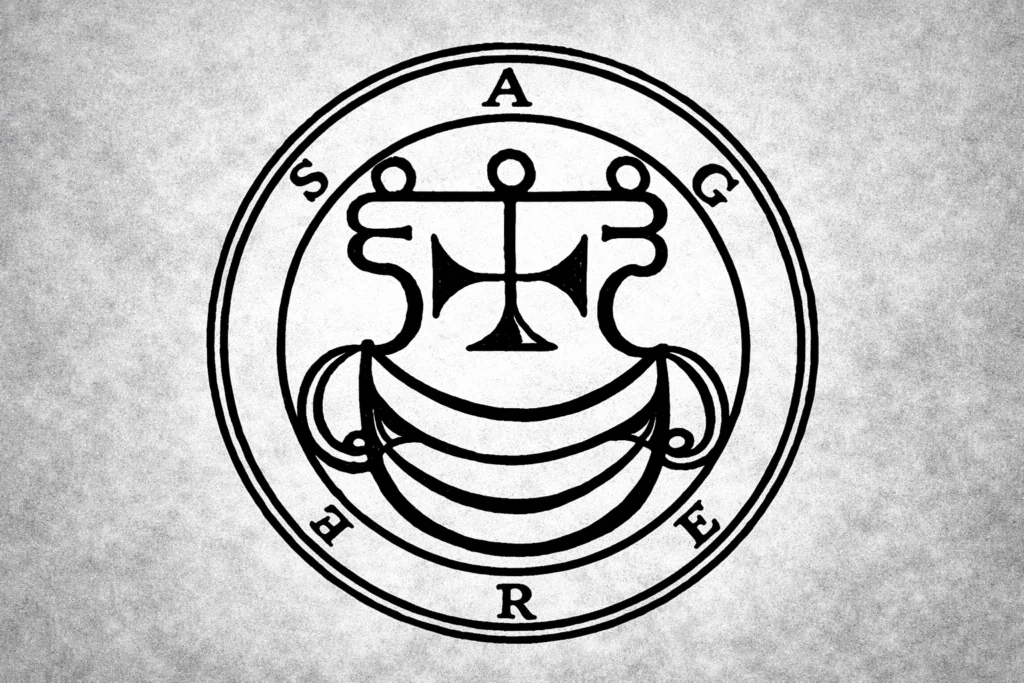
Agares’s Sigil
Agares’s sigil is a special symbol used in old magic. It looks like a circle with curved lines and a cross at the center, which can resemble horns or an upside-down smile. The letters of his name go around the edge. This design comes from grimoires like the Ars Goetia.
In the past, people drew the sigil to summon Agares. It worked as his signature and helped focus magical energy. The sigil was made on paper or metal and used in rituals to gain power or knowledge. Its curved lines may be linked to his crocodile, looking like scales.
People would carve the sigil on tools or wear it as an amulet. It was used to seal pacts or to protect them with spells. Today, the sigil appears in books and art about demons.
Summoning and Rituals
Old grimoires say that summoning Agares took careful planning and strict attention to spiritual rules. Books like the Ars Goetia describe how to draw detailed protective circles on the ground with special chalk or clay. These circles kept out evil forces and had the names of God or angels written inside to help control the demon.
People used special tools in these rituals, such as wands made from certain woods with spiritual significance and incense with chosen scents to set the right mood. They also used candles of different colors, each with its own meaning, like red for power, yellow for intellect, or green for prosperity. These were important parts of the ritual. The rituals were meant to use Agares’s powers, such as improving language skills, speaking many languages, or even causing tremors and earthquakes.
To call Agares, summoners would recite strong spells, usually in Latin, which was seen as a magical language. They also faced east during the ritual, as this direction stood for new beginnings and enlightenment.
The Sloane MS 3824 manuscript mentions using crystals, which were thought to capture and reflect the image of the summoned being. Crystals acted as both a focus and a container. Calling out his name and giving strong commands were key parts of these rituals. People did this to find hidden treasures or to get revenge on enemies.
It’s important to note that these practices were considered very dangerous and were believed to risk a person’s soul. Over time, the fear of witchcraft made these rituals even more taboo.
You may also enjoy:
Abadir: The Demon Servant of Chaos and Dispersion
September 30, 2025
Allocer: Great Duke of Hell and the 52nd Spirit of the Ars Goetia
November 17, 2025
Who Is Adrammelech in Demonology and the Bible?
October 1, 2025
Empusa: The Blood-Drinking Wraith of Greek Mythology
November 20, 2025
What Is the Akkorokamui, Japan’s Colossal Sea Monster?
November 14, 2025
Aži Dahāka: The Three-Headed Dragon of Zoroastrian Mythology
January 14, 2026
Bibliography
Author’s Note: Looking at these records, I noticed a strong contrast between the simple “earthquake” powers in the Lemegeton and George Steiner’s ideas about the instability of language. This suggests Agares stands for deeper problems with language. Comparing the Dictionnaire Infernal and Weyer’s Latin text shows how Agares’s gentle image was replaced by a more aggressive, military one in the 1800s. It’s interesting to see how his role in bringing back deserters fits with his power to destroy ranks. This shows Agares is not just a spirit of travel, but a strict enforcer of order. My research highlights a rare pattern in demon stories: a being whose power over the earth is closely linked to the trickiness and sometimes falseness of human speech.
- Collin de Plancy, Jacques. Dictionnaire infernal: répertoire universel des êtres, des personnages, des livres, des faits et des choses qui tiennent aux esprits. 6th ed., Henri Plon, 1863. Internet Archive.
- Weyer, Johann. Pseudomonarchia Daemonum. Edited and translated by Joseph H. Peterson, digital edition, 2000. Twilit Grotto: Esoteric Archives.
- De Laurence, L. W. The Lesser Key of Solomon, Goetia. Project Gutenberg, 7 Nov. 2023. Originally published by De Laurence, Scott & Co., 1916.
- Henson, Mitch, and Jeff Wellman, editors. Lemegeton: The Complete Lesser Key of Solomon. Metatron Books, 1999. Internet Archive.
- Migne, Jacques-Paul, editor. Dictionnaire des sciences occultes: ou Répertoire universel des êtres, des personnages, des livres, des faits et des choses qui tiennent aux apparitions, aux divinations, à la magie. Vol. 1, Chez l’Éditeur, 1846. Internet Archive. Originally published as part of the Encyclopédie théologique.
- Clymer, R. Swinburne. The Grand Grimoire. The Philosophical Publishing Co., 1910. Internet Archive.
- Steiner, George. After Babel: Aspects of Language and Translation. Oxford University Press, 1975. Internet Archive.