In Slavic beliefs, the Chort represents the breakdown of natural order and the arrival of chaos in everyday life. Unlike many European demons tied to major theological sins, this creature disrupts daily rural routines and connects the old forest spirits with the later image of the Christian Devil.
Most grimoires describe powerful demons at the top of infernal hierarchies, but the Chort is different. It often appears in a physical, local form and directly participates in human life, rather than acting as a distant, abstract force.
For my research, I compared 19th-century field notes from Afanasyev’s Slavic Mythology with the Laurentian Codex to separate the creature’s original folk traits from the later Christian influences. [View Full Bibliography ↓]
Summary
Key Takeaways
| Attribute | Details |
| Names | Chort, Čert, Czort, Korat, The Unclean One |
| Title | Spirit of Evil, Prince of the Peklo, The Lame Imp |
| Origin | Proto-Slavic/Early Medieval Eastern Europe |
| Gender | Male |
| Genealogy | No clear lineage; occasionally cited as a progeny of primordial darkness |
| Role | Temptation, trickery, causing misfortune, and serving as a personification of chaos |
| Associated Deity | Chernobog (opposing force or master), Veles (syncretic associations) |
| Brings | Moral corruption, physical illness, bad luck, and social discord |
| Weaknesses | Religious icons, iron, fire, the sign of the cross, and specific verbal formulas |
| Realm/Domain | Swamps, deep thickets, crossroads, and the underworld (Peklo) |
| Weapon/Item | Occasionally a pitchfork or a bag for capturing souls |
| Symbolism | Malice, the unpredictability of fate, and the subversion of social norms |
| Sources | Slavic folklore records, the Primary Chronicle, and 19th-century ethnographic studies |
Who or What is Chort?
The Chort is a key demon in Slavic mythology. It was seen as living in the underworld but often coming to earth to meddle in human life. Before Christianity, these beings were part of a larger group of spirits found in places like marshes and thickets. People saw them as real, physical beings to avoid or appease, not just symbols of evil.
When Christianity spread in Eastern Europe, this spirit’s name became the common word for the Devil. Still, it retained many folk traits, such as being more mischievous and physically present than the distant, abstract Satan.
The Chort is usually shown as a lone entity or part of a group of lesser spirits, ranking below the top demons but still able to harm people through trickery.
“Chort” Meaning
The origin of the name is debated among linguists. Some link it to the Proto-Indo-European root ker-, meaning “to cut” or “shorten,” which may refer to the demon’s short tail in folk tales. Others think it comes from a word for “black” or “charred,” tying it to soot, ash, and the darkness of the underworld.
The name appears in different forms across Slavic languages: Czort in Polish, Čert in Czech and Slovak, and Chort in Russian and Ukrainian. Over time, it transitioned from naming a specific spirit to a general term for a demon, and eventually to an expression of annoyance.
Early Slavic translations of Greek church texts often used this word for diabolos. Still, in folk stories, it refers to a spirit with limited power that a clever person can outwit, unlike the all-powerful Devil of formal theology.
How to Pronounce “Chort” in English
In English, the name is usually pronounced /tʃɔːrt/. It starts with the “ch” sound as in “church,” then the “or” sound as in “short,” and ends with a hard “t.” It is one syllable. Some Slavic versions use a rolled “r” or a softer “t,” but the English version is sharp and clear.
You may also enjoy:
Andhaka: The Blind Demon Born From Cosmic Darkness
February 6, 2026
Marid: The Ocean Jinn That Defies Heaven and Earth
September 30, 2025
Who Is the Jann in Islamic Mythology and Why Is He Feared?
October 2, 2025
Who Was Hiranyakashipu, the Demon King of Hindu Mythology?
October 6, 2025
Jikininki: The Japanese Ghost That Feeds on Human Corpses
February 9, 2026
Origins
This spirit comes from the animistic and polytheistic beliefs of early Slavic tribes. Before there was a formal Slavic pantheon, people thought these spirits lived in wild, untamed places.
They were seen as part of the “unclean force” (nechistaya sila), a group of supernatural beings often hostile or indifferent toward humans. People believed they came from ancient waters or deep underground, long before human society began.
As Slavic societies grew more complex, the Chort became part of the struggle between Chernobog (the Black God) and Belobog (the White God). It acted as a minor agent of chaos. When Christianity arrived in the 10th century, the spirit was turned into a demon and linked to the Christian Devil.
This blending of beliefs preserved the spirit’s physical traits while placing it in a biblical context of sin. Archaeological finds of amulets and the continued use of its name in folk charms show that it stayed important in Slavic culture for centuries.
Genealogy
The Chort’s origins are not traced through family lines. Instead, it is usually seen as a sudden creation from the world’s natural darkness.
| Relationship | Details |
| Parents | Usually none; occasionally said to be born from the foam of the sea or primordial chaos. |
| Siblings | Other spirits of the ‘unclean force,’ such as the Leshy or Vodyanoy, are found in some traditions. |
| Spouse | The Chortovka (female demon) or, in syncretic tales, a witch or fallen human. |
| Children | Lesser imps, changelings, or half-human offspring sired through trickery. |
What Does the Chort Look Like?
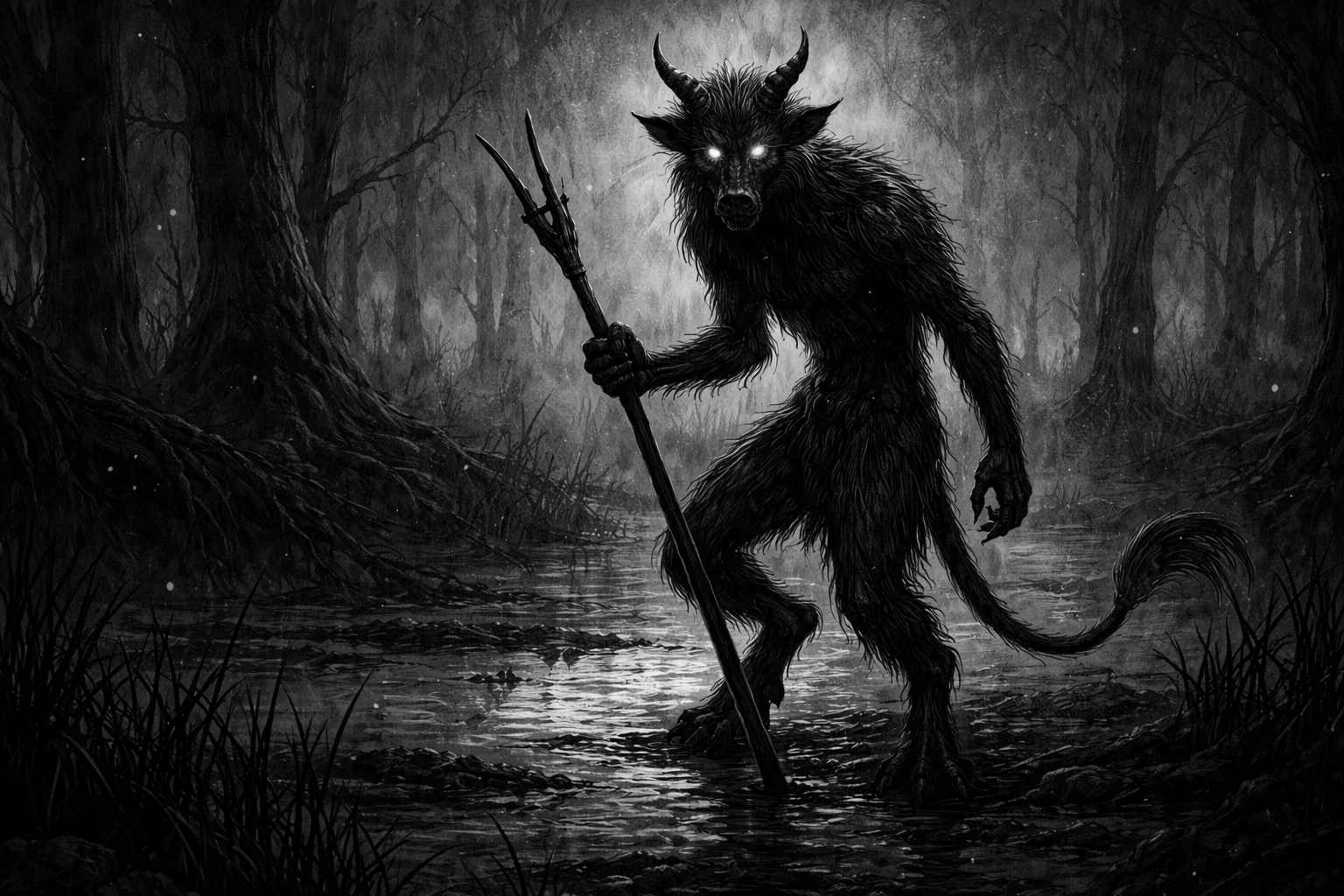
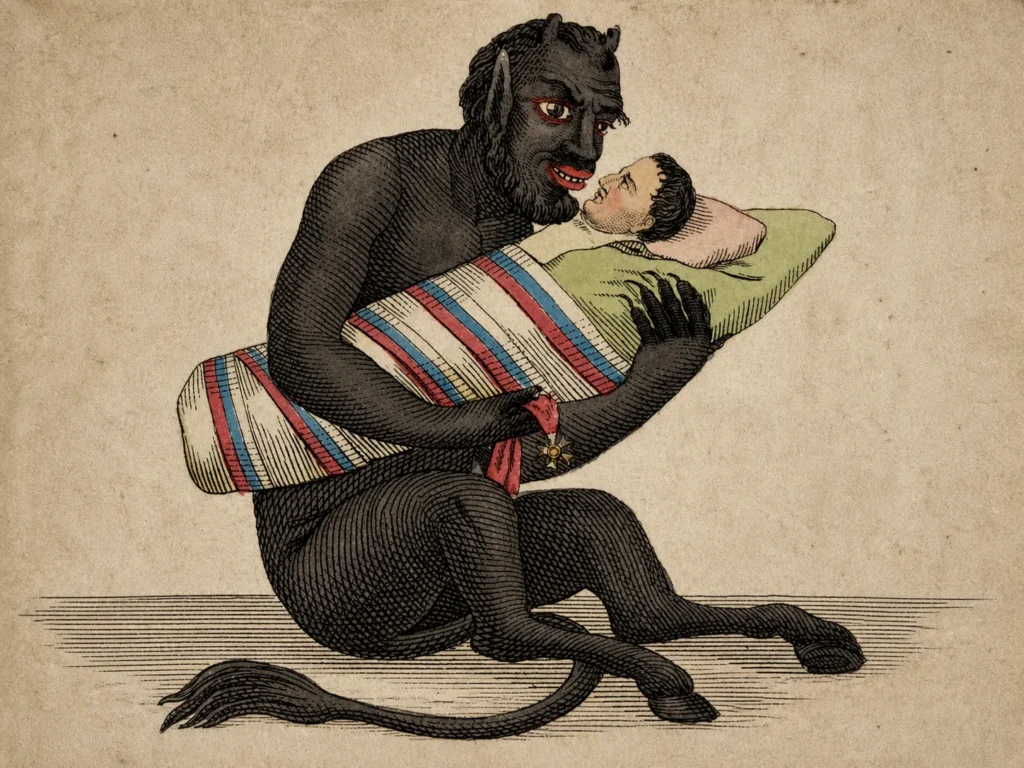
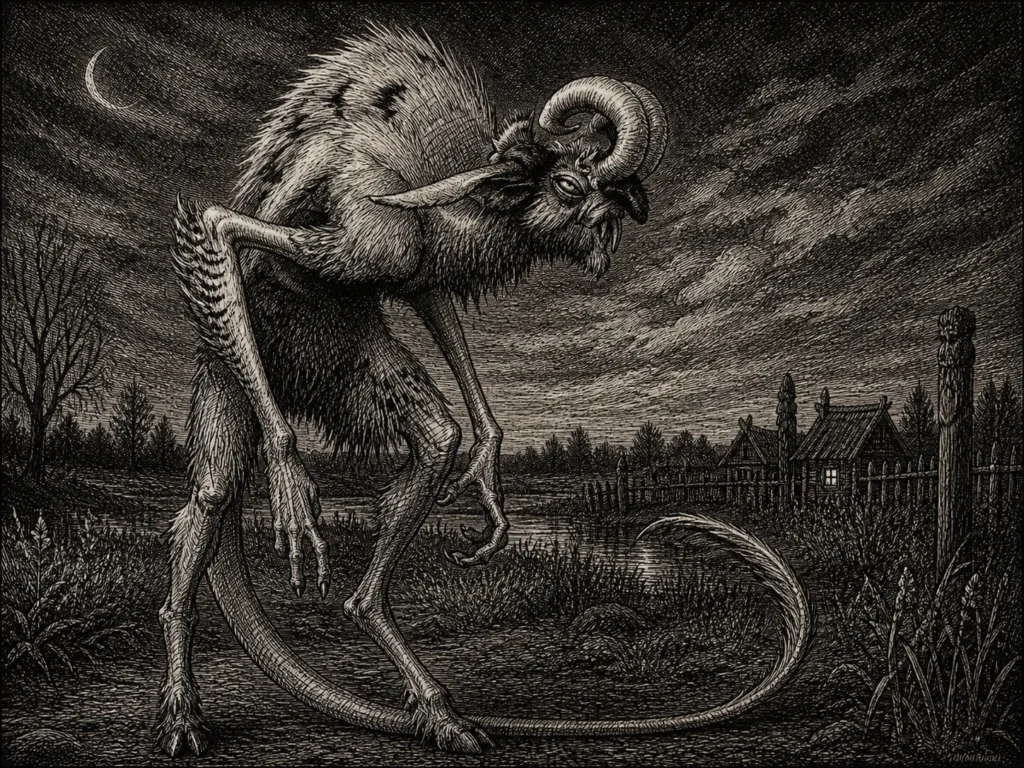
The Chort usually looks human but with animal-like features. It often has short horns, a long, thin tail, and a body covered in black fur or soot.
One leg usually ends in a hoof, while the other may have a human foot or a bird’s claw. It has a thin, pointed beard and glowing eyes, showing its sly and predatory side. It is often described as small or medium in height, fitting its role as a sneaky troublemaker rather than a giant monster.
In mythology, the Chort’s limp or uneven walk comes from the “lame god” archetype. This physical trait often shows a link to the underworld and secret, underground knowledge.
Overall, I believe this uneven appearance was a clear sign to ancient people that the spirit did not belong in the normal world, marking it as a permanent outsider.
Connections to Other Ancient Demons
| Name | Genealogy | Type | Appearance |
| Pazuzu | Mesopotamian | Bringer of famine and storms | Humanoid body, lion head, wings, scorpion tail |
| Lamashtu | Mesopotamian | Nursery demon/disease spirit | Lion head, donkey teeth, hairy body, bird talons |
| Apep | Egyptian | Chaos serpent | Giant snake or serpent |
| Ammit | Egyptian | Soul devourer | Crocodile head, lion torso, hippopotamus hindquarters |
| Fenrir | Norse | Chaos monster | Giant wolf |
| Jörmungandr | Norse | World serpent | Serpent that encircles the world |
| Tiamat | Babylonian | Primordial chaos goddess | Multi-headed dragon or sea serpent |
| Typhon | Greek | Father of monsters | Hundreds of dragon heads, fire-breathing eyes |
| Echidna | Greek | Mother of monsters | Half-woman, half-serpent |
| Mara | Buddhist | Tempter/Demon of death | Varies; often a beautiful human or a multi-armed deity |
| Vetala | Hindu | Vampiric spirit/ghoul | Hanging upside down from trees, cadaverous appearance |
| Oni | Japanese | Ogre/Demon | Red or blue skin, horns, and an iron club |
| Rakshasa | Hindu | Metamorph maneater | Fangs, claws, and various animalistic features |
| Kappa | Japanese | Water imp | Turtle shell, beak, and water-filled indentation on the head |
Chort Myths, Legends, and Stories
The Primordial Division of the Sea
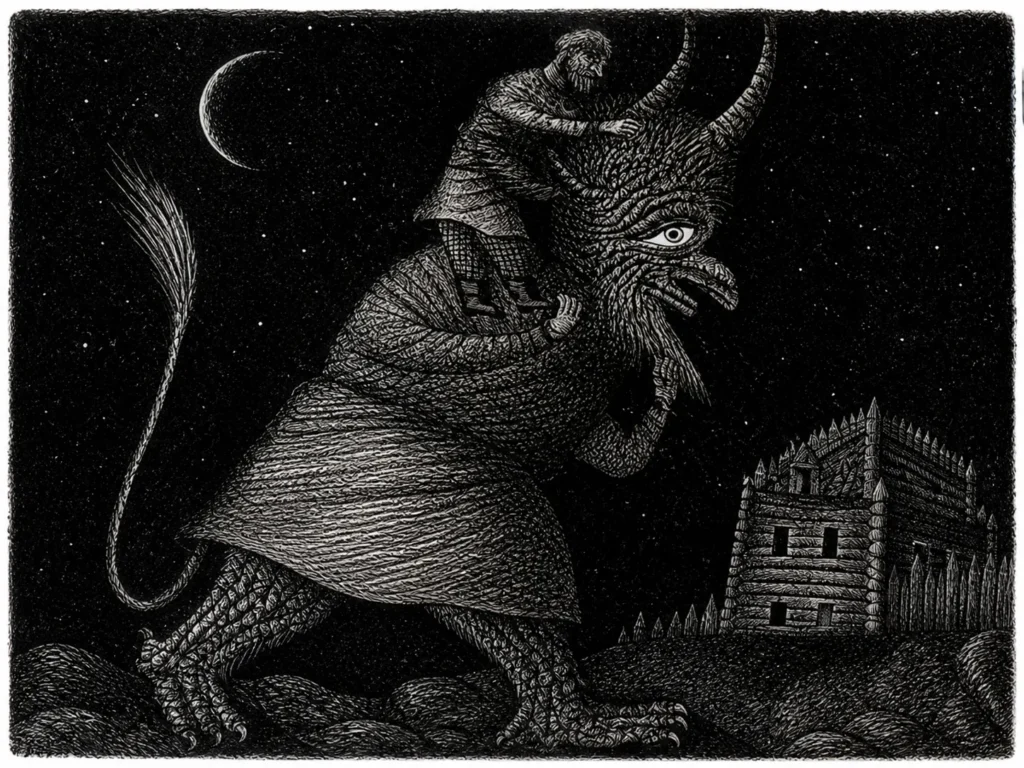
In some Slavic creation myths, especially those shaped by Bogomilist ideas, the world is made through a partnership between the main god and this spirit. At first, there was only a huge, ancient ocean. The supreme god could not reach the bottom to get sand for making land, so he asked the spirit for help.
The god said, “Dive into the deep and bring back a handful of sand in my name.” But the spirit wanted the power of creation for itself. It dove down, thinking, “I will bring back the sand in my own name.” When it returned, the sand in its hand had turned to stone, leaving its hand empty.
The god told the spirit to dive again. This time, the spirit tried to hide some sand in its mouth to make its own land later. As the god spread the sand over the water to form the earth, the hidden sand in the spirit’s mouth also started to grow, making it choke and gasp.
“Spit it out!” the god ordered. The spirit spat out the growing sand and mud, which became the world’s mountains, swamps, and marshes. The sand spread by the god became the fertile plains.
You may also enjoy:
Yuki Onna: The Terrifying Bride Who Feeds on Travelers
December 9, 2025
Ancient Demons: The Real Origins of the Setcheh Myth
November 11, 2025
Who Is Agares, the Demon of Earthquakes and Deception?
October 13, 2025
Vaisravana: The Golden Guardian King Who Rules the North
October 16, 2025
Who Was Abezethibou, the Fallen Angel Who Opposed Moses?
October 1, 2025
Demon Alastor: The Grand Executioner of Hell
November 17, 2025
Chort Powers and Abilities
The Chort has many supernatural powers that let it affect both the physical world and people’s minds. The demon is not all-powerful, but it is much stronger and smarter than a normal person.
Its strength often comes from staying hidden or changing its appearance to get past social and spiritual barriers. It can also affect the environment, causing sudden storms or making livestock die unexpectedly.
- Transformation: The ability to transform into animals such as black cats, dogs, or pigs, and occasionally into a handsome human to seduce or deceive.
- Temptation: The power to whisper into the ears of humans, inducing them to commit acts of greed, violence, or betrayal.
- Invisibility: The capacity to move unseen through human settlements, allowing it to commit acts of sabotage without detection.
- Illusion: Creating objects of great value, such as gold or fine clothing, which eventually revert to their true forms as dry leaves, charcoal, or dung.
- Disease: The ability to cause sudden illness in humans or animals through a malevolent touch or breath.
- Telekinesis: The power to move heavy objects, disrupt household order, or hurl stones.
Chort, the Unclean
In my research on Proto-Slavic, I found an interesting link that challenges the usual view that this spirit’s name means “blackness” or “darkness.”
Many researchers connect the name to words for “charred” or “black,” but a closer look at Slavic verbs shows it is mainly linked to črtati, meaning “to draw,” “to scratch,” or “to mark.” I find it interesting that this suggests the spirit is not just a being of darkness, but a “Delineator.”
For ancient Slavs, drawing a line was an important ritual for setting boundaries. So, the Chort stands for crossing those boundaries. It is the “Marked One,” living where the village’s circle is broken, and represents a mythological “glitch” in social and spiritual order.
I believe the spirit’s uneven body, like its limp or single hoof, is not just a random flaw but a sign of its underground origins.
In mythology, the “lame” entity, such as Greek Hephaestus or Slavic Veles, is seen as adapted to the rough, shifting ground of the underworld rather than to the flat earth of the living. I think giving this spirit a limp was a way for ancient Slavs to show its place between worlds.
The spirit’s uneven walk shows that it lives between the real world and the chaos of the deep. This imbalance is part of its role: it keeps reality from becoming too fixed by bringing in transformation and even decay.
I find it most interesting that 19th-century records show this spirit’s evil side was made less frightening in folk magic. Unlike the terrifying Western Satan, the Slavic spirit is often shown as a clumsy trickster who can be fooled. I think this made it easier for peasants to deal with misfortune.
By turning misfortune into a spirit that a smart farmer could trick or even trap in a violin, people felt more in control of their world. The spirit became a way to explain minor disasters such as spoiled milk, lost animals, or sudden storms.
I see the Chort not as the “Great Evil” of the universe, but as the “Small Malice” found at boundaries. It helped ancient people handle the wild’s unpredictability using humor and rituals.
Rituals, Amulets, and Protective Practices
Old practices linked to this spirit were mostly meant to protect people, since it was seen as a constant threat to homes. Rituals were aimed to keeping it out or trapping it before it could enter. These rituals often focused on places like doorways, windows, and crossroads, where the line between the human and spirit worlds was thought to be weakest.
Incantations and Ceremonies
Rituals to fight the “unclean force” often used magic and purifying things like salt, fire, and iron.
One common ritual was “fencing” a property, where someone would walk around the farm’s edge, saying special words to make a barrier the spirit could not cross. If a house was thought to be haunted, people might sweep the corners with a broom made from certain herbs.
The main aim was usually to shame or trap the spirit. In some traditions, if caught, it could be forced to serve by using special words. A common chant to drive the spirit away, taken from folk records, stresses that it does not belong in the sacred world:
Unclean spirit, depart from this place
Your path is in the marshes, your home is in the abyss
You have no part in this house, no seat at this table
By the iron and the salt, I bar your way
Go to where the sun does not shine, and the wind does not blow
Leave the servant of the world in peace.
Amulets and Talismans
People relied on protective objects for safety, especially when traveling. Iron was the most common material for charms, as it was thought to hurt the spirit. Small iron horseshoes or tools were often carried or nailed to doors. Silver was also used because it symbolized purity and the moon.
Amulets often depicted the cross or special patterns called “thunder marks” (hexagonal rosettes), linked to the god Perun, which were believed to strike the spirit with heavenly power. People wore these around their necks or sewed them into clothes. Garlic or wormwood was also used, as their smell was thought to drive the spirit away.
Professional Practitioners
Most people knew simple charms, but tougher cases needed a Znahar (healer) or Vedun (wise man). These experts were thought to know the spirit’s true name and its weaknesses.
Before Christianity, the Volkhv (pagan priest) led group sacrifices to ward off chaotic spirits. These priests acted as go-betweens, using their knowledge of the spirit world to protect the community from the unpredictable harm spirits could cause.
You may also enjoy:
The Ghul: The Flesh-Eating Demon of Arabian Folklore
October 1, 2025
Who Was Abezethibou, the Fallen Angel Who Opposed Moses?
October 1, 2025
Aeshma: The Zoroastrian Demon of Wrath and Fury
January 13, 2026
Vaisravana: The Golden Guardian King Who Rules the North
October 16, 2025
Nasnas: The Monstrous Demon Hybrid That Haunted Pre-Human Earth
November 12, 2025
Bibliography
Author’s Note: For my research, I combined the “delineator” idea from Dahl’s research with the dualistic creation stories in the Bogomilist Apocrypha. I also used Rybakov’s study of old symbols and compared it with church warnings in the Primary Chronicle. I focused on the spirit as a symbol of social and physical disorder, not just moral evil. By blending language studies and folklore, I was able to show how ancient Slavs used humor and rituals to handle the unpredictability of the wild.
- Vinitsky, Ilya. (2020). Lord of the Words: Vladimir Dahl’s Explanatory Dictionary of the Living Great-Russian Language as a National Epic. Vladimir Dahl’s Explanatory Dictionary of the Living Great-Russian Language as a National Epic. 10.1093/oso/9780190913199.003.0011. ResearchGate.
- Cross, Samuel Hazzard, and Olgerd P. Sherbowitz-Wetzor, editors and translators. The Russian Primary Chronicle: Laurentian Text. The Medieval Academy of America, 1953.
- Conway, R. S. The Laurentian Manuscript of Livy’s Third Decade. The Classical Quarterly, vol. 27, no. 3/4, 1933, pp. 182–94. JSTOR, http://www.jstor.org/stable/637115. Accessed 5 May 2026.
- Ioffe, Dennis, editor. East-Slavic Religions and Religiosity: Mythologies, Literature and Folklore: A Reassessment. MDPI, 2021. https://doi.org/10.3390/books978-3-0365-2026-1.
- Riabinin, Yaroslav V. Slavic Paganism in Kievan Russia and the Coming of Christianity. 13 Apr. 2007. University of Toronto.