Many supernatural beings in Japanese folklore come from the ancient animism of Shinto. However, Aka Manto shows how urban legends have changed to reflect modern social fears. It represents a “no-win” situation in which the encounter is set up so that no matter what the victim chooses, there is no escape.
Traditional spirits usually offer a way out through rituals or teach a moral lesson. This spirit is different because it removes the idea of real choice, turning an ordinary place at home into a scene where escape is impossible.
To better understand how this yōkai has evolved over time, I examined police reports from the early 1900s that mention “cloaked strangers. I compared them to stories from the Gakkō no Kaidan (School Ghost Stories) collection. This approach allows me to provide an accurate description without the over-the-top details often found in modern films. [View Full Bibliography ↓]
Summary
Key Takeaways
| Attribute | Details |
| Names | Aka Manto, Akai Manto, Aka-hanten, Akai-kami-aoi-kami |
| Translation | Red Cloak or Red Cape |
| Title | The Cloaked Phantom of the Stall |
| Type | Yūrei or Urban Legend (Onryō variant) |
| Spirit Classification | Ara-mitama (Violent spirit); Goryō (Vengeful spirit) |
| Origin | Modern urban folklore; likely a transformation of earlier “red vest” school myths |
| Gender | Commonly identified as male |
| Appearance | A tall figure wearing a long red cloak and a white mask to hide a strikingly handsome or horrific face |
| Kehai (Aura/Presence) | A disembodied, deep voice emanating from an adjacent empty stall; a sudden heavy stillness in the air |
| Powers/Abilities | Spatial manipulation within closed stalls; supernatural speed; manifestation of sharp implements |
| Methods of Pacification | Polite refusal of all offered items; silence; escaping the physical facility before the choice is completed |
| Habitat | Public school toilets, specifically the final stall in a row; older government buildings |
| Diet/Prey | School-aged children and young adults |
| Symbolic Item | A red cloak or red paper |
| Symbolism | Anxiety regarding choices; the loss of privacy in modernized spaces; the “Red vs. Blue” societal dichotomies |
| Associated Kami | None; it is a modern spectral manifestation disconnected from classical divinity |
| Sources | Gakkō no Kaidan (School Ghost Stories); various regional oral accounts from the mid-20th century onwards |
The Fundamental Identity of Aka Manto
Aka Manto is a key character in the “School Ghost Story” type of Japanese folklore. It is a harmful ghost that haunts small, private places.
People usually describe it as a masked man who appears in the last stall of a restroom and gives a deadly choice between red or blue. Unlike many yōkai that live in nature, this spirit comes from city life and is found in the shared spaces of modern schools.
This vengeful spirit goes after people when they are alone and vulnerable. It acts like a modern onryō, but the stories rarely explain what angered it. Instead, the focus is on the cruel rules of its game.
The spirit is seen as a modern version of the “cloaked man” from early 20th-century Japanese rumors, shifting from dark alleys in the Taishō era to the bright bathrooms of the Shōwa and Heisei periods.
Semantic Origins
The name comes from the Japanese words aka (red) and manto, which is borrowed from Portuguese or French and means cloak or cape. In the late 1800s and early 1900s, manto became popular in Japan as Western-style clothing came to signify modernity or elite status. This background hints that the spirit is both an outsider and someone who once had high status.
In some regions, especially around Osaka and Kyoto, people call the spirit Aka-hanten, meaning “Red Short-sleeved Coat”. Another well-known version is the “Red Paper, Blue Paper” story, in which the cloak is gone but the choice of color remains.
The name’s history shows a shift from stories about a real, cloaked kidnapper in the early 1900s to tales of a ghostly, masked entity in more recent times. In the 1930s, “Red Mantle” referred to an actual criminal. Still, by the 1980s, the name was used only for a supernatural being.
How to Pronounce “Aka Manto” in English
The name is pronounced Ah-kah Mahn-toh. For Aka, say “ah” like in father and “kah” like in calm. For Manto, start with “mahn” (rhymes with gone) and end with “toh” (rhymes with go). Each syllable is said evenly, with no special emphasis.
What Does Aka Manto Look Like?
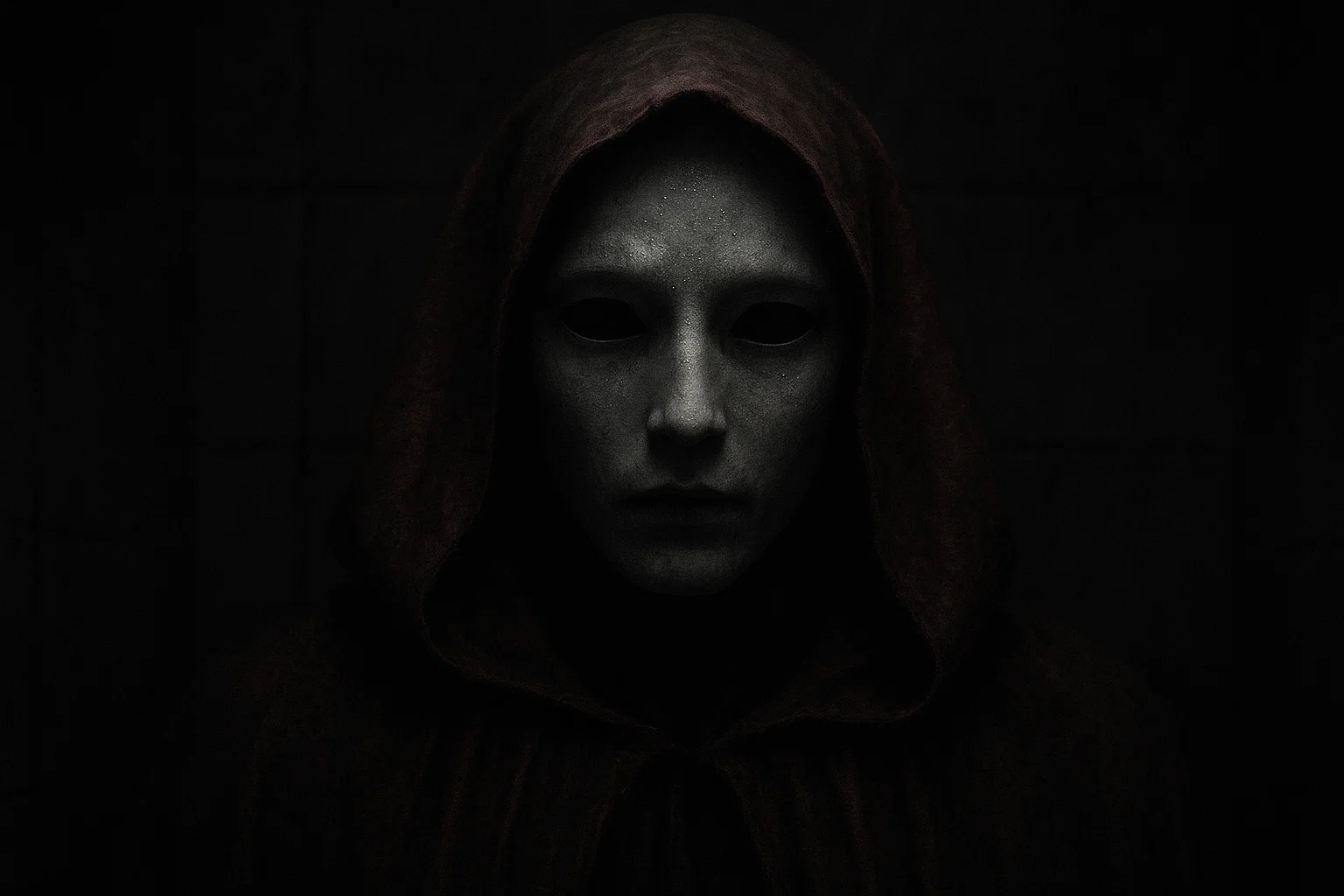
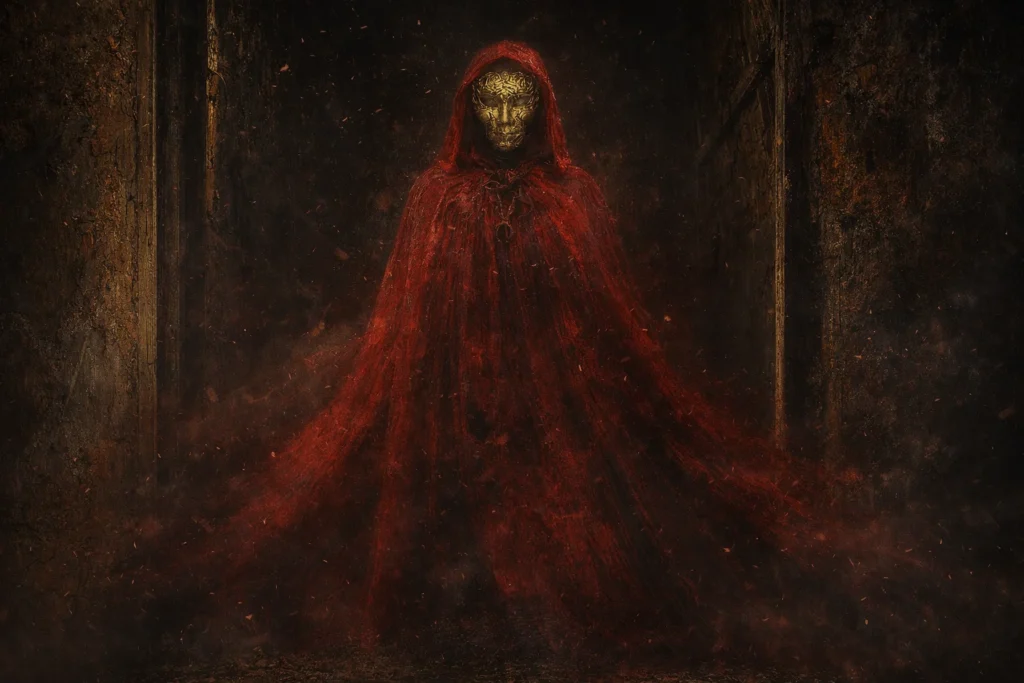
Descriptions of this spirit highlight both its dramatic appearance and its frightening nature. It is usually shown as a tall, thin man hidden by a large, floor-length red cloak. The cloak is often a bright, deep red, which some believe represents the blood of past victims.
Aka Manto’s most noticeable feature is its white mask, which looks like those from Noh theater or a plain porcelain mask. The mask hides its true face, which is sometimes said to be extremely handsome, a reference to its “stalker” origins, or sometimes described as a decaying, blank void.
Under the cloak, Aka Manto is sometimes described as wearing a dark tuxedo or formal clothes, which adds to the sense that it comes from an earlier time. In newer stories, it might appear only as pale hands holding colored paper above the stall or through a gap in the floor.
People often notice the spirit’s arrival by a shadow that looks darker than everything else, even in bright light. He does not show any weapons until he attacks, when long, thin blades or even the cloak itself are used to kill.
You may also enjoy:
What Is Baku? The Bizarre Yōkai That Eats Nightmares
January 28, 2026
Who Was Ravana in Hindu Mythology and Why Was He Feared?
October 3, 2025
Nasnas: The Monstrous Demon Hybrid That Haunted Pre-Human Earth
November 12, 2025
What Is the Akkorokamui, Japan’s Colossal Sea Monster?
November 14, 2025
Origins and History
The historical emergence of the entity can be traced to the rapid modernization of Japan’s school system and the accompanying social anxieties of the early to mid-20th century. During the late Meiji and Taishō periods, rumors of “cloaked kidnappers” (manto fushisha) were common in urban centers like Tokyo.
These stories often told of men in capes waiting near schools to kidnap children. After World War II and during the rebuilding in the 1950s, these fears turned into ghost stories. The restroom, being a place where people feel exposed and in-between, became the perfect setting for these anxieties.
Looking at the timeline, I think this spirit is really a symbol of the stress and lack of privacy found in Japan’s culture. The choice between “red or blue” reflects the high-pressure, either-or decisions in school exams, where one mistake can feel like “social death.”
Interestingly, the first reports of this spirit appeared when schools switched from old pit toilets to Western-style flush toilets. The new bathroom design created hidden areas where people could imagine a stalker hiding.
I also believe the red cloak is a twist on the “rebel” image from the 1970s Bousou-zoku culture. Instead of freedom, Aka Manto represents a strict, unavoidable authority that punishes anyone found alone. It is a “stagnation spirit,” created from students’ shared fears and growing stronger as the story is told from one class to the next in the Gakkō no Kaidan tradition.
Habitat
Aka Manto is only found in schools, especially in primary and secondary ones. It appears only in bathrooms, which Japanese folklore sees as “liminal spaces” where the line between the living and spirit worlds is thin. He is said to prefer the oldest or most distant stall in the girls’ restroom, though boys can also encounter him there.
The spirit chooses these places because bathrooms are among the few places where students are really alone during a busy school day. He thrives in the quiet and isolation of these rooms. Some stories say he is connected to schools with a tragic past, while others claim he can appear in any dark or neglected restroom.
The Symbolism of the Ultimatum
Looking at the history of ghost stories, I see that the “Red Cloak” marks a big transition in Japanese folklore. It shows the move from the old “omen-based” yōkai of the Heian period to the more rule-driven urban legends of the Shōwa era.
Interestingly, the first schoolyard rumors in the 1930s happened as Japanese schools became more standardized. My research suggests this spirit is more than just a ghost; it is a symbol of the “No-Win” situations found in modern bureaucracy.
Traditional spirits like the Kappa could be calmed with certain rituals, such as bowing or giving cucumbers. In contrast, the red-cloak spirit offers a choice in which both answers lead to death. This shows a deeper cultural problem: a lack of real control.
In the 1930s, as Japan became more nationalistic and strict, the bathroom stall came to represent how people could not escape their assigned roles. Choosing “red” (for sacrifice or patriotism) or “blue” (for silence or suffocation) both lead to the loss of one’s sense of self.
Also, when I looked at the “Red Vest” (Aka-hanten) version from Kyoto, I found it connects to the Kainade. These older, hairy yōkai only touched people. The shift from a harmless but annoying spirit to a masked killer mirrors Japan’s move toward urban life.
As forests and mountains became less mysterious, the darkness moved into the last unlit places: public restroom stalls. The spirit’s white mask is a “blank canvas” for social fears, showing how, in modern city life, the public face (tatemae) can hide an empty or troubled reality beneath.
Famous Aka Manto Legends and Stories
Red or Blue?
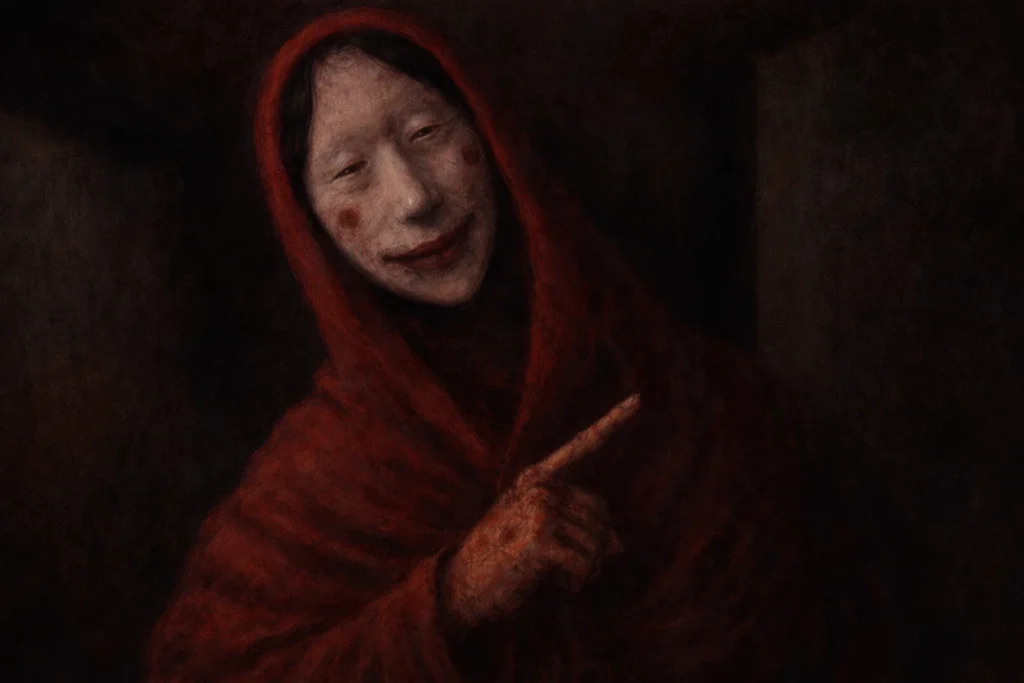
In this most pervasive version of the legend, a student finds themselves alone in the final stall of a school restroom late in the afternoon. After discovering that there is no toilet paper, a strange, masculine voice asks from the void: “Do you want red paper or blue paper?” The student, assuming a classmate is playing a prank, answers, “Red paper.”
Instantly, the entity manifests—often described as reaching down from the ceiling or through the stall walls—and proceeds to violently slash the victim’s body.
The wounds are so numerous and deep that blood sprays across the walls and saturates the victim’s clothing until they are entirely crimson. When the body is later discovered, the authorities find the victim deceased, wearing a literal “cloak” of their own blood.
On the other hand, if the student answers, “Blue paper,” the entity does not use a blade. Instead, the victim is seized by an invisible, crushing force around the throat.
Aka Manto strangles the individual with such sustained intensity that the blood is drained from the face, leaving the skin a pale, cyanotic blue. The victim is found slumped in the stall, dead from asphyxiation, their face a permanent shade of bruised violet-blue.
The Girl Who Chose Yellow
While the primary legend dictates a binary choice, several regional accounts from the 1980s involve attempts to subvert the spirit’s question by introducing a third color. In a documented variation from an elementary school in the Kantō region, a young girl was confronted with the classic question: “Red paper or blue paper?”
Seeking to avoid the fate of the colors mentioned, she replied, “Yellow paper.” In this specific tradition, the spirit does not vanish; instead, it adapts the punishment to the new color. The stall floor is said to have opened or turned into a viscous golden-yellow sludge, and a mass of pale hands dragged the girl downward.
This story concludes with the girl disappearing entirely, leaving only the smell of sulfur and waste, leading to the folk belief that a “yellow” choice results in being dragged into the literal pits of the “Earth Prison” beneath the plumbing.
You may also enjoy:
Abura-sumashi: The Potato-Headed Yōkai That Punishes Greed
October 23, 2025
Jikininki: The Japanese Ghost That Feeds on Human Corpses
February 9, 2026
Ammit: Devourer of the Dead in Ancient Egyptian Mythology
November 10, 2025
Who Is the Jann in Islamic Mythology and Why Is He Feared?
October 2, 2025
The Kumbhāṇḍa: Grotesque Demons of Buddhist Hell
November 13, 2025
The White Mask and the Stalker of the Third Stall
In certain versions prevalent in the Osaka area, the legend focuses less on paper and more on the spirit’s physical presence. A student entered the third stall of the girls’ restroom and heard a voice ask, “Shall we put on a red vest?” This phrasing harks back to the older Aka-hanten (Red Vest) rumors.
When the student nervously replied, “Yes,” the door swung open to reveal a tall man in a white mask and a flowing red cape. He immediately tore the clothes from the student’s back. He used a sharp implement to skin the victim in the shape of a vest, leaving the red musculature exposed to mimic the garment.
This specific narrative is often used to stress Aka Manto’s transition from a human “phantom kidnapper” to a supernatural yōkai, as the man in the story is said to have vanished through the solid wall of the school immediately after the act.
The Purple Escape and the Logic of Refusal
A final narrative focuses on the “trap” of the entity’s logic. A student, hearing rumors about the red and blue paper, decided to name the color that combined them: “Purple paper.”
Rather than being spared, the student suffered a hybrid fate. The entity manifested and first strangled the victim until they turned blue, then slashed them until they bled red, resulting in a “purple” corpse.
This story is frequently told alongside the “successful” counter-narrative: a student who, when asked the question, remained perfectly calm and replied, “I don’t need any paper, thank you.” According to this account, the spirit was momentarily silenced by the lack of a chromatic commitment.
The student was able to stand up, exit the stall, and leave the restroom. When they looked back from the doorway, the stall door was hanging open. The red-cloaked entity was gone, proving that the only way to “win” the encounter is to refuse the premise of the game entirely.
Aka Manto Powers and Abilities
Aka Manto has several supernatural abilities that make him one of the most feared spirits found in schools. His main power is to trap people in bathroom stalls, preventing them from opening the door or escaping once the encounter starts. He can also make himself invisible to everyone except his chosen target, who can hear and feel him until he leaves.
- Chromatic Execution: Aka Manto can kill his victim in a way that matches the color they pick. For example, choosing red leads to bleeding, while blue means strangulation.
- Vocal Projection: He can make his voice come from the walls or empty stalls, even when he can’t be seen.
- Manifestation: He can appear or vanish whenever he wants inside a restroom, ignoring any locks on the doors.
- Supernatural Strength: He is strong enough to overpower people right away and pull them into tight or impossible spaces.
Traditional Defenses Against Aka Manto
To defend yourself against Aka Manto, you need to understand how the legend works. Unlike other ghosts that can be scared off with salt or talismans, this spirit follows a rule based on choice.
The best way to stay safe is to refuse to play. If he asks you a question, say “I don’t need any paper” or just stay quiet and leave the stall right away. Refusing to take part usually makes the spirit disappear, since you have not agreed to his game.
Another way to protect yourself is by being polite. Some stories say that replying with a polite “No, thank you” or “I am fine as I am” can confuse Aka Manto, since he follows certain social rules. But trying to trick him by asking for a different color, like purple or green, is very risky and often leads to a worse outcome.
The safest option is to avoid the ‘cursed’ stall, which is usually the one farthest from the door, and never go into the school bathroom alone after dark.
Aka Manto vs Similar Spirits
| Name | Category | Origin | Threat Level | Escape Difficulty |
| Hanako-san | Yūrei | WWII-era school death | Moderate | Easy; leave the stall |
| Kashima Reiko | Onryō | Train accident victim | Extreme | Very Hard; must answer riddles |
| Kuchisake-onna | Onryō | Mutilated woman | High | Moderate; use hard candy |
| Teke Teke | Yūrei | Severed torso | Extreme | Very Hard; she is very fast |
| Kunekune | Modern | Distortion in fields | High | Easy; do not look at it |
| Noppera-bō | Obake | Ancient faceless spirit | Low | Easy; just a prankster |
| Toire no Kambari-nyūdō | Yōkai | New Year’s Eve spirit | Low | Easy; recite a poem |
| Hasshaku-sama | Urban Legend | 8-foot tall woman | Extreme | Hard; salt and sanctuary |
| Daruma-san | Urban Legend | Bath accident | Moderate | Moderate; finish the game |
| Onibaba | Bakemono | Cannibalistic hag | High | Hard; physical escape |
Symbolism
| Attribute | Details |
| Element | Water (due to the restroom habitat and stagnation) |
| Cardinal Direction | North (associated with the “back” or “hidden” areas) |
| Color | Red (representing blood) and Blue (representing cyanosis) |
| Symbolic Item | The Mask and the Cloak |
In Japanese culture, Aka Manto represents the fear hidden in everyday life. He turns a normal, private place into a scene of judgment. The spirit shows the fear of strangers that can exist even in safe places like schools.
His mask is especially meaningful, showing the idea of honne (true feelings) versus tatemae (public face). Aka Manto is all tatemae—a hollow, porcelain mask hiding a violent and mysterious truth.
Aka Manto is also a warning about the dangers of making choices. In a culture that values group agreement, he forces people to choose alone, with every option leading to disaster. This reflects the worries young people have about growing up, where choosing the wrong path in school or work can feel like a huge mistake.
Through stories and movies, Aka Manto shapes the “J-Horror” style, showing that the scariest things are often found in the places we visit every day.
You may also enjoy:
Barbas: The Lion Demon Who Spreads Disease
March 3, 2026
Who Is Barqan, The Powerful Jinn King?
March 12, 2026
Aim (Aym): The Great Duke of Hell in the Ars Goetia
November 11, 2025
Kuchisake-onna: Folklore, Origins, and Urban Legend History
February 10, 2026
What Is a Pishacha, the Flesh-Eating Demon of the Dead?
February 11, 2026
Marid: The Ocean Jinn That Defies Heaven and Earth
September 30, 2025
Bibliography
Author’s Note: In this article, I used a method inspired by Kunio Yanagita’s work on folklore. I looked at how violent urban legends from the post-war period connect with older stories about spirit beings from the classic collection called Konjaku Monogatarishū. I also compared police reports from the mid-20th century on kidnappings with themes found in popular ghost stories for kids, such as Gakkō no Kaidan. This revealed a significant moment when real-life fears became woven into these ritual tales. My main focus was on the changes that happened from the early to mid-Shōwa era, rather than the more recent internet stories.
- Kelsey, W. Michael. Konjaku Monogatari-shū. Twayne Publishers, 1982. Twayne’s World Authors Series 621. Internet Archive.
- Konakawa H, Kawai T, Tanaka Y, Hatanaka C, Bowen K, and Koh A (2023). Examining the association between cultural self-construal and dream structures in the United States and Japan. Front. Psychol. 14:1069406. doi: 10.3389/fpsyg.2023.1069406.
- Bradt, Aaron. The Role of Yokai in Japanese Myth. 2016. Academia.edu.
- Hirota, Ryuhei. (2022). Traversing the Natural, Supernatural, and Paranormal: Yōkai in Postwar Japan. Japanese Journal of Religious Studies. 48. 321-339.
- Ichiro Kuriki, Ryan Lange, Yumiko Muto, Angela M. Brown, Kazuho Fukuda, Rumi Tokunaga, Delwin T. Lindsey, Keiji Uchikawa, Satoshi Shioiri. The modern Japanese color lexicon. Journal of Vision 2017;17(3):1. https://doi.org/10.1167/17.3.1.