Many think of Baphomet simply as a symbol of “the devil.” However, this demonic entity actually represents the union of opposing forces.
Unlike the specific spirits found in medieval grimoires, Baphomet is a modern creation. It was developed in the nineteenth century to connect ancient Gnostic ideas about dualism with the new scientific thinking of the Enlightenment.
To truly understand Baphomet, it is important to look past the accusations from the Templar trials and focus on Éliphas Lévi’s “Sabbatic Goat.” Lévi’s image serves is a guide to the Astral Light and symbolizes the perfect balance needed to master the occult world.
This article examines modern occult images by examining the 1307 Templar Trial Records and Éliphas Lévi’s Dogme et Rituel de la Haute Magie, aiming to provide a historical overview grounded on evidence. [View Full Bibliography ↓]
Summary
Key Takeaways
| Attribute | Details |
| Names | Baphomet, Baphometus, The Sabbatic Goat, Goat of Mendes, Goat of Mary |
| Title | The Hieroglyphic Figure of Arcane Science, Symbol of the Absolute |
| Gender | Androgynous (possesses both male and female physical characteristics) |
| Role | Idolatrous focal point, representative of dualism, symbol of the equilibrium of opposites |
| Rank | Unranked in traditional hierarchies; viewed as a symbolic deity or high-level egregore |
| Powers | Induces heresy, facilitates the union of opposites, and represents carnal knowledge |
| Associated Figures | Jacques de Molay, Éliphas Lévi, Aleister Crowley, Anton LaVey |
| Weaknesses | Exposure of truth, rejection of dualism, and traditional Christian exorcism rites |
| Opposing Angel/Saint | St. Michael the Archangel, St. Bernard of Clairvaux |
| Pantheon | Occult/Western Esoteric (with roots in medieval Christian accusations) |
| Primary Sources | Trial of the Templars (1307), Dogme et Rituel de la Haute Magie, The Satanic Bible |
Who or What is Baphomet?
Baphomet is a mysterious entity that connects medieval legends with modern occult beliefs. In the 1300s, the Inquisition described the demon as an idol, sometimes a severed head, a cat, or a three-faced being, said to be worshipped by the Knights Templar during secret rituals. These claims led to the end of the Templar Order and the execution of its leaders.
In the 1800s, French occultist Éliphas Lévi gave the demon a new look by combining different mystical symbols into the famous “Sabbatic Goat.” This image was meant to show the balance of opposites, like light and dark or male and female. Today, Baphomet is the main symbol of the Church of Satan, standing for physical desires and rejecting spiritual hypocrisy.
“Baphomet” Meaning
The origin of the name “Baphomet” has been debated for centuries, with several theories about where it comes from. The first known use of the word was in a letter from a crusader named Anselm of Ribemont in 1098, who wrote about the Siege of Antioch and said the enemies called on “Baphomet.”
Most historians think this was a medieval Old French mispronunciation of Mahomet, the Latin name for the Prophet Muhammad. During the Crusades, European Christians wrongly believed Muslims worshipped idols, so “Baphomet” became a general term for a so-called “infidel” god.
Another idea came from Hugh J. Schonfield, a scholar of the Dead Sea Scrolls. He used the Atbash cipher, a Hebrew code, on the name Baphomet (written in Hebrew letters). When decoded, it spells the Greek word Sophia, meaning “wisdom.” This suggests the Templars might have used the name as a secret way to refer to Gnostic wisdom.
Some occultists, like Aleister Crowley, believed the name originated from the Greek phrase Baph-Metis, meaning “baptism of wisdom.” Another popular theory says it is short for a Latin phrase meaning “the father of the temple of peace of all men.” Still, most historians agree that the name started as a mispronunciation of an Islamic name.
How to Pronounce “Baphomet” in English
In English, Baphomet is usually pronounced as BAF-oh-met. The first part, “BAF,” rhymes with “laugh,” the middle is a short “oh,” and the last part, “met,” rhymes with “set.” The stress is on the first syllable. Some people might say the “f” more softly or change the last vowel a bit, but BAF-oh-met is the most common way to say it.
What Does Baphomet Look Like?
Baphomet’s appearance has changed a lot over time. During the Knights Templar trials from 1307 to 1314, witnesses gave different descriptions. Some said it was a life-sized severed head covered in silver or gold; others described a wooden head with two or three faces, or even a black cat. No one mentioned a goat-headed creature at that time.
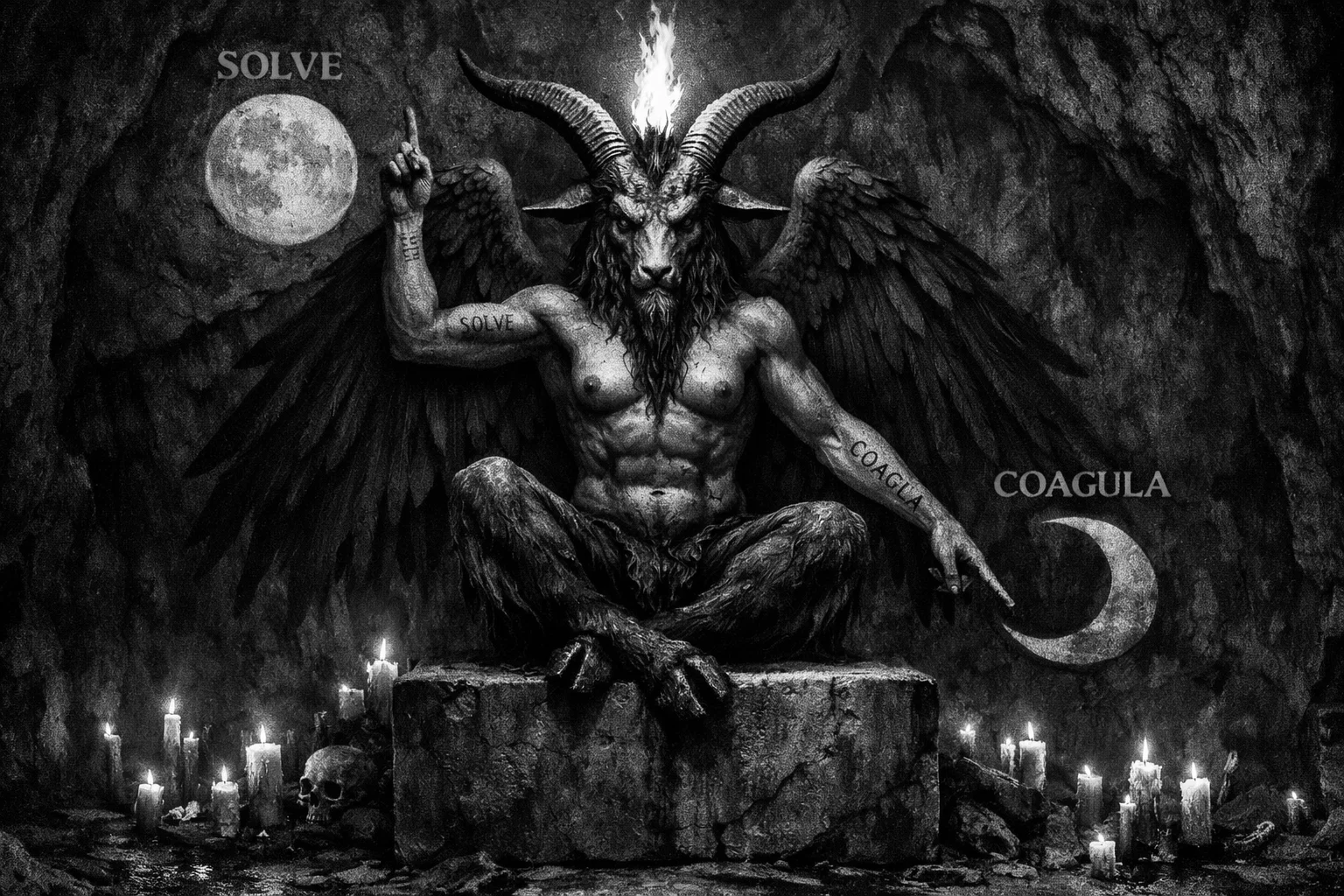
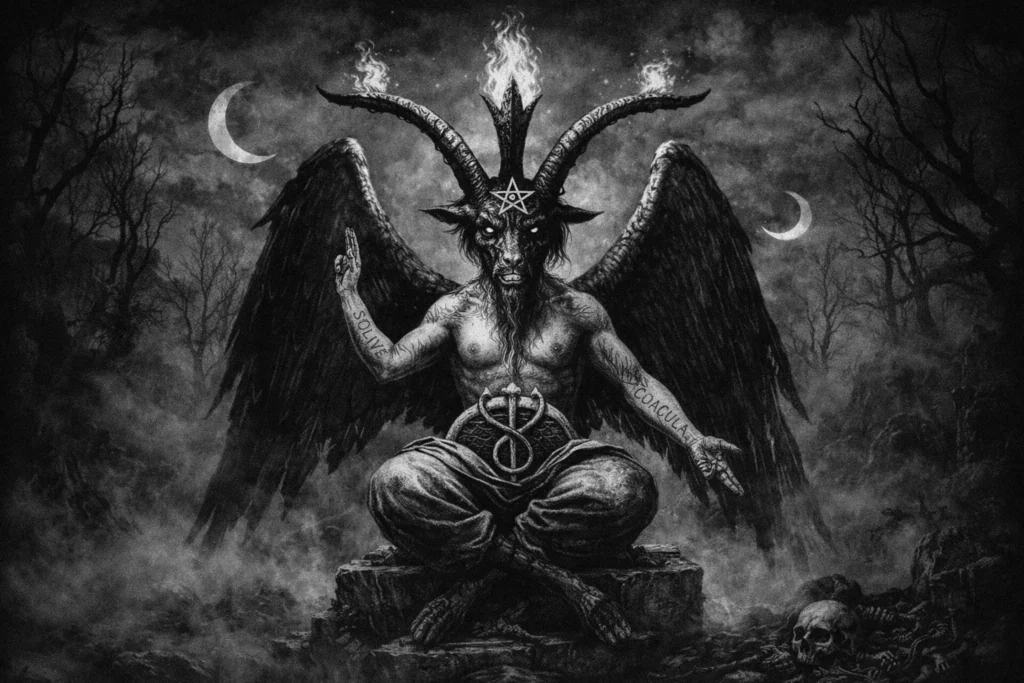
The modern look of Baphomet was created by Éliphas Lévi in his 1854 book Dogme et Rituel de la Haute Magie. Lévi’s version is a winged, human-like goat. It has a goat’s head with a torch between its horns to show spiritual enlightenment. The entity has female breasts and a phallus, which is shown as the caduceus of Hermes, a rod with two snakes wrapped around it.
One arm of the monster points up toward a white moon labeled “Solve,” and the other points down to a black moon labeled “Coagula.” These Latin words refer to the alchemical ideas of breaking apart and joining together. Baphomet has cloven feet and sits on a cube or globe, showing its power over the earth.
You may also enjoy:
What Is a Tengu? Origins, Powers, and Dark Folklore
January 29, 2026
Who Was Abezethibou, the Fallen Angel Who Opposed Moses?
October 1, 2025
Who Is Abaddon, the Demon of the Abyss, in the Bible?
September 29, 2025
What Is a Dīv? The Terrifying Giant Demon of Persian Myth
January 22, 2026
Erinyes: The Chthonic Goddesses Who Enforced Blood-Guilt
November 20, 2025
Abura-sumashi: The Potato-Headed Yōkai That Punishes Greed
October 23, 2025
Origins & History
Baphomet’s history does not come from ancient demonology. Instead, it developed through changes in medieval language, wartime propaganda, and 19th-century occult ideas. Understanding Baphomet means following a name that started as a misunderstanding and later became a key symbol in Western esoteric traditions.
The “Mahomet” Corruption (1098–1300)
The term “Baphomet” originated as a vernacular corruption of the name Mahomet (the Old French translation of Muhammad). Its first recorded use appears in a letter dated 1098 by Anselm of Ribemont, a chronicler of the First Crusade. He described the local Saracens at the Siege of Antioch calling on “Baphomet” in their prayers.
During the 11th and 12th centuries, Western Christendom possessed a deeply distorted view of Islamic theology. Rather than recognizing Islam as a monotheistic faith, medieval poets and chroniclers depicted Muslims as “pagans” who worshipped a pantheon of idols.
In the chansons de geste—popular epic poems like The Song of Roland—“Baphumetz” was frequently cited as one of the three primary deities of the “Saracen” pantheon, alongside Apollo and Termagant.
The change from Mahomet to Baphomet happened because of how words blended in Old Occitan and Old French. At that time, Baphomet was not seen as a real being. Instead, it was a term used to label Muslims as idol worshippers and justify the Crusades.
The Templar Trials (1307–1314)
The name transitioned from a general literary slur to a specific “heretical idol” during the Knights Templar trial. By 1307, King Philip IV of France was effectively bankrupt and deeply indebted to the Order. To seize their assets and dissolve their power, he collaborated with Pope Clement V to charge the Knights with apostasy, sodomy, and the worship of a secret idol.
On October 13, 1307, hundreds of Templars were arrested throughout France. The Inquisition used torture to get confessions about worshipping an entity called Baphomet in the trial records. However, history shows this story was forced and not based on a real cult. The Knights gave very different descriptions of the so-called “idol”:
- The Severed Head: Many depositions described a life-sized human head, sometimes silver or gold, and occasionally featuring three faces or four legs.
- The Reliquary Theory: Modern historians, such as Malcolm Barber, suggest these descriptions may have been distorted accounts of genuine Templar reliquaries—containers designed to hold the skulls of saints (especially a head reliquary labeled “Caput LVIII” found at the Paris Temple).
- The Bearded Man: Other confessions mentioned a “great wooden head” with a long white beard, which some researchers link to a misinterpretation of the Shroud of Turin or images of Christ.
Importantly, the goat-headed image did not exist in 1307. None of the many trial records mentions horns, hooves, or wings. At this point, Baphomet was just an invented accusation, used to claim that the Templars had adopted the supposed idolatry of the East.
The Occult Rebirth (1854)
After the execution of the last Grand Master, Jacques de Molay, in 1314, the name Baphomet vanished from public record for over five centuries, surviving only in the archives of the Inquisition. It was resurrected in the mid-19th century by the French occultist Éliphas Lévi in his work Dogme et Rituel de la Haute Magie.
Lévi was the first to give Baphomet a physical form, creating the iconic “Sabbatic Goat” illustration. He sought to create a “Universal Pantheomorphic” entity that represented the sum total of the universe’s energies. He combined elements from:
- The Goat of Mendes: A misinterpretation of the Egyptian ram-headed God Banebdjedet.
- The Alchemical Rebis: A symbolic representation of the “divine hermaphrodite” found in Renaissance alchemy.
- Classical Mythology: Drawing on the attributes of Pan (the wild nature) and Prometheus (the bringer of light).
When Lévi completed his version, Baphomet changed from a medieval political tool into a complex symbol with deep meaning. This transformation enabled various esoteric groups to adopt the figure in the 20th century.
The Alchemical Androgyne
Baphomet’s lasting influence comes not from being seen as evil, but from its role as a symbol that brings together opposites—a problem that has challenged Western philosophy since the second century. While the Templars were accused of worshipping a head or idol, the Baphomet we know today, the Sabbatic Goat, was created in the 19th century to address the strict dualism of medieval Christianity.
The figure includes both male and female traits, as well as features of bird, animals, and humans. This makes it a symbol of the union of opposites, known as Coincidentia Oppositorum. It reflects the Hermetic idea of “As above, so below,” meaning that the divine and earthly worlds are connected as one flow of energy.
Psychologically, Baphomet stands for the “Transcendent Function” described by Carl Jung. This is the process where the conflict between the conscious mind and the unconscious is resolved, leading to a higher state of being.
The torch between the horns does not mean hellfire. Instead, it stands for “Intelligence” or “Enlightenment” (the Lux), showing that true wisdom comes when our basic instincts are balanced with spiritual understanding.
Unlike the traditional Christian Devil, who stands for a fall from grace, Baphomet represents rising through integration. Baphomet is a symbol of the “Astral Light,” a force that can be shaped by a person’s will. It reminds us that the power to create or destroy comes from within, not from an outside god.
The word “Baphomet” has been used to mark esoteric knowledge as foreign or strange. Its likely origin as a mispronunciation of “Mahomet” (Muhammad) shows medieval Europe’s fear of the “sophisticated East.” For inquisitors, Baphomet stood for something unknown and threatening—a mix of Islamic science, Gnostic ideas, and Greek philosophy that challenged the Church.
When occultists like Lévi reclaimed the name in the 1800s, they were not worshipping the devil. Instead, they were taking back a term once used to attack the Templars and turning it into a symbol of balance. In this way, they changed a tool of persecution into a symbol of protection for modern seekers.
Historical & Occult Records
While Baphomet does not appear in the Bible or any foundational Abrahamic scripture, its historical record dates to the late 11th century, in the correspondence of the First Crusade.
Original:
“Sequenti die aurora apparente, altis vocibus Baphometh invocaverunt; et nos Deum nostrum in cordibus nostris deprecantes, illos invasimus et extra civitatis muros expulimus.” [Anselm of Ribemont, Letter to Manasses II, Archbishop of Reims, 1098]
Translation:
“As the next day dawned, they called upon Baphomet with loud voices; and we, praying to our God in our hearts, attacked them and drove them forth outside the city walls.”
This letter represents the “Root Source” for the term Baphomet. It is critical to note that in this 11th-century context, Baphomet is not described as a physical entity, a demon, or a goat-headed entity. Instead, it is a linguistic corruption of “Mahomet” (Muhammad).
The Crusaders, possessing a limited understanding of Islamic monotheism, projected their own hagiographic framework onto their enemies, assuming the “Saracens” worshipped a central idol or deity.
Theological significance here lies in the “Othering” of the enemy. By naming a specific entity that the opposing force “invoked,” the Crusaders transformed a geopolitical conflict into a cosmic battle between the “true God” and a specific, named false idol. At this stage, Baphomet is a purely rhetorical phantom of the Crusades.
Original:
“Item, quod magister noster vester habebat unum caput, et videbatur esse de ligno, depictum, et habebat duas facies, et erat ita terribile quod videbatur esse figura diaboli… et dicebant quod illud caput salvabat eos, et faciebat arbores florere et terram germinare.” [Trial Records of the Knights Templar (Deposition of Jean Cassanhas), 1307]
Translation:
“Item, that our master had a head, and it seemed to be of wood, painted, and it had two faces, and it was so terrible that it seemed to be the figure of a devil… and they said that this head saved them, and made the trees flower and the land germinate.”
This “Codification Source” marks the transition of Baphomet from a distant “Saracen god” to a specific, heretical idol allegedly kept in secret by the Knights Templar.
Unlike the earlier linguistic corruption, the trial records provide the first—albeit inconsistent—physical descriptions. Note the shift in “powers”: the entity is no longer just a name to be shouted in battle, but a talismanic object credited with agricultural fertility and salvation.
The divergence between “two faces” in this account and the “severed head” in others highlights the coercive nature of the Inquisition. The description of it being “terrible” and a “figure of a devil” reflects the 14th-century preoccupation with identifying internal enemies of the Church. This source established the “Templar Mythos” that would remain dormant until the occult revival of the 1800s.
Original:
“Le baphomet est le nom d’un personnage symbolique… C’est une figure panthéistique et magique de l’absolu. Le bec de l’oiseau, les cornes du bouc, les mamelles de la femme, les ailes de l’ange, les attributs de la science et de la nature… C’est le dieu de la lumière et de la liberté.” [Éliphas Lévi, Dogme et Rituel de la Haute Magie, 1854]
Translation:
“Baphomet is the name of a symbolic character… It is a pantheistic and magical figure of the absolute. The beak of the bird, the horns of the goat, the breasts of the woman, the wings of the angel, the attributes of science and nature… It is the God of light and liberty.”
This 19th-century text is the definitive “Synthesis Source.” Lévi completely reimagines the entity, discarding the “severed head” of the Templar trials in favor of the now-iconic “Sabbatic Goat.”
This is the first time Baphomet is characterized by androgyny and the union of opposites. Lévi’s insight is not a recording of folklore, but an intentional creation of a “Higher Philosophy” icon.
Linguistically, Lévi connects Baphomet to the Greek Baphe-Metis (Baptism of Wisdom), a radical departure from the Crusader etymology. Theologically, this represents the transition from Baphomet as a “demon of the pit” to Baphomet as a “map of the universe.”
By identifying it as a “figure of the absolute,” Lévi moved the entity out of the realm of medieval heresy and into the center of modern Western Hermeticism.
“The symbol of Baphomet was used by the Knights Templar to represent Satan. Through the ages this symbol has been called by many different names. Among these are: The Goat of Mendes, The Goat of a Thousand Young, The Black Goat, The Judas Goat, and perhaps most appropriately, The Scapegoat.” [Anton Szandor LaVey, The Satanic Bible, 1969]
This “Folklore/Modern Codification” source represents the final evolution: the adoption of the symbol by 20th-century counter-culture. LaVey’s account is historically divergent—he inaccurately claims the Templars used the symbol to represent “Satan,” ignoring the fact that the goat-headed visual didn’t exist until Lévi. However, this source is vital because it recontextualizes Baphomet as a symbol of carnal ego and social rebellion.
The shift here is from “Absolute Balance” (Lévi) to “The Scapegoat” (LaVey). By stripping away the alchemical nuances of Solve et Coagula, modern Satanism turned Baphomet into a direct antagonist to Christian morality.
This highlights how the entity’s significance is entirely dependent on the era’s cultural anxieties: in 1098, an Islamic threat; in 1307, a political heresy; in 1854, a philosophical secret; and in 1969, a symbol of carnal liberation.
Powers and Abilities
The powers linked to Baphomet are mostly symbolic and philosophical, not magical abilities like those of Goetic demons. In mystical traditions, Baphomet is seen as a channel for the “Astral Light” or the “Universal Agent.”
Baphomet’s power comes from bringing opposites together. By showing both light and dark, male and female, and human and animal traits, Baphomet is said to help people see the “Absolute.”
In Christianity, this is not seen as a good thing; it is considered the worst kind of pride and heresy, since it suggests someone can become like God or gain total knowledge by joining forbidden forces.
Baphomet is also linked to the loss of faith. In history, its image was used to explain why the Knights Templar supposedly fell from grace, hinting that it could cause “secret apostasy.” In modern occultism, Baphomet is seen as a symbol of giving in to physical desires and breaking free from traditional moral rules, letting people explore their basic instincts.
You may also enjoy:
The Ghul: The Flesh-Eating Demon of Arabian Folklore
October 1, 2025
What Is a Yūrei? The True Meaning of Japanese Ghosts
January 30, 2026
The Kumbhāṇḍa: Grotesque Demons of Buddhist Hell
November 13, 2025
Allocer: Great Duke of Hell and the 52nd Spirit of the Ars Goetia
November 17, 2025
Who Was Hiranyakashipu, the Demon King of Hindu Mythology?
October 6, 2025
Baphomet vs Other Christian Demons
| Demon Name | Associated Sin/Temptation | Rank/Origin | Key Traits/Powers |
| Lucifer | Pride | Fallen Seraph | Intellectual pride; light-bringer. |
| Mammon | Greed | Prince of Hell | Wealth and material obsession. |
| Asmodeus | Lust | King (Ars Goetia) | Breaks marriages; induces lust. |
| Beelzebub | Gluttony | Prince/Lord of Flies | False gods; pestilence. |
| Leviathan | Envy | Sea Monster/Prince | Chaos; deception. |
| Belphegor | Sloth | Prince of Hell | Lazy inventions; discovery. |
| Satan | Wrath | Adversary | War; opposition to God. |
| Belial | Lawlessness | King (Ars Goetia) | Worthlessness; lying. |
| Astaroth | Vanity | Grand Duke | Grants knowledge of past/future. |
| Pazuzu | Plague | Assyro-Babylonian | Winds; famine; locusts. |
| Moloch | Child Sacrifice | Canaanite God | Fire; destruction of innocence. |
| Azazel | Corruption | Watcher (Enoch) | Weaponry; cosmetics; sin. |
| Abaddon | Destruction | Angel of Abyss | Commands locust army. |
| Mephistopheles | Deceit | Germanic Folklore | Soul-binding contracts. |
| Lilith | Rebellion | Jewish Myth | Night demon; child-stealer. |
Mystical Correspondences
| Attribute | Details |
| Planet | Saturn |
| Zodiac Sign | Capricorn |
| Element | Earth |
| Direction | North (or Center) |
| Color | Black |
| Number | 15 (The Devil in Tarot) |
| Crystal/Mineral | Black Onyx, Obsidian |
| Metal | Lead |
| Herb/Plant | Hemlock, Nightshade |
| Animal | Goat, Serpent |
Baphomet’s link to Saturn shows its role as a symbol of limits, time, and the physical world. Saturn stands for “restriction,” and Baphomet represents the “prison” of the body. This connection shows Baphomet as a guardian between the physical and spiritual worlds. Its tie to Capricorn, the goat-fish, matches its mixed, goat-headed appearance.
Baphomet is connected to the earth element, showing its grounded and physical side. Unlike air or fire demons, which stand for quick passions, Baphomet stands for the lasting, heavy reality of the material world.
The color black means the “massa confusa,” or the chaotic void where everything begins. The number 15 links Baphomet to the “Devil” card in Tarot, which usually shows a Baphomet-like creature chaining two people.
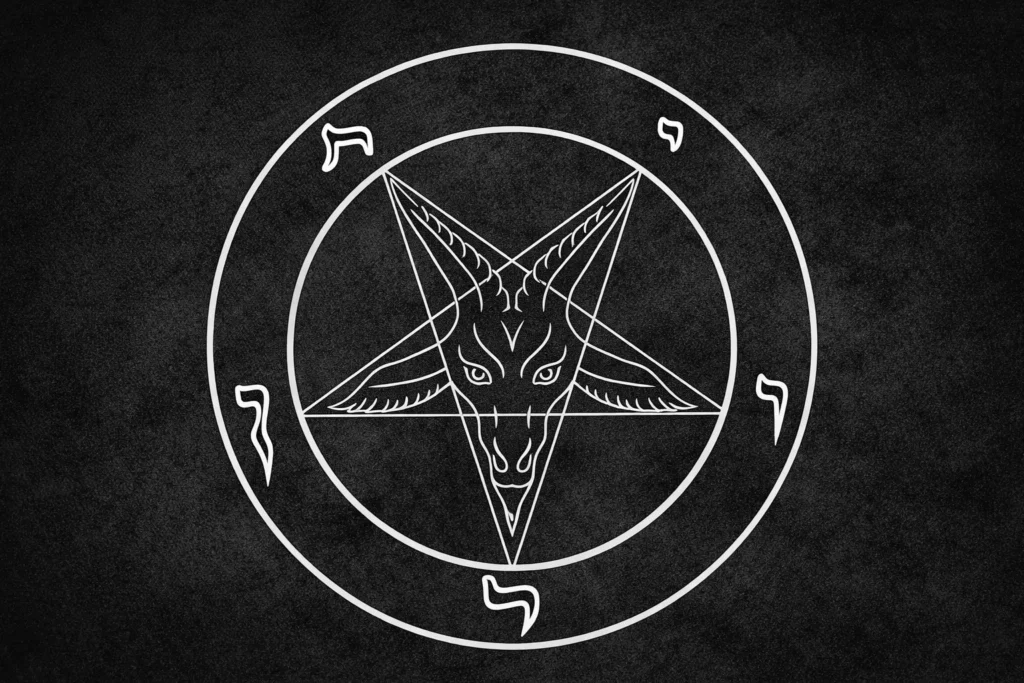
Baphomet’s Sigil
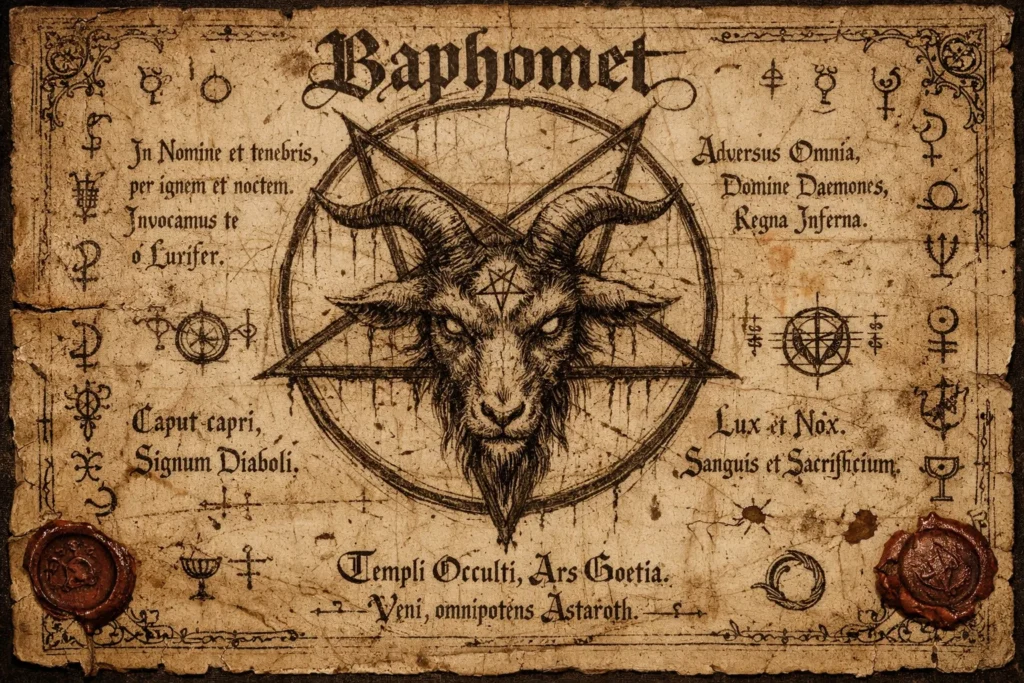
The Sigil of Baphomet is probably the most well-known symbol in modern occultism. It is an upside-down pentagram with two points up, showing a goat’s head inside. The top points are the goat’s horns, the side points are the ears, and the bottom point is the beard.
This symbol matters because it shows matter winning over spirit. A regular pentagram (one point up) stands for humans or the spirit ruling over the elements.
Turning it upside down means that physical and animal desires are more important than spiritual goals. In the past, people used this symbol in rituals to get what they wanted in the material world.
Summoning and Rituals
In history, people have spoken of summoning Baphomet during the Templar heresy and later in the 1800s during “Black Mass” rituals. These ceremonies were said to take place secretly underground to avoid detection by the Church. The goal was often to get forbidden knowledge or to gain success in the world by making a deal with the “Prince of this World.”
Books like the Grimoire of Honorius or fake Palladian documents say that to call on Baphomet, you needed to burn special incense like sulfur and musk and draw the sigil on the floor.
Witches and warlocks were said to honor Baphomet by kissing its backside (the Osculum Infame), a common theme in medieval tales of the Witches’ Sabbath. These rituals were not meant to control the demon, like in Solomonic magic, but to connect the person with its energy.
You may also enjoy:
Gandharva: God, Spirit, or Demon?
November 13, 2025
Who Is Arioch, the Demon of War and Vengeance?
January 21, 2026
Who Is the Jann in Islamic Mythology and Why Is He Feared?
October 2, 2025
What Is Baku? The Bizarre Yōkai That Eats Nightmares
January 28, 2026
Bibliography
Author’s Note: While reviewing these records, I noticed a strong contrast between the confusing, torture-driven “head” idols described in Barber’s study of the 1307 trials and the clear, philosophical “Sabbatic Goat” created by Lévi much later. Julien Théry’s work on “State Heresy” shows that Baphomet was not a real being but a political invention that only took on a physical form in the 19th century. My goal was to connect these different stories, moving past LaVey’s modern image to focus on how the name Baphomet started as a misunderstanding during the Crusades. This journey from a misspelled word to a worldwide symbol is a powerful example of how human fears can take shape.
- Théry, Julien. A Heresy of State. Philip the Fair, the Trial of the ‘Perfidious Templars’, and the Pontificalization of the French Monarchy. Journal of Medieval Religious Cultures, 39/2, 2013, p. 117-148. Academia.edu.
- Théry, Julien. Procès Des Templiers”, Dans “Prier Et Combattre. Dictionnaire Européen Des Ordres Militaires. Dir. N. Bériou, Ph. Josserand, Paris, Fayard, 2009, p. 743-750. Academia.edu.
- The Beguine, the Angel, and the Inquisitor: The Trials of Marguerite Porete and Guiard of Cressonessart. Notre Dame, IN: University of Notre Dame Press, 2012. Academia.edu.
- Lévi, Éliphas. Dogme et rituel de la haute magie. Vol. 2, G. Baillière, 1861. Internet Archive.
- LaVey, Anton Szandor. The Satanic Bible. Avon Books, 1969. Internet Archive.
- Barber, Malcolm. The Trial of the Templars. 2nd ed., Cambridge University Press, 2006. Internet Archive.
- Kamiya, A. Baphomet History, Significance & Symbol. 2023. Study.com.