Many supernatural beings in Japanese folklore are seen as threats from outside, like the wilderness or the heavens. In contrast, Bakeneko represents problems that come from within the home. This yōkai personifies worries about growing old and being betrayed by those closest to us, showing how the line between everyday life and the supernatural can blur inside Japanese households.
Most animal spirits, such as the kitsune, are seen as messengers of gods or playful tricksters. This creature is different because its harmful nature often comes from the close bond it once had with its human owners, turning a companion into a threat to the family.
By comparing the detailed classifications in the Wakan Sansai Zue with local stories from the Kanshō Mado no Suusa, I was able to identify a few key features that set Bakeneko apart from its wilder mountain relatives. [View Full Bibliography ↓]
Summary
Key Takeaways
| Attribute | Details |
| Names | Bakeneko, Kaibyō, Monster Cat, Changed Cat |
| Translation | The name translates to “changed cat” or “transforming cat.” |
| Title | Ghost Cat or Goblin Cat |
| Type | Obake (specifically an animal shapeshifter) |
| Spirit Classification | Primarily viewed as Ara-mitama due to its violent nature; occasionally a vengeful Goryō. |
| Origin | A domestic cat that reaches an advanced age, grows to a certain size, or possesses a long tail. |
| Gender | Commonly depicted as female, though male instances exist. |
| Appearance | A large feline capable of walking on hind legs, often wearing a towel on its head. |
| Kehai (Aura/Presence) | The flickering of lamp flames, the smell of rancid oil, and the sound of soft dancing. |
| Powers/Abilities | Shapeshifting, speech, fire manipulation, and reanimating the dead. |
| Methods of Pacification | Cutting the tail early in life, using heavy stones on graves, or Buddhist exorcism. |
| Habitat | Human residences, particularly old mansions or rural homes. |
| Diet/Prey | Lamp oil (lamp oil was traditionally made from fish oil), humans, and carrion. |
| Symbolic Item | A tenugui (hand towel) often worn on the head while dancing. |
| Symbolism | The dangers of long life and the hidden nature of domestic animals. |
| Associated Kami | None directly; they are often seen as antithetical to the protection of Toshigami. |
| Sources | Wakan Sansai Zue, Ansei Kenmonroku, and various Edo-period Kaidan. |
The Fundamental Identity of the Bakeneko
Unlike the nekomata, which has a split tail and comes from the mountains, this spirit is closely tied to life in Japanese homes, both in cities and the countryside. It shows what happens when nature takes back a pet that people thought was tame.
Usually, a cat changes into this creature when it gets old, often at 12 or 13 years old, or when it weighs more than 1 kan (about 3.75 kilograms).
As a metamorph, Bakeneko usually goes after the family it once lived with. It can copy human speech and actions, and in many stories, it eats its owner to take their place in the household.
This leads to a special kind of horror in which the most trusted companion becomes the greatest danger. In Japanese folklore, this spirit warns people about how they treat animals and suggests that maintaining the status quo at home for too long can have supernatural consequences.
Semantic Origins
The word comes from the verb bakeru (化ける), which means ‘to disguise,’ ‘to take another form,’ or ‘to transform,’ and neko (猫), which means ‘cat.’ In the past, obake or bakemono referred to any creature that could change shape, so this name literally describes a cat that has become something supernatural.
In the Edo period, the term became common in works such as the Wakan Sansai Zue (1712). Some regions called them kaibyō, meaning ‘strange cats,’ but the central idea remained tied to henge, or transformation.
In some coastal areas, people sometimes confuse the name “Bakeneko” with nekomata. Still, scholars later distinguished them by their split tails. The alteration in the name shows how people began to see cats not just as pest controllers, but as mysterious creatures with human-like intelligence and even malice.
How to Pronounce “Bakeneko” in English
To say the name, break it into four parts: bah-keh-neh-koh. The first part sounds like ‘ba’ in ‘father.’ The next two use a short ‘e,’ like in ‘met.’ The last part is a long ‘o,’ as in ‘go.’ Say each part evenly, without stressing any one syllable.
What Does Bakeneko Look Like?
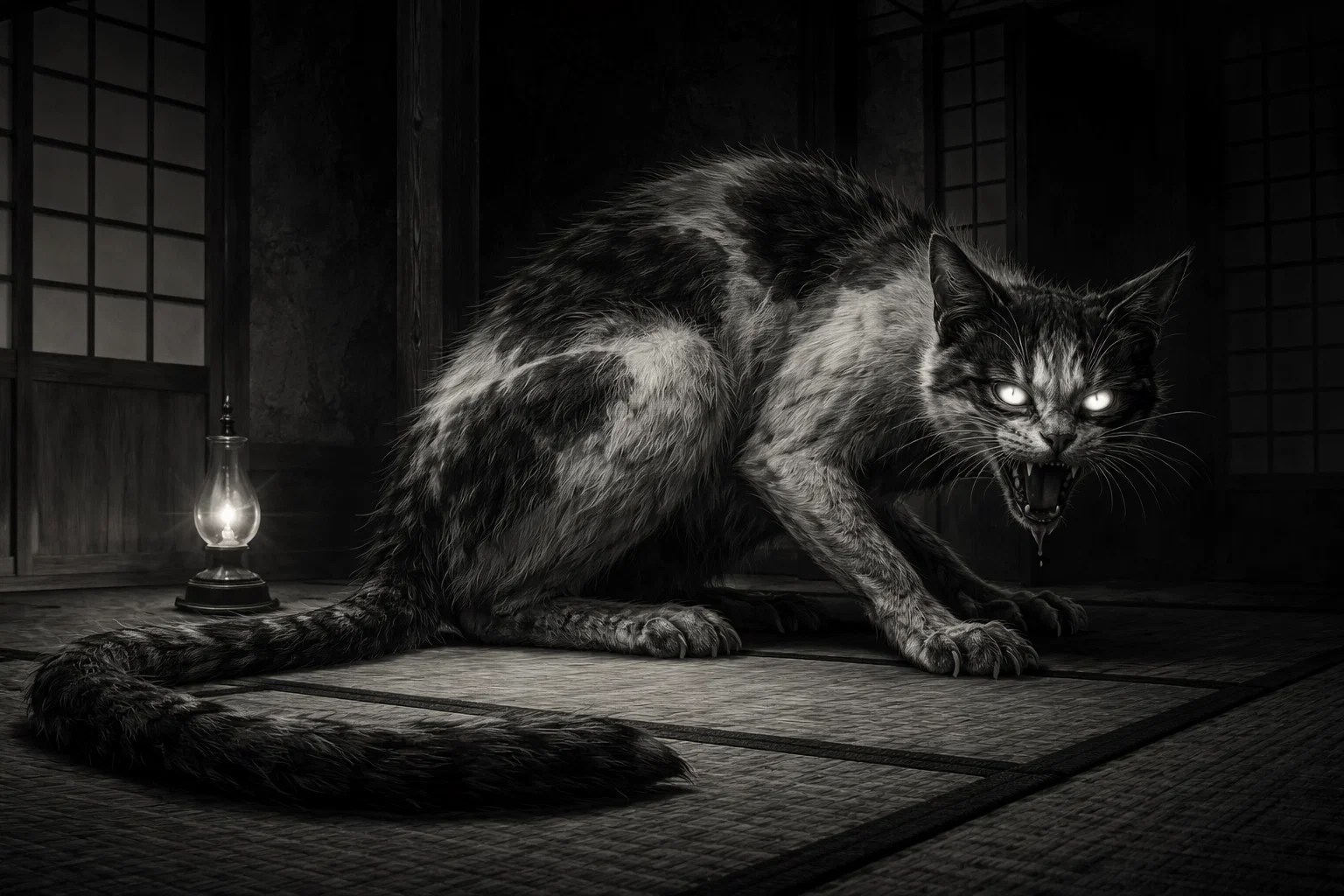
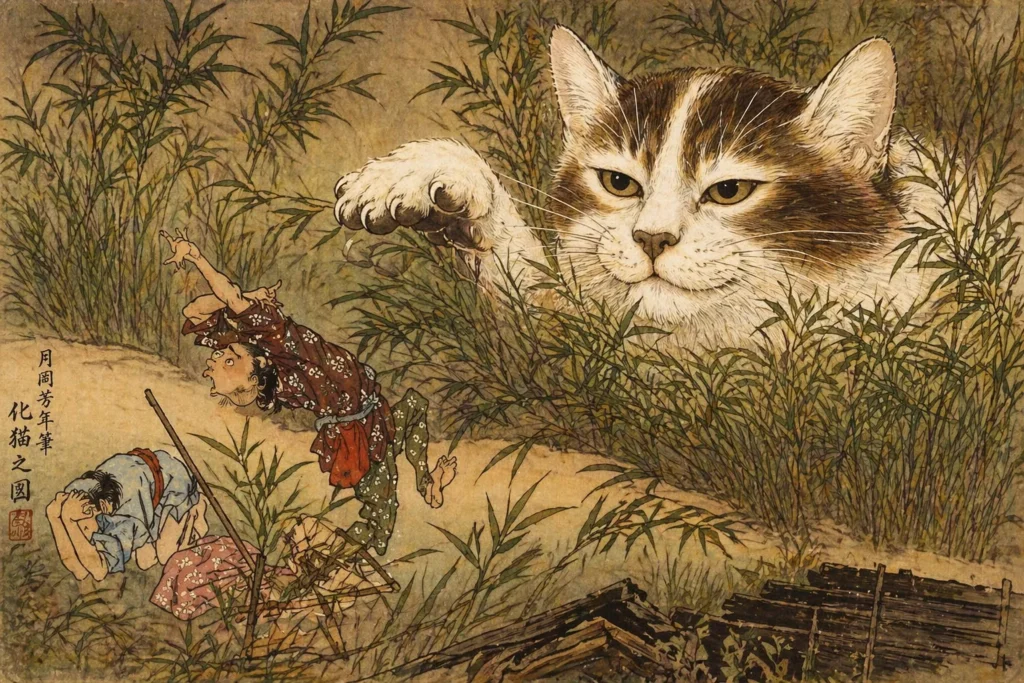
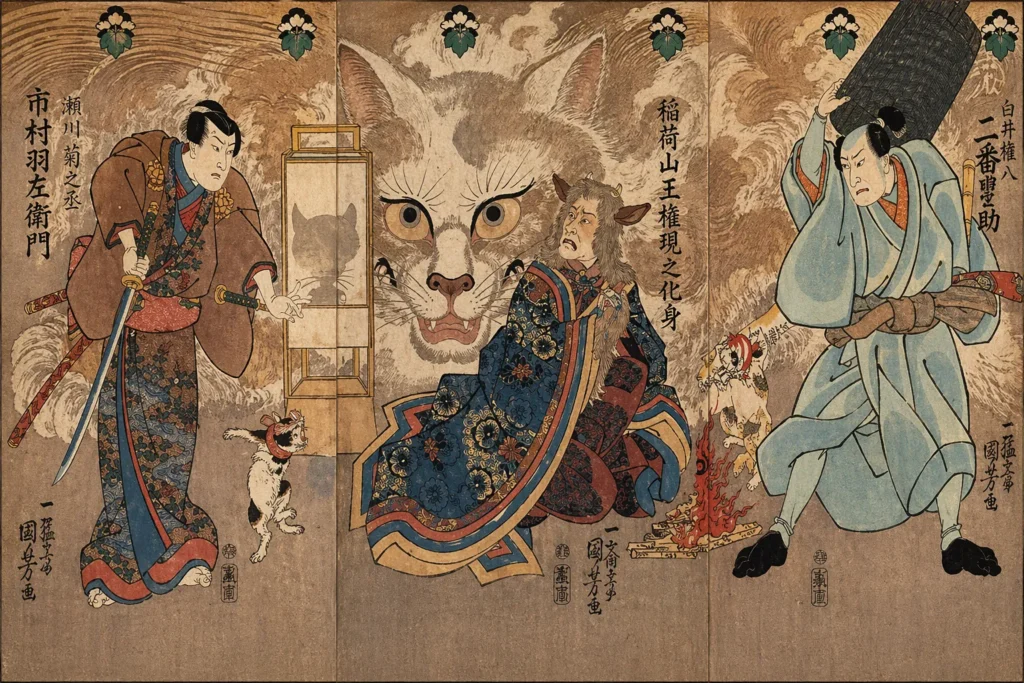
At first, Bakeneko looks like a regular house cat, but it is much bigger than normal cats. As it becomes more supernatural, it starts to act more like a human. One clear sign is that it can stand and walk on two legs. In many old Japanese prints and paintings, it is shown dancing with a cloth towel on its head, strangely copying human festival dances.
Some stories say it can grow as big as a person, or even large enough to fill a whole room. Its eyes still look like a cat’s, but seem smart and dangerous. When it transforms into a human, it often looks like an old woman, fitting the ‘cat-witch’ character found in East Asian stories.
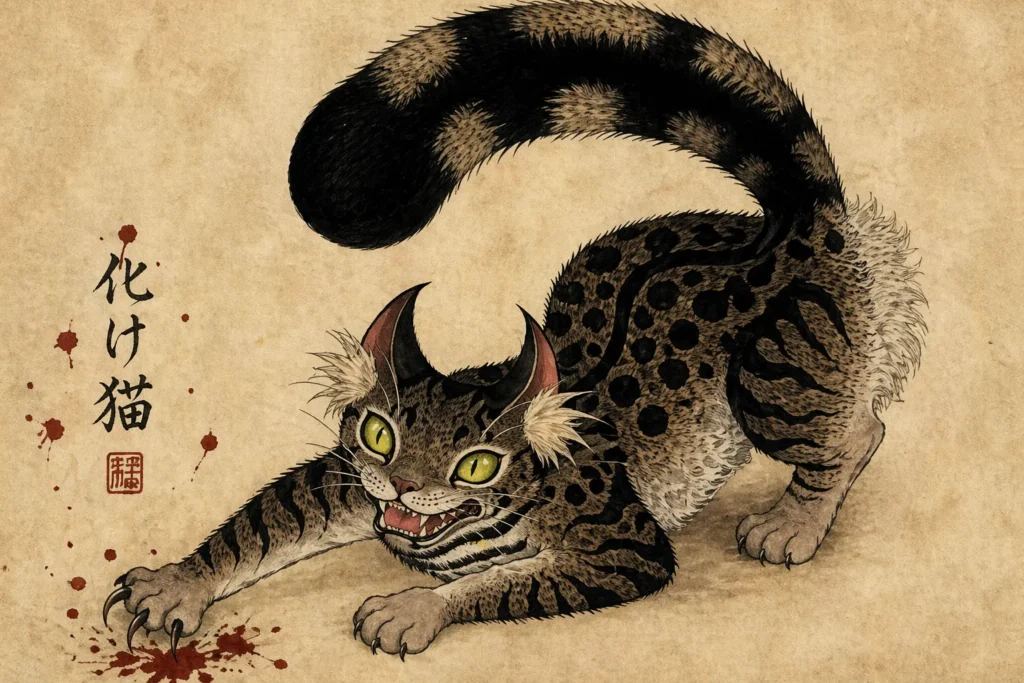
Another important detail is its link to fire. It is often shown licking oil from paper lamps, with its long tongue and face lit up by the flame. Its tail is long and single, unlike the nekomata’s, which is split.
In some stories, just having a long tail can cause the change, which is why people in Japan used to cut cat tails short to stop them from turning into monsters.
You may also enjoy:
Erinyes: The Chthonic Goddesses Who Enforced Blood-Guilt
November 20, 2025
Who Is Aka Manto, Japan’s Terrifying Red-Cloaked Yōkai?
October 24, 2025
Vritra: The Dragon Who Swallowed the Sky in Hindu Mythology
October 7, 2025
Yuki Onna: The Terrifying Bride Who Feeds on Travelers
December 9, 2025
Andhaka: The Blind Demon Born From Cosmic Darkness
February 6, 2026
Palden Lhamo: The Black Goddess of Blood and Protection
October 20, 2025
Origins and History
This spirit became well-known in Japan during the Edo period (1603–1868), a time of big social and economic changes. Before then, cats were rare and prized for protecting silkworms and books from mice.
As cities grew and more people kept cats at home, people started to see them differently. The stories likely began because of cats’ nighttime habits and odd behaviors, like their eyes changing in the light or their silent movements.
I think this legend reflects people’s fears about aging family members in traditional Japanese families. During the Edo period, there were more elderly people, and families had to care for them. Cats live longer than most pets and can seem ‘useless’ when old, so they became symbols for the worries families had about caring for aging relatives who might need help or feel resentful.
I find it interesting that the first stories about this spirit appeared when people started using more lamp oil. In the 17th century, lamp oil was costly and made from fish, which attracted cats.
Cats would stand up to lick the oil, and in a dark, flickering room, this could look spooky to someone who believed in the supernatural. This real behavior helped create the ghost stories that became popular in Japanese folklore.
Historical & Folkloric Records
Original:
“Kanjū no neko, toshifuru mono wa, bi warete futatsu to nari, nekomata to iu. Mata, rōneko no bakekaeru mono o bakeneko to gō su.” [Wakan Sansai Zue (Illustrated Sino-Japanese Encyclopedia), 1712]
Translation:
Among domestic cats, those that grow old will have their tails split in two and be called nekomata. Also, old cats that transform are named bakeneko.
This passage from the Wakan Sansai Zue, written by Terajima Ryōan, is an important source for Japanese demon stories. It sets clear rules for when a cat becomes supernatural, based on age and physical traits.
In the early 1700s, scholars sought to organize folklore, and they made a clear distinction between the nekomata, with its split tail, and the bakeneko, which is just an old cat that transforms.
The split tail or old age of the cat shows a cultural worry about things going beyond their natural limits. In the Edo period, people were suspicious of anything that lived too long, as if it had taken extra life from others. This text helped spread the idea that even home life has a limit, and after that, what was once familiar can become strange or dangerous.
Original:
“Echigo no kuni, Kanbara-gun no uchi, Seta-mura to iu tokoro ni, hito-ya ari. Sono uchi no neko, naitoku nite, andon no abra o namu. Hito kore o mite ayashimu ni, neko tachimachi ni ningen no kotoba o hasshite, ‘kono koto hito ni iu na’ to iite, izuko to mo naku usetari.” [Kanshō Mado no Suusa (Small Talk by the Window), 1751]
Translation:
In Seta Village, Kanbara District of Echigo Province, there was a house. The cat of that house was clever and licked the oil of the lamps. When a person saw this and thought it strange, the cat suddenly spoke in human words, saying, ‘Do not tell this to anyone,’ and disappeared to parts unknown.
This story from the mid-1700s introduces the idea of a ‘speech taboo’ and describes a cat licking lamp oil. The detail about lamp oil is important because it was made from fish, which cats liked. But the writer saw this normal cat behavior as a sign of something supernatural.
The phrase ‘Do not tell this to anyone’ is a common theme in Japanese ghost stories, where breaking a secret can bring a curse. This shows how the creature became a more psychological and social threat, able to understand and trick people.
It also connects the spirit to the nighttime atmosphere of Edo-period homes, where shadows from oil lamps made people think they saw animals change shape.
Original:
“Saga no rōneko, ryuuzōji no kō-tane o kurai, sono sugata ni bakete, yoru-yoru tsuide tono-sama o nayamasu. Nabeshima-shi no kerai, Komori Hanzaemon, kore o miyaburi, tsuini kore o sashikorosu.” [Saga no Kaibyō (The Ghost Cat of Saga – Oral Tradition/Kabuki Play adaptation), 19th Century]
Translation:
The old cat of Saga devoured the offspring of Ryuzoji, transformed into that form, and night after night tormented the lord. The retainer of the Nabeshima clan, Komori Hanzaemon, saw through this and finally stabbed it to death.
This story shows the political and historical side of the legend. The Saga tale is more than just a ghost story; it is about political power. By making the cat a vengeful spirit from the defeated Ryuzoji clan, the legend turns it into a symbol for Goryō, or spirits seeking revenge for past wrongs.
In this 19th-century version, the spirit can steal someone’s identity and drain the strength of a leader. This matches the troubled times at the end of the Shogunate, when people worried about secret enemies in their homes or the government.
The cat is now more than a household problem; it represents old traumas and past mistakes coming back to trouble a family.
Original:
“Neko no tachi-furumai, tsuini ningen no gotoku nari. Tenugui o kaburi, te o agite odoru koto, kore bakemono no shirushi nari.” [Ansei Kenmonroku (Record of Ansei Era Observations), 1856]
Translation:
The cat’s behavior eventually became like a human’s. Wearing a hand towel and dancing with hands raised—this is the sign of a monster.
The Ansei Kenmonroku gives a clear picture of the spirit’s human-like actions. The detail about the hand towel on its head refers to Japanese festival dances. This image is important because it shows the creature is not really trying to be human, but is instead making fun of human customs.
The mid-1800s saw a big social transition and more contact with Western countries. Showing the spirit as a ‘mimic’ may have stemmed from fears that people were pretending to be something they weren’t, especially as social classes adjusted. The belief that a cat dancing at night meant bad luck probably comes from how strange it is to see a familiar animal act like a person.
Habitat
Bakeneko prefers to live in human homes, especially big, old, or run-down ones. Unlike other yōkai that haunt forests or bridges, this one stays indoors. It hides in the dark corners of traditional Japanese houses, like under the floor, in ceiling spaces, or behind sliding paper doors.
The spirit lives near people because it needs to feed on their oil, food, and even their identities. The most powerful versions are linked to empty mansions, where the cat can grow stronger without anyone stopping it. These ‘cat houses’ are said to be full of the ghosts of its victims, with the cat ruling over them like a small king.
Famous Bakeneko Legends and Stories
One of the most famous accounts is the Saga no Kaibyō (The Ghost Cat of Saga), which involves the Nabeshima clan.
According to the legend, Nabeshima Mitsushige, the second daimyo of the Saga Domain, executed his blind retainer, Ryuzoji Matashichiro. Matashichiro’s mother, overwhelmed by grief, told her sorrows to the family cat and then committed suicide.
The cat licked her blood and turned into a vengeful spirit. It went into the castle, haunted Mitsushige every night, and finally killed his favorite concubine, O-toyo. The cat then took on O-toyo’s shape and slowly weakened Mitsushige until a loyal soldier named Komori Hanzaemon discovered the truth and killed the creature.
In another well-known Edo-period story, an old woman in a wealthy family began acting strangely. She stayed away from others, and a servant saw her crouched in the kitchen at night, licking oil from the lamps.
The family grew suspicious when their pet cat disappeared just as the grandmother’s behavior changed. One night, the son looked through a hole in the sliding door and saw a huge cat dressed in his mother’s clothes, chewing on a human bone. He realized the creature had killed and eaten his mother to take her place.
A lighter but still spooky story tells of a traveler who stayed at an inn where people said the cats were magical. Late at night, he heard music and saw the innkeeper’s cats standing on two legs, towels on their heads, dancing together.
This story is less violent, but it stresses the strange intelligence and secret lives people thought cats had when no one was watching.
You may also enjoy:
Jikininki: The Japanese Ghost That Feeds on Human Corpses
February 9, 2026
Who Is Adrammelech in Demonology and the Bible?
October 1, 2025
Who Is Agares, the Demon of Earthquakes and Deception?
October 13, 2025
Palden Lhamo: The Black Goddess of Blood and Protection
October 20, 2025
Who Is Azazel, the Demon Blamed for Human Corruption?
February 24, 2026
Bakeneko: A Supernatural Cat Yōkai in Japanese Folklore
January 27, 2026
Bakeneko Powers and Abilities
This spirit has many supernatural powers, making it one of the most dangerous yōkai in Japanese folklore. It may not be as strong as an oni. Still, its cleverness and ability to blend in with people make it especially threatening.
- Metamorphosis: The ability to take human form, usually that of an elderly woman or the person it has recently consumed.
- Speech: The capacity to understand and speak human languages fluently.
- Necromancy: According to lore, if a cat leaps over a fresh corpse, it can reanimate the body and control it like a puppet.
- Fire Manipulation: The ability to create “cat fire” (neko-bi) or ignite fires with its tail.
- Spirit Command: Powerful versions can enslave the ghosts of their victims.
- Enormous Growth: The ability to expand its physical size to overwhelm an opponent.
Traditional Defenses Against Bakeneko
The main way to stop a cat from turning into a Bakeneko was to prevent it from happening. In old Japan, people often cut kittens’ tails short so they wouldn’t grow long enough to become yōkai. Owners were also told not to keep a cat for more than thirteen years. If a cat got too old, it was sometimes sent away to protect the family.
To guard a house from this spirit, people put ofuda (holy charms) from Shinto shrines or Buddhist temples above their doors. In stories where the spirit looks human, it can be revealed by its habits, like being afraid of dogs or loving the smell of fish.
To stop a cat from bringing a dead body back to life, families would put heavy stones or metal on the coffin and lay a sword or knife across the chest as a spiritual barrier.
Bakeneko vs Similar Spirits
| Name | Category | Origin | Threat Level | Escape Difficulty |
| Nekomata | Obake | Mountain cat or aged domestic cat | High | High; they are faster and more feral. |
| Kitsune | Obake | Wild fox gaining wisdom | Variable | Moderate; can be outsmarted or bribed. |
| Tanuki | Obake | Wild raccoon dog | Low | Easy; they are often clumsy and drunk. |
| Kasha | Demon | Hell-born entity | Extreme | Very High; they steal corpses during funerals. |
| Inugami | Spirit | Ritually murdered dog | High | High; they are bound to a family’s will. |
| Mujina | Obake | Badger | Moderate | Moderate; they prefer faceless trickery. |
| Yuki-onna | Yūrei/Obake | Spirit of the snow | High | Hard; they freeze victims instantly. |
| Kappa | Suijin | Water deity/nature spirit | Moderate | Moderate; can be escaped by bowing. |
| Rokurokubi | Obake | Human with a curse | Low | Easy; they are mostly harmless pranksters. |
| Tsuchigumo | Oni | Giant spider spirit | High | Hard; they use webs and illusions. |
Symbolism
| Attribute | Details |
| Element | Fire (associated with lamp oil and nekomata-fire) |
| Animal | Cat (Felis catus) |
| Cardinal Direction | North-East (the Kimon or “Demon Gate”) |
| Color | Black or Calico (the latter being more “lucky” and thus more prone to betrayal) |
| Plant | Silver Vine (Matatabi), which cats are obsessed with. |
| Season | Winter (when lamps are used most and indoor activity is high) |
| Symbolic Item | Lamp oil and the tenugui towel |
In Japanese culture, this spirit represents the basic uncertainty of home life. It reminds people that even the most loyal pets can have a wild and mysterious side. Because cats can live with people yet remain distant, they became the perfect symbol for stories about hidden dangers.
This creature also shapes yōkai stories by connecting the ideas of animal tricksters and vengeful ghosts. It often appears in ukiyo-e art, where it is used to mock the two-faced nature of actors or courtesans.
Even now, the idea of the ‘cat-girl’ or ‘monster-cat’ shows up in modern media, showing how people are still fascinated by the line between cute and dangerous.
You may also enjoy:
Who Was Hiranyakashipu, the Demon King of Hindu Mythology?
October 6, 2025
What Is a Qareen and Why Does It Follow Every Human Being?
October 8, 2025
Aim (Aym): The Great Duke of Hell in the Ars Goetia
November 11, 2025
What Is the Abumi-guchi Yōkai and Why Does It Wait Forever?
October 22, 2025
Lamia: The Queen Cursed to Devour the Children of Others
January 7, 2026
Rāga: The Seductive Demon of Passion and Desire in Buddhist Lore
October 16, 2025
Bibliography
Author’s Note: In my research, I concentrated on the Wakan Sansai Zue to clearly separate the household shapeshifter from its wild mountain relatives. Comparing Ryōan’s factual descriptions with the more dramatic stories in the Ansei Kenmonroku shows how the legend evolved from simple animal facts to human-like monsters. By linking the behaviors in local stories to the practical use of fish-oil lamps, I could connect the creature’s scary traits to real concerns in Edo-period homes.
- Reider, Noriko T. Japanese Demon Lore: Oni from Ancient Times to the Present. Utah State University Press, 2010. Internet Archive.
- Johnson, Adam J. The Evolution of Yōkai in Relationship to the Japanese Horror Genre. 2021. University of Massachusetts Amherst, Capstone Project. ScholarWorks@UMass Amherst.
- Foster, Michael Dylan. The Book of Yokai: Mysterious Creatures of Japanese Folklore. University of California Press, 2015. Internet Archive.
- Reider, Noriko T. Japanese Demon Lore: Oni from Ancient Times to the Present. University Press of Colorado, 2010. JSTOR.
- Kelsey, W. Michael. Konjaku Monogatarishū. Twayne Publishers, 1982. Twayne’s World Authors Series 621. Internet Archive.
- Davisson, Zack. (2026). The Persistence of Yōkai. Education About Asia. 29. 10.65959/eaa.1847. ResearchGate.
- Terajima, Ryōan. Wakan Sansai Zue. 1712. Internet Archive.
- Marca, Paolo. (2023). Horror Manga: Themes and Stylistics of Japanese Horror Comics. Humanities. 13. 8. 10.3390/h13010008. ResearchGate.
- Kaul, M.A. (2026). Animals in Premodern Japan. In: Animals in Premodern Japan. The Palgrave Macmillan Animal Ethics Series. Palgrave Macmillan, Cham. https://doi.org/10.1007/978-3-032-08005-9_3.