Most fireplace spirits are seen as household protectors or playful tricksters. Still, the Agubanba is remarkable as a symbol of disorder and decay within the home. This spirit turns the hearth, usually a place of warmth and safety, into a dangerous and threatening space.
Unlike the well-known Yuki-onna, who lives in the open wilderness, the Agubanba stays close to families, hiding in the ashes that people rely on for warmth and survival.
In my research, I look at the significance of the spirit, particularly its ‘fallen’ state, by examining Shinto purification rituals known as Harae. These rituals, outlined in early medieval writings, help us understand how people sought to cleanse and restore the purity of the spirit. [View Full Bibliography ↓]
Summary
Key Takeaways
| Attribute | Details |
| Names | Agubanba, Akubanba, Hai-bōzu (ash monk/priest) |
| Translation | Ash old woman or soot-hag |
| Title | The Blind Ash-Mother |
| Type | Obake (Shapeshifter/Transformed entity) or Yama-uba (Mountain Crone variant) |
| Spirit Classification | Ara-mitama (Rough/Violent spirit) |
| Origin | Folk tradition suggests the spirit of an elderly woman who perished in a fire or was abandoned to the hearth during famine. |
| Gender | Female |
| Appearance | A withered, elderly woman with gray, soot-stained skin, typically depicted as blind or having hollow eye sockets. |
| Kehai (Aura/Presence) | The scent of cold charcoal, a sudden thickening of the air near the fireplace, and the sound of soft shuffling in the ash pit. |
| Powers/Abilities | Invisibility within ash, thermal manipulation, and the ability to drain the heat or vitality from unsuspecting victims. |
| Methods of Pacification | Scattering salt over the hearth, placing a bamboo sieve over the ash pit, or reciting prayers to the kitchen deity Kōjin. |
| Habitat | Rural kitchens, irori (traditional sunken hearths), and abandoned houses in the Akita and Aomori prefectures. |
| Diet/Prey | Small children left unattended near fires or the household’s lingering heat. |
| Symbolic Item | Fire tongs or a bamboo ash-blower. |
| Symbolism | The danger of neglect and the fragility of the domestic boundary. |
| Associated Kami | Occasionally viewed as a corrupted or fallen servant of Kōjin (The Kitchen God). |
| Sources | Regional folklore records from the Tohoku region, specifically the oral histories of Akita and Aomori. |
The Fundamental Identity of Agubanba
The Agubanba is a female spirit from the folklore of Northern Japan, especially in Akita and Aomori. She is known as a ‘hearth-dweller,’ a type of yōkai that lives inside homes instead of in the mountains. Most stories describe her as a blind, elderly woman who lives in the gray ashes of the irori, or sunken hearth.
People rarely notice her until she decides to appear, often when a home is in disorder or neglect. She is sometimes grouped with Yama-uba, or mountain hags, but she is less active. The Agubanba represents the fear that even the heart of the home can hide something dangerous.
For people in the Tohoku region, she was a warning to keep the hearth clean and respected, since the fire was essential for surviving the cold northern winters.
Semantic Origins
The name Agubanba comes from changes in northern Japanese dialects. The first part, agu or aku, is a local variant of 灰 (hai), meaning ‘ash.’ In some Akita dialects, the word for ash or lye, both important for fire and cleaning, became agu. The ending, banba, is a common word for an old woman or grandmother, similar to baba but with a stronger local meaning.
So, the name means ‘The Ash Hag.’ Some Edo-period records mention similar spirits called Hai-bōzu, or Ash Monks, which could be male or gender-neutral. However, in rural northern areas, the spirit is always female.
In some stories from Aomori, she is called Akubanba, where aku can also mean the bitterness of lye. This link hints that she comes from the waste left after a fire, made up of what remains when the warmth is gone.
How to Pronounce “Agubanba” in English
To say this name in English, break it into four parts: Ah-goo-bahn-bah. ‘Ah’ sounds like in ‘father.’ ‘Goo’ rhymes with ‘too.’ Both ‘bahn’ and ‘bah’ use a short ‘ah’ sound, like in ‘bon’ or the start of ‘bonfire,’ but without the strong ending.
What Does Agubanba Look Like?
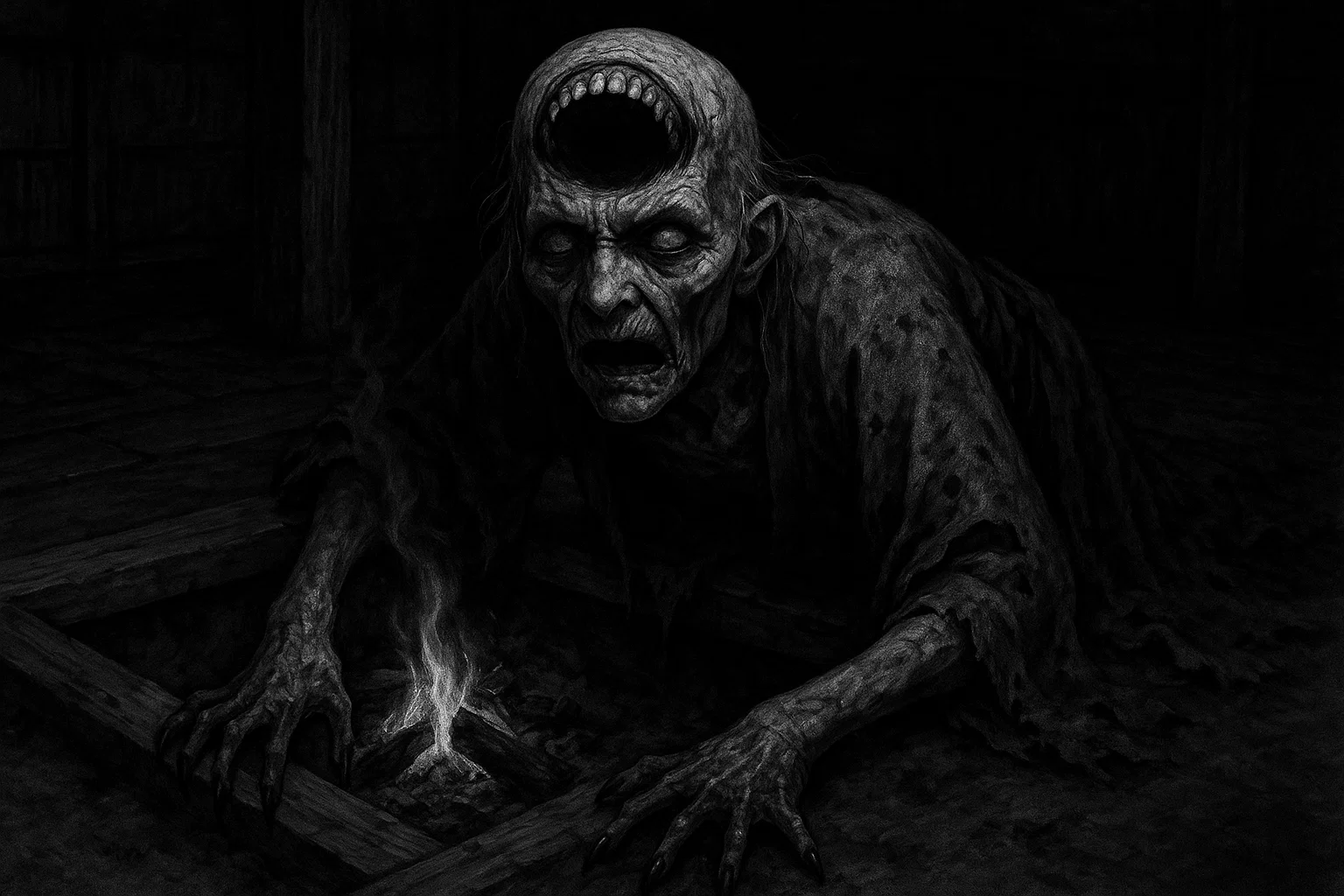
This spirit’s appearance is closely tied to the hearth. Most stories describe her as a very old woman, thin and bent from living in small spaces. Her most noticeable feature is her skin, which is not just pale but the color of cold wood-ash, a mottled gray that lets her blend in with the ashes of the irori.
She is always described as blind, with eyes that are either always closed, covered by thin skin, or missing completely, leaving dark pits. Her hair is thin, white, and often tangled with soot. Some Akita stories say she has long, claw-like fingers for sifting through embers without getting burned.
When her clothing is mentioned, it is a torn, gray kimono stained by charcoal, making her blend into the kitchen shadows. Even though she is blind, she moves smoothly, guided by a supernatural sense for heat and vibrations in the house.
You may also enjoy:
Who Is Agares, the Demon of Earthquakes and Deception?
October 13, 2025
Who Is Aka Manto, Japan’s Terrifying Red-Cloaked Yōkai?
October 24, 2025
Who Is Baal in Christian Demonology?
February 25, 2026
Who Is the Infernal King Balam? Origins, Powers, and Occult History
February 26, 2026
Abadir: The Demon Servant of Chaos and Dispersion
September 30, 2025
Iblis, the Jinn King of Darkness and Deception
September 29, 2025
Origins and History
The Agubanba appeared at a time when the hearth was very important in Tohoku during the Edo period. In these northern areas, the irori was more than just for cooking—it was the only source of heat during winters when snow piled up to the roof. The fire marked the line between life and death.
Based on my research, I think the Agubanba is a psychological response to the Great Tenmei Famine (1782–1788). During this time, northern Japan faced terrible crop failures and freezing weather. The hearth, once a sign of comfort, became a place of sadness as families burned their furniture or sat around cold, empty fire pits.
I find it interesting that the first stories about her appear around the same time as tales of ubasute, the legendary practice of leaving the elderly behind during famines. The Agubanba probably represents the ‘returned’ grandmother—someone who once cared for the fire, now returning as a blind, hungry spirit to reclaim the warmth she lost.
As cities grew during the mid-Edo period, the rural north felt left behind while the central government in Edo (now Tokyo) prospered. The Agubanba reflects this sense of being forgotten—she is a spirit from the old ways, rising from the ashes of a neglected social class.
Habitat
This spirit only lives in homes, especially rural farmhouses in Northern Honshu. She is never found in forests or near water—her life is tied to the sunken hearth. She is drawn to houses where the fire is neglected or where the family is not getting along.
Since she is made of ash, she lives under or beside the floorboards around the fire pit. In abandoned temples or ruins, she sits in the cold ash, waiting for someone to light a fire. She is drawn to the smell of burnt things and the sound of a crackling fire, which calls her to appear.
Famous Agubanba Legends and Stories
The Blind Guest of the Irori
In a remote Akita village, an old man lived by himself after his children left for the city. One winter night, as he sat by his hearth, he saw the ash begin to move on its own.
He blew through his bamboo tube to revive the embers, and suddenly, a pair of gray, withered hands appeared from the ash. A blind woman, her skin as dark as soot, pulled herself out of the pit. She sat silently across from him, soaking up the warmth of the fire. Though afraid, the man felt he had to be hospitable and offered her a bowl of rice.
The woman reached out, but instead of taking the rice, she touched the man’s hand. Her touch was not warm like the fire, but strangely cold, as if she was drawing out all the heat. By morning, the fire was out, and the old man was found frozen, even though the house was tightly closed.
The Missing Embers of Aomori
A legend from the Aomori coast tells of a young bride who had to keep the family fire burning all night. For three nights, the fire went out by midnight, leaving the house dangerously cold. On the fourth night, the bride hid behind a screen and watched. She saw a blind old woman crawl out from behind the chimney.
The creature started eating the glowing embers, pulling them into her toothless mouth. The bride realized this was the Agubanba. She remembered her grandmother’s advice and threw coarse salt into the hearth. The salt crackled and burned the spirit. The old woman screamed and disappeared into the ash, never to return.
The Domestic Abandonment and the Crone
In my study of Tohoku folklore, I see the Agubanba as a reflection of the concerns of pre-modern Japanese families, especially about the fragile ties between generations. While many yōkai are seen as outside threats, this one shows the problems that can grow inside the home.
I find it interesting that her blindness matches the way families sometimes ignore their elders. In Akita’s harsh winters, keeping the hearth fire going was vital for survival. Letting it go out was more than a mistake—it showed neglect. So, this spirit is not an outsider, but a result of a home that is falling apart.
My research shows that this entity is part of a group of ‘liminal hags’ who stand for the transition from respected grandmother to unwanted burden. In the Edo period, the main fear shown by the Agubanba was ubasute—the legendary, though debated, act of leaving the elderly behind during famine.
By appearing as a blind monster made from the ashes that once gave warmth, she makes people face what they have used and discarded. She is the ‘dust to dust’ of the home, turning the hearth from a sacred place into one of loss and taking back.
I have also noticed a strong link between this ash spirit and the Yama-uba. But unlike the mountain witch who hunts, the Agubanba quietly takes heat. I think she is a weakened form of the hearth god. In old Shinto beliefs, the fire was the home of Kōjin, a strong and sometimes unpredictable protector.
When people stopped following home rituals, the ‘gentle spirit’ (nigi-mitama) faded, leaving only the ‘rough spirit’ (ara-mitama). The Agubanba is what remains of a forgotten god—the soot left when the divine is lost because people stopped caring.
Her blindness is also important to consider. For people in the 17th century, her sightless eyes meant more than just a physical problem; they showed a loss of social recognition. In a society where the’ eye of the community’ (sekentei) set the rules, being blind and hiding in ashes meant being left out of society.
When she takes the family’s embers, she is not only looking for warmth. She is also taking revenge, making sure those who ignored her must face her darkness. This makes her more than just a monster; she becomes a symbol of how people’s hearts can grow cold.
You may also enjoy:
Allocer: Great Duke of Hell and the 52nd Spirit of the Ars Goetia
November 17, 2025
Who Is Agaliarept, the General of Hell Under Lucifer?
October 8, 2025
Akateko: The Bloody Hand Yōkai That Guards a Cursed Temple Tree
November 14, 2025
Aeshma: The Zoroastrian Demon of Wrath and Fury
January 13, 2026
Who Was Hiranyakashipu, the Demon King of Hindu Mythology?
October 6, 2025
Ammit: Devourer of the Dead in Ancient Egyptian Mythology
November 10, 2025
Agubanba Powers and Abilities
The Agubanba is not as physically strong as an Oni. Still, she has special supernatural powers that make her very dangerous in her own space. Her main ability is Thermal Absorption, which lets her take heat from fires and living people.
- Ash Camouflage: The ability to become physically indistinguishable from wood ash or soot.
- Heat Consumption: She can extinguish a roaring fire instantly by drawing the thermal energy into her own body.
- Vibrational Sensing: To compensate for her blindness, she can detect the slightest movement in a house by sensing vibrations through the floorboards.
- Vitality Drain: Prolonged contact with the spirit results in hypothermia and a leaching of the victim’s “inner fire” or life force.
Traditional Defenses Against Agubanba
The best way to protect against this spirit is to purify the hearth. Since she is a spirit of impurity and decay, salt is her main weakness. Throwing salt into the fire or around the hearth creates a barrier she cannot pass.
Another common remedy is to use a bamboo sieve or a basket with many holes. If you place it over the ash pit at night, the blind spirit tries to count the holes and gets confused by the pattern until morning.
You can also ask for protection from Kōjin, the stove and hearth god, by putting a small shrine or a clean bowl of water near the fire. Keeping the ash pit clean and removing clinkers (hardened slag) stops her from finding a place to stay in the home.
Agubanba vs Similar Spirits
| Name | Category | Origin | Threat Level | Escape Difficulty |
| Yama-uba | Obake | Mountain witch born from abandonment | High | Hard; she is fast and predatory. |
| Zashiki-warashi | Kami/Yōkai | The house spirit of a deceased child | Low | Easy; generally benevolent. |
| Yuki-onna | Yūrei/Obake | The spirit of a woman died in the snow | Extreme | Very Hard; her frost is instant. |
| Enraenra | Obake | Smoke that takes human form | Low | Easy; it is formless and harmless. |
| Kuro-bōzu | Obake | Shadow spirit that licks breath | Medium | Moderate; repelled by light. |
| Ohaguro-bettari | Obake | Faceless woman with black teeth | Low | Easy; she only seeks to startle. |
| Amanojaku | Oni | Ancient demon of provocation | Medium | Moderate; requires mental fortitude. |
| Ubume | Yūrei | A woman who died in childbirth | Medium | Hard; she compels you to hold her. |
| Oiwa | Goryō | Vengeful ghost of a poisoned wife | Extreme | Impossible; she is a curse. |
| Nure-onna | Obake | Sea serpent with a woman’s head | High | Hard; she traps you with her tail. |
Symbolism
| Attribute | Details |
| Element | Earth and Fire (specifically the cooling of fire) |
| Cardinal Direction | North (associated with the Tohoku region) |
| Color | Gray and Charcoal Black |
| Plant | Bamboo (used for ash-blowers and sieves) |
| Season | Winter |
| Symbolic Item | The Irori (sunken hearth) |
In Japanese culture, the Agubanba represents the side of the home that breaks down over time. While families work for growth and warmth, she shows the build-up of waste, soot, and the chill of old age. She is the fear of being useless or thrown away—the ash left after the wood is gone.
Her place in folklore is a warning about the taboo of neglecting the elderly. By showing the abandoned grandmother as a monster who comes back to take the family’s warmth, the story stresses the need for respect and care for elders.
She is like a kitchen version of the Yama-uba myth, showing that the scariest spirits are often the ones we create at home.
You may also enjoy:
Ammit: Devourer of the Dead in Ancient Egyptian Mythology
November 10, 2025
Who Is Futakuchi-onna, the Two-Mouthed Woman?
March 9, 2026
Who Is Astaroth in Demonology and the Ars Goetia?
February 20, 2026
Ancient Demons: The Real Origins of the Setcheh Myth
November 11, 2025
Who Is the Infernal King Balam? Origins, Powers, and Occult History
February 26, 2026
Bibliography
Author’s Note: I found researching this particular yōkai quite challenging. However, I came across some interesting records from Akita that helped clarify common misconceptions about ‘hags’ in old Japanese encyclopedias, such as the Gazu Hyakki Yagyō. By looking into historical events, such as the Tenmei Famine, and stories from the Konjaku Monogatarishū, I discovered that the Agubanba represents more than just its appearance; it symbolizes the neglect that can occur within a household. This connection is fascinating when we consider how Shinto beliefs view fire as sacred and compare that to local legends about the Agubanba, which illustrate how the warmth of home can transform into something threatening.
- Cucinelli, Diego. Windows Onto The Supernatural In The Second Half Of The Edo Period: From The Gazu Hyakki Yagyō (1776) By Toriyama Sekien To The E-Hon Hyaku Monogatari (1841) By Takehara Shunsen. Ming Qing Studies 2015, 2015.
- Kelsey, W. Michael. Konjaku Monogatari-shū. Twayne Publishers, 1982. Twayne’s World Authors Series 621. Internet Archive.
- Kyōkai. Miraculous Stories from the Japanese Buddhist Tradition: The Nihon Ryōiki of the Monk Kyōkai. Translated and edited by Kyōko Motomochi Nakamura, Harvard University Press, 1973. Harvard-Yenching Institute Monograph Series 20. Internet Archive.
- Davisson, Zack. (2026). The Persistence of Yōkai. Education About Asia. 29. 10.65959/eaa.1847. ResearchGate.
- Bradt, Aaron. The Role of Yokai in Japanese Myth. 2016. Academia.edu.
- Foster, Michael Dylan. The Book of Yokai: Mysterious Creatures of Japanese Folklore. University of California Press, 2015. Internet Archive.