In the Kamadhatu, or Desire Realm, the daughters of Mara are seen as the main psychological barriers to liberation. Rather than being just external monsters, they act as inner forces that keep the mind trapped in suffering.
Looking at Rāga and her two sisters shows how Buddhism explains the shift from physical feelings to spiritual attachment. She also has strong roots in Indian mythology, so those interested should check the Hindu Demons category for more on Kama and Rāga as cosmic obstacles.
This study focuses on the Sanskrit Mara-samyutta texts instead of popular stories, using them to confirm the entity’s role in the Desire Realm within the Abhidharma cosmology. [View Full Bibliography ↓]
Summary
Key Takeaways
| Attribute | Details |
| Names | Rāga, Raga, Lobha (often associated with the root of greed) |
| Title | Daughter of Mara, Personification of Passion |
| Region | Ancient India (Magadha), Central Asia, East Asia |
| Type | Buddhist demon (Mara-duhitr) |
| Gender | Female |
| Realm | Kamadhatu (Desire Realm), Specifically the Paranimmita-vasavatti heaven |
| Obstacle/Threat | Sensual attachment, lust, the fetter of desire that prevents Nirvana |
| Associated Figures | Mara (Father), Arati and Tanha (Sisters), Gautama Buddha |
| Weapon/Item | Visual beauty, various feminine disguises, the snare of passion |
| Weaknesses | Meditation on foulness (asubha bhavana), equanimity, realization of emptiness |
| Associated Deity/Figure | Gautama Buddha |
| Pantheon | Buddhist (Theravada and Mahayana traditions) |
| Primary Sources | Sutta Nipata, Samyutta Nikaya (Mara-samyutta), Buddhacarita, Lalitavistara Sutra |
Who or What is Rāga?
She is one of Mara’s three daughters. Mara is the ruler of the sixth Heaven in the Desire Realm and tried to prevent the Buddha from attaining enlightenment.
While Mara stands for death and spiritual obstacles, this daughter represents lust and sensual attachment. She is often described as a supernatural being who can take many forms to distract people from meditation.
In Buddhist teachings, she is one of the daughters who appear during the Buddha’s final struggle under the Bodhi tree. Unlike Mara’s armies, which use violence and fear, she and her sisters use seduction and emotional tricks. She stands for one of the three “unwholesome roots” or poisons that keep the cycle of existence (Samsara) going.
“Rāga” Meaning
The name comes from the Sanskrit and Pali root’ ranj,’ which means “to color” or “to dye.” Spiritually, this shows how passion or desire “colors” the mind and keeps it from seeing things clearly. It is the basic force that draws a person toward pleasure.
In various Buddhist texts, the term is used to refer to Lobha (greed) or Kama (sensual desire). The name stays mostly the same in Sanskrit and Pali, but in Chinese, she is called Tan-yu (贪欲), which highlights the greedy side of desire.
In Tibetan, her name is Chakpa (chags pa), which still means “attachment” or “clinging.” Over time, she changed from a mythological creature in early texts to a symbol of psychological states in later Buddhist writings.
You may also enjoy:
Akateko: The Bloody Hand Yōkai That Guards a Cursed Temple Tree
November 14, 2025
What Is a Bhuta? The Backward-Footed Ghosts of Hindu Horror
February 5, 2026
Marid: The Ocean Jinn That Defies Heaven and Earth
September 30, 2025
Abura-sumashi: The Potato-Headed Yōkai That Punishes Greed
October 23, 2025
Who Is Agaliarept, the General of Hell Under Lucifer?
October 8, 2025
How to Pronounce “Rāga” in English
The name is pronounced RAH-gah. The first part sounds like the ‘a’ in “father,” and the second part is a short, neutral ‘a.’
What Does Rāga Look Like?
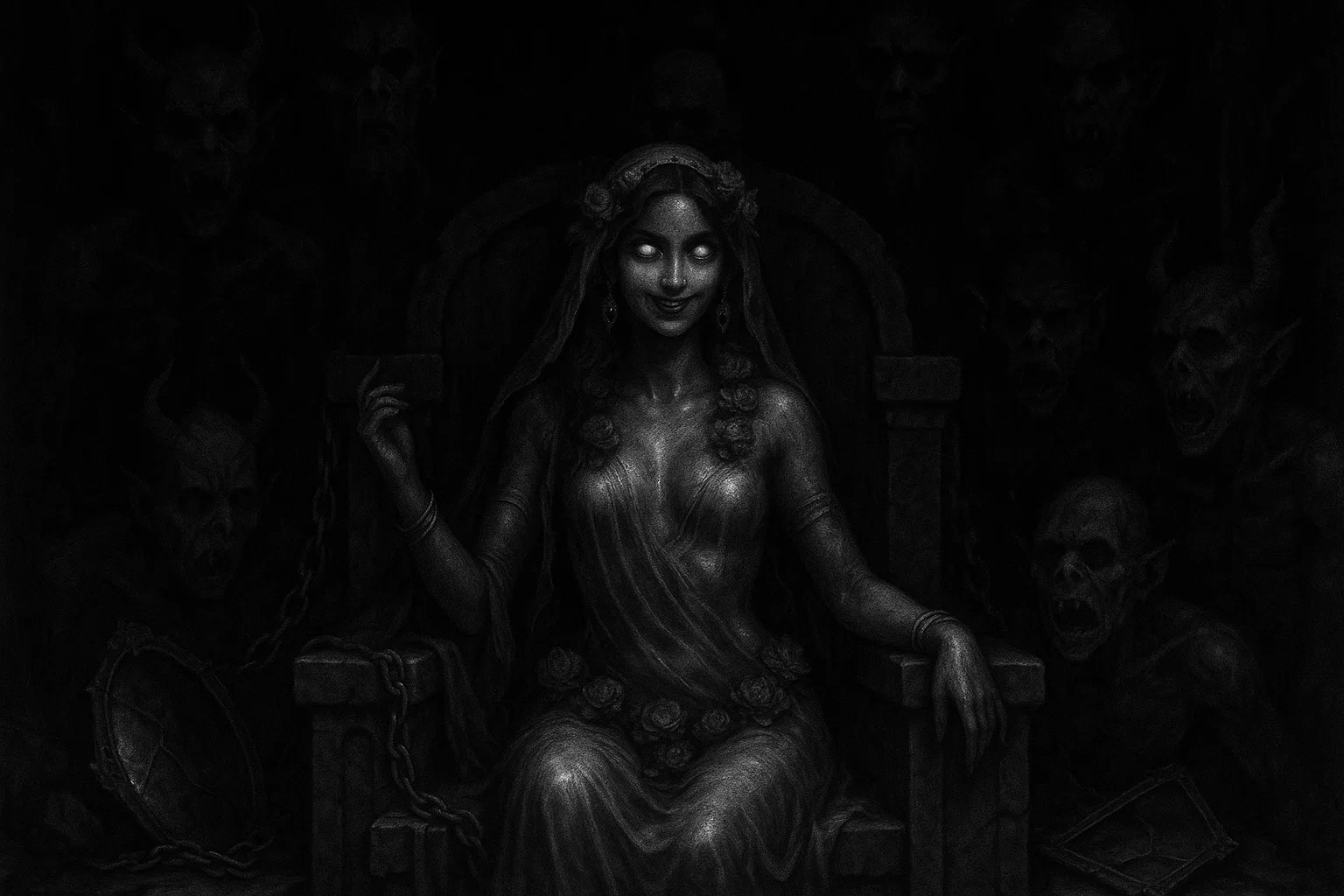
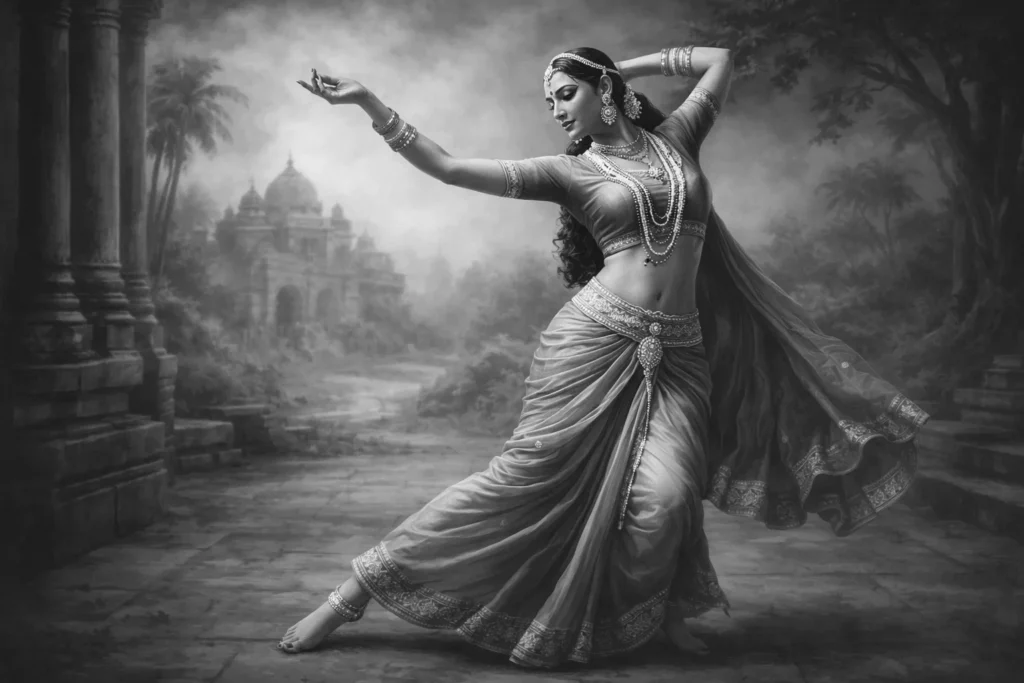
Her appearance is always changing. The Lalitavistara Sūtra and the Buddhacarita state that she does not have a fixed form but can change her appearance to increase her seductive power. She is usually shown as a beautiful woman dressed in fine silks and jewels.
In Indian art, like the carvings at Ajanta or Sanchi, she is shown with a curvy figure, a graceful pose, and fancy headgear. But Buddhist stories say her looks are just an illusion.
When the Buddha was unaffected by her beauty, some texts say that she and her sisters changed into different types of women. They appeared as young girls, women who had not given birth, women who had given birth once, and middle-aged women, to see if any form would get a reaction.
In later Mahayana stories, if her beauty is taken away, she is seen as a skeleton or demon, showing the decay behind her appearance.
Origins
The earliest records of Rāga are in the Pali Canon, especially the Samyutta Nikaya and Sutta Nipata, which recount the search for freedom by Siddhartha Gautama. She is closely tied to Mara Namuci, who stands for evil in Buddhism. She is not born in the usual way but comes from the Desire Realm to keep suffering in place.
Her character grew as Buddhist teachings became more organized. Early texts like the Padhana Sutta talk about Mara’s armies but do not say much about the daughters. Later, as stories about the Buddha became more detailed, the daughters became more important in the tales.
The Nidanakatha, which introduces the Jataka tales, provides a fuller account of her arrival after Mara’s armies are defeated. This change in the story shows that Buddhism began to focus more on how hard it is to overcome inner cravings compared to outside threats.
Powers and Abilities
Unlike other spirits or Yakshas, her power is subtle and widespread. While ordinary demons might possess people or cause illness, she can influence how people see and feel. In the Kamadhatu, her power is considered the strongest because she is the force that keeps the realm running.
- Transformation: The ability to assume any age, form, or level of attractiveness.
- Illusion Projection: Creating sensory environments that mimic paradise or objects of intense longing.
- Emotional Infiltration: Sensing the specific hidden desires of a target and manifesting them.
- Persistence: The ability to return repeatedly in different guises whenever a practitioner’s mindfulness wavers.
Myths, Legends, and Stories
The Temptation Under the Bodhi Tree
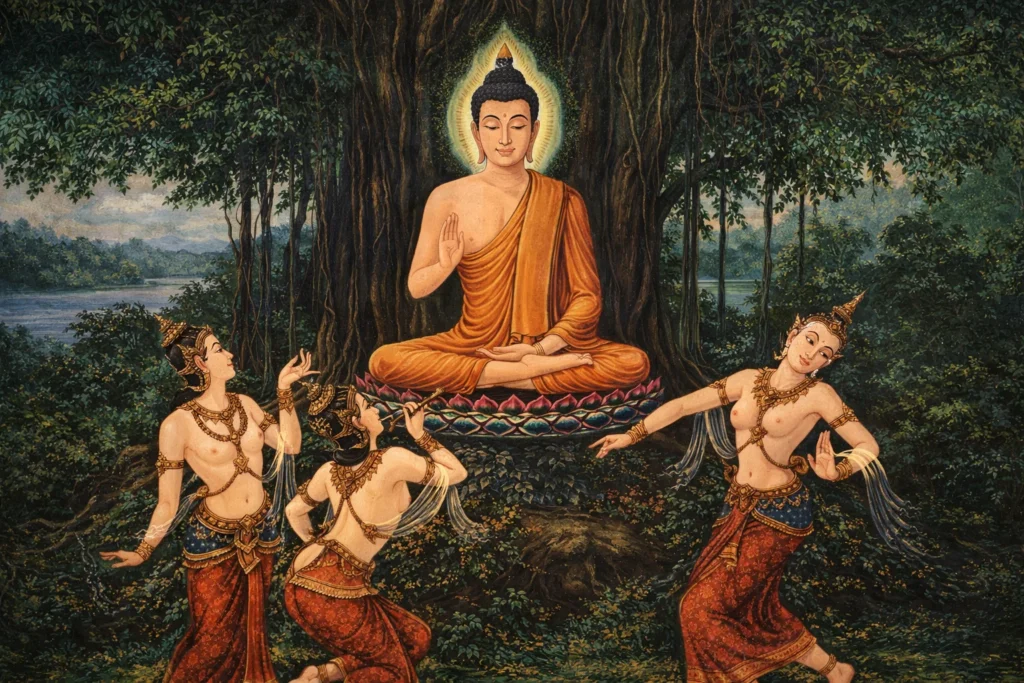
The most well-known story about Rāga takes place on the night before the Buddha’s enlightenment. After Mara’s army of monsters ran away in fear, he sent his three daughters, Rāga, Arati (Discontent), and Tanha (Craving), to try what force could not accomplish.
The Samyutta Nikaya says they went to the Bodhi tree and spoke to the Buddha, saying, “We serve at your feet, ascetic.” They tried to distract him by showing off their charms and feminine graces.
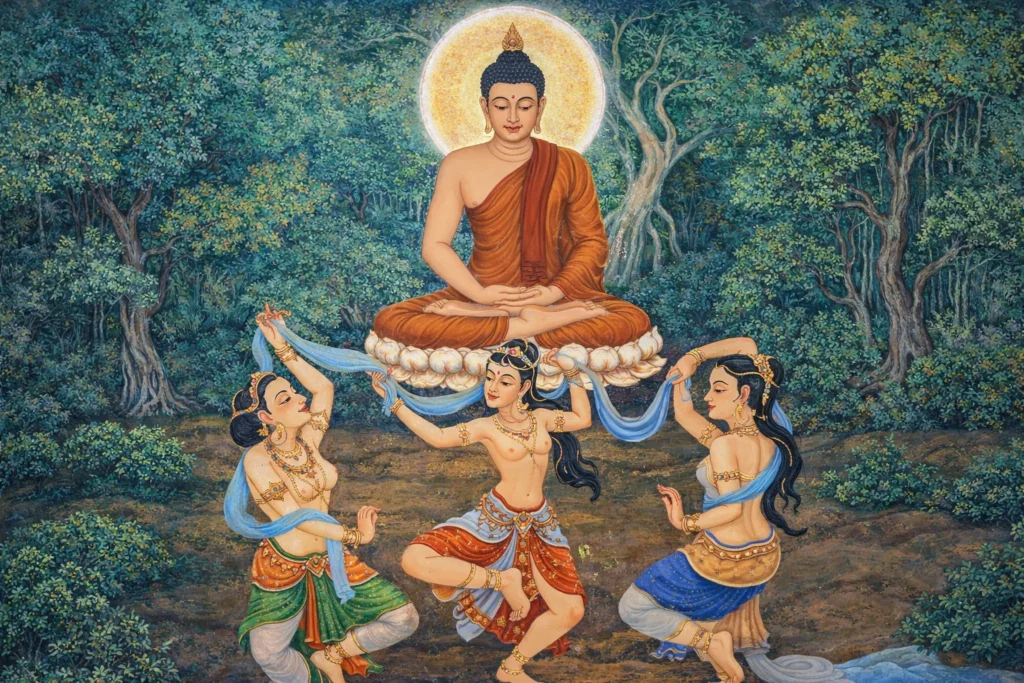
But the Buddha had already overcome desire. He stayed as still as a “pillar of stone” or a “mountain in a windless place.” The Buddhacarita by Ashvaghosa gives more details, describing how she and her sisters used songs, dances, and alluring looks. The text says they tried to “unsettle the mind of the sage” by showing the thirty-two feminine wiles.
The Buddha looked at them and saw only that the body is temporary. He famously said he saw them as “bags of filth” or as vessels of aging and death. In some versions of the story, he used his psychic powers to turn them into old, frail women with grey hair and wrinkled skin, making them face the truth about themselves.
You may also enjoy:
Mara: The Buddhist Demon King of Desire and Death
October 13, 2025
Who Is Andromalius, and Why Is He the Last Demon of the Goetia?
January 20, 2026
Who Is Hariti, the Mother of Ogres in Buddhist Mythology?
December 8, 2025
Palden Lhamo: The Black Goddess of Blood and Protection
October 20, 2025
The Ghul: The Flesh-Eating Demon of Arabian Folklore
October 1, 2025
The Challenge of the Daughters in the Samyutta Nikaya
In another story from the Mara-samyutta, the daughters show up after the Buddha has already become enlightened. They find their father, Mara, sitting sadly on the ground because he could not find any fault in the Buddha’s virtue. The daughters promise to catch the Buddha with the “snare of passion,” just as an elephant is trapped in the wild.
She and her sisters went to the Buddha and asked to sit with him. The Buddha answered, “That goal has been reached, the heart is well-released. I have defeated the army of the pleasant and the agreeable. I meditate alone, having attained bliss.”
Even though they kept trying to appear in many beautiful forms, the Buddha stayed in the state of Nirvana. The daughters finally gave up and told their father that the Buddha was out of their reach because he no longer had the “hooks” of attachment they needed to draw someone back into the world.
The Anatomy of Attachment
In my research, I found that how Rāga is shown in history and art is a very detailed example of “psychological mapping” in ancient Buddhist stories.
Today, people often see her as just a symbol of lust. Still, my analysis shows that in the Lalitavistara Sūtra and early Theravāda commentaries, her role is more like a tool to break down how people see beauty. What stands out to me is how her physical seduction turns into a lesson about the body itself.
When I look at how Rāga is shown in art, I see that the Buddha’s meditative gaze changing her from a young, attractive woman into an old, withered entity is not just a story of “defeat.” It also shows the practice of Asubha Bhavana, or meditation on the unattractive nature of the body.
In 16th-century Tibetan and Southeast Asian temple murals, she is often shown with two sides: her outer skin looks bright and attractive, but underneath her clothes, you can see bones or organs.
This shows that, for people at the time, she represented the line between the illusion of self and the reality of the body. She does not just tempt people; she challenges them to look past surface appearances.
I have also noticed a clear link between Rāga and the idea of Kleshas, or mental defilements. In early Sanskrit texts, she is often used as another name for Lobha, meaning “greed”.
What makes her a unique entity, not just a concept, is her ability to imitate. Unlike her sisters, Arati (discontent) and Tanha (thirst), who stand for emptiness or lack, she stands for extra things—like jewelry, perfume, and the “coloring” of reality.
My research into the Buddhacarita shows that she represents the “Arrogance of Form,” in which people believe that beauty and pleasure last forever, rather than being like “water bubbles or foam,” as the Buddha said.
Finally, the way she was described in early texts shows the worries of her time, when Buddhist monks were moving from quiet forest retreats to rich city centers in India. The idea of the feminine as a “threat” became important for keeping monastic discipline. In this setting, she acts as the guardian of the social world.
By calling her a “daughter of death” (Mara), the texts warn not only about sexual desire, but also about the whole social world of family, inheritance, and beauty that keeps people tied to rebirth.
In my view, she is the ultimate “Necessary Evil” in the Buddhist story—a “creature” who must exist so that the path to the “unconditioned” stands out clearly against the “pleasant and agreeable.”
Rāga vs Other Similar Entities
| Demon Name | Associated Obstacle/Role | Origin/Source | Key Traits/Powers |
| Mara | Death, delusion, and the cycle of rebirth | Pali Canon | Lord of the Desire Realm, command over armies |
| Arati | Aversion, discontent, and boredom | Samyutta Nikaya | Sister of Rāga, induces spiritual sloth |
| Tanha | Thirst, craving, and greed | Sutta Nipata | Sister of Rāga, personifies fundamental longing |
| Kumbhanda | Obstruction of spiritual progress | Mahayana Sutras | Misshapen spirits that drain vital energy |
| Preta | Insatiable hunger and attachment | Bhavacakra | Ghostly beings with tiny throats and large bellies |
| Yaksha | Nature spirits, sometimes malevolent | Vinaya Pitaka | Great strength, ability to grant or take wealth |
| Rakshasa | Cannibalistic violence and chaos | Lanka Sutra | Terrifying appearance, human-eating |
| Asura | Pride, jealousy, and wrath | Six Realms | Constant warfare with the Devas |
| Vritra | Drought and obstruction of knowledge | Vedic/Buddhist crossover | Serpentine form, blocking the flow of life |
| Pishacha | Mental illness and obsession | Early Buddhist texts | Feeding on the flesh and minds of the unwary |
Mystical Correspondences
| Attribute | Details |
| Planet | Venus (In its aspect of mundane attraction) |
| Zodiac Sign | Scorpio (For intensity and deep-seated desire) |
| Element | Water (Symbolizing the fluid, drowning nature of passion) |
| Direction | West (Often associated with the setting sun and the realm of the senses) |
| Color | Red (The color of blood, passion, and the ‘dye’ of the mind) |
| Number | 3 (The triad of Mara’s daughters) or 108 (The number of worldly desires) |
| Crystal/Mineral | Ruby (Associated with the heat of desire) |
| Metal | Copper (Conductive and warm) |
| Herb/Plant | Hibiscus or Red Lotus (Representing the bloom of the senses) |
| Animal | Peacock (Symbolizing beauty and the pride of appearance) |
| Trait/Role | Temptation through sensory pleasure |
Rāga’s mystical links focus on sensory overload. In many esoteric Buddhist traditions, her connection to the color red is not just about looks, but about the “heating” of the blood and the restless breath that come with longing. She stands for the “snare”—something that seems beautiful but leads to being trapped.
In rituals, people are taught to see her not as an outside demon, but as a symbol of their own cravings. By linking her to water, the tradition shows that desire comes and goes like a tide; those who understand this are not controlled by it.
Rāga’s link to the number three connects her to the “Three Poisons,” making her one part of the main psychological barrier a person must overcome to become an Arhat.
You may also enjoy:
Amdusias in the Ars Goetia: The Demon of Dark Music
December 2, 2025
Erinyes: The Chthonic Goddesses Who Enforced Blood-Guilt
November 20, 2025
What Is a Bhuta? The Backward-Footed Ghosts of Hindu Horror
February 5, 2026
Hitotsume kozō: One-Eyed Yōkai of Japanese Folklore
February 4, 2026
Who Is Al-Abyad? The White King Jinn Who Rules Love and Chaos
January 26, 2026
Who Is the Infernal King Balam? Origins, Powers, and Occult History
February 26, 2026
Bibliography
Author’s Note: For this article, I decided to move away from just the basic stories in the Samyutta Nikaya and focus more on the psychological development of the legend, as Mengqiu Tian discusses. By comparing the old themes in Johnston’s translation of the Buddhacarita with later additions in the Lalitavistara, I traced how the daughters changed from simple story characters into complex symbols of the Kleshas. I chose to focus on these early Indian versions rather than later East Asian ones to preserve the original, powerful tension of the ascetic’s last psychological challenge.
- E. H. Johnston, translator. The Buddhacarita; or, Acts of the Buddha. Baptist Mission Press, 1936. Internet Archive.
- Feer, Léon, editor. The Saṃyutta-Nikāya of the Sutta-Piṭaka: Part I. Sagātha-Vagga. Published for the Pali Text Society, Henry Frowde / Oxford University Press, 1884. Internet Archive.
- Mitra, Rajendralala, translator. The Lalitavistara; or, Memoirs of the Early Life of S’ākya Siñha. Fasciculus 1–2, Baptist Mission Press, 1881–1882. Bibliotheca Indica. Internet Archive.
- Ṭhānissaro Bhikkhu, translator. The Sutta Nipāta: The Discourse Group. Dhammatalks.org, 2021.
- Fausböll, V., editor. Buddhist Birth Stories; or, Jātaka Tales: The Oldest Collection of Folk-Lore Extant. Translated by T. W. Rhys Davids, vol. 1, Trübner & Co., 1880. Internet Archive.
- Giddings, William. A Structuralist Examination of the Origins of the Māra Mytheme and Its Function in the Narrative of the Dàoxíng Bōrě Jīng, the Earliest Complete Recension of the Aṣṭasāhasrikā-Prajñā-Pāramitā-Sūtra. Academia.edu.
- Tian, Mengqiu. The Evolution of the Legend of Māra’s Daughters in Early Indian Buddhist Literature. INDIAN INTERNATIONAL JOURNAL OF BUDDHIST STUDIES, vol. 23, 2023, pp. 161–90.