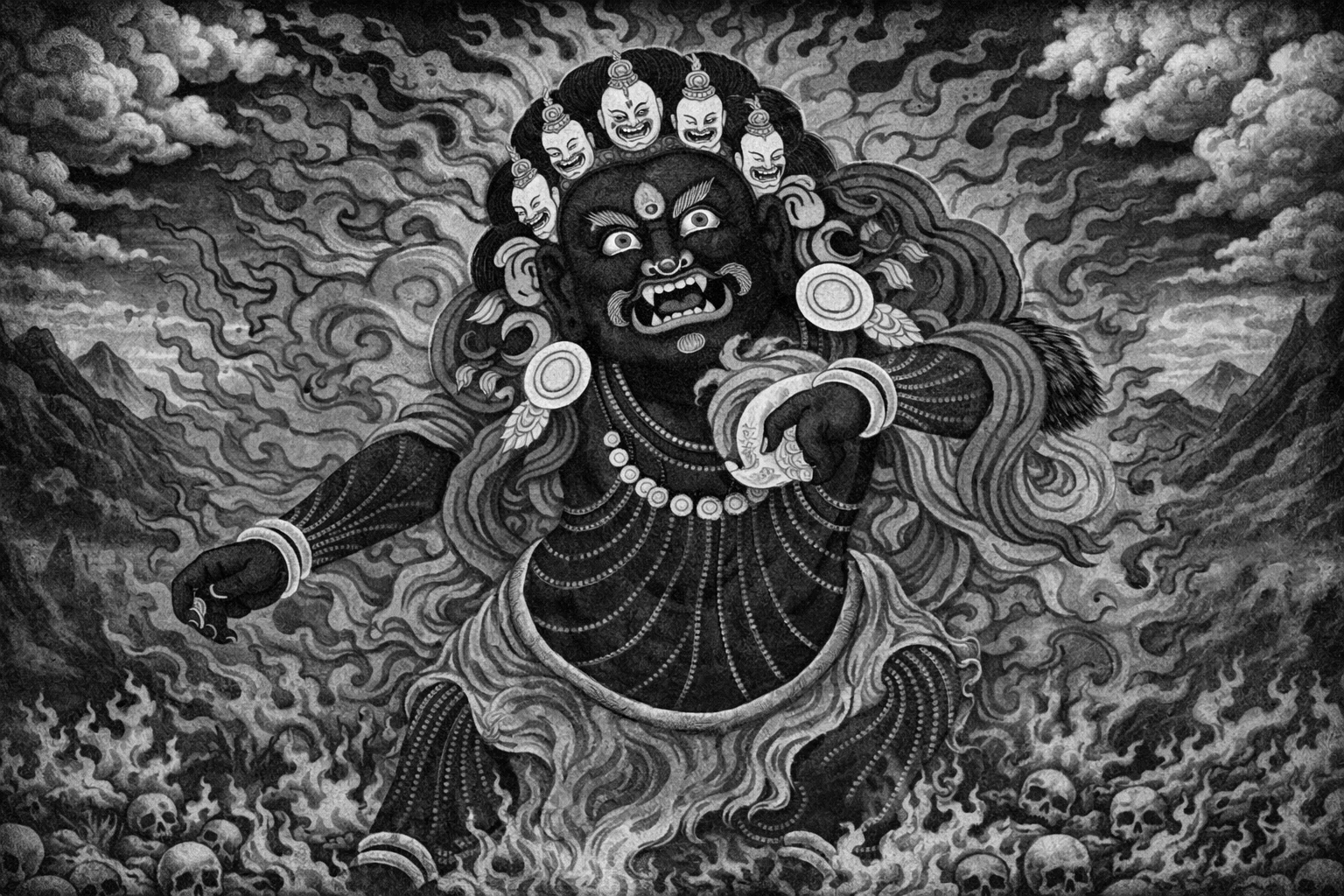
Mara, the main antagonist in Siddhartha Gautama’s life, is seen as the personification of the Kamadhatu, or Realm of Desire. Instead of being an external source of evil like in Western traditions, he acts as the psychological and cosmic force behind Samsara, the cycle of birth and death.
During the confrontation under the Bodhi tree, he acts as the last obstacle of the ordinary mind, using attachment, fear, and ego to block the path to Nirvana. He also appears in Hindu mythology and shares some traits with Kama, the god of love.
In researching my article, I used translations of the Padhana Sutta and the Buddhacarita to ensure Mara’s role is accurately described. It also checks modern interpretations against the Samyutta Nikaya to provide a reliable historical overview. [View Full Bibliography ↓]
Summary
Key Takeaways
| Attribute | Details |
| Names | Mara, Namuci, Kanha (The Dark One), Papiyan (The Evil One), Lord of Death |
| Title | Lord of the Sixth Heaven of the Desire Realm, Devaputra-mara |
| Region | Ancient India (Magadha), Central Asia, East Asia (China, Japan, Tibet) |
| Type | Buddhist demon, Deva (fallen or adversarial deity) |
| Gender | Male |
| Realm | Paranimmita-vasavatti (The Heaven of Lords over the Creations of Others) |
| Obstacle/Threat | Spiritual delusion, attachment to sensory pleasure, fear of death |
| Associated Figures | Gautama Buddha, The Three Daughters (Tanha, Arati, Raga), Mara-paisa |
| Weapon/Item | The flower-tipped arrows of desire, a vast demonic army |
| Weaknesses | Mindfulness, the realization of sunyata (emptiness), the earth-touching mudra |
| Associated Deity/Figure | Shakyamuni Buddha |
| Pantheon | Buddhist (Early Pali Canon and Mahayana traditions) |
| Primary Sources | Padhana Sutta, Buddhacarita, Lalitavistara Sutra, Samyutta Nikaya |
Who or What is Mara?
In Buddhist cosmology, this being is called a devaputra, or son of the gods, and lives in the highest Heaven of the Kamadhatu. He represents the forces that block spiritual growth, mainly through desire, duty, and death.
Instead of being just one monster, he is often seen as four different “maras”: Khandha-mara (the aggregates), Kilesa-mara (defilements), Abhisankhara-mara (karmic formations), and Maccu-mara (death).
As the “Lord of the World,” he sees any effort to break free from the cycle of rebirth as a challenge to his rule. When someone tries to reach Enlightenment, he steps in to keep things as they are. He rules the “Heaven of Controlling Others’ Creations,” meaning his strength comes from shaping how people perceive reality and encouraging the ego’s desire for pleasure.
“Mara” Meaning
The name comes from the Sanskrit root mṛ, meaning ‘dying’ or ‘killing’. It is a causative form, so it means “the one who causes death” or “the killer.” This connects him directly to the idea of mortality and the short-lived nature of life.
In the Pali Canon, he is often called Namuci, an old Vedic name meaning “the one who does not let go” or “the non-releaser,” showing his role in keeping beings trapped in the cycle of rebirth.
In Chinese Buddhism, the name became Móló and was later shortened to Mó. To show his demonic nature, Chinese translators added the symbol for “ghost” or “demon” to the character, which is now used across East Asia.
In Tibetan, he is called Bdud, meaning an obstacle or a demon that causes spiritual death. Although he shares roots with the Hindu god of love, Kama, the Buddhist view focuses on the dangerous results of uncontrolled desire.
How to Pronounce “Mara” in English
The name is usually pronounced MAH-rah. In Chinese, Mo is pronounced MWOH.
What Does Mara Look Like?
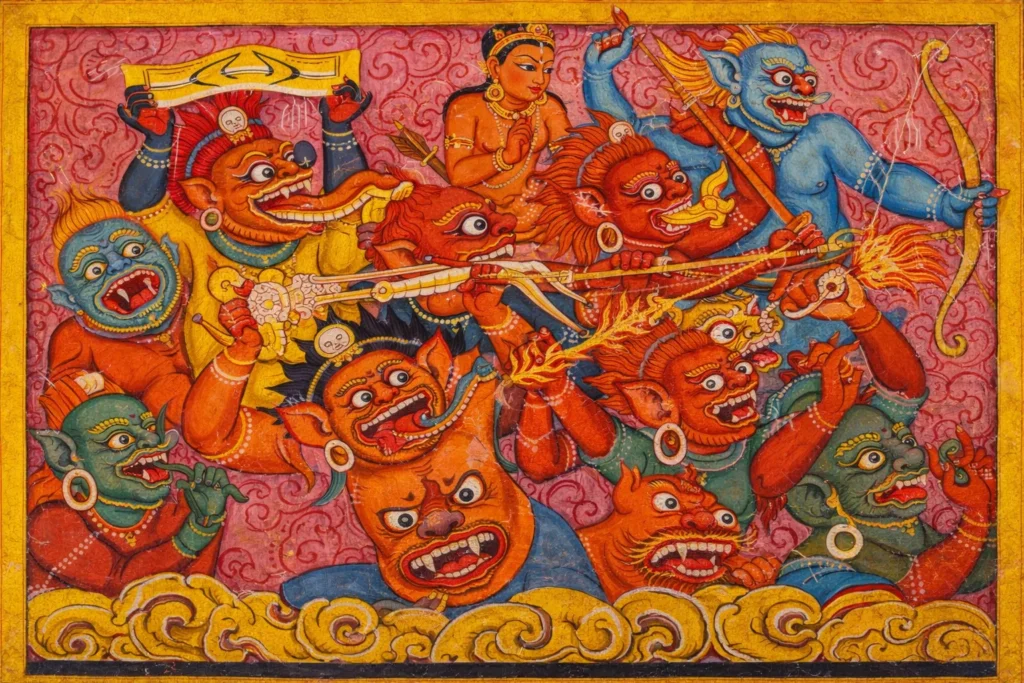
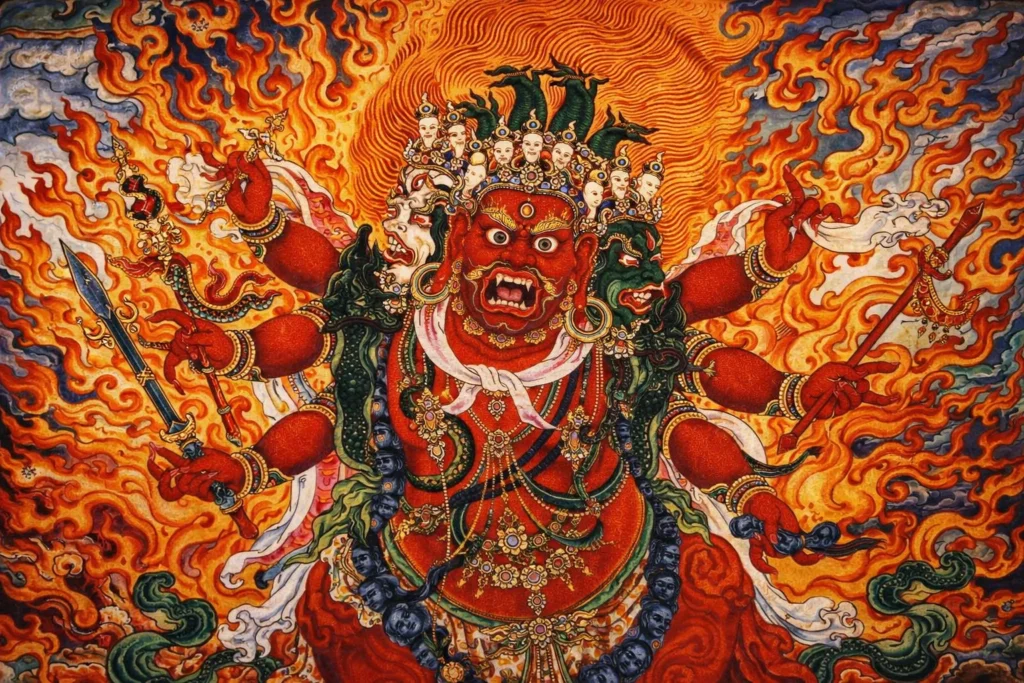
His appearance changes a lot depending on the story. In his usual heavenly form, he is a handsome god from the deva realms, often shown riding a giant elephant named Girimēkhala. He is also pictured with many arms, holding a bow and arrows decorated with flowers, which connects him to the Hindu god Kama.
During the attack on the Bodhi tree, he becomes much more frightening. He is described as leading a huge army of “maras” with blue, black, and yellow skin. Some have thousands of eyes, while others have animal heads or bodies wrapped with snakes.
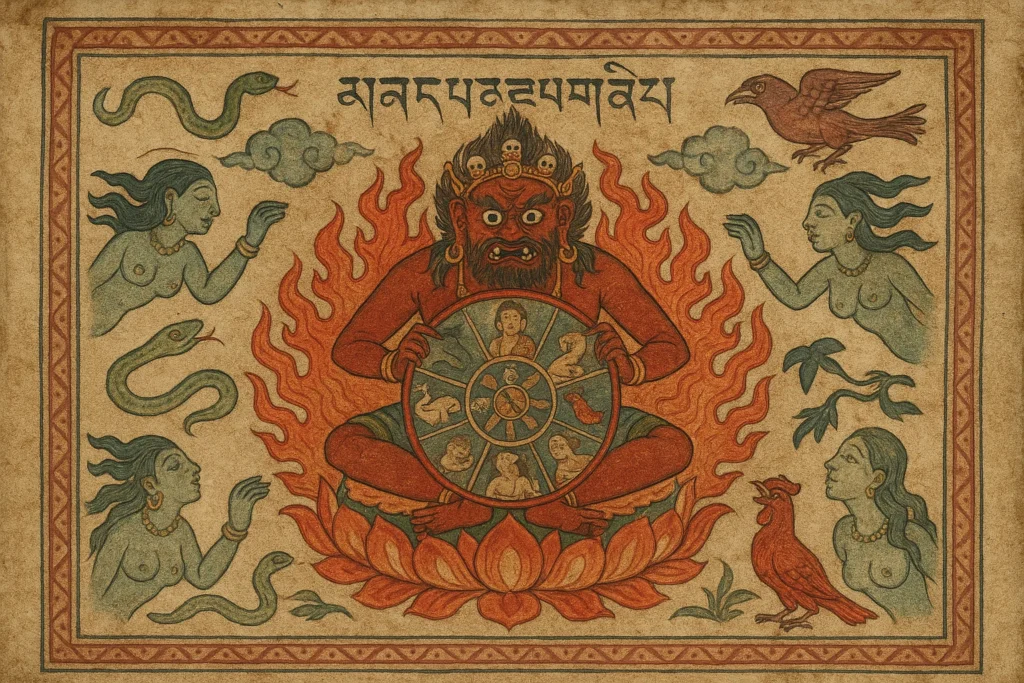
In Mahayana art, especially Tibetan Thangkas, he is sometimes shown as a fierce demon with red or dark skin, bulging eyes, and a crown of skulls. But his most powerful form is an illusion. He can appear as the Buddha’s father, King Suddhodana, or other loved ones to stir up emotions. In some texts, he is just a “dark shadow” or a quiet voice whispering to the practitioner.
You may also enjoy:
What Is a Pishacha, the Flesh-Eating Demon of the Dead?
February 11, 2026
Aamon: The Infernal Marquis of Lust, Feuds, and False Prophecies
September 29, 2025
Rāga: The Seductive Demon of Passion and Desire in Buddhist Lore
October 16, 2025
Demon Alastor: The Grand Executioner of Hell
November 17, 2025
Si’la: The Seductive Jinn Who Lures Travelers to Their Doom
October 9, 2025
Tarakasura: The Dark Demon Who Ruled Hell on Earth
December 4, 2025
Origins
The first records of this entity appear in the Pali Canon, especially in the Sutta Pitaka. In these texts, he comes from a mix of old Vedic ideas about death and new Buddhist ideas about the mind. According to research, he takes traits from Mrtyu (the Vedic god of death) and Kama (desire). By the time of the Padhana Sutta, he is clearly the main tempter who confronted Siddhartha during his years of ascetic practice.
When Buddhism entered the Mahayana period, the idea of this being grew from a simple concept to a complex part of the universe. The Lalitavistara Sutra and the Buddhacarita (by Ashvaghosha, 2nd century CE) provided detailed accounts of his battle with the Buddha, which served as the basis for Buddhist art and literature. This change turned him from a local forest spirit into a universal symbol of obstacles, woven into the Buddhist heavens.
Sources
“‘I have come to you,’ said Mara, ‘on account of that effort of yours. You are lean, your color is bad, and you are in the presence of death. A thousand parts of you belong to death; only one part of you is alive. Live, O venerable man! Life is better. Living, you can perform acts of merit.'” [Padhana Sutta (Sutta Nipata 3.2), c. 3rd Century BCE]
This early source from the Pali Canon shows the first stage of the entity’s story. Here, he is not a monster, but someone who quietly supports keeping things as they are. By telling Siddhartha to live a “life of merit” instead of ending rebirth, he shows his main goal: to keep the cycle of existence going.
The name “Namuci,” often used at this time, means “The Non-Releaser.” This highlights the idea that the material world is like a prison, kept in place by fear of death and the comfort of ordinary living.
“Then Mara, the lord of the world of desire, having seen that the Great Sage was seated with the desire for liberation, and was about to lead the world away from his dominion, was filled with anxiety… He brought with him his three sons, Confusion, Gaiety, and Pride, and his three daughters, Lust, Delight, and Thirst, that they might satisfy his mind.” [The Buddhacarita of Ashvaghosha (Book XIII), 2nd Century CE]
By the 2nd century, the story of this adversary became more detailed and refined. Ashvaghosha’s version describes a formal court of demons, turning abstract mental states into his children.
This marks a change from an inner struggle to a larger cosmic story. The main conflict is the threat to the entity’s rule. In this period, the universe is seen as a feudal system, with the Buddha as a spiritual rebel trying to free people from the Lord of Desire’s control.
“The Papiyan (Evil One) took the form of a beautiful woman, with a face like the autumn moon and eyes like the petals of a blue lotus, and approached the monk to unsettle his mind… But the monk, being mindful, recognized the illusion and said, ‘O Mara, I see you. This body is but a bag of bones and filth.'” [The Sutra of the One Hundred Parables (Bǎiyú Jīng), 5th Century CE]
In this Chinese folklore source, the idea of the entity as a shapeshifter becomes important. The focus on “recognizing the illusion” shows a key point in Buddhist demon stories: the demon only has power if the person does not see through the illusion.
Unlike Western demons, which use force or contracts, this being is defeated simply by being named. Saying “I see you” became a common superstition, used by people to end nightmares or unwanted thoughts, treating the demon as a kind of “glitch” in how we see reality.
“There are four types of Maras: 1. Devaputra-mara (the demon who is a god), 2. Kilesa-mara (the demon of defilements), 3. Khandha-mara (the demon of the five aggregates), and 4. Maccu-mara (the demon of death).” [The Mahaprajnaparamita Shastra (attributed to Nagarjuna), 4th-5th Century CE]
This later scholarly source gives a full “taxonomy” of the entity. It marks the shift from seeing Mara as a person to understanding him as an idea. By breaking him into “Four Types,” the text makes the demon less mysterious and situates him within psychology and science.
The Khandha-mara (the demon of the aggregates) is especially important because it suggests that the parts of human identity—body, feelings, perceptions, mental formations, and consciousness—are “demonic” since they create the illusion of a lasting self. This shows why the entity is seen as the most dangerous: he is not outside the person. Still, he is actually the person’s own ego.
Powers and Abilities
Compared to regular ghosts (preta) or lower demons (Asura), this being is much more powerful and is seen as a high-ranking god. While a Yaksha can cause physical harm, this entity can change time, space, and consciousness itself. His power is “systemic,” meaning he controls the rules of the desire world.
- Illusion Projection: The ability to create entire landscapes, armies, or comforting visions of home to distract meditators.
- Transformation: He can assume the form of humans, animals, or even the Buddha himself to sow confusion.
- Atmospheric Control: He is documented as being able to summon storms of fire, hot ashes, and darkness to intimidate his enemies.
- Emotional Manipulation: He can directly trigger the “three poisons”: greed, hatred, and delusion within the mind of a target.
- Karmic Obscuration: He has the power to hide the truth of reality from sentient beings, keeping them “blinded” to the nature of suffering.
Mara Myths, Legends, and Stories
The Temptation of Siddhartha under the Bodhi Tree
In the Buddhacarita, as Siddhartha sat beneath the Bodhi tree, the demon king realized that his dominion over the world was at risk.
Mara first attempted to use diplomacy, appearing before the Bodhisattva and urging him to return to his palace to perform his duties as a prince and a householder. He argued that the path of renunciation was difficult and that Siddhartha should focus on accumulating merit through animal sacrifices and kingly rule. Siddhartha remained unmoved, stating that “the pleasures of the senses are like the head of a snake.”
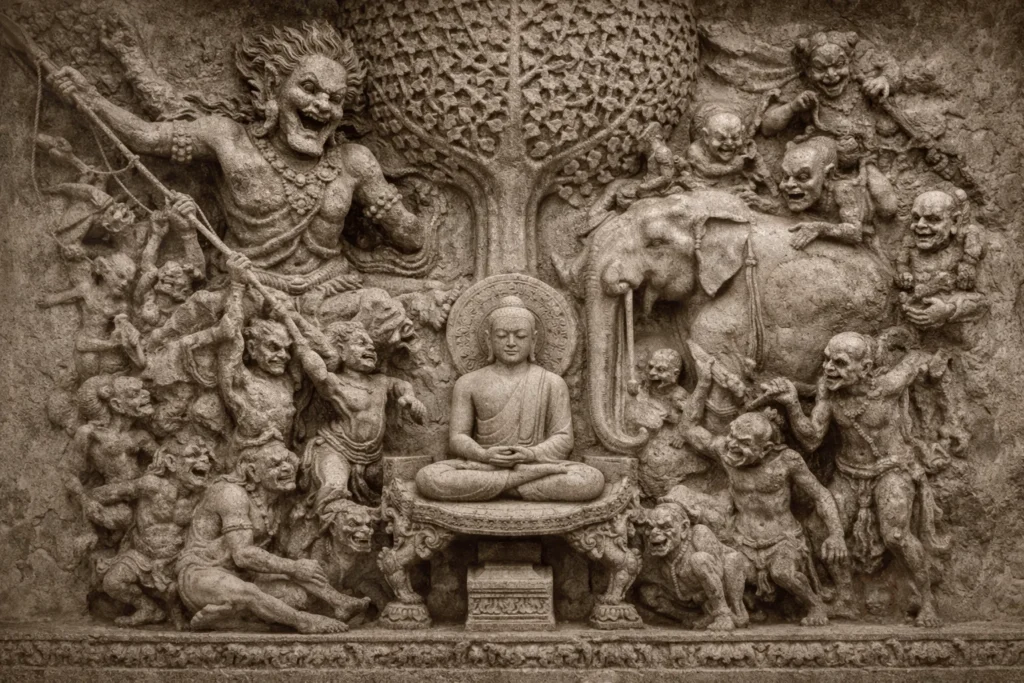
Seeing that words failed, the entity unleashed his demonic horde. The sky grew dark as thousands of monstrous beings rained down spears, arrows, and rocks.
However, the Buddhacarita notes that through the power of the Bodhisattva’s loving-kindness, the weapons were transformed into lotus flowers before they could touch his skin. The demon then challenged Siddhartha’s right to sit on the “unconquerable seat,” claiming it for himself based on his own past merits.
The entity’s followers shouted their witness to his greatness. Still, Siddhartha, having no human witness, touched the ground and asked the Earth to testify. The Earth Goddess (Prithvi) appeared with a deafening roar, confirming Siddhartha’s merit through countless lifetimes, causing the demon’s elephant to kneel and his army to flee in terror.
The Visit of the Three Daughters
Following the army’s defeat, Mara sent his three daughters—Tanha (Cravings), Arati (Aversion), and Raga (Attachment)—to seduce the Buddha. They appeared in various forms, ranging from young maidens to mature women, performing dances and offering sensory delights. They whispered, “Beautiful is the springtime, and we are at your service.”
The Buddha, however, remained in a state of perfect equanimity, seeing through their forms to the underlying decay and impermanence of the flesh. Realizing that he was beyond the reach of the “hook of desire,” the daughters retreated, admitting to their father that the Great Sage was like a “swan in a pond of lotuses,” untouched by the water.
You may also enjoy:
Who Is Agaliarept, the General of Hell Under Lucifer?
October 8, 2025
What Is a Bhuta? The Backward-Footed Ghosts of Hindu Horror
February 5, 2026
Who Is Shiva, the Destroyer and the Lord of the Universe?
November 12, 2025
Who Is Abaddon, the Demon of the Abyss, in the Bible?
September 29, 2025
Who Is Abalam in Demonology? The Demon King That Serves Paimon
September 30, 2025
The Samyutta Nikaya Encounters
In the Mara-Samyutta of the Samyutta Nikaya, the demon is depicted as a persistent nuisance who continues to harass the Buddha and his disciples even after the Enlightenment.
In one instance, he approaches the Buddha while he is resting in a cave and tries to fill his mind with fear by making the sound of a falling mountain. The Buddha, recognizing the intruder immediately, says, “I know you, Evil One.”
Once the Buddha or an Arhat says, “Mara, I see you,” he loses his power and vanishes, often “sad and disappointed.” These stories illustrate that while the entity is a cosmic force, Mara is also a psychological projection that dissolves after the application of mindfulness and direct perception of reality.
Mara vs Other Similar Entities
| Demon Name | Associated Obstacle/Role | Origin/Source | Key Traits/Powers |
| Yama | Judgment and Death | Pali Canon | Lord of the Underworld, tallies karma |
| Pishacha | Flesh-eating, madness | Early Buddhist texts | Possession, feeding on life force |
| Preta | Insatiable hunger | Abhidharma | Invisible, elongated necks, distended bellies |
| Kumbhanda | Vitality theft | Lotus Sutra | Dwarf-like, servants of Virudhaka |
| Rakshasa | Violence and consumption | Lanka Suttas | Superhuman strength, shape-shifting |
| Asura | Pride and warfare | Six Realms theory | Envy of Devas, constant combat |
| Vetala | Corpse reanimation | Tibetan Buddhism | Inhabiting the dead, vampiric |
| Yaksha | Nature guardianship/Hoarding | Mahamayuri | Invisibility, nature magic |
| Dakini | Spiritual testing/Energy | Vajrayana | Flight, wrathful wisdom |
| Jurei | Unresolved attachment | Japanese Buddhism | Ghostly apparition, haunting |
| Oni | Punishment of sinners | Japanese folklore | Iron clubs, extreme durability |
| Gaki | Greed | Japanese Buddhism | Version of Preta, localized traits |
Mystical Correspondences
| Attribute | Details |
| Planet | Venus (in its aspect of base desire) or Saturn (Death) |
| Zodiac Sign | Scorpio (Obsession and Transformation) |
| Element | Air (the fleeting nature of thoughts and illusions) |
| Direction | West (associated with the setting sun and transition) |
| Color | Black or Deep Crimson |
| Number | Four (representing the four types of Maras) |
| Crystal/Mineral | Obsidian (to ground against illusions) |
| Metal | Lead (heaviness of the material realm) |
| Herb/Plant | Lotus (the flower he cannot touch) |
| Animal | Elephant (Girimēkhala) or Serpent |
| Trait/Role | The Obstructor / The Tempter |
The mystical links to this being focus on the struggle between the material and spiritual worlds.
As ruler of the highest desire Heaven, his element is often seen as air, since his main weapons are thoughts, fears, and fantasies. These have no physical form but can strongly affect the mind. He is also linked to the color black, which stands for the “darkness” of ignorance (avidya) that he tries to keep in place.
In rituals and meditation, people often use the “Earth-touching” gesture (Bhumisparsha mudra) to resist his influence. The number four is important in Buddhist teachings because it divides his influence into the Four Maras.
This helps students see that he is not just a person, but a set of obstacles, such as physical decay and mental corruption. By breaking down the demon in this way, practitioners can eventually see that he does not truly exist on his own.
You may also enjoy:
What Is a Tengu? Origins, Powers, and Dark Folklore
January 29, 2026
Si’la: The Seductive Jinn Who Lures Travelers to Their Doom
October 9, 2025
Andhaka: The Blind Demon Born From Cosmic Darkness
February 6, 2026
Edimmu: The Mesopotamian Wind Demon That Steals Life
November 6, 2025
Who Is Barqan, The Powerful Jinn King?
March 12, 2026
Who Was Hiranyakashipu, the Demon King of Hindu Mythology?
October 6, 2025
Bibliography
Author’s Note: To create this article, I compared the abstract ideas in Vasubandhu’s Abhidharmakośabhāṣyam with the vivid battle scenes from the “Assault on the Bodhi Tree” in the Lalitavistara and Buddhacarita. I also looked at archaeological studies by Malandra on early Indian art to connect the demon’s role as both a mental obstacle and a leader of monsters. I focused on dialogues from the Saṃyutta-Nikāya to show that his real power is not in his army but in his ability to slowly erode a practitioner’s mindfulness.
- E. H. Johnston, translator. The Buddhacarita; or, Acts of the Buddha. Baptist Mission Press, 1936. Internet Archive.
- Feer, Léon, editor. The Saṃyutta-Nikāya of the Sutta-Piṭaka: Part I. Sagātha-Vagga. Published for the Pali Text Society, Henry Frowde / Oxford University Press, 1884. Internet Archive.
- Mitra, Rajendralala, translator. The Lalita-Vistara; or, Memoirs of the Early Life of S’ākya Siñha. Fasciculus 1–2, Baptist Mission Press, 1881–1882. Bibliotheca Indica. Internet Archive.
- Christoph Harbsmeier. Reading the One Hundred Parables Sūtra: The Dialogue Preface and the Gāthā Postface. Zen Buddhist Rhetoric in China, Korea, and Japan, BRILL, 2011.
- Gunabhadra, translator. The Sutra of One Hundred Fables. Translated from Chinese by Tetcheng Liao, Huntington Archive, 1996. The John C. and Susan L. Huntington Archive of Buddhist Sanskrit Manuscripts.
- Vasubandhu. Abhidharmakośabhāṣyam. Translated by Louis de La Vallée Poussin, translated from French by Leo M. Pruden, vol. 1, Asian Humanities Press, 1988. Internet Archive.
- Malandra, Geri Hockfield. Māra’s Army: Text and Image in Early Indian Art. East and West, vol. 31, no. 1/4, 1981, pp. 121–30. JSTOR. Accessed 14 Apr. 2026.