In the Ars Goetia, Andras stands out as the spirit of sudden, dangerous escalation, not just simple temptation. Most spirits in the Lemegeton are called for knowledge or wealth.
However, this particular demon is different because he is openly hostile to the person who summons him. He represents the fine line between controlling conflict and being overtaken by it.
This demon profile is based on a careful comparison of the Pseudomonarchia Daemonum (1577), the Ars Goetia, and the Dictionnaire Infernal (1863). I chose to focus on these original sources to help me separate the authentic 16th-century details from later additions. [View Full Bibliography ↓]
Summary
Key Takeaways
| Attribute | Details |
| Names | Andras |
| Title | Great Marquis of Hell |
| Gender | Male |
| Role | Sower of discord, instigator of strife, promoter of fatal violence, and destroyer of enemies. |
| Rank | Marquis |
| Hierarchy | Subordinate to the higher kings of the Goetic hierarchy; he commands his own subordinates. |
| Legions | 30 Legions of Spirits |
| Powers | The ability to incite discord, provoke anger, escalate arguments into physical violence, and kill the unwary or disrespectful. |
| Associated Figures | Flauros (fellow Goetic spirit), the Angel Anauel (opposing figure). |
| Weaknesses | Bound by the seals of Solomon, controlled through specific ritual precautions, and countered by the influence of his opposing angel. |
| Opposing Angel/Saint | Anauel |
| Pantheon | Christian (occult/grimoire tradition) |
| Primary Sources | Ars Goetia, Pseudomonarchia Daemonum, Dictionnaire Infernal, The Discoverie of Witchcraft. |
Who or What is Andras?
Andras is a demon ranked as a Marquis in the infernal hierarchy. He is known as a spirit of conflict, with no redeeming qualities. In the Lesser Key of Solomon, he is described as very aggressive, with the main goal of pushing people toward violence and constant arguments.
Unlike other Goetic spirits who might offer knowledge or riches, Andras is usually called on only for his power to destroy. He is often linked to turning small arguments into deadly fights. In occult writings, he is known for being extremely dangerous. He is said to attack his own summoner if there is any mistake during the ritual.
“Andras” Meaning
Researchers often debate where the name Andras comes from, but a common theory links it to the Greek word anēr (andros), which means “man” or “warrior.” This fits his violent nature and his role in starting fights. In this sense, the name highlights how warrior traits can be twisted into senseless violence and conflict.
The name Andras has changed very little over time in different grimoires, showing that it has been passed down consistently for centuries. While there are a few minor spelling changes in less-known texts, the main name Andras is used in both the Ars Goetia and the Pseudomonarchia Daemonum. This consistency shows that his identity as a dangerous spirit was well known in the medieval and Renaissance periods.
Some think Andras’s name might come from older mythologies. Still, there is no clear link to any ancient gods from the Near East or Mediterranean. His identity is mainly based on the grimoire tradition of the last thousand years, in which names were often made to sound old and important within the Solomonic system of demonology.
You may also enjoy:
Rāga: The Seductive Demon of Passion and Desire in Buddhist Lore
October 16, 2025
Aži Dahāka: The Three-Headed Dragon of Zoroastrian Mythology
January 14, 2026
Pazuzu: The Ancient Demon Who Fought Evil with Evil
November 4, 2025
What Is a Qareen and Why Does It Follow Every Human Being?
October 8, 2025
Amdusias in the Ars Goetia: The Demon of Dark Music
December 2, 2025
How to Pronounce “Andras” in English
In English, Andras is usually pronounced as AN-drass or AN-drahs. The first part is stressed and uses a short “a” like in “pan.” The second part can sound like the “a” in “glass” or the “ah” in “bra.”
What Does Andras Look Like?
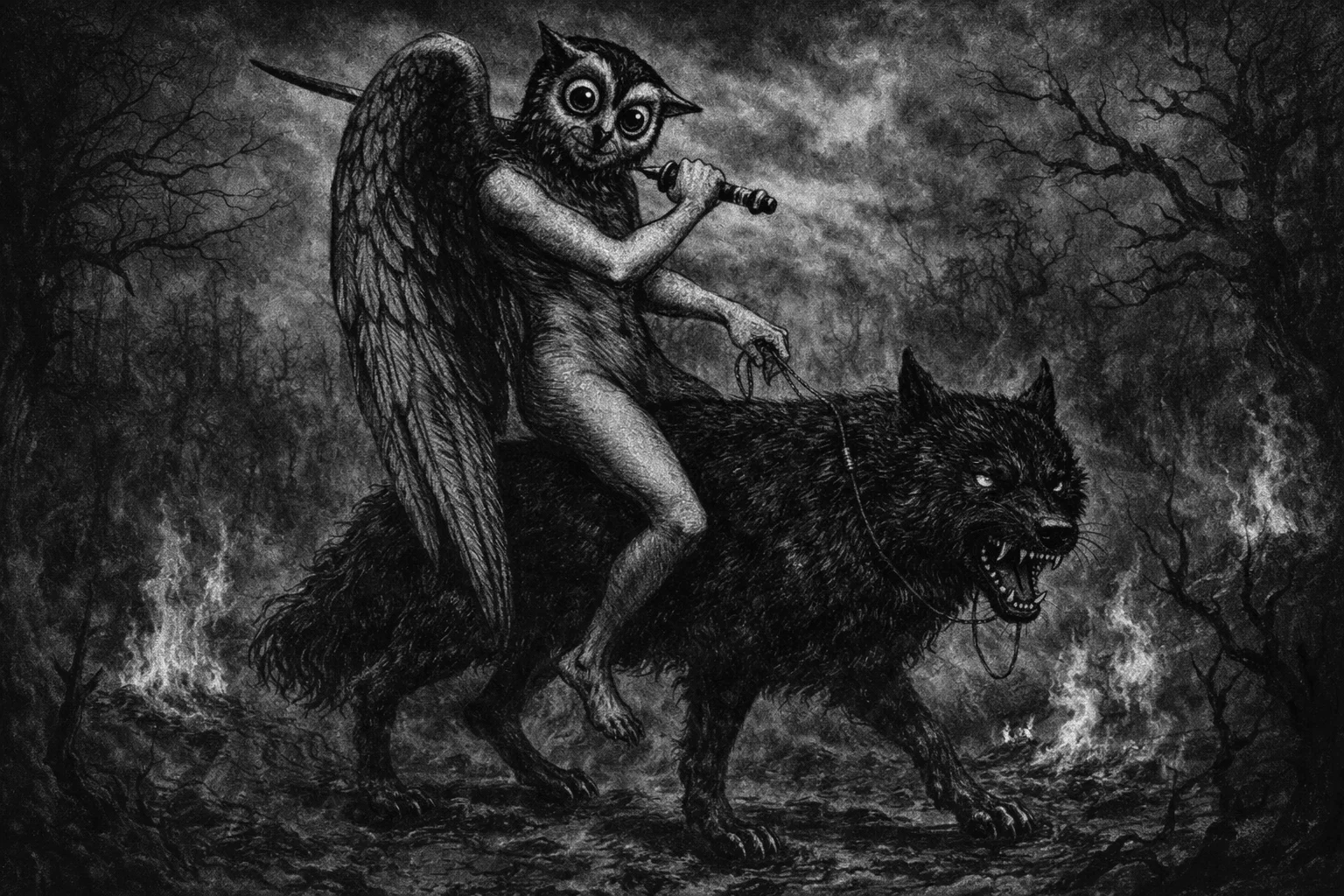
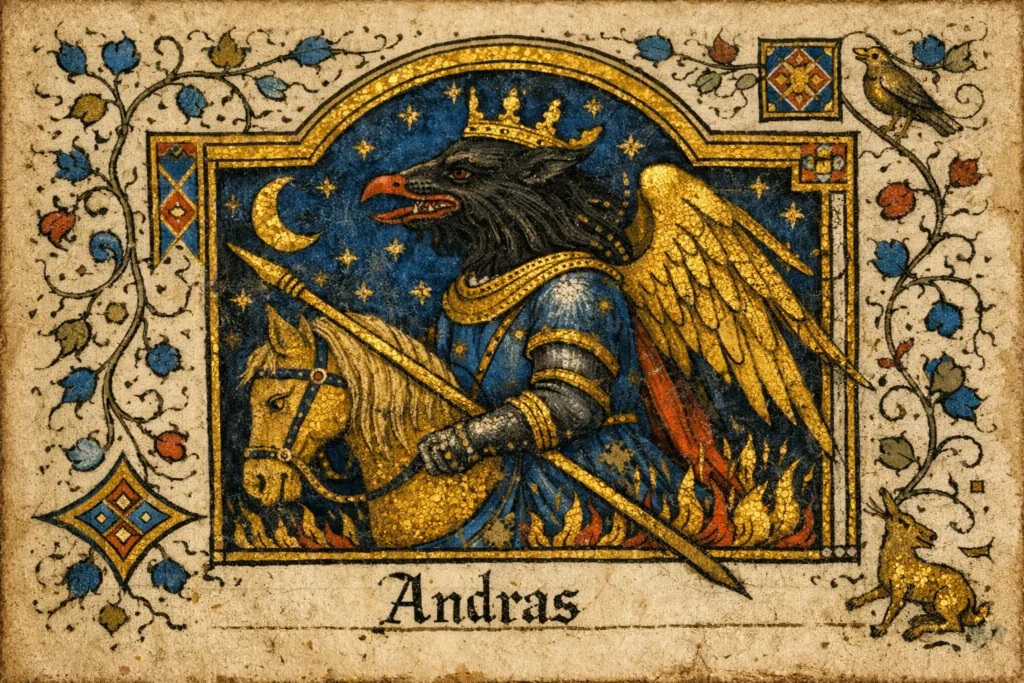
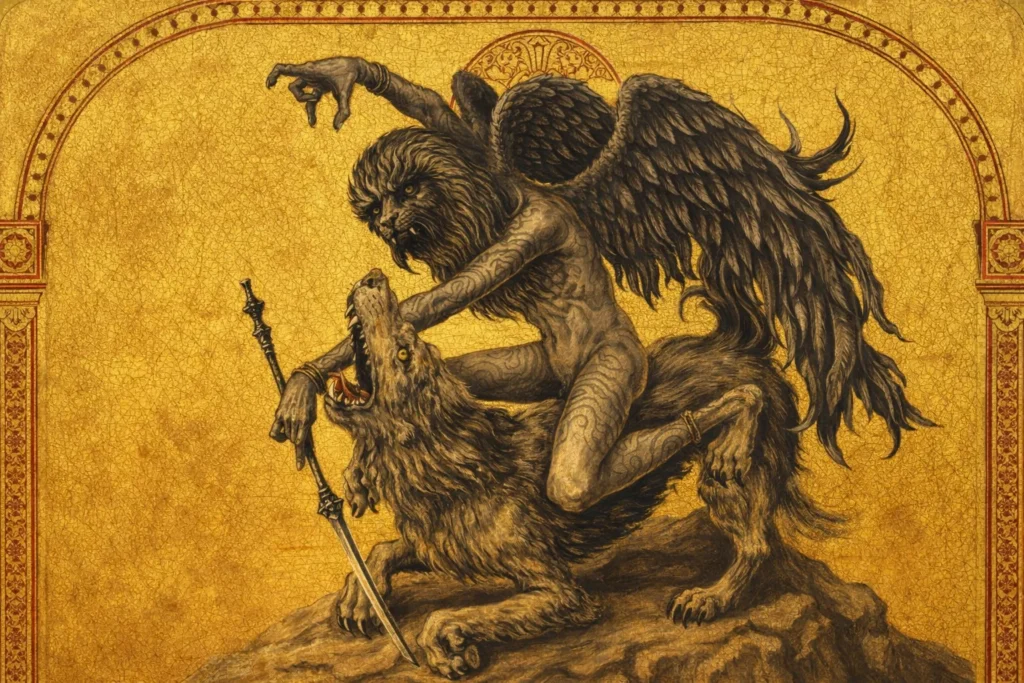
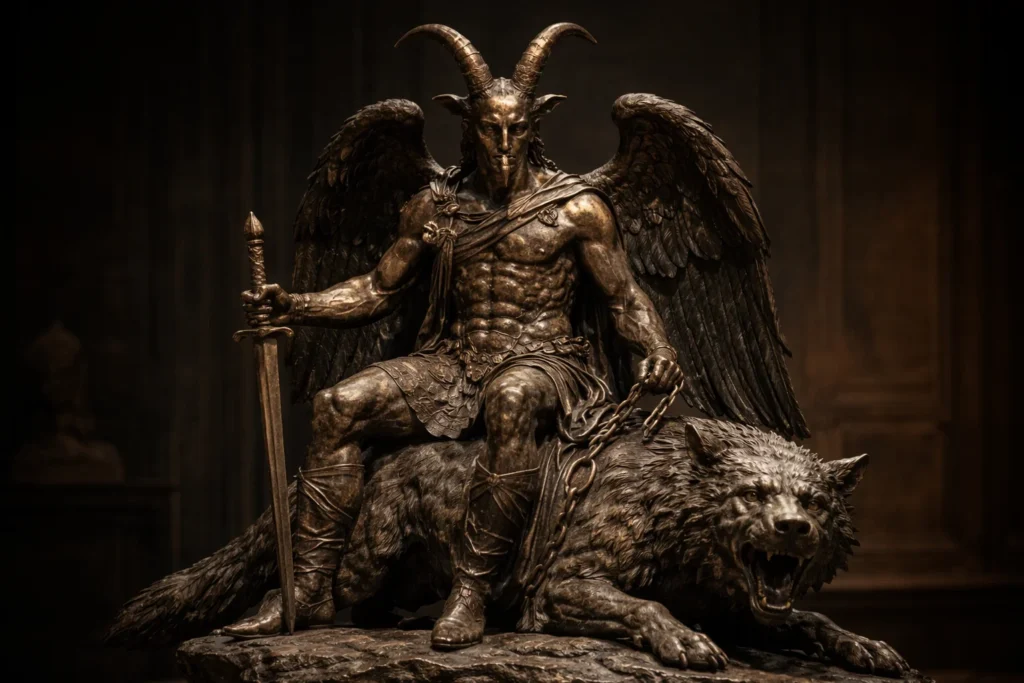
Many grimoires, especially the Dictionnaire Infernal, describe Andras as appearing like an angel with the head of an owl or a large raven. This mix of a winged human body and a bird of prey’s head shows his deceptive and unsettling nature.
Andras is usually shown riding a powerful black wolf, which stands for his wild and fierce nature. He has a sharp, bright sword, showing both his rank and his role in causing bloodshed. Some sources say his sword is always drawn, meaning he is always ready for battle and never seeks peace.
Important Historical & Grimoire Mentions
While the demon does not appear in the Bible or in the early Christian apocrypha, his historical record begins in the 16th century in the Pseudomonarchia Daemonum.
Original:
Andras Magnus Marchio est, visitur forma angelica, capite nycticoraci nigro, equitans lupum nigrum & validissimum, manuque gestans gladium acutissimum & rutilantem. Auctor est discordiarum. Si præstigiator non caveat, interficiet ipsum & socios. [Johann Weyer, Pseudomonarchia Daemonum, 1577]
Translation:
Andras is a great Marquis, and is seen in an angelic form with a black night-raven’s head, riding upon a black and very strong wolf, and flourishing with a sharp and bright sword in his hand. He is the author of discords. If the exorcist be not wary, he will kill him and his fellows.
Johann Weyer’s original description is what gives Andras his deadly reputation. While many Goetic spirits are called for secret knowledge or honor, Andras is known for being unpredictable and dangerous. The ‘night-raven’ head, often seen as an owl, is important because in 16th-century Europe, owls were seen as signs of death and darkness, times when reason is lost.
As a physician, Weyer probably included this ‘kill condition’ to warn people about the real dangers of ceremonial magic, both mental and physical. Andras is not just a spiritual threat; he also shows what happens when a magician loses control. Once discord is called up, it cannot be easily controlled or aimed only at enemies.
The Sixty-third Spirit is Andras. He is a Great Marquis, appearing in the Form of an Angel with a Head like a Black Night Raven, riding upon a strong Black Wolf, and having a Sharp and Bright Sword flourished aloft in his hand. His Office is to sow Discords. If the Exorcist have not a care, he will slay both him and his fellows. [The Goetia: The Lesser Key of Solomon, 17th Century]
The Ars Goetia keeps most of Weyer’s description of Andras but adds an important detail: the Sigil. This change turns the text from just a description into a practical guide for magic, focusing more on how to use the demon rather than just what he is like.
The title ‘Marquis’ (or Marchio) is important. In feudal times, a Marquis ruled the borderlands between kingdoms, which were often dangerous places. The demon is seen as the ruler of the line between peace and war. By the 17th century, his ‘Bright Sword’ symbolized sudden violence, such as in a duel or a riot, showing that his main role is to break social ties.
Original:
Andras, grand marquis des enfers. On le voit sous la figure d’un ange à tête de chat-huant, à cheval sur un loup noir et tenant un sabre très affilé. Il apprend à ceux qu’il favorise à tuer leurs ennemis, leurs maîtres et leurs serviteurs; c’est lui qui élève les discordes et les querelles. [Jacques Auguste Simon Collin de Plancy, Dictionnaire Infernal, 1863]
Translation:
Andras, great marquis of Hell. He is seen in the figure of an angel with the head of a screech-owl, riding a black wolf, and carrying in his hand a very sharp saber. He teaches those whom he favors to kill their enemies, their masters, and their servants; it is he who raises discords and quarrels.
In the 19th century, Collin de Plancy’s Dictionnaire Infernal adds a social and folklore angle to Andras, showing him as a force that upsets social order. Earlier texts talked about killing ‘the exorcist and his fellows,’ but de Plancy lists’ masters and servants’ directly. This change reflects 19th-century worries about class conflict and betrayal within families after the French Revolution.
The ‘screech-owl’ (chat-huant) replaces the less clear ‘night-raven,’ focusing on the frightening sound the demon makes. In de Plancy’s version, the demon is less a cosmic entity and more a patron of assassins, giving people the power and desire to attack those in charge. This change makes the demon a threat not just to magicians, but to society as a whole.
Powers and Abilities
Andras’s main power is to break social harmony and cause harm. He is known for starting discord, not just small arguments. He is said to push people from minor disagreements into serious fights. When he is involved, people stop thinking clearly and quickly become enemies.
Andras is also said to teach people how to kill. Old texts say he gives his followers both the knowledge and the desire to destroy their enemies, masters, or servants. This makes him a spirit for assassins or anyone who wants to use violence to solve problems. He does this by taking away a person’s moral limits and replacing them with a strong urge to harm others.
Importantly, Andras is known for being able to kill the exorcist. This is rare among Goetic spirits. While many demons are hard to control, Andras is especially feared because he can destroy the person summoning him and anyone helping. This deadly trait means rituals must be done with extreme care.
You may also enjoy:
Who Is Al-Abyad? The White King Jinn Who Rules Love and Chaos
January 26, 2026
Who Is Agares, the Demon of Earthquakes and Deception?
October 13, 2025
What Is Akaname, The Filth-Licking Yōkai?
October 28, 2025
Who Is Adrammelech in Demonology and the Bible?
October 1, 2025
Edimmu: The Mesopotamian Wind Demon That Steals Life
November 6, 2025
Demon Alastor: The Grand Executioner of Hell
November 17, 2025
Andras and the Medieval Terror of “Social Contagion”
The Ars Goetia focuses on the physical danger Andras brings to the person who summons him. Still, his deeper meaning lies in is role as a symbol of ‘social contagion.’ In medieval and early modern times, people saw discord not just as a feeling but as a force that could spread through a home or city like an illness.
Andras, shown as an angel with an owl’s head riding a wolf, symbolizes how a quiet rumor can escalate to open violence. The owl, which flies silently at night, is a symbol for hidden gossip, while the wolf stands for the wild violence that can follow. Unlike other demons who tempt with clever arguments, Andras skips reason and pushes people straight into a wild, emotional state where logic is lost to the crowd.
Andras is seen as the spirit of ‘uncontrollable escalation,’ showing old fears about how fragile society was in feudal times. Back then, honor was everything, and even a small insult could lead to long, violent family feuds. Andras represents that moment when things go too far to turn back.
Given his rank as a Marquis, a title for those who guarded borderlands, Andras can be seen as a guard at the edge of conflict. He does not stay in the middle of fights; instead, he stands at the point where arguments turn into deadly violence, making sure that once people cross that line, there is no going back.
Compared to other myths, Andras is similar to the Greek Eris or the Norse Býleistr, but he has a distinctive kind of cruelty linked to his angelic form. This form mocks the idea of divine order, suggesting that the worst kinds of conflict often masquerade as justice or moral outrage.
Andras’s real power is turning the conjurer’s own fears and dark thoughts against them. He does not attack directly; instead, he makes people believe others are already out to get them. Studying Andras is like looking at ‘Invisible Rot,’ where a strong group or society falls apart not from external attacks but from losing trust from within.
Andras vs Other Christian Demons
| Demon Name | Associated Sin/Temptation | Rank/Origin | Key Traits/Powers |
| Asmodeus | Lust | King (Ars Goetia) | Breaks marriages, teaches math/astronomy. |
| Belial | Lawlessness | King (Ars Goetia) | Grants senatorships, creates civil strife. |
| Beelzebub | Gluttony | Prince (Hierarchy of Hell) | Lord of the Flies, breeds false belief. |
| Pazuzu | Famine/Plague | King (Mesopotamian/Christian) | Brings drought, controls locusts. |
| Bael | Greed/Ambition | King (Ars Goetia) | Grants invisibility, commands 66 legions. |
| Astaroth | Sloth | Grand Duke (Ars Goetia) | Teaches liberal sciences, knows the fall. |
| Paimon | Pride | King (Ars Goetia) | Teaches arts and sciences, binds will. |
| Leraje | Conflict/War | Marquis (Ars Goetia) | Causes battle wounds to putrefy. |
| Flauros | Destruction | Duke (Ars Goetia) | Burns enemies, knows the creation. |
| Marchosias | False Hope | Marquis (Ars Goetia) | Fights well, was of the Order of Dominations. |
| Furcas | Cruelty | Knight (Ars Goetia) | Teaches philosophy, logic, and chiromancy. |
| Abaddon | Destruction | King of the Abyss (Revelation) | Commands locust army, symbolizes death. |
| Mammon | Avarice | Prince (Binsfeld’s Class.) | Incites greed for material wealth. |
| Leviathan | Envy | Grand Admiral (Hierarchy of Hell) | Symbolizes chaos of the sea, incites envy. |
Rank in the Hierarchy of Hell
Andras is ranked as a Great Marquis of Hell. In the system described by occultists in the 16th and 17th centuries, a Marquis is a middle rank—below Kings and Dukes, but above Earls and Knights. Andras commands 30 legions of spirits, which are groups of lesser demons who spread discord on his orders.
Andras’s relationships with other demons are also full of conflict, just like his dealings with humans. He serves the higher Kings of Hell, but is often seen as unstable among the other demons.
Unlike demons like Astaroth or Belial, who use politics or philosophy to corrupt, Andras is a straightforward force of chaos. He is often linked with other warlike demons such as Flauros or Leraje. Still, his tendency for random violence makes him a danger even among his peers. He is the “raw nerve” of Hell’s aggression, starting wars and internal fights.
Mystical Correspondences
| Attribute | Details |
| Planet | Moon |
| Zodiac Sign | Sagittarius |
| Element | Fire |
| Direction | East |
| Color | Violet or Black |
| Number | 63 |
| Crystal/Mineral | Silver (linked to the Moon) |
| Metal | Silver |
| Herb/Plant | Hellebore |
| Animal | Wolf, Owl, Raven |
Andras’s link to the Moon is unusual, since the Moon usually stands for hidden or subconscious things. For Andras, it fuels sudden violent outbursts. Many sources connect Marquis demons to the Moon. However, this particular demon uses this influence to stir up emotions, causing madness and rage. He is also tied to Sagittarius and the element of Fire, which highlight his quick, fierce attacks and the fiery nature of his chaos.
These connections help explain his chaotic nature in a cosmic way. In his rituals, the East, which usually means new beginnings, is turned around to tell the start of a new conflict. Silver, his main metal, stands for the sharpness of his sword and his cold, relentless malice. All these elements show him as a force of quick, cold, and fiery destruction.
Andras’ Sigil
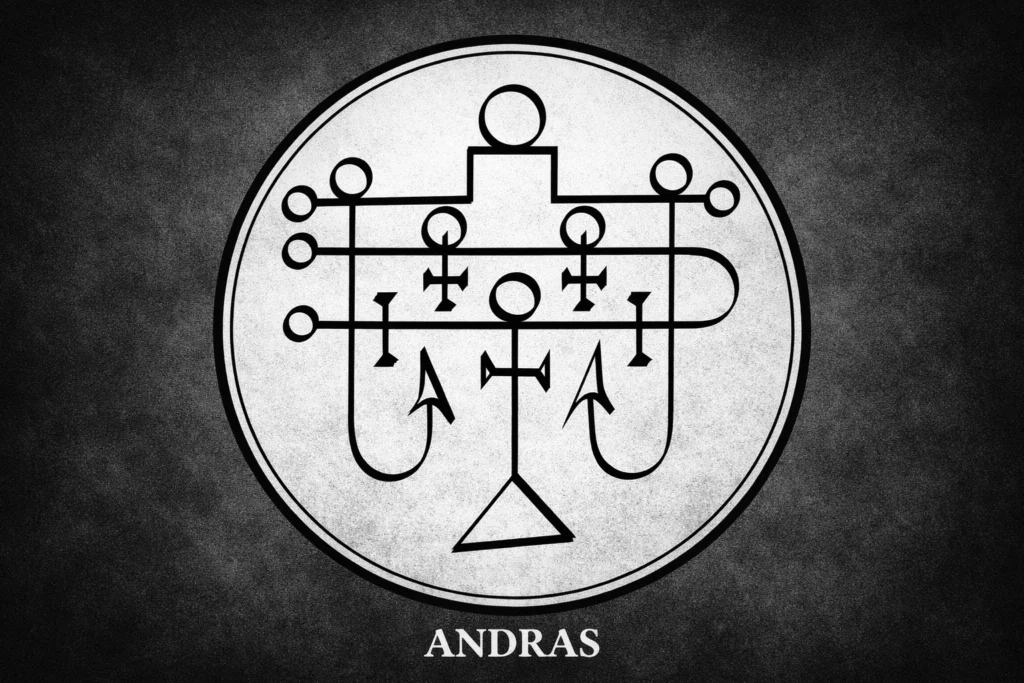
The Sigil of Andras is a detailed geometric symbol that stands for the demon’s essence and helps focus during summoning. In Goetic tradition, the sigil is like a signature or a spiritual phone number. People believe the demon is bound by Solomon’s seals to his sigil.
In the past, the sigil was carved onto a silver lamen because silver matched his Marquis rank. The person performing the ritual would wear this lamen around their neck for protection and to show control over the spirit. Without the sigil, people believed Andras would not have to appear or obey, and might kill the summoner right away.
Summoning and Rituals
Summoning Andras was always seen as one of the riskiest acts in ceremonial magic. These rituals, found in books such as the Ars Goetia, were usually performed by expert occultists or magicians. The main goal was often to destroy an enemy or create a permanent split between people.
These rituals took place inside a blessed magic circle for protection. Since Andras was known for killing the summoner, people took extra care, often saying long lists of strange names or prayers to control his aggression. They also used items such as black wolf skin and bird feathers to match his appearance.
Still, even with all these precautions, the texts warn that Andras is so dangerous that any mistake or break in the circle could mean instant death for everyone involved.
You may also enjoy:
Amaymon: The Infernal King Who Commands Death and Decay
November 17, 2025
Al-Ahmar: The Tuesday King of the Seven Jinn
February 13, 2026
Yuki Onna: The Terrifying Bride Who Feeds on Travelers
December 9, 2025
Jikininki: The Japanese Ghost That Feeds on Human Corpses
February 9, 2026
Pazuzu: The Ancient Demon Who Fought Evil with Evil
November 4, 2025
Bibliography
Author’s Note: What’s interesting here is the strong tension between Johann Weyer’s 16th-century medical warnings of “lethal instability” and the later, more stylized images in Collin de Plancy’s 1863 Dictionnaire Infernal. The Ars Goetia gives the technical rank and sigil. However, it was by comparing Jungian archetypes with Lendor’s research on the “Wolf in Art” that I began to understand why the mix of owl and wolf was so frightening to people in the Middle Ages. I was especially struck by how the “kill condition” for the conjurer stayed almost unchanged in manuscripts over four centuries. This suggests that Andras represents a psychological “point of no return” that goes beyond mere historical interest. In my study, I focus on the raw volatility described in the Pseudomonarchia Daemonum, so the Marquis is seen not as a tool for the practitioner, but as a symbol of uncontrollable social chaos.
- Weyer, Johann. Pseudomonarchia Daemonum. Edited and translated by Joseph H. Peterson, digital edition, 2000. Twilit Grotto: Esoteric Archives.
- De Laurence, L. W. The Lesser Key of Solomon, Goetia. Project Gutenberg, 7 Nov. 2023. Originally published by De Laurence, Scott & Co., 1916.
- Henson, Mitch, and Jeff Wellman, editors. Lemegeton: The Complete Lesser Key of Solomon. Metatron Books, 1999. Internet Archive.
- Collin de Plancy, Jacques. Dictionnaire infernal: répertoire universel des êtres, des personnages, des livres, des faits et des choses qui tiennent aux esprits. 6th ed., Henri Plon, 1863. Internet Archive.
- Gasdia, Russell. Frightful Demons and Faithful Prayer: Possession, Exorcism, and Religious Sentiments in Johann Weyer’s De Praestigiis Daemonum and Reginald Scot’s The Discoverie of Witchcraft. Academia.edu.
- Barrett, Francis. The Magus, or Celestial Intelligencer; Being a Complete System of Occult Philosophy. Printed for Lackington, Allen and Co., 1801. Internet Archive. Including works by Johannes Trithemius.
- Lendor, Celestyn. International Representation of the Wolf in Art: Deity or Demon? Utah State University Today, 2019. Utah State University.
- Jung, C. G. Alchemical Studies. Translated by R. F. C. Hull, edited by Herbert Read et al., vol. 13, Princeton University Press, 1967. Collected Works of C. G. Jung. British Association of Jungian Analysts.