
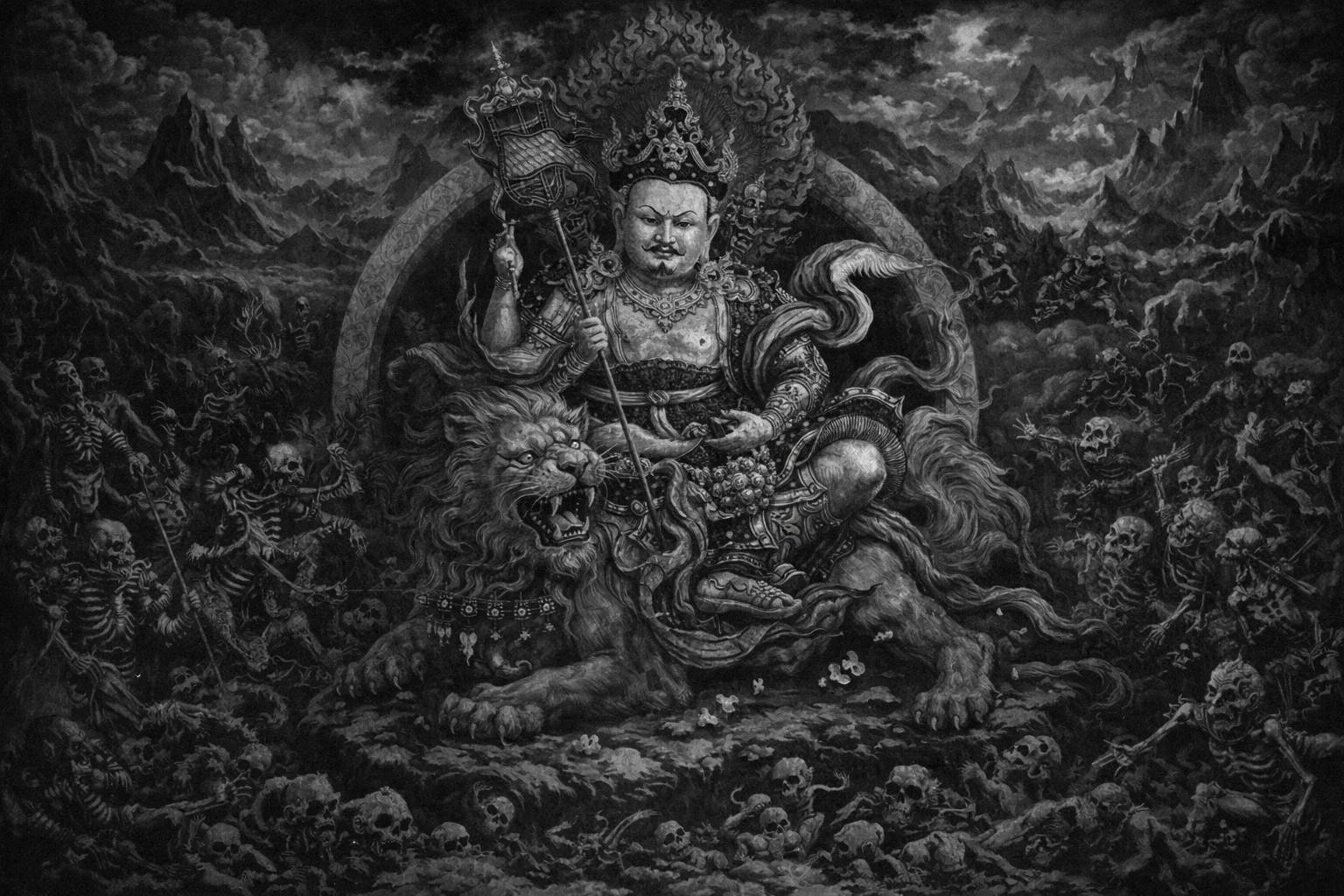
Vaisravana can be placed somewhere in between heavenly divinity and the earthy nature of the yaksha spirits. He is more than just a god of wealth; he is the key entity who channels the wild energy of nature spirits to help protect the Dharma.
Looking at how Vaisravana has changed over time, we see an ancient earth-spirit become a cosmic guardian. This shows how Buddhism turned local spirits into important protectors within its own worldview.
As one of the main Lokapalas, Vaisravana is also an important entity in Hindu mythology. If you want to learn more about his origins before Buddhism, you can look up the Hindu Demons category for more details.
In my research on the Li-yul-gyi-lo-rgyus (Prophecy of the Li Country), I make sure to separate the local myths of the Khotan region from the broader stories found later in the Lotus Sutra. [View Full Bibliography ↓]
Summary
Key Takeaways
| Attribute | Details |
| Names | Vaisravana, Bishamonten, Duō Wén Tiānwáng, Namthöse, Kubera |
| Title | King of the North, Lord of the Yakshas, Guardian King of the World |
| Region | India, Tibet, China, Japan, Central Asia |
| Type | Buddhist Deva / Yaksha King |
| Gender | Male |
| Realm | Caturmaharajika (Realm of the Four Heavenly Kings) in the Desire Realm |
| Obstacle/Threat | Spiritual poverty, demonic incursions from the north, lack of discipline |
| Associated Figures | The Four Heavenly Kings, Gautama Buddha, Sri Devi, The Five Yaksha Generals |
| Weapon/Item | A jewel-spouting mongoose, a stupa (relic pagoda), a trident or halberd |
| Weaknesses | Subservience to the Buddha’s teachings, bound by monastic vows of protection |
| Associated Deity/Figure | Gautama Buddha, Avalokiteshvara |
| Pantheon | Buddhist (Mahayana and Vajrayana) with significant Hindu and Central Asian influences |
| Primary Sources | Golden Light Sutra (Suvarnaprabhasa Sutra), Lotus Sutra, Lotus Treasury World |
Who or What is Vaisravana?
Vaisravana leads the Caturmaharaja, the four heavenly kings who live on the lower slopes of Mount Meru. His main job is to guard the northern part of the universe. Unlike lesser demons who act out of malice, he is a transformed being who leads a large group of yakshas, nature spirits once seen as wild and dangerous.
He has two main roles: he is both a god of prosperity and a strong protector in battle. Many traditions call on him for both material support and protection from supernatural dangers. He is known for his great wealth, which he shares with those who follow spiritual values. This makes him important to both everyday people and Buddhist monks.
You may also enjoy:
Pazuzu: The Ancient Demon Who Fought Evil with Evil
November 4, 2025
Who Was Hiranyaksha, the Golden-Eyed Asura?
October 7, 2025
Nasnas: The Monstrous Demon Hybrid That Haunted Pre-Human Earth
November 12, 2025
Who Is the Infernal King Balam? Origins, Powers, and Occult History
February 26, 2026
Allocer: Great Duke of Hell and the 52nd Spirit of the Ars Goetia
November 17, 2025
Ancient Demons: The Real Origins of the Setcheh Myth
November 11, 2025
Vaisravana Meaning
The name Vaisravana comes from the Sanskrit word Vishravana, which means “Son of Vishrava,” a well-known sage. It can also mean “He who is famous” or “He who hears everything.”
The idea of hearing everything is why the Chinese call him Duō Wén Tiānwáng, or the “Much-Hearing Heavenly King.” This name points to his role as a guardian who always listens to the Buddha’s teachings and knows the Dharma well.
The name Vaisravana changed as it spread across Asia. In Japan, he is called Bishamonten, which sounds like the original Sanskrit. In Tibet, he is known as rnam thos sras (Namthöse), which keeps the meaning of being the son of the “Great Hearer.”
Although he is often linked to the Hindu god Kubera, Buddhist traditions usually see them as separate figures or as similar roles in different belief systems.
What Does Vaisravana Look Like?
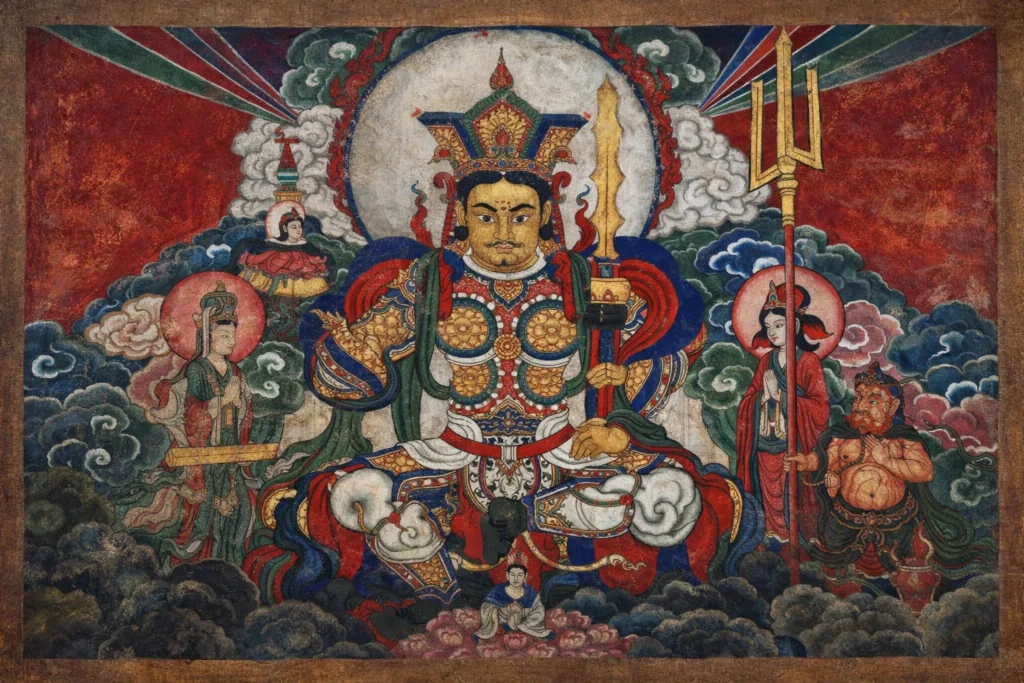
Vaisravana is usually shown with strong warrior themes, though local art styles add their own touches. In traditional Buddhist art, he has a golden-yellow skin tone, which symbolizes his connection to the sun and to valuable metals. He is almost always dressed in heavy armor, with decorated breastplates, greaves, and a flowing scarf.
In China and Japan, Vaisravana is shown with a fierce look, often with a dark beard and bulging eyes to scare away evil spirits. He usually has a small stupa, or pagoda, in his left hand to represent the Buddha’s teachings.
In his right hand, he might hold a halberd, spear, or victory banner. In Tibetan art, he is often seen riding a snow lion and holding a mongoose that spits out jewels, showing his role as a giver of endless wealth.
Origins
The first records of Vaisravana appear in the Agamas and early Sutras of the Pali Canon, where he is one of the four kings who visit the Buddha after his enlightenment.
His story is linked to the way Buddhism absorbed the ancient Indian yaksha cults. Yakshas were local earth and tree spirits that people tried to please. By making their king into a “Heavenly King,” Buddhism turned these local fears into a system of protective guardians.
As Buddhism spread into Central Asia, especially in the Kingdom of Khotan, Vaisravana changed from a lesser guardian to a main state deity. Local legends say the royal family came from him. When his story reached China and Japan, he became more closely linked to military victories.
By the Tang Dynasty, people put his image in monasteries and at city gates to protect against both physical and spiritual threats. This change marked his shift from an old Indian nature spirit to a universal protector of both the state and religion.
Vaisravana, the Martial Alchemist
From what I’ve found, the change from the Vedic-Hindu Kubera to the Buddhist Vaisravana is one of the most effective examples of religious adaptation. While many encyclopedias call him just a god of wealth, my look at his early images, especially the 1st-century BCE reliefs at Bharhut, shows he was first seen as a symbol of deep cultural fears.
As the King of the Yakshas, he ruled over the wild and untamed. Early Indians did not see yakshas as friendly; they were blamed for sudden illness and natural dangers. What stands out to me is that Buddhism did not get rid of this “demon king”—it put him to work. By turning a predator into a protector, Buddhism showed that even the wildest forces could be guided by the Dharma.
One of the most interesting parts of his story is the Khutanese Genealogy of the Forehead. In Khotan, a Central Asian kingdom, the royal family claimed they came directly from Vaisravana, who gave birth to an ancestor from his forehead. This marks a turning point, as he shifts from a distant cosmic guardian to a national ancestor.
When I looked at the Suvarnaprabhasa Sutra (Golden Light Sutra), I found that by the Tang Dynasty, Vaisravana was seen not just as a “Much-Hearing” follower of the Buddha, but as a protector backed by the state.
In art, he changed from holding a mongoose, which in India symbolized the destruction of greed, to holding a stupa in East Asia. The stupa symbolizes the safekeeping of wisdom, shifting the focus from wild displays of wealth to the careful protection of religious truth.
From what I’ve seen, the mongoose (nakula) still appears in Tibetan and Himalayan images of Vaisravana, showing a key difference from his East Asian version, Bishamonten. In Tibet’s high mountains, he stays closer to his yaksha roots. Here, he is a “Necessary Evil” who makes earth spirits give up the wealth needed for monks to survive.
In contrast, in Japan, Vaisravana loses his animal companion and is shown with a spear. This change fits a society more worried about military threats than spiritual lack. No matter the symbols, he is a “Sentinel at the Threshold,” turning the scary power of the unknown into something useful and civilized.
Powers and Abilities
His power is much greater than that of ordinary yakshas or Asuras because he is a Deva and serves directly as a protector of the Samyaksambuddha. He leads the “Northern Assembly,” a supernatural force strong enough to defeat whole groups of lesser demons.
- Inexhaustible Wealth: He can give material wealth to good people using his jewel-spitting mongoose.
- Omniscience: As the “Much-Hearing” king, he can sense all sounds and events in his part of the universe.
- Command of the Yaksha Legions: He has complete control over nature spirits and stops them from harming people.
- Spiritual Fortification: He creates a “protective aura” around Buddhist temples and followers, serving as a shield against negative karma.
- Clairaudience: He can hear his followers’ prayers and needs from afar.
You may also enjoy:
Pazuzu: The Ancient Demon Who Fought Evil with Evil
November 4, 2025
Who Is Agares, the Demon of Earthquakes and Deception?
October 13, 2025
Allocer: Great Duke of Hell and the 52nd Spirit of the Ars Goetia
November 17, 2025
Who Is Astaroth in Demonology and the Ars Goetia?
February 20, 2026
Who Was Abezethibou, the Fallen Angel Who Opposed Moses?
October 1, 2025
Who Is Aka Manto, Japan’s Terrifying Red-Cloaked Yōkai?
October 24, 2025
Vaisravana Myths, Legends, and Stories
The Atanatiya Protection in the Digha Nikaya
The Four Great Kings, having stationed a guard and a garrison over the four quarters of the world, approached the Blessed One at Vulture’s Peak. Vaisravana, acting as the primary spokesperson, addressed the Buddha, saying:
“Lord, there are eminent spirits who have no faith in the Word of the Blessed One; there are also eminent spirits who have faith in the Word of the Blessed One. But for the most part, Lord, spirits are finders of little faith in the Word of the Blessed One. And why? The Blessed One teaches a doctrine of abstaining from taking life, from stealing, from sexual misconduct, from lying, and from the use of intoxicants. To these spirits, such a doctrine is unpleasant and distasteful.”
He continued:
“There are, Lord, disciples of the Blessed One who frequent remote lodgings in the forest and jungle. In those places, there dwell formidable spirits who have no faith in the Word of the Blessed One. To give these disciples confidence, I shall provide the Atanatiya protection, so that they may live in peace and be guarded.” Vaisravana then recited the verses of protection: “We pay homage to Vipassi the Buddha, possessed of vision and glory. We pay homage to Sikhi the Buddha, compassionate toward all beings. Homage to Vessabhu the Buddha, washed clean of all passions and possessed of ascetic energy. Homage to Kakusandha the Buddha, the conqueror of the army of Mara. Homage to Konagamana the Buddha, who has shed all defilements and lived the holy life. Homage to Kassapa the Buddha, free from all bonds. Homage to Angirasa, the glorious son of the Sakyas, who taught this Dhamma for the sake of removing all suffering. Those in the world who are extinguished, who have seen things as they really are, they never speak slanders; they are great souls and are without fear.”
Following the recitation, he warned:
“If any spirit, whether male or female, should approach a monk or nun with evil intent while this protection is being recited, that spirit would not gain honor or hospitality in any of our cities. They would not be allowed to enter the assembly of the spirits, nor would they be eligible for marriage or union. Their fellow spirits would heap insults upon them and, eventually, they would have their heads split into seven pieces.”
The Founding of the Kingdom of Khotan
In ancient records of the western regions, it is written that a king of the Li country, advanced in years and without an heir, went to the temple of the Northern Heavenly King to seek a son.
As he offered incense and prostrated himself, the forehead of the golden image of the deity split open. From this opening, a young child appeared, radiating light. The king took the child with great joy and brought him to the palace.
However, the infant refused to drink the milk of any human nurse, and his strength began to fail. Fearing for the child’s life, the king returned to the temple and pleaded for assistance.
In response to his prayer, the earth in front of the statue’s pedestal suddenly swelled and took the form of a human breast. The child immediately began to drink from this miraculous source of celestial milk. Because he was nourished by the earth, he was given the name Sa-nu, and he grew to be a powerful and wise sovereign.
Throughout his reign, he acknowledged the Heavenly King as his true father and the guardian of his lineage. To this day, the people of the region believe that the deity lives within the mountains of the north. When the kingdom is threatened by foreign invaders, a massive golden armored creature is said to appear atop the city walls, brandishing a halberd and causing the enemy horses to stumble and flee in terror.
The Flying Storehouse of Mount Shigi
In the days of the Emperor Daigo, the monk Myoren lived in a small hut on Mount Shigi, where he spent his days in devotion to the image of the Northern Guardian. Myoren possessed a miraculous iron bowl. When it was time for his daily meal, he would send the bowl flying down to the village at the base of the mountain, where a wealthy landlord would fill it with rice.
One day, the landlord, irritated by the bowl’s constant arrival, grabbed the vessel and threw it into the corner of his massive rice storehouse, vowing not to fill it again. Suddenly, the entire storehouse began to tremble.
To the horror of the landlord, the building rose into the air, balanced precariously on the small iron bowl. The storehouse flew over the treetops and ascended the slopes of Mount Shigi, landing softly next to Myoren’s hut.
The landlord climbed the mountain and begged for his rice back, promising to be charitable in the future. Myoren replied: “This is the work of the King who hears all, who does not tolerate the hoarding of wealth while others go hungry. You may have your rice, but it shall return in a way that demonstrates the King’s power.”
Myoren then instructed the landlord to open the storehouse door. One by one, the bales of rice took flight like a flock of birds, soaring through the sky and landing neatly back in the landlord’s courtyard, leaving the landlord and all who witnessed it in awe of the deity’s command over the material world.
Vaisravana vs Other Similar Entities
| Demon Name | Associated Obstacle/Role | Origin/Source | Key Traits/Powers |
| Mara | Temptation and Death | Pali Canon | Illusion, Army of Desires |
| Haryiti | Child-snatching (formerly) | Vinaya Texts | Protection of children |
| Yama | Judgment of the Dead | Vedic/Buddhist Texts | Control over Hell Realms |
| Aravaka | Predatory Violence | Sutta Nipata | Immense physical strength |
| Virupaksa | Guardian of the West | Lotus Sutra | Command over Nagas |
| Virudhaka | Guardian of the South | Golden Light Sutra | Command over Kumbhandas |
| Dhrtarastra | Guardian of the East | Pali Canon | Command over Gandharvas |
| Kumbhira | Protection of Wealth | Yakshavidya | Water-based abilities |
| Pancika | Martial Defense | Gandhara Art | General of Yaksha Armies |
| Vritra | Drought and Obstruction | Rig Veda / Puranas | Weather manipulation |
| Rakshasa | Carnivorous Hunger | Ramayana / Sutras | Shapeshifting, Night-vision |
| Preta | Insatiable Greed | Abhidharma | Invisibility, Hunger |
Mystical Correspondences
| Attribute | Details |
| Planet | Jupiter (Associated with expansion and wealth) |
| Zodiac Sign | Capricorn (Structure and discipline) |
| Element | Earth / Gold |
| Direction | North |
| Color | Yellow, Gold |
| Number | 8 (Associated with the Eight Yaksha Generals) |
| Crystal/Mineral | Topaz or Citrine |
| Metal | Gold |
| Herb/Plant | Bamboo or Pine (Strength in winter) |
| Animal | Mongoose, Snow Lion, or Horse |
| Trait/Role | Wealth, Martial Valor, Protection |
This deity is mainly linked to stability. In the north, a place often seen as cold and mysterious, he acts as a protector. His connection to the color gold and the earth element shows his role as the “Tamer of the Material World,” changing raw resources into spiritual value.
Rituals for this deity often focus on the “Jewel-Spitting Mongoose” to bring prosperity. Unlike demonic figures, he stands for order, discipline, and turning wild energy into organized abundance. He connects the wild spirits of the forest with the orderly heavens.
You may also enjoy:
Nasnas: The Monstrous Demon Hybrid That Haunted Pre-Human Earth
November 12, 2025
Hitotsume kozō: One-Eyed Yōkai of Japanese Folklore
February 4, 2026
Who Is Andromalius, and Why Is He the Last Demon of the Goetia?
January 20, 2026
Marid: The Ocean Jinn That Defies Heaven and Earth
September 30, 2025
Edimmu: The Mesopotamian Wind Demon That Steals Life
November 6, 2025
Who Is the Jann in Islamic Mythology and Why Is He Feared?
October 2, 2025
Bibliography
Author’s Note: My focus was on how Vaisravana transitioned from a “tamed” predator in the Atanatiya Sutta to a divine king in the Suvarnaprabhasa Sutra. By comparing the realistic details in the Shigisan Engi Emaki with the family stories in the Li-yul-gyi-lo-rgyus, I found a clear link between monastic miracle stories and national myths. This method highlights how his role changed over time to help both local communities and rulers.
- Aggacitta Bhikkhu, translator. Discourse on Atanatiya Protection. Edited by Looi Sow Fei, Kumara Bhikkhu, and Ang Siew Mun, Sasanarakkha Buddhist Sanctuary, 2003. Sasanarakkha.org.
- Tan, P. B. The Golden-Illumining Scripture (Suvarṇaprabhāsottama-Sūtra). 2025. Academia.edu.
- Gummer, Natalie. Suvarṇabhāsottamasūtra. Brill’s Encyclopedia of Buddhism, Volume One: Literature and Languages, Edited by Jonathan Silk, Oskar Von Hinüber, and Vincent Eltschinger, 249-260. Leiden: Brill, 2015.
- Zhu, Lishuang. The Annals of the Noble Land Khotan. Great Journeys across the Pamir Mountains. Academia.edu.
- Kern, H., translator. Saddharma-Puṇḍarīka; or, The Lotus of the True Law. Dover Publications, 1963. Internet Archive.