Western ghost stories usually focus on spirits haunting certain places or leaving behind lingering energy. However, the Yūrei in Japanese mythology highlight the unresolved emotions of the person who died. These spirits are defined by the reasons they stay, not by their location.
Looking at how beliefs shifted from Buddhist ideas about the afterlife to Edo-period stories of revenge, we see a unique perspective: the restless spirits are understood as the result of strong, lingering resentment (onen) that persists beyond death.
To keep the article accurate, I cross-referenced the information to the style of Ugetsu Monogatari. I focused on the mood and psychological depth found in 18th-century ‘scholar-ghost’ tales, rather than using modern horror clichés. [View Full Bibliography ↓]
Summary
Key Takeaways
| Attribute | Details |
| Names | Yūrei, Bōrei, Shiryō, Onryō (vengeful), Ubume (birthing ghost), Funayūrei (mariner ghost). |
| Translation | The term translates literally to “faint spirit” or “dim soul.” |
| Title | Restless Souls, Departed Spirits. |
| Type | Yūrei (This is a primary category of Japanese folklore distinct from Yōkai). |
| Spirit Classification | Typically categorized as Ara-mitama (rough/violent spirit) when vengeful, or Goryō (vengeful spirits of aristocrats). |
| Origin | A human who has died under sudden, violent, or emotionally traumatic circumstances without proper funeral rites. |
| Gender | Can be male or female, though female depictions are significantly more prevalent in art and literature. |
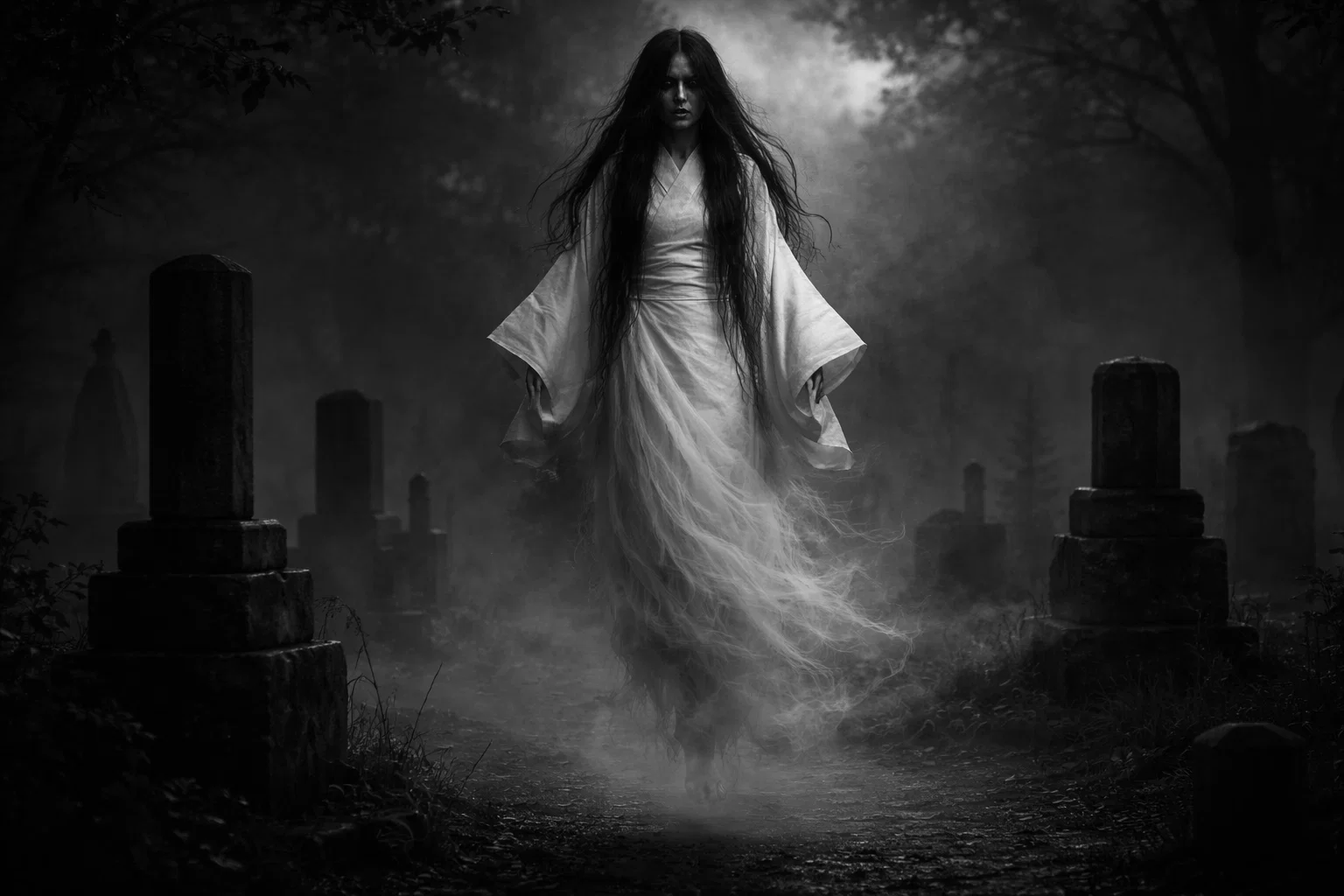
| Appearance | Traditionally depicted in white burial kimonos (katabira) with long, disheveled black hair and a lack of lower limbs. |
| Kehai (Presence) | Preceded by a sudden drop in temperature, the appearance of hitodama (floating blue or purple fireballs), and the sound of soft weeping or rustling silk. |
| Powers/Abilities | Intangibility, psychological torment, manipulation of the elements (water/fire), and the ability to place powerful curses. |
| Methods of Pacification | Performance of segaki (feeding hungry ghosts) rituals, application of ofuda (paper charms), chanting Nembutsu, or resolving the spirit’s emotional attachment. |
| Habitat | Liminal spaces such as graveyards, riverbanks, old wells, or the specific sites of their death or emotional attachment. |
| Diet/Prey | Does not consume food; targets those responsible for their suffering or those who disturb their rest. |
| Symbolic Item | Hitaikakushi (triangular white forehead paper) and the yanagi (weeping willow tree). |
| Symbolism | Represents the consequences of unresolved injustice, the power of negative emotions, and the necessity of proper burial rites. |
| Associated Kami | Often associated with Enma-ō (Judge of the Dead) or Jizō Bosatsu (protector of souls). |
| Sources | Nihon Ryōiki, Konjaku Monogatari, Ugetsu Monogatari, and numerous Kabuki/Bunraku plays. |
The Restless Dead
These spirits are the remains of people who have died but cannot move on to the afterlife. Unlike most yōkai, which often come from nature or objects, the Yūrei are always human. They stay in the world because of lingering attachments (reiren) or obsessions (shūjaku). They appear to ask for justice, finish something left undone, or show the pain of their death.
Among Japanese supernatural beings, the Yūrei are known for their strong emotions. Some appear as gentle figures wanting to say goodbye. Still, the most famous are vengeful ghosts who try to make others suffer as they did. Their stories remind people how close the worlds of the living and the dead are, and why it is important to keep harmony and respect those who have passed away.
Semantic Origins
The word comes from two kanji: yū (幽), which means ‘faint,’ ‘dim,’ or ‘hidden,’ and rei (霊), which means ‘soul’ or ‘spirit.’ It originally described a soul that became lost or hidden between worlds. Early Japanese texts like the Nihon Shoki used words like shiryō (spirit of the dead). Still, the term we use now became common during the Edo period (1603–1868).
Different words show what kind of haunting is happening. For example, Onryō uses the kanji for ‘resentment’ or ‘grudge,’ and refers to a spirit driven by revenge. Kosodate yūrei means ‘child-rearing ghost,’ describing a kinder spirit.
The word transformed over time as ghost stories (Kaidan) became popular, and it was used to describe the unique look and actions of ghosts in art and theater.
How to Pronounce “Yūrei” in English
In English, this word is pronounced ‘yoo-ray.’ The first part sounds like ‘you,’ and the second part sounds like ‘ray.’ In Japanese, the ‘u’ is a long vowel, often shown with a line over the letter to lengthen the sound.
What Do They Look Like?
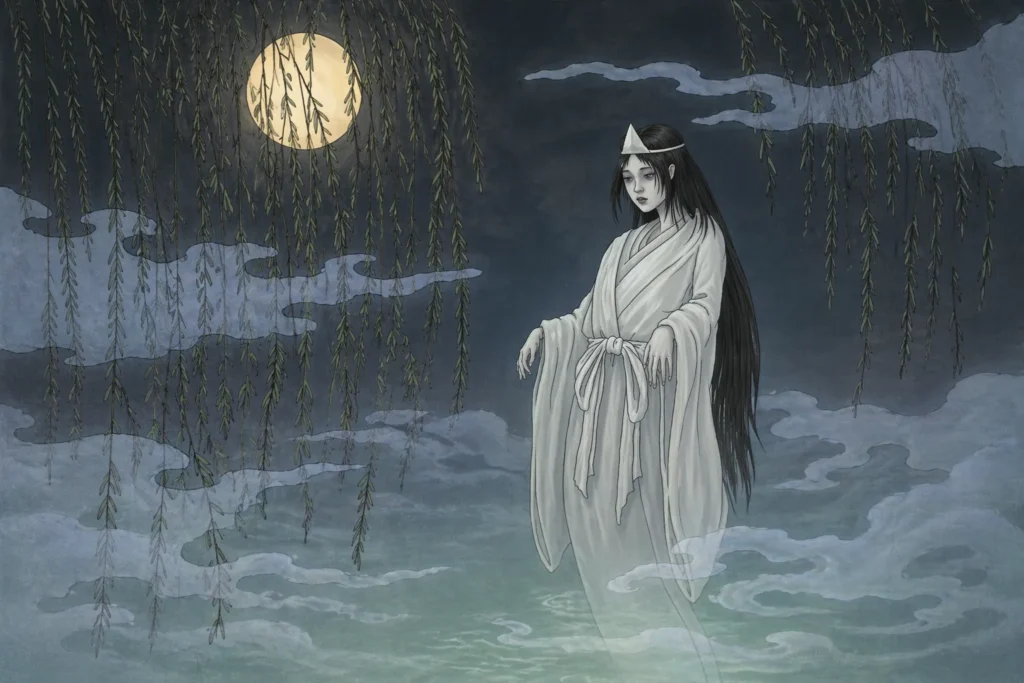
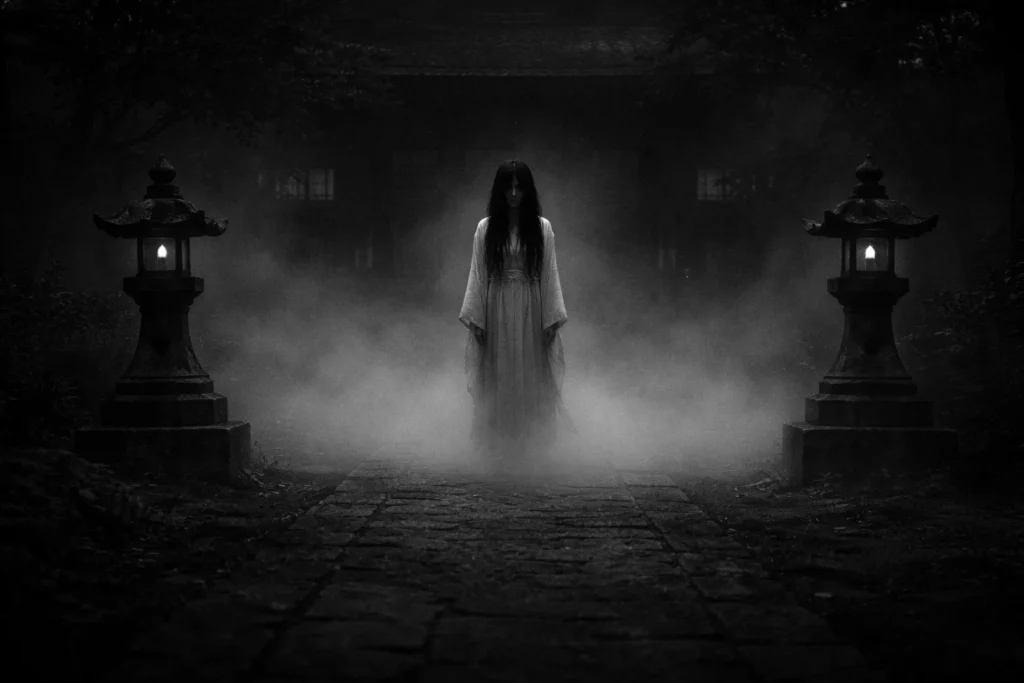
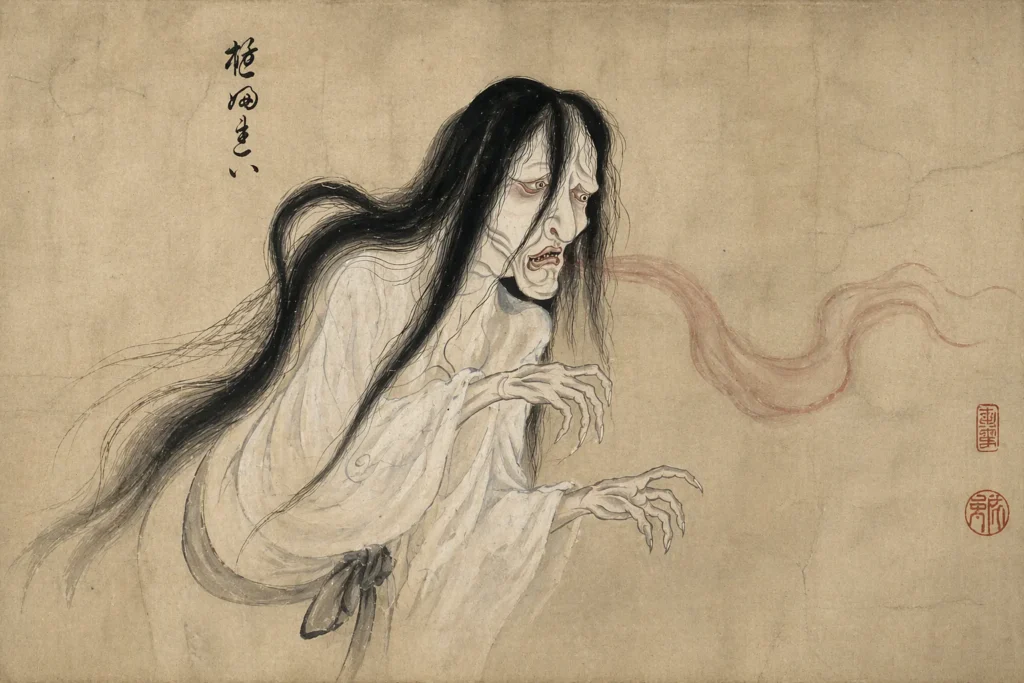
The way the Yūrei look is mostly based on 18th-century art. They are usually shown wearing a white kimono called a katabira or kyōkatabira, which is a burial robe folded right-over-left (the opposite of how living people wear it).
On their forehead, they often have a small, triangle-shaped piece of white paper or cloth called a hitaikakushi, meant to protect the soul or show they are in a state of transition.
One key feature is their hair, which is usually long, black, and messy. In the Heian period, noblewomen grew their hair very long and left it loose for burial. As ghosts, the Yūrei’s hair flows wildly, showing their troubled emotions.
The most noticeable feature is that they have no feet. In many artworks, the ghost fades into a mist or see-through trail below the waist, showing they are not connected to the earth. Their hands hang loosely, and their skin looks pale, bluish, or see-through.
You may also enjoy:
Who Is Astaroth in Demonology and the Ars Goetia?
February 20, 2026
Who Is Abaddon, the Demon of the Abyss, in the Bible?
September 29, 2025
Abura-sumashi: The Potato-Headed Yōkai That Punishes Greed
October 23, 2025
Lamia: The Queen Cursed to Devour the Children of Others
January 7, 2026
Banasura: The Thousand-Armed Demon King
October 10, 2025
Arāti: The Beautiful Demon of Aversion in Buddhist Mythology
October 15, 2025
Origins and History
The idea of restless spirits comes from old Shinto beliefs about the soul (tama), later mixed with Buddhist ideas.
Traditionally, people believed that after death, the soul waits in a state of transition. If someone dies peacefully and gets the right funeral, their soul joins their ancestors. But if the death is sudden or the funeral is not done properly, the soul becomes ‘heavy’ and cannot cross the Sanzu River.
In the Edo period, Japan became more urban, and merchant culture grew. During this time, people enjoyed a game called Hyakumonogatari Kaidankai, in which they would tell 100 ghost stories together.
This trend, along with the work of ukiyo-e artists like Maruyama Ōkyo and Katsushika Hokusai, set the standard for how spirits looked and acted. The peaceful Edo period made people more interested in ghost stories, which became popular entertainment and often addressed the unfair treatment of women or the harsh rule of rulers.
From my research, I think these spirits reflect the shared guilt and worries of a strict class system. Interestingly, the first stories about them appeared in literature at the same time as economic pressures on lower classes and women grew in the late 1700s.
These stories gave a voice to people who had no power or rights in life, showing that after death, the powerless could become strong. I think the ‘lack of feet’ in most images depicting the Yūrei represents both their spiritual state and their lack of social status or ‘grounding’ in the old class system.
Historical & Folkloric Sources
While the term does not appear in the foundational Kojiki or Nihon Shoki in its modern sense, the historical record of these spirits begins in the 8th Century within the Nihon Ryōiki, the earliest collection of Japanese Buddhist parables.
“In the fourth year of the reign of Empress Genshō, in the village of Keta in the district of Hagui in the province of Noto, there lived a man of the Abe clan… After his death, his wife did not perform the service for the first seven-day period. Then the dead man appeared to his wife in a dream and said: ‘Because you have not performed the service for me, I have become a hungry spirit and am suffering greatly. If you do not perform the service soon, I will take you with me.'” [Nihon Ryōiki (Miraculous Stories from the Buddhist Tradition in Japan), compiled by the monk Kyōkai, c. 822 CE]
In this early story, the Yūrei is described as ‘hungry’ for rituals, not for revenge or violence.
The ghost appears in dreams, not in a solid form that people can see when awake. It exists in the mind of the living person. The main issue is that the living failed to perform the right funeral rituals, which were very important in the Nara and Heian periods for helping the soul move on.
This story uses words like shiryō (spirit of the dead) and gaki (hungry ghost), focusing on the soul’s condition rather than how it looks. The Yūrei’s warning is a spiritual demand—the wife is not punished for a crime, but for failing to perform the proper rituals. This sets the main rule in Japanese ghost stories: the dead stay behind when the living neglect them.
“The spirit of the Late Emperor [Sutoku] has transformed into a great eagle-like monster, and his resentment is such that he has sworn to become a great demon of Japan, to turn the world upside down, and to take vengeance upon the court… He bit his tongue, wrote a curse in his own blood upon the sutras, and died in a state of supreme fury.” [Hōgen Monogatari (The Tale of the Disorder of the Hōgen Era), c. 1320 (describing events of 1156)]
This story shows how ghosts became connected to politics. Emperor Sutoku’s transformation into a spirit is different from the earlier ‘dream-ghost.’ He becomes a Goryō, a powerful spirit whose strong resentment (onen) can affect the weather, crops, and even the government.
The description of him as ‘eagle-like’ with long nails and hair connects him to the Tengu, showing that the line between human ghosts and monsters was not clear at that time.
Using blood to write a curse became a new way to start a haunting, showing that it was now about strong emotions at death, not just missed funerals. This idea led to later ‘Grudge’ stories, in which the dying person’s feelings determine the haunting’s power.
“The woman’s face was as pale as the moon, and her hair hung in wild disarray about her shoulders. ‘I have waited for you through the long autumn nights,’ she whispered, and though her voice was as thin as the wind, it chilled his very marrow. He realized then that the house was in ruins, and the woman he embraced was but a shadow of a promise unkept.” [Ugetsu Monogatari (Tales of Moonlight and Rain), “The House Amid the Reeds,” Ueda Akinari, 1776]
In this fragment, we see a more refined image of the Yūrei. Influenced by Chinese ‘scholar-ghost’ tales and Gothic themes, Ueda Akinari portrays the spirit as a sad reminder of the past rather than a terrifying monster. The ‘ruined house’ represents the Buddhist idea of mujō (impermanence), with the ghost representing memories that won’t disappear.
The ‘pale face’ and ‘messy hair’ described here became the usual way to show ghosts. People in Edo were fascinated by ghost stories (Kaidan). In a busy city, the idea of a ghost living in an old, quiet house stood out against the lively ‘Floating World.’
“Kohada Koheiji was a man of small talent who was murdered by his wife and her lover. In his skeletal form, he returns to peer through the mosquito netting, his bony hands pulling back the fabric to gaze upon the guilty pair with eyes that no longer have lids.” [Description of the legend depicted in ‘Kohada Koheiji’ from the series One Hundred Ghost Tales (Hyaku Monogatari), Katsushika Hokusai, 1831]
Hokusai’s image of Koheiji is a classic example of horror focused on the body. By this time, ghosts were no longer seen as beautiful or sad, but as truly frightening.
The ‘mosquito net’ is important in Japanese culture; during hot summers, people told ghost stories to feel a chill, and the net was a thin barrier. A ghost looking through it showed that even in private, you are not safe from spirits.
The transition from a ‘shadowy woman’ to a ‘skeletal entity‘ shows the impact of Kabuki theater, where actors used dramatic makeup and stage tricks to surprise people. Hokusai’s use of Prussian Blue, a color linked to the strange and ghostly, helped make blue-white the standard color for these spirits.
Habitat
Yūrei are usually tied to the place where they died or where something traumatic happened to them. Wells often appear in stories, symbolizing a deep, dark path to the underworld and a place where bad things happen. Riverbanks and bridges are also common, as they are seen as borders between the living and the dead.
These spirits can also appear in traditional Japanese homes, especially near the hearth or in bedrooms, where they might visit family members or new residents.
In the countryside, the Yūrei are linked to willow trees (yanagi), which are believed to attract ghosts because their drooping branches look like a ghost’s hair and robes.
Famous Legends and Stories
The Plate Mansion at Banchō (Banchō Sarayashiki)
In Edo’s Banchō district, the proud samurai Aoyama Tessan lived in a grand manor.
One of his servants was Okiku, a young woman known for her delicate beauty. She was responsible for ten precious Dutch plates, treasured by the Aoyama family. Tessan became obsessed with Okiku and tried to make her his concubine. Still, she refused him again and again, holding firm to her values.
Tessan, angry and vengeful, decided to break Okiku’s spirit. He secretly hid one of the plates and called Okiku to count them. “Count them,” he said coldly. Okiku sensed something was wrong as she began: “One… two… three… four… five… six… seven… eight… nine…” She stopped, shocked. She counted again, her hands shaking, but there were still only nine.
“The tenth plate is missing, Okiku,” Tessan said. “Losing a treasure from this house means death. But if you agree to be mine, I’ll say the plate was only misplaced.” Even when threatened, Okiku refused. Furious, Tessan killed her and threw her body into the deep well in the garden.
Not long after, strange things started happening. Each night when the moon was high, a cold blue light shone from the well. A ghost with tangled hair would climb out and start to count in a rough, sad voice: “One… two… three…” She would sob with each number. “Seven… eight… nine…”
When she reached the missing number, the ghost would scream in despair, a sound that echoed through Banchō, then disappear back into the well. This happened night after night until a family friend, a brave priest, hid by the well. When the spirit cried “Nine!”, the priest jumped out and shouted “TEN!” loudly.
The spirit, at last feeling at peace, bowed her head and vanished. She was never heard counting again.
The Ghost Story of Yotsuya (Tōkaidō Yotsuya Kaidan)
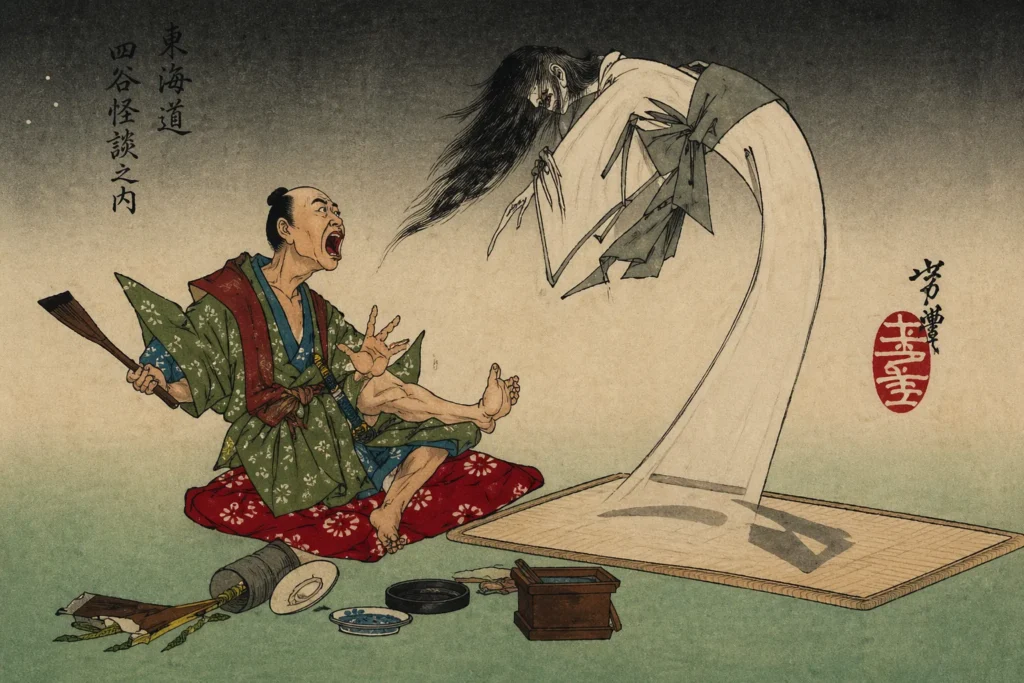
Oiwa was a good-hearted woman married to Tamiya Iemon, a poor but ambitious rōnin. Even though they lived in poverty, and Oiwa was left weak after giving birth, she stayed loyal to her husband. Their neighbor, the rich Itō Kihei, wanted Iemon to marry his granddaughter Oume. Kihei sent a “medicinal” cream to the Tamiya home, saying it would help Oiwa recover.
But the cream was actually poison. When Oiwa put it on her face, her skin burned and melted. Her right eye drooped, her forehead swelled, and her hair fell out in bloody clumps. When Iemon came home, he felt disgust instead of pity. He saw her condition as a way out. He sold the house’s screens for sake, leaving Oiwa exposed to the cold.
When Oiwa discovered Iemon’s betrayal and his plan to marry Oume, she ran to a mirror. Horrified by her reflection, she tripped and fell onto a sword, dying while cursing Iemon. On his wedding night with Oume, Iemon lifted her veil and saw Oiwa’s decaying face staring back at him.
Panicking, Iemon drew his sword and attacked, only to realize he had killed Oume. He ran to the Yotsuya bridge, but everywhere he looked, things became strange. A paper lantern split open, and Oiwa’s face appeared in the fire, her one eye following him. Her hair seemed to grow from the floor, wrapping around his feet until he lost his mind.
The Peony Lantern (Botan Dōrō)
On the first night of the Obon festival, the widower Hagiwara Shinzaburō sat alone in his garden in Negishi. Suddenly, he heard the clack-clack of wooden sandals.
Two women appeared: a beautiful woman named Otsuyu and her young maid, who carried a red peony-shaped lantern. Otsuyu said she had admired Shinzaburō for a long time, and they spent the night talking quietly and making shadows.
The women came back every night. Shinzaburō’s neighbor, Tomozō, grew suspicious of these visits. One night, he looked through a hole in the wall and was shocked. While Shinzaburō saw a lovely woman by his side, Tomozō saw a white, grinning skeleton. The maid was actually a small, mossy corpse holding a lantern that gave off a sickly light.
Tomozō warned Shinzaburō, who then asked a Buddhist priest for help. The priest gave him ofuda, sacred yellow paper charms, to seal every window and door.
“Do not let them in, and do not look out,” the priest said. For several nights, the sound of sandals circled the house. Otsuyu’s voice cried through the walls, begging to be let in. Finally, the spirits offered Tomozō a pile of gold to remove one charm from the window.
Tomozō, tempted by greed, pulled off the charm. The next morning, the neighbors found the house quiet. Shinzaburō was dead in his bed, his body cold and shriveled, wrapped in the arms of a skeleton whose bones were decorated with pieces of a peony lantern.
You may also enjoy:
Apophis: The Great Serpent of Egyptian Chaos
November 11, 2025
Who Was Ravana in Hindu Mythology and Why Was He Feared?
October 3, 2025
Who Is Adrammelech in Demonology and the Bible?
October 1, 2025
Who Is Barqan, The Powerful Jinn King?
March 12, 2026
Who Was Hiranyakashipu, the Demon King of Hindu Mythology?
October 6, 2025
Powers and Abilities
The Yūrei have many supernatural powers, but they usually affect the mind and atmosphere rather than causing physical damage like the Oni do. Their main strength is changing the environment and influencing people’s thoughts.
While an Oni might break a house, the Yūrei might drive people mad or make them sick.
- Intangibility: They can pass through solid objects and are immune to conventional physical weapons.
- Onen (Resentment Projection): The ability to manifest a curse (shushin) that affects the health, luck, or sanity of the target.
- Phantasmagoria: Creating vivid hallucinations, often making a person see a loved one as a monster or vice versa.
- Elemental Control: They are frequently associated with manipulating water or manifesting hitodama (spirit fire).
- Teleportation: Moving instantly between the site of their death and the location of their target.
Traditional Defenses
To protect yourself from these spirits, you need spiritual or ritual help, not physical force.
The most common way is to use ofuda, which are paper charms with a deity’s name or a sacred phrase. Placing them on doors and windows keeps the ghosts out. Buddhist priests also perform the segaki ritual, offering food and prayers to ‘hungry ghosts’ to help them move on.
In folk customs, people use salt to purify spaces, often sprinkling it at doorways or after funerals to keep spirits away. Reciting sacred texts such as the Heart Sutra or the Nembutsu is believed to calm angry ghosts.
Sometimes, the only way to get rid of a spirit is to solve what keeps it here, such as finding a lost item, giving a proper burial, or making sure justice is done.
Yūrei vs Similar Spirits
| Name | Category | Origin | Threat Level | Escape Difficulty |
| Oni | Yōkai | Manifestation of evil or a transformed human. | High (Physical) | Moderate; can be fought or tricked. |
| Kappa | Yōkai | A water deity that lost its status. | Moderate | Easy; bow to make it spill its water. |
| Yuki-onna | Yōkai | Spirit of the snow/winter. | High | Difficult; it depends on her whim. |
| Kuchisake-onna | Urban Legend | A woman was mutilated by her husband. | Extreme | Very Hard; requires specific answers. |
| Teke Teke | Urban Legend | Woman cut in half by a train. | Extreme | Hard; she is exceptionally fast. |
| Rokurokubi | Yōkai | Human cursed by karma or disease. | Low | Easy; usually harmless, just scary. |
| Gashadokuro | Yōkai | Mass of bones from unburied dead. | Extreme | Very Hard; it is a giant physical force. |
| Zashiki-warashi | Yōkai | Spirit of a child in a house. | None | N/A; they bring good fortune. |
| Futakuchi-onna | Yōkai | Woman with a second mouth. | Moderate | Moderate; related to food and neglect. |
| Noppera-bō | Yōkai | Faceless spirit of unknown origin. | Low | Easy; they only seek to frighten. |
| Ubume | Yūrei | A woman who died in childbirth. | Low/Med | Moderate; she usually seeks help. |
| Funayūrei | Yūrei | Souls of those drowned at sea. | High | Hard; they try to sink ships. |
Symbolism
| Attribute | Details |
| Element | Water (Associated with wells, rain, and the Sanzu River). |
| Animal | Snake or Crane (Representing transformation and the soul). |
| Cardinal Direction | North-East (Kimon, or the Demon Gate). |
| Color | White (The color of death and mourning in Japan). |
| Plant | Yanagi (Weeping Willow) or Higanbana (Spider Lily). |
| Season | Summer (The time of the Obon festival). |
| Symbolic Item | Hitaikakushi (Triangular forehead shroud). |
In Japanese culture, the Yūrei show that human emotions can last beyond death. They often stand for people who had no voice in life, acting as a form of social criticism. These stories remind society that cruelty, betrayal, and neglect have lasting spiritual effects.
These spirits are important in the Obon festival, held in mid-summer when people believe their ancestors return. Families light fires and leave offerings to help guide the spirits home and keep them at peace.
In art, the image of a pale woman with long hair has become a worldwide symbol of horror, inspiring movies and books by playing on the fear of being haunted by the past. These stories also highlight the importance of harmony (wa) and the need for communities to care for both the living and the dead.
You may also enjoy:
Apophis: The Great Serpent of Egyptian Chaos
November 11, 2025
Abura-sumashi: The Potato-Headed Yōkai That Punishes Greed
October 23, 2025
What Is a Bhuta? The Backward-Footed Ghosts of Hindu Horror
February 5, 2026
Agubanba: The Blind Yōkai That Preys on Young Women
October 23, 2025
Abura-akago: The Bizarre Oil-Licking Yōkai
October 22, 2025
Bibliography
Author’s Note: While tracing the history of these ghosts, I noticed that stories transformed from early Buddhist tales about ‘hungry spirits’ to later, more detailed and frightening images in Hokusai’s art. I focused on the storytelling style of Ugetsu Monogatari to show the deep psychological impact of these hauntings, as these works connect religious warnings with literature. By examining how Emperor Sutoku’s political troubles gave rise to stories like Oiwa’s, I created a timeline showing how personal grief became a well-known cultural symbol.
- James, Grace, Basil Hall Chamberlain, and Lafcadio Hearn. Japanese Fairy Tales. Project Gutenberg, 2006.
- Ueda, Akinari. Tales of Moonlight and Rain. Edited and translated by Anthony H. Chambers, Columbia University Press, 2007. Internet Archive.
- Aston, W. G., translator. Nihongi: Chronicles of Japan from the Earliest Times to A.D. 697. Kegan Paul, Trench, Trübner & Co., 1896. Internet Archive.
- Marks, Andreas. Japanese Yōkai and Other Supernatural Beings: Authentic Paintings and Prints of 100 Ghosts, Demons, Monsters, and Magicians. Tuttle Publishing, 2023.
- Wilson, William R., translator. Hōgen Monogatari: Tale of the Disorder in Hōgen. Cornell University East Asia Program, 2001. Cornell East Asia Series 99. Internet Archive.
- Davisson, Zack. (2026). The Persistence of Yōkai. Education About Asia. 29. 10.65959/eaa.1847. ResearchGate.
- Bradt, Aaron. The Role of Yokai in Japanese Myth. 2016. Academia.edu.
- Foster, Michael Dylan. The Book of Yokai: Mysterious Creatures of Japanese Folklore. University of California Press, 2015. Internet Archive.
- Johnson, Adam J. The Evolution of Yōkai in Relationship to the Japanese Horror Genre. 2021. University of Massachusetts Amherst, Capstone Project. ScholarWorks@UMass Amherst.