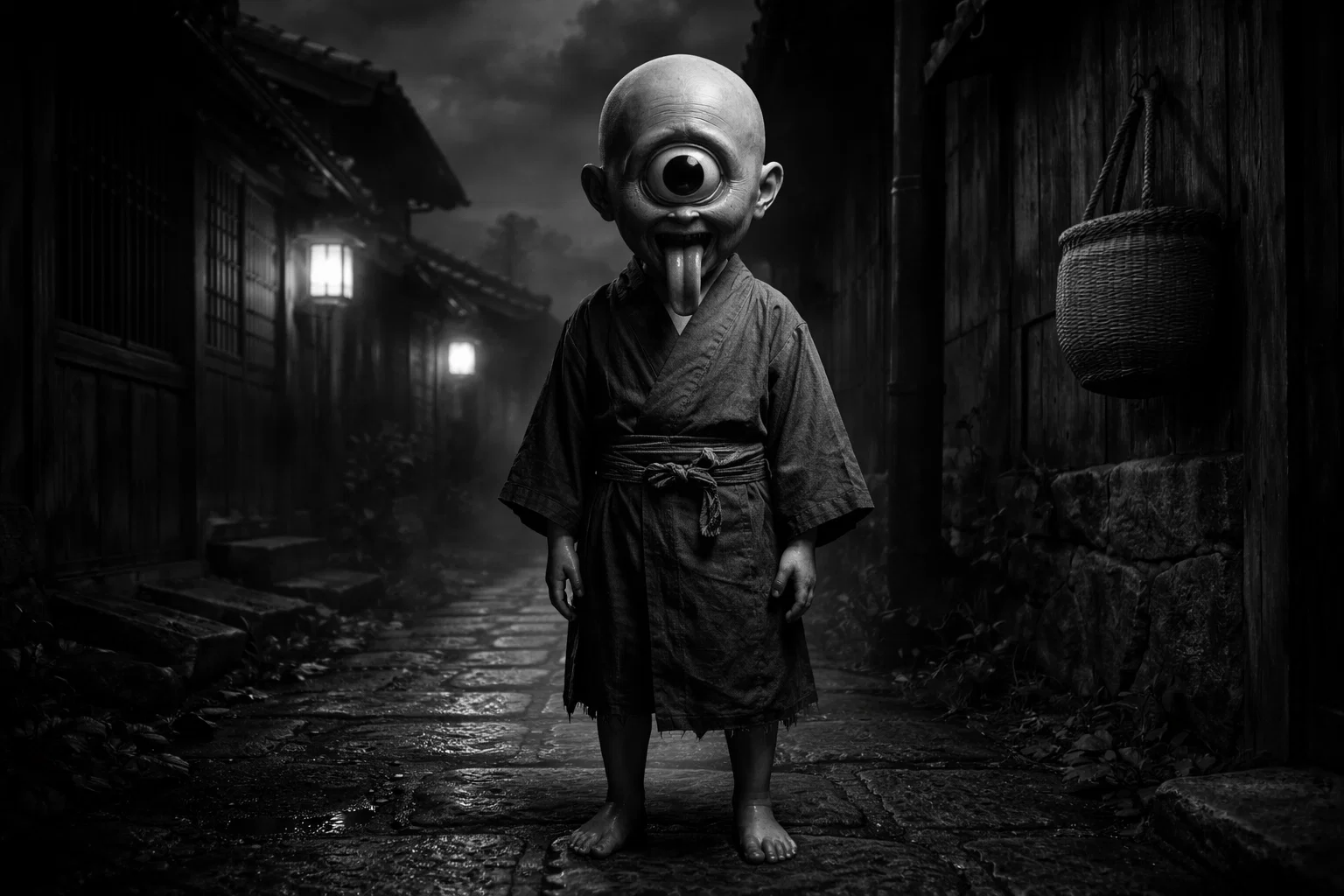

Hitotsume kozō is a well-known Japanese yōkai that appears as a small child with a single large eye in the middle of its face. It is not considered dangerous and mostly likes to surprise people.
Although they do not cause physical harm, Hitotsume kozō are linked to bad luck and are said to report household misbehavior to the gods. People often spot them in cities, dark alleys, or near homes on certain ritual nights.
Summary
Key Takeaways
| Attribute | Details |
| Names | Hitotsume kozō, One-eyed boy, Ichime-kozō |
| Translation | One-eyed priest boy or one-eyed youngster |
| Title | The One-Eyed Goblin |
| Type | Obake (shapeshifter) / Bakemono |
| Origin | Often associated with fallen mountain deities or transformed monks |
| Gender | Male |
| Appearance | A bald child with a single giant eye and a long protruding tongue |
| Powers/Abilities | Surprise tactics, recording human behavior, shapeshifting |
| Weaknesses | Woven bamboo baskets (zaru), high-mesh sieves |
| Habitat | Dark streets, abandoned temples, residential gardens |
| Diet/Prey | Does not consume humans; sometimes associated with beans or offerings |
| Symbolic Item | Bamboo sieve or basket (as a deterrent) |
| Symbolism | The transition from ancient gods to folklore monsters; household surveillance |
| Sources | Buson Yōkai Emaki, Kyōka Hyaku Monogatari, Tōno Monogatari |
Who or What is Hitotsume Kozō?
Hitotsume kozō looks like a young boy around ten years old, with a shaved head like a Buddhist novice. Its main feature is a single large eye in the middle of its forehead. It is often shown wearing a wide straw hat or traditional robes. Unlike more dangerous yōkai found in the wild, this one is mostly known for playing pranks.
This spirit is often grouped with other one-eyed creatures in Japanese myths, many of which are connected to old mountain gods who lost their importance over time. In many areas, seeing a Hitotsume kozō is thought to be a sign or omen.
It does not bite or scratch, but its main way of interacting with people is by suddenly appearing and giving them a fright, often when someone turns a corner or looks into a dark garden.
MEET THE MONSTERS THAT HAUNT JAPAN Limited-Time: Up to 28% OFF!
Kappa • Yuki-onna • Tanuki • Kitsune • Hundreds more legendary spirits Hilarious, horrifying, and downright bizarre tales from Japan’s shadow side. Fully illustrated encyclopedia by Thersa Matsuura – your passport to the world of yōkai. Anime origins • Real folklore • Things that go bump in the tatami. Dare you invite them in?
“Hitotsume kozō” Meaning
The name Hitotsume kozō comes from the Japanese words hitotsu (one), me (eye), and kozō (a young monk or boy). Originally, kozō referred to young helpers in Buddhist temples who had not yet taken full vows, but over time it came to mean any young boy. The name literally means “one-eyed priest boy.”
In some local dialects, especially in the Kantō region, the name stays the same, but the yōkai’s role changes. The word’s origin suggests it may come from stories about young monks who did not finish their training or were changed by spiritual problems.
In the past, one-eyed figures in Japan, called hitotsume, were often linked to the smithing god Amenoma-hitotsu-no-kami or to mountain spirits. As these old beliefs faded during the Edo period, the once-powerful one-eyed god came to be seen as the playful, bald-headed boy we know today.
How to Pronounce “Hitotsume Kozō” in English
In English, you say the name as hee-to-tsu-meh koh-zoh. The “hi” is like the “he” in “heat.” The “tsu” sounds like the end of “cats.” The “me” is like “met” without the “t,” and “kozō” has two long “o” sounds, like in “go.”
What Does Hitotsume Kozō Look Like?
Hitotsume kozō has looked the same in Japanese art and stories for hundreds of years. It is almost always shown as a small boy with a shaved head, wearing Edo-period clothes like a kimono or a short cloak. In many ukiyo-e prints, it wears a big straw hat called a ronin-gasa, which it uses to hide its face before showing its single eye.
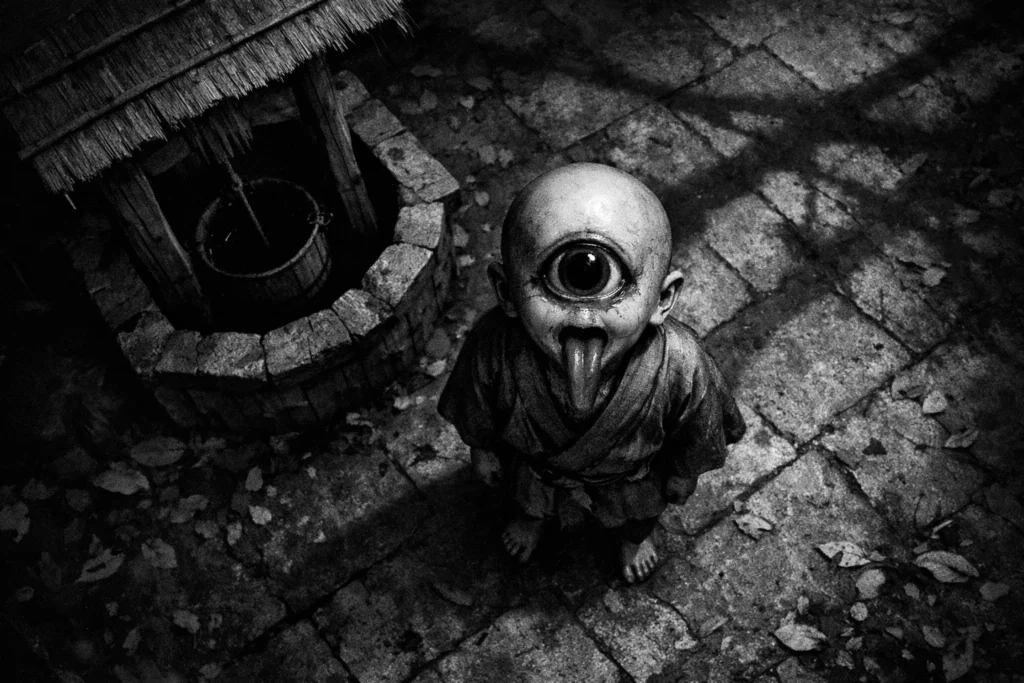
Its face has one big eye with a dark pupil and a wide iris, centered where the nose would be. Another common feature is a long, bright red tongue that often protrudes from its mouth.
The rest of its body looks human, but in some art, its skin is a bit pale or has a blue tint. It is about the size of a child between eight and twelve years old. Unlike the bigger and scarier Hitotsume-nyūdō, the kozō version looks young and not threatening.
You may also enjoy:
Who Is the Demon Andras, The Great Marquis of Discord?
January 15, 2026
Ambri: The Imperial Duchess of Caspiel’s Empire
December 1, 2025
The Ghul: The Flesh-Eating Demon of Arabian Folklore
October 1, 2025
Allocer: Great Duke of Hell and the 52nd Spirit of the Ars Goetia
November 17, 2025
Alû: The Mesopotamian Demon of Malevolence and Pestilence
November 10, 2025
Ifrit: Demon of Fire Who Serves Iblis in Islamic Tradition
September 30, 2025
Habitat
Hitotsume kozō mostly live in cities and towns. They are rarely seen in deep forests or high mountains, as they prefer places where they can meet and scare people. People often spot them in dark alleys, near old temples, or at the entrances of homes.
In the Edo period, people often reported seeing them in the busy streets of Edo, which is now Tokyo. In some regions, they are linked to the hearth and home. In the Kantō area, they are said to visit houses on the 8th day of the 12th month and the 8th day of the 2nd month, known as the Koto-yatsuka days.
They like to stay in the dark to make their surprise more effective, so they often hide in the shadows of buildings or under the eaves.
Origins and History
The history of Hitotsume kozō is closely tied to changes in Japanese religion. In old Shinto beliefs, one-eyed beings were often seen as gods, or “kami.”
This idea may come from rituals or jobs like blacksmithing, where people sometimes lost sight in one eye from working near hot fires. As Japan entered the Edo period, many of these old gods were seen as yōkai instead.
Hitotsume kozō became a common creature in lending libraries and Ukiyo-e art. Parents used stories about it as a “bogeyman” to make sure children behaved or stayed inside at night.
In the Edo period, it was so famous that it showed up in toy prints and card games like Karuta. Its story is also connected to Koto-gami rituals, where it acted as a messenger for the gods, keeping track of families’ behavior to report to the heavens.
Sources
The Hitotsume kozō appears in numerous classical scrolls and texts from the Edo period and beyond.
| Source | Quote |
| Buson Yōkai Emaki | “The Hitotsume kozō appears suddenly from the shadows to lick the steam from a hot pot or startle a passerby.” |
| Kyōka Hyaku Monogatari | “A small child with a single eye, known to haunt the outskirts of the capital and peek through the paper doors of the unwary.” |
| Tōno Monogatari | “In the mountains of Tōno, it is said that the one-eyed boy is a remnant of the old mountain spirits who have lost their power.” |
1,000+ SPIRITS, GODS & GODDESSES AWAITING YOUR CALL. Limited-Time: Up to 49% OFF!
The ultimate global spirit encyclopedia – 2,000+ entries from every culture on Earth. Fairies • Djinn • Demons • Loa • Angels • Deities • Ancestors Real names • True offerings • Ancient rituals that actually work. Judika Illes’ legendary masterwork – the one book every serious witch, mage, and spirit-worker owns.
Famous Hitotsume Kozō Legends and Stories
The Messenger of the Eighth Day
In the Kantō and Tohoku regions, a specific legend persists regarding the Hitotsume kozō’s role as a celestial auditor. On the nights of the 8th of December and the 8th of February, the yōkai is said to travel from house to house carrying a ledger. In this book, it records the names of families who have been disrespectful, messy, or wicked over the past year.
According to oral tradition, the Hitotsume kozō then takes this information to the Koto-gami (the household gods). The families whose names are recorded are destined to suffer misfortune or illness in the coming year.
To prevent the yōkai from looking into the house and writing down their names, families began the tradition of hanging a woven bamboo basket on a pole outside their homes. The yōkai, seeing the many “eyes” of the basket (the holes in the mesh), would become confused or intimidated and flee before it could record any names.
The Tongue of the One-Eyed Boy
A common urban legend from the Edo period involves a traveler walking through the district of Akasaka at night. As the man passed an old temple, he saw a young boy standing by the gate with his back turned. Thinking the child was lost or crying, the man approached and asked what was wrong.
The boy slowly turned around, revealing a face with no nose and a single, massive eye that occupied the entire forehead. Before the man could scream, the Hitotsume kozō extended a long, slimy tongue and licked the man’s face. The traveler fainted from the shock. When he woke up, the boy was gone, but the man’s face felt cold and damp for three days.
You may also enjoy:
Setcheh: Egypt’s Soul-Stealing Ancient Demon
November 11, 2025
Who Is Al-Abyad? The White King Jinn Who Rules Love and Chaos
January 26, 2026
Who Are the Yaksha, and Why Did Buddhists Fear Their Wrath?
October 20, 2025
Gandharva: God, Spirit, or Demon?
November 13, 2025
Tarakasura: The Dark Demon Who Ruled Hell on Earth
December 4, 2025
Who Is Astaroth in Demonology and the Ars Goetia?
February 20, 2026
Hitotsume Kozō Powers and Abilities
The Hitotsume kozō is not known for causing destruction. Its main power is to scare people and keep records for the gods. Compared to yōkai like Tengu or Oni, it is seen as less dangerous.
However, people still worry about it because it is believed to bring bad luck.
- Sudden Manifestation: The ability to appear instantly in a person’s line of sight to cause a “jump scare.”
- Spiritual Recording: The power to document human sins and report them to higher spiritual authorities.
- Blight Induction: In some legends, it carries a small amount of infectious bad luck or minor illness (such as the “one-eyed cold”).
- Metamorphosis: Occasionally disguised as a regular human child before revealing its true form.
How to Defend Against Hitotsume Kozō
The best way to keep a Hitotsume kozō away is to use a bamboo sieve or a woven basket, called a zaru. Since the yōkai has only one eye, according to lore, the creature often feels jealous or overwhelmed by things with many “eyes,” like the holes in a basket. Putting a basket on a pole outside your house is believed to scare it off.
They are also driven away by holly leaves and the smell of burnt sardines, just like the methods used against Oni during Setsubun. In some stories, just being brave and not showing fear is enough to make the yōkai go away, since it only wants to scare people.
UNLOCK THE FORBIDDEN KNOWLEDGE OF DEMONS. Limited-Time: Up to 29% OFF!
The Encyclopedia of Demons & Demonology 400+ entries • Real history • Exorcisms & Ancient Evils • Possession • Terrifying photos. This is Rosemary Ellen Guiley’s masterpiece of the occult.
Hitotsume Kozō vs Other Yōkai
| Name | Category | Origin | Threat Level | Escape Difficulty |
| Kappa | Suijin | Water deity | High | Hard; requires bowing or cucumbers |
| Rokurokubi | Obake | Human curse | Medium | Moderate; avoid the long neck |
| Yuki-onna | Yūrei | Snow spirit | Fatal | Very Hard; she freezes victims |
| Tengu | Kami | Mountain spirit | High | Very Hard; they are master warriors |
| Noppera-bō | Obake | Shapeshifter | Low | Easy; they only want to scare |
| Gashadokuro | Yūrei | Mass graves | Fatal | Hard; invisible until near |
| Abura-akago | Obake | Oil thief | Low | Easy; they just lick oil lamps |
| Aka Manto | Urban Legend | Vengeful spirit | Fatal | Impossible; trapped in stall |
| Jorōgumo | Obake | Spider spirit | High | Hard; she uses seductive traps |
| Bakeneko | Obake | Old cat | Medium | Moderate; they possess houses |
| Kodama | Kami | Tree spirit | Very Low | Easy; they are passive |
| Karakasa-kozō | Tsukumogami | Old umbrella | Low | Easy; they are playful |
| Nurarihyon | Obake | House guest | Low | Hard; hard to notice he is there |
Symbolism
| Attribute | Details |
| Element | Air/Shadow |
| Animal | None (Humanoid) |
| Cardinal Direction | North-East (Kimon/Demon Gate) |
| Color | Red (Tongue) and Blue/White (Skin) |
| Plant | Holly (as a repellent) |
| Season | Winter (specifically December/February) |
| Symbolic Item | Bamboo Sieve (Zaru) |
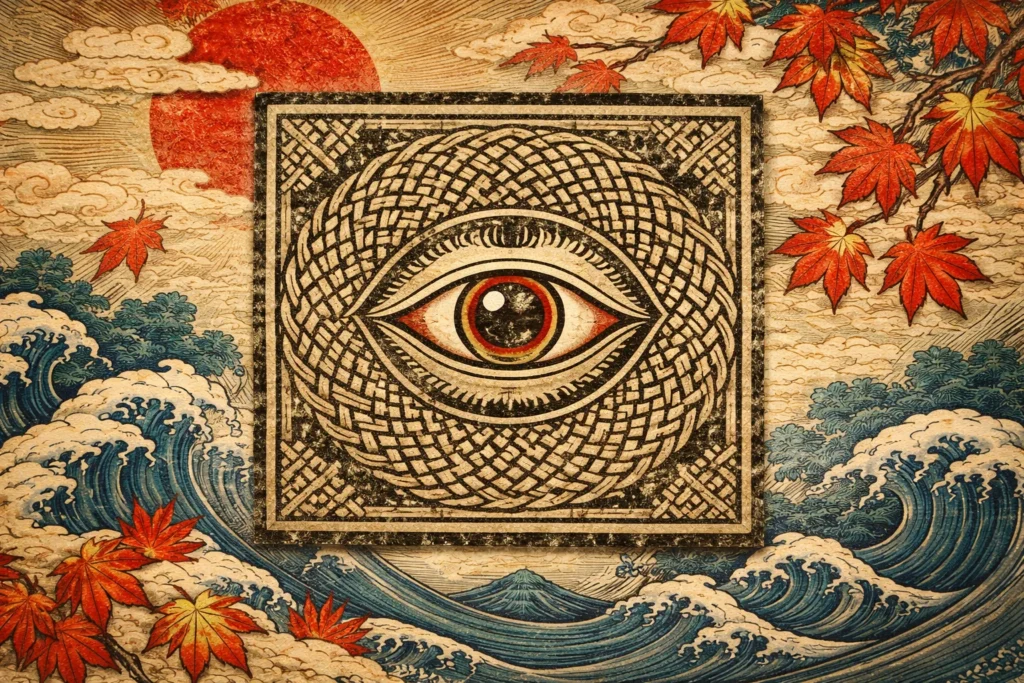
In Japanese culture, Hitotsume kozō stands for the “gaze of the divine,” but in a more everyday and even funny way. It shows how Japanese society moved from deep respect for nature to more urban superstitions and folklore for fun.
The single eye stands for a focused, watchful gaze on people’s actions, reminding everyone that even in private, the spiritual world is watching.
The yōkai also helps teach children about good behavior. By turning the “one-eyed” fear into a character, Japanese culture used it to teach lessons about cleanliness and morals. Today, Hitotsume kozō is still one of the most famous yōkai, showing up in anime, manga, and festivals as a symbol of the fun side of the supernatural.
You may also enjoy:
Who Is Adrammelech in Demonology and the Bible?
October 1, 2025
Vritra: The Dragon Who Swallowed the Sky in Hindu Mythology
October 7, 2025
Palis: The Foot-Licking Desert Jinn That Drinks Your Blood
December 3, 2025
Who Is Andromalius and Why Is He the Last Demon of the Goetia?
January 20, 2026
Aamon: The Infernal Marquis of Lust, Feuds, and False Prophecies
September 29, 2025
Mara: The Buddhist Demon King of Desire and Death
October 13, 2025
Frequently Asked Questions (FAQ)
What is the connection between Hitotsume kozō and tofu?
People often mix up Hitotsume kozō with Tōfu-kozō. Still, Hitotsumekozō is usually shown in Edo-period playing cards and poems licking a block of tofu. Folklore experts think this began because the yōkai was said to dislike beans, which are used to ward off evil, but over time, art changed this to a love of tofu, which is made from soybeans. Some stories even warn that eating tofu licked by this yōkai could cause a deadly fungus grow inside you.
Is there a medical explanation for the Hitotsume kozō legend?
Modern researchers often connect the story of the “one-eyed boy” to a rare birth condition called cyclopia. In 1932, a skull with one eye socket was found in Zama, Kanagawa, and locals built a “Hitotsume-kozō Jizō” memorial there. While many people think the legend comes from ancient mountain gods, seeing babies with this rare condition likely led people to believe more in one-eyed spirits.
Are Hitotsume kozō and Tōfu-kozō the same yōkai?
No, they are different yōkai, though people often mixed them up in the 18th and 19th centuries. Hitotsume kozō is older and comes from religious folklore. At the same time, Tōfu-kozō was mostly made up of popular storybooks during the Edo period. In today’s media, they are sometimes shown as cousins or helpers to bigger monsters.
Why does Hitotsume kozō sometimes tell people to “be quiet”?
In several old ghost stories, like those from the Kaidanoi no Tsue, the yōkai shows up to scold people who are too loud. One well-known story tells of a man named Ojima Yakiemon who saw a child playing with a scroll. When Yakiemon told the boy to stop making a mess, the boy turned around, showed his single eye, and told him to “Shut up!” The man fainted from the shock.
What is Hitotsume kozō’s role in modern anime and games?
The yōkai is still popular in Japanese media today. It appears as one of the 47 Yōkai Warriors for Tokyo in the GeGeGe no Kitarō series. You can also find it as a character or enemy in games like Yo-kai Watch, Nioh, and Trek to Yomi, where it usually keeps its role as a playful trickster instead of a real threat.
