Unlike many urban yōkai that threaten people with violence or revenge, Abura-akago stands out for creating anxiety about losing essential resources at home. Instead of harming people, it consumes the household’s light, turning a place of comfort into one of unsettling scarcity.
Compared to aggressive spirits like the Gashadokuro, this entity acts as a quiet parasite in the home. It reflects old fears of poverty and the real darkness that came when costly fuels ran out.
To stay accurate, I based Abura-akago’s physical traits on Otsu’s regional records and Sekien’s original sketches. The “oil-licking” theme is a clear metaphor for Edo-period social and economic concerns. [View Full Bibliography ↓]
Summary
Key Takeaways
| Attribute | Details |
| Names | Abura-akago, Oil Baby |
| Translation | The name translates literally as “oil baby” or “oil infant.” |
| Title | The Oil-Licking Child |
| Type | Obake (Shapeshifter) / Hi-no-tama (Atmospheric ghost fire) |
| Spirit Classification | Usually categorized as a Nigi-mitama that has become stray or an elemental manifestation of a restless soul. |
| Origin | Legend suggests it originates from the spirits of oil thieves who, after death, are reincarnated as spectral infants doomed to seek the fuel they once stole. |
| Gender | Male (Infant) |
| Appearance | A small, pale infant with a disproportionately large tongue, often appearing as a floating orb of fire before manifesting. |
| Kehai (Aura/Presence) | The presence is preceded by the faint flickering of lamps (andon), a soft lapping sound like a cat drinking, and the smell of cold vegetable oil. |
| Powers/Abilities | Flight in the form of a fireball, shapeshifting from fire to human form, and the ability to drain oil lamps silently. |
| Methods of Pacification | Securing lamps with heavy lids, offering small amounts of oil at local shrines, or the use of ofuda charms to ward off household intruders. |
| Habitat | Private residences, rural homes, and roadside shrines, particularly in the Otsu region of Shiga Prefecture. |
| Diet/Prey | Lamp oil (traditionally extracted from rapeseed or sesame seeds). |
| Symbolic Item | An oil lamp (Andon). |
| Symbolism | Represents the consequences of petty theft, the fragility of domestic security, and the fear of poverty. |
| Associated Kami | Indirectly associated with Hadenokami (God of the hearth) or local tutelary spirits of the Shiga region. |
| Sources | Konjaku Gazu Zoku Hyakki by Toriyama Sekien. |
The Fundamental Identity of Abura-akago
The Abura-akago is a unique figure in Japanese folklore, existing between a spirit and a physical being. It usually appears as a small child who sneaks into homes at night to drink lamp oil.
Unlike other predatory spirits, it rarely harms people directly. Instead, its presence signals unnatural consumption and compromises the home’s safety.
During the Edo period, lamp oil was valuable and costly in Japan. This spirit became a supernatural symbol of the loss of both wealth and light. It is often grouped with the obake because it can change from a small ghostly fireball into a crawling baby.
Semantic Origins
The name’s origin is simple but meaningful. It combines abura (油), meaning “oil,” and akago (赤子), which means “red child,” the usual Japanese word for an infant. The “red” refers to a newborn’s flushed skin, symbolizing new and undeveloped life.
The name became established in the late 1700s thanks to Toriyama Sekien. In his important book, Konjaku Gazu Zoku Hyakki (The Illustrated Hundred Demons from the Present and Past), he listed the spirit under this name.
In some parts of Kansai, people call it an “oil-thief spirit,” connecting it to the older Abura-sumashi. However, Abura-akago is unique because of its baby-like form. The name’s history shows a shift from general “ghost fires” (hi-no-tama) to a more specific yōkai with clear behaviors.
How to Pronounce “Abura-akago” in English
To say this name in English, break it into five syllables: Ah-boo-rah Ah-kah-go. The “Ah” sounds are like the “a” in “father.” “Boo” rhymes with “too,” and “rah” uses a quick, short “r.” The second part starts with “ah” and “kah” (like “spa”) and ends with a long “go,” as in “proceed.”
What Does Abura-akago Look Like?
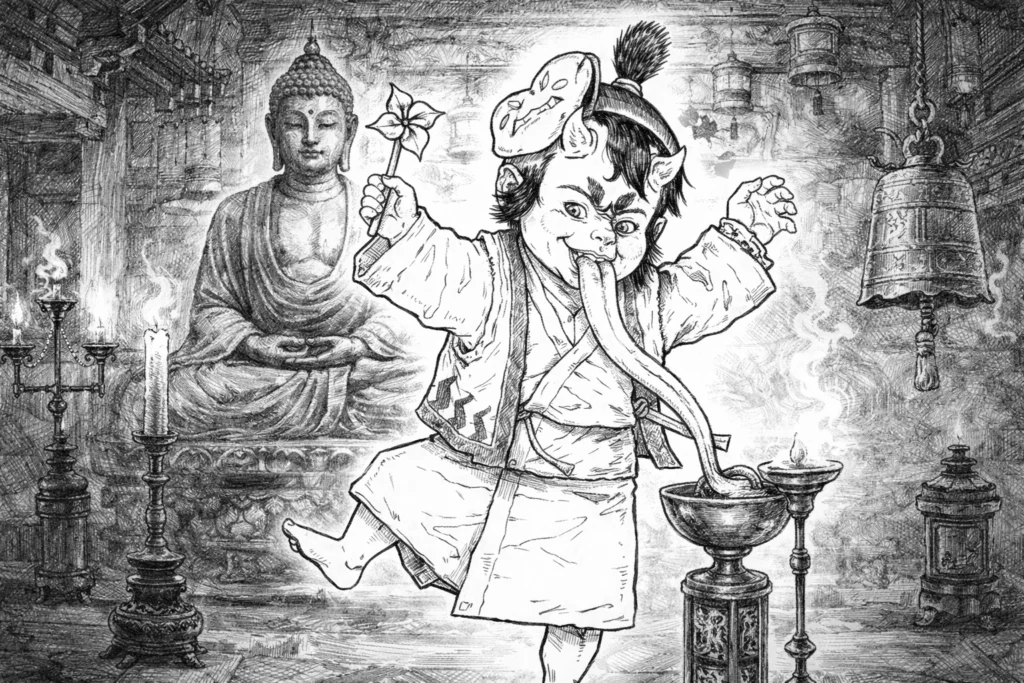
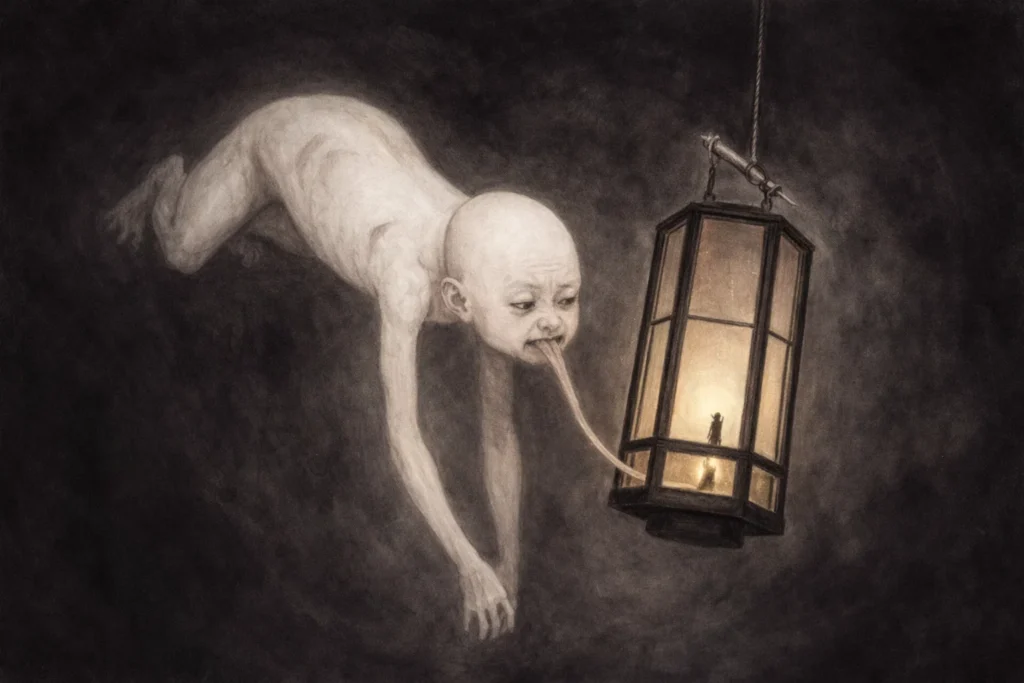
This spirit usually appears as a human baby, about 6 months to 1 year old. Its skin is often described as very pale or slightly see-through, hinting at its ghostly nature.
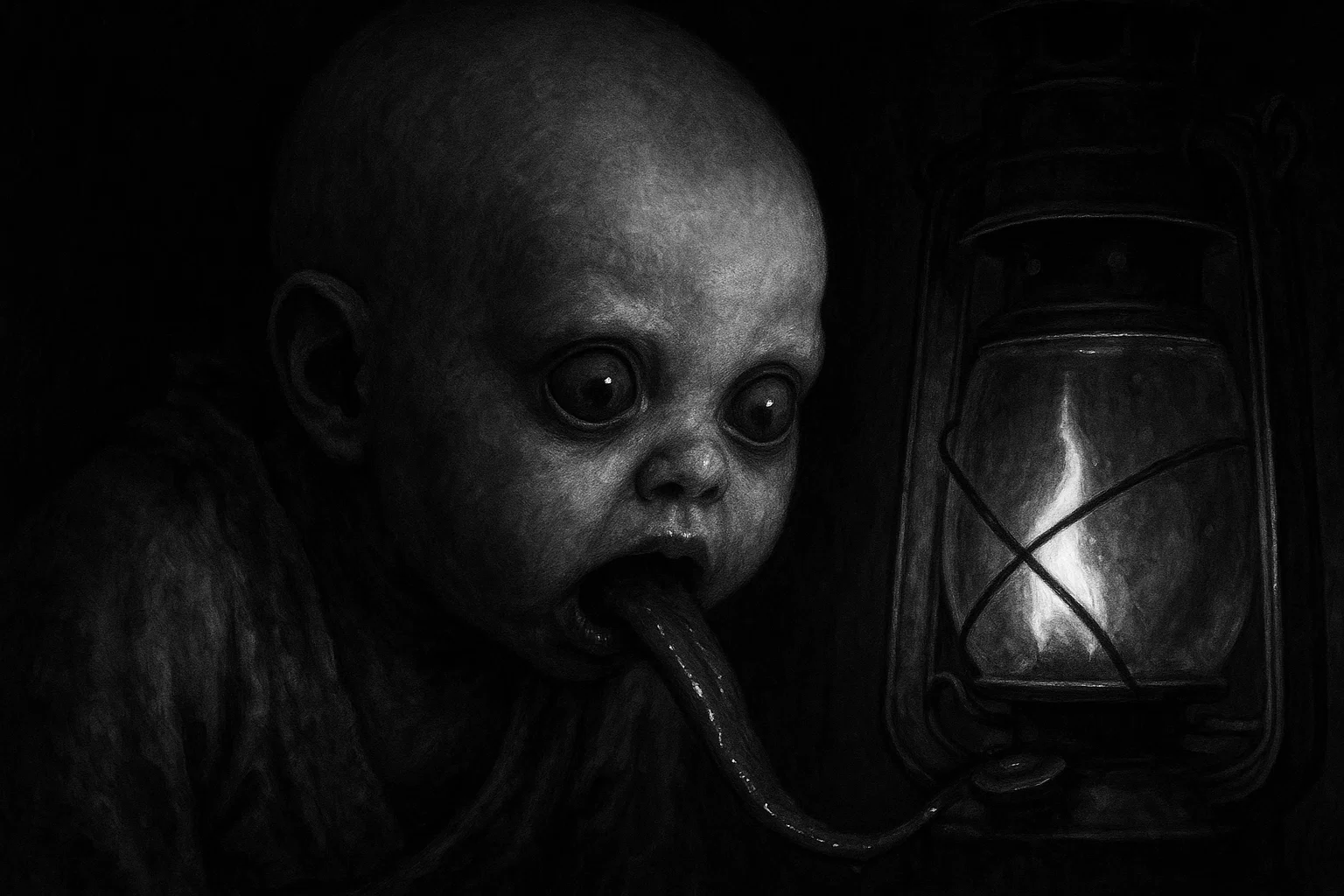
Abura-akago’s most distinctive feature is its long, flexible tongue, which it uses to lick oil from traditional Japanese lamps. Unlike real children, it moves silently and smoothly, letting it climb furniture to reach the lanterns.
Before appearing as a child, it often appears as a glowing ball of fire, or a hitodama. This fireball is usually yellow or orange, matching the color of the oil it wants. When it slips into a house through a small opening, the fire settles near a lamp and quickly changes into a crawling baby.
In some artwork, including Sekien’s, Abura-akago wears a simple child’s bib or kimono. This makes its strange actions seem even more unsettling by adding a touch of normal home life. Its eyes are usually wide and empty, fixed only on the oil it wants.
You may also enjoy:
Who Is Ariton (Egyn), the Infernal King of the Eastern Gate?
February 17, 2026
Abura-sumashi: The Potato-Headed Yōkai That Punishes Greed
October 23, 2025
Ambri: The Imperial Duchess of Caspiel’s Empire
December 1, 2025
Nasnas: The Monstrous Demon Hybrid That Haunted Pre-Human Earth
November 12, 2025
Who Is Adrammelech in Demonology and the Bible?
October 1, 2025
Andrealphus: The Peacock Demon Who Twists Minds and Bodies
January 19, 2026
Origins and History
Abura-akago’s story is closely linked to the social and economic changes of the Edo period (1603–1868). As cities grew, the need for fuel rose sharply. Rapeseed oil (natane-abura) was the main light source for wealthier people, but it was costly and taxed. For poorer families, losing oil meant real darkness after sunset.
Records suggest that the legend is particularly rooted in Otsu, a city in Shiga Prefecture. Local lore suggests that the spirit is the reincarnation of a person who made a living by stealing oil from the lamps of roadside shrines or private homes.
In the moral framework of the time, stealing from a sacred space was a grave sin that resulted in the thief being unable to enter the next life. Instead, they were reborn as a “hungry infant,” forever seeking the very substance they illicitly acquired in life.
I think this spirit reflects the ongoing fear of instability at home. During the Edo period, prices for goods often changed, and having light in the house showed a family’s wealth.
Interestingly, the first stories about this spirit appeared as oil became a commercial product. By making the thief an infant, a symbol of need and weakness, the story changes from a simple crime to a tale of endless hunger.
I also believe this spirit acted as a warning for families. Before electricity, leaving a flame unattended was very dangerous. Stories about a “baby” licking lamps probably kept children away from lanterns. They reminded adults to watch their oil and lamp safety.
Sources
While the Abura-akago does not appear in the Kojiki or the Nihon Shoki, its historical record begins in the late 18th century, as documented in the Konjaku Gazu Zoku Hyakki and regional accounts from Shiga Prefecture.
Original:
近江国大津に、あぶらあかごといふものあり。夜な夜な火のたま飛来りて、家に入り、行灯の油をなぶるといふ。もしや油をぬすみし者の執心、この物となれるか。
Translation:
In Otsu of Omi Province, there is a thing called Abura-akago. Night after night, a fireball flies in, enters a house, and licks the oil of the lamps. Could it be that the obsession of one who stole oil became this thing? [Toriyama Sekien, Konjaku Gazu Zoku Hyakki (The Illustrated Hundred Demons from the Present and Past), 1779]
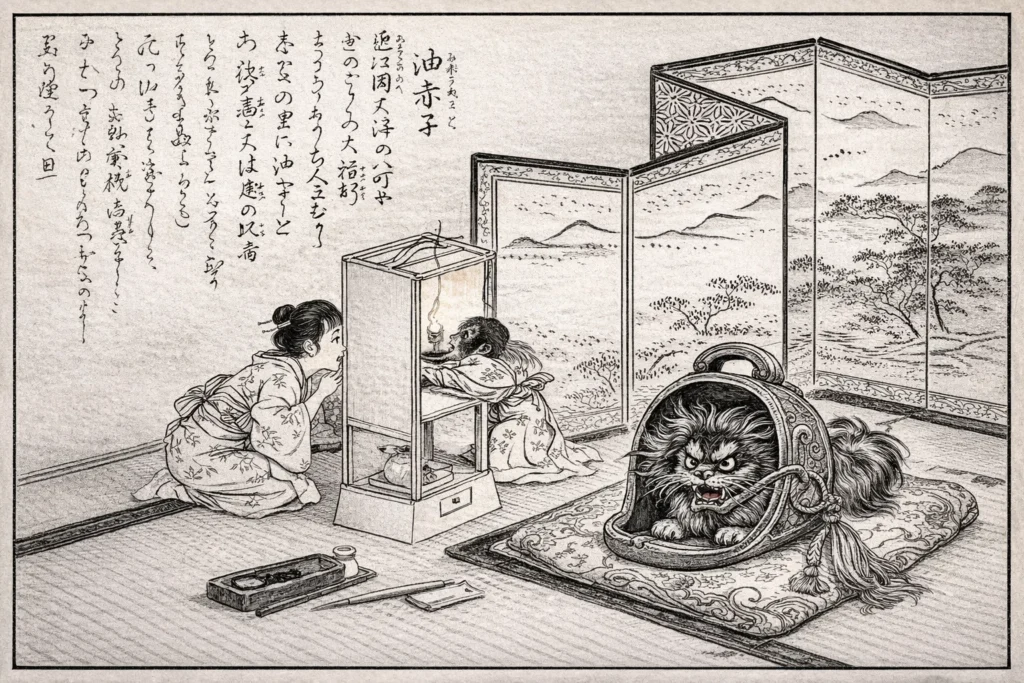
Toriyama Sekien’s entry is the main source that defines this spirit. In his 18th-century book, he connects ghostly lights (hitodama) with a unique, character-based monster. By asking whether the spirit is the “obsession” (shūshin) of an oil thief, he draws on Buddhist ideas of karma to give the story a deeper moral meaning.
The word naburu (to lick or tease) in the original text is important. It suggests a playful or fixated action rather than violence. This shows the spirit is more of a household nuisance than a real danger. In the Edo period, “oil thieves” were disliked because fuel was expensive. By depicting the thief as an infant, Sekien underscores how pitiful and childish the crime is.
Original:
昔、大津の八町に油屋あり。夜毎に油をぬすみ、辻の地蔵の油をなぶるといふ。其後、その油ぬすみの魂、赤子の形となりて油をなぶる。
Translation:
Long ago, there was an oil shop in the Hachicho area of Otsu. It is said that every night, oil was stolen, and the oil of the roadside Jizo was licked. Afterward, the soul of that oil-thief took the form of a baby and licks the oil. [Traditional Oral Lore of Otsu, Shiga Prefecture, documented in Shiga-ken no Densetsu (Legends of Shiga Prefecture), early 20th-century compilation of Edo-period oral traditions]
This local story adds important geographic and religious details to the spirit’s identity. Unlike Sekien’s general description, this version links the spirit to Otsu and to stealing from Jizo, a guardian of children and travelers. It’s ironic that the thief, who wronged a protector of children, is doomed to exist forever as a child.
The story’s mention of an “oil shop” suggests the legend may have originated as a warning or social commentary among merchants. As cities grew during the Edo period, business disputes and hoarding resources became common.
This legend probably served as a supernatural warning against stealing, using the image of a “shameful infant” to show how dishonesty can strip someone of their dignity.
Original:
「提灯や行灯の油が急になくなるのは、油赤子の仕業であると信じられていた。この妖怪は、まず怪しい火の玉として現れ、隙間から家の中に入り込むと、たちまち赤ん坊の姿に変わって、その長い舌で油をなめとるのである。」
Translation:
It was believed that the sudden disappearance of oil from lanterns and lamps was the work of the Abura-akago. This yōkai first appears as a suspicious fireball, and upon entering the house through a crack, it instantly changes into a baby and licks up the oil with its long tongue. [Mizuki Shigeru, Mujyara (Yōkai Encyclopedia), 1994 (drawing on Edo-period records)]
Mizuki Shigeru, a modern scholar and artist, brings together earlier hints about the spirit’s ability to change shape. He also points out the “long tongue” as a key feature, which is common among oil-eating yōkai like Abura-sumashi or Ubumari.
The idea of oil suddenly disappearing shows how people explained things they couldn’t understand. Before science, if a lamp ran out of oil too soon, blaming a yōkai like Abura-akago gave families a story that took the blame off household members or servants.
This reflects how many Japanese household spirits represent the everyday losses and problems of running a home. The way this spirit changes from a fireball to a baby is its most unique trait, setting it apart from other fire-spirits (hi-no-tama) that don’t have a human shape.
You may also enjoy:
The Ghul: The Flesh-Eating Demon of Arabian Folklore
October 1, 2025
What Is a Dīv? The Terrifying Giant Demon of Persian Myth
January 22, 2026
Jikininki: The Japanese Ghost That Feeds on Human Corpses
February 9, 2026
Andhaka: The Blind Demon Born From Cosmic Darkness
February 6, 2026
Ancient Demons: The Real Origins of the Setcheh Myth
November 11, 2025
Habitat
This spirit mainly lives in traditional Japanese homes, especially in tatami rooms with portable or hanging lanterns. As a household parasite, it is rarely seen in the wild. It prefers towns and villages where oil is readily available.
Besides homes, this spirit is closely linked to Otsu in Shiga Prefecture, especially near the old Tokaido road. It often visits roadside shrines where travelers leave lamps as offerings, attracted by the steady supply of “sacred” oil. It likes quiet, dim places and is rarely seen during the day because sunlight weakens its fire form and its baby shape is easy to spot in bright light.
Famous Abura-akago Legends and Stories
The Fireball of Otsu
This is the main story about the spirit, set in Otsu. Local records say a strange fireball often floated through the night, moving from house to house. People saw it hover near rooftops before shrinking and slipping through cracks in the walls.
Inside, the fire would turn into a small child. The baby would go to the lamp, stand up, or climb to reach the oil, and drink it. Once satisfied, it would become a fireball again and leave. Locals believed this was the ghost of an oil merchant who cheated customers and was now doomed to search for oil after death.
The Thief of the Roadside Shrine
In a village near Kyoto, a story persisted of a small shrine dedicated to a local deity that could never keep its lamp lit.
No matter how much oil villagers put in the lamp, it was always empty by morning. Thinking a person was stealing it, a young man kept watch at night. Instead of a thief, he saw a glowing orb come down from the trees. It turned into a pale baby, who started licking the oil with a steady, wet sound.
The man was so scared by the sight of the baby’s tongue glowing with oil that he couldn’t move. The spirit finished the oil and disappeared. This story strengthened the idea that the spirit was seeking penance, drawn to pure shrine oil to cleanse its own guilty soul.
Powers and Abilities
The Abura-akago has supernatural powers that enable it to scavenge at night. It is not as destructive as major demons, but it is strong because it can move quietly and change its form.
It can overcome almost any barrier by becoming a spiritual flame. As a “low-tier” yōkai, it is more of a financial and psychological problem than a deadly threat, and it scares easily if people make noise or interfere.
- Pyromorphic Transformation: The ability to shift between a sentient fireball (hitodama) and a physical infant.
- Intangibility (Flame Form): In its fire state, it can pass through small crevices, paper screens (shōji), and gaps in wooden walls.
- Resource Drainage: It can consume vast quantities of oil in seconds, far more than a physical stomach of its size should allow.
- Silent Movement: In its infant form, it produces no sound while crawling or climbing, allowing it to feed even while humans sleep nearby.
Traditional Defenses Against Abura-akago
To protect against Abura-akago, people used both physical and spiritual methods. Since it looks for easy chances to steal, the best defense was to use heavy, locking lids on oil containers and lamps. The spirit is thought to have only the strength of a baby and can’t open heavy or tricky locks.
For spiritual protection, people placed ofuda (sacred paper charms) from Shinto shrines above doors or near the hearth. These charms were believed to block the hitodama form from entering the house.
People also believed that keeping a cat in the house would scare away the spirit, since cats sense ghosts and their hunting instincts frighten the timid infant spirit. In some areas, if the spirit bothered a home, residents would offer good oil at a local temple for the “thirsty spirits” to help the entity leave.
Abura-akago vs Similar Spirits
| Name | Category | Origin | Threat Level | Escape Difficulty |
| Abura-sumashi | Yōkai | Spirit of an oil thief from Amakusa. | Low | Easy; it is a shy entity. |
| Hinoenma | Obake | Manifestation of dangerous fire. | High | Hard; it is predatory. |
| Chōchin-obake | Tsukumogami | A lantern that reaches 100 years of age. | Low | Very Easy; it mostly just scares people. |
| Kitsunebi | Yōkai | Breath or tail-fire of a kitsune. | Medium | Moderate; can lead travelers astray. |
| Ubume | Yūrei | The ghost of a woman who died in childbirth. | Medium | Hard; she compels people to hold her baby. |
| Zashiki-warashi | Yōkai | The house spirit of a child. | None | N/A; its presence is actually good luck. |
| Hyōsube | Yōkai | A relative of the Kappa that eats eggplants. | High | Hard; seeing it causes illness. |
| Nurarihyon | Yōkai | An old man who enters houses to drink tea. | Low | Moderate; he is hard to kick out. |
| Gashadokuro | Yūrei | A giant skeleton made of war victims. | Extreme | Near Impossible; it is a massive hunter. |
| Hitotsume-kozō | Yōkai | One-eyed monk-child. | Low | Easy; repelled by baskets. |
| Kawa-akago | Yōkai | A river infant that mimics crying. | Medium | Moderate; lures people into water. |
Symbolism
| Attribute | Details |
| Element | Fire (and the liquid fuel that sustains it). |
| Cardinal Direction | West (associated with the region of Shiga and the setting sun). |
| Color | Yellow (the color of oil and flickering lamplight). |
| Plant | Rapeseed (the source of traditional lamp oil). |
| Season | Winter (when the nights are longest and oil is most needed). |
| Symbolic Item | The Andon (Japanese floor lamp). |
Abura-akago symbolizes the financial weakness of households in old Japan. Going after the household’s light threatens both safety and productivity. More broadly, it represents the fear of someone who uses up resources without helping the family survive.
It also reminds people of the lasting effects of karma. Turning a thief into a ghostly baby shows that greed can cause a person’s soul to regress, leaving them helpless and forcing them to beg or steal for basic necessities.
In Japanese art and festivals, this spirit remains popular because it blends the “cute” look of a child with the “creepy” side of the supernatural. This mix is common in many yōkai stories.
You may also enjoy:
Who Was Abezethibou, the Fallen Angel Who Opposed Moses?
October 1, 2025
Lamia: The Queen Cursed to Devour the Children of Others
January 7, 2026
Who Is Astaroth in Demonology and the Ars Goetia?
February 20, 2026
Vritra: The Dragon Who Swallowed the Sky in Hindu Mythology
October 7, 2025
Who Is the Jann in Islamic Mythology and Why Is He Feared?
October 2, 2025
Who Are the Yaksha, and Why Did Buddhists Fear Their Wrath?
October 20, 2025
Bibliography
Author’s Note: My article is based on the change from hitodama to infant shown in Toriyama Sekien’s 1779 woodblock prints, which sets this spirit apart from regular “ghost fires.” By comparing these artworks with local shrine stories from Shiga-ken no Densetsu, I found a clear link between the misuse of sacred oil and the spirit’s sad, baby-like form. This mix of formal “demonology” and local tales helped me see the spirit as a symbol of the fragility of home resources during the Edo period.
- Cucinelli, Diego. Windows Onto The Supernatural In The Second Half Of The Edo Period: From The Gazu Hyakki Yagyō (1776) By Toriyama Sekien To The E-Hon Hyaku Monogatari (1841) By Takehara Shunsen. Ming Qing Studies 2015, 2015. Academia.edu.
- Foster, Michael Dylan. The Book of Yokai: Mysterious Creatures of Japanese Folklore. University of California Press, 2015. Internet Archive.
- Bradt, Aaron. The Role of Yokai in Japanese Myth. 2016. Academia.edu.
- Davisson, Zack. (2026). The Persistence of Yōkai. Education About Asia. 29. 10.65959/eaa.1847. ResearchGate.
- Marks, Andreas. Japanese Yōkai and Other Supernatural Beings: Authentic Paintings and Prints of 100 Ghosts, Demons, Monsters, and Magicians. Tuttle Publishing, 2023.
- Ohno, Kenichi. (2017). The History of Japanese Economic Development: Origins of Private Dynamism and Policy Competence. 10.4324/9781315444048. ResearchGate.
- Reider, Noriko T. Japanese Demon Lore: Oni from Ancient Times to the Present. University Press of Colorado, 2010. JSTOR.