
Andhaka is an important character in Hindu mythology, known as a powerful Daitya king and the adopted son of the Asura king Hiranyaksha. He is often shown as a strong opponent of Lord Shiva.
Although mainly part of Hindu stories, some traditions connect him to wider asuric legends, but he is not usually listed among Buddhist demons.
Summary
Key Takeaways
| Attribute | Details |
| Names | Andhaka, Andhakasura |
| Title | King of the Daityas |
| Gender | Male |
| Role | Antagonist, conqueror of the three worlds, seeker of Parvati |
| Clan | Daitya |
| Followers | Asuras, Daityas |
| Powers | Regeneration from blood droplets, invincibility to all except Shiva |
| Appearance | Often depicted with two thousand eyes, two thousand arms, or as a blind, dark-skinned giant |
| Etymology | Derived from “Andha,” meaning “blind” |
| Associated Figures | Shiva (father/slayer), Parvati (mother/object of desire), Hiranyaksha (foster father) |
| Weaknesses | Piercing by Shiva’s trident (Trishula), depletion of blood |
| Opposing Deva/Avatar | Lord Shiva (Bhairava form) |
| Pantheon | Hindu (Puranic) |
| Primary Sources | Shiva Purana, Matsya Purana, Kurma Purana, Harivamsa |
Who or What is Andhaka?
Andhaka is a powerful Asura and Daitya king, and his stories are important in the Shaivite tradition. He is often said to be the biological son of Shiva and Parvati, born from the sweat that appeared when Parvati covered Shiva’s eyes, and the universe became dark. Even though he had divine parents, he was born blind and was given to Hiranyaksha, who raised him as an Asura.
Andhaka later performed intense penance to Brahma and was granted sight and near-invincibility. He went on to conquer the three worlds and, in his pride, tried to kidnap Parvati, not knowing she was his real mother. This led to a violent battle with Shiva, which ended in either his transformation or destruction, depending on the version of the story.
1,000+ SPIRITS, GODS & GODDESSES AWAITING YOUR CALL. Limited-Time: Up to 49% OFF!
The ultimate global spirit encyclopedia – 2,000+ entries from every culture on Earth. Fairies • Djinn • Demons • Loa • Angels • Deities • Ancestors Real names • True offerings • Ancient rituals that actually work. Judika Illes’ legendary masterwork – the one book every serious witch, mage, and spirit-worker owns.
Andhaka Meaning
The name Andhaka comes from the Sanskrit word andha, meaning “blind” or “darkness.” This meaning is closely tied to his origin story. According to the Shiva Purana, when Parvati covered Shiva’s eyes, the world became blind and dark, and this darkness took form as Andhaka. He was named Andhaka because he was born from darkness and was blind at birth.
Over time, the term Andhaka changed from describing physical blindness to symbolizing spiritual ignorance (avidya). In some Puranic texts, the name also refers to a certain clan or family. Still, when talking about the demon, it always means blindness and the darkness from which he came.
Names like Andhakasura just add the suffix -Asura to show that he is a demon.
How to Pronounce Andhaka in English
Andhaka is pronounced as uhn-dhuh-kuh. The ‘A’ sounds are short, like the ‘u’ in ‘cup.’ The ‘dh’ is made by touching your tongue to your upper teeth and letting out a small puff of air. The last ‘a’ is a soft, unstressed sound.
What Does Andhaka Look Like?
Andhaka’s appearance changes a lot from his birth to after he receives his boons. As a baby, he is described as a scary, dark-skinned infant who was blind. His skin is often compared to soot or a dark storm cloud, showing the darkness he came from.
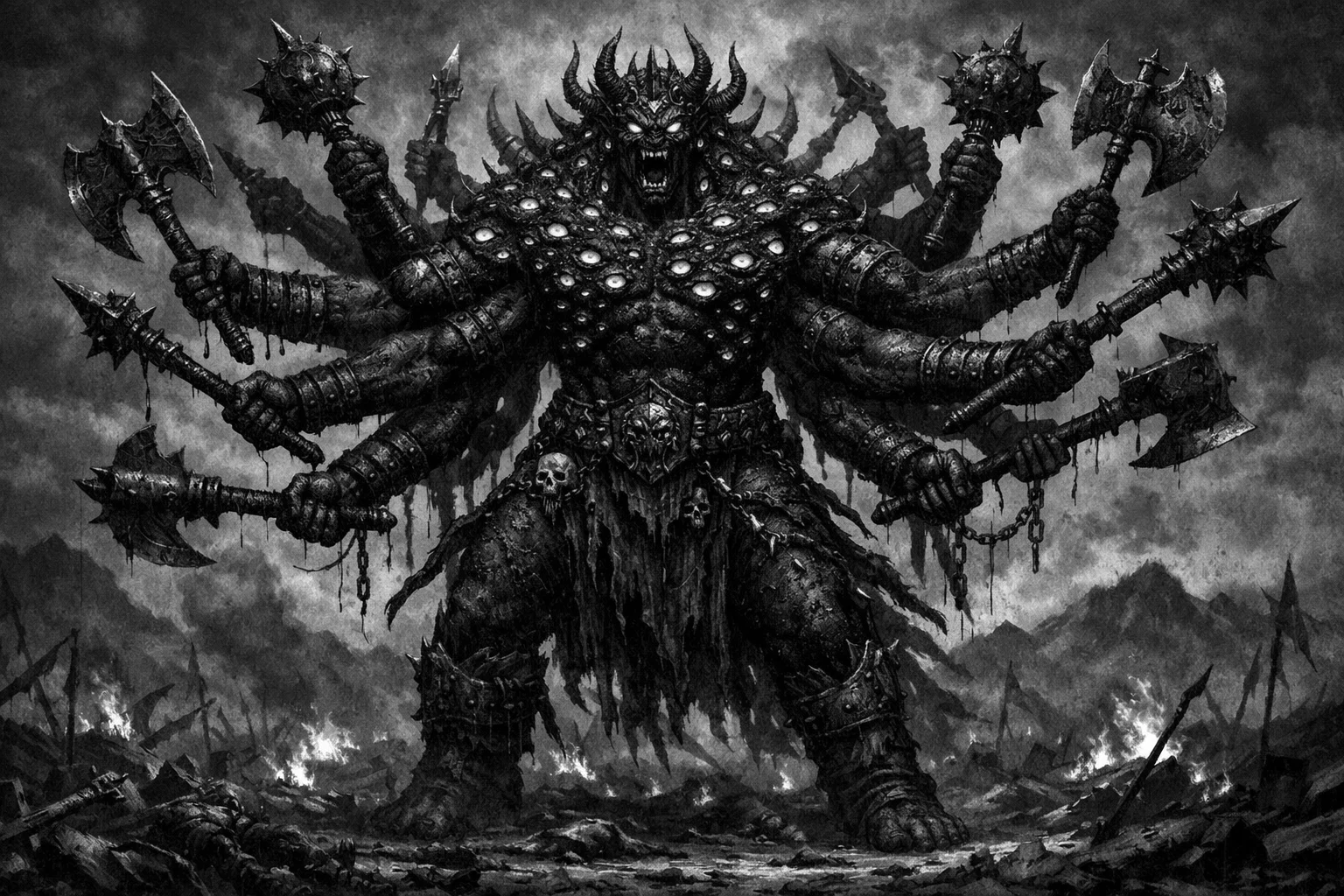
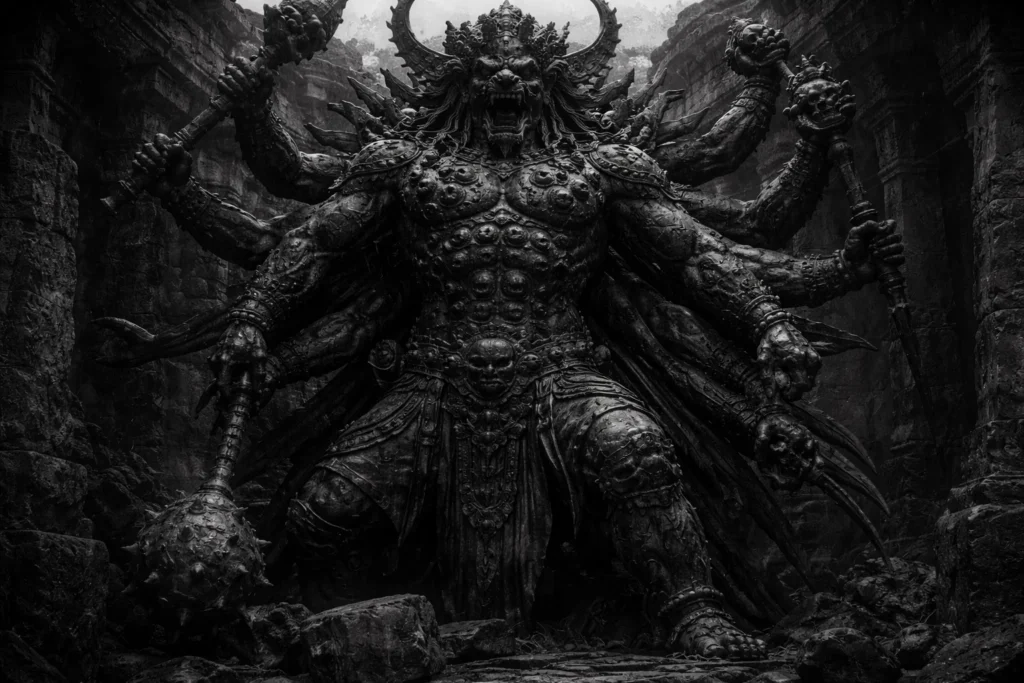
After his penance and the boons from Brahma, Andhaka got his sight back and became much more powerful and monstrous. Many Puranic stories describe him as having two thousand arms and two thousand eyes, showing his great strength and awareness.
He is usually shown as a huge giant wearing iron or dark metal ornaments and carrying weapons typical of Asuras. His eyes are often described as red and glowing with anger, especially when he fights the Devas. Some art shows him with many heads, but most stories focus on his many eyes and arms, as seen in the Matsya Purana and Kurma Purana.
Origins
Andhaka’s story starts with a cosmic accident involving the main gods of the Shaivite tradition. He goes from being a blind child to a powerful ruler, following the classic Puranic pattern of gaining power through penance and then becoming proud.
Unlike most Asuras, who are born from Diti and Kashyapa, Andhaka is unique because he is directly connected to Shiva. This mix of having divine parents but being raised by the gods’ enemies is the main source of conflict in his life and leads to his downfall.
You may also enjoy:
Pazuzu: The Demon Who Fought Evil with Evil
November 4, 2025
Who Is the Demon Andras, The Great Marquis of Discord?
January 15, 2026
Who Was Hiranyakashipu, the Demon King of Hindu Mythology?
October 6, 2025
Chort: The Sinister Slavic Demon of Chaos and Bad Luck
March 10, 2026
Gandharva: God, Spirit, or Demon?
November 13, 2025
Abura-sumashi: The Potato-Headed Yōkai That Punishes Greed
October 23, 2025
Birth
Andhaka was born when Parvati playfully covered all three of Lord Shiva’s eyes while they were on Mount Mandara. Since Shiva’s eyes symbolize the sun, moon, and fire, the whole universe was suddenly plunged into darkness. Sweat formed on Parvati’s hands from the heat of Shiva’s third eye, fell to the ground, and mixed with the darkness.
From this mix, a blind, deformed, and crying child was born. Parvati was shocked at first, but Shiva knew the child was theirs. At the same time, the Asura Hiranyaksha was praying to Shiva for a son. Shiva gave the blind child to Hiranyaksha as a gift, so Andhaka was taken to the Asura kingdom and raised as the next Daitya king.
NAME THEM. BIND THEM. CAST THEM OUT! Limited-Time: Up to 40% OFF!
The ultimate deliverance thesaurus by Apostle John Eckhardt. Hundreds of demonic names & attributes exposed alphabetically – from Jezebel to Python, infirmity to poverty. Hundreds of demons named & defeated Identify → Bind → Cast Out!
The essential weapon for every prayer warrior, intercessor, and deliverance minister. Victory starts with identification.

Family
| Relationship | Name |
| Parents | Shiva and Parvati (Biological); Hiranyaksha (Adoptive) |
| Siblings | Ganesha, Kartikeya (Biological half-siblings); Prahlada (Cousin via adoption) |
| Spouse | None mentioned in primary Puranic texts |
| Children | None |
Andhaka’s family is complicated, with both his divine parents and his adoptive Asura family. His adoptive father, Hiranyaksha, was a strong Daitya king who was killed by Vishnu’s Varaha avatar. His adoptive uncle was Hiranyakashipu, another famous enemy of the gods.
Asura-Deva Conflicts
After Hiranyaksha died, Andhaka became king of the Daityas. He did a long and difficult penance to Brahma, standing on one leg for centuries. Brahma appeared and offered him a wish. Andhaka asked for sight and to be invincible against everyone.
Brahma agreed, but said he could only be killed by someone like a father to him, which Andhaka thought was impossible because he saw himself as an orphan or just an Asura.
With his new power, Andhaka attacked the Devas, defeated Indra, and took over the heavens. He broke the rules of Dharma by banning Vedic sacrifices and mistreating sages.
His last battle began when he heard about Parvati’s beauty. Wanting her for himself, he tried to take her by force, which started a huge war between his Asura army and Shiva’s followers.
Role in Hindu Cosmology
In Hindu cosmology, Andhaka stands for ignorance (moha) and the soul’s blindness to its divine roots. His story warns against misusing blessings and shows that karma cannot be avoided. Unlike Prahlada, who was an Asura but a devotee, Andhaka represents the ego that tries to claim even the divine.
In many stories, Shiva’s defeat of Andhaka is not just a physical death but a spiritual cleansing. In the Varaha Purana, after Shiva’s trident pierces him, Andhaka’s sins are removed, and he becomes a Gana (attendant) of Shiva, now called Bhringi. This shows that even the worst beings can be redeemed through divine help in Hindu cosmology.
Was Andhaka Ever Mentioned in Vedic Texts?
Andhaka does not appear as a demon in the early Vedic texts, such as the Rig Veda or the Samaveda. His story comes later, mainly in the Epics and Puranas. The early Vedas discuss other figures, such as Vritra and Vala.
THE BOOK THEY BANNED FROM THE BIBLE Limited-Time: Up to 90% OFF!
Why was Enoch removed? The fallen Watchers • The birth of the Nephilim • Origin of demons • Names of the angels who became demons • Apocalyptic visions. The original source text that inspired all demonology. Read the apocalyptic visions the church didn’t want you to see.
Andhaka in Epics and Puranas
Many Puranas tell Andhaka’s story in detail, and there are often different versions of how his story ends.
| Source | Quote |
| Shiva Purana (Rudra Samhita) | “The drops of sweat from the hand of the goddess, produced by the contact of the eyes of the lord, fell on the ground and a child was born of it, who was blind, deformed and of a dark complexion.” |
| Matsya Purana | “Andhaka, the king of the demons, having two thousand arms and eyes, was the son of Hiranyaksha, and was killed by Shiva on the peak of the mountain.” |
| Harivamsa | “The Asura named Andhaka, who was blind from birth, became the king of the Daityas and was later granted vision by the grace of Brahma.” |
Powers and Abilities
Andhaka’s strength is similar to other great Asura kings like Hiranyakashipu or Ravana, mostly because of the special boons hgothrough hihis intense practices.
- Regenerative Blood: Similar to Raktabija, every drop of Andhaka’s blood that touched the ground when he was wounded would create a new, identical Andhaka.
- Near-Invincibility: He could not be killed by gods, humans, or animals, except by his own father.
- Vast Physical Strength: Capable of lifting mountains and defeating the king of the gods, Indra, in single combat.
- Mystical Sight: Even though he was born blind, his boon let him see all worlds, but he still could not see spiritual truth.
Andhaka Myths, Legends, and Stories
The Battle of Mount Mandara
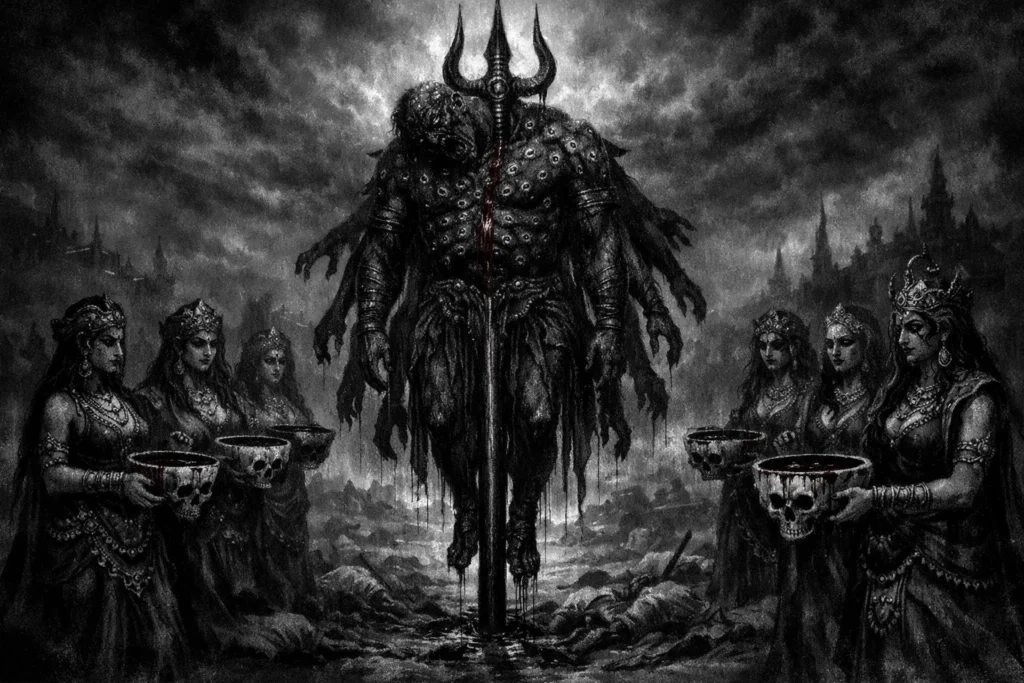
The Shiva Purana says that Andhaka led his army to Mount Mandara to kidnap Parvati. Lord Shiva saw him coming and fought a fierce battle. During the fight, Shiva’s trident pierced Andhaka’s chest. But when his blood touched the ground, thousands of copies of Andhaka appeared, making it hard for the gods to win.
To stop this, Shiva created the Matrikas (mother goddesses), who drank Andhaka’s blood before it could reach the ground. Shiva then kept Andhaka on his trident for a thousand years, until Andhaka’s pride was gone and he started praising Shiva.
You may also enjoy:
Who Is Baal in Christian Demonology?
February 25, 2026
Azhi Dahaka: The Three-Headed Dragon of Zoroastrian Mythology
January 14, 2026
Who Is Ambolin, the Demon of Nighttime Dread
December 1, 2025
What Is the Abumi-guchi Yōkai and Why Does It Wait Forever?
October 22, 2025
Barbas: The Lion Demon Who Spreads Disease
March 3, 2026
Andhaka: The Blind Demon Born From Cosmic Darkness
February 6, 2026
The Transformation into Bhringi
In another version from the Varaha Purana, Andhaka’s defeat is not the end but his chance for salvation. While on Shiva’s trident, Andhaka understood his mistakes and who his real parents were. He apologized to Shiva and Parvati.
Shiva was pleased with Andhaka’s true regret and did not kill him. Instead, Shiva took away his demonic side, and Andhaka became a skeletal devotee named Bhringi, one of Shiva’s most loyal followers.
Andhaka vs Other Asuras
| Asura Name | Associated Trait/Role | Clan/Origin | Key Traits/Powers |
| Hiranyaksha | Earth Stealing | Daitya | Immense Strength |
| Hiranyakashipu | Tyranny/Atheism | Daitya | Boon of immortality (conditional) |
| Ravana | Conquest/Lust | Rakshasa | Ten heads, immense boons |
| Mahishasura | Shapeshifting | Asura | Form of a water buffalo |
| Bali | Generosity/Sacrifice | Daitya | Rule over three worlds |
| Tarakasura | Ambition | Daitya | Invincible except to Shiva’s son |
| Sumbha | Misogyny/Power | Asura | Powerful army |
| Narakasura | Tyranny | Asura | Son of Bhudevi/Vishnu |
| Vritra | Drought/Obstruction | Asura (Vedic) | Dragon-like, anti-Indra |
| Raktabija | Multiplication | Asura | Cloning from blood drops |
Rank Among Asuras
Andhaka was the top leader of the Daitya clans in his time, taking over after Hiranyaksha. He was not just a local ruler but a Chakravartin, or world-ruler, of the Asuras. He led all the Asura forces against Amaravati, the city of the Devas. His fight with Shiva is one of the most important ‘God vs. Demon’ battles in the Puranas, especially because they are related by blood.
Mystical Correspondences
| Attribute | Details |
| Planet | Saturn (Sani) – representing darkness and obstacles |
| Zodiac Sign | Capricorn – associated with worldly ambition and discipline |
| Element | Earth and Darkness |
| Direction | Southwest (Nirriti) |
| Color | Black or Soot-Grey |
| Number | 2000 (arms and eyes) |
| Crystal/Mineral | Iron / Hematite |
| Metal | Iron |
| Herb/Plant | Dhatura (poisonous plants associated with Shiva) |
| Animal | Bat or Owl (creatures of darkness) |
| Trait/Role | Ignorance (Avidya) and eventual Redemption |
Andhaka’s connections highlight his roots in darkness. His ruling planet is often said to be Saturn, which matches the heavy and difficult parts of his early life. The element Earth links him to the material world and shows how his physical desires kept him from seeing spiritual truth.
Moving from the heavenly to the symbolic, Andhaka’s link to iron and the color black shows how hard-hearted he was before he changed. In tantric traditions, rituals for Andhaka use the southwest direction, which is connected to Nirriti, the force of destruction.
Animal symbols like the owl show that Andhaka was at home in the darkness of night. His link to the Dhatura plant connects him to the ascetic side of his father, Shiva.
Andhaka’s Symbols
Andhaka’s main symbols are the iron mace, showing his brute strength as a Daitya king, and Shiva’s trident, which stands for breaking through ignorance. Sometimes, art shows him with a severed head or many eyes to represent his ‘thousand-eyed’ form before his defeat.
Worship and Boons
Andhaka is not usually worshipped in mainstream Hinduism because he is an Asura. But in Tantric Shaivism, his story is important. It is used in meditation to help people overcome the darkness of their own ego.
Andhaka’s most famous boon came from Brahma after he stood on one leg for a thousand years and offered his own flesh in sacrifice. This boon gave him sight and made him invincible to both gods and demons. The story shows that even a demon can gain divine power through strong will and discipline.
You may also enjoy:
Who Is Agares, the Demon of Earthquakes and Deception?
October 13, 2025
Abura-akago: The Oil-Licking Demon Baby
October 22, 2025
Pazuzu: The Demon Who Fought Evil with Evil
November 4, 2025
Palis: The Foot-Licking Desert Jinn That Drinks Your Blood
December 3, 2025
What Is Akaname, The Filth-Licking Yōkai?
October 28, 2025
Frequently Asked Questions about Andhakasura
Is Andhaka related to the blind King Dhritarashtra from the Mahabharata?
Both Andhaka and Dhritarashtra are blind and important figures in the Hindu epics, but they are distinct characters. Andhaka is a demon and the son of Shiva, while Dhritarashtra is a human king from the Kuru dynasty. Both symbolize the ‘blindness of ego,’ but Andhaka’s story is set during the Deva-Asura wars, and Dhritarashtra’s is set in the Dvapara Yuga.
What is the connection between Andhaka and the “Andhaka” clan in ancient India?
The Andhakas were an old Yadava clan mentioned in the Mahabharata and Puranas, and Lord Krishna was part of this group. Even though they share the name, the clan is seen as a human family of warriors. Some scholars think the story of the demon Andhaka was used as a negative or symbolic tale against rival tribes. Still, in myths, the demon king and the Yadava clan are separate.
Does Andhaka appear in the Ramayana?
Andhaka is not a main character in the Ramayana’s main story about Rama and Ravana. He is only briefly mentioned in the Uttara Kanda, where various Asura families and old battles are described. Most of his main stories are found in the Shaivite Puranas, not the Vaishnavite epics.
What is the role of the Matrikas in the myth of Andhaka?
The Matrikas, or Seven/Eight Mother Goddesses, were created by Shiva to help fight Andhaka. Their job was to drink his blood before it hit the ground. This stopped his power to make copies of himself from his blood, so Shiva could finally defeat the real Andhaka.
Was Andhaka ever a devotee of Lord Vishnu?
No, Andhaka is mainly linked to Lord Shiva and Lord Brahma. Unlike other Asuras like Prahlada and Bali, who were known for worshipping Vishnu, Andhaka’s story is about Shiva alone. He is saved by Shiva’s trident and becomes the devotee Bhringi.
What is the “Andhakasura Vadha” in Indian art?
Andhakasura Vadha is a well-known theme in Indian art, especially in the Ellora and Elephanta Caves. It shows Shiva in his fierce Bhairava or Gajasurasamhara form, holding Andhaka on his trident, while the Matrikas or Yoginis wait below with bowls to catch his blood.
