
Barqan is a major Jinn King in Islamic occult traditions and is one of the seven kings who rule the days of the week. He rules Wednesday and is connected to the planet Mercury. Many old magical texts describe him as a powerful leader of many spirits. However, he still answers to certain celestial angels.
Summary
Key Takeaways
| Attribute | Details |
| Names | Barqan, Abu al-Abas, Barqan al-Yahudi (in some specific contexts) |
| Type | Ground Jinn (Ardi), one of the seven kings |
| Title | King of Wednesday, Malik (King) |
| Gender | Male |
| Servitors | Various sub-tribes of Jinn assigned to Wednesday |
| Superior Jinn | None specified (Reports to the Angel Michael/Mika’il in celestial hierarchy) |
| Powers | Inducing linguistic confusion, causing tremors, influence over commerce and theft, facilitating deceit |
| Appearance | Often depicted with multiple heads or appearing as a regal figure dressed in yellow or multi-colored robes |
| Etymology | Derived from the Arabic root B-R-Q, meaning “lightning” or “to shine/glimmer” |
| Associated Figures | Angel Mika’il (Michael), King Sulayman (Solomon) |
| Weaknesses | Subservience to the Great Names of God, specific seals of Solomon, the authority of the Angel Mika’il |
| Opposing Holy Figure | The Archangel Mika’il (Michael) |
| Social Structure or Tribe | Monarch of the Wednesday Jinn tribe |
| Followers/Tribe Size | Commands a vast legion of spirits and sub-rulers |
| Primary Sources | Shams al-Ma’arif al-Kubra, Manba’ Usul al-Hikma, various medieval Arabic magic manuals |
Who or What is Barqan?
Barqan is a supernatural being and one of the seven Jinn kings, called al-Muluk al-Sab’a. These kings are believed to live on Earth but have a close link to the heavens. Barqan rules the middle day of the week.
Unlike regular spirits or the evil Shayatin, Barqan is viewed as a neutral or practical king in occult teachings. He does his job according to the cosmic order set by higher divine powers. On Wednesdays, he oversees spiritual forces linked to communication, intellect, and the material world.
People have often called on Barqan in old talismans to help solve tough problems or to gain influence over others by using clever speech.
1,000+ SPIRITS, GODS & GODDESSES AWAITING YOUR CALL. Limited-Time: Up to 49% OFF!
The ultimate global spirit encyclopedia – 2,000+ entries from every culture on Earth. Fairies • Djinn • Demons • Loa • Angels • Deities • Ancestors Real names • True offerings • Ancient rituals that actually work. Judika Illes’ legendary masterwork – the one book every serious witch, mage, and spirit-worker owns.
“Barqan” Meaning
The name Barqan comes from the Arabic word “Barq,” which means “lightning.” The ending of the name suggests intensity or someone who shows that trait. This background hints that Barqan’s influence is quick and sudden, much like the fast movements linked to Mercury.
In manuscripts like the Shams al-Ma’arif, Barqan’s name is always linked to brightness and sudden appearances. In some regions or Hebrew-influenced occult groups, he is called Barqan al-Yahudi, but this is a special title used in certain rituals, not a general change to his identity.
The changes in Barqan’s name over time follow the Classical Arabic tradition of naming powerful spirits after natural phenomena or the sky. This shows their rank and the element they are connected to.
How to Pronounce “Barqan” in English
Barqan is pronounced as Bar-qan. The first part, “Bar,“ sounds like the English word “bar.” The second part, “qan,” starts with a deep “k” sound, like the Arabic letter Qaf, and ends with a short “an,” similar to “can” but with a stronger, throaty beginning.
What Does Barqan Look Like?
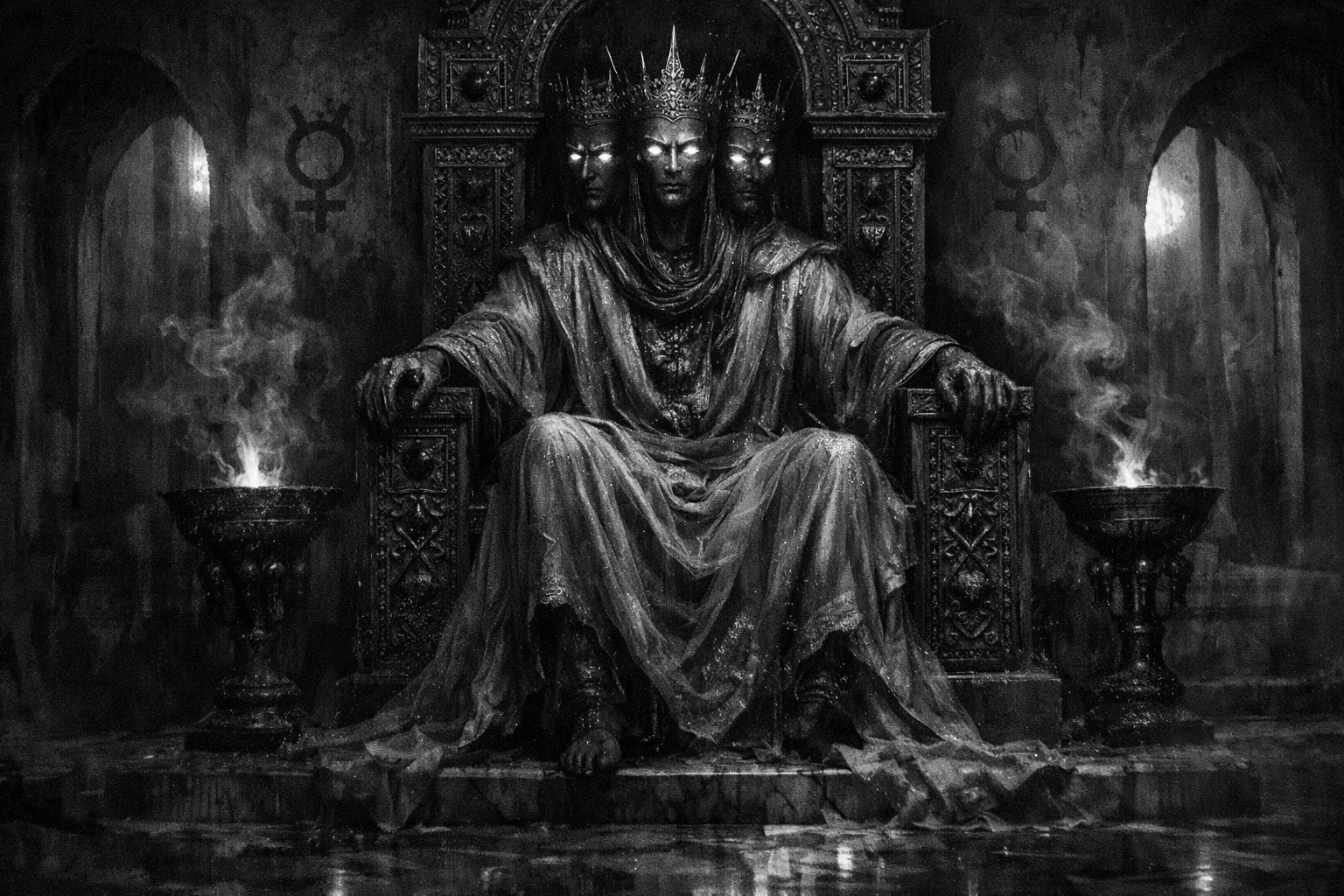
Medieval Arabic grimoires and works such as the Kitab al-Bulhan (Book of Surprises) portray Barqan as a grand and impressive entity. He is often shown wearing a crown and sitting on a throne, which shows his royal status. His clothes are usually yellow or brightly colored, matching the changing nature of Mercury, the planet he is linked to.
Some talismanic traditions show Barqan with two or three heads, which represents his ability to see in many directions or his skill with languages and secrets. Other stories say he is slim with sharp, clever features, showing that he is a spirit of intelligence and cunning, not just physical strength.
When Barqan appears in the physical world during rituals, often through smoke or mirrors, he is said to look like a tall, noble man. His eyes often have a supernatural glow, which reminds people of the lightning his name refers to.
You may also enjoy:
Andhaka: The Blind Demon Born From Cosmic Darkness
February 6, 2026
Who Is Jann in Islamic Mythology and Why Is He Feared?
October 2, 2025
Apophis: The Great Serpent of Egyptian Chaos
November 11, 2025
What Is Qarin and Why Does It Follow Every Human Being?
October 8, 2025
Rokurokubi: The Yokai That Looks Human Until Midnight
February 3, 2026
The Kumbhanda: Grotesque Demons of Buddhist Hell
November 13, 2025
Origins
The origins of Barqan are embedded in the pre-Islamic and early Islamic fusion of Arabian folk belief and Hellenistic astrology. Before the advent of Islam, the Arabian Peninsula was home to various beliefs regarding Jinn who inhabited specific geographical and celestial domains. As Islamic scholarship expanded, particularly during the Abbasid Caliphate, these entities were systematized into a coherent hierarchy.
Barqan became part of this system as one of the seven earthly kings. This change showed the Jinn not just as random desert spirits, but as organized beings who served under a divine order. His story was strongly influenced by Greek Hermetic texts, which linked spirits to the seven planets.
By the 13th century, when the Shams al-Ma’arif was written, Barqan’s role as the King of Wednesday was well-established in the “Science of Letters” (Ilm al-Huruf) and in talismanic magic.
BREAK THE TOUGHEST DEMONIC BONDAGE! Limited-Time: Up to 41% OFF!
Real-life deliverance secrets from Apostle Alexander Chisango – straight from the front lines in Africa. Generational curses • Witchcraft • Sexual bondages • Addiction strongholds. Step-by-step keys that actually work when everything else has failed. Hundreds set free – your breakthrough starts here!

Was Barqan Ever Mentioned in the Quran or Hadith?
Barqan is not named in the Quran or the main Hadith collections. The Quran describes the Jinn as beings made from “smokeless fire” and their roles, but it does not list the seven kings or mention names such as Barqan. These names and their roles over days and planets appeared later in Islamic esoteric writings and folklore.
Barqan in Other Texts
Barqan is mentioned often in several major works of Islamic esotericism and occultism.
| Source | Quote |
| Shams al-Ma’arif al-Kubra | “And the king of Wednesday is Barqan, and he is the one who serves the planet Mercury, and the angel over him is Mika’il.” |
| Kitab al-Bulhan | “This is the image of Barqan, the king of the Jinn for Wednesday, who sits upon his throne and commands his hosts.” |
| Manba’ Usul al-Hikma | “Know that Barqan has many tribes under his hand, and he is reached through the squares of the day of Wednesday.” |
Powers and Abilities
Barqan is much more powerful than common Jinn, Ghouls, or Ifrits. As a King, he usually does not act directly but commands many lesser spirits to carry out his wishes. His authority is strongest in the spiritual world, especially on Wednesdays.
- Linguistic Mastery: He is believed to have the ability to grant a person the understanding of different languages or, on the other hand, to cause someone to lose their ability to speak clearly.
- Commercial Influence: Because of his link to Mercury, he has power over trade, markets, and financial transactions, which are often used in historical talismans to bring luck in business.
- Discovery of Secrets: He is said to be able to reveal hidden information, such as the location of stolen goods or the intentions of enemies.
- Mental Manipulation: He can induce confusion, hesitation, or “foggy” thinking in targets.
- Earth Tremors: In some specialized lore, he is associated with the ability to cause minor movements in the earth or the structural shifting of buildings.
Influence on Humans and Possession
Barqan’s influence is usually intellectual or social, not just physical. He rarely “possesses” people like a Ghul or a low-level Marid might. Instead, his influence can show up as obsession, compulsive lying, or extreme indecisiveness.
Someone under the influence of Barqan’s forces might find it hard to settle on a single truth or could get caught up in complex legal or financial fraud.
Signs of his influence include sudden speech problems, a quick and uncontrollable “fluttering” of the mind, or a series of bad business decisions happening on a Wednesday. In cases of “Jinn sickness,” practitioners often look for symptoms involving the head and tongue if they suspect a spirit from Barqan’s tribe.
You may also enjoy:
Who Is Arioch, the Demon of War and Vengeance?
January 21, 2026
Nasnas: The Monstrous Demon Hybrid That Haunted Pre-Human Earth
November 12, 2025
Who Is Abaddon, the Demon of the Abyss, in the Bible?
September 29, 2025
Amdusias in the Ars Goetia: The Demon of Dark Music
December 2, 2025
Who Is Agares, the Demon of Earthquakes and Deception?
October 13, 2025
What Is the Akkorokamui, Japan’s Colossal Sea Monster?
November 14, 2025
Protection and Exorcism Methods
Historically, people protected themselves from Barqan and his followers by using sacred geometry and divine names. Since he is a king who respects hierarchy, the most effective remedy in old texts is to call on the Archangel Mika’il, who is his celestial superior.
- Amulets (Ta’wiz): Specifically, those containing the “Seal of Solomon” or verses from the Quran that highlight God’s sovereignty over all kingdoms.
- Metals: The use of tin (sometimes associated with Mercury in certain Arabic traditions) or mercury (sealed in glass) was historically used in talismans to balance his energy.
- Incense: Burning specific resins like mastic or sandalwood during his hour was thought to appease or ward off his more volatile sub-spirits.
- Spiritual Barriers: Drawing circles with a silver or iron tool while reciting the Ayat al-Kursi is a common traditional protective measure.
UNLOCK THE FORBIDDEN KNOWLEDGE OF DEMONS. Limited-Time: Up to 29% OFF!
The Encyclopedia of Demons & Demonology 400+ entries • Real history • Exorcisms & Ancient Evils • Possession • Terrifying photos. This is Rosemary Ellen Guiley’s masterpiece of the occult.
Barqan Myths, Legends, and Stories
The Submission of Barqan to the Seal of Solomon
In various folklore accounts from the Solomonic cycle of Arabic literature, Barqan is described as one of the many Jinn kings compelled to serve King Sulayman (Solomon).
According to the legend, when Sulayman received the Ring (the Seal), he summoned the kings of the four corners of the world and the seven days. Barqan arrived with his host, manifesting as a brilliant flash of light that momentarily blinded the temple guards.
Sulayman demanded that Barqan use his knowledge of the world’s languages to help translate the records of ancient civilizations. Barqan, recognizing the divine authority of the Seal, pledged his loyalty and the loyalty of the Wednesday Jinn.
According to lore, he provided the king with the secrets of the “tongues of birds”. He helped construct specialized temple machines that required precise intellectual calculations.
The Trial of the Archangel Mika’il
A common theme in the Shams al-Ma’arif involves the relationship between the terrestrial Jinn kings and the celestial angels. There is a narrative concerning the “Accountability of the Kings.” According to lore, every Wednesday, Barqan must present himself spiritually before the Archangel Mika’il.
In this story, Mika’il oversees the distribution of sustenance and the flow of the celestial spheres. Barqan is required to report the actions of his tribes and ensure that they have not overstepped their boundaries by harming humans without cause.
If a member of Barqan’s tribe is found to have acted unjustly, the legend states that Mika’il strikes a great celestial drum, the sound of which causes Barqan to tremble, reminding him of his subservience to the divine order.
Barqan vs Other Jinn
| Jinn Name | Associated Traits/Influence | Rank/Origin | Key Traits/Powers |
| Mazhab | Pride and Sunday dominion | King (Al-Madhab) | Gold, Sun, authority |
| Abyad | Purity or deception (Monday) | King (The White) | Moon, emotions, silver |
| Ahmar | War and blood (Tuesday) | King (The Red) | Mars, violence, iron |
| Shamhurish | Justice and law (Thursday) | King (The Judge) | Jupiter, wisdom, tin |
| Zoba’ah | Wind and whirlwinds (Friday) | King (The Flier) | Venus, love, copper |
| Maymun | Grief and delay (Saturday) | King (The Black) | Saturn, time, lead |
| Iblis | Ultimate rebellion/shirk | Sovereign (Quran) | Whispering (waswas), despair |
| Pazuzu | Famine and locusts | Demon King (Sumerian) | Wind, protection from plague |
| Asmodeus | Lust and gambling | King (Goetia) | Breaking marriages, invisibility |
| Marid | Arrogance and rebellion | High Rank (Folklore) | Water-based, immense size |
| Ifrit | Vengeance and fire | High Rank (Quran) | Shape-shifting, manipulation |
| Ghul | Gluttony and graves | Low Rank (Folklore) | Eating flesh, desert mimicry |
Position Among Jinn
Barqan has in the middle among the seven kings. He is not as aggressive as Ahmar, the Red King of Tuesday, or as serious as Maymun, the Black King of Saturday.
In Jinn society, he is seen as the diplomat and the scribe. He keeps close ties with the other kings. He often acts as a mediator in spiritual disputes because of his link to Mercury, the messenger planet.
His relationship with Iblis is complicated. While Iblis is the father of the Shayatin (demons), Barqan is a ground Jinn king who works within the legal order of the cosmos. Most occultists call him a “Muslim Jinn” or a “Neutral Jinn,” meaning he follows the laws of Solomon and the Angels. However, his followers may still cause trouble if not kept in check.
Mystical Correspondences
| Attribute | Details |
| Planet | Mercury |
| Zodiac Sign | Gemini and Virgo |
| Element | Air (occasionally Water in variant systems) |
| Direction | East |
| Color | Yellow, Turquoise, or Multi-colored |
| Number | 8 or 4 (depending on the magic square used) |
| Crystal/Mineral | Agate, Emerald, or Quicksilver |
| Metal | Mercury (Quicksilver) or Tin |
| Herb/Plant | Hazel, Fennel, or Storax |
| Animal | Ibis, Ape, or Fox |
Barqan’s mystical connections show his changeable and intellectual nature. His link to Mercury and the Zodiac signs Gemini and Virgo highlights a dual nature that is both communicative and analytical.
This duality is key to his “evil” or “testing” side. He gives tools for both great truth and harmful lies. The Air element also links him to the world of thought and the hidden whispers that move through the air.
The color yellow stands for intellect but also for the “jaundice” of deceit, while the number 8 often relates to the mind’s pathways in occult numerology. These connections are important for practitioners because they show that Barqan’s power is not in physical destruction but in subtle changes in reality through words and perception.
His use of quicksilver (mercury) as a symbol of his strange character also shows his mysterious character. He is impossible to hold onto and always changing shape.
Barqan’s Sigil
Barqan does not have one universally recognized “sigil” like in modern Western traditions. Still, he does have special Talismans and Khatams (seals) found in the Shams al-Ma’arif. These seals are usually magic squares (Wafq) filled with numbers that add up to his value, surrounded by the names of the four Archangels.
In the past, the Seal of Barqan was written on rings made of mixed metals or drawn on yellow parchment with saffron ink. These seals were used to bind the spirit to a task, like helping in a court case or protecting a merchant’s caravan from desert spirits.
Summoning and Rituals
In medieval grimoires, summoning Barqan had to be done on Wednesday during the hour of Mercury. Ritualists would prepare by becoming ritually pure and using a quiet space away from the city. They would make a mandala or circle with the names of Mika’il and the sub-commanders of the Wednesday tribe.
The practitioner would use a special incantation (Azima) that mentions the old agreements between the Jinn and King Sulayman. Tools like a hazel wand or a silver bowl were often used. The goal was not to worship Barqan, but to command or invite his help by using higher divine names.
These rituals were seen as very dangerous because any mistake in the “Science of Letters” could cause the practitioner to fall into the same mental confusion that Barqan controls.
You may also enjoy:
Who Is Adrammelech in Demonology and the Bible?
October 1, 2025
Tarakasura: The Dark Demon Who Ruled Hell on Earth
December 4, 2025
The Ghul: The Flesh-Eating Demon of Arabian Folklore
October 1, 2025
Kuchisake-onna: Folklore, Origins, and Urban Legend History
February 10, 2026
Who Is the Demon Andras, The Great Marquis of Discord?
January 15, 2026
Akateko: The Bloody Hand Ghost That Guards a Cursed Temple Tree
November 14, 2025
Frequently Asked Questions
Who is the eldest son of Barqan?
According to Arabic naming conventions in the Ilm al-Hikma (Science of Wisdom), Barqan is frequently referred to as Barqan Abu al-‘Adja’yb, which translates to “Father of Wonders.” In Jinn lore, kings are often identified by their most prominent offspring; however, specific manuscripts, such as the Arabic Book of Wonders, suggest that his lineage includes high-ranking Marid commanders who oversee his five hill-strongholds.
What is Barqan’s role in the “Army of Iblis”?
While many Jinn kings are neutral, certain occult traditions describe Barqan as a strategic leader within the legions of Prince Morrah, Iblis’s son. In this capacity, Barqan is regarded as the “Sorcerer King” who instructs lesser spirits and Shayatin in the arts of magic and deception, specifically to be used as a weapon against human willpower.
Which part of the human body is Barqan believed to attack?
In traditional Moroccan and Levantine folklore concerning Jinn-related ailments, Barqan is specifically associated with back afflictions. While other kings, like Al-Ahmar, are linked to the head or blood, Barqan’s influence is thought to manifest as chronic spinal pain, stiffness, or a “weight” on the shoulders, often treated through specific talismanic inscriptions placed near the affected area.
What are the five hill-strongholds of Barqan?
Barqan is unique among the seven kings for his documented terrestrial geography. He is said to rule from the City of Carnelian and the Castle of Gold. His military power is distributed across five hill-strongholds, with each location reportedly housing an army of 500,000 Marid Jinn, making him one of the most physically protected monarchs in the spiritual world.
What is the specific incense used to summon Barqan?
To facilitate a connection with Barqan during his planetary hour on Wednesday, practitioners of historical Arabic magic traditionally used Coriander and Mastic (or sometimes Sandarak). These scents are believed to harmonize with the “intellectual” and “airy” frequency of the planet Mercury, allowing the spirit’s presence to manifest without the chaotic interference of lower-level entities.
Who is Barqan’s primary Ifrit deputy?
Every Jinn king has a high-ranking lieutenant who executes their direct orders. Barqan’s primary deputy is an Ifrit named Wahdelbadj (or Wahdeliadj). Unlike the King himself, who remains regal and distant, the deputy is the entity responsible for the physical manifestation of Barqan’s decrees. It is the spirit most often encountered by those performing lesser rituals.
