The demon Alastor shows how an idea can change over time, starting as a Greek symbol of blood feuds and later becoming a high-ranking entity in the infernal court.
Unlike many demons who are known for certain sins, Alastor stands out for his role in inevitable retribution. He changed from being the “avenger” in ancient stories to the “Grand Executioner” in modern occultism. This change shows how people moved from seeing vengeance as a natural cycle to viewing it as a formal, organized system of endless punishment.
In this article, I used sources such as the Dictionnaire Infernal (1863) and the Pseudomonarchia Daemonum (1577) to provide a historical, evidence-based profile of the demon. [View Full Bibliography ↓]
Summary
Key Takeaways
| Attribute | Details |
| Names | Alastor, Alástōr, Alestor |
| Title | Chief Executioner of Hell, The Executioner, Avenging Spirit |
| Gender | Male |
| Role | Avenger of evil deeds, personification of a curse or blood-guilt, possessing entity, tormenting spirit |
| Rank | Minor Demon, or a generic class of evil spirits; cited by some sources as Chief Executioner to the monarch of Hell |
| Hierarchy | Serves under the monarch of Hell (i.e., Lucifer), has no known lesser demons serving under him in this context. |
| Powers | Relentlessly pursues the guilty, incites humans to murder and commit other sins, personifies familial curses, inflicts vengeance |
| Associated Figures | Zeus Alastor (Greek epithet), Nemesis (Greek goddess of retribution), Erinyes (Greek Furies), Lucifer (as his superior) |
| Pantheon | Christian Demonology (with strong Greek and Zoroastrian influences) |
| Primary Sources | Hesychius of Alexandria, Etymologicum Magnum, Plutarch’s Parallel Lives, Dictionnaire Infernal (Collin de Plancy), Occultopedia |
Who or What is Alastor?
Alastor is a lesser-known demon in Christian demonology, primarily associated with vengeance and family curses. He was added to these hierarchies by combining ideas from Greek mythology. In Greek tradition, Alastor (Ἀλάστωρ) was not a demon but a title for Zeus when he punished those who killed their relatives or committed serious crimes.
In demonology, Alastor can be seen as either a single tormenting spirit or a general term for a group of evil spirits called alastores. The Dictionnaire Infernal, a key book on demonology, describes Alastor as the Nemesis of the infernal hierarchy.
Later occult sources strengthen his dark reputation by calling him the Chief Executioner for the ruler of Hell. His main job is to punish and seek relentless retribution against sinners.
“Alastor” Meaning
The name Alastor derives from the Ancient Greek word Ἀλάστωρ (Alástōr).10 This term translates directly as “avenger” or, more broadly, “persecutor” or “tormenter.”
The Greek root is linked to ἄλαστος (álastos), which means “unforgettable” or “not to be forgotten.“ This connection supports the idea that an alastor avenges crimes so serious that they can never be erased or forgotten.
In early Greek beliefs, the alastor was seen as a curse or a spirit of vengeance that drove family members to commit new crimes to make up for old ones. This idea represented blood-guilt passed down through generations.
By the 4th century BC, the word alastor had lost its original meaning in Greek and become a general insult, akin to calling someone a “scoundrel.”
Still, the idea of alastor as a spirit of relentless revenge remained in tragic literature and later in occult writings. In Christian tradition, he is often shown as an evil spirit or possessing entity, keeping the original sense of inescapable vengeance.
How to Pronounce “Alastor” in English
The common English pronunciation for Alastor is /əˈlæstər/ or /əˈlæstɔːr/, often rendered as uh-LAS-tər or uh-LAS-tor.
What Does Alastor Look Like?
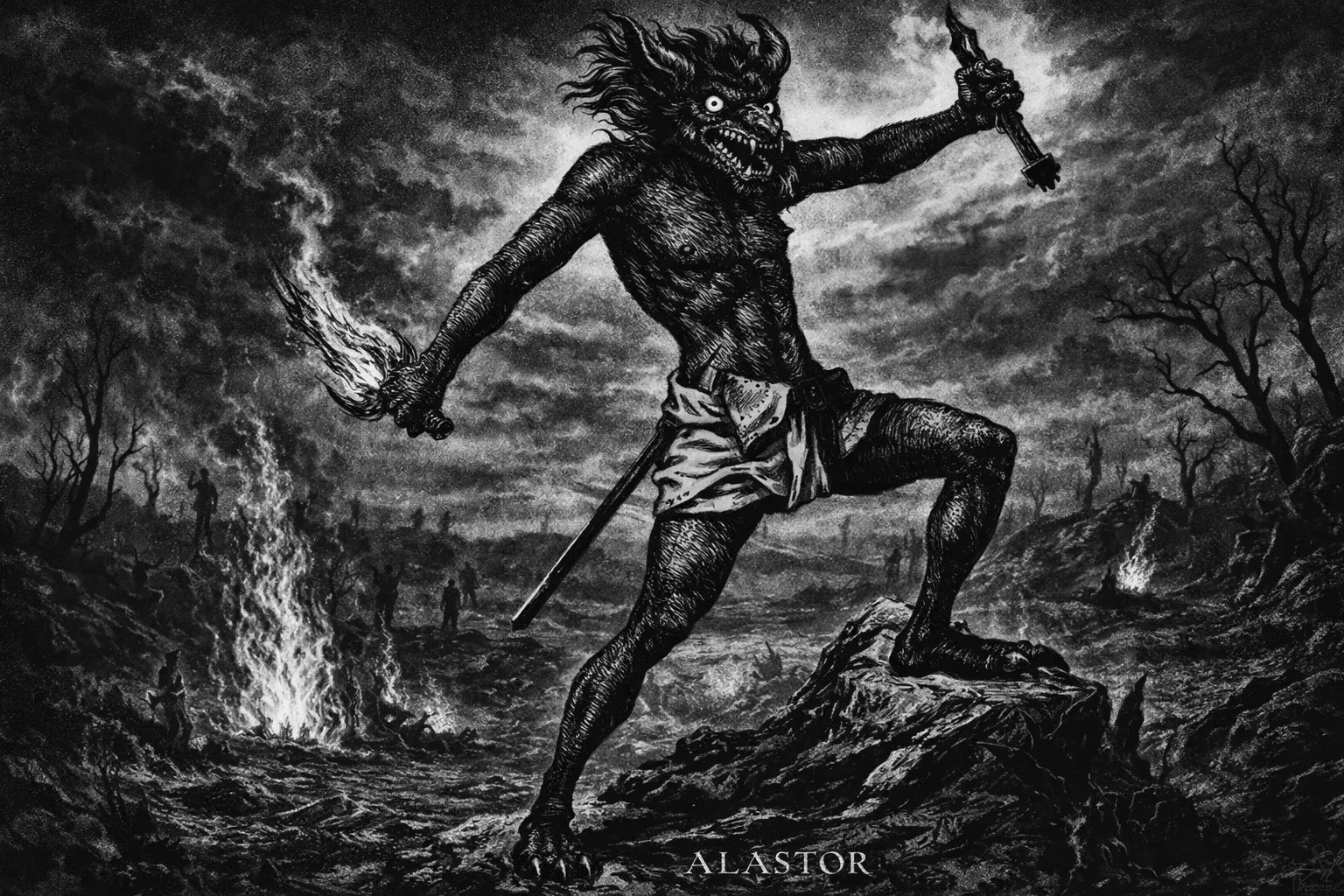
There are very few physical descriptions of this demon in traditional demonology texts. Unlike higher-ranking demons described in works like the Ars Goetia, Alastor is not given detailed imagery.
In his Christian demonological role, Alastor is defined more by his function than his form.
He is usually described as a possessing spirit or a tormentor. Because of this, he is often seen as having no physical body or as being able to change form. His main presence is felt through the torment or curses he brings. Unlike demons with set animal or mixed forms, Alastor is described by what he does: he is the unseen force that never stops chasing the guilty.
In the Dictionnaire Infernal, Alastor is linked to the Zoroastrian idea of “The Executioner.” This title suggests he can deliver quick and harsh physical punishment. He is imagined as having a frightening, human-like form with disturbing features, fitting for a torturer.
From Chthonic Curse to Bureaucratic Executioner
The story of Alastor shows how Western ideas about justice and sin have changed over time. In Aeschylus’s tragedies, the alastor was not a person but a mindless force of vengeance, like a family curse caused by bloodshed that needed more blood to end. This reflects a time before formal laws, when justice was seen as a kind of spiritual or biological infection.
Later, when Alastor became part of Renaissance grimoires and 19th-century demonology, he changed again. He was no longer just an abstract force like the Furies. Still, he became a very specific entity: the Grand Executioner of Hell.
This change reflects the development of centralized governments and formal legal systems in early modern Europe. By giving Alastor a specific rank and job in the infernal court, writers like Wierus and de Plancy showed a human desire to see the universe as a structured, though frightening, system.
Alastor stopped being a symbol of wild, personal revenge and instead came to represent the strict, efficient punishment of Hell’s system. He stands for the idea of official consequences, where punishment is not personal but a necessary part of the system.
Alastor’s role as a strict executioner sets him apart from other, more creative torturers in mythology. In comparison, he is like the Western version of the Vedic Yama or the Egyptian Ammit. Still, he does not have their sense of fairness. He represents a kind of justice that has lost its balance.
Studying Alastor means looking at the fear of a justice system without mercy, one that becomes a machine for endless punishment. He stands for the moment when a trial ends, and the automatic, final sentence begins.
Origins
Alastor’s roots go back to ancient Greek mythology and ideas about justice, not to the story of a fallen angel from Heaven in Christian tradition.
The earliest documented appearances of the name are in Classical Greek literature. In these texts, Alastor is an epithet of Zeus (Zeus Alastor), signifying his role as the avenger of evil deeds (particularly kinslaying).
Alastor is also described as a spirit that never stops chasing the guilty, passing the curse to their children for their parents’ sins. Greek tragic writers often used the name for any god or evil spirit who punished wrongdoers. The name was often linked to Nemesis (retribution) and the Erinyes (Furies).
Alastor’s change into a Christian demon is a good example of how pagan ideas were turned into figures seen as evil. By the 19th century, when Collin de Plancy wrote the Dictionnaire Infernal, Alastor was fully part of the infernal hierarchy.
De Plancy points out that ancient people used the word alastores to refer to evil spirits in general. He also links Alastor to Zoroaster’s idea of “The Executioner” and compares him to Azazel in Origen’s writings.
Historical & Grimoire Records
While Alastor does not appear in the Bible, its historical record begins in Classical Antiquity, in the works of Greek tragedians and early mythographers.
“But the ancient Alastor of the house, taking the form of this dead man’s corpse, hath paid off the debt of Atreus, the entertainer of that cruel feast, by sacrificing a full-grown victim for the young.” [Aeschylus, Agamemnon, 458 BCE]
In this important Greek tragedy, Alastor is not a being with a body, but an “unforgettable” spirit of vengeance or a family curse. The word comes from the Greek alastos, meaning “unforgettable” or “not to be forgotten,” which suggests that sin lingers both in the mind and spirit.
In Aeschylus’s works, Alastor is not an outside judge like in later medieval stories, but an inherited curse within a family. He is the “Old Avenger” of the House of Atreus, showing a time before Christianity when punishment was a never-ending cycle of blood-guilt, not a decision made by a devil in a court.
“ALASTOR: A cruel demon, who, according to some, is the chief of the executioners of the infernal monarchy. He was the Ephor of the ancient Greeks, whose name comes from ‘alastô,’ which means to wander, or from ‘alastos,’ which means unforgotten. He is also the one who carries out the sentences of the judges of Hell.” [Jacques Collin de Plancy, Dictionnaire Infernal, 1818]
By the 19th century, the demon changed from a poetic idea into a named official in the underworld. Collin de Plancy’s work made him the “Grand Executioner,” giving him a clear job in the infernal hierarchy.
The language change is important: de Plancy tries to connect the classical “Ephor” (a Greek overseer) with the medieval idea of a demon. This shows how the Romantic era liked to imagine “Infernal Monarchies,” turning supernatural justice into a system of legal punishments rather than a cycle of fate.
“The name of Alastor was also used by the ancient poets to designate Zeus, when he was in his character of the avenger of evil deeds. It was also a name given to the Furies, as the ministers of divine vengeance.” [William Smith, Dictionary of Greek and Roman Biography and Mythology, 1849]
This 19th-century analysis points out an important difference often missed today. Alastor was not first seen as a “demon” in a negative way, but as a title for Zeus Alastor, the highest god acting as a punisher of the wicked.
This shows a big change in religious thinking: what was once a quality of the King of the Gods became, in Christian thought, a separate and evil being. This source connects Alastor from “divine force of justice” to “fallen executioner,” showing how traits of an ancient god were transformed into the modern idea of a demon.
You may also enjoy:
Who Is Abaddon, the Demon of the Abyss, in the Bible?
September 29, 2025
Who Were the Hinn, the First Spirits of Creation?
November 12, 2025
Who Is Agaliarept, the General of Hell Under Lucifer?
October 8, 2025
Ammit: Devourer of the Dead in Ancient Egyptian Mythology
November 10, 2025
Who Is the Infernal King Balam? Origins, Powers, and Occult History
February 26, 2026
Allocer: Great Duke of Hell and the 52nd Spirit of the Ars Goetia
November 17, 2025
Powers and Abilities
Alastor’s powers are all about punishment, vengeance, and spiritual harm. Everything he does is harmful, and he brings no benefits to anyone he encounters.
- Infliction of Curses: Alastor can personify and perpetuate familial curses and blood-guilt, ensuring that the sins of a progenitor are visited on the next generations.
- Relentless Pursuit of the Guilty: His primary function is the unrelenting pursuit and torment of those who have committed great transgressions. His role is to punish those who committed kinslaying or other crimes that violated the sacred law.
- Incitement to Sin: As a possessing entity or evil genius of the household (as noted in Roman contexts), the demon can incite humans to murder and to commit other grave sins, driving the individual to further wickedness.
- Execution of Infernal Justice: He serves in the role of Chief Executioner of Hell, suggesting the power to inflict the most brutal and final forms of punishment and torture on condemned souls.
- Torment and Psychological Affliction: He is inherently a tormenting spirit. The demon has powers over the mental and spiritual well-being of his victims, likely inducing guilt, despair, and madness.
Alastor’s Myths, Legends, and Stories
Alastor is not the main character in any long or detailed myths or stories in religious or occult texts. Unlike well-known demons like Beelzebub or Asmodeus, who appear in many stories, Alastor is mostly a concept, a name, or a symbol of vengeance.
The main story linked to Alastor is historical and comes from classical times. It is about the fear of becoming an alastor, as told by Plutarch and later mentioned by Collin de Plancy.
Cicero’s Hatred and the Fear of Becoming an Alastor
The historical anecdote referenced in texts discussing Alastor involves the Roman statesman Marcus Tullius Cicero and his intense hatred for the Emperor Augustus. According to Plutarch, Cicero, fueled by hatred, considered a final, desperate act to ensure Augustus would suffer divine retribution. Cicero contemplated secretly entering the house of Caesar Augustus and committing suicide on the altar of his household gods.
The idea behind this plan was that dying violently and sacrificing himself on a sacred altar would turn Cicero’s spirit into an alastor, a vengeful demon. He would then be bound to and endlessly pursue Augustus, bringing divine vengeance on him and his family.
Cicero was reportedly deterred from this path only by the fear of being tortured beforehand.
Alastor vs Other Christian Demons
| Demon Name | Associated Sin/Temptation | Rank/Origin | Key Traits/Powers |
| Asmodeus | Lust, extravagance | Prince of Hell / Lesser Key of Solomon (Goetia) | Incites gambling, appears with three heads (man, ram, bull), commands 72 legions. |
| Mammon | Greed, avarice | Archdemon / Biblical/Apocryphal (Syriac Apocalypse of Baruch) | Personifies material wealth/gain, binds souls to earth. |
| Belial | Lawlessness, arrogance | King of Hell / Lesser Key of Solomon (Goetia) | Lies about his angelic origin, grants familiar spirits and dignity, commands 80 legions. |
| Beelzebub | Gluttony | Prince of Demons / Biblical (New Testament) | Lord of the Flies causes pestilence, the supreme commander of Hell’s forces. |
| Leviathan | Envy | Demon of Chaos/Mouth of Hell / Biblical (Old Testament) | A great sea monster/dragon, associated with watery depths and chaos, resists God’s creation. |
| Balaam | Covetousness, deceit | Grand Duke of Hell / Dictionnaire Infernal | Answers questions about the past, present, and future, speaks with a hoarse voice, and appears with three heads (bull, man, ram). |
| Bifrons | Witchcraft, necromancy | Count of Hell / Lesser Key of Solomon (Goetia) | Teaches astrology and geometry, changes corpses from their resting places, commands 26 legions. |
| Azael | Sexual corruption, weaponry | Fallen Angel / Book of Enoch | Corrupted mankind with cosmetics and jewelry, and revealed the secrets of war and weaponry. |
| Andras | Discord, murder | Marquis of Hell / Lesser Key of Solomon (Goetia) | Sows discord, can kill the Master and his servants, and appears as a winged angel with a raven head. |
| Purson | Truth, hidden things | Great King of Hell / Lesser Key of Solomon (Goetia) | Answers truly on all things divine and secret, carries a venomous serpent, and commands 22 legions. |
| Abaddon | Destruction, ruin | Angel of the Bottomless Pit / Biblical (Revelation) | Leads a horde of monstrous locusts, a personification of ruin and destruction. |
Rank in the Hierarchy of Hell
Alastor’s rank in the organized hierarchies of Hell is inconsistent and is usually low or merely functional. He is not listed among the Kings, Dukes, or Marquises in books like the Lesser Key of Solomon. Instead, he is known for two special roles that give him an official status, but not a noble rank.
First, Alastor is called the Chief Executioner for the ruler of Hell, usually Lucifer or Satan. This job is like being a top court official, working directly for the highest leader. His power comes from the ruler’s order to punish, making him an agent of organized terror. This role puts him in charge of punishing souls, which is different from demons, who tempt people to sin.
Second, and more often, the word alastor is used as a general term for a group of evil spirits. In this way, Alastor is not just one being with a set rank, but a type of harmful demon. This is similar to terms like incubus or succubus, which describe what they do rather than their rank. These alastores are seen as spirits that possess and torment, acting as the foot soldiers of misfortune and family curses.
Mystical Correspondences
| Attribute | Details |
| Planet | Saturn |
| Zodiac Sign | Capricorn or Aquarius |
| Element | Earth |
| Direction | North |
| Color | Black, Deep Indigo |
| Crystal/Mineral | Onyx, Obsidian (stones of protection and retribution) |
| Metal | Lead |
| Herb/Plant | Cypress, Yew (plants associated with mourning and death) |
| Animal | Dog (as a pursuer or avenger), Serpent |
Alastor is closely linked to the ancient, dark, and strict energy of the planet Saturn. Saturn is connected to retribution, karma, sorrow, and time, which all fit Alastor’s main role as a spirit of endless vengeance and chief executioner. Saturn’s influence makes him a relentless punisher who never lets wrongs be forgotten.
His connection to the zodiac sign Capricorn, ruled by Saturn, ties him to the heavy, restrictive nature of fate and family burdens. If linked to Aquarius, also ruled by Saturn, he represents cold and impersonal judgment.
Alastor’s link to the Earth element and the North direction grounds his evil in the real world. This shows his focus on real forms of justice or punishment, like blood-guilt, physical suffering, and family ruin.
The color black and the metal lead, both linked to Saturn, stand for the seriousness and finality of Alastor’s role as a punisher.
You may also enjoy:
The Ghul: The Flesh-Eating Demon of Arabian Folklore
October 1, 2025
Who Is Futakuchi-onna, the Two-Mouthed Woman?
March 9, 2026
Andhaka: The Blind Demon Born From Cosmic Darkness
February 6, 2026
Who Is Arioch, the Demon of War and Vengeance?
January 21, 2026
Who Is Astaroth in Demonology and the Ars Goetia?
February 20, 2026
Who Is Andromalius, and Why Is He the Last Demon of the Goetia?
January 20, 2026
Bibliography
Author’s Note: While researching this lesser-known demon, I noticed the biggest change was how Alastor went from being a Greek symbol of family vengeance, like in the Oresteia, to the bureaucratic “Grand Executioner” in De Plancy’s Dictionnaire Infernal. Weyer’s Pseudomonarchia Daemonum gives the basic structure for his rank. Still, it was only by comparing these with ideas from Hesiod and modern studies of Greco-Roman chaos that his shift from “divine necessity” to “demonic official” became clear. What stood out most to me was that even as his title changed, the core idea of the “implacable punisher” stayed the same for over two thousand years.
- Weyer, Johann. Pseudomonarchia Daemonum. Edited and translated by Joseph H. Peterson, digital edition, 2000. Twilit Grotto: Esoteric Archives.
- Collin de Plancy, Jacques. Dictionnaire infernal: répertoire universel des êtres, des personnages, des livres, des faits et des choses qui tiennent aux esprits. 6th ed., Henri Plon, 1863. Internet Archive.
- Lonsdale, Steven H. Divine and Demonic Necessity in the Oresteia. Mnemosyne, vol. 38, no. 1/2, 1985, pp. 150-52. ResearchGate.
- Smith, William, editor. A Dictionary of Greek and Roman Biography and Mythology. Vol. 1, John Murray, 1873. Internet Archive.
- Hesiod. Theogony. Translated by Michael Heumann, digital ed., 2005. Internet Archive.
- Tor, Shaul. Order and Chaos in the Ancient Greco-Roman Philosophical Imagination. The Oxford Handbook of Chaos, edited by Christopher Tucker, Oxford University Press, 2024. ResearchGate.