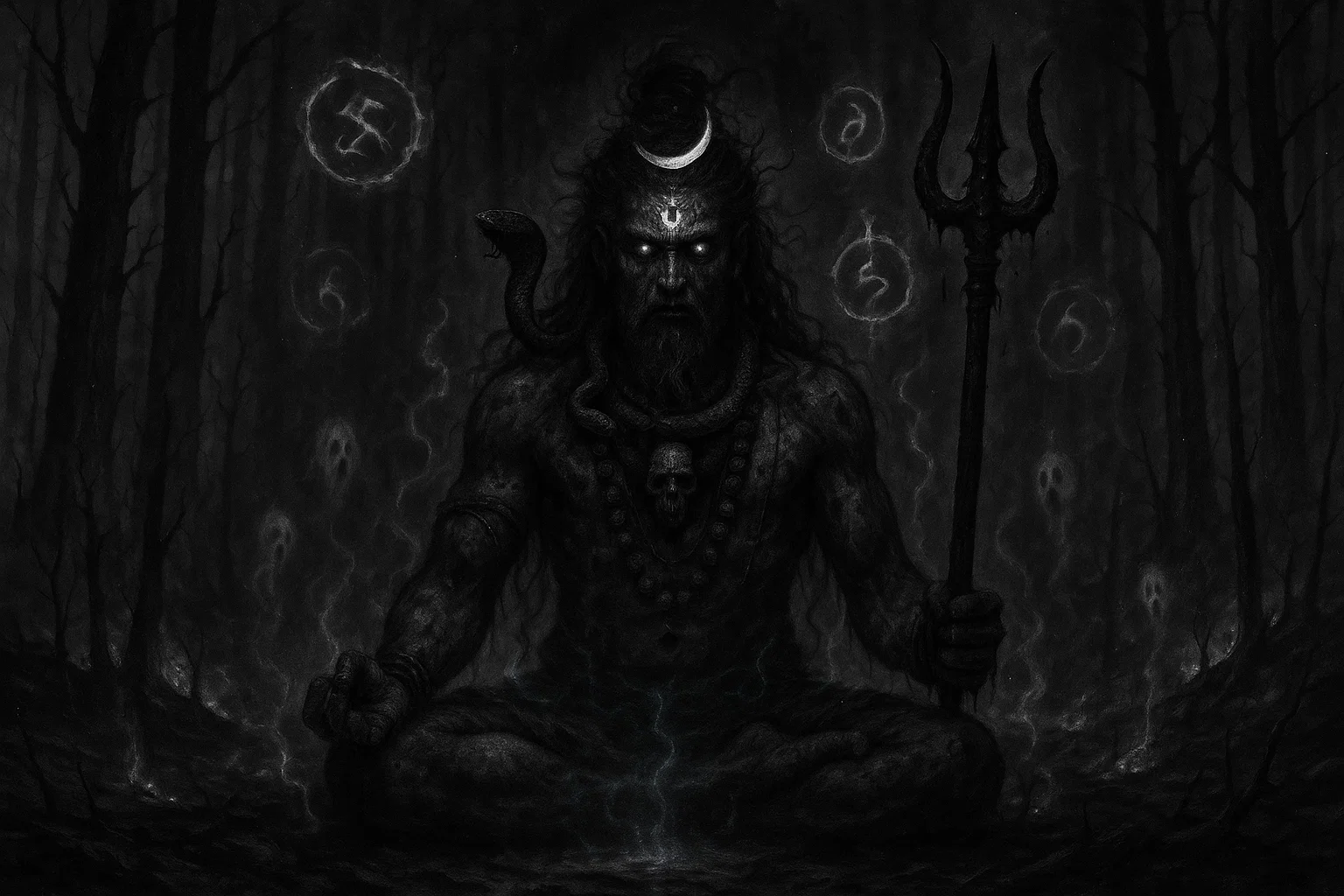

Shiva is one of the principal deities of Hinduism, revered as the Supreme Being within Shaivism, one of the three most influential denominations of the faith.
He is a prominent figure in the Trimurti. This Hindu triad includes Brahma (the Creator) and Vishnu (the Preserver). His primary roles are those of the destroyer of the universe, allowing it to be recreated cyclically, and the transformer.
However, his multifaceted nature means he is also widely known as an all-powerful ascetic, a master yogi, the lord of dance (Nataraja), and the embodiment of both destructive and benevolent forces.
While often categorized in Western contexts alongside demonic entities (like Asuras) due to his fierce aspects and association with cremation grounds, Shiva himself is the ultimate divine authority, not a demonic entity; he is the controller and conqueror of all such forces.
Summary
Key Takeaways
| Attribute | Details |
| Names | Mahadeva (Great God), Nataraja (Lord of Dance), Rudra (The Roarer/Terrible), Shankara (Giver of Joy), Neelakantha (Blue Throated), Isvara (Lord), Tryambaka (Three-eyed one). |
| Title | The Destroyer, The Transformer, Yogi of Yogis (Mahayogi), Lord of the Universe. |
| Gender | Male, but often represented in the androgynous form of Ardhanarishvara (half-man, half-woman) with Parvati. |
| Role | Destruction, Meditation (Yoga), Procreation (through the Lingam), Dance (Cosmic rhythm), Austerity. |
| Clan | Deva (God) / Supreme Being (Mahadeva). |
| Followers | Ganas (attendants, often mischievous), Devotees (Shaivas), Ascetics, and even Asuras (demons). |
| Powers | Omnipotence, Omniscience, Immortality, Creation/Dissolution of the Universe, Granting of Boons, Transcendence. |
| Appearance | White or ash-covered body, matted hair (Jata) holding the Ganges River, a third eye on the forehead, wearing a snake as a necklace, and a crescent moon on his head. |
| Etymology | Derived from the Sanskrit root śi, meaning “in whom all things lie,” or the verbal root vas, meaning “to dwell” or “to shine.” |
| Associated Figures | Parvati (Consort), Ganesha and Kartikeya (Sons), Nandi (Bull mount), Brahma and Vishnu (Trimurti). |
| Weaknesses | None (as the Supreme Being), but his anger can be exploited or his ascetic state disturbed. |
| Opposing Deva/Avatar | None, as he is one of the three supreme deities; he is in balance with Brahma and Vishnu. |
| Pantheon | Hindu, with origins tracing back to Vedic and Indus Valley Civilization influences. |
| Primary Sources | Vedas (as Rudra), Upanishads, Puranas (specifically the Shiva Purana and Linga Purana), Ramayana, Mahabharata. |
Who or What is Shiva?
Shiva—often translated as “The Auspicious One”—is a complex figure in Hindu theology, encompassing paradoxes such as creation and destruction, meditation and ecstasy. He is the ultimate reality for millions of devotees, especially those belonging to the Shaivism tradition.
As the third deity in the Trimurti, he plays a crucial role: he is responsible for destroying the world when its current cycle is complete, paving the way for Brahma’s next creation. This is not arbitrary destruction; it is a necessary, cyclical process integral to cosmic evolution and balance.
Beyond his cosmic role, he is also the archetypal ascetic (Mahayogi). He is typically depicted deep in meditation on Mount Kailash, detached from all worldly affairs, including pleasure and pain. He embodies the ideal of achieving spiritual realization through intense yoga, austerity (tapas), and self-control.
This dual nature—the powerful destroyer and the tranquil yogi—makes him one of the most enigmatic and universally revered deities in the Hindu pantheon.
“Shiva” Meaning
The name Shiva (Sanskrit: शिव, Śiva) is deeply rooted in Sanskrit and carries profound philosophical and theological significance.
The most common interpretation of the name is “The Auspicious One,” “The Kind One,” or “The Favorable One.” Ironically, this benign meaning is attributed to a deity also known for his fierce and terrifying aspects, particularly as Rudra.
The name can be derived from the root śi (शी), which implies “in whom all things lie,” meaning he is the reality in which the entire universe rests. Another linguistic interpretation traces it to the verbal root vas (वस्), which means “to dwell,” “to shine,” or “to rule,” suggesting Shiva is the supreme, shining, indwelling ruler of the cosmos.
Historically, Shiva evolved from the Vedic deity Rudra (“The Roarer,” or “The Terrible”). Rudra was primarily associated with storms, wind, hunting, death, and healing. Over time—particularly in the later Upanishads and Puranas—the benevolent name Shiva was deliberately used as a euphemism or a qualifying title for the formidable Rudra, gradually eclipsing the older name.
By the time of the major Puranas (post-5th century CE), Shiva had consolidated these multiple aspects—the destructive, the meditative, and the auspicious—into the singular figure of the Mahadeva (Great God).
Variations like Shankara (“Giver of Joy”) and Shambhu (“Beneficent”) further highlight his gracious aspect, demonstrating the theological process of transforming a terrifying natural deity (Rudra) into the supreme, all-encompassing Parabrahman (Ultimate Reality).
How to Pronounce “Shiva” in English
The most common and accepted pronunciation of Shiva in English is “SHI-vuh”. The stress is placed on the first syllable. The ‘i’ sound is short, similar to the ‘i’ in the word “ship.”
What Does Shiva Look Like?
Shiva’s appearance is one of the most distinctive and iconographically rich in Hinduism, symbolizing his ascetic nature, transcendental power, and cosmic role. He is typically described as having a body that is either white from the ash of the cremation grounds or, in many texts, having a blue-throated or Neelakantha form.
The most striking features include:
- The Third Eye (Trinetra): Located vertically on his forehead, this eye is the eye of wisdom and destruction. It remains closed, but when opened, it can incinerate anything in its path, including the God of Desire, Kama, whom Shiva once burned to ashes for interrupting his meditation.
- Matted Hair (Jata): His long, matted, and coiled hair holds the Ganges River (Ganga). According to myth, when Ganga descended from Heaven, Shiva caught the river’s enormous force in his hair to break its fall, saving Earth from being crushed.
- Crescent Moon (Chandra): A small crescent moon is pinned to his hair, symbolizing his control over time and his connection to the cosmic cycles.
- Serpent (Naga): A cobra, often Vasuki, is worn around his neck like a garland, representing his power over the most dangerous creatures, and symbolizing eternity.
- Ash (Bhasma or Vibhuti): His body is smeared with the holy ash from cremation grounds (smashana). This signifies his transcendence over the material world and his dominion over death.
- Tiger Skin: He is often depicted wearing a tiger or elephant skin, symbolizing his victory over desire and ego, and his ultimate power over nature.
Collectively, his appearance is a paradox: terrifying yet serene, fierce yet beautiful, highlighting his ability to transcend all duality.
Origins
Shiva’s origins are ancient, with elements tracing back to the earliest known Indian religious traditions. This powerful entity is a culmination of a long process of theological synthesis, integrating the Vedic deity Rudra with pre-Vedic or local deities, potentially including a figure from the Indus Valley Civilization.
The earliest confirmed precursor is the formidable Rudra in the Rig Veda (c. 1500 BCE). Rudra is a god of storms, healing, and, ominously, death. His name is invoked to avert his terrible arrows, yet he is also praised as the greatest of physicians.
By the time of the Yajur Veda, the term Shiva begins to appear as an epithet for Rudra, suggesting a move towards propitiation and emphasizing the god’s benevolent side.
Over the centuries, particularly with the rise of the Puranas (3rd-10th centuries CE), the name Shiva became dominant, fusing the untamed power of Rudra with the philosophical gravitas of the ultimate yogi and cosmic destroyer/transformer.
The Shaiva tradition ultimately elevated him to the status of Parabrahman—the ultimate reality, superior even to Brahma and Vishnu.
You may also enjoy:
Who Is Agares, the Demon of Earthquakes and Deception?
October 13, 2025
Who Is Adrammelech in Demonology and the Bible?
October 1, 2025
Who Is Shiva, the Destroyer and the Lord of the Universe?
November 12, 2025
What Is a Dīv? The Terrifying Giant Demon of Persian Myth
January 22, 2026
Abura-sumashi: The Potato-Headed Yōkai That Punishes Greed
October 23, 2025
Birth
Unlike the Avatars of Vishnu, who are born into the human world for specific purposes, Shiva is generally considered unborn (Aja) and eternal (Sanatana).
As the Supreme Being in Shaivism, he has no conventional birth or beginning; he is the origin of all existence. However, Hindu mythology contains several narratives related to his manifestation or partial incarnations:
Vedic Origin (Rudra): In some Puranic accounts derived from the Vedic tradition, Rudra is said to have been born from Brahma’s anger or sorrow. When Brahma wished to create children, a brilliant, terrifying boy was born from his forehead who instantly began to weep.
When asked why, the boy said he was weeping for a name, so Brahma gave him the name Rudra (The Roarer/Weeper). Brahma then bestowed eight names upon him—including Shiva—and assigned him eight specific domains of existence.
Linga Manifestation: One of the most famous myths, described in the Linga Purana, is the Pillar of Fire story. When Brahma and Vishnu were arguing over who was supreme, a brilliant, endless pillar of fire (Linga) appeared between them.
Challenged to find its ends, Brahma failed to find the top, and Vishnu was unable to find the bottom. When they admitted defeat, the fire burst open, revealing Shiva at its center. This tale establishes Shiva’s supremacy as the Maha-Deva (Great God), with no beginning or end.
Family
Shiva’s family relationships are crucial to his identity as both a detached ascetic and a loving householder (Grihastha). His domestic life with his consort, Parvati, and his sons, Ganesha and Kartikeya, serves as the basis for many popular devotional stories and philosophical concepts.
His primary consort is Parvati, the daughter of the Mountain King, Himavan, and the sister of the river Ganga. Parvati is considered the reincarnation of Shiva’s first wife, Sati, who immolated herself after her father, Daksha, insulted Shiva.
The reunion of Shiva and Parvati is a central mythological theme that symbolizes the union of the male principle (Purusha) and the female energy (Prakriti).
| Attribute | Details |
| Parents | Unborn, Eternal. In some Puranas, he is an emanation from Brahma or the Supreme Absolute itself. |
| Siblings | None (as the Supreme God). Ganga is sometimes considered a sister-like figure, being held in his hair. |
| Spouse | Sati (first wife, reincarnated as Parvati), also called Uma or Durga. |
| Children | Ganesha (God of Beginnings, Remover of Obstacles) and Kartikeya (Skanda, God of War). |
Asura-Deva Conflicts
Shiva’s role in the cosmic struggle between the Devas (gods) and Asuras (demons) is often that of a neutral, yet decisive arbiter or a mighty protector of both sides.
He is not primarily defined by a constant conflict with Asuras like Vishnu or Indra. Instead, both Devas and Asuras seek his boons, as his power is universally acknowledged as supreme.
One of the most significant battles involving this powerful deity is the destruction of Tripura—three powerful, mobile cities built by the Asura architect, Maya, for the three Asura brothers, Tarakaksha, Kamalaksha, and Vidyunmali.
These Asuras, having gained immense power through penance to Brahma, became invincible to all except Shiva. The deity, riding a great chariot (where the earth was the body, the sun and moon the wheels), and Brahma, the charioteer, destroyed the three cities with a single arrow (Pinaka) at the precise moment they aligned in the sky.
This act, described in the Shiva Purana, cemented his status as the unparalleled archer and destroyer of evil.
In another conflict, the great Rakshasa (demon) king Ravana from the Ramayana was a fierce devotee of Shiva. Ravana performed intense penance (tapasya), even attempting to sever his own head ten times. He famously tried to uproot Mount Kailash, Shiva’s abode.
When Shiva simply pressed the mountain down with his toe, trapping Ravana, the Asura sang the Shiva Tandava Stotram in praise of the god for a thousand years. Pleased, he released him and granted him the mighty sword, Chandrahasa.
Role in Hindu Cosmology
In Hindu cosmology, particularly in Shaivism, Shiva’s position is not just one of a god, but of the Ultimate Reality (Parabrahman).
He is the transcendental source of the entire universe, who constantly governs its existence through five actions (Panchakrityas):
- Creation (Srishti)
- Preservation (Sthiti)
- Dissolution (Samhara)
- Concealment (Tirobhava, or the veiling of reality through illusion)
- Grace (Anugraha, the unveiling of truth)
Shiva is neither strictly a villain nor an anti-hero. He transcends these moral categories, embodying Dharma itself. His destructive aspect is necessary for cosmic balance. He destroys the old and corrupt to make way for the new.
For example, his destruction of Kama prevents the cycle of desire-driven action, paving the way for spiritual liberation. He is the ultimate Devotee of himself, the Mahayogi who sits in eternal meditation, symbolizing the potential for every soul (Atman) to achieve union with the Ultimate Reality.
His influence on human affairs is profound: he grants both terrible boons to Asuras (testing the universe) and salvation to devotees, making him the ultimate authority on spiritual liberation (Moksha).
Was Shiva Ever Mentioned in Vedic Texts?
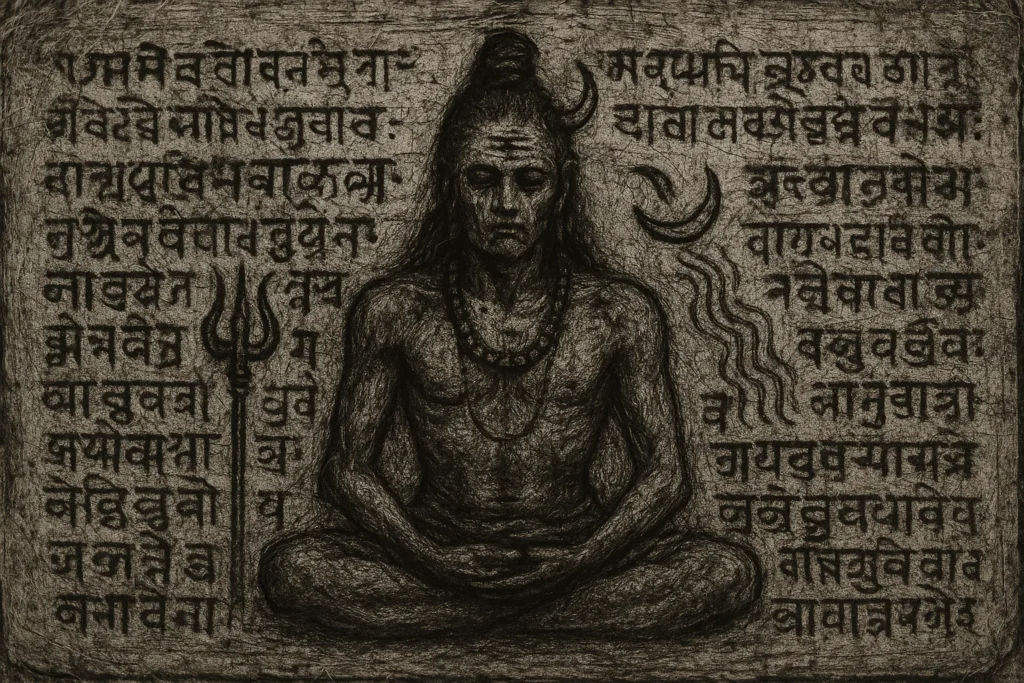
Yes, Shiva, in his antecedent form as Rudra, is a prominent deity in the Vedic texts. Rudra is frequently mentioned, especially in the Rig Veda and the Yajur Veda.
| Source | Quote |
| Rig Veda 1.114.1 | I invoke with offerings the brilliant god, with matted hair, who is a fierce beast, Rudra, who is seated in the heart. |
| Yajur Veda, Taittiriya Samhita 4.5.1 (from the Shri Rudram) | Homage to the gold-chested one, to the one wearing the saffron-colored garment, to the supreme lord, to the one with the twisted locks, to the auspicious one (Śivaya), and to the terrible one. |
| Atharva Veda 11.2.9 | Homage to Rudra of the thousands of eyes, with the thousand quivers, with the thousand arrows. |
Shiva in Epics and Puranas
Shiva’s character and mythology were fully developed in the later classical texts, particularly the Epics (Ramayana and Mahabharata) and the Puranas. These texts provide abundant stories detailing his role in the Trimurti, his marriage to Parvati, and his interactions with mortals and gods.
| Source | Quote |
| Ramayana, Bala Kanda 47.11 (Valmiki) | That great archer, he who is known as Maheshvara (Great Lord), the three-eyed one, took up that best of bows, with an intent to string it. (Referring to the divine bow of Shiva, later broken by Rama). |
| Mahabharata, Drona Parva 80.5 (Vyasa) | The auspicious one (Shiva) is the source of all creatures, and the cause of their destruction, and he is known as the ultimate truth. |
| Shiva Purana, Vayaviya Samhita 40.23 | I am Shiva, the lord of all, the omnipresent, the supreme soul, the cause of all causes, the one without a second, eternal and undecaying. |
| Bhagavata Purana 4.2.14 (referring to Daksha’s sacrifice) | He is Neelakantha, the one whose throat is dark blue, due to holding the deadly poison which arose from the ocean churning, thus saving the world. |
You may also enjoy:
Who Is Taṇhā, the Seductive Demon of Craving in Buddhist Mythology?
October 15, 2025
Erinyes: The Chthonic Goddesses Who Enforced Blood-Guilt
November 20, 2025
Ifrit: Demon of Fire Who Serves Iblis in Islamic Tradition
September 30, 2025
Who Is Andromalius and Why Is He the Last Demon of the Goetia?
January 20, 2026
Who Is Baal in Christian Demonology?
February 25, 2026
Hariti: The Demon Mother Who Fed on Children at Night
December 8, 2025
Powers and Abilities
Shiva’s power level is universally considered supreme within Shaivism, placing him above almost all other deities, including the other two of the Trimurti (Brahma and Vishnu), whom he is often depicted as emanating from or controlling.
His power is not merely physical strength, but cosmic and transcendental, granting him command over the entire cycle of existence.
His powers and abilities include:
- Cosmic Dissolution (Pralaya): The power to destroy the entire universe at the end of a cosmic cycle, reducing it to ashes and preparing it for recreation.
- Omniscience and Omnipotence: As the Parabrahman, he is all-knowing and all-powerful, controlling all aspects of creation, preservation, and destruction.
- Austerity (Tapas): The ability to generate immense, world-altering spiritual energy through deep meditation and penance, granting him incredible powers (Siddhis).
- Immortality and Invincibility: He is unborn and undying, beyond the reach of time and death (Kala).
- Master of Dance (Tandava): His cosmic dance, the Tandava, is the rhythm of the universe. The destructive Rudra Tandava is responsible for dissolution, while the joyful Ananda Tandava is associated with creation and preservation.
- Poison Consumption (Vishapana): The ability to consume the deadliest poison (Halahala) that appeared during the churning of the cosmic ocean, Samudra Manthan, holding it in his throat without dying, thus earning the name Neelakantha (Blue Throated).
- Granting of Boons: He is renowned for quickly being pleased by sincere devotion and granting powerful boons to gods, demons, and mortals alike (often with disastrous, yet necessary, consequences for the cosmic play).
- Master of Yoga: He is the originator of Yoga, capable of existing in eternal, undisturbed meditation.
Shiva Myths, Legends, and Stories
The Burning of Kama (Kama-Dahana)
This crucial myth, recounted in various Puranas, explains the origin of Shiva’s third eye and the nature of selfless devotion. After his first wife, Sati, sacrificed herself, Shiva retreated to the Himalayas to perform extreme penance, grieving and detached from the world.
Meanwhile, the wicked Asura Tarakasura had gained a boon that he could only be killed by a son of Shiva.
Concerned, the Devas (gods) realized that Shiva had to be drawn out of his meditation and convinced to marry Parvati (Sati’s reincarnation) to conceive the son destined to kill the Asura.
The Devas enlisted Kama (or Kamadeva), the God of Desire, to strike Shiva with his flower-tipped arrows while Parvati was attending to him. As Kama shot his arrow, Shiva’s meditation was instantly broken. In a flash of intense anger and profound interruption, Shiva opened his third eye (Trinetra).
A fierce burst of fire emanated from it, instantly reducing Kama to a pile of ashes (Ananga – “the one without a body”). This event highlights Shiva’s immense power and his uncompromising devotion to austerity, teaching that desire (Kama) must be annihilated to achieve true spiritual liberation.
Neelakantha: The Drinking of the Halahala Poison
The legend of Neelakantha (Blue-Throated One) is a testament to Shiva’s compassion and role as the Preserver of the universe, despite his title as the Destroyer.
During the great churning of the cosmic ocean (Samudra Manthan) by the Devas and Asuras to extract the Amrita (nectar of immortality), the first substance to appear was the deadly, world-ending poison, Halahala (Kalkuta).
Its noxious fumes began to pollute the cosmos, suffocating all life. Neither the Devas nor the Asuras could contain it. In this moment of universal crisis, the gods approached Shiva for help. Out of boundless compassion for all creatures, Shiva willingly gathered the poison and drank it.
He prevented the poison from descending into his stomach, which would have destroyed the world, by holding it in his throat. His consort, Parvati, is also credited with pressing his throat to ensure the poison did not reach his body.
The poison permanently stained his throat blue, a permanent mark of his sacrifice, earning him the name Neelakantha.
The Descent of the Ganges (Ganga-Vataran)
This tale explains how the sacred river Ganges (Ganga) came to Earth. The great King Sagara’s 60,000 sons were accidentally burned to ashes by the sage Kapila’s curse.
To liberate their souls, the only path was to bring the heavenly river Ganga down to Earth, whose pure waters could wash away their sins. The king’s descendant, Bhagiratha, performed intense penance for thousands of years to persuade Ganga to descend and Brahma to grant his request.
When Ganga agreed, she was furious, believing her immense force would destroy the Earth. Bhagiratha then prayed to Shiva to manage the river’s descent. Pleased by the devotion, Shiva stood on the Himalayas and caught the entire river in the dense, matted coils of his hair (Jata).
Ganga, confused, wandered through the labyrinthine locks for many years until Shiva released her gently onto the Earth in seven trickles, saving the planet from her celestial wrath.
This myth is why Shiva is often called Gangadhara (Bearer of the Ganga) and why the Ganges is so sacred.
The Contest of the Phallus (Linga-Udbhava)
As mentioned in the Linga Purana, this story focuses on Shiva’s supremacy over the other two major deities, Brahma and Vishnu.
One day, Brahma (the Creator) and Vishnu (the Preserver) were locked in a quarrel over who was the supreme god. To settle the dispute, a gigantic, blazing pillar of fire, without beginning or end, suddenly manifested between them.
This cosmic pillar was the Shiva Lingam. Brahma and Vishnu agreed to find the ends of the column. Brahma took the form of a swan (Hamsa) and flew upwards to find the top, while Vishnu transformed into a boar (Varaha) and dug downwards to find the base. After eons of searching, both failed.
Vishnu humbly admitted his failure. Brahma, however, lied, claiming to have seen the top, a lie attested to by the Ketaki flower.56 At that moment, Shiva appeared from the pillar, exposing Brahma’s deceit. Shiva cursed Brahma that he would have no temples on Earth, and Vishnu was praised for his honesty.
This story establishes the Linga as the unmanifest form of Shiva—the ultimate, limitless, and superior reality (Mahadeva).
Shiva vs Other Asuras
| Asura Name | Associated Trait/Role | Clan/Origin | Key Traits/Powers |
| Mahisha | Deception (shape-shifting), Arrogance | Danava/Asura | Shape-shifting (Buffalo), Immunity to all males. |
| Hiranyakashipu | Ego (Ahamkara), Hatred of Vishnu | Daitya/Puranic | Invincibility boon (not killed by man or beast, day or night, etc.). |
| Indrajit (Meghanada) | Conquest, Warrior skill | Rakshasa/Ramayana | Son of Ravana, Boons to use celestial weapons (Indra’s conqueror). |
| Bali | Generosity, Devotion to Vishnu | Daitya/Puranic | King of the three worlds, Philanthropy, Overthrown by Vamana. |
| Vritra | Drought, Chaos | Asura/Vedic | Embodiment of drought, Fought Indra, Killed by thunderbolt (Vajra). |
| Tarakasura | Tyranny, Invincibility | Asura/Puranic | Could only be killed by a son of Shiva (Kartikeya). |
| Shumbha & Nishumbha | Conquest, Cosmic Threat | Asura/Puranic | Defeated Devas, Ultimately killed by the goddess Durga. |
| Rahu | Eclipses, Deception | Asura/Puranic | Stealer of Amrita, Severed head, Causes solar and lunar eclipses. |
| Kumbhakarna | Gluttony, Immeasurable Strength | Rakshasa/Ramayana | Brother of Ravana, Granted a boon of perpetual sleep. |
| Tripurasura | Technological Mastery (Three Cities) | Asura/Puranic | Built three impregnable cities, Destroyed by Shiva. |
| Bana (Banashura) | Devotion to Shiva, Thousand Arms | Asura/Puranic | Son of Bali, Devotee of Shiva, Fought Krishna. |
Rank Among Deities
In the broader Hindu pantheon, Shiva is one of the three deities of the Trimurti (Brahma, Vishnu, and Shiva), ranking him as the highest among the Mahadevas (Great Gods).
In this framework, all three gods are considered equally powerful and essential, representing the cosmic functions of creation, preservation, and dissolution. However, within the Shaivism tradition, Shiva is regarded as the Supreme Being (Parabrahman), the only true God, with Vishnu and Brahma merely being his emanations or aspects.
Shiva’s relationship with the Asuras is unique. While many Asuras are mortal enemies of Vishnu and Indra, Shiva often remains impartial. He is easily pleased by sincere devotion (Bhakti), regardless of whether the devotee is a Deva or an Asura.
His devotees, such as Ravana, Bana, and the Tripurasuras, performed intense austerities to him, and he, in turn, granted them immense, often world-threatening, boons.
Mystical Correspondences
| Attribute | Details |
| Planet | Moon (Chandra) (due to wearing the moon on his head), or sometimes Saturn (Shani) (representing austerity and time). |
| Zodiac Sign | Capricorn (representing mountains, solitude, and structure) or sometimes Aquarius (representing meditation and the water-bearer of Ganga). |
| Element | Ether or Space (Akasha) (as the transcendent Supreme Being), but also heavily associated with Fire (destruction) and Water (Ganga). |
| Direction | North (The direction of Mount Kailash, his abode, symbolizing transcendence and knowledge). |
| Color | White (representing the ash-smeared yogi, purity, and transcendence) or Blue (due to his Neelakantha form). |
| Number | 5 (Symbolizing his five faces or aspects, Panchamukha) or 108 (sacred to Hindus). |
| Crystal/Mineral | Rudraksha beads (literally Tears of Rudra), Sapphire (related to Saturn). |
| Metal | Silver (associated with the Moon and purity). |
| Herb/Plant | Bael (Bilva) leaves (used in Shiva worship), Bhang (cannabis, consumed by the ascetic). |
| Animal | Nandi (The sacred Bull, his vehicle and gatekeeper), Serpent (Naga, worn around the neck). |
| Trait/Role | Destruction, Meditation, Transcendence, Austerity. |
Mystical Correspondences
Shiva’s correspondences reflect his nature as a universal, transcendental deity who is simultaneously the Lord of Time and Eternity, and the Master of the physical elements.
His cosmic ties begin with the Moon (Chandra), which he wears on his matted hair, symbolizing his command over time and its cycles. This lunar association links him to the zodiac sign of Capricorn (or sometimes Aquarius), highlighting his nature as the eternal ascetic of the mountains, controlling the rigid structure of the cosmos.
His position as the ultimate reality aligns him with the element of Ether (Akasha), which is space—the container of all things—and reinforces his role as the detached observer and controller of the cosmos.
Flowing from the cosmos to the physical world, his directional association is the North, the location of Mount Kailash. On this legendary, sacred mountain, he sits in eternal meditation.
His primary color, White, reflects the purity of the ash (Bhasma) covering his body, signifying his transcendence over all duality and mortality. The auspicious number 5 corresponds to his Panchamukha (five faces/aspects), representing his five fundamental cosmic functions and elements.
His association with the Rudraksha bead and the Bael leaf is central to his worship, providing specific, tangible tools for devotees to align their spiritual practice with his transcendent energy and help them achieve self-realization and liberation.
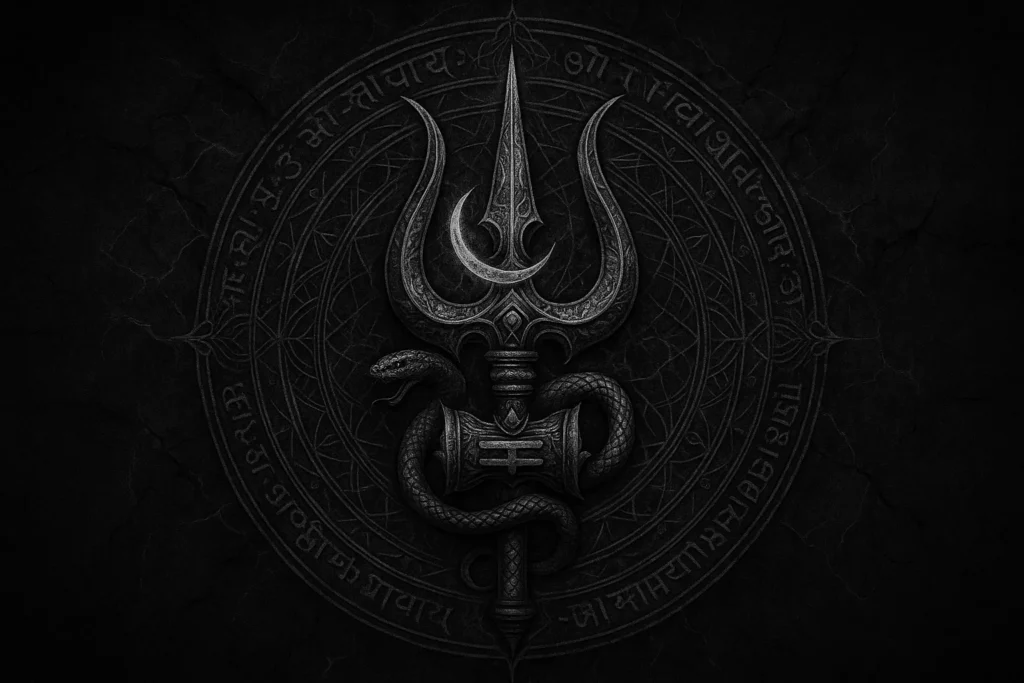
Shiva’s Symbols
Shiva is represented by some of the most powerful and recognizable symbols in Hinduism, each representing a complex aspect of his nature.
- The Shiva Lingam: Perhaps the most important symbol, the Lingam (meaning “sign” or “mark”) is an abstract, aniconic representation of Shiva.67 It is a vertical, cylindrical column that signifies the ultimate reality, which is unmanifest, formless, and limitless—the very Pillar of Fire (Linga-Udbhava) from which Shiva emerged. It also represents the union of the male and female creative principles when placed within the yoni (base).
- Trishula (Trident): Shiva’s primary weapon, the Trishula symbolizes his threefold nature. Its three prongs symbolize his power over the three worlds (Triloka), his mastery over the three qualities (Gunas—Sattva, Rajas, Tamas), and his authority over the three aspects of time (past, present, and future).
- Damaru (Drum): The small hourglass-shaped drum held in Shiva’s hand. Its continuous sound represents the rhythmic, creative pulse of the universe and the primordial cosmic vibration, Om. In his Nataraja form, the sound of the Damaru calls all creation into existence.
- Vibhuti (Ash): The three horizontal lines of sacred ash (Tripundra) on his forehead symbolize the essence of all beings after death, reminding his followers of the ultimate impermanence of the material world and the need to seek liberation.
Worship and Boons
Worship of Shiva is primarily carried out by adherents of Shaivism, one of Hinduism’s largest sects. His worship is characterized by austerity, simple rituals, and profound devotion (Bhakti).
Methods of Worship and Rituals
The most common form of worship involves the Shiva Lingam. Devotees perform Abhishekam (ritual bathing) of the Lingam with five sacred substances (Panchamrita): milk, yogurt, ghee, honey, and sugar. This is often accompanied by offerings of Bael (Bilva) leaves, which are considered extremely sacred to him.
Unlike the elaborate rituals for other gods, Shiva’s worship often takes place in humble temples, sometimes in cremation grounds (smashana), reflecting his ascetic and non-material nature.
Repetition of the Panchakshara Mantra (Om Namah Shivaya) is the most potent form of devotion. Mahashivaratri (The Great Night of Shiva) is his most important festival, marked by all-night fasting and meditative vigil.
Granting of Boons
Shiva is known as Ashutosh (“One who is easily pleased”), meaning he readily grants boons to anyone who shows sufficient devotion and performs intense penance (tapasya).
- Tapasya and Boons: Shiva often grants boons that seem counterintuitive to cosmic order, such as to the Asuras, which inadvertently drives the narrative of the universe.78 For instance, he granted the demon Tripurasura the boon of three flying, invincible cities. This power led to their downfall at the hands of Shiva himself, demonstrating the principle that power granted without wisdom often leads to destruction, which Shiva must then correct.
- The Boon of Immortality: The ultimate boon Shiva grants is not material wealth or power, but Moksha (liberation) or release from the cycle of death and rebirth (samsara). As the Supreme Yogi, the goal of his worship is to attain union with him through spiritual practice and devotion, transcending the temporary boons sought by the Asuras and Devas.
You may also enjoy:
Marid: The Ocean Jinn That Defies Heaven and Earth
September 30, 2025
Lamashtu, the Mesopotamian Demoness of Childbirth and Infant Death
November 4, 2025
Who Is the Demon Andras, The Great Marquis of Discord?
January 15, 2026
Who Was Hiranyakashipu, the Demon King of Hindu Mythology?
October 6, 2025
Who Is Al-Abyad? The White King Jinn Who Rules Love and Chaos
January 26, 2026
Frequently Asked Questions
What is Shiva the god of?
Shiva is the Hindu god of destruction and transformation, forming the third part of the Trimurti (triad) alongside Brahma (Creator) and Vishnu (Preserver). He is also revered as the Lord of Ascetics (Mahayogi), the Patron of Yoga, the Lord of Dance (Nataraja), and the ultimate source of both death and regeneration. In Shaivism, he is the Supreme Being (Parabrahman).
Is Lord Shiva good or evil?
Lord Shiva transcends the dualities of “good” and “evil.” He is the embodiment of the Ultimate Reality, encompassing both benevolent and terrifying aspects. He is considered auspicious and the source of salvation (Moksha), but his role as the Destroyer is fierce and necessary for cosmic renewal. Devotees see his destruction as a merciful act that clears away illusion and negativity.
Which god can destroy Shiva?
As the Supreme Being in Shaivism and one of the three principal deities (Trimurti), Shiva cannot be destroyed by any other god or entity. He is considered Aja (unborn) and Avinashi (indestructible). His power is the final power that dissolves the entire universe at the end of a cosmic cycle, and he remains the sole entity in existence before the next creation begins.
Why do demons pray to Shiva?
Asuras (demons) pray to Shiva because he is easily pleased by sincere devotion (Bhakti) and rigorous penance (Tapasya), regardless of the worshipper’s nature or intentions. He is known as Ashutosh (“One who is easily pleased”) and readily grants powerful boons, which Asuras often use to gain immense strength and challenge the Devas (gods).
What are the 7 laws of Shiva?
The “7 laws of Shiva” is a modern, non-traditional concept, not a recognized doctrine in classical Hindu scriptures such as the Vedas or Puranas. The concept often refers to simplified spiritual or life principles inspired by Shiva’s ascetic and cosmic roles, such as non-attachment, austerity, meditation, and transcending ego, which are distilled from his mythological characteristics.
Where does Shiva live?
Shiva primarily resides on Mount Kailash (Kailāsa), a sacred peak in the Himalayas. He is often depicted sitting there in a state of deep, eternal meditation (Samadhi). In Hindu belief, Mount Kailash is a spiritual center of the universe and Shiva’s transcendental abode, embodying his ultimate detachment and asceticism.
What is the meaning of the Rudraksha bead?
The Rudraksha is a seed from the Elaeocarpus ganitrus tree, commonly used as prayer beads (malas), particularly by Shiva devotees. The name literally means “Tears of Rudra” (Rudra is a Vedic name for Shiva). According to the Shiva Purana, the Rudraksha was formed from Shiva’s tears of compassion that fell to the Earth. Wearing them is believed to offer protection, bring peace, and aid in meditation.
What is the significance of the crescent moon on Shiva’s head?
The crescent moon (Chandra) on Shiva’s matted hair symbolizes his mastery over the passage of Time and its inherent cycle of creation and dissolution. The crescent shape represents the eternal process of waxing and waning, signifying that Shiva is both the Lord of Time (Mahakala) and the one who is transcendent of it, existing in eternal stillness.
What is the difference between Shiva and Vishnu?
The primary difference lies in their cosmic roles within the Trimurti: Vishnu is the Preserver, responsible for maintaining cosmic order (Dharma) and equilibrium, often taking mortal incarnations (Avatars) to save the world. Shiva is the Destroyer and Transformer, whose role is to dissolve the universe when the time is right, leading to its eventual rebirth.
