
Ambolin is a lesser demonic entity that is mentioned in several texts of Christian demonology. The demon is characterized primarily by his subordinate position within the infernal hierarchy. He is classified as a spiritus familiaris (familiar spirit). He is noted specifically for being a servant of two of the most potent entities in the demonic realm: Asmodeus and Astaroth.
Unlike the 72 spirits listed in the Ars Goetia, Ambolin is not a crowned king or a duke, but rather a lesser, operative demon whose function is to attend to and execute the commands of his powerful masters. His role is fundamentally tied to the larger operations and domains of Asmodeus and Astaroth.
Summary
Key Takeaways
| Attribute | Details |
| Names | Ambolin |
| Title | None |
| Gender | Male |
| Role | Servant of the higher-ranking demons, primarily Asmodeus and Astaroth |
| Rank | Lesser demon; a spiritus familiaris |
| Hierarchy | Serves under Asmodeus and Astaroth |
| Legions | None |
| Powers | Functions as an attendant or familiar, carrying out the will of his masters |
| Associated Figures | Asmodeus, Astaroth, Balam, Paimon, Leviathan |
| Weaknesses | Bound by the authority of higher spiritual names and divine power |
| Opposing Angel/Saint | The Archangel Raphael (who bound Asmodeus) |
| Pantheon | Christian demonology, particularly the tradition related to the Lemegeton |
| Primary Sources | The Book of Sacred Magic of Abramelin the Mage, the Grimorium Verum |
Who or What is Ambolin?
Ambolin is a subordinate demonic entity, recognized within esoteric texts as a familiar spirit who carries out specific tasks for superior demons. His primary identity in demonology is defined by his service to the high-ranking demon Asmodeus, a King of the infernal regions and the demon of lust, gambling, and extravagance, and to Astaroth, a Great Duke who is a high-ranking spirit of idleness and vanity.
Lesser demons such as Ambolin function as key components in the infernal structure, acting as messengers, attendants, or operators on the terrestrial plane. While he is not credited with the ability to command legions himself, his association with figures of the stature of Asmodeus and Astaroth indicates that he holds a position of some functional importance.
WHAT SATAN DOES NOT WANT YOU TO KNOW Limited-Time: Up to 30% OFF!
Straight from Rome’s chief exorcist of 30 years – Fr. Gabriele Amorth. Real cases of possession, oppression, and diabolic infestation exposed. How demons attack today • Signs of demonic influence • Weapons that actually work • The terrifying truth the devil fights to keep hidden • Possession • Infestation • True spiritual warfare.
“Ambolin” Meaning
The name Ambolin is obscure in its exact linguistic origins, reflecting its nature as a less-documented entity within the primary grimoires of the European occult tradition. Unlike the names of major demons such as Baal or Lucifer, which often have clear roots in Semitic or classical languages, the etymology of Ambolin is not clearly defined in mainstream scholarship.
One possible context for the name’s appearance is within the complex terminology and naming conventions of the Lemegeton tradition and related works. Names in these grimoires were often constructed or transcribed from various source languages, including Hebrew, Latin, and Greek, or were corrupted through transmission.
Given his association with The Book of the Sacred Magic of Abramelin the Mage, the name may potentially contain elements of Kabbalistic or Hebraic influence, though a direct, verifiable root remains speculative.
How to Pronounce “Ambolin” in English
The most conventional way to pronounce the name Ambolin in English follows standard phonetic rules for the arrangement of its syllables. The pronunciation is generally AM-buh-lin. The emphasis is typically placed on the first syllable, “Am,” with the subsequent syllables “bo” and “lin” being pronounced quickly and clearly.
What Does Ambolin Look Like?
Specific and detailed physical descriptions of Ambolin are absent from the known primary source texts, such as The Book of the Sacred Magic of Abramelin the Mage and the Grimorium Verum. This lack of a detailed physical account is common for lesser or subordinate demons, particularly familiar spirits, whose primary role is functional rather than iconic.
Demons who serve as spiritus familiares are often described generally, if at all, as taking on forms that are convenient or unassuming to their masters or the magician who binds them. These forms can be highly variable and unstable, ranging from simple spectral manifestations to shadowy shapes, and from animal to hybrid forms.
You may also enjoy:
Erinyes: The Chthonic Goddesses Who Enforced Blood-Guilt
November 20, 2025
Who Was Hiranyakashipu, the Demon King of Hindu Mythology?
October 6, 2025
Who Was Ravana in Hindu Mythology and Why Was He Feared?
October 3, 2025
What Is a Rakshasa? Meaning, Origins, and Dark Powers
January 23, 2026
What Is a Dīv? The Terrifying Giant Demon of Persian Myth
January 22, 2026
Ifrit: Demon of Fire Who Serves Iblis in Islamic Tradition
September 30, 2025
Origins
The earliest documented appearances of the demon Ambolin are found in texts that deal with the summoning and binding of familiar spirits. The figure’s primary origin can be traced to the tradition of European occultism, which coalesced around King Solomon and the binding of demons.
The most critical and relatively early source for Ambolin is The Book of the Sacred Magic of Abramelin the Mage. This 15th-century text, allegedly translated by Abraham of Worms, details a system of magic designed to attain the “Knowledge and Conversation of the Holy Guardian Angel” and subsequently to gain power over the demonic hierarchy.
In this work, Ambolin is explicitly listed as a servant demon under the command of two of the Eight Sub-Princes, who are subordinate to the Four Grand Princes of Evil (Lucifer, Leviathan, Satan, and Belial).
COMMAND THE 72 DEMONS OF THE ARS GOETIA. Limited-Time: Up to 10% OFF!
The complete Lemegeton – restored from ancient manuscripts. Full seals & rituals • True evocation rites • Ranks & powers of every spirit Ars Goetia • Theurgia-Goetia • Ars Paulina • Almadel • Notoria • The ultimate grimoire of Solomon.
The most accurate, beautiful edition ever published (Skinner & Rankine). Every serious magician owns this. Do you?
Was Ambolin Ever Mentioned in the Bible?
Ambolin is not mentioned in the Old or New Testaments or the Apocrypha. The demon is likely a product of later Jewish and Christian esoteric traditions, specifically emerging within the body of occult literature known as grimoires and works of ritual magic that developed during the Middle Ages and the Renaissance.
Ambolin in Grimoires and Other Texts
The primary documentation of Ambolin is found within two key grimoires of Western esoteric tradition, which detail the summoning and control of demons:
| Source | Quote |
| The Book of the Sacred Magic of Abramelin the Mage | “The Names of the Spirits which he saith are under the Eight Sub-Princes: AMBOLIN [listed under Asmodeus, Maggot, Ashtaroth and Beelzebub]” |
| Grimorium Verum | “[Referring to various spirits, including Ambolin in later appendices/editions]… servants of the greater spirits.” |
Powers and Abilities
Ambolin’s powers are functional and derived from his position as a spiritus familiaris. His abilities are designed to facilitate the execution of their malicious intentions and operations.
Ambolin’s powers and abilities include:
- Serving as a Dedicated Attendant: His primary power is to act as a direct and tireless servant to his masters, Asmodeus (King of Lust and Wrath) and Astaroth (Duke of Idleness and Rationalization).
- Executing Commands: He is empowered to carry out specific, practical tasks and commands given by Asmodeus and Astaroth, which are often directed toward human corruption and sin.
- Facilitating Vice: Given his association with Asmodeus, Ambolin is implicated in the promotion of lust, gambling, extravagance, and general hedonism among mortals.
- Inducing Sloth and Vanity: Through his service to Astaroth, his powers extend to fostering idleness, vanity, and the rationalization of evil, making humans susceptible to profound self-deception and moral decay.
- Aiding in Infernal Communications: He may serve as a messenger between his masters and other lesser demons or bound human agents.
- Granting Wealth or Secrets (Indirectly): Since Asmodeus and Astaroth are associated with the giving of treasures and knowledge (though always with ruinous consequences), Ambolin’s powers are used to help channel or dispense these dark gifts to those who perform the requisite dark pacts.
Ambolin vs Other Christian Demons
| Demon Name | Associated Sin/Temptation | Rank/Origin | Key Traits/Powers |
| Balam | Idolatry, deception | King (Ars Goetia #51) | Knowledge of past, present, and future; grants invisibility; three heads (bull, man, ram) |
| Paimon | Worldly pride, carnal desires | King (Ars Goetia #9) | Grants Dignities; commands 200 legions; knowledge of all arts and sciences; appears on a dromedary |
| Purson | False piety, materialism | King (Ars Goetia #20) | Discovers hidden things; answers questions of Earth’s creation; grants good familiars; appears as a man with a lion’s face, riding a bear |
| Zagan | Corruption, deceit | King and President (Ars Goetia #61) | Transmutes liquids (wine to water, blood to wine); makes men witty; appears as a bull with griffin wings |
| Gremory | Lust, infidelity | Duke (Ars Goetia #56) | Reveals past, present, and future; finds treasures; procures the love of women; appears as a beautiful woman riding a camel |
| Belial | Lawlessness, worthless things | King (Ars Goetia #68) | Instills pride and sin; grants high titles; appears in a fiery chariot |
| Beelzebub | Gluttony, sloth | Prince of the Seraphim (Binsfeld’s) | Commands vast armies; associated with flies and disease; high-ranking demon of corruption |
| Mammon | Greed, avarice | Prince of Tempters (Christian Demonology) | Personification of wealth and material desire; incites the love of money |
| Leviathan | Envy, heresy | Prince of the Seraphim (Binsfeld’s) | Controls the seas; demon of the abyss; associated with massive, untamable chaos |
| Orias | Sorcery, divination | Marquis (Ars Goetia #59) | Transmutes men into any form; gives dignities; knows the courses of the stars |
| Valefor | Theft, temptation | Duke (Ars Goetia #6) | Lures people into stealing; appears as a lion with a man’s head |
| Banshee | Misery, grief | Lesser spirit (Celtic/Irish Folklore) | Forewarns death through wailing |
| Pazuzu | Plague, drought | Ancient Mesopotamian Demon | Bringer of famine and pestilence; often invoked against the demon Lamashtu |
You may also enjoy:
Allocer: Great Duke of Hell and the 52nd Spirit of the Ars Goetia
November 17, 2025
Mara: The Buddhist Demon King of Desire and Death
October 13, 2025
Jikininki: The Japanese Ghost That Feeds on Human Corpses
February 9, 2026
Who Is Agaliarept, the General of Hell Under Lucifer?
October 8, 2025
Iblis, the Jinn King of Darkness and Deception
September 29, 2025
Ambri: The Imperial Duchess of Caspiel’s Empire
December 1, 2025
Rank in the Hierarchy of Hell
Ambolin has a subordinate and functional rank within the intricate hierarchy of Christian demonology. He is classified as a spiritus familiaris (familiar spirit), placing him a lot lower than the Kings, Dukes, Marquises, and Presidents who command legions of lesser spirits.
In the system documented in The Book of the Sacred Magic of Abramelin the Mage, this relationship is clearly delineated:
- The Four Grand Princes of Evil (Lucifer, Satan, Leviathan, Belial) are at the apex.
- The Eight Sub-Princes (which include Asmodeus and Astaroth) serve under the Grand Princes.
- Ambolin and other named familiar spirits serve under the Eight Sub-Princes.
Ambolin is essentially a dedicated, high-value servant who executes the wills of his two masters, who are themselves Princes of Hell. While he does not possess the independent authority to command legions of his own, his direct association with two of the most influential entities in the infernal court grants him access to and involvement in powerful operations of malice.
His rank is operational—he is an agent of implementation rather than a figure of independent authority, focusing his activities on the specific execution of sins related to lust, gambling, sloth, and vanity.
Mystical Correspondences
| Attribute | Details |
| Planet | Mars (via Asmodeus), Venus (via Astaroth) |
| Zodiac Sign | Aries, Scorpio (via Asmodeus) |
| Element | Fire (via Asmodeus/Wrath) |
| Direction | South (via Fire/Wrath) |
| Color | Red (for wrath/lust), Blue/Green (for sloth/vanity) |
| Number | 9 (for its association with the 9th degree of the 9 Archangels of the Qliphoth) |
| Crystal/Mineral | Diamond or Ruby (associated with destructive passions) |
| Metal | Iron or Copper (for war/veneer) |
| Herb/Plant | Wormwood, Mandrake (plants associated with bitterness and forbidden lore) |
| Animal | Goat or Dragon (via Asmodeus), Dove or Serpent (via Astaroth) |
The mystical correspondences of Ambolin are largely derived from the combined attributions of his two high-ranking masters, Asmodeus and Astaroth, as Ambolin is too minor a figure to possess unique, distinct correspondences in the foundational texts.
This amalgamation of traits creates a highly volatile and contradictory profile, underscoring the entity’s dedication to chaos and diverse forms of human ruin.
From his master, Asmodeus, Ambolin inherits strong associations with the celestial body Mars and the element of Fire. Mars, the planet of conflict, energy, and aggression, fuels Asmodeus’s roles as the demon of wrath, lust, and gambling.
This Martial energy directs Ambolin’s potential influence toward impulsive, destructive, and passionate actions. The corresponding zodiac signs, Aries and Scorpio, signify the volatile energy of new passion and the hidden depth of destructive obsession, both of which are central to Ambolin’s assigned tasks.
Conversely, his service to Astaroth introduces the passive and deceptive aspects of Venus and the element of Earth (due to Astaroth’s association with the West and his Duke-like domain).
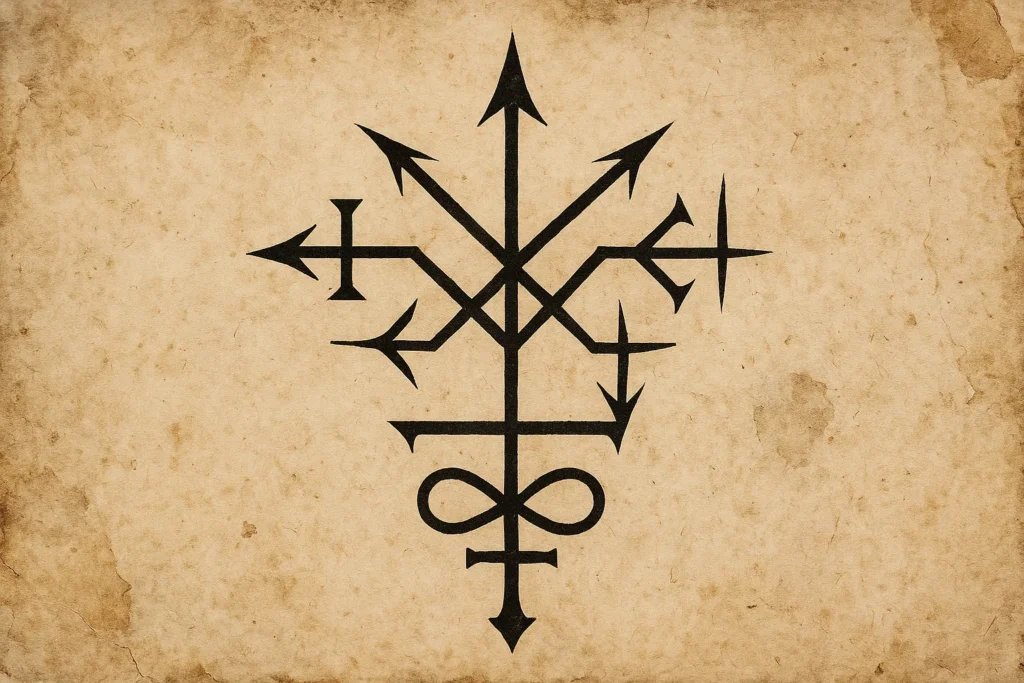
Ambolin’s Sigil
Unlike the 72 spirits of the Ars Goetia, which each possess a distinct magical seal for binding and control, the lesser, familiar spirits, cataloged in The Book of the Sacred Magic of Abramelin the Mage and related works, typically do not have individual seals.
Summoning and Rituals
Since Ambolin is a spiritus familiaris of Asmodeus and Astaroth, his appearance is contingent on the successful summoning and binding of his masters. Rituals targeting Ambolin directly are not detailed in the major grimoires. Instead, the purpose of knowing his name is to command him once his master is already subdued.
In works like The Book of the Sacred Magic of Abramelin the Mage, the ultimate goal is to attain the Knowledge and Conversation of the Holy Guardian Angel. Once this is achieved, the ritual magician is then given authority to command the demons.
You may also enjoy:
Banasura: The Thousand-Armed Demon King
October 10, 2025
What Is Baku? The Japanese Yōkai That Eats Nightmares
January 28, 2026
Bakeneko: A Supernatural Cat Yōkai in Japanese Folklore
January 27, 2026
Who Is Agares, the Demon of Earthquakes and Deception?
October 13, 2025
Akateko: The Bloody Hand Ghost That Guards a Cursed Temple Tree
November 14, 2025
Mahakala: The Dark Guardian Who Consumes Evil
October 16, 2025
