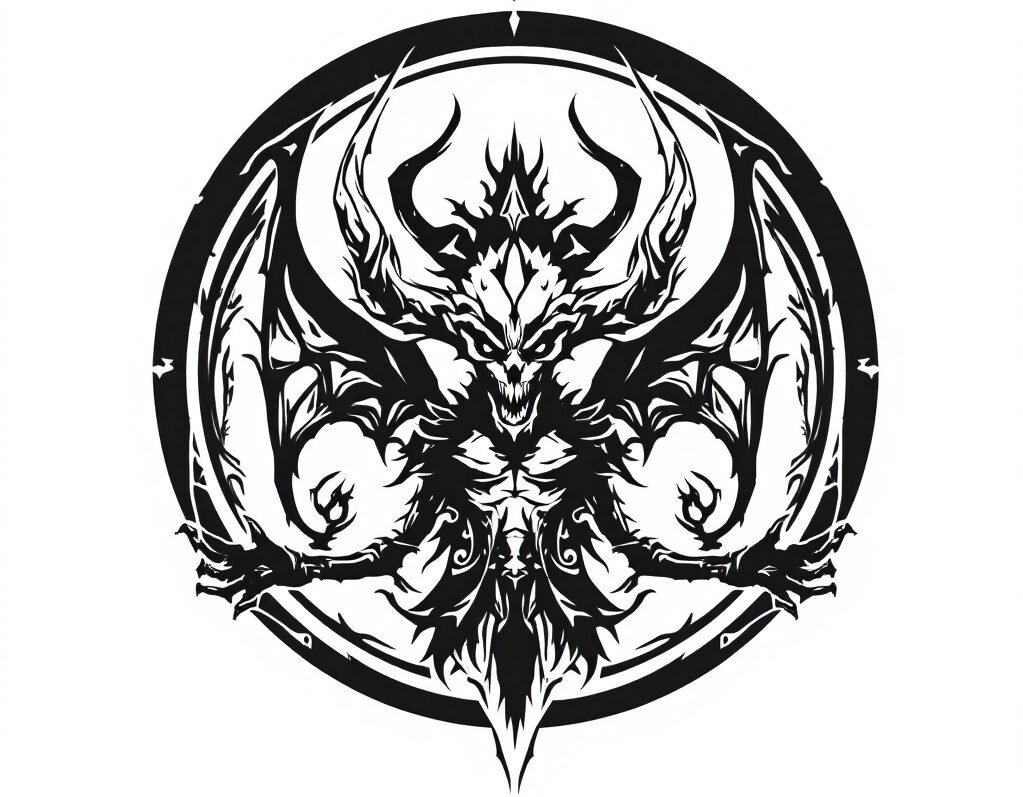

Most supernatural beings in Islamic tradition are seen as distant from human life. Still, the Qareen is unique because it is always close. It represents the ongoing internal moral struggle, acting as a shadow to the human soul rather than an external threat.
Unlike the Ifrit or Ghul, which are seen as specific or elemental dangers, the Qareen is considered a necessary part of theology. It is a constant companion that keeps the test of free will balanced between divine guidance and the temptations it whispers.
This article uses the main translations of Sahih Muslim and Sahih Bukhari to make sure the description of the Qareen is accurate within its cultural context. By comparing folklore with Quranic interpretation (Tafsir), this entry offers a historical overview based on evidence. [View Full Bibliography ↓]
Summary
Key Takeaways
| Attribute | Details |
| Names | Qareen (singular), Qurana (plural), Hamzad (Persian/Urdu variation) |
| Type | Shaytan (Demonic Jinn, constant companion) |
| Title | The Companion, The Constant Associate |
| Gender | Typically matches the gender of the human host |
| Servitors | None; the Qareen operates as a solitary entity assigned to a single human |
| Superior Jinn | Iblis (the primary Shaytan) |
| Powers | Waswasa (whispering), psychological manipulation, inciting doubt, memory recall of sins |
| Appearance | Usually invisible; occasionally described as a shadowy double or reflection of the host |
| Etymology | Derived from the Arabic root q-r-n, meaning ‘to link,’ ‘to couple,’ or ‘to accompany’ |
| Associated Figures | Prophet Muhammad, Iblis, Prophet Sulayman |
| Weaknesses | Consistent dhikr (remembrance of God), recitation of the Mu’awwidhatayn (Suras Al-Falaq and An-Nas) |
| Opposing Holy Figure | The Mulham (the Angelic counterpart/inspirer of good) |
| Social Structure or Tribe | Part of the host of Shayatin; assigned at birth to every human descendant of Adam |
| Followers/Tribe Size | Vast; equal to the total population of humanity throughout history |
| Primary Sources | Quran (Surahs Qaf, Az-Zukhruf, An-Nisa), Sahih Muslim, Sahih Bukhari, Musnad Ahmad |
Who or What is Qareen?
The Qareen is a type of Jinn that is given to every person at birth. Unlike other Jinn that live in empty places or ruins, these spirits have a close but challenging relationship with the human spirit.
In Islamic belief, their main role is to tempt people, always encouraging them to do wrong and avoid their religious duties. It is not just any spirit, but a special kind of Shaytan (devil) focused on its assigned person. The Qareen cannot physically control anyone, but it influences thoughts, making bad actions seem appealing or reasonable.
The Mimetic Parasite
The idea of the Qareen connects Islamic beliefs about fate with the concept of an ‘Internal Critic’ in psychology. In Western traditions, demons are often portrayed as external forces that seek to tempt people.
But this type of spirit is seen as an inner opponent that everyone has. Looking at debates among Islamic scholars about free will, the demon acts as a kind of challenge, making sure that making good choices is never simple.
If people were only attracted to good by nature, free will would be automatic instead of meaningful. The demon creates the necessary challenge, always offering a personal voice that runs counter to divine guidance.
The idea of the Qareen changed as society moved from pre-Islamic beliefs to strict monotheism. In pre-Islamic times, poets thought their creativity came from a poetic spirit or a companion Jinn, seen as a ‘twin’ that inspired them.
With the rise of Islam, this close companion shifted from a source of creative power to a test of morality. The spirit was no longer seen as wild and creative, but as a being whose job was to tempt people within a strict religious system.
Modern analysis sees the Qareen as similar to the Jungian Shadow or the Freudian Id. Unlike other Shayatin, which move freely, this Jinn exists only with its human host. It grows with the person and uses their own words, memories, and experiences to create its whispers (waswasa).
This concept makes the Qareen a good example of Cognitive Dissonance. When someone has thoughts that conflict with their morals, the Qareen offers a religious explanation for this inner conflict. It represents the darker side of a person, helping believers see and fight their own harmful urges as if they were facing a real, though unseen, enemy.
UNLOCK THE FORBIDDEN KNOWLEDGE OF DEMONS. Limited-Time: Up to 29% OFF!
The Encyclopedia of Demons & Demonology 400+ entries • Real history • Exorcisms & Ancient Evils • Possession • Terrifying photos. This is Rosemary Ellen Guiley’s masterpiece of the occult.
“Qareen” Meaning
The word Qareen comes from the Arabic root q-r-n (Q-R-N), which means to join or pair things together. In the past, this root described a ‘peer’ or ‘companion’ who could not be separated. Over time, in poetry and early religious discussions, it came to mean a constant or close partner.
In the Quran, the word is used in various ways to refer to companions. In discussions about demons, it means a satanic counterpart. The word’s origin suggests a bond that is not chosen but is always there, lasting from birth to death.
Names like the Persian Hamzad, which means ‘born together,’ highlight this close connection. In different Islamic traditions, the name stays mostly the same, always showing that the Qareen is like a spiritual twin, sharing the person’s life to influence their spiritual path.
How to Pronounce “Qareen” in English
The name is pronounced kah-REEN. The first part uses a strong ‘k’ sound, followed by a long ‘ee’ sound, with the stress on the last syllable.
What Does s Qareen Look Like?
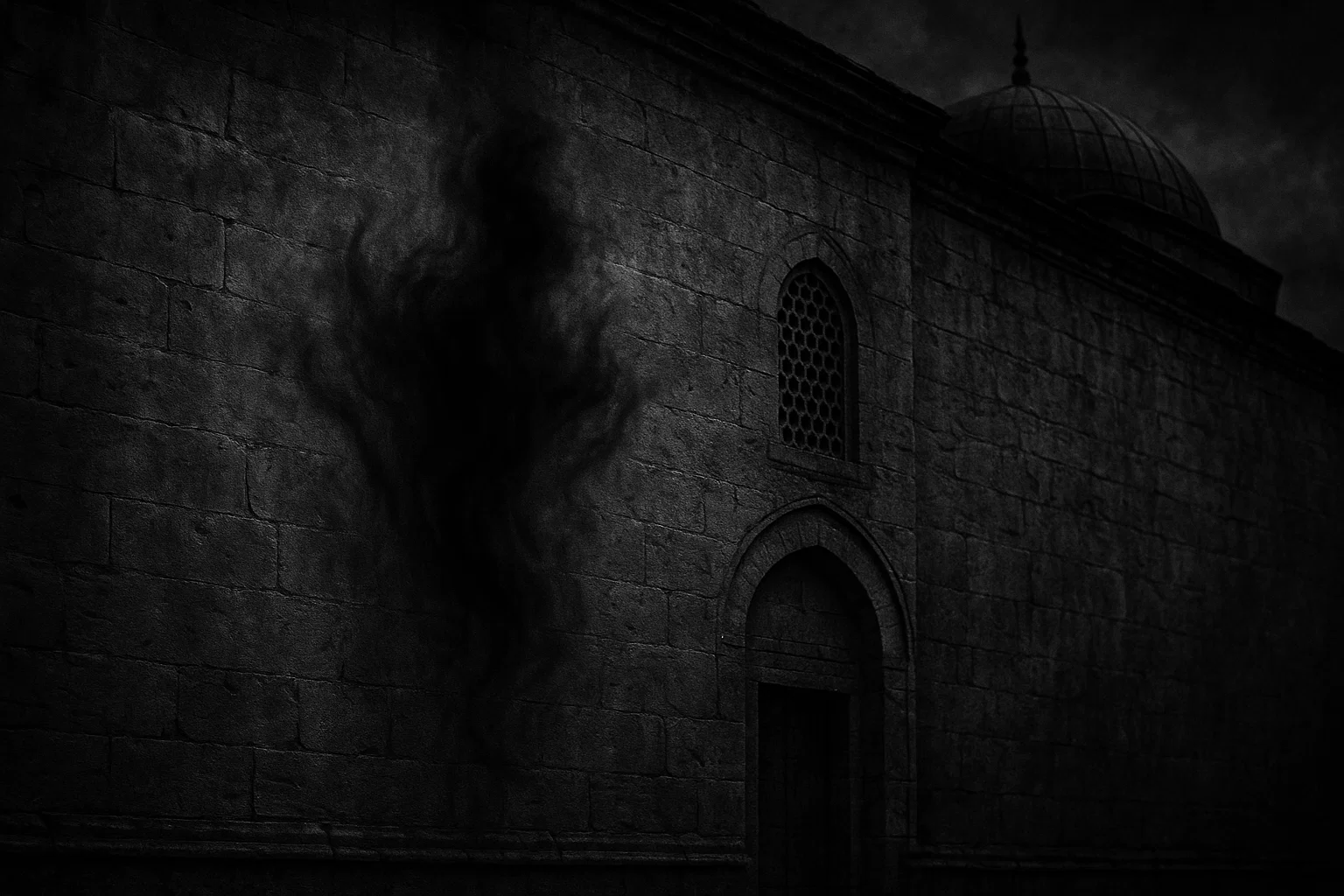
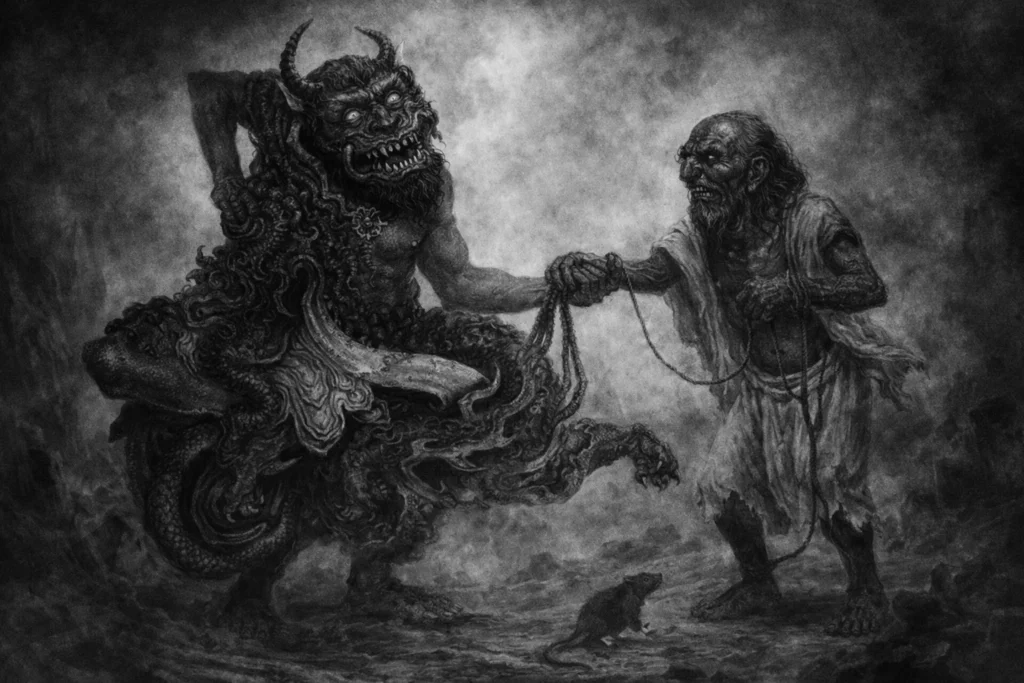
The Qareen is a spirit that exists in the Unseen world (Ghayb), so religious texts do not describe it with a fixed appearance. In folk stories and occult writings, it is often described as a shadowy double or a ghostly copy of the person it follows.
According to some stories, these demons have no distinct face and appear as dark shapes that mimic the person’s movements. As a type of Jinn, it is believed to be made of ‘smokeless fire’ (marijin min nar), but this fire cannot be seen by people.
Some spiritual practitioners say that if such a spirit ever appeared, it would look like the person it follows, but with darker or twisted features to show its evil side. They do not age like humans; they stay the same as long as their host is alive and leave only when the person dies.
You may also enjoy:
What Is Akaname, The Filth-Licking Yōkai?
October 28, 2025
Who Was Hiranyakashipu, the Demon King of Hindu Mythology?
October 6, 2025
Ifrit: Demon of Fire Who Serves Iblis in Islamic Tradition
September 30, 2025
Bakeneko: A Supernatural Cat Yōkai in Japanese Folklore
January 27, 2026
Origins
The story of the Qareen goes back to the creation of humans. In Islamic tradition, when Iblis (Satan) refused to bow to Adam and was sent out of Paradise, he promised to mislead Adam’s descendants until the end of time. The Qareen is seen as the way this promise is carried out.
The Quran does not say exactly when the first Qareen was created, but it shows that having a Qareen became a normal part of human life after Adam’s fall. Hadiths explain that every person, even the Prophet Muhammad, was given a Qareen at birth.
According to Sahih Muslim, the Prophet’s Qareen was made to become Muslim by God’s help, so it only encouraged him to do good. For everyone else, the Qareen comes from the line of demons and starts its influence as soon as a child is born. It is a spiritual companion that has been present in every culture and time.
Powers and Abilities
This entity is different from other Jinn because it does not have the physical strength of an Ifrit or the magical powers of a Marid. Still, it is seen as more dangerous to people because it has full access to their minds. While a strong Jinn might destroy a house, the Qareen can harm a person’s character.
- Waswasa (Whispering): The ability to inject thoughts, doubts, and desires into the human mind, often making them indistinguishable from the person’s own internal monologue.
- Amnesia of Virtue: The power to make a person “forget” their religious obligations or the consequences of their sins at the critical moment of temptation.
- Vulnerability Assessment: Because it lives with the host 24/7, it knows every psychological weakness, fear, and secret desire, using this data to craft personalized temptations.
- Image Projection: It can manipulate the “eye of the heart,” making forbidden actions appear beautiful and righteous deeds appear burdensome.
- Tracking: It can communicate with other Shayatin to coordinate broader spiritual attacks on the host.
1,000+ SPIRITS, GODS & GODDESSES AWAITING YOUR CALL. Limited-Time: Up to 49% OFF!
The ultimate global spirit encyclopedia – 2,000+ entries from every culture on Earth. Fairies • Djinn • Demons • Loa • Angels • Deities • Ancestors Real names • True offerings • Ancient rituals that actually work. Judika Illes’ legendary masterwork – the one book every serious witch, mage, and spirit-worker owns.
Influence on Humans and Possession
This type of entity usually does not take control of a person’s body like in stories of possession. Instead, its influence is more about obsession. Signs of a strong spirit influence include ongoing anxiety, sudden anger without reason, and trouble focusing during prayer.
In more serious cases, the Jinn’s influence can show up as scrupulosity (Waswas al-Qahri), where a person gets stuck in repeated rituals or constant doubts about their faith. Since the Qareen is always with the person, its effects are often confused with mental health issues or personality problems instead of being seen as outside interference.
Protection and Exorcism Methods
Traditionally, people do not protect themselves from the Qareen with a single exorcism. Instead, they rely on ongoing spiritual practices to stay safe:
- Recitation: The most common remedy is the frequent recitation of Sura An-Nas, which specifically mentions the “retreating whisperer.”
- Dhikr: Constant verbal remembrance of God is believed to “shrink” the Qareen, making it weak and incapable of exerting influence.
- Salt and Iron: In folklore, carrying iron keys or placing salt near the bed was believed to repel the influence of Jinn companions during sleep.
- Amulets (Ta’wiz): Some traditions involve wearing verses of the Quran wrapped in leather to serve as a spiritual shield against the internal whispers.
- The Mulham: Believers are encouraged to strengthen their relationship with their Angel (Mulham) through good deeds, as the angel’s presence naturally crowds out the Qareen.
Important Historical & Scriptural Records
“His companion [qarinuhu] will say, ‘Our Lord, I did not make him transgress, but he [himself] was in extreme error.’ [Allah] will say, ‘Do not dispute before Me, for I had already presented to you the warning.’” [Quran, Surah Qaf (50:27-28), 7th Century CE]
This important text shows that the Qareen is not just a myth, but a real part of divine justice. Unlike later stories that make it seem more evil, here the spirit is shown as a witness in the heavenly court. The demon does not control people or force them to act; it only helps bring out the mistakes that are already there. The word qarinuhu (his companion) shows that this bond lasts until the final judgment.
In this period, the focus is on personal responsibility. The 7th-century texts show the Qareen as abandoning the person at judgment, making it clear that each person is fully responsible for their actions and cannot blame the devil.
“The Messenger of Allah (ﷺ) said: ‘There is none of you who does not have a companion from among the jinn appointed over him.’ They said: ‘Even you, O Messenger of Allah?’ He said: ‘Even me, but Allah helped me against him and he submitted [aslama], so he only commands me to do good.’” [Sahih Muslim, Book 39, Hadith 6757, 9th Century CE]
This 9th-century codification introduces the “Universal Assignment” protocol. While the Quranic source focuses on the Judgment, the Hadith shifts the focus to the Living Experience. It establishes the Qareen as a standard biological/spiritual companion for every human descendant of Adam.
The most remarkable divergence is the “Conversion Motif”—the idea that a Qareen is not inherently unchangeable. The term aslama (submitted or became Muslim) suggests that the entity’s rank and nature are tethered to the spiritual authority of the host.
This change shows the Qareen moving from being just a witness to being a tempter or shadow. It explains why people feel pressured to do wrong: the Qareen is always there, focused on one person. Unlike other Jinn that affect many, the Qareen is unique because it is tied to just one individual.
“The heart has two impulses: an impulse from an angel which calls towards good and confirms the truth… and an impulse from the enemy [the qareen] which calls towards evil and denies the truth and forbids good.” [Sunan al-Tirmidhi, Hadith 2988 (Attributed to Ibn Mas’ud), 9th-10th Century CE]
This source explains how the Qareen works, focusing on its main action: whispering (waswasa). At this time, scholars tried to explain the inner thoughts of believers. The Qareen is seen as the opposite of the Mulham (the inspiring angel), creating a model where the heart is pulled in two directions.
Linguistically, the entity is often referred to here as the ‘aduww (enemy), emphasizing a state of perpetual internal warfare. This portrayal was essential for the medieval Islamic researcher to explain Cognitive Dissonance. By defining the urge to sin as an “impulse from the enemy,” the tradition provided a diagnostic tool for spiritual health, allowing individuals to categorize their thoughts and distance themselves from destructive impulses.
“When a child is born, a Hamzad is born with him. It is his double in the world of the Jinn. If the man is strong in spirit, his Hamzad is weak; if the man is wicked, his Hamzad becomes a king among the shadows, leading him into the wilderness of the soul.” [Regional Oral Traditions of Greater Khorasan/Persia, Collected in various forms, 18th-19th Century]
As the story moved into Persian and Central Asian folklore, the Qareen became known as the Hamzad (‘Born Together’). This change brought in the idea of a spiritual double. Instead of just whispering, the Hamzad was said to copy a person’s appearance and could sometimes be seen in mirrors or out of the corner of one’s eye.
This change shows the influence of older Zoroastrian beliefs about the fight between good and evil spirits, now seen in a Muslim context. The Hamzad is now more like a parasitic twin than a witness. People in this era used talismans and physical protections, such as iron or special prayers, to guard against the Qareen, treating it as a real threat that required both physical and spiritual defenses.
You may also enjoy:
Aim (Aym): The Great Duke of Hell in the Ars Goetia
November 11, 2025
What Is Jorōgumo? The Deadly Spider Woman of Japanese Myth
February 2, 2026
Akateko: The Bloody Hand Ghost That Guards a Cursed Temple Tree
November 14, 2025
Si’la: The Seductive Jinn Who Lures Travelers to Their Doom
October 9, 2025
What Is a Yūrei? The True Meaning of Japanese Ghosts
January 30, 2026
Gandharva: God, Spirit, or Demon?
November 13, 2025
Myths, Legends, and Stories
The Conversion of the Prophet’s Companion
In a gathering of the Sahaba, the Prophet Muhammad spoke of the unseen bonds that tie every soul to the spiritual world. He revealed to those present, “There is not one of you who does not have a companion from among the Jinn assigned to him.” After hearing this, the companions were struck with a sense of gravity and asked, “Even you, O Messenger of Allah?”
The Prophet replied, “Even me. However, Allah has granted me victory and helped me against him, and so my Qareen has submitted and become a Muslim. Because of this transformation, he no longer whispers suggestions of vice or doubt; instead, he now commands me to do nothing but that which is good and righteous.”
THE BOOK THEY BANNED FROM THE BIBLE Limited-Time: Up to 90% OFF!
Why was Enoch removed? The fallen Watchers • The birth of the Nephilim • Origin of demons • Names of the angels who became demons • Apocalyptic visions. The original source text that inspired all demonology. Read the apocalyptic visions the church didn’t want you to see.

The Qareen’s Disavowal at the Great Reckoning
On the Day of Resurrection, as described in Surah Qaf, the human soul is brought forth to face the record of its life, led by a driver and accompanied by a witness.
In this moment of ultimate accountability, the demon stands beside the individual, not as a friend, but as an accuser. The human, realizing the weight of their transgressions, looks toward their constant companion.
However, the spirit immediately speaks to the Divine Presence to absolve itself of the human’s choices. The entity declares, “Our Lord, I did not push him into transgression by force, nor did I possess his will; rather, he was already in deep error and chose the path of straying himself.”
The Qareen effectively severs the link that lasted a lifetime, leaving the individual to answer for the whispers they chose to adopt as their own thoughts. The Divine Response then silences the dispute, noting that the warning had already been sent and the judgment is now final.
The Parable of the Lean and Fat Companions
A traditional teaching narrative describes a chance meeting between two Qareen. One was solid, well-fed, and dressed in fine spiritual raiment. At the same time, the other was emaciated, shivering, and looked physically broken. The well-fed demon looked at his companion with pity and asked, “Why are you in such a wretched state? Look at me; I am thriving.”
The lean spirit sighed and explained the nature of his host: “I live with a man who, whenever he eats, mentions the name of Allah, so I remain hungry. When he drinks, he mentions the name of Allah, so I remain thirsty. When he enters his house, he offers the greeting of peace and remembers his Lord, so I am forced to spend the night outside in the cold.”
The fat Qareen laughed and replied, “My situation is the opposite. I live with a man who never mentions the name of Allah when he eats, so I eat my fill with him. He forgets his Lord when he drinks, so I quench my thirst. When he enters his home, he is silent and heedless, so I sleep warmly in his bed and share in all his comforts.”
Qareen vs Other Jinn
| Jinn Name | Associated Traits/Influence | Rank/Origin | Key Traits/Powers |
| Ifrit | Rebellion and extreme strength | Quranic/Arabian Folklore | Pyrokinesis and heavy lifting |
| Marid | Arrogance and sea-dwelling | Ancient Arabian Lore | Granting wishes/High-level magic |
| Ghul | Cannibalism and grave-robbing | Pre-Islamic Folklore | Shape-shifting into animals |
| Si’lat | Seduction and deception | Wilderness Folklore | Expert shape-shifters, mimicking women |
| Hatif | Disembodied voices | Early Islamic accounts | Crying out warnings or lies from shadows |
| Palis | Vampiric foot-licking | Persian Folklore | Drains energy from sleeping travelers |
| Shiq | Half-formed man | Mythological Arabia | Attacks solitary travelers in deserts |
| Nasnas | Weakness and deformity | Yemeni Folklore | Hop on one leg, deceptive appearance |
| Zoba’ah | Whirlwinds and dust storms | Arabian Occultism | Commands the wind and sand |
| Dasim | Domestic discord/Divorce | Islamic Demonology | Causes friction between married couples |
| Awar | Lust and indecency | Fallen Shaytan | Encourages adultery and voyeurism |
| Sut | Lies and fabrications | Lesser Shaytan | Spreads false news and rumors |
Position Among Jinn
In the ranks of the Jinn, the Qareen has a special place in the army of Iblis. They are not leaders, but more like foot soldiers focused on the soul. They are called Shayatin (devils), which means they are Jinn who have joined Satan’s rebellion.
This entity is usually seen as lower in rank than more powerful Shayatin, such as Dasim (who destroys homes) or Awar (who encourages lust).
If a Qareen cannot tempt a very religious person, it is believed that it can ask stronger Jinn for help or bring troubles that might weaken the person’s faith. The demon acts as an ‘insider,’ giving information to other spirits so they can target the person more effectively.
Mystical Correspondences
| Attribute | Details |
| Planet | Moon (reflecting the host) or Saturn (limitation) |
| Zodiac Sign | Gemini (The Twins) |
| Element | Air (the medium of whispers) |
| Direction | North (traditionally associated with darkness) |
| Color | Grey or Charcoal (the color of shadows) |
| Number | 2 (Duality and the split self) |
| Crystal/Mineral | Obsidian (reflective but dark) |
| Metal | Lead (heavy and dull) |
| Herb/Plant | Hellebore (associated with madness/doubt) |
| Animal | Chameleon (for its ability to blend in) |
The Qareen is often seen as a mirror image of the person, showing the idea of duality. Its connection to Gemini and the number 2 points to the ongoing struggle between right and wrong inside each person. Unlike the fiery Ifrit, the Qareen is linked to the element of Air, since it works through thoughts and the inner voice.
In occult practices, obsidian is used with the Qareen because it acts like a dark mirror, showing only the hidden parts of a person. These symbols remind people that the Qareen is not a foreign force, but something closely connected to each person’s life.
The color grey and the metal lead symbolize the heavy feeling and confusion the Qareen seeks to create, keeping people focused on worldly things and hindering spiritual growth.
You may also enjoy:
Azhi Dahaka: The Three-Headed Dragon of Zoroastrian Mythology
January 14, 2026
Who Was Abezethibou, the Fallen Angel Who Opposed Moses?
October 1, 2025
Andhaka: The Blind Demon Born From Cosmic Darkness
February 6, 2026
Erinyes: The Chthonic Goddesses Who Enforced Blood-Guilt
November 20, 2025
Lamia: The Queen Cursed to Devour the Children of Others
January 7, 2026
Bibliography
Author’s Note:
While putting together this article, I noticed a strong contrast between modern medical views and the ancient descriptions of the entity. Today, psychologists often see these ‘whispers’ as signs of scrupulosity, but older sources like al-Tabari show the spirit as a built-in part of human nature. The shift from the Quran’s original idea of a ‘Witness’ to the Hadith’s ‘Constant Companion’ shows a move from focusing on outside judgment to looking at the inner struggle within each person.
- M. A. S. Abdel Haleem (translator). The Qur’an: English Translation and Parallel Arabic Text. Oxford University Press, 2004. Quran Project Edition.
- Abdul Hamid Siddiqui (translator). al-Hajjaj, Muslim ibn. Sahih Muslim. Islamic Book Service, 2004. Internet Archive.
- Ali, Abdullah Yusuf (translator). The Holy Qur’an: English Translation and Commentary. 1934. Internet Archive.
- Ahmad bin Hanbal. English Translation of Musnad Imam Ahmad bin Hanbal. Translated by Nasiruddin al-Khattab, edited by Huda al-Khattab, vol. 1, Darussalam, 2012. Internet Archive.
- al-Mas‘ūdī, ‘Alī ibn al-Ḥusayn. Historical Encyclopaedia: Entitled “Meadows of Gold and Mines of Gems”. Translated by Aloys Sprenger, Oriental Translation Fund of Great Britain and Ireland, 1841. Internet Archive.
- al-Ṭabarī, Abū Jaʿfar Muḥammad ibn Jarīr. The History of al-Ṭabarī, Vol. 5: The Sasanids, the Byzantines, the Lakhmids, and Yemen. Translated by C. E. Bosworth, State University of New York Press, 1999. Internet Archive.
- al-Ṭabarī, Abū Jaʿfar Muḥammad ibn Jarīr. The History of al-Ṭabarī, Vol. 10: The Conquest of Arabia. Translated by Fred M. Donner, State University of New York Press, 1993. Internet Archive.
- Volkan, Prof. Kevin. The Jinn: Islam, Exorcism, and Psychology. Journal of Social and Political Sciences, vol. 6, no. 3, Asian Institute of Research, 2023, pp. 1–14. Academia.edu.
- Khalifa, Najat, and Tim Hardie. Possession and Jinn. Journal of the Royal Society of Medicine vol. 98,8 (2005): 351-3. doi:10.1177/014107680509800805.
