
Tarakasura is one of the most powerful Daityas in Hindu mythology. He is best known as the mighty Asura who was eventually slain by the war-god Kartikeya (Skanda or Murugan).
Born as the son of the Asura Vajranaga and the daughter of Kala (Time), Tarakasura acquired immense power through severe penance (tapasya) to Brahma. He also received a boon granting him invincibility from all entities except a son of Shiva. This boon helped him conquer the three worlds and dethrone the Devas, who were unable to defeat him.
However, his oppression of the cosmos required the birth of Kartikeya (the divine general), who eventually fulfilled the prophecy and killed Tarakasura.
Summary
Key Takeaways
| Attribute | Details |
| Names | Tarakasura, Taraka, Tāraka (often used interchangeably in Puranic texts) |
| Title | Daitya King, Sovereign of the Three Worlds |
| Gender | Male |
| Role | Conqueror, Oppressor of the Devas, Central antagonist in the Kartikeya/Skanda cycle |
| Clan | Daitya (Children of Diti and Kashyapa) |
| Followers | Asuras, Daityas, and various demonic hosts |
| Powers | Invincibility to all beings except a son of Shiva; Tapasya-granted strength; mastery of illusion and magic |
| Appearance | Described as a colossal, fearsome being with great might; often depicted with dark skin and menacing features |
| Etymology | Sanskrit: Tāraka means ‘star’ or ‘pupil (of the eye)’, but in this context, it is associated with his Daitya lineage |
| Associated Figures | Vajranaga (Father), Shiva (Antagonist’s Father), Parvati (Antagonist’s Mother), Brahma (Boon-giver) |
| Weaknesses | Only vulnerable to a son born from Shiva |
| Opposing Deva/Avatar | Kartikeya (Skanda, Murugan), the son of Shiva and Parvati |
| Pantheon | Hindu (Puranic period development) |
| Primary Sources | Skanda Purana, Shiva Purana, Mahabharata (brief mentions of Skanda’s birth and deeds) |
Who or What is Tarakasura?
Tarakasura is one of the most powerful Daityas who plays an essential role in Hindu cosmic history (specifically in the narrative concerning the birth and exploits of the war-god Kartikeya).
His legend is so popular because he was one of the few Daityas who successfully acquired a near-complete invincibility boon from the creator-god Brahma. The boon specified that he could not be killed by any god, human, or celestial being, except by “a child born from the fiery seed of Shiva”.
Protected by this divine boon, Tarakasura conquered the three worlds (Triloka), drove the Devas (gods) out of Svarga (Heaven), and established his tyrannical rule. However, his reign of terror and oppression became so extreme that it eventually forced the Devas to petition the great gods (Brahma, Vishnu, and Shiva) to find a way to end his terror.
NAME THEM. BIND THEM. CAST THEM OUT! Limited-Time: Up to 40% OFF!
The ultimate deliverance thesaurus by Apostle John Eckhardt. Hundreds of demonic names & attributes exposed alphabetically – from Jezebel to Python, infirmity to poverty. Hundreds of demons named & defeated Identify → Bind → Cast Out!
The essential weapon for every prayer warrior, intercessor, and deliverance minister. Victory starts with identification.

Tarakasura Meaning
The name Tarakasura is a compound Sanskrit term. The term Tāraka in Sanskrit generally means ‘star,’ ‘pupil of the eye,’ or ‘a savior/one who helps to cross over.’
The suffix Asura simply denotes his identity as a member of the Asura (demonic) class of beings. However, the connotation here is less about its celestial or salvific meaning and more associated with his Daitya lineage.
How to Pronounce “Tarakasura” in English
The name is typically pronounced in English following the Sanskrit sounds. A common approximation is: Tah-ruh-kuh-SOO-ruh. The first ‘a’ is a short, soft sound, similar to the ‘a’ in ‘about.’ The ‘su’ has a long ‘oo’ sound, as in ‘moon.’ The emphasis falls on the ‘soo’ syllable.
What Does Tarakasura Look Like?
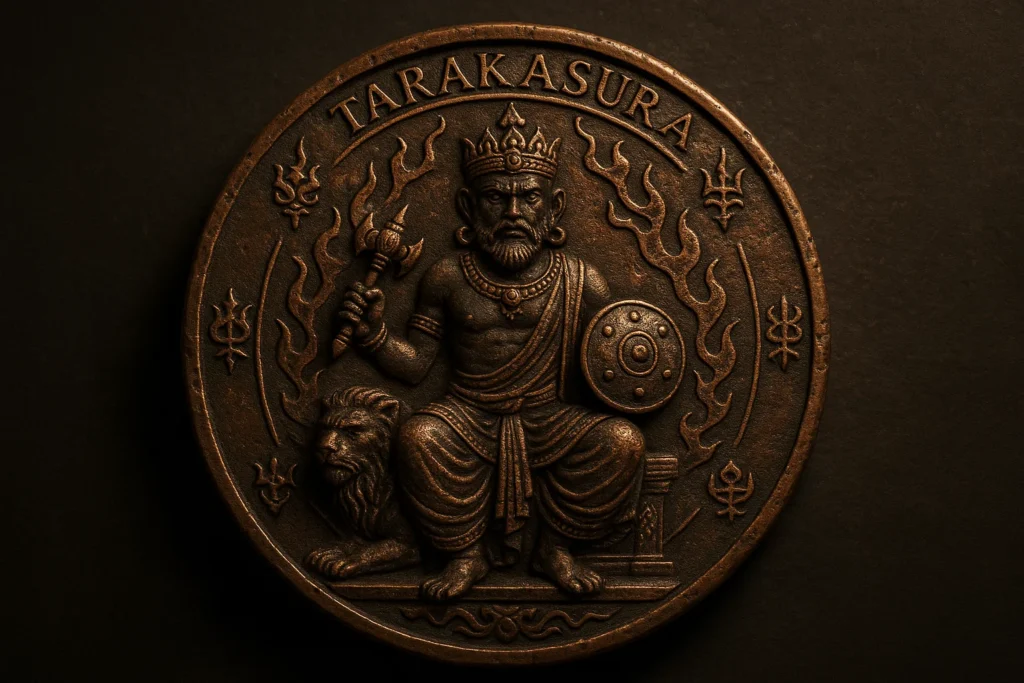
Detailed physical descriptions of Tarakasura vary somewhat across the Puranas.
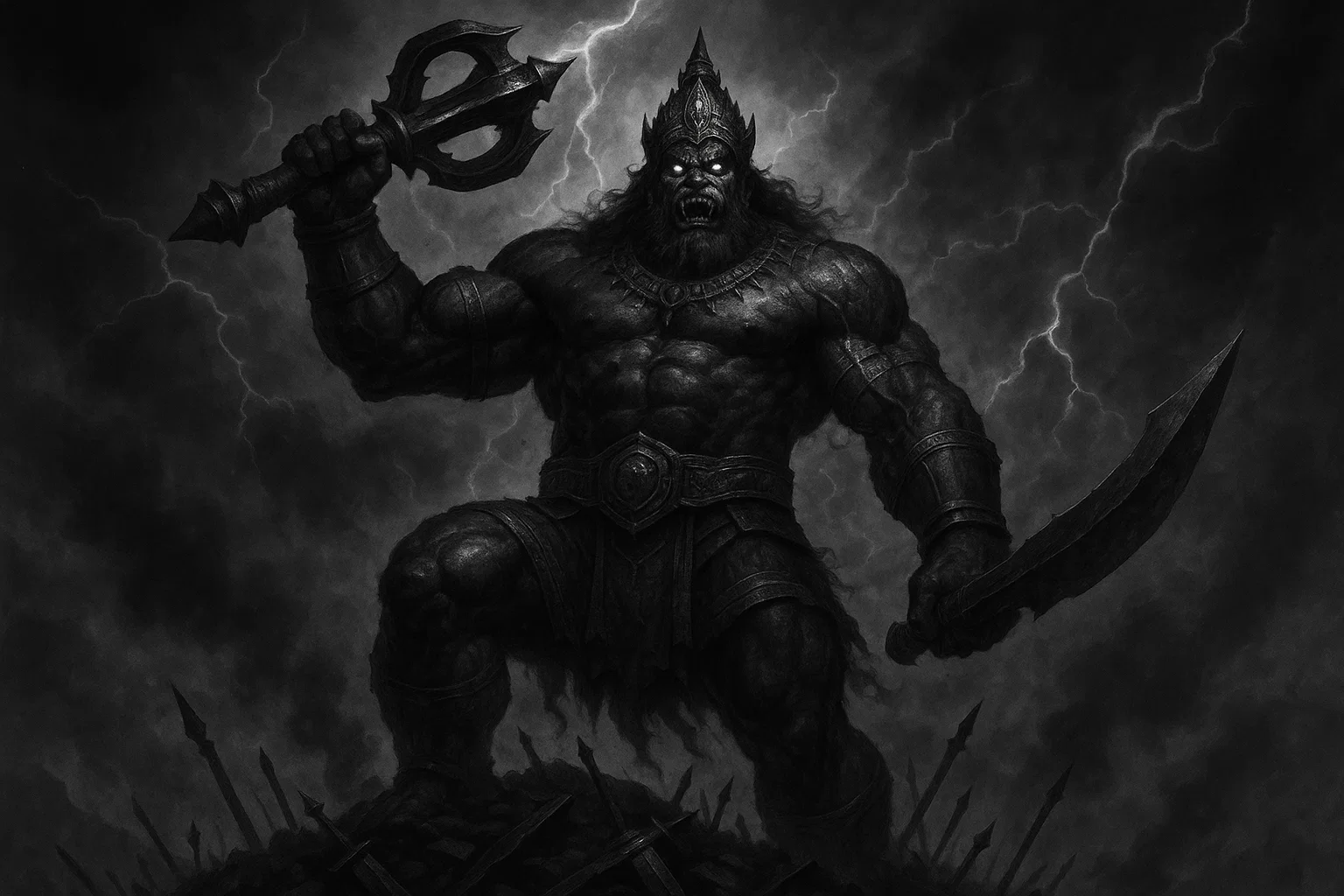
However, most depictions mention an entity of immense and terrifying physical power, befitting his status as a world-conquering Daitya. He is universally portrayed as a colossal entity embodying the formidable might of the Asura class. He looks ferocious and menacing. He can instill fear in his opponents (particularly the Devas).
Descriptions often focus on his dark complexion—a common trait among Daityas, which symbolizes their opposition to the Devas’ bright, celestial nature.
While not typically described as multi-headed (like some other Asuras, such as Ravana or Hiranyakashipu), his form is still enormous and incredibly muscular, indicating his raw strength gained from penance and his violent disposition.
He is often portrayed holding powerful, oversized weapons in battle, symbolizing his destructive capabilities. His general appearance reflects his dominant characteristic: a powerful tyrant who successfully subjugated the entire cosmos.
You may also enjoy:
Who Was Hiranyakashipu, the Demon King of Hindu Mythology?
October 6, 2025
Aeshma: The Zoroastrian Demon of Wrath and Fury
January 13, 2026
Yuki Onna: The Terrifying Demon Bride Who Feeds on Travelers
December 9, 2025
Barbas: The Lion Demon Who Spreads Disease
March 3, 2026
Kuchisake-onna: Folklore, Origins, and Urban Legend History
February 10, 2026
Alû: The Mesopotamian Demon of Malevolence and Pestilence
November 10, 2025
Origins
Tarakasura’s story begins with his Daitya lineage. He is the son of the powerful Asura Vajranaga, who himself was the son of Diti and the sage Kashyapa. This makes Tarakasura a direct descendant of the Daitya clan’s founding parents, the traditional opponents of the Devas.
His earliest significant appearances are found in the Puranas, particularly the Shiva Purana and the Skanda Purana, which detail the circumstances leading to the birth of his slayer, Kartikeya.
The central conflict of his narrative is his oppression of the Devas. Since Tarakasura was essentially unbeatable by any existing deity, he forced the Devas to retreat. His reign of terror jeopardized the entire cosmic order (Dharma).
Birth
Tarakasura was born to Vajranaga, a son of Diti and Kashyapa. His lineage cemented his position within the Daitya clan.
Vajranaga’s wife was the daughter of Kala (Time). According to legend, Tarakasura was born after his father’s rigorous penance. Vajranaga performed tapasya to Brahma to avenge his mother, Diti, for Indra’s humiliation. As a result, Vajranaga requested a powerful, immortal son. However, Vajranaga’s son, Tarakasura, was not granted full immortality but rather the condition that he could be killed only by a son of Shiva.
Soon after his birth, he began his own formidable period of tapasya (austere penance), demonstrating extraordinary resolve and devotion to the creator-god Brahma. His penance was so intense that it reportedly shook the heavens and created extreme heat, compelling Brahma to appear before him.
THE BOOK THEY BANNED FROM THE BIBLE Limited-Time: Up to 90% OFF!
Why was Enoch removed? The fallen Watchers • The birth of the Nephilim • Origin of demons • Names of the angels who became demons • Apocalyptic visions. The original source text that inspired all demonology. Read the apocalyptic visions the church didn’t want you to see.
Family
Tarakasura is a member of the Daitya clan, the lineage of Asuras born from Diti. His family relationships are primarily significant due to his parentage, which links him to the core opposition in Hindu mythology.
His father, Vajranaga, was a formidable Daitya himself, known for his own acts of penance and subsequent gifts from Brahma. Tarakasura’s mother, the daughter of Kala (Time), gives him a direct link to the cosmic forces of destruction.
While the Puranas focus heavily on his political and military exploits, they are less detailed regarding his wives and children in the same manner as the accounts of Ravana or Hiranyakashipu. However, he is the sire of several other key Asuras.
Genealogy
| Genealogy | Details |
| Parents | Vajranaga (Father), Daughter of Kala (Mother) |
| Siblings | None explicitly named as central figures in the Tarakasura narrative |
| Spouse | None prominently featured in the main narrative |
| Children | Tarakaksha, Kamalaksha, Vidyunmali (collectively the builders of the Tripura or Three Cities, later slain by Shiva) |
Asura-Deva Conflicts
Tarakasura’s role in the cosmic struggle between the Asuras and Devas is one of the most significant in Hindu mythology, as his actions directly lead to the birth of the central war-god, Kartikeya.
Having acquired the near-invincibility boon from Brahma, Tarakasura immediately initiated a massive campaign of conquest. He successfully defeated Indra and the other Devas, driving them from their celestial kingdom, Svarga, and seizing control of the three worlds (Triloka).
He ruled with tyranny and oppression, disrupting the celestial order (Dharma) and compelling the Devas and sages to perform rituals and sacrifices in his name, rather than to the Vedic gods.
This period of Asura dominance created a profound cosmic imbalance. Tarakasura’s reign was not merely a territorial conquest; it was a crisis of Dharma that threatened the entire universe.
The Devas, rendered powerless by the boon, finally approached Brahma, who confessed his inability to retract the boon and directed them to Shiva, explaining that only a son of the great ascetic could slay the Asura. This central rivalry is the entire purpose of Kartikeya’s manifestation.
Role in Hindu Cosmology
Tarakasura is a quintessential villain and a necessary catalyst in Hindu cosmology. His primary function is not one of devotion or anti-heroism, but of a tyrannical obstacle that must be removed for Dharma to be restored.
His reign of terror forces the cosmic machinery into motion, necessitating the highest form of divine intervention—the union of Shiva and Parvati and the birth of Kartikeya. In the cycle of Dharma and cosmic balance, Tarakasura represents the extreme culmination of Adharma (unrighteousness) and Asuric pride.
His defeat by Kartikeya is a powerful mythological affirmation of the ultimate triumph of the divine over the demonic forces and the cyclical nature of creation, destruction, and preservation.
Was Tarakasura Ever Mentioned in Vedic Texts?
Tarakasura is not explicitly mentioned in the core Vedic texts such as the Rig Veda, Yajur Veda, Sama Veda, or Atharva Veda. Tarakasura, along with the detailed narrative of his conquest and subsequent death at the hands of Kartikeya, appears to have developed during the period of the Epics and, more extensively, the Puranas.
Tarakasura in Epics and Puranas
Tarakasura’s story is foundational to the Puranic narratives, particularly those focused on the Shaiva and Skanda traditions. He is the central antagonist whose power necessitates the very existence of the war-god.
| Source | Quote (Original, Unaltered Text) |
| Shiva Purana | …Tāraka, son of Vajrāṅga, became haughty on obtaining the boon. He harassed the three worlds and dethroned the Devas. |
| Skanda Purana | O great sages, when Tāraka’s tyranny reached its extreme limit, the Devas, afflicted with grief, sought the refuge of Brahmā. |
| Mahabharata (Vana Parva, Section 224) | …Skanda, whose power is immeasurable, for the destruction of the Daitya Tāraka. |
Powers and Abilities
Tarakasura’s power level places him among the most formidable Asuras in Hindu mythology, comparable to figures such as Hiranyakashipu and Ravana. He achieved a level of dominance that completely dethroned the Devas and ruled the cosmos uncontested for a significant period.
His greatest power came not from birth, but from extreme tapasya (penance), which earned him the ultimate protective boon.
Tarakasura’s powers and abilities:
- Near-Invincibility Boon: His most critical power was the divine protection granted by Brahma, making him immune to death from all Devas, humans, and any other celestial being, with the sole exception of a son of Shiva.
- Conquest and Rule: He possessed the strategic and military capability to defeat Indra and the collective Deva army, effectively establishing universal sovereignty over the three worlds.
- Cosmic Strength: Due to the boons, his physical and magical strength were vastly superior to that of the Devas, allowing him to easily repel their attacks.
- Mastery of Illusion (Maya): As a high-ranking Asura, he likely possessed significant abilities to create illusions and use Asura Maya to confuse and overpower his foes, although the texts focus more on his martial might.
- Immense Durability: His body was rendered virtually indestructible due to the efficacy of Brahma’s boon.
You may also enjoy:
Who Is Andromalius and Why Is He the Last Demon of the Goetia?
January 20, 2026
Who Is Abalam in Demonology? The Terrifying King That Serves Paimon
September 30, 2025
Barbas: The Lion Demon Who Spreads Disease
March 3, 2026
Andhaka: The Blind Demon Born From Cosmic Darkness
February 6, 2026
Iblis, the Jinn King of Darkness and Deception
September 29, 2025
Who Is Ariton, the Infernal King of the Eastern Gate?
February 17, 2026
Tarakasura Myths, Legends, and Stories
Tarakasura’s Penance and the Boon
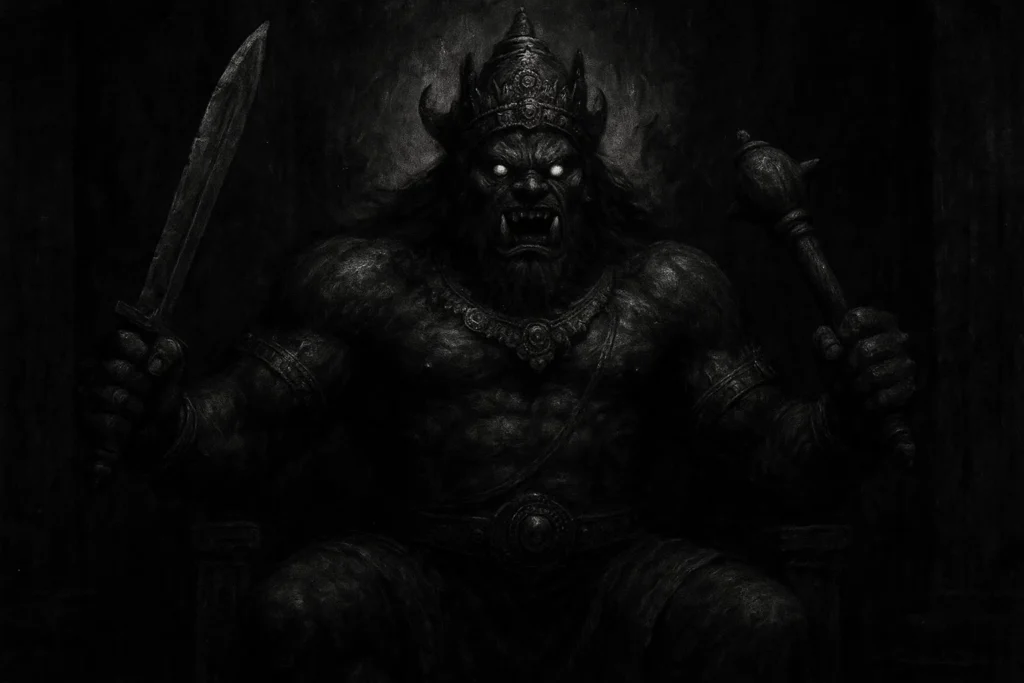
Inspired by his father, Vajranaga, the young demon Tarakasura decided to undertake a rigorous and long-lasting form of meditation to win the favor of the creator god, Brahma. His intense efforts were so extreme that they generated an immense heat, causing smoke and fire to emanate from his body, which threatened to disrupt the balance of the universe.
Brahma, disturbed by the chaos Tarakasura was creating, appeared before him and was prepared to grant him a wish. Driven by a desire for power over the gods, Tarakasura asked for immortality—the ability to never be defeated by any god, human, or being. Brahma explained that complete immortality was impossible in the material world, so he offered a different condition for the wish.
Tarakasura cleverly chose a condition that he believed would protect him: he could only be killed by a child born from the seed of Lord Shiva. At that time, Shiva was known as the great ascetic, completely focused on meditation and thought to be incapable of having children. With this condition set, Brahma granted the boon and vanished, leaving Tarakasura with what he thought was an unbeatable status.
The Conquest of the Three Worlds
After receiving the powerful gift, Tarakasura quickly gathered his huge army of demonic beings and launched a fierce attack on the gods, known as the Devas. He boldly challenged Indra, the leader of the gods. In a series of intense battles, Tarakasura proved to be nearly invincible.
The Devas, despite their combined strength, were powerless against the unique advantage that Tarakasura possessed. One by one, he defeated them, driving them out of Heaven and taking control of all three worlds. Under his rule, the Devas and wise sages were forced to serve him, leading to chaos in the universe as ancient customs and rituals were disrupted.
The Devas, feeling humiliated and helpless, were scattered across the earth and forced into hiding, always afraid of Tarakasura. As the suffering grew unbearable, the Devas came together. They went to the powerful gods Brahma and Vishnu, pleading for help to end Tarakasura’s cruel reign, as they believed the current situation could not continue.
1,000+ SPIRITS, GODS & GODDESSES AWAITING YOUR CALL. Limited-Time: Up to 49% OFF!
The ultimate global spirit encyclopedia – 2,000+ entries from every culture on Earth. Fairies • Djinn • Demons • Loa • Angels • Deities • Ancestors Real names • True offerings • Ancient rituals that actually work. Judika Illes’ legendary masterwork – the one book every serious witch, mage, and spirit-worker owns.

The Birth of Kartikeya and Tarakasura’s End
After hearing the Devas (the celestial gods) express their sadness, Brahma, the creator god, reminded them of an essential rule: the demon Tarakasura could only be defeated by the son of Shiva. The Devas realized that since Shiva was a solitary ascetic without a partner, the only way to meet this challenge was to help him find a wife and have a child.
Enter Parvati, who was a reincarnation of Shiva’s previous wife, Sati. After a long time spent in deep meditation and proving her worth through various challenges, Shiva finally appeared from his focused state and agreed to marry Parvati. They had a son, Kartikeya, also known as Skanda, born with a special purpose: to defeat Tarakasura.
As soon as he was born, Kartikeya showcased incredible powers, and he was quickly appointed as the leader of the Devas’ army. A grand battle against Tarakasura was launched, and despite the demon’s great strength and his army of Asuras (demonic beings), the young god didn’t back down.
In an epic showdown that spanned the skies, Kartikeya fulfilled his destiny by confronting Tarakasura head-on. In a dramatic battle, he landed the final blow, defeating the demon and putting an end to his reign of terror, eventually restoring peace and order among the Devas.
Tarakasura vs Other Asuras
Tarakasura is distinguished from other Asuras by the unique nature of his boon, which directly led to the birth of Kartikeya, a figure central to Hindu mythology.
| Asura Name | Associated Trait/Role | Clan/Origin | Key Traits/Powers |
| Hiranyakashipu | Cosmic pride, antagonist of Vishnu | Daitya, Bhagavata Purana | Invincibility to man/beast/god, slain by Narasimha (Avatar of Vishnu) |
| Mahisha | Shape-shifting, antagonist of the Goddess | Asura, Devi-Bhagavata Purana | Shape-shifting (buffalo), slain by Durga (Mahishasuramardini) |
| Bali | Righteous king, devotee of Vishnu | Daitya, Bhagavata Purana | King of three worlds, generous, subdued by Vamana (Avatar of Vishnu) |
| Vritra | Drought and darkness, early Vedic conflict | Asura/Dragon, Rig Veda | Imprisoned waters, slain by Indra’s Vajra |
| Ravana | Conquest, abductor, devotee of Shiva | Rakshasa, Ramayana | Ten heads, boons from Brahma, slain by Rama (Avatar of Vishnu) |
| Shumbha | Pursuit of Goddess Parvati, cosmic imbalance | Asura, Devi Mahatmya | Boons from Brahma, slain by Kali/Durga |
| Banasura | Thousand arms, devotee of Shiva | Daitya, Bhagavata Purana | Thousand arms, battle with Krishna, arms severed by Krishna’s Sudarshana Chakra |
| Jalandhara | Arrogance, power from chastity of wife | Asura, Shiva Purana | Power from wife’s chastity, defeated by Shiva after Vishnu tricked his wife |
| Madhu and Kaitabha | Primeval chaos, threat to creation | Danava, Devi Mahatmya | Born from Vishnu’s earwax, slain by Vishnu at the beginning of creation |
| Andhaka | Blindness, lust for Parvati | Daitya, Shiva Purana | Power from tapasya, battle with Shiva over Parvati |
| Pralamba | Deception, enemy of young Krishna | Daitya, Bhagavata Purana | Shape-shifter, slain by Balarama |
| Kumbhakarna | Gluttony, brother of Ravana | Rakshasa, Ramayana | Six-month sleep, immense strength, slain by Rama |
Rank Among Asuras
Tarakasura has a very high rank among the Daitya leaders, primarily due to his status as a Sovereign of the Three Worlds (Trilokapati). Unlike some Asuras who were powerful regional kings (like Ravana in Lanka), Tarakasura achieved universal military dominance over the Devas in Svarga, usurping Indra’s throne and effectively ruling the entire cosmos.
His position as the son of Vajranaga, a powerful Daitya descendant of Diti and Kashyapa, gives him pedigree within the Daitya clan. However, his rank is fundamentally defined by his success in conquering all three worlds, a feat rarely sustained in the Puranas.
His rivalry was not with other Asuras, but solely with the Devas, who were completely defeated and powerless before him. The only being capable of surpassing his authority was the one entity who could exploit his single, narrow weakness: Kartikeya, the son of Shiva.
Mystical Correspondences
| Attribute | Details |
| Planet | Mars (embodiment of war and aggression) |
| Zodiac Sign | Aries (fiery ambition, martial prowess) |
| Element | Fire (destructive power, burning ambition) |
| Direction | South (associated with Yama, death, and conflict) |
| Color | Black (associated with darkness and Asura nature) |
| Number | 6 (signifying the six faces of his slayer, Kartikeya, and the constant battle) |
| Crystal/Mineral | Iron Pyrite (reflecting false gold/power, martial nature) |
| Metal | Iron (representing unyielding strength and warfare) |
| Herb/Plant | Datura (associated with Shiva’s ascetic side, which he challenged) |
| Animal | Tiger/Lion (predatory dominance and power) |
| Trait/Role | Tyranny, Conquest, Asuric Might |
Tarakasura’s associations are deeply intertwined with the theme of conflict and destructive power. His ruling planet is Mars, which governs war and aggression, mirroring his character as a universal conqueror who rules through military might.
This martial energy aligns with the zodiac sign Aries, which channels fiery ambition and a relentless drive for dominance, perfectly encapsulating Tarakasura’s successful conquest of the cosmos and the overthrow of Indra’s regime.
His elemental tie is to Fire, symbolizing his burning ambition, the intensity of his world-shaking tapasya, and his general destructive nature. The direction of South is associated with Yama (Death) and conflict, fitting the atmosphere of terror that pervaded the three worlds during his reign.
His symbolic Black color reflects the darkness (Tamas) and unrighteousness (Adharma) that he spread through his tyrannical rule. The number 6 is a direct, ironic link to his destined slayer, Kartikeya, who is often depicted with six faces (Shanmukha), signifying the inescapable nature of his weakness.
His association with Iron speaks to his unyielding, brutal physical strength and the martial core of his power. The Tiger/Lion as his animal highlights his predatory, dominant role as the supreme ruler of the cosmos, whose strength was unmatched until the intervention of the war-god.
Tarakasura’s Symbols
Tarakasura, unlike other central figures such as Ravana, is not consistently associated with a specific, named symbol or yantra in the major Puranic texts.
His primary symbols are those of dominion and unparalleled strength:
- The Crown of Indra: The most significant, though temporary, symbol of his power was the throne and crown of Indra in Svarga. By usurping Indra, Tarakasura symbolically held the ultimate authority of the cosmos.
- The Thunderbolt (Vajra): Tarakasura is often depicted holding the Vajra or similar celestial weapons taken from the Devas, symbolizing his complete neutralization of their power.
- The Asura Banner: He would have marched under the banner of the Asuras (likely a dark, stylized emblem), signifying the rule of Adharma over Dharma.
His boon itself is his greatest symbolic representation, standing for the dangerous power of untempered tapasya and the consequences of clever manipulation of divine law.
Worship and Boons
Tarakasura himself is not a figure of worship in mainstream Hindu traditions, as he represents a force of tyranny and Adharma that was overcome by the divine.
However, the mechanism of his power acquisition is central to Hindu thought:
- Tapasya and Brahma’s Boon: Tarakasura’s power originated from his rigorous tapasya (penance) performed to Brahma. His austerities were extreme, demonstrating an unflinching dedication that compelled Brahma to appear. This adherence to the spiritual discipline of tapas resulted in the granting of the Invincibility Boon, which made him immune to all except the son of Shiva. This illustrates the Hindu principle that spiritual effort (tapas) is rewarded according to cosmic law, regardless of the practitioner’s ethical intent.
- Forced Worship: During his tyrannical reign, Tarakasura forced the Devas, sages, and human kings to offer him worship and perform sacrifices in his name, thereby diverting the cosmic energy (offered through Yajna) away from the rightful Devas and into himself. This act of Adharma was one of the chief reasons for the gods’ distress.
The true focus of worship in this cycle is his slayer, Kartikeya (Skanda), whose existence and worship are inextricably linked to Tarakasura’s defeat and the subsequent restoration of cosmic order.
You may also enjoy:
What Is the Akashita, the Red-Tongued Demon of Japanese Folklore?
November 5, 2025
Who Is Astaroth in Demonology and the Ars Goetia?
February 20, 2026
What Is a Rakshasa? Meaning, Origins, and Dark Powers
January 23, 2026
Lamia: The Queen Cursed to Devour the Children of Others
January 7, 2026
What Is the Abumi-guchi Yōkai and Why Does It Wait Forever?
October 22, 2025
Palden Lhamo: The Black Goddess of Blood and Protection
October 20, 2025
Frequently Asked Questions
Who defeated and killed Tarakasura?
Tarakasura was eventually defeated and killed by Kartikeya (also known as Skanda or Murugan), the god of war. Kartikeya was born specifically to defeat Tarakasura, as the Daitya had a boon granting him invincibility against all beings except a son of Shiva.
Why and how did Kartikeya kill Tarakasura?
Kartikeya killed Tarakasura because the Asura’s tyrannical rule over the three worlds (Triloka) had created a severe crisis of Dharma and driven the Devas from Heaven. Kartikeya, born from the combined energies of Shiva and Parvati, was the only being capable of defeating Tarakasura due to the specific condition of the Asura’s boon from Brahma. Kartikeya defeated him in a decisive battle as the Deva army’s general, restoring cosmic order.
Are Surapadman and Tarakasura the same?
No, Surapadman and Tarakasura are not the same entity, but they are closely related in mythology. They are both vanquished by Kartikeya (Murugan). In some South Indian traditions, particularly those focused on Murugan, Surapadman is the primary antagonist and a major Asura. At the same time, Tarakasura is often considered his younger brother or a general under his command. Both figures represent the demonic forces overcome by the war-god.
Who are Tarakasura’s brothers and sisters?
The major Puranic narratives of Tarakasura’s defeat by Kartikeya do not prominently feature his brothers or sisters. However, he is the father of three powerful sons: Tarakaksha, Kamalaksha, and Vidyunmali. These three Asuras later built the flying cities known as the Tripura (Three Cities), which were eventually destroyed by Shiva, an event known as Tripurantaka.
