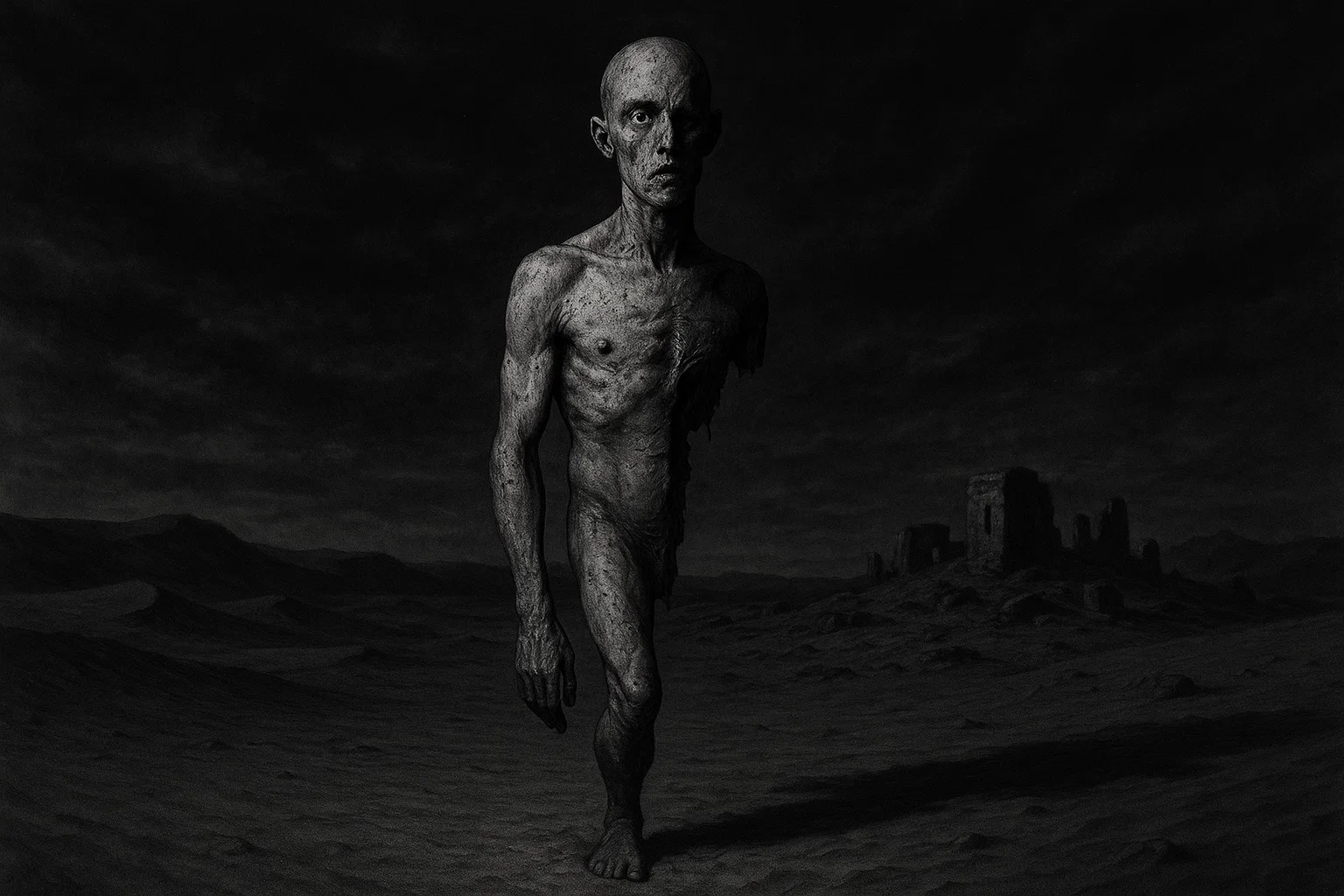

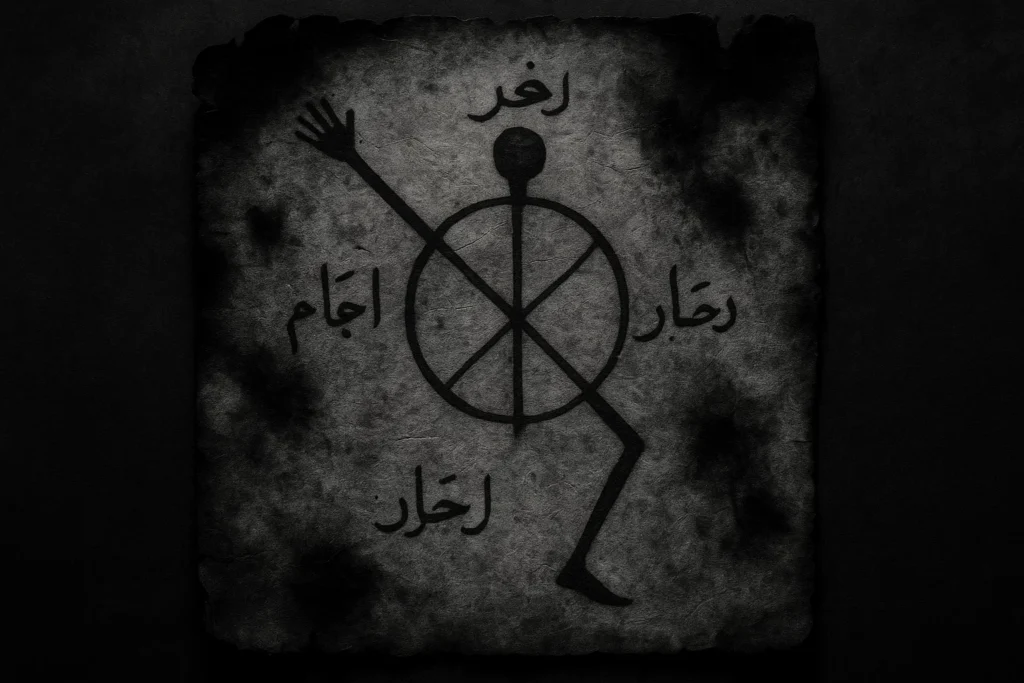
The Nasnas is a creature from Arab folklore classified as a type of Jinn or hybrid being. It appears as a half-human form, consisting of one leg, one arm, half a head, and half a body, and moves by hopping on its single leg.
This entity is documented in texts such as One Thousand and One Nights, where it serves as a symbol of deformity and otherworldliness. The Nasnas is often described as the offspring of a shiqq Jinn and a human, which accounts for their incomplete physical structure.
In certain Shi’i interpretations of Islamic texts, the Nasnas (and their plural form, nisānīs) represent pre-Adamic inhabitants of the earth who engaged in violence and disorder. These beings coexisted with Jinn before the creation of humans, contributing to the conditions that led angels to question divine plans for earthly successors.
However, Sunni sources omit the Nasnas from similar narratives, focusing solely on Jinn.
Summary
Key Takeaways
| Attribute | Details |
|---|---|
| Names | Nasnas, Nisānīs (plural), Xunguruuf (Somali variant) |
| Type | Hybrid jinn, monopod creature as offspring of shiqq jinn and human |
| Title | None |
| Gender | Ambiguous, depictions lean toward male forms |
| Servitors | None specified |
| Superior Jinn | Shiqq (as parental origin in hybrid lore) |
| Powers | Agility in single-legged hopping, lethal touch stripping flesh in seconds (Somali variant) |
| Appearance | Half head, half body, one arm, one leg; face described as beautiful but mute |
| Etymology | Arabic nasnās, denoting small monkeys or half-formed imagined beings |
| Associated Figures | Shiqq jinn, human parents in hybrid origin, pre-Adamic earth population |
| Weaknesses | None documented in primary accounts |
| Opposing Holy Figure | Angels, who observed and reported Nasnas disorder in Shi’i exegesis |
| Social Structure or Tribe | Earth-dwelling group alongside jinn in pre-human era |
| Followers/Tribe Size | Inhabited earth for 70,000 years before human creation in lore |
| Primary Sources | One Thousand and One Nights, Shi’i tafsir on Quran 2:30, Somali oral traditions |
Who or What is a Nasnas?
The Nasnas is a supernatural entity in Arab and Islamic folklore, characterized as a deformed jinn-like being. It possesses only half of the typical human anatomy, including one leg for movement, one arm, and a bisected head and torso. This incomplete form enables rapid hopping movement across terrains.
The creature appears in narratives as a product of an interspecies union between a human and a shiqq (a lesser type of Jinn known for being only partially formed).
Accounts position the Nasnas among monstrous demonic entities rather than organized hierarchies. Unlike structured Jinn tribes (such as the Marid or Ifrit), the Nasnas operates as aberrant individual or group entities, often tied to themes of isolation and peril.
In Somali extensions of this lore, the variant xunguruuf amplifies its threat by endowing it with a touch that instantly desiccates flesh from victims.
“Nasnas” Meaning
The term Nasnas derives from Arabic nasnās, a word applied to certain small monkey species observed in regional wildlife. This linguistic root extends to conceptualize incomplete or asymmetrical beings in imaginative constructs.
Early usages in Arab texts link the name to entities exhibiting halved physiology, reflecting perceptions of natural anomalies. The plural nisānīs appears in collective references, denoting groups of such creatures in pre-human earthly settings.
Historical evolution traces the name through oral traditions into written compilations. In pre-Islamic Arabian contexts, similar terms may have described tribal deformities or mythical half-beings, possibly influenced by observations of injured animals or congenital conditions.
After the integration into Islamic frameworks—particularly Shi’i exegesis—nasnās gains layered connotations as a descriptor for disordered pre-Adamic populations. Some interpretations connect it to the ancient ‘Ād tribe mentioned in Quranic narratives, suggesting a degraded remnant form after divine punishment.
How to Pronounce “Nasnas” in English
The name Nasnas is pronounced in English as /ˈnæs.næs/, with emphasis on the first syllable. The ‘a’ sounds resemble the ‘a’ in “cat,” and the ‘s’ is a sharp hiss, repeated crisply.
What Does a Nasnas Look Like?
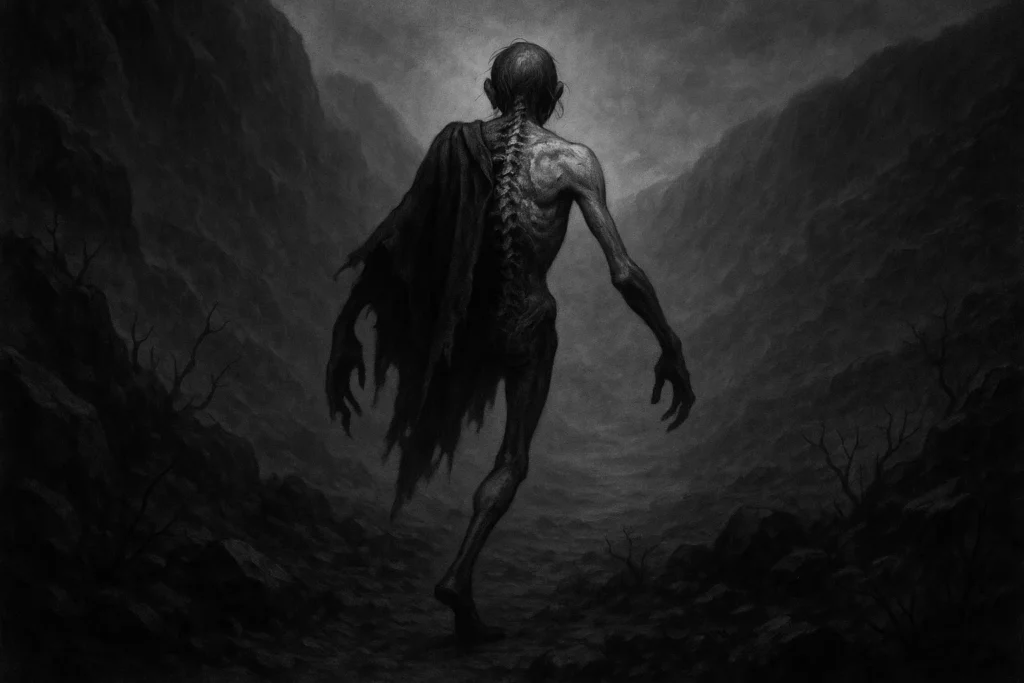
Primary descriptions of the Nasnas focus on its halved human anatomy, drawn from Arab folklore compilations.
The creature features a single leg, upon which it balances and propels itself in hops, demonstrating notable speed despite the limitation. Accompanying this is one arm, functional for grasping or balance during movement. The head consists of half a face, often noted for beauty in contrast to the body’s incompleteness, with a single eye and a partial mouth that renders speech impossible.
The torso mirrors this division, appearing as a vertical slice through the midline and lacking symmetry. Skin tone aligns with human variations but appears pallid or shadowed in illustrations, such as those in Turkish manuscripts depicting single-limbed figures alongside camels.
In Edward William Lane’s 19th-century translation of One Thousand and One Nights, the Nasnas is rendered as “half a human being; having half a head, half a body, one arm, one leg, with which it hops with much agility.” This portrayal recurs in textual accounts, focusing on the eerie proportionality of the remnant parts.
Somali variants introduce minor divergences, portraying the xunguruuf with elongated limbs suited for rapid strikes, but retaining the core monopod structure.
Medieval depictions in works like The Wonders of Creation illustrate three such creatures, each with a single exaggerated feature.
You may also enjoy:
What Is the Abumi-guchi Yōkai and Why Does It Wait Forever?
October 22, 2025
Who Is the Infernal King Balam? Origins, Powers, and Occult History
February 26, 2026
Who Is Shiva, the Destroyer and the Lord of the Universe?
November 12, 2025
Al-Ahmar: The Tuesday King of the Seven Jinn
February 13, 2026
Lamashtu, the Mesopotamian Demoness of Childbirth and Infant Death
November 4, 2025
Empusa: The Blood-Drinking Wraith of Greek Mythology
November 20, 2025
Origins
The Nasnas enters documented lore through pre-Islamic Arabian oral traditions, where half-formed beings symbolized curses or divine disfavor.
Tribal narratives from Yemen and surrounding regions describe such entities as remnants of punished clans, possibly echoing the Quranic’ Ād tribe’s destruction for arrogance. These stories predate Islam, integrating with beliefs about Jinn that viewed shapeshifted hybrids as common supernatural occurrences.
With Islam’s emergence, the Nasnas integrates into esoteric interpretations, particularly Shi’i tafsir. Here, it inhabits exegeses of creation myths, expanding on the roles of Jinn in earthly history. Sunni traditions exclude it, adhering to jinn-only accounts of pre-human chaos.
Poetry from the Umayyad era occasionally references nasnās-like figures in odes on desolation, reframing them as manifestations of Jinn under prophetic authority.
Over time, the Nasnas evolve from an isolated anomaly to an emblem of cosmic transition. In Abbasid compilations like One Thousand and One Nights, it appears in frame tales, blending with magician lore. Somali adaptations, influenced by Arab trade, localize it as xunguruuf, emphasizing lethality over deformity.
Was Nasnas Ever Mentioned in the Quran or Hadith?
The Nasnas does not receive direct mention in the Quran or Hadith. Core Islamic scriptures reference Jinn broadly, as in Surah Al-Jinn (72), and detail their conversion to faith. On the other hand, Surah Al-A’raf (7:27) warns of Jinn temptations.
Shi’i scholars later incorporated these entities into interpretations of Surah Al-Baqarah (2:30), portraying nisānīs as chaotic earth-dwellers alongside Jinn, but this constitutes an interpretive addition rather than textual evidence.
Nasnas in Other Texts
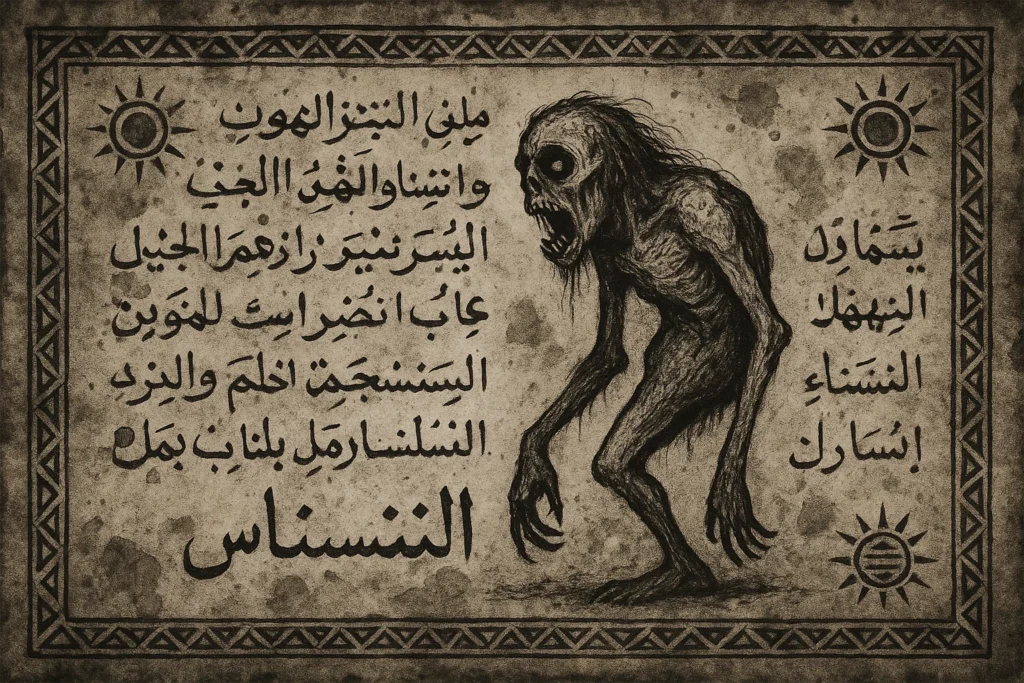
The Nasnas features in medieval Arab literary collections and regional traditions.
| Source | Quote |
|---|---|
| One Thousand and One Nights (Lane translation) | half a human being; having half a head, half a body, one arm, one leg, with which it hops with much agility |
| Shi’i exegesis on Quran 2:30 (Vilozny summary) | nisānīs lived on earth [with jinn]… allowing angels to see injustice and bloodshed |
| Somali folklore (xunguruuf variant) | can kill a person by touching them, stripping their flesh in seconds |
Powers and Abilities
The Nasnas holds a subordinate power level among Jinn variants, far below the commanding strength of Marid or the elemental dominance of Ifrit. It functions as a peripheral threat, relying on physical peculiarities rather than magical hierarchy or vast influence.
Compared to Ghul‘s graveyard manipulations or Shiqq’s partial shapeshifting, the Nasnas focus on innate deformity as its core attribute, limiting it to opportunistic encounters.
Their powers and abilities include:
- Exceptional hopping agility on one leg, enabling swift evasion or pursuit across uneven ground.
- Lethal tactile contact in Somali depictions, where touch causes immediate flesh dissolution from bone.
- Mute presence inducing fear through silent, asymmetrical approach.
- In some accounts, hybrid fertility results in Jinn offspring with humans, even though it is incomplete.
- Disguise as frail elderly figures to lure victims in certain folktales.
Influence on Humans and Possession
Nasnas’ influence manifests through direct physical interaction rather than subtle possession.
In transformation tales, exposure to enchanted substances like kohl from a magician’s eye salve can convert humans into Nasnas, imposing perpetual half-existence. This alteration strips victims of full mobility and speech, enforcing isolation.
Somali lore amplifies harm through xunguruuf encounters, where proximity leads to rapid desiccation, leaving skeletal remains as a warning.
Signs of Nasnas-related affliction include asymmetrical limb weakness or phantom hopping sensations, though undocumented in formal theology.
You may also enjoy:
Ifrit: Demon of Fire Who Serves Iblis in Islamic Tradition
September 30, 2025
Edimmu: The Mesopotamian Wind Demon That Steals Life
November 6, 2025
Mara: The Buddhist Demon King of Desire and Death
October 13, 2025
Ammit: Devourer of the Dead in Ancient Egyptian Mythology
November 10, 2025
Aamon: The Infernal Marquis of Lust, Feuds, and False Prophecies
September 29, 2025
Vritra: The Dragon Who Swallowed the Sky in Hindu Mythology
October 7, 2025
Protection and Exorcism Methods
Historical remedies against Nasnas draw from general Jinn wards in Islamic practice. Recitation of Ayat al-Kursi (Quran 2:255) repels hybrid threats, as noted in medieval amulets.
Salt circles or iron talismans, rooted in pre-Islamic customs, encircle dwellings to block hopping incursions. In Shi’i traditions, invoking the Imams’ names during twilight hours counters pre-human echoes.
Exorcism narratives involve scholarly intervention, such as counter-kohl applications by sages to reverse transformations. These methods, preserved in folklore compendia, focus on communal prayer rather than solitary rituals, framing protection as adherence to divine succession rather than chaotic antecedents.
Nasnas Myths, Legends, and Stories
The Pre-Adamic Disorder of Nisānīs
In the interpretations of Shi’i scholars on the creation account, the earth existed under the domain of Jinn and nisānīs for a span of seventy thousand years.
These nisānīs, halved in form with single limbs and bisected heads, roamed the lands in perpetual conflict. They waged battles among themselves and against other beings, spilling blood across the realms and fostering widespread injustice. Their hopping forms traversed vast distances, raiding and leaving desolation in their wake.
God maintained a veil separating the seven heavens from the earthly plane during this period. The angels resided above, unaware of the turmoil below.
Eventually, the divine command lifted this barrier, granting the angels a view of the chaos enacted by the nisānīs and Jinn. Witnessing the rivers of blood and fields of ruin, the angels raised concerns to the Creator.
They inquired whether such a successor species, prone to corruption from inception, would inherit the earth. In response, God announced the formation of humans as the new stewards, displacing the violent nisānīs and their Jinn companions.
The Magician’s Kohl and the Scholar’s Transformation
Within a collection of tales akin to One Thousand and One Nights, a sage of profound knowledge mentors a young scholar in the arts of letters and hidden forces.
The sage demonstrates command over ethereal servants through inscribed symbols, compelling them to execute tasks beyond mortal capacity. To illustrate the perils of unchecked curiosity, the sage devises a demonstration involving a potent cosmetic.
He applies a specially prepared kohl to one eye of the scholar, drawing from substances infused with Jinn essences. Upon contact, the scholar’s form immediately divides. His body cleaves along the central line, reducing to a head and torso, one arm, and one leg.
Speech departs him, leaving only silent hops as his mode of travel. The sage observes this change with detachment, noting the agility now possessed by his pupil in navigating the chamber on the single limb.
The transformed scholar, once eager for wisdom, now embodies the Nasnas state—a warning against delving into forbidden blends of the human and Jinn realms.
The Xunguruuf’s Fatal Touch
In Somali oral accounts transmitted through coastal clans, the xunguruuf appears as a solitary wanderer in arid expanses, descended from a shiqq Jinn’s union with a nomadic herder.
This variant retains the Nasnas’s halved physique but augments it with an elongated reach for sudden strikes. It traverses dunes under moonlight, its single eye gleaming with inherited malice from the Jinn parent.
A herder, separated from his caravan during a sandstorm, encounters the creature disguised as a weary elder propped against a rock. Offering water from his skin, the herder extends his hand in hospitality.
The xunguruuf sheds its guise upon contact, its partial face twisting into revelation. The touch transmits instant decay, flesh sloughing from the herder’s frame in seconds, leaving bones scattered on the wind-swept ground.
Surviving kin later discover the remains and perform ablutions with seawater, invoking protective verses to ward off similar perils.
Nasnas vs Other Jinn
| Jinn Name | Associated Traits/Influence | Rank/Origin | Key Traits/Powers |
|---|---|---|---|
| Ifrit | Fiery mischief and rebellion | Powerful demon tribe, Quran and Hadith | Shape-shifting into animals, immense physical strength, command over flames |
| Ghul | Grave-haunting deception | Desert shapeshifter, Arabian folklore | Illusion-casting to lure prey, flesh-eating, gender fluidity |
| Marid | Oceanic arrogance and wishes | Strongest sea jinn, One Thousand and One Nights | Wish-granting under duress, storm summoning, resistance to bindings |
| Shiqq | Partial formation and seduction | Hybrid progenitor, Islamic exegesis | Half-bodied allure leading to unions, limited speech, fertility inducement |
| Jann | Desert guardianship | Ancient ancestral type, pre-Islamic lore | Sand manipulation, prophetic visions, tribal leadership |
| Hinn | Animalistic instinct | Canine or serpentine form, Hadith mentions | Pack hunting, scent tracking, minor curses on livestock |
| Si’la | Shape-shifting trickery | Female seductress variant, folklore tales | Human mimicry for entrapment, whisper-induced madness, nocturnal activity |
| Palis | Infant-targeting malice | Child-afflicting spirit, medieval texts | Cradle haunting, growth stunting, cries mimicking babies |
| Qareen | Personal temptation | Shadow companion, Quran 43:36 | Doubt implantation, moral whispering, lifelong attachment |
| Shaitan | Wholesale disobedience | Devilish overseer, Quran core | Mass incitement to sin, legion command, veil of forgetfulness |
| Qutrub | Werewolf-like predation | Lunar beast jinn, regional myths | Moon-phase transformation, pack assaults, wound infection |
| Ababil | Swarming destruction | Bird-form jinn, Quran 105:3 | Aerial bombardment, crop devastation, divine tool in punishment |
Position Among Jinn
The Nasnas occupies a marginal position in Jinn classifications, categorized as a chimeric or hybrid subtype rather than a dominant tribe. It lacks hierarchical command, functioning as an outlier among structured groups such as the Marid oceanic lords or the Ifrit fire warriors.
In broader Jinn societies, depicted in Islamic lore as mirroring human divisions into believers and rebels, the Nasnas align with aberrant fringes, often solitary or in loose pre-Adamic clusters.
Relationships with other Jinn derive from their origin as shiqq offspring, implying subordinate ties to parental lines. Shiqq entities, themselves incomplete, view Nasnas hybrids as extensions of flawed creation and occasionally use them in minor deceptions.
Interactions with Ghul or Si’la involve territorial overlaps in wastelands, where Nasnas hopping serves scouting roles. However, its muted nature precludes alliances, rendering it a peripheral actor in conflicts like those against prophets.
Mystical Correspondences
Nasnas’ associations, where documented, highlight its grounded, disordered essence through sparse elemental ties. The earth element reflects its role as an ancient terrestrial dweller, embodying instability in pre-creation landscapes as per Shi’i lore.
In general, Jinn frameworks such as these amplify inherent flaws; for the Nasnas, the monkey-animal tie evokes primal mimicry without intellect, revealing its half-formed peril.
Summoning and Rituals
Historical accounts provide no dedicated summoning rituals for the Nasnas, distinguishing it from invocable Jinn like Ifrit in Solomonic-style grimoires.
Indirect methods in Arab folklore involve alchemical preparations, such as kohl infused with jinn-attracting inks, applied to induce manifestations or transformations. These occur in scholarly demonstrations, encircled by letter-based barriers to contain the resulting half-form.
Bindings draw on prophetic precedents, employing ring-like talismans that echo Sulayman’s authority to compel obedience. Incantations recite creation verses from Quran 2:30, framing the Nasnas as subordinate to human vicegerency.
Tools include single-limbed effigies for focus, but texts stress reversal over control, viewing such evocations as hazardous experiments in hybrid lore.
You may also enjoy:
Who Is Asmodeus in Demonology and the Bible?
February 18, 2026
Iblis, the Jinn King of Darkness and Deception
September 29, 2025
Who Is Taṇhā, the Seductive Demon of Craving in Buddhist Mythology?
October 15, 2025
What Is a Rakshasa? Meaning, Origins, and Dark Powers
January 23, 2026
Aeshma: The Zoroastrian Demon of Wrath and Fury
January 13, 2026
Who Are the Yaksha, and Why Did Buddhists Fear Their Wrath?
October 20, 2025
Frequently Asked Questions
Is the Nasnas based on real animals or sightings?
The Nasnas legend may originate in ancient encounters with real animals, such as apes or seals, whose asymmetrical movements or half-submerged appearances could inspire tales of hopping half-humans. Some folklore researchers suggest it reflects observations of congenital deformities in humans or wildlife in Yemen’s rugged terrains, blending natural anomalies with supernatural fears.
What is the Nasnas’s role in Shi’i theology beyond pre-Adamic lore?
In Shi’i Islamic exegesis, the Nasnas symbolize prototypes of opposition to the Imamate, representing defiant forces that contrast with obedient jinns who submit to Ali and his descendants. This theological framing positions Nasnas’ hordes as archetypal rebels against divine succession, reinforcing narratives of loyalty in Shi’i doctrine. Sunni theology excludes such details, viewing the entity solely as folklore without scriptural ties.
Does the Nasnas appear in Western literature?
Yes, French author Gustave Flaubert references the Nasnas in his 1874 novel “The Temptation of Saint Anthony,” portraying it as a grotesque vision tormenting the saint amid hallucinatory demons. This inclusion adapts Arabian folklore into European surrealism, highlighting the creature’s universal appeal as a symbol of bodily imperfection and unnatural dread.
Is there a half-tree variant of the Nasnas?
Some contemporary retellings describe a rare variant of the Nasnas as half-human and half-tree, with bark-like skin and root-like appendages for its single leg, evoking forest-dwelling hybrids in Arab folklore expansions. This adaptation, possibly influenced by environmental myths, portrays it as a guardian or trapper in wooded oases, diverging from the standard humanoid form but rooted in themes of unnatural fusion.
