Bathin is the demon who personifies moving through space and crossing physical limits. Unlike most spirits in the Lemegeton (who are known for granting social standing or wisdom), this demon is remarkable for his control over travel and the natural world’s physical rules.
He connects the medieval fascination with distant lands to the hermetic wish to control the world’s dangerous distances using supernatural means.
My research is based on a careful comparison of Bathin’s traits in the Ars Goetia with earlier, more military-focused descriptions from Reginald Scot’s The Discoverie of Witchcraft. [View Full Bibliography ↓]
Key Takeaways
| Attribute | Details |
| Names | Bathin, Bathym, Mathim, Marthim |
| Title | Great Duke of Hell |
| Gender | Male |
| Role | Agent of sudden displacement, purveyor of toxic botanical knowledge, and master of transcontinental transport. |
| Rank | Duke |
| Hierarchy | Serves under the broader infernal administration of the East; commands no specific superior but operates within the Goetic framework. |
| Legions | Thirty legions of inferior spirits. |
| Powers | Instantaneous teleportation of humans across vast distances, identification of the lethal properties of herbs, and the revelation of the hidden virtues of precious stones. |
| Associated Figures | Often associated with the spirit Purson due to shared transit capabilities, and King Solomon, who allegedly bound him. |
| Weaknesses | Constrained by the secret names of the Tetragrammaton and the specific seals provided in the Lesser Key. |
| Opposing Angel/Saint | Caliel (one of the 72 angels of the Shem HaMephorash). |
| Pantheon | Christian Occultism (Goetic). |
| Primary Sources | Ars Goetia, Pseudomonarchia Daemonum, Dictionnaire Infernal, The Discoverie of Witchcraft. |
Who or What is Bathin?
Bathin is the eighteenth spirit in the Ars Goetia and has the title of Great Duke. He is best known for his control over geography and plants, serving as an expert in shaping the physical world. Instead of tempting people morally, the demon focuses on overcoming human physical limits, letting people skip the hardships of travel and uncover the secrets of the earth.
The demon commands thirty legions of spirits, which is a middle rank in the infernal order. His main power is the ability to instantly move people from one country to another, a skill that would have attracted those in the Middle Ages and Renaissance, when travel was dangerous and slow. He also knows a lot about the uses of herbs and precious stones, especially their practical and sometimes dangerous effects.
“Bathin” Meaning
Researchers still debate the origin of the name, as it doesn’t have a clear root in Hebrew or Latin, as is common for many Goetic spirits. A common theory is that Bathin’s name comes from the Arabic word Batin (بطن), meaning “hidden,” “inner,” or “concealed.” In Islam, Al-Batin is a name for God, meaning “the Inward.”
In Western demonology, the name may have changed to refer to the earth’s hidden qualities, such as the secret powers of plants and gemstones.
Other versions of the name, like Marthim or Mathim, appear in Johann Weyer’s Pseudomonarchia Daemonum (1577). These differences may be due to copying errors or to differences in pronunciation between German, Latin, and English texts.
The “M” at the start of Marthim might come from the Hebrew word Mar, meaning “bitter,” which could relate to Bathin’s link with bitter or poisonous herbs. Over time, the name transitioned from Marthim to the shorter form in the Lemegeton, following a general trend to make names easier to say during rituals.
How to Pronounce “Bathin” in English
Bathin is usually pronounced with two syllables. The first part, Bath, rhymes with “math” (short ‘a’), not “path.” The second part, “in,” sounds like the word “in.” The stress is on the first syllable: BATH-in. In versions like Bathym, the second part sounds like “him.”
What Does Bathin Look Like?
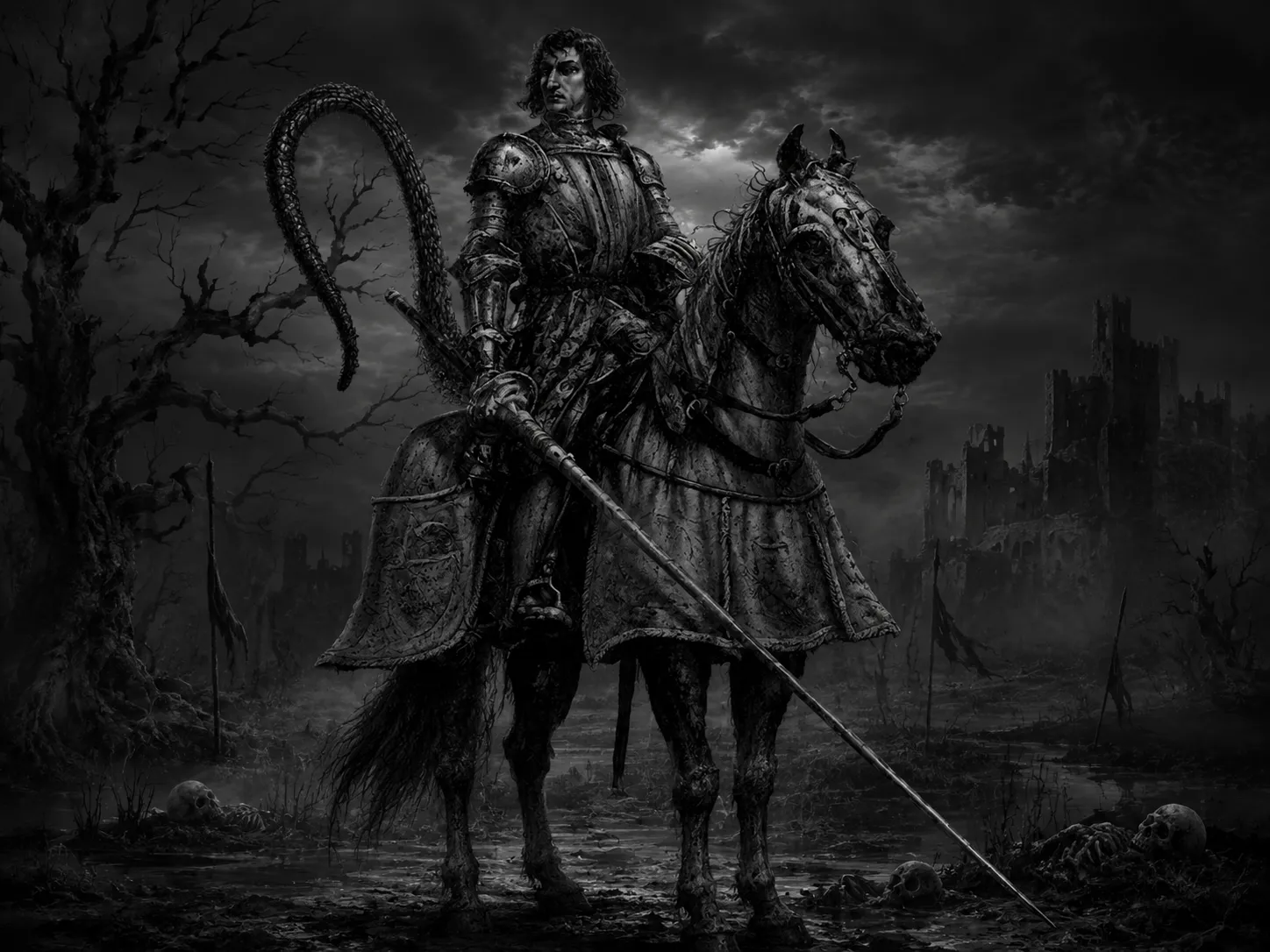
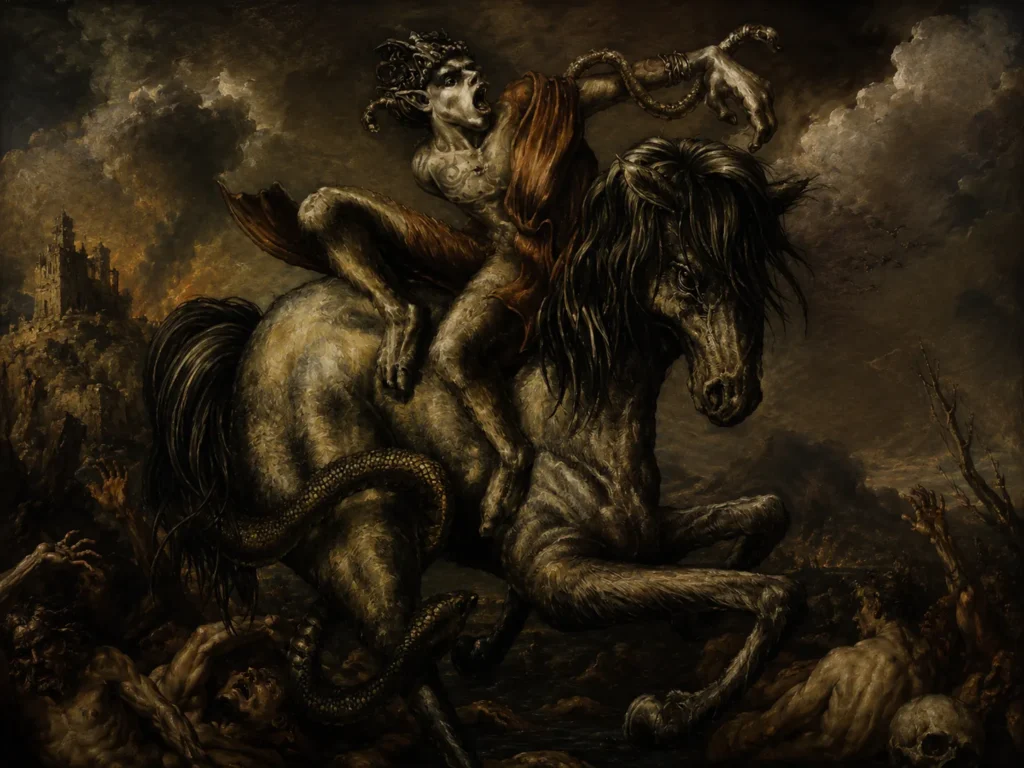
Old grimoires often show the demon as a strong man with a serpent’s tail, sitting on a pale horse. The serpent tail is a symbol of his connection to the earth and its hidden dangers. The pale horse represents fast movement and disaster, similar to the Four Horsemen of the Apocalypse.
Researchers note that the “pale horse” in old texts is sometimes seen as a horse with a changing or unclear color, which could represent how reality blurs during Bathin’s instant transport.
For people in the Middle Ages, the serpent’s tail was a sign of original sin and earth’s wisdom, showing that Bathin’s knowledge comes from a fallen state.
You may also enjoy:
Who Is Ambolin, the Demon of Nighttime Dread
December 1, 2025
Aeshma: The Zoroastrian Demon of Wrath and Fury
January 13, 2026
Agubanba: The Blind Yōkai That Preys on Young Women
October 23, 2025
Pazuzu: The Ancient Demon Who Fought Evil with Evil
November 4, 2025
History & Origins
Bathin’s recorded history dates to the late 1500s, when Europeans were very interested in cataloging and organizing demons. He first appears clearly in Johann Weyer’s Pseudomonarchia Daemonum (1577) as Marthim.
Weyer, who was a doctor and occultist, probably used a now-lost “Book of Offices” (Liber officiorum spirituum) that came before his own work and set Bathin’s rank as a top official in Hell. At that time, demonology was moving from folk beliefs to a more organized system, similar to the government structure of the Holy Roman Empire.
The worries of the Age of Discovery shaped ideas about Bathin. In the 1400s and 1500s, as trade and exploration grew quickly, people wanted spirits who could help them understand or control the world’s new, huge distances.
The demon is similar to the Arabic Marid or Jinn, spirits known for their great size and power to move people across continents instantly. Changing the name from Batin (meaning “the hidden” in Islamic thought) to a Western demon shows how European writers adapted Middle Eastern ideas about hidden knowledge into demonic powers over geography.
By the early 1600s, Bathin’s role was set in the Ars Goetia, the first book of the Lemegeton Clavicula Salomonis. His rank as Duke became official, and his seal had to be made of copper, which fit the beliefs about planets at the time.
The details of the serpent tail and pale horse in Bathin’s description match the images of plague and sudden death found in art from that time. Bathin connects old fears of wild places with the Renaissance wish to control the world using magic and the study of minerals.
Bathin’s story is also linked to the growth of hermetic alchemy. In the 1500s and 1600s, people did not separate science from superstition when studying herbs and stones. Making Bathin a demon who knew about the powers of herbs was a way to explain the risks of studying plants, since many useful plants were also deadly.
The demon came to represent the double-edged nature of the natural world, showing the dangers of trying to control the earth’s secrets without proper respect or permission.
In the late 1800s and early 1900s, Bathin’s story changed focus. When S.L. MacGregor Mathers’ translation of the Goetia was published in 1904, edited by Aleister Crowley, Bathin was reinterpreted as a symbol of psychological ideas.
Historically, the demon was seen as a being who moved people across land. In modern times, some see him as a symbol for the mind’s ability to move between different states of awareness, which is very different from his original, earth-based role.
Bathin in Grimmoires and Other Demonology Texts
Original:
Marthim Dux magnus & fortis: Visitur in forma viri valentissimi, habentis caudam serpentinam, equitantis super equum pallidum. Herbarum vires & lapidum pretiosorum intelligit. Curat hominem de loco ad locum velocitate incredibili. Huic subjacent legiones triginta. [Johann Weyer, Pseudomonarchia Daemonum, 1577]
Translation:
Marthim is a great and mighty duke: he is seen in the form of a very valiant man, having a snake’s tail, riding on a pale horse. He understandeth the virtues of herbs and precious stones. He transferreth a man from place to place with incredible celerity. Under him are thirty legions.
Johann Weyer’s 16th-century entry is the main source for Bathin under the name Marthim. The image of a strong man with a serpent’s tail on a pale horse combines medieval symbols and images from the apocalypse.
The pale horse is like the horse of Death from the Book of Revelation, which suggests that the demon’s fast travel is not just helpful, but also as sudden and frightening as a plague or quick death.
The interest in herbs and precious stones shows how, in the 1500s, people did not clearly separate botany, medicine, and alchemy. Learning about a plant’s powers could save or end a life, so a demon like Bathin was thought to hold this risky, secret knowledge. The serpent tail marks him as a spirit connected to the earth and underground.
The Eighteenth Spirit is Bathin. He is a Mighty and Strong Duke, and appeareth like a Strong Man with the tail of a Serpent, sitting upon a Pale-Coloured Horse. He knoweth the Vertues of Herbs and Precious Stones, and can transport men suddenly from one Country to another. He ruleth over 30 Legions of Spirits. [S.L. MacGregor Mathers, The Goetia: The Lesser Key of Solomon the King, 1904]
The early 1900s translation of the Ars Goetia transitioned the name from Marthim to the more familiar Bathin. While his appearance stayed the same, the demon’s role as a transporter became more important.
During the British Empire and the Industrial Revolution, the idea of moving instantly from one country to another aligned with people’s interest in new technologies that made the world feel smaller.
Calling Bathin “Mighty and Strong” and stating that he leads 30 legions shows a strict military hierarchy among demons. Grouping demons into ranks such as “Duke” (linked to the planet Venus in occult beliefs) reflects how people in the Renaissance and Victorian eras sought to impose order even to the spirit world.
The continued mention of the serpent’s tail in later sources shows the lasting idea that forbidden knowledge, especially knowledge that breaks the rules of time and space, is tied to the serpent from Eden.
Original:
Bathim, grand duc aux enfers, qui a la figure d’un homme très-robuste; il a une queue de serpent et monte un cheval d’une blancheur livide. Il connaît les vertus des herbes et des pierres précieuses. Il transporte les hommes d’un pays dans un autre avec une rapidité merveilleuse. Trente légions lui obéissent. [Jacques Auguste Simon Collin de Plancy, Dictionnaire Infernal, 1863]
Translation:
“Bathim, a grand duke of hell, who has the figure of a very robust man; he has a serpent’s tail and mounts a horse of a livid whiteness. He knows the virtues of herbs and precious stones. He transports men from one country to another with a marvelous rapidity. Thirty legions obey him.”
In this 1800s French source, the demon rides a horse of “livid whiteness” (blancheur livide). This phrase adds a dark, superstitious feeling to his story. In French literature, “livid” whiteness often meant the color of a corpse, hinting that Bathin’s travel is not just fast but also risky, like a journey close to death.
Collin de Plancy wrote for a wider audience than the private grimoires of the 1500s. His folklore approach shows how Bathin became a cultural entity in the “infernal dictionary,” with a focus on his amazing speed. This shift marks a shift from seeing Bathin as something to fear to viewing him as a symbol of dark romance and curiosity about the occult.
Mathim, alias Marthim, a great duke and a strong, comming foorth as a worthie man, but having a tail like a serpent, and riding upon a pale horsse, he understandeth the vertues of herbes and pretious stones, he transferreth men suddenlie from countrie to countrie, and hath thirtie legions under him. [Reginald Scot, The Discoverie of Witchcraft, 1584]
Reginald Scot’s version is different because he wrote it to question witchcraft, not to teach it. By mentioning Mathim (another name for Bathin) in English, Scot kept the story alive for English readers while trying to make it less mysterious.
Calling Bathin “worthy” in his human form hints at a false sense of dignity, which was common in Elizabethan times, when high-ranking spirits were shown as noblemen to tempt scholars into pride.
Using both “Mathim” and “Marthim” shows how demon names transformed in the late 1500s. These differences probably resulted from how names were pronounced or from mistakes in copying Latin texts by hand.
Scot’s writing points out the belief that spirits associated with precious stones were considered especially dangerous to the wealthy and educated, who often sought quick ways to gain riches and control through alchemy.
You may also enjoy:
What Is the Akkorokamui, Japan’s Colossal Sea Monster?
November 14, 2025
What Is a Qareen and Why Does It Follow Every Human Being?
October 8, 2025
Kuchisake-onna: Folklore, Origins, and Urban Legend History
February 10, 2026
Who Is Agaliarept, the General of Hell Under Lucifer?
October 8, 2025
Erinyes: The Chthonic Goddesses Who Enforced Blood-Guilt
November 20, 2025
Vritra: The Dragon Who Swallowed the Sky in Hindu Mythology
October 7, 2025
Powers and Abilities
The demon’s main power is controlling distance. He doesn’t just guide travelers—he lets them skip the journey completely. This power is described as moving someone instantly from one place to another, regardless of barriers such as oceans or mountains. It completely breaks the usual rules of travel.
Bathin is also like a demonic botanist and mineralogist. He shows the hidden powers of herbs and stones, often focusing on their dangerous or magical effects, which include knowing which plants can cause madness, paralysis, or death, and which stones can affect the mind or body.
Bathin’s knowledge is practical. He teaches how to use nature’s hidden resources, letting people use the environment as a weapon or a way to influence others.
Bathin vs Other Christian Demons
| Demon Name | Associated Sin/Temptation | Rank/Origin | Key Traits/Powers |
| Purson | Curiosity / Hidden Knowledge | King (Ars Goetia) | Knows hidden things and sees the past/future. |
| Gaap | Sloth / Misdirection | President/Prince (Ars Goetia) | Can make men insensible or transport them. |
| Buer | Malice / Sickness | President (Ars Goetia) | Teaches moral/natural philosophy and herbalism. |
| Foras | Avarice / Lost Items | President (Ars Goetia) | Teaches the virtues of herbs and precious stones. |
| Morax | Callousness / Knowledge | Earl/President (Ars Goetia) | Gives knowledge of astronomy and herbs. |
| Paimon | Pride / Subservience | King (Ars Goetia) | Teaches all arts and sciences; commands spirits. |
| Asmoday | Lust / Wrath | King (Ars Goetia) | Teaches arithmetic and geometry; grants invisibility. |
| Marax | Intellectual Arrogance | Earl (Pseudomonarchia) | Expert in stones and the use of herbs. |
| Stolas | Indulgence / Poison | Prince (Ars Goetia) | Teaches astronomy and the properties of herbs. |
| Bifrons | Necromancy / Forgetfulness | Earl (Ars Goetia) | Teaches astrology, geometry, and herb virtues. |
| Malphas | Deception / Fortification | President (Ars Goetia) | Builds houses and high towers; reveals secrets. |
| Vepar | Violence / Disease | Duke (Ars Goetia) | Governs waters; guides armored ships. |
| Crocell | Illusion / Hidden Waters | Duke (Ars Goetia) | Discovers hidden waters and teaches geometry. |
| Alloces | Warfare / Vanity | Duke (Ars Goetia) | Teaches astronomy and the liberal sciences. |
| Murmur | Necromancy / Spiritualism | Duke/Earl (Ars Goetia) | Compels souls of the dead to answer questions. |
Rank & Role in the Hierarchy of Hell
Bathin’s place in the demon hierarchy shows how demons became more specialized over time. In the 1500s and 1600s, books such as Weyer’s Pseudomonarchia Daemonum and the Ars Goetia consistently referred to him as a Great Duke.
This title is not just for show. It means Bathin is a middle manager in Hell, leading thirty legions of spirits. As a Duke, he works more with the physical world, while Kings or Princes handle bigger spiritual battles.
Looking at wider religious systems, Bathin’s role is more detailed. In Agrippa’s Nine Orders of Evil, he matches the seventh group, the Furies, who cause trouble and handle physical travel and movement.
In the 11th-century system by Michael Psellus, which sorts spirits by where they live, Bathin is an Earthbound demon. Unlike demons who avoid light or live in water, Bathin’s power comes from the land, making him important when Hell needs to act in the physical world.
To see where Bathin fits, it helps to compare him to Gaap, another high-ranking demon. Both are in charge of instant travel, but Gaap handles the social side, like causing desire or debate, while Bathin deals with the physical and plant-related parts of the journey. It’s like they work in the same department, with Gaap focusing on the traveler’s spirit and Bathin on the land itself.
Bathin does not appear in The Lanterne of Light (1409) or Binsfeld’s Classification (1589), which groups demons by the Seven Deadly Sins. This is because his “evil” is about crossing physical limits, not moral failings like pride or lust. Since he doesn’t represent a specific sin, he is usually found in books that focus on the natural world, like the Dictionnaire Infernal or The Magus.
In the Michaelis Hierarchy (1612), which links fallen spirits to their original angel groups, many Dukes are tied to the Choir of Virtues or Dominations. Michaelis does not name Bathin’s original choir, but his control over the “virtues of herbs” suggests he fell from the Order of Virtues, who managed natural laws.
Now, as a Duke who breaks those same laws, Bathin’s role is the opposite of his original angelic duty. Instead of keeping order, he now helps people find shortcuts that go against it.
Bathin’s Sigil
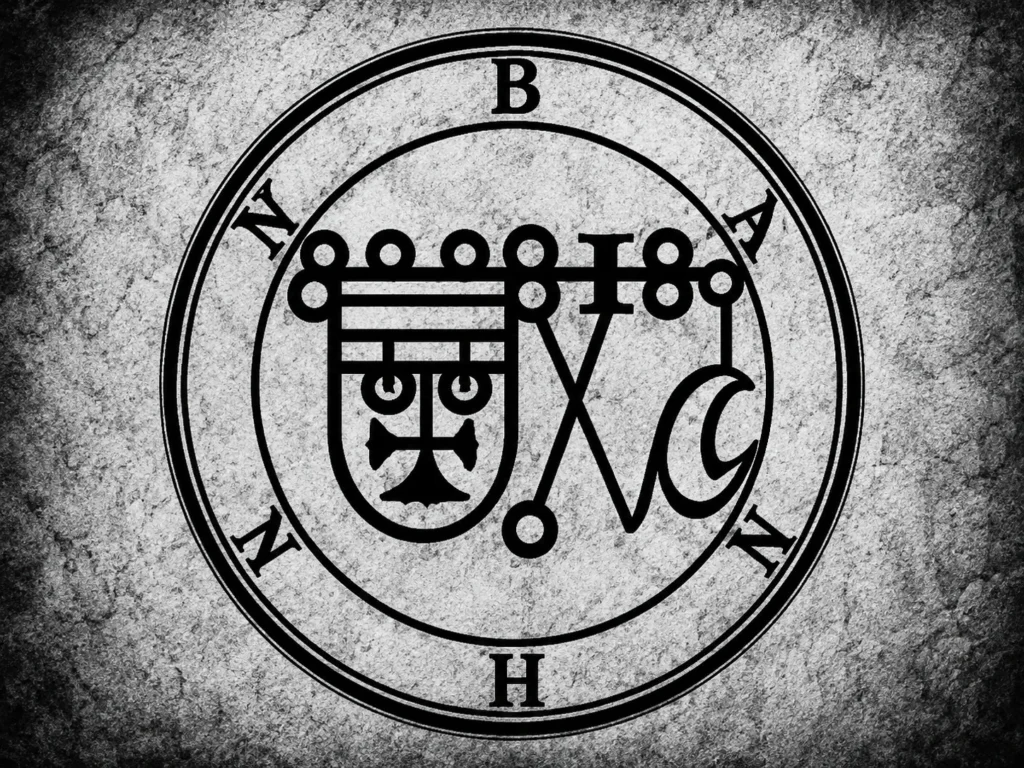
Bathin’s sigil is a complex geometric symbol found in the Ars Goetia. It is required for any ritual with him. In the past, the sigil served as a contract and a form of protection. People believed that without the seal, usually made of tin or silver, Bathin would not obey or share his secrets.
The sigil acts like a tuning fork for Bathin’s energy. In the past, people wore it over their heart to show control over his thirty legions. The sigil was important because Goetic spirits were seen as wild and hard to control, so the symbol helped force Bathin to obey during rituals.
Mystical Correspondences
| Attribute | Details |
| Planet | Venus (often associated with the rank of Duke) |
| Zodiac Sign | Virgo / Libra cusp |
| Element | Earth |
| Direction | East |
| Color | Green or Copper |
| Number | 18 (his Goetic sequence) |
| Crystal/Mineral | Agate or Jasper |
| Metal | Copper (corresponding to Venusian rank) |
| Herb/Plant | Mandragora or Belladonna |
| Animal | Serpent / Horse |
Bathin’s fast travel powers are linked to the Element of Earth, showing his control over land. As a Duke, he is also connected to Venus, but not for love or beauty—instead, it’s about the heavy, hidden secrets of the earth and plants, which is why his sigils are made of copper, which was thought to carry his earth-based energy.
Bathin is also linked to the Zodiac sign Virgo, especially its later part, which highlights his careful and detailed knowledge of herbs and stones. Virgo’s influence means he is precise in knowing the chemical properties of poisonous plants, showing that his evil comes from cold, calculated skill, not from wild passion.
Practitioners thought that knowing Bathin’s number (18) and his direction (East) would help them use the organized, though infernal, natural laws he controlled.
You may also enjoy:
Demon Alastor: The Grand Executioner of Hell
November 17, 2025
Aamon: The Infernal Marquis of Lust, Feuds, and False Prophecies
September 29, 2025
Banasura: The Thousand-Armed Demon King
October 10, 2025
Who Were the Hinn, the First Spirits of Creation?
November 12, 2025
Yuki Onna: The Terrifying Bride Who Feeds on Travelers
December 9, 2025
Rokurokubi: The Yōkai That Looks Human Until Midnight
February 3, 2026
Bibliography
Author’s Note: While writing this article, I noticed that the evolution from Weyer’s Marthim to the Ars Goetia’s Bathin marks a move from a general earth spirit to a specialist in moving people and things. By comparing the “livid” images in the Dictionnaire Infernal with the earlier focus on plants in the Pseudomonarchia Daemonum, I found a theme of “toxic expertise” that is often missed today. This shows that Bathin’s true nature is to master the dangers posed by nature’s limits, which is why I focused on his role as a link between old natural philosophy and occult geography.
- Weyer, Johann. Pseudomonarchia Daemonum. Edited and translated by Joseph H. Peterson, digital edition, 2000. Twilit Grotto: Esoteric Archives.
- De Laurence, L. W. The Lesser Key of Solomon, Goetia. Project Gutenberg, 7 Nov. 2023. Originally published by De Laurence, Scott & Co., 1916.
- Henson, Mitch, and Jeff Wellman, editors. Lemegeton: The Complete Lesser Key of Solomon. Metatron Books, 1999. Internet Archive.
- Collin de Plancy, Jacques. Dictionnaire infernal: répertoire universel des êtres, des personnages, des livres, des faits et des choses qui tiennent aux esprits. 6th ed., Henri Plon, 1863. Internet Archive.
- Scot, Reginald. The Discoverie of Witchcraft. Edited by Brinsley Nicholson, Elliot Stock, 1886. Internet Archive. Reprint of the 1584 edition.
- Barrett, Francis. The Magus, or Celestial Intelligencer; Being a Complete System of Occult Philosophy. Printed for Lackington, Allen and Co., 1801. Internet Archive. Including works by Johannes Trithemius.
- Clymer, R. Swinburne. The Grand Grimoire. The Philosophical Publishing Co., 1910. Internet Archive.
- Guiley, Rosemary Ellen. The Encyclopedia of Demons and Demonology. Visionary Living, Inc., 2009. Internet Archive.
- Kalmin, Richard. The Demons in Solomon’s Temple. (2014). ResearchGate.
- Larsen, Iver. Seven Covenants in the Bible. Academia.edu.
- Bufford, Rodger. Demonic Influence and the Christian: Issues and Implications for Counseling. 2008. Academia.edu.
- Psellus, Michael. De operatione daemonum. Edited by Jean François Boissonade and Gilbert Gaulmin, Apud Fr. Nap. Campe, 1838. Internet Archive.
- Binsfeld, Peter. Tractatus de confessionibus maleficorum et sagarum recognitus & auctus. Henricus Bock, 1591. Internet Archive.
- Gairdner, James. Lollardy and the Reformation in England: An Historical Survey. Vol. 1, Macmillan and Co., 1908. Internet Archive.
- Wu, John. Goetia, Exorcism and Demonic Struggles in Christianity and Tibetan Buddhism. Academia.edu