
Yūrei are spirits of the dead in Japanese folklore who cannot move on to the afterlife. Unlike other yōkai, which are monsters or nature spirits, yūrei are human souls (reikon) that stay in the world because of strong feelings like grudges, jealousy, sorrow, or unfinished attachments.
Yūrei are different because they do not follow the usual cycle of death and rebirth. If someone dies suddenly, violently, or without the right funeral rituals, their spirit might become a yūrei to seek justice or haunt certain places. Yūrei are important figures in Japanese horror, literature, and art, especially in ghost stories known as kaidan.
Summary
Key Takeaways
| Attribute | Details |
| Names | Yūrei, Borei, Shiryō, Onryō (vengeful spirit), Ubume (birthing spirit), Goryō (noble spirit) |
| Translation | Faint spirit or dim spirit |
| Title | Ghost of Japan, The Departed |
| Type | Yūrei |
| Origin | The spirit of a deceased human who remains in the world due to emotional attachment or lack of proper burial |
| Gender | Male or Female (though female depictions are more common in art) |
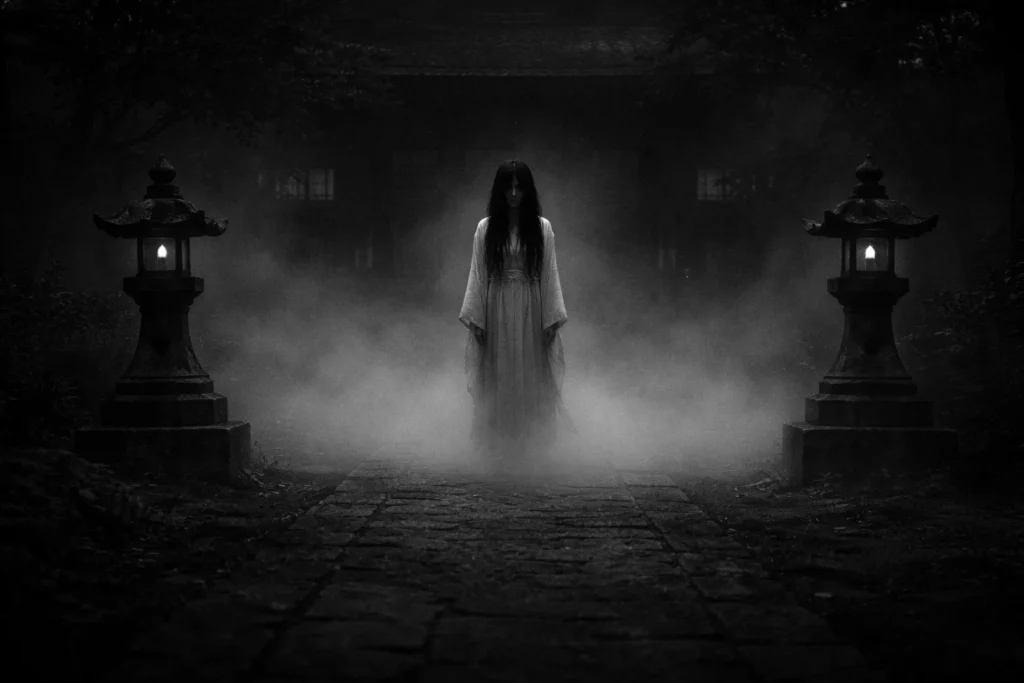
| Appearance | Often depicted in white burial kimonos (katabira) with long, disheveled black hair and no feet |
| Powers/Abilities | Invisibility, levitation, manifestation of cold, infliction of psychological terror, and physical curses |
| Weaknesses | Shinto ofuda charms, Buddhist prayers (nenbutsu), and completion of their unfinished business |
| Habitat | Graveyards, the location of their death, or the vicinity of the person they are haunting |
| Diet/Prey | None (they do not eat), though they target those who wronged them or strangers who trespass |
| Symbolic Item | Hitaikakushi (triangular white forehead paper), willow trees, and hitodama (floating spirit flames) |
| Symbolism | The importance of proper funerary rites and the destructive power of human emotion |
| Sources | Nihon Ryōiki, Konjaku Monogatarishū, Ugetsu Monogatari, and various Edo-period Kaidan collections |
Who or What is Yūrei?
A yūrei is a Japanese ghost, meaning the soul of a person who has been disturbed. In traditional Japanese belief, everyone has a spirit called a reikon. When someone dies, the reikon leaves the body and waits in a kind of limbo until the right funeral rites are performed so it can join the ancestors. If the death is sudden or filled with strong emotions like revenge or love, the reikon can become a yūrei.
Yūrei are different from other yōkai because they are tied to the human world by strong emotional connections. They usually do not wander without purpose.
Instead, they are attached to a certain person, like a murderer or a lover, or to a place, such as the well where they died. Some yūrei are harmless and just want to deliver a message. Still others, called onryō, are dangerous and try to harm, or even kill, those they see as enemies.
MEET THE MONSTERS THAT HAUNT JAPAN Limited-Time: Up to 28% OFF!
Kappa • Yuki-onna • Tanuki • Kitsune • Hundreds more legendary spirits Hilarious, horrifying, and downright bizarre tales from Japan’s shadow side. Fully illustrated encyclopedia by Thersa Matsuura – your passport to the world of yōkai. Anime origins • Real folklore • Things that go bump in the tatami. Dare you invite them in?
“Yūrei” Meaning
The word yūrei comes from two kanji: 幽 (yū), which means faint or dark, and 霊 (rei), which means soul or spirit. Together, yūrei means ‘faint spirit.’ This shows how people have traditionally seen yūrei as ghostly, barely visible beings, hard to make out clearly.
The term yūrei became common during the Edo period (1603–1868) to distinguish human ghosts from other supernatural beings, such as oni (demons) and bakemono (shapeshifters). In different regions, yūrei may also be called borei (departed spirits) or shiryō (spirits of the dead).
In Shinto and Buddhist traditions, a yūrei that turns into a powerful and angry spirit is called a goryō. The word’s origin highlights how the spirit is no longer a ‘bright’ living soul but a ‘dim’ leftover of what it once was.
How to Pronounce “Yūrei” in English
In English, yūrei is pronounced ‘yoo-ray.’ The first part sounds like ‘too,’ and the second part sounds like ‘say.’ The ‘u’ is held a little longer, which is shown by the line over the letter. It is not pronounced ‘yoo-ree.’
What Does a Yūrei Look Like?
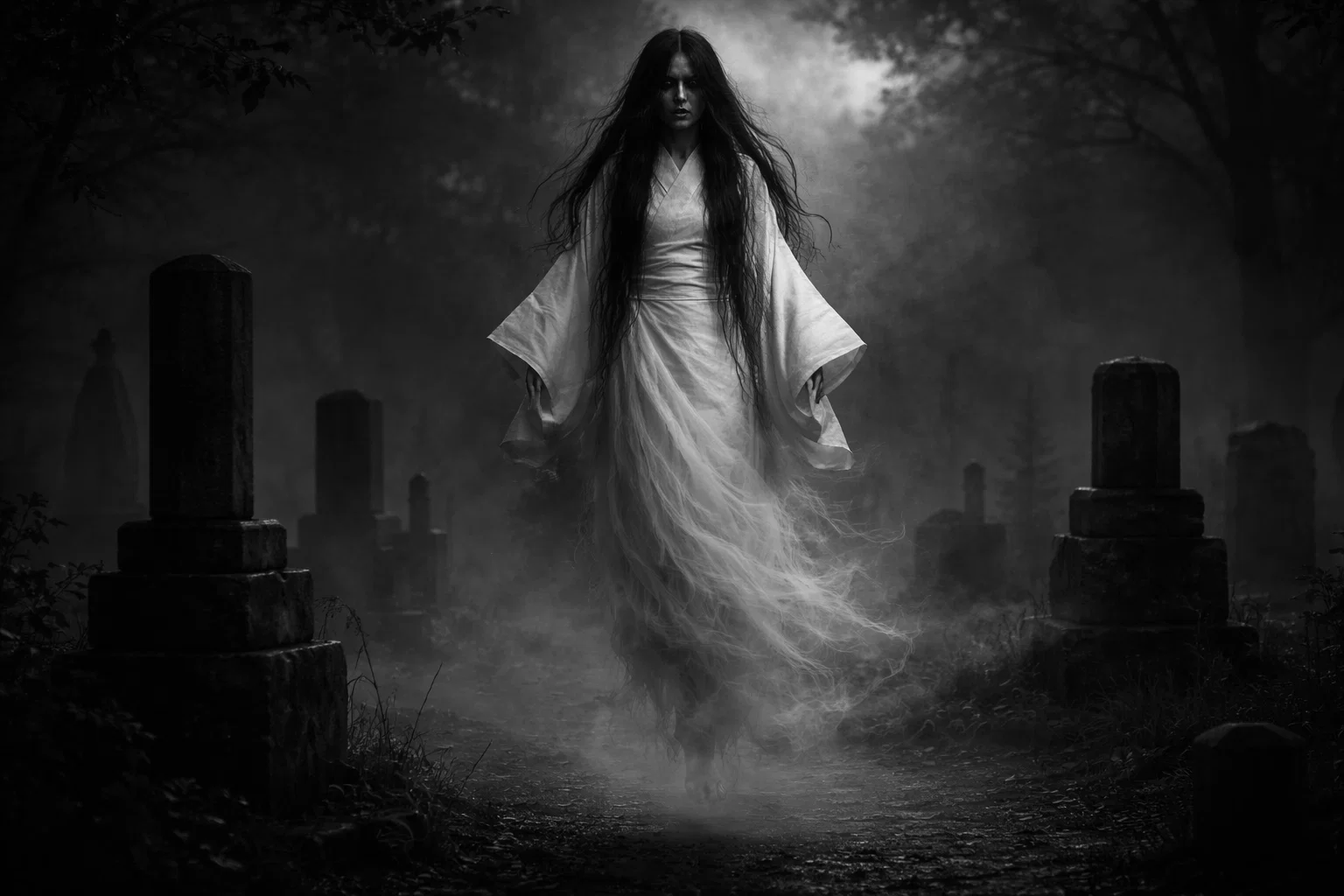
The way yūrei look was mostly set during the Edo period, thanks to ukiyo-e prints and Kabuki theater. A yūrei usually appears wearing a white burial kimono called a katabira or kyōkatabira. This is the traditional clothing for the dead in Japanese funerals and is folded right over left, which is the opposite of how living people wear kimonos.
A key feature of a yūrei is that it has no feet. In art and theater, its body fades into a misty or translucent trail, making it seem as if the spirit is floating just above the ground.
Yūrei almost always have long, black, messy hair. When alive, Japanese women wore their hair in neat buns, but for burial, their hair was let down, so loose hair shows the person is dead. Their skin is very pale, sometimes with a blue or green tint.
Yūrei are often shown with hitodama, which are small, floating balls of blue, green, or purple fire that stand for the soul’s energy. They may also wear a hitaikakushi, a small white triangle of paper or cloth tied to the forehead.
You may also enjoy:
Gandharva: God, Spirit, or Demon?
November 13, 2025
Bali: The Benevolent Asura King of Hindu Mythology
October 10, 2025
Who Is Ahriman, and Why Is He Pure Evil Incarnate?
January 8, 2026
Chort: The Sinister Slavic Demon of Chaos and Bad Luck
March 10, 2026
Who Is Jann in Islamic Mythology and Why Is He Feared?
October 2, 2025
Who Is Ariton, the Infernal King of the Eastern Gate?
February 17, 2026
Habitat
Yūrei are usually found in places that have a strong link to their life or death. Most often, they appear at the site of the person’s death, especially if the death was traumatic. This could be a house where a murder happened, a dark forest, or water like a well or river. Since they are spirits of the dead, yūrei are also often connected to graveyards and temples where funerals take place.
People say yūrei often appear during the Hour of the Ox, between 2:00 and 4:00 AM, when the boundary between the living and the dead is weakest. Unlike Western ghosts that might haunt any house, a yūrei usually stays where it has unfinished business. If it wants revenge, it will follow the person it is haunting, no matter where that person goes.
1,000+ SPIRITS, GODS & GODDESSES AWAITING YOUR CALL. Limited-Time: Up to 49% OFF!
The ultimate global spirit encyclopedia – 2,000+ entries from every culture on Earth. Fairies • Djinn • Demons • Loa • Angels • Deities • Ancestors Real names • True offerings • Ancient rituals that actually work. Judika Illes’ legendary masterwork – the one book every serious witch, mage, and spirit-worker owns.
Origins and History
The idea of yūrei comes from old Japanese beliefs about the reikon and the need for proper burials. Before Buddhism, people thought spirits could become dangerous if not calmed with rituals. When Buddhism arrived, these beliefs mixed with ideas about karma and the hungry ghost realm, called gaki-dō.
In the Heian period (794–1185), people were most concerned about goryō, the angry spirits of powerful nobles who died in exile. By the Edo period, attention shifted to ordinary people. This time saw a boom in ghost stories, especially with the game Hyakumonogatari Kaidankai, in which people gathered to tell 100 supernatural tales.
This period set the look and common themes for yūrei that are still used today. In modern times, yūrei have become icons of Japanese horror, like the ghosts in Ringu and Ju-On, who still wear the classic long hair and white clothes.
Sources
| Source | Quote |
| Nihon Ryōiki | The spirit of the dead woman remained in the house, manifesting as a shadow that could not be grasped by the living. |
| Konjaku Monogatarishū | There appeared a ghost of a woman with long hair, weeping bitterly at the edge of the abandoned veranda. |
| Ugetsu Monogatari | The ghost of Akana appeared before his friend, for a spirit can travel a thousand miles in a single day to keep a promise. |
Famous Yūrei Legends and Stories
The Ghost of Okiku (Banchō Sarayashiki)
The story of Okiku is one of Japan’s most famous ghost tales. Okiku was a servant girl who worked for the samurai Aoyama Tessan. Aoyama wanted her, but she refused him. To force her to give in, Aoyama hid one of ten valuable Dutch plates from his family’s collection. He told Okiku that if she could not find the missing plate, she would be executed for stealing.
Upset, Okiku counted the plates again and again: one, two, three… eight, nine, but the tenth was always gone. When she still refused Aoyama, he hit her and threw her into a well, killing her. Soon after, her yūrei started to appear from the well every night.
People would hear her counting the plates in a sad voice: “One… two… three…” When she got to nine, she would let out a terrifying scream or a sobbing cry. The haunting only stopped when a monk or a family friend shouted “Ten!” after she reached nine, making the ghost believe the missing plate was found.
The Vengeance of Oiwa (Yotsuya Kaidan)
Oiwa was married to a rōnin named Tamiya Iemon. Iemon was cruel and wanted to leave his wife to marry a rich neighbor’s granddaughter. To get rid of Oiwa, Iemon and his helpers gave her a ‘medicine’ that was really poison meant to disfigure her.
The poison made Oiwa’s eye droop and her hair fall out. When she saw herself and realized what had happened, she died in an accident with a sword, cursing Iemon as she passed.
Oiwa’s yūrei haunted Iemon without stopping. Her deformed face showed up in the lanterns in his new home and even in the face of his new bride. These visions drove Iemon mad, and he accidentally killed his new wife and her father. Oiwa’s spirit kept following him until he died, showing how a grudge (urami) cannot be escaped.
You may also enjoy:
Who Is Ariton, the Infernal King of the Eastern Gate?
February 17, 2026
Who Is Agares, the Demon of Earthquakes and Deception?
October 13, 2025
Who Is Abalam in Demonology? The Demon King That Serves Paimon
September 30, 2025
Tarakasura: The Dark Demon Who Ruled Hell on Earth
December 4, 2025
What Is the Abumi-guchi Yōkai and Why Does It Wait Forever?
October 22, 2025
What Is the Akkorokamui, Japan’s Colossal Sea Monster?
November 14, 2025
The Ghost of Otsuyu (Botan Dōrō)
In this story, a young man named Hagiwara Shinzaburō falls in love with Otsuyu. He does not know that Otsuyu has died of a broken heart. Every night, she visits him with a servant who carries a peony lantern. One night, Shinzaburō’s neighbor looks through a hole in the wall and sees him holding a rotting skeleton instead of a beautiful woman.
A priest gave Shinzaburō protective ofuda charms to keep the ghost away. But the ghost convinced a servant to remove the charms, letting her in. The next morning, Shinzaburō was found dead, wrapped up with Otsuyu’s skeleton.
Yūrei Powers and Abilities
Yūrei have many supernatural powers because they are spirits. Even though they do not have a physical body, they can still affect the real world through their strong emotions. Their main power is to manipulate people’s minds and even drive them mad.
- Apparition/Invisibility: The ability to appear or disappear at will, often manifesting only to the person they intend to haunt.
- Levitation: Yūrei float above the ground and can move through solid objects like walls or doors.
- Temperature Manipulation: Their presence is often preceded by a sudden, intense drop in temperature, known as a reiki (spirit chill).
- Illusion: Creating terrifying visual or auditory hallucinations to deceive or terrify the living.
- Curses (Eisui): Powerful, vengeful spirits can bring sickness, misfortune, or death to an entire lineage.
- Possession: Some yūrei can inhabit the bodies of the living to speak or act through them.
BREAK THE TOUGHEST DEMONIC BONDAGE! Limited-Time: Up to 41% OFF!
Real-life deliverance secrets from Apostle Alexander Chisango – straight from the front lines in Africa. Generational curses • Witchcraft • Sexual bondages • Addiction strongholds. Step-by-step keys that actually work when everything else has failed. Hundreds set free – your breakthrough starts here!

How to Defend Against Yūrei
The best way to protect yourself from a yūrei depends on why it appeared. Unlike physical monsters, you cannot defeat them with weapons.
The most common way to defend against yūrei is with Shinto ofuda charms. These are strips of paper blessed by a priest and placed on doors to keep spirits out. Buddhist rituals, like chanting sutras or the nenbutsu, can also calm the spirit and help it move on to the afterlife.
But the only lasting solution is to settle the spirit’s unfinished business. This could mean finding a missing body for burial, punishing someone who did wrong, or giving a final message to a loved one. Once the emotional tie is broken, the yūrei disappears on its own.
Yūrei vs Other Yōkai
| Name | Category | Origin | Threat Level | Escape Difficulty |
| Oni | Oni | Demonic entities from Buddhist hell | High | Hard; requires great strength or holy weapons |
| Kappa | Suijin | Water deity/monster | Medium | Easy; bow to it or give it a cucumber |
| Tengu | Obake | Mountain spirit/bird-human | High | Hard; they are masters of martial arts |
| Yuki-onna | Yōkai | Spirit of a woman who died in the snow | High | Moderate; avoid the mountains in storms |
| Rokurokubi | Obake | Human cursed with a long neck | Low | Easy; they are mostly tricksters |
| Gashadokuro | Yūrei | Giant skeleton made of war victims | Extreme | Very Hard; it is massive and mindless |
| Kuchisake-onna | Urban Legend | Vengeful spirit of a mutilated woman | High | Moderate; give ambiguous answers |
| Noppera-bō | Obake | Faceless shapeshifter | Low | Easy; they only seek to scare people |
| Jorōgumo | Obake | Spider that lived 400 years | High | Hard; it uses webs and seduction |
| Ubume | Yūrei | Woman who died in childbirth | Medium | Moderate; help her carry her child |
Symbolism
| Attribute | Details |
| Element | Water (associated with wells, rain, and the “misty” nature of spirits) |
| Animal | Snake (symbolizing jealousy and rebirth) or Crane |
| Cardinal Direction | North-East (the Kimon or Demon Gate direction) |
| Color | White (the color of death and burial garments in Japan) |
| Plant | Willow Tree (traditionally where ghosts appear) or Peony |
| Season | Summer (specifically during the Obon festival) |
| Symbolic Item | Hitaikakushi (triangular forehead protector) |
In Japanese culture, yūrei stand for how life is temporary and how dangerous it is to leave conflicts unresolved. They remind people of the need for social harmony and of the duty the living owe to the dead. A yūrei haunting is often seen as a sign that the community failed to give justice or proper care.
Yūrei also show the long-lasting strength of women’s spirits in a society mostly run by men. Many of the strongest yūrei are women who were mistreated by men, showing that even if they had no power in life, their spirits become unstoppable after death. This idea has made yūrei a common theme in Japanese art, from old scrolls to modern movies.
You may also enjoy:
Vaisravana: The Golden Guardian King Who Rules the North
October 16, 2025
Arati: The Beautiful Demon of Aversion in Buddhist Mythology
October 15, 2025
Lamashtu, the Mesopotamian Demoness of Childbirth and Infant Death
November 4, 2025
Ambri: The Imperial Duchess of Caspiel’s Empire
December 1, 2025
Rāga: The Seductive Demon of Passion and Desire in Buddhist Lore
October 16, 2025
Amdusias in the Ars Goetia: The Demon of Dark Music
December 2, 2025
Frequently Asked Questions
What is the difference between a Yūrei and a Western Ghost?
Western ghosts are usually linked to places, such as haunted houses, and can often be exorcised. A yūrei, on the other hand, is connected to a certain person or an emotional debt. Unlike Western ghosts, yūrei have a set look, like wearing a white burial kimono and having no feet. They can only move on if their specific problem (urami) is solved or if Buddhist funeral rites are completed.
What is the significance of the triangle headband (Hitaikakushi) on a Yūrei?
The hitaikakushi is a triangle of white paper or cloth put on the forehead of the dead during Japanese funerals. It is meant to protect the soul from demons or show that the person has moved to a higher state. In stories, it marks a spirit as ‘officially dead,’ setting yūrei apart from living people or shapeshifting yōkai.
Can a Yūrei be benevolent or bring good luck?
Most well-known stories are about angry onryō, but some yūrei are actually protective. For example, Zashiki Warashi is a child spirit that brings good luck to the home where it lives. During the Obon festival, families welcome ancestral spirits as kind visitors who protect the family, as long as they are given food and prayers.
Why do Yūrei often appear near willow trees?
In Japanese myths, the willow tree (yanagi) is linked to the border between the real world and the spirit world. Its drooping branches are thought to look like a floating yūrei. That is why art and theater often show ghosts under a willow tree by a river or well, marking a spiritual crossing point.
What is a “Funayūrei” and how does it differ from a standard ghost?
A Funayūrei is a special kind of ghost: the spirit of someone who drowned at sea. Unlike regular yūrei that haunt homes or wells, Funayūrei go to ships and ask for a ladle. If they get one, they use it to pour seawater into the boat until it sinks. Sailors would give them a ladle with a hole in the bottom, so the spirit could not fill the vessel.
How does the Obon festival relate to Yūrei?
The Obon festival is a Japanese Buddhist tradition for honoring ancestors’ spirits. People believe that during Obon, the barrier between worlds becomes thin and spirits come back to visit their families. Families light Chochin lanterns and dance the Bon Odori to guide the spirits. While yūrei are usually spirits stuck by trauma, Obon is about the peaceful return and farewell of spirits who have moved on to the afterlife.
