
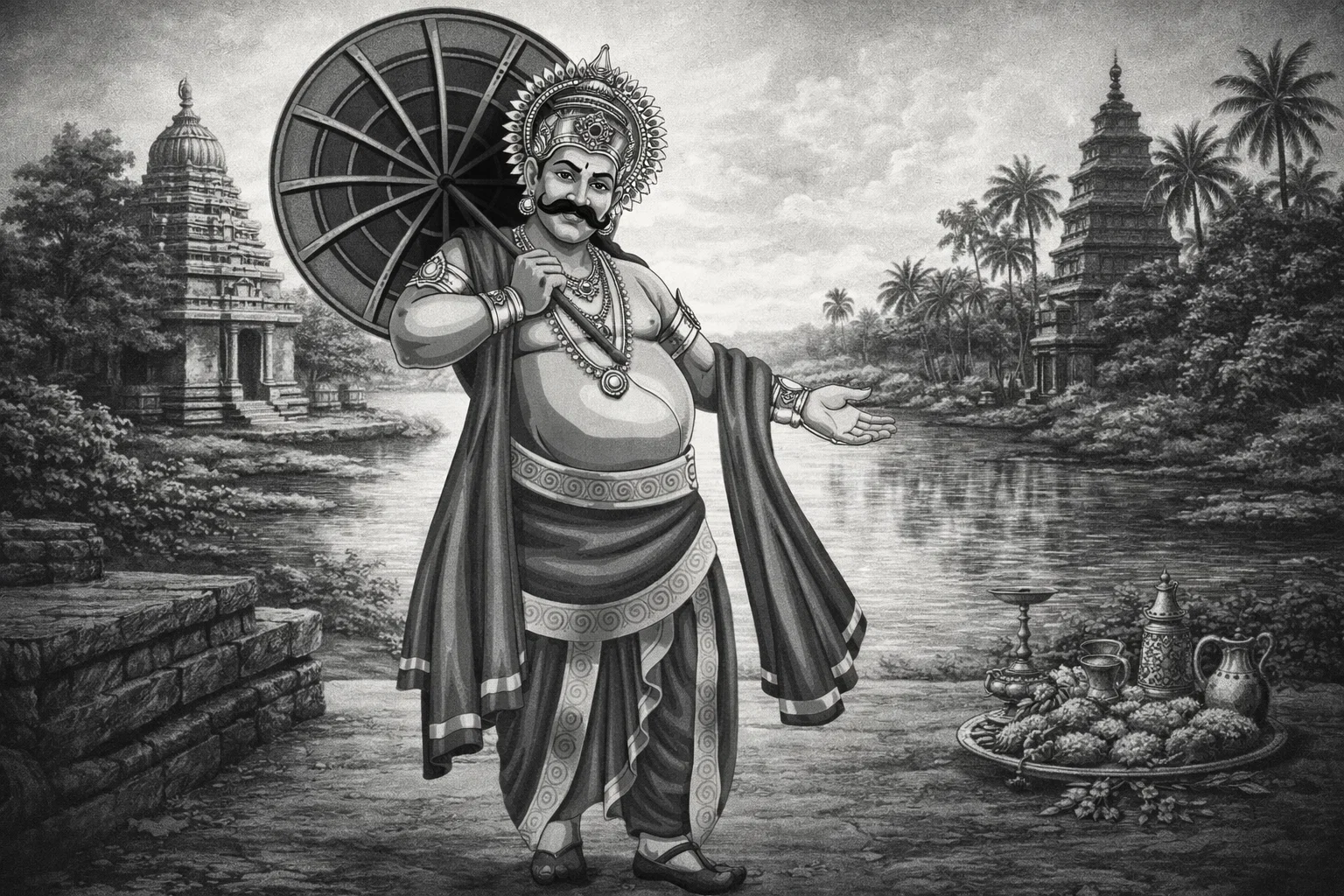

Most stories about the Daitya lineage focus on chaos and rebellion against the gods. Still, Mahabali (Bali) stands out as a unique entity. Instead of seeking disorder, he represents the tension between great earthly merit and the need for a divine cosmic order.
Most Asuras are known for eventually turning away from righteousness, but this ruler is different. His downfall happened not because of evil, but because his strong virtue threatened the balance of the heavens.
My research below relies on translations of the Bhagavata Purana and the Vamana Purana to trace how the story and meaning of Mahabali changed from ancient times to the Puranic era. [View Full Bibliography ↓]
Summary
Key Takeaways
| Attribute | Details |
| Names | Mahabali, Indrasena, Virochana-putra, Maveli |
| Title | Chakravartin of the Three Worlds, King of the Daityas |
| Gender | Male |
| Role | Benevolent Conqueror, Exemplar of Charity, Future Indra |
| Clan | Daitya (Descendant of Diti and Kashyapa) |
| Followers | Asuras, Danavas, and the citizens of the golden age |
| Powers | Invulnerability through sacrifice, mastery of the three worlds |
| Appearance | Majestic, crowned, often depicted with a royal parasol |
| Etymology | Sanskrit for “Strong” or “Greatly Powerful” |
| Associated Figures | Vishnu (Vamana), Prahlada (Grandfather), Shukracharya (Guru) |
| Weaknesses | Extreme adherence to a promise, unbound generosity |
| Opposing Deva/Avatar | Vamana (The fifth avatar of Vishnu) |
| Pantheon | Hindu (Vedic and Puranic) |
| Primary Sources | Bhagavata Purana, Vamana Purana, Mahabharata, Ramayana |
Who or What is Mahabali?
Mahabali is recognized in the Puranas as a Daitya king who became a Chakravartin, or universal ruler. Unlike earlier Daityas who tried to disrupt the Vedic order with violence, he brought stability by performing sacrifices and upholding social justice. The main texts describe his rule as a Golden Age, when poverty and wealth disappeared and the earth provided for everyone without hard work.
Although he is an Asura, a group usually opposed to the Devas, Mahabali is known for his self-sacrifice. As the grandson of Prahlada, a famous devotee, he inherited a tradition of deep devotion, which made his rivalry with Indra more complex.
His story shows how great merit can be so powerful that it requires the Supreme Deity to step in and restore balance between Heaven and Earth.
“Mahabali” Meaning
The name Mahabali comes from Sanskrit words meaning “strength,” “power,” or “force.” In Vedic rituals, it can also mean an offering, especially the daily food given to spirits and creatures. This double meaning highlights Mahabali’s dual role as both a powerful ruler and someone known for giving through rituals.
In the Puranas, he is often called Mahabali, meaning The Great Strong One. Over time, the name shifted from describing general strength to becoming a title for the ideal virtuous king. In South India, especially in Malayalam, he is called Maveli, a shortened form of Mahabali.
This version of his name is important in local culture, as it moves away from the idea of a demon and instead represents the image of a respected ancestral ruler. In different regions, the name also comes to mean a “Sacrificed King,” connecting him closely to the story of the three steps of land.
UNLOCK THE FORBIDDEN KNOWLEDGE OF DEMONS. Limited-Time: Up to 29% OFF!
The Encyclopedia of Demons & Demonology 400+ entries • Real history • Exorcisms & Ancient Evils • Possession • Terrifying photos. This is Rosemary Ellen Guiley’s masterpiece of the occult.
How to Pronounce “Bali” in English
The name is pronounced Bah-lee. The first part sounds like the ‘a’ in ‘father,’ and the second part is a long ‘ee’ as in ‘see.’ The stress is on the first syllable. Academically, it is sometimes written as Ba-li to show the short vowels from Sanskrit.
What Does Mahabali Look Like?
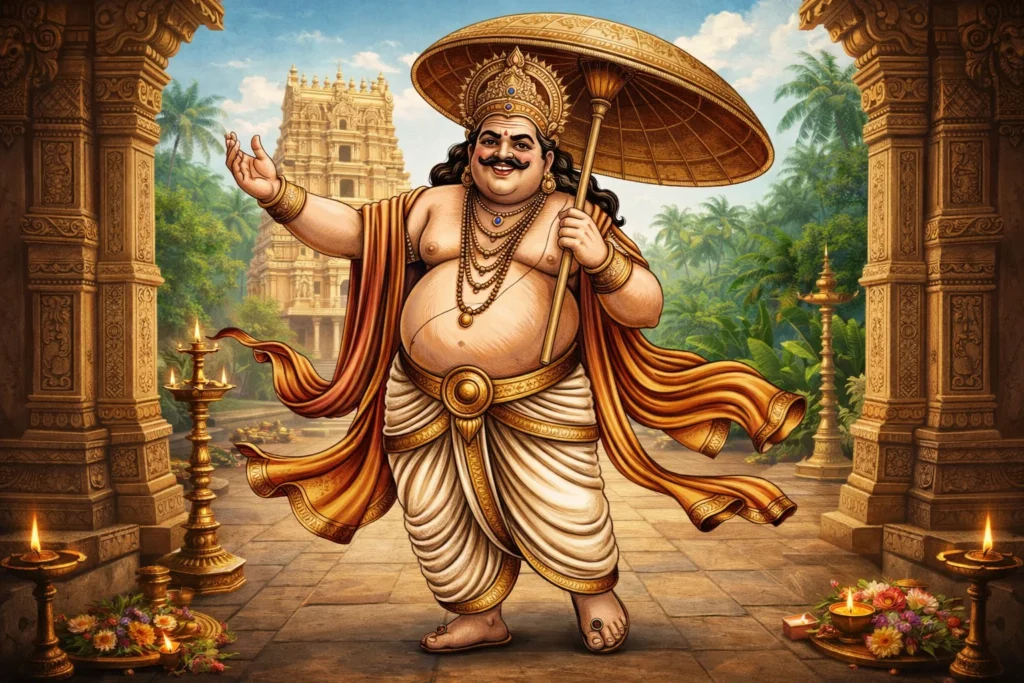
Art and texts show Mahabali very differently from other Daitya leaders. He is not shown with fangs or scary features. Instead, the Bhagavata Purana describes him as handsome and regal, shining with spiritual merit. He is usually pictured wearing fine jewelry, a tall crown, and silks, showing his status as ruler of the three worlds.
In classical Indian art, Mahabali is shown as majestic and calm. He often has a palm-leaf umbrella, a key symbol in Kerala’s traditions. Mahabali is depicted with broad shoulders and a steady gaze, looking like a protector.
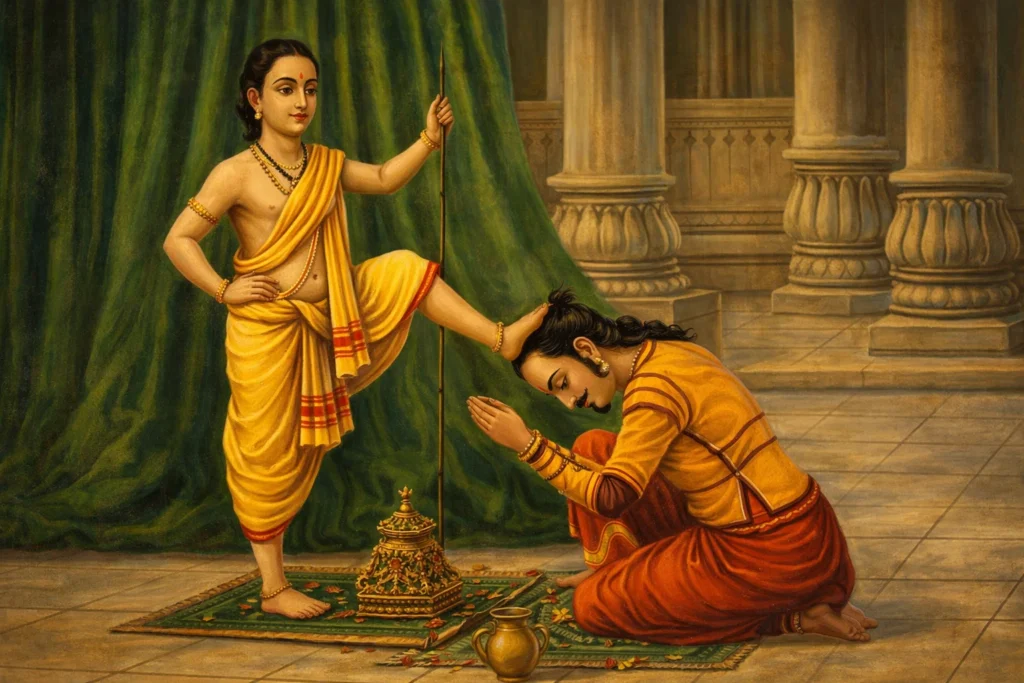
When shown with Vamana, he is usually humble, bending or offering water from a vessel, showing his change from a powerful king to a devoted follower.
You may also enjoy:
What Is a Bhuta? The Backward-Footed Ghosts of Hindu Horror
February 5, 2026
Akateko: The Bloody Hand Ghost That Guards a Cursed Temple Tree
November 14, 2025
Who Is Shiva, the Destroyer and the Lord of the Universe?
November 12, 2025
Gandharva: God, Spirit, or Demon?
November 13, 2025
Who Is Arioch, the Demon of War and Vengeance?
January 21, 2026
Azhi Dahaka: The Three-Headed Dragon of Zoroastrian Mythology
January 14, 2026
Origins
Mahabali’s story starts with his ancestors, Kashyapa and Diti, who founded the Daitya race. He appears in the Puranas after Hiranyakashipu, showing a change in Daitya tactics. Instead of using force and fear, as earlier rulers did, Mahabali used discipline and ritual purity to claim Indra’s throne both legally and spiritually.
Mahabali first appears in early Vedic texts, but his full story is told in the Epics and Puranas. Over time, his life changed from a simple story of a defeated rival to a complex tale about duty and the cycles of the universe.
Birth
Mahabali was born into the top ranks of the Asura hierarchy. His father was Virochana, son of the devoted Prahlada. From a young age, he learned both the martial skills and leadership of the Daityas and the spiritual wisdom of his grandfather.
The sage Shukracharya, teacher of the Asuras, guided Mahabali’s upbringing. He taught that true power comes from self-control and performing Ashvamedha sacrifices. Unlike many of his relatives, Mahabali’s early life focused on disciplined rule and following universal laws.
Family
Mahabali’s family is important in Hindu cosmology. As the great-grandson of Hiranyakashipu, he belonged to a powerful lineage. Despite his ancestors’ violent past, his close family valued devotion and intelligence. His father, Virochana, was extremely generous, a quality that would later affect Mahabali’s fate.
| Category | Details |
| Parents | Father: Virochana; Mother: Devamba |
| Siblings | Historical accounts focus on him as the primary heir; others are rarely named in major Puranas. |
| Spouse | Vindhyavali (also known as Ashrama) |
| Children | Bana (Banasura) was his eldest and most prominent son, along with many others. |
Historical & Folkloric Records
“Then the Lord, the master of all, in the form of a dwarf (Vamana), went to the sacrificial ground of the high-souled son of Virochana. He was accompanied by the sages and had the appearance of a brahmacarin. On seeing Him, the King, the son of Virochana, stood up and, after greeting Him with joined palms, offered Him a seat.” [Matsya Purana, Chapter 245, Estimated 3rd–4th Century CE]
This passage from the Matsya Purana, one of the oldest Puranic texts, is the main source for the key event in Mahabali’s story. Unlike later versions, it focuses on the rituals between the Daitya king and the divine avatar. Calling him Virochana-putra (son of Virochana) highlights his family line. It shows that his power was inherited and confirmed by his Vedic sacrifices.
The image of a brahmacarin (celibate student) meeting a noble king shows the tension between spiritual and worldly power. At this time, the king was not seen as an evil demon, but as an Asura whose great merit challenged the cosmic order. The Ashvamedha sacrifice marked his rise from local ruler to a cosmic leader.
“O King, I ask from you only three steps of land, measured by my own steps. I do not desire anything else, for a wise man who accepts only what he needs is not touched by sin. … Bali replied: ‘O son of a Brahmana, your words are as beautiful as they are full of wisdom. Therefore, take from me whatever land you desire.’” [Bhagavata Purana, Canto 8, Chapter 19, Estimated 8th–10th Century CE]
In the Bhagavata Purana, Mahabali’s character becomes more defined. He changes from a conqueror to a philosopher-king. The story highlights atmanivedanam (complete self-surrender), seen as the highest devotion in Vaishnavism. This change shows the Bhakti movement’s influence, in which even God’s enemy is redeemed through giving.
The meaning of his name—’strength’—is tested in this story. His real strength is moral, as he keeps his promise even when warned by his teacher, Shukracharya.
This story makes him a Mahabhagavata (Great Devotee), thereby allowing him to avoid the usual fate of Asuras. The three steps stand for earth, sky, and Heaven, and by giving them up, the king admits that all things belong to the divine.
“Maveli nadu vaneedum kalam, manushyarellarum onnu pole. Amodathode vasikkum kalam,apathangekkumilla thonnum. Kallavumilla chathiyumilla, ellolamilla polivachanam.” (Translation: When Maveli ruled the land, all people were equal. They lived in joy and were free from all dangers. There was no theft, no deceit, and not even a grain of falsehood.) [Onapattu (Traditional Folk Songs of Kerala), Oral Tradition codified in the 19th–20th Century]
This folk source from Kerala shows the next stage in Mahabali’s story. Here, he is called Maveli, a friendlier version of Mahabali. The song describes a perfect society where everyone is equal and honest. Unlike the scriptural stories where he rules the three worlds, this version makes his reign local and more human.
This song reflects a longing for a time before strict social divisions. The ‘Golden Age’ it describes is a way to criticize later caste-based societies. The idea of no theft or deceit makes Mahabali a folk hero, and his yearly return during Onam is a joyful celebration of harmony rather than fear. This is the most human version of his story, showing him as a wise, fatherly king instead of a monster.
“The high-souled Bali, the son of Virochana, was a king of great fame. He was always devoted to truth and had his senses under control. He was the protector of his subjects and was liked by all the people. Having conquered the celestial regions by his own prowess, he performed many sacrifices.” [The Mahabharata, Shanti Parva (Section 227), Estimated 4th Century BCE – 4th Century CE]
In the Mahabharata, Mahabali is often used as an example of how power rises and falls. In the Shanti Parva, which discusses kingship and morality, his story helps explain that no ruler’s power lasts forever. This text treats him as equal to the great human kings, not as a mythological monster.
The Mahabharata highlights Mahabali’s truthfulness and self-control, traits usually linked to royal sages. This shows the shift from tribal society to organized kingship, where a ruler’s worth depended on protecting people and performing sacrifices. His fall warns that even the best rulers must eventually give way to time and the cosmic order.
SPEAK THEIR TRUE NAMES… IF YOU DARE
Limited-Time: Up to 40% OFF!
Over 1,700+ demons – true names, ranks, infernal seals, powers & forbidden histories. The expanded & revised masterpiece by occult legend Michelle Belanger. Now with 200+ new entities, dozens of never-before-seen illustrations from ancient grimoires. The ultimate arsenal for demonologists, magicians, and the deliciously curious.

Role in Hindu Cosmology
In the system of Dharma, Mahabali is a ‘pious opponent.’ He does not try to destroy the world, but rules so well that the gods are no longer needed. This upsets the cosmic order, so his defeat by Vishnu is not a punishment, but a way to restore balance.
Mahabali now lives in Sutala, a rich world said to be even grander than Heaven, where he waits for the next cosmic age. In the future, he is destined to become Indra, the King of the Gods. This makes him an anti-hero, with his current exile preparing him for a future divine role.
You may also enjoy:
Jikininki: The Japanese Ghost That Feeds on Human Corpses
February 9, 2026
What Is Jorōgumo? The Deadly Spider Woman of Japanese Myth
February 2, 2026
Who Is Shiva, the Destroyer and the Lord of the Universe?
November 12, 2025
Hariti: The Demon Mother Who Fed on Children at Night
December 8, 2025
Hitotsume kozō: One-Eyed Yōkai of Japanese Folklore
February 4, 2026
Who Is Al-Abyad? The White King Jinn Who Rules Love and Chaos
January 26, 2026
The “Sacrificed King”
Mahabali’s move from ruling the three worlds to living in Sutala shows a Vedic critique of too much merit. In Western stories, beings are usually cast down for moral failure or rebellion.
But in Mahabali’s story, he is removed because he ruled too well. By making earth as perfect as Heaven, he made the gods’ rituals unnecessary. This shows that, in ancient Indian thought, the universe needs balance, not just goodness, and that the roles of humans, demons, and gods must remain distinct.
The meeting between Vamana and Mahabali is like an early lesson in contract law. When Mahabali ignores Shukracharya’s advice, choosing to keep his word instead of protecting his throne, he values truth over survival.
This story creates the idea of a ruler who is open and honest. Historically, it may reflect the struggles between growing empires and the priestly class in ancient India. The ‘three steps’ are more than just distance—they show the priests taking back power from a king who had grown too strong for old rituals.
Mahabali’s future, as Indra shows, reflects a cyclical view of merit, unlike the linear conflicts in Western or Middle Eastern myths. While figures like Lucifer are in endless struggle, Mahabali is a ‘King in Waiting.’ His exile is a period of divine probation, not a final punishment.
This shows that in the Puranas, the difference between a god and an Asura is not about their nature, but about their role and timing. Mahabali’s story teaches that even good deeds, if done at the wrong time, can upset the universe and must sometimes be held back.
Myths, Legends, and Stories
The Conquest of the Three Worlds and the Vamana Avatar
The heavens trembled as the rhythmic chanting of the hundredth Ashvamedha sacrifice echoed from the banks of the sacred Narmada River. Bali, the grandson of Prahlada, sat on his golden throne, his presence radiating a luster that rivaled the sun.
Having already brought the three worlds under his singular canopy, he sought to cement his sovereignty through the finality of ancient ritual. Beside him stood the venerable Shukracharya, the preceptor of the Asuras, watchful and wary of the divine balance that his disciple’s sheer merit had disrupted.
Into this assembly of giants and sages walked a youth of diminutive stature—a Vamana or dwarf Brahmin. He carried a wooden umbrella and a water pot, his face glowing with a serene, Vedic brilliance that silenced the crowd.
The King, bound by the codes of royal hospitality and his own innate generosity, rose to greet the boy. “Ask of me what you will, O Brahmin,” the monarch proclaimed, his voice steady with the pride of a ruler who possessed everything. “Gold, elephants, or fertile provinces—they are yours for the taking.”
The youth smiled, a small gesture that contained the weight of the universe. “I seek no vast kingdoms, O King of the Daityas,” he replied. “I ask only for a humble gift: three paces of land, measured by my own stride.”
A ripple of laughter moved through the court, but Shukracharya’s eyes narrowed. Sensing the cosmic shift, the sage leaned toward the King’s ear. “This is no mere beggar,” the guru hissed. “It is Vishnu himself, cloaked in maya, to strip you of your empire. Do not offer the water; do not seal this vow.”
Yet the King looked on the small Brahmin and shook his head. To recede from a promise was, to him, a fate worse than death. “If it is the Lord himself come to ask a favor of me,” the King replied, “then I am the most blessed of all givers.”
As the King tilted his golden vessel to pour the ceremonial water, the Vamana began to grow. The small frame expanded with terrifying velocity, piercing the clouds and extending beyond the stars.
In his cosmic form as Trivikrama, the Lord took his first step, and the entire Earth was covered by his sole. With the second step, his stride spanned the heavens, reclaiming the celestial realms of the Devas and the vast reaches of the firmament.
The universe stood still. There was no space left for a third pace. The giant turned his gaze toward the now-humbled monarch. “You promised three steps, O King, yet the worlds are exhausted in two. Where shall I place the third?”
In that moment of total displacement, the King found his final victory. He did not flee, nor did he protest the divine deception. Instead, he knelt before the towering manifestation of the infinite. Removing his jeweled crown, he lowered his head. “Place your foot here, Lord,” he whispered. “The possessions were yours to reclaim, but the possessor still remains to be offered.”
As the divine foot pressed on the King’s head, he was not crushed but consecrated, pushed gently into the opulent depths of Sutala, where he would reign as a beloved exile until his destined rise as the future King of the Gods.
Bali vs Other Similar Entities
| Asura Name | Associated Trait | Clan/Origin | Key Traits/Powers |
| Ravana | Ego/Conquest | Rakshasa | Ten heads, invincibility boon |
| Hiranyakashipu | Tyranny/Atheism | Daitya | Conditioned immortality |
| Mahishasura | Force/Ego | Buffalo-Asura | Shape-shifting (Buffalo) |
| Narakasura | Greed/Filth | Bhauma | Control over earth elements |
| Bana | Pride/War | Daitya | Thousand arms, Shiva’s devotee |
| Vritra | Drought/Chaos | Vedic Asura | Serpent form, blocking rivers |
| Tarakasura | Ambition | Daitya | Boon against all but Shiva’s son |
| Andhaka | Blind Passion | Daitya | Regeneration from blood |
| Rahu | Eclipse/Obsession | Svirbhanu | Severed head, immortality |
| Kamsa | Fear/Paranoia | Yadu-descended | Martial mastery |
MEET THE MONSTERS THAT HAUNT JAPAN Limited-Time: Up to 28% OFF!
Kappa • Yuki-onna • Tanuki • Kitsune • Hundreds more legendary spirits Hilarious, horrifying, and downright bizarre tales from Japan’s shadow side. Fully illustrated encyclopedia by Thersa Matsuura – your passport to the world of yōkai. Anime origins • Real folklore • Things that go bump in the tatami. Dare you invite them in?
Mystical Correspondences
| Attribute | Details |
| Planet | Jupiter (Guru) – Representing wisdom and expansion |
| Zodiac Sign | Sagittarius – Symbolizing truth and justice |
| Element | Earth (Prithvi) – Rooting his reign in material stability |
| Direction | South-West (Nairitya) – Associated with the ancestors and Asuras |
| Color | Yellow and Gold – Symbolic of the Golden Age |
| Number | 3 – Representing the three steps and the three worlds |
| Crystal/Mineral | Yellow Sapphire (Pukhraj) |
| Metal | Copper – Used in ritual vessels |
| Herb/Plant | Paddy/Rice – Symbolizing the harvest of his reign |
| Animal | Elephant – Representing royal dignity and strength |
| Trait/Role | Charity and Sacrifice |
Mahabali is linked to Jupiter, the planet of growth and moral law. This fits his image as a king who expanded his rule by following Dharma, not just by fighting. His connection to Sagittarius shows his search for higher truth, even when it led to his own loss. Jupiter’s influence makes him seem generous, unlike Mars-linked demons like Ravana, who are seen as aggressive.
These connections also tie Mahabali to the Earth element, linking his story to prosperity and abundance. As ruler of the three worlds, he is associated with the South-West, the area of Asuric forces in Vastu Shastra. Gold and yellow in his images show his role as a symbol of wealth, and the number three reminds us of the link between human pride and the divine.
Worship and Boons
Unlike most Daityas, who are mainly remembered for their battles with the gods, Mahabali is part of living traditions in India. He is not often worshipped in temples like the Devas. Still, he is the main entity in annual festivals celebrating his return from Sutala.
The main rituals welcome Mahabali as the ‘Sacrificed King,’ not as a defeated demon but as a beloved ancestor whose presence brings prosperity and well-being to the community.
The Festival of Onam
The biggest celebration is Onam, a 10-day harvest festival in Kerala that marks Mahabali’s yearly visit to his people. Families make Pookalam, or floral carpets, at their doors to welcome his spirit.
Kerala’s folklore tells how Mahabali returns to visit his people every year. In his time, there was no crime, disease, or inequality. After Vamana sent him to the netherworld, Mahabali asked to visit his subjects once a year, which is celebrated as Onam. The story highlights his fair rule and lasting prosperity, focusing on social harmony rather than religious conflict.
On Thiruvonam, the main day of Onam, families make a big vegetarian feast on banana leaves to show the abundance of Mahabali’s rule. They also worship clay figures of the king and Vamana together, honoring the divine meeting that changed his fate.
Bali Pratipada and Diwali
During Diwali, the fourth day is called Bali Pratipada (or Bali Padyami). In many parts of India, especially in the West and South, people make small figures of Mahabali from clay or cow dung and worship them with lamps, flowers, and sweets.
This tradition remembers the boon Vishnu granted Mahabali, allowing him to visit Earth once a year to be honored. Lighting lamps at this time both celebrates the victory of light and welcomes the good Asura back to the world.
Tapasya and Divine Boons
Mahabali’s high status comes from his intense Tapasya (penance), which earned him special boons beyond just immortality. His deep devotion to Brahma and later surrender to Vishnu led to his future role as Indra in the next cosmic age.
He also received the ‘Boon of Divine Guardianship,’ with Vishnu himself guarding his palace in Sutala. This protection keeps Mahabali safe from all threats until he becomes king in Heaven.
You may also enjoy:
Demon Alastor: The Grand Executioner of Hell
November 17, 2025
Who Is the Infernal King Balam? Origins, Powers, and Occult History
February 26, 2026
Tarakasura: The Dark Demon Who Ruled Hell on Earth
December 4, 2025
Who Is Al-Abyad? The White King Jinn Who Rules Love and Chaos
January 26, 2026
Abura-akago: The Oil-Licking Demon Baby
October 22, 2025
What Is the Abumi-guchi Yōkai and Why Does It Wait Forever?
October 22, 2025
Bibliography
Author’s Note: While writing this profile, I noticed how the Matsya Purana’s focus on strict rituals is very different from the Bhagavata Purana’s view of Mahabali as a model of self-surrender. It was challenging to balance the image of a warrior in the Mahabharata with that of a folk hero in local stories. I used key translations to show how Mahabali changed from a cosmic threat to a ‘Sacrificed King,’ making his merit a unique case among Asuras.
- Griffith, Ralph T. H., and Arthur Berriedale Keith, translators. Complete Rig Veda in English (Sakala Shakha). Edited by Rigvedacomplete, Internet Archive ed., 2018. Internet Archive.
- Ganguli, Kisari Mohan, translator. The Mahabharata of Krishna-Dwaipayana Vyasa. Edited and published by Pratap Chandra Roy, Bharata Press, 1883-1896. Internet Archive.
- Dutt, Romesh C., translator. The Ramayana: The Epic of Rama, Prince of India. Condensed into English Verse, 1899. Ancient Buddhist Texts, edited by Ānandajoti Bhikkhu, 2018.
- Goyandka, C. L., editor. The Bhagavata Purana. Translated by a Board of Scholars, Gita Press, 2019. Internet Archive.
- Basu, B. D., editor. The Matsya Puranam. Translated by A Taluqdar of Oudh, vol. 17, part 1, Panini Office, 1916. Sacred Books of the Hindus. Internet Archive.
- Vyāsadeva, Krsna Dvaipāyana. Śrīmad Bhagavatam (Bhāgavata Purāņa): Canto 8. Translated by Anand Aadhar, 3rd revised ed., Filognostic Association, 2020. SrimadBhagavatam.org.
