
Andras is a well-known demon in Goetic demonology. He is listed as the 63rd spirit in the Ars Goetia and has the rank of Great Marquis. Andras is mainly known for causing discord and encouraging deadly violence. Because of his unpredictable nature and reputation for killing those who summon him, he is considered one of the most dangerous spirits.
Summary
Key Takeaways
| Attribute | Details |
| Names | Andras |
| Title | Great Marquis of Hell |
| Gender | Male |
| Role | Sower of discord, instigator of strife, promoter of fatal violence, and destroyer of enemies. |
| Rank | Marquis |
| Hierarchy | Subordinate to the higher kings of the Goetic hierarchy; he commands his own subordinates. |
| Legions | 30 Legions of Spirits |
| Powers | The ability to incite discord, provoke anger, escalate arguments into physical violence, and kill the unwary or disrespectful. |
| Associated Figures | Flauros (fellow Goetic spirit), the Angel Anauel (opposing figure). |
| Weaknesses | Bound by the seals of Solomon, controlled through specific ritual precautions, and countered by the influence of his opposing angel. |
| Opposing Angel/Saint | Anauel |
| Pantheon | Christian (occult/grimoire tradition) |
| Primary Sources | Ars Goetia, Pseudomonarchia Daemonum, Dictionnaire Infernal, The Discoverie of Witchcraft. |
Who or What is Andras?
Andras is a demon ranked as a Marquis in the infernal hierarchy. He is known as a spirit of conflict, with no redeeming qualities. In the Lesser Key of Solomon, he is described as very aggressive, with the main goal of pushing people toward violence and constant arguments.
Unlike other Goetic spirits who might offer knowledge or riches, Andras is usually called upon only for his power to destroy. He is often linked to turning small arguments into deadly fights. In occult writings, he is known for being extremely dangerous and is said to attack his own summoner if there is any mistake during the ritual.
SPEAK THEIR TRUE NAMES… IF YOU DARE
Limited-Time: Up to 40% OFF!
Over 1,700+ demons – true names, ranks, infernal seals, powers & forbidden histories. The expanded & revised masterpiece by occult legend Michelle Belanger. Now with 200+ new entities, dozens of never-before-seen illustrations from ancient grimoires. The ultimate arsenal for demonologists, magicians, and the deliciously curious.
“Andras” Meaning
Scholars often debate where the name Andras comes from, but a common theory links it to the Greek word anēr (andros), which means “man” or “warrior.” This fits his violent nature and his role in starting fights. In this sense, the name highlights how warrior traits can be twisted into senseless violence and conflict.
The name Andras has changed very little over time in different grimoires, showing that it has been passed down consistently for centuries. While there are a few minor spelling changes in less-known texts, the main name Andras is used in both the Ars Goetia and the Pseudomonarchia Daemonum. This consistency shows that his identity as a dangerous spirit was well-known in medieval and Renaissance times.
Some think Andras’s name might come from older mythologies. Still, there is no clear link to any ancient gods from the Near East or Mediterranean. His identity is mainly based on the grimoire tradition of the last thousand years, in which names were often made to sound old and important within the Solomonic system of demonology.
How to Pronounce “Andras” in English
In English, Andras is usually pronounced as AN-drass or AN-drahs. The first part is stressed and uses a short “a” like in “pan.” The second part can sound like the “a” in “glass” or the “ah” in “bra.”
What Does Andras Look Like?
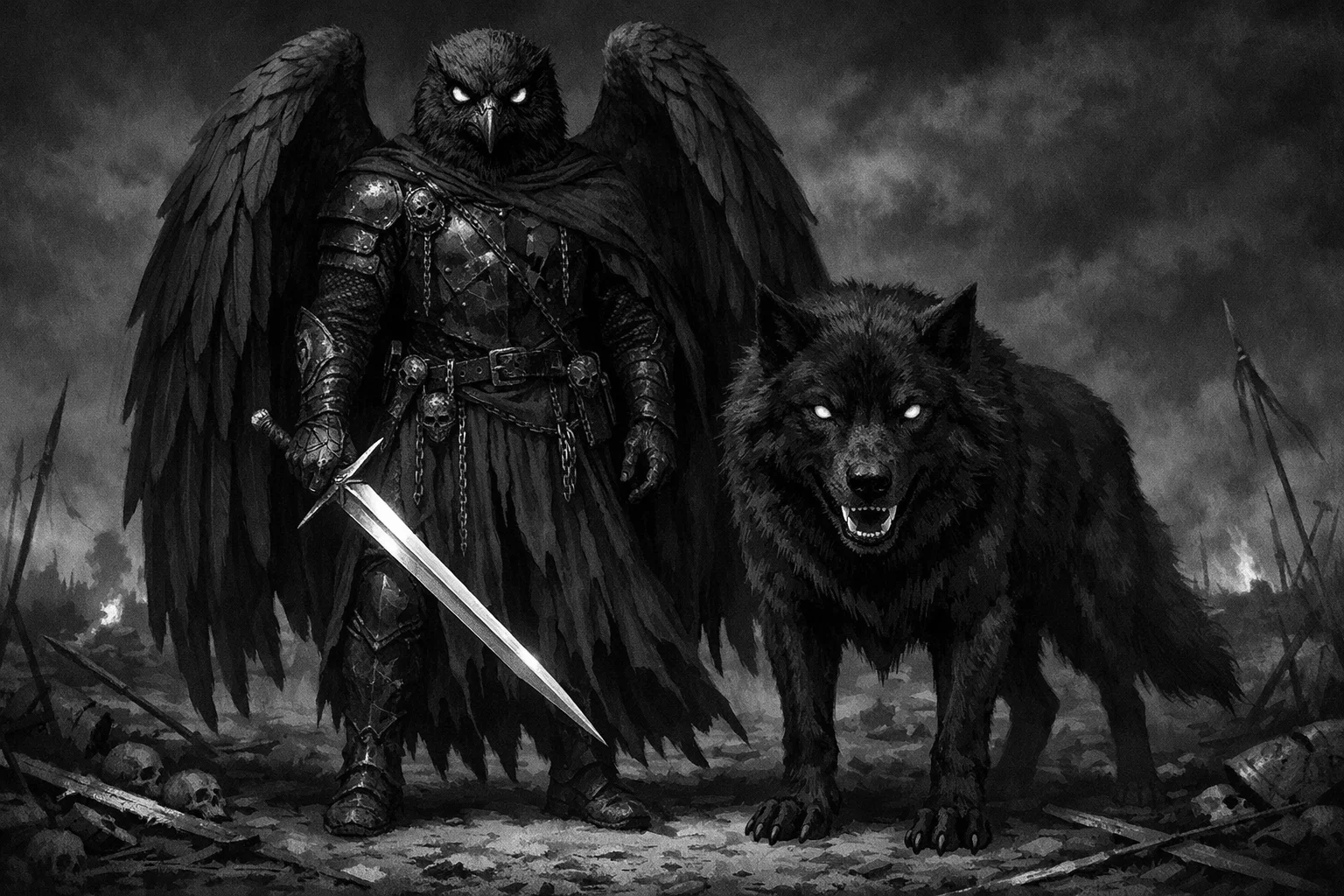
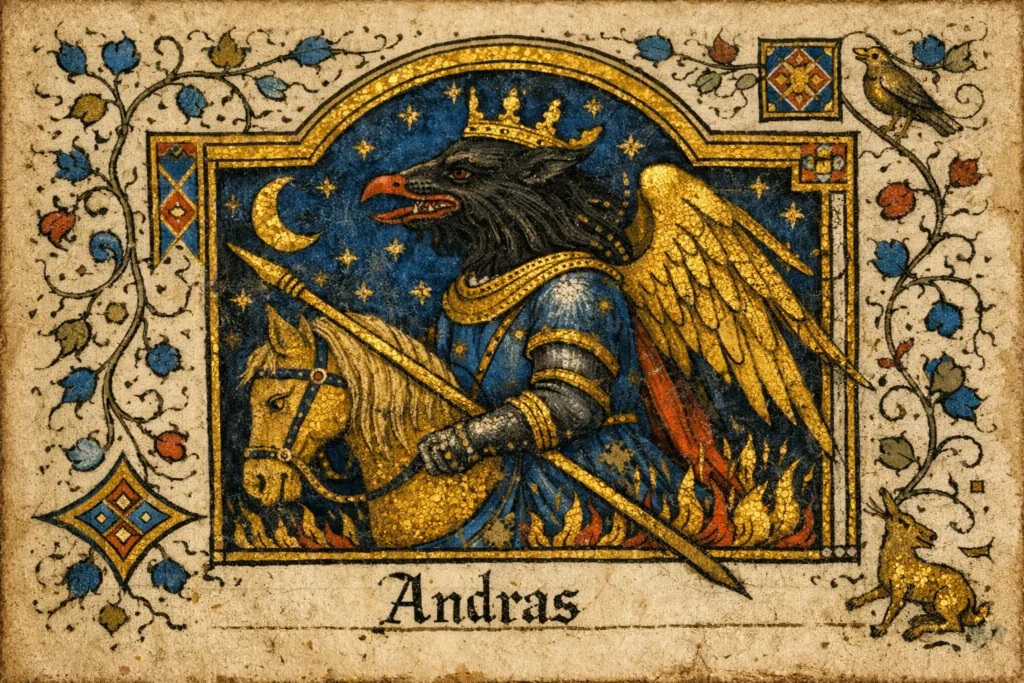
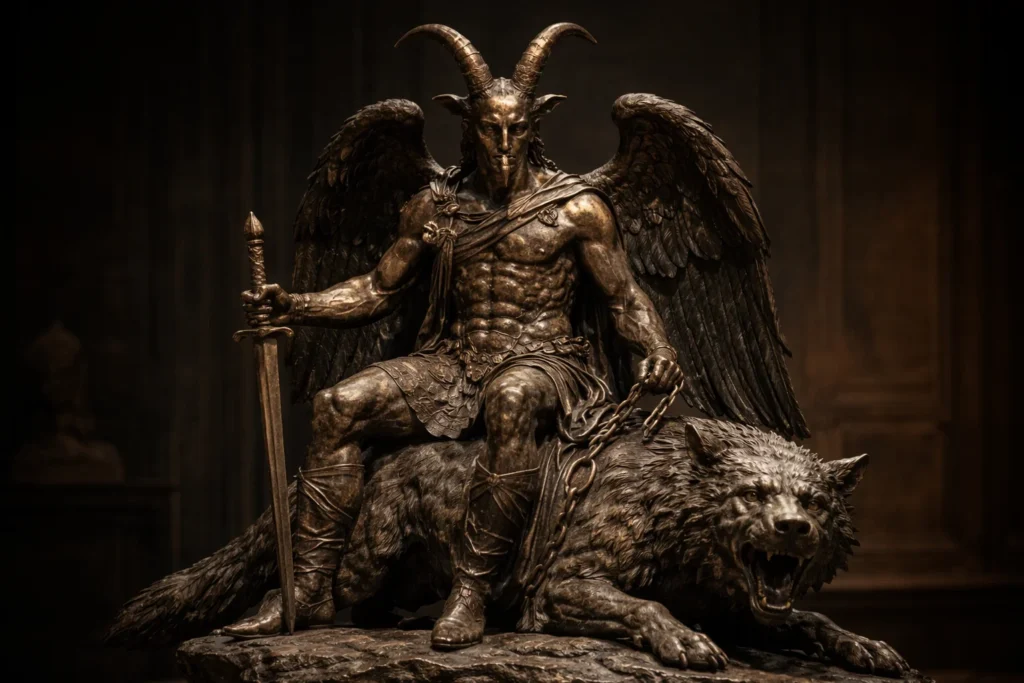
Many grimoires, especially the Dictionnaire Infernal, describe Andras as appearing like an angel with the head of an owl or a large raven. This mix of a winged human body and a bird of prey’s head shows his deceptive and unsettling nature.
Andras is usually shown riding a powerful black wolf, which stands for his wild and fierce nature. He has a sharp, bright sword, showing both his rank and his role in causing bloodshed. Some sources say his sword is always drawn, meaning he is always ready for battle and never seeks peace.
Origins
Andras’s story is mostly connected to the growth of European demon lists during the late Middle Ages and the Renaissance.
Medieval Development
The first clear mentions of Andras are from the 16th century. He was listed in Johann Weyer’s Pseudomonarchia Daemonum (1577), which was an appendix to Weyer’s book about demon illusions. Weyer described Andras as a great marquis with an owl’s head, a wolf to ride, and a sword—traits that have defined him ever since.
You may also enjoy:
Hitotsume kozō: One-Eyed Yōkai of Japanese Folklore
February 4, 2026
What Is a Rakshasa? Meaning, Origins, and Dark Powers
January 23, 2026
Yuki Onna: The Terrifying Demon Bride Who Feeds on Travelers
December 9, 2025
Who Is Taṇhā, the Seductive Demon of Craving in Buddhist Mythology?
October 15, 2025
Who Is the Infernal King Balam? Origins, Powers, and Occult History
February 26, 2026
Who Is Abalam in Demonology? The Terrifying King That Serves Paimon
September 30, 2025
The Solomonic Tradition
After Weyer, Andras was added to the Lesser Key of Solomon (the Ars Goetia) in the 17th century. At this time, he was firmly set as the 63rd spirit and said to command 30 legions. This period also marked a shift toward a more organized view of Hell, with Andras given specific roles in its hierarchy.
Was Andras Ever Mentioned in the Bible?
Andras is not named or described anywhere in the Bible, including the Old and New Testaments and the Apocrypha. He comes from later occult traditions and grimoires that built on biblical ideas about fallen angels and demons.
Andras in Grimoires and Other Texts
Andras appears often in the most important Western occult books. These texts give details about his rank and actions.
| Source | Quote |
| Pseudomonarchia Daemonum | Andras is a great marquesse, and commeth in an angels shape with a head like a blacke night raven, riding upon a blacke and a verie strong woolfe, flourishing with a sharpe sword in his hand: he can kill the maister, the servant, and all assistants, he is author of discords, and ruleth thirtie legions. |
| Ars Goetia | The Sixty-third Spirit is Andras. He is a Great Marquis, appearing in the Form of an Angel with a Head like a Black Night Raven, riding upon a strong Black Wolf, and having a Sharp and Bright Sword flourished aloft in his hand. His office is to sow Discords. If the Exorcist have not a care, he will slay both him and his fellows. He governeth 30 Legions of Spirits. |
| Dictionnaire Infernal | Grand marquis des enfers. On le voit avec le corps d’un ange, la tête d’un chat-huant, à cheval sur un loup noir et portant à la main un sabre très-effilé. Il apprend à ceux qu’il favorise à tuer leurs ennemis, leurs maîtres et leurs serviteurs; c’est lui qui élève les discordes et les querelles. Il commande trente légions. |
Powers and Abilities
Andras’s powers focus on breaking social harmony and causing harm. His main ability is to start discord. This goes beyond simple arguments—he is said to supernaturally push people from small disagreements into major conflicts. When he is involved, people lose the ability to reason and are driven to become enemies.
Besides influencing the mind, Andras is said to teach people how to kill. Old texts claim he gives his followers both the knowledge and the drive to destroy their enemies, masters, or servants. This makes him an entity for assassins or anyone wanting to solve problems with violence. He does this by removing a person’s moral limits and replacing them with a violent urge to destroy their opponent.
Importantly, Andras is known for being able to kill the exorcist. This is rare among Goetic spirits. While many demons are hard to control, Andras is especially feared because he can destroy the person summoning him and anyone helping. This deadly trait means rituals must be done with extreme care.
You may also enjoy:
Ifrit: Demon of Fire Who Serves Iblis in Islamic Tradition
September 30, 2025
Alû: The Mesopotamian Demon of Malevolence and Pestilence
November 10, 2025
Banasura: The Thousand-Armed Demon King
October 10, 2025
Kuchisake-onna: Folklore, Origins, and Urban Legend History
February 10, 2026
Agubanba: The Ash-Born Demon of Japanese Folklore
October 23, 2025
Aim (Aym): The Great Duke of Hell in the Ars Goetia
November 11, 2025
Myths, Legends, and Stories
The Warning of Johann Weyer in Pseudomonarchia Daemonum
In his important book, Johann Weyer warns readers about Andras. Weyer says Andras is not just a passive spirit to be controlled. Instead, stories about him show that he is actively malicious.
Weyer writes that when Andras is summoned, he shows up with his sword raised, ready to threaten. He calls Andras the “author of discords,” meaning he is behind many fights that end in violence. Weyer’s story highlights the danger to the summoner, showing Andras as a predator who sees the summoner as a possible victim, not a master.
UNLOCK THE FORBIDDEN KNOWLEDGE OF DEMONS. Limited-Time: Up to 29% OFF!
The Encyclopedia of Demons & Demonology 400+ entries • Real history • Exorcisms & Ancient Evils • Possession • Terrifying photos. This is Rosemary Ellen Guiley’s masterpiece of the occult.
The Role of Andras in the Dictionnaire Infernal
Collin de Plancy’s Dictionnaire Infernal adds to Andras’s legend by showing him as a teacher of violence. The book says Andras “favors” some people by teaching them how to kill those in power over them, like masters or bosses.
This view shows Andras as a force of chaos and rebellion, trying to upset society through acts of violence. The stories describe him as a wandering spirit who, when he finds someone open to his influence, encourages rebellion and murder.
Andras vs Other Christian Demons
| Demon Name | Associated Sin/Temptation | Rank/Origin | Key Traits/Powers |
| Asmodeus | Lust | King (Ars Goetia) | Breaks marriages, teaches math/astronomy. |
| Belial | Lawlessness | King (Ars Goetia) | Grants senatorships, creates civil strife. |
| Beelzebub | Gluttony | Prince (Hierarchy of Hell) | Lord of the Flies, breeds false belief. |
| Pazuzu | Famine/Plague | King (Mesopotamian/Christian) | Brings drought, controls locusts. |
| Bael | Greed/Ambition | King (Ars Goetia) | Grants invisibility, commands 66 legions. |
| Astaroth | Sloth | Grand Duke (Ars Goetia) | Teaches liberal sciences, knows the fall. |
| Paimon | Pride | King (Ars Goetia) | Teaches arts and sciences, binds will. |
| Leraje | Conflict/War | Marquis (Ars Goetia) | Causes battle wounds to putrefy. |
| Flauros | Destruction | Duke (Ars Goetia) | Burns enemies, knows the creation. |
| Marchosias | False Hope | Marquis (Ars Goetia) | Fights well, was of the Order of Dominations. |
| Furcas | Cruelty | Knight (Ars Goetia) | Teaches philosophy, logic, and chiromancy. |
| Abaddon | Destruction | King of the Abyss (Revelation) | Commands locust army, symbolizes death. |
| Mammon | Avarice | Prince (Binsfeld’s Class.) | Incites greed for material wealth. |
| Leviathan | Envy | Grand Admiral (Hierarchy of Hell) | Symbolizes chaos of the sea, incites envy. |
Rank in the Hierarchy of Hell
Andras is ranked as a Great Marquis of Hell. In the system described by occultists in the 16th and 17th centuries, a Marquis is a middle rank—below Kings and Dukes, but above Earls and Knights. Andras commands 30 legions of spirits, which are groups of lesser demons who spread discord on his orders.
Andras’s relationships with other demons are also full of conflict, just like his dealings with humans. He serves the higher Kings of Hell, but is often seen as unstable among the other demons.
Unlike demons like Astaroth or Belial, who use politics or philosophy to corrupt, Andras is a straightforward force of chaos. He is often linked with other warlike demons such as Flauros or Leraje. Still, his tendency for random violence makes him a danger even among his peers. He is the “raw nerve” of Hell’s aggression, starting wars and internal fights.
Mystical Correspondences
| Attribute | Details |
| Planet | Moon |
| Zodiac Sign | Sagittarius |
| Element | Fire |
| Direction | East |
| Color | Violet or Black |
| Number | 63 |
| Crystal/Mineral | Silver (linked to the Moon) |
| Metal | Silver |
| Herb/Plant | Hellebore |
| Animal | Wolf, Owl, Raven |
Andras’s link to the Moon is unusual, since the Moon usually stands for hidden or subconscious things. For Andras, it fuels sudden violent outbursts. Many sources connect Marquis demons to the Moon, but Andras uses this influence to stir up emotions, causing madness and rage. He is also tied to Sagittarius and the element of Fire, which highlight his quick, fierce attacks and the fiery nature of his chaos.
These connections help explain his chaotic nature in a cosmic way. In his rituals, the East, which usually means new beginnings, is turned around to tell the start of a new conflict. Silver, his main metal, stands for the sharpness of his sword and his cold, relentless malice. All these elements show him as a force of quick, cold, and fiery destruction.
Andras’ Sigil
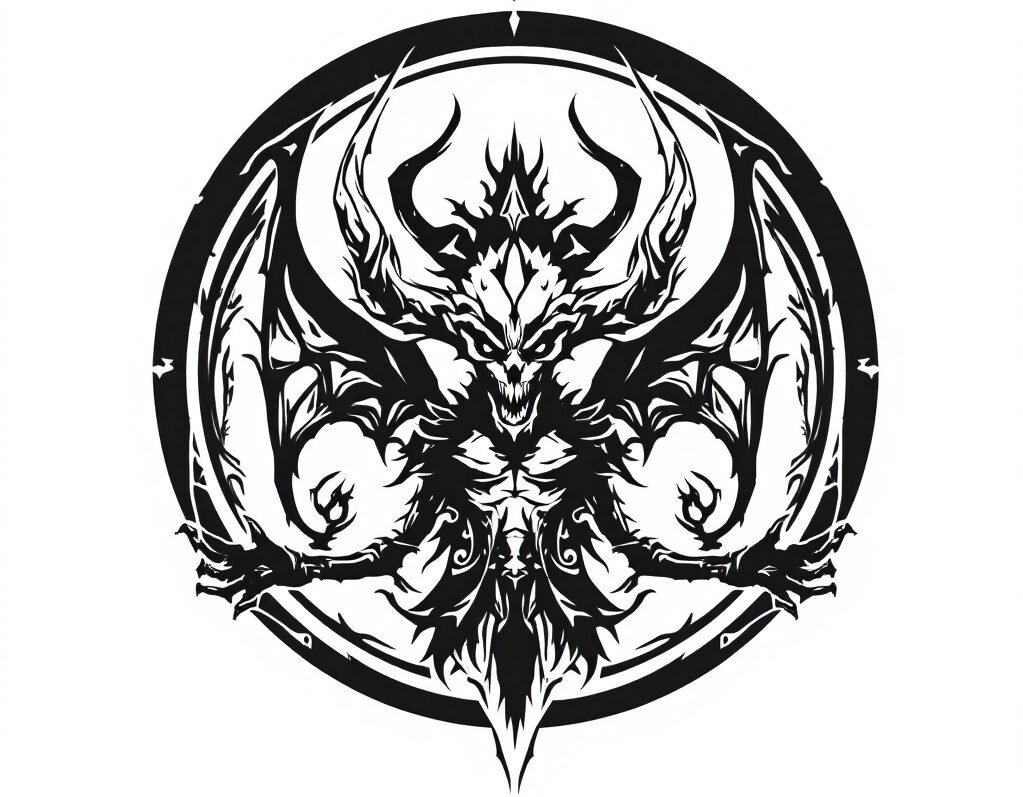
The Sigil of Andras is a detailed geometric symbol that stands for the demon’s essence and helps focus during summoning. In Goetic tradition, the sigil is like a signature or a spiritual phone number. People believe the demon is tied to his sigil by the power of Solomon’s seals.
In the past, the sigil was carved onto a silver lamen because silver matched his Marquis rank. The person performing the ritual would wear this lamen around their neck for protection and to show control over the spirit. Without the sigil, people believed Andras would not have to appear or obey, and might kill the summoner right away.
THE BOOK THEY BANNED FROM THE BIBLE Limited-Time: Up to 90% OFF!
Why was Enoch removed? The fallen Watchers • The birth of the Nephilim • Origin of demons • Names of the angels who became demons • Apocalyptic visions. The original source text that inspired all demonology. Read the apocalyptic visions the church didn’t want you to see.
Summoning and Rituals
Summoning Andras was always seen as one of the riskiest acts in ceremonial magic. These rituals, found in books such as the Ars Goetia, were usually performed by expert occultists or magicians. The main goal was often to destroy an enemy or create a permanent split between people.
These rituals took place inside a blessed magic circle for protection. Since Andras was known for killing the summoner, people took extra care, often saying long lists of strange names or prayers to control his aggression. They also used items like black wolf skin or bird feathers to match his appearance.
Still, even with all these precautions, the texts warn that Andras is so dangerous that any mistake or break in the circle could mean instant death for everyone involved.
You may also enjoy:
Ammit: Devourer of the Dead in Ancient Egyptian Mythology
November 10, 2025
Who Was Ravana in Hindu Mythology and Why Was He Feared?
October 3, 2025
Who Is Ariton, the Infernal King of the Eastern Gate?
February 17, 2026
Aeshma: The Zoroastrian Demon of Wrath and Fury
January 13, 2026
Banasura: The Thousand-Armed Demon King
October 10, 2025
Iblis, the Jinn King of Darkness and Deception
September 29, 2025
Frequently Asked Questions (FAQ)
What is the specific day and time associated with the demon Andras?
In modern occult practices, Andras is linked to the time between January 30 and February 3. He is seen as a Night Demon, and rituals to contact or control him are said to work best at night during these dates.
Is Andras mentioned in modern popular culture or media?
Yes, Andras shows up in many modern media, often keeping his Goetic look. He is a frequent enemy in the Shin Megami Tensei and Persona video games, usually shown with an owl’s head. He also appears as a villain in the comic Promethea by Alan Moore. He is the main demon in the novel and movie My Best Friend’s Exorcism.
What is the connection between Andras and the Angel Anauel?
In the Shem HaMephorash system, each Goetic demon has an opposing angel. Andras’s opposite is the Angel Anauel, who is part of the Archangels. While Andras causes conflict and violence, Anauel is said to bring unity, protect people, and help with business, balancing out Andras’s chaos.
Does Andras have a specific Tarot card correspondence?
In the Golden Dawn’s system, Andras is connected to the Six of Swords Tarot card. This card usually means change or leaving conflict behind, but in Goetic terms, it shows the subtle way Andras creates discord and leads things toward destruction.
What is the significance of the owl’s head in Andras’ appearance?
The owl’s head stands for silent hunting and twisted wisdom. Unlike Athena’s owl, which means wisdom, Andras’s owl head shows the ability to see into the darkness of human evil. It represents a being that waits for the right moment to attack when society is weakest.
