Today, many people see supernatural beings as just folklore, but the Bhoota is more than that. It acts as a link between the physical world and a state of transition. The Bhoota is not just a typical ghost; it represents the idea of ‘unresolved existence,’ where the usual cycle of life, death, and rebirth (Samsara) has been interrupted.
The Bhoota is different from the Preta, which is known for endless hunger and karmic debt. Instead, the Bhoota is tied to the pancha bhoota, or five elements, showing a state where the soul remains connected to the physical world through the elements it could not let go of.
My article is largely based on translations of the Garuda Purana and the Atharva Veda to trace how the idea of the Bhoota changed from ancient times to the Puranic era. By looking at how Bhootas shifted from being seen as Vedic threats to attendants of Shiva, this entry offers a scholarly view of their changing role in Hindu cosmology. [View Full Bibliography ↓]
Summary
Key Takeaways
| Attribute | Details |
| Names | Bhoota, Bhuta, Bhut, Bhutam |
| Title | Earthbound Spirit, Elemental Revenant |
| Gender | Variable; may manifest as male, female, or genderless |
| Role | Guardian of the wild, bringer of disease, or restless ancestor |
| Clan | Gana (attendants of Shiva) |
| Followers | Pretas, Pisachas, and other lower-order spectral beings |
| Powers | Invisibility, shape-shifting, possession, and illusion (Maya) |
| Appearance | Often shadow-like, casting no reflection, or appearing with backward-turned feet |
| Etymology | Derived from the Sanskrit root ‘bhu’ (to be, to become, or what has passed) |
| Associated Figures | Lord Shiva (Bhuteshvara), Parvati, and the Saptarishi |
| Weaknesses | Holy ash (Vibhuti), iron, specific mantras, and turmeric |
| Opposing Deva/Avatar | Shiva (as the controller) and Hanuman (the protector) |
| Pantheon | Hindu, with significant integration into regional Dravidian folk traditions |
| Primary Sources | Garuda Purana, Atharva Veda, and various Agamas |
Who or What is the Bhoota?
In Hindu cosmology, Bhootas are supernatural beings made up of the spirits of people who have died but have not yet moved on to the world of the ancestors (Pitru Loka).
These spirits are usually seen as restless souls whose deaths were sudden, violent, or happened without the proper funeral rites. As a result, they stay trapped in the earthly world, existing in a subtle body made from the lower elements.
More broadly, Bhootas are also seen as messengers of Lord Shiva, especially in his form as Bhuteshvara, the Lord of Spirits. In this role, they are not just evil ghosts but part of the cosmic order, reminding people of how fragile life is and the importance of proper rituals.
In Buddhist beliefs, similar spirits appear as restless beings who need to be calmed or guided to the Dharma, often called ‘hungry ghosts’ or spirits of the forest.
“Bhoota” Meaning
The word ‘Bhoota’ comes from the Sanskrit root’ bhū,’ meaning ‘to be’ or ‘to become.’ As a past participle, it means ‘that which has been’ or ‘the past.’
This is important because it shows that a Bhoota is defined by its previous existence, not its current state. In Vedic science, the word also refers to the Pancha Bhoota, the five main elements: Earth (Prithvi), Water (Apas), Fire (Agni), Air (Vayu), and Ether (Akasha).
Over time, the word came to mean spirits who have lost their physical bodies but remain composed of the subtle forms of the five elements. In regional languages like Hindi, Marathi, and Kannada, the term became ‘Bhut’ or ‘Bhoot,’ which now means a ghost or evil spirit.
In the Agamas, the meaning of Bhoota also includes a group of beings that are neither human nor divine and often live in the ‘in-between’ spaces of the universe. Unlike Rakshasas, who are seen as a separate race in myths, Bhoota refers to a particular state of the soul.
How to Pronounce “Bhoota” in English
In English, ‘Bhoota’ is pronounced as BOO-tuh. The first part sounds like ‘too’ or ‘shoe,’ with a soft ‘B’ sound. The second part is a short ‘uh,’ like at the end of ‘sofa.’ In everyday speech, especially in Northern India, it is often shortened to ‘Bhoot,’ pronounced like ‘boot’ but with a breathy ‘B.’
What Does the Bhoota Look Like?
Descriptions of Bhootas differ a lot between Sanskrit texts and local stories.
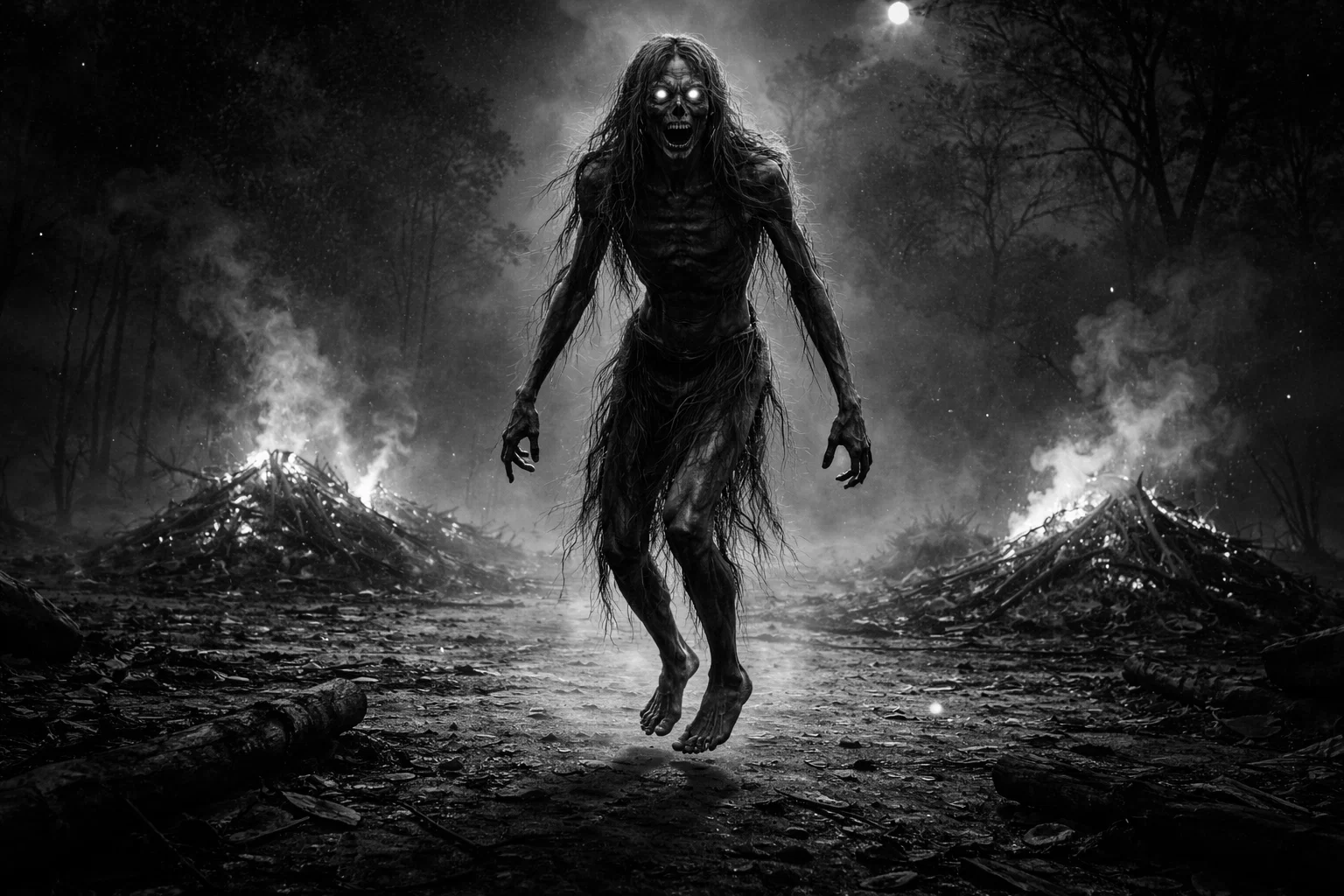
In the Puranas, they are often shown as ghostly, smoke-like beings without a solid form, but they can appear scary when they want to frighten people. They are usually described as pale or gray, showing they lack blood and life. In Indian folklore, one common feature is their backward-turned feet, which shows they are the opposite of normal humans.
These beings are also said to cast no shadow and to float just above the ground, rather than touching it. This shows they do not truly belong to either the world of the living or the world of the dead.
In some stories, they have glowing, coal-like eyes and long, messy hair. When they appear in a more elemental form, they might look like flickering lights, similar to will-o’-the-wisps, or as large, changing shapes.
Origins
The history of the Bhoota begins in the Atharva Veda, where they are mentioned alongside other supernatural beings such as the Pisachas and the Kshatras. These early texts see them as dangers in the environment—beings that live at crossroads, cremation grounds, and lonely trees. They can cause madness or illness.
Over time, the idea of Bhootas shifted from general spirits to a part of Saivite theology. In the medieval Puranic period, they became part of Lord Shiva’s group. This meant they were no longer just random spirits but a special class that serves Shiva.
Because of this, ‘Bhoota-Aradhana’ or spirit worship developed in parts of Southern India, where Bhootas are seen as protectors of the land rather than just as demons.
Birth
A Bhoota is not born like living beings, but comes into existence through Akaala Mrityu, or untimely death. The Garuda Purana explains that if someone dies by suicide, animal attack, accident, or if the Sapindikarana ritual is not done, the soul cannot get a new body.
Instead, it becomes a Bhoota, which is seen as a painful and frustrated state. The spirit is made from the subtle body, or linga-sharira, that does not dissolve into the universe.
Role in Hindu Cosmology
In the cycle of Dharma, Bhootas are seen as a kind of karmic blockage. Their existence temporarily stops the usual process of rebirth. They play an important role in keeping cosmic balance by collecting unresolved Karma. By haunting certain places or families, they often compel the living to fulfill unfulfilled duties or rituals, helping to restore Dharma.
Bhootas are usually seen as Tamasic beings, which means they are linked to darkness and inertia. Still, they are not ‘villains’ like in Western stories. Often, they are shown as tragic figures or followers of Shiva. The Bhagavata Purana says that even the scariest spirits can be freed by a deity’s grace, showing that their state is more like purgatory than eternal punishment.
The Liminality of the Five Elements
The way Bhootas are described shows a deep Vedic concern about how souls separate from the body. While Western ideas about ghosts often focus on ‘unfinished business,’ the Sanskrit tradition views Bhootas through the lens of metaphysical biology.
The main issue is that the physical body (sthula sharira) does not fully relinquish the subtle body (sukshma sharira). This creates a Bhoota, which is like a missing link in the cycle of reincarnation—a being that has the energy of life but not the body to use it.
Looking at the Pancha Bhoota, or five elements, these spirits are like ‘elemental leftovers.’ They show what happens when the earth, water, fire, and air in a person do not return to the universe, leaving the spirit stuck in a state of energy without movement.
This state is similar to the Greek idea of the asphodel meadows, but with a focus on the material world. In Hindu belief, moving from Bhoota to an ancestor (Pitri) requires the Sapindikarana ritual. Without it, the spirit stays trapped in the intermediate space, called Antariksha.
Symbolically, the Bhoota stands for what is left of a person’s identity after the body is gone. It is the ‘I’ that remains when the body fails. This is similar to the Vetala, but they are not the same.
The Vetala is a spirit that moves from body to body, like a guest in the house of death, while the Bhoota is like the house itself, refusing to disappear. This shows the idea that strong desires and memories can keep the self from moving on, even after death.
The connection between Bhootas and Lord Shiva as Bhuteshvara also challenges ideas about social and cosmic order. By making these restless and ‘unclean’ spirits the main followers of Shiva, the tradition shows that chaos is not opposed to the divine but is under its control.
This link also points to a history of being left out. Just as Bhootas are kept out of the world of ancestors, they stand for the ‘untouchables’ of the spiritual world.
By including them among Shiva’s followers, the tradition symbolically brings the rejected and chaotic into the cosmic order. So, the Bhoota is more than a ghost; it shows how thin the line is between life and death, a line upheld by rituals and the passage of time.
Bhoota Myths, Legends, and Stories
The Marriage Procession of Shiva
When Lord Shiva was to marry Parvati, he gathered his followers for the event. This was not a normal wedding party, but included the Ganas and many frightening beings from the cosmos.
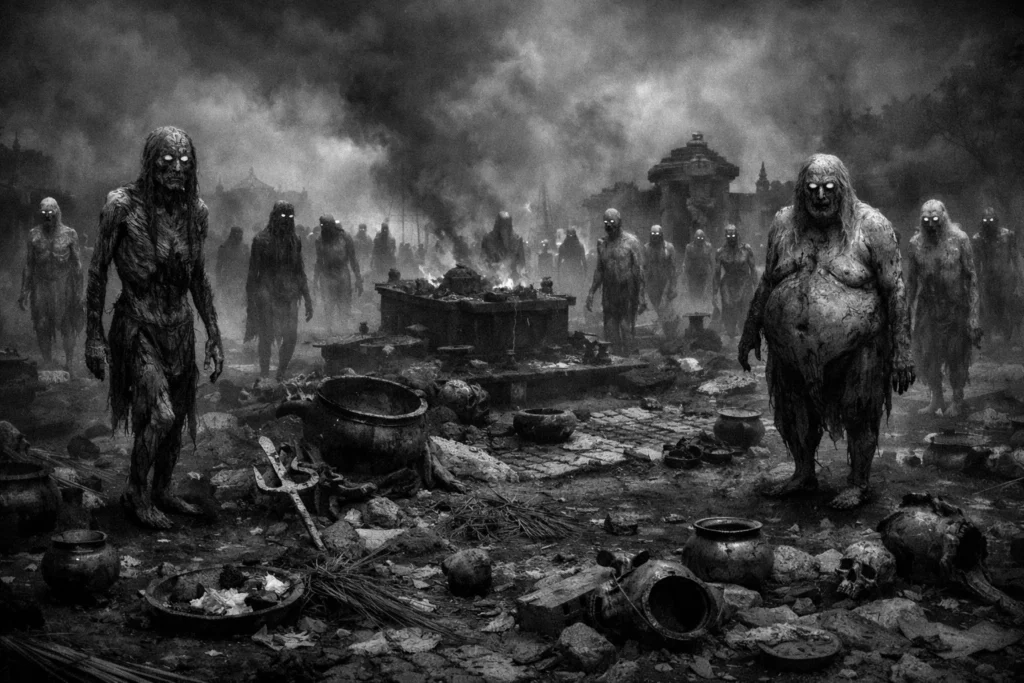
As they moved toward the mountains, thousands of Bhootas led the way. Some looked distorted, some had no heads, and they came in many colors—some were pitch black, others pale as ash. They carried skulls as bowls and wore snakes as jewelry.
Their loud shouts and drumming echoed through all three worlds. When the people of the mountain city saw this group, they were terrified. The story says the people cried, ‘Is this a wedding or the end of the world?’ Mothers hid their children, thinking the ghostly followers had come to harm the living.
Shiva, known as Bhutanatha, rode in the center, covered in funeral ashes and wearing elephant hide. This showed that even the most feared and restless spirits found their place and leader in him. The story highlights that even the most rejected and scary beings are an important part of the divine order.
The Origin of the Panjurli Spirit
In Tulu oral traditions, the goddess Parvati had a young wild boar as a pet and cared for it deeply. As the boar grew, it became more destructive and started ruining the heavenly gardens and fields.
Lord Shiva saw the damage and killed the boar to restore balance. Seeing Parvati’s sadness, Shiva did not let the animal simply die. Instead, he turned its spirit into a Bhoota called Panjurli.
Shiva told the spirit, ‘Go to the world of humans. You will no longer destroy crops; you will protect them. You will guard the good and punish thieves.’ In this way, the boar’s spirit became a Bhoota. It went to the coastal forests, where people began to worship it as an elemental god.
Even today, during Bhuta Kola rituals, people call on this spirit to help settle land disputes and protect village borders. This shows how the spirit changed from a wild animal to a disciplined guardian.
The King and the Vetal
As King Vikramaditya traveled through dark forests to the cremation ground, he felt surrounded by supernatural forces. The story says the trees were full of Bhootas hanging upside down like bats. As he walked, the spirits used their magic to create scary illusions—the ground looked like a river of blood, and the air was filled with strange, unsettling laughter.
The Bhootas guarded the area between the world of the living and the dead. They whispered to the king, trying to distract him from carrying the Vetal. In one story, a Bhoota blocked his way, appearing as a giant with flaming hair and backward feet.
The king was not afraid and spoke to the spirit with confidence, reminding it that its power was only temporary and limited by Karma. Seeing his strong will and role as a protector of Dharma, the spirits moved aside and let him pass into the burial grounds.
The Liberation of the Spirit
The Bhagavata Purana describes people who become Bhootas because of strong attachments at death. In one story, these spirits haunt empty places on earth, suffering in their ‘wind-body.’ This body lets them feel hunger and thirst, but they cannot eat or drink real food.
These spirits gather near places where the Puranas are read, hoping to hear even one word of the divine names. The text says that even a Bhoota, though trapped in darkness (Tamas), can be freed if it hears the sacred words of the Shrimad Bhagavatam.
When the spirit hears stories of Vishnu, its subtle body starts to dissolve, and it is given a ‘divine form.’ This lets it leave the earthly world and rise to higher realms. This shows that the Bhoota is not a permanent demon but a soul awaiting spiritual rescue.
Bhoota vs Other Similar Entities
| Asura Name | Associated Trait/Role | Clan/Origin | Key Traits/Powers |
| Ravana | Conquest and Ego | Rakshasa | Ten heads, immense Vedic knowledge |
| Bali | Sacrifice and Charity | Daitya | Righteousness, rule over Patala |
| Vritra | Drought and Obstruction | Danava | Dragon-like, blocking world waters |
| Hiranyakashipu | Tyranny and Hubris | Daitya | Invulnerability boon, hatred of Vishnu |
| Mahishasura | Shapeshifting and Deceit | Asura | Manifests as a buffalo, high combat skill |
| Andhaka | Blindness and Desire | Asura | Every drop of blood creates a clone |
| Rahu | Eclipse and Consumption | Asura | Severed head, swallows the sun/moon |
| Bhasmasura | Destruction and Greed | Asura | Turns anything he touches to ash |
| Madhu | Chaos (from earwax) | Asura | Born from Vishnu’s ear, primordial force |
| Narakasura | Filth and Imprisonment | Asura | Son of Bhudevi, hoarded 16,000 maidens |
Rank Among Asuras
Bhootas are lower in rank than the great Asura kings like Ravana or Bali. Asuras are powerful beings who fight the gods for control of the heavens, but Bhootas are a type of ghostly being.
They do not lead armies in the big battles of the Puranas; instead, they act as the foot soldiers of the night. Bhootas often live with Asuras in the lower worlds (Patala) or in the space between worlds (Antariksha). Higher demons often order them to possess people or spread fear.
Mystical Correspondences
| Attribute | Details |
| Planet | Saturn (Shani) and Ketu |
| Zodiac Sign | Scorpio and Capricorn |
| Element | Akasha (Ether) and Vayu (Air) |
| Direction | South (The direction of Yama) |
| Color | Ash-gray and Midnight Blue |
| Number | 8 (associated with Saturn and stability) |
| Crystal/Mineral | Black Tourmaline and Iron Ore |
| Metal | Lead and Iron |
| Herb/Plant | Banyan Tree (Ficus benghalensis) and Datura |
| Animal | Owl and Jackal |
| Trait/Role | Restlessness, Protection, and Transition |
These spirits are mainly linked to the planet Saturn, which rules over time, death, and Karma.
Saturn’s slow and cold energy matches the ‘frozen’ state of a spirit stuck between worlds. Ketu, the south node of the moon, is also important as it represents disembodiment and spiritual freedom, often shown as the ‘headless’ state of many spirits. These planetary connections show that Bhootas are beings of transition and consequence.
Bhootas are most closely linked to Ether and Air, the two elements without weight. This is why they can move through walls and travel with the wind. Their connection to the South ties them to Yama, the god of death. In rituals, people use iron or holy ash (which symbolizes the end of the fire element) to create barriers that spirits cannot cross.
You may also enjoy:
Aeshma: The Zoroastrian Demon of Wrath and Fury
January 13, 2026
Who Is Baal in Christian Demonology?
February 25, 2026
Amaymon: The Infernal King Who Commands Death and Decay
November 17, 2025
Palden Lhamo: The Black Goddess of Blood and Protection
October 20, 2025
Who Was Hiranyakashipu, the Demon King of Hindu Mythology?
October 6, 2025
Andrealphus: The Peacock Demon Who Twists Minds and Bodies
January 19, 2026
Bibliography
Author’s Note: What’s fascinating about this strange entity is the strong contrast between the strict rituals described in the Garuda Purana and the more flexible stories in the Katha Sarit Sagara, especially in how a restless spirit becomes free. The Vedas and Brahmanas explain the elements of the subtle body. Still, by carefully comparing translations of the Siva Purana, I saw that Bhootas are not just ordinary ghosts. Instead, they remind us of the importance of completing rituals. To make sense of the different descriptions in the Ramayana and local traditions, I focused on the main Sanskrit texts rather than modern summaries.
- Naunidhirâma. The Garuda Purâna (Sâroddhâra). Translated by Ernest Wood and S. V. Subrahmanyam, edited by Major B. D. Basu, AMS Press, 1974. Internet Archive.
- Shastri, J. L., editor. The Siva-Purana, Part 1. Translated by a Board of Scholars, Motilal Banarsidass, 1970. Internet Archive.
- Shastri, J. L., editor. The Śiva-Purāṇa: Part 2. Translated by a Board of Scholars, vol. 2, Motilal Banarsidass, 1970. Ancient Indian Tradition and Mythology. Internet Archive.
- Besant, Annie, and Bhagavan Das, compilers. The Vedas and Brahmanas. Theosophical Publishing House, 1912. Internet Archive.
- Shastri, J. L., editor. The Siva-Purana, Part 4. Translated by a Board of Scholars, Motilal Banarsidass, 1970. Internet Archive.
- Goyandka, C. L., editor. The Bhagavata Purana. Translated by a Board of Scholars, Gita Press, 2019. Internet Archive.
- Somadeva Bhatta. The Katha Sarit Sagara; or, Ocean of the Streams of Story. Translated by C. H. Tawney, vol. 1, Baptist Mission Press, 1880. Internet Archive.
- Witzel, Michael. Brahmanas. Academia.edu.
- Dutt, Romesh C., translator. The Ramayana: The Epic of Rama, Prince of India. Condensed into English Verse, 1899. Ancient Buddhist Texts, edited by Ānandajoti Bhikkhu, 2018.
- Dutt, Manmatha Nath, editor and translator. The Rāmāyana, Volume 4: Uttara Kānda. Edited by James Simmons, Project Gutenberg, 2020. Project Gutenberg. Originally published in Calcutta, 1894.
- Ganguli, Kisari Mohan, translator. The Mahabharata of Krishna-Dwaipayana Vyasa. Edited and published by Pratap Chandra Roy, Bharata Press, 1883-1896. Internet Archive.