
The Palis is a lesser vampiric Jinn primarily associated with the desert regions, distinguished by its practice of draining blood from sleeping individuals.
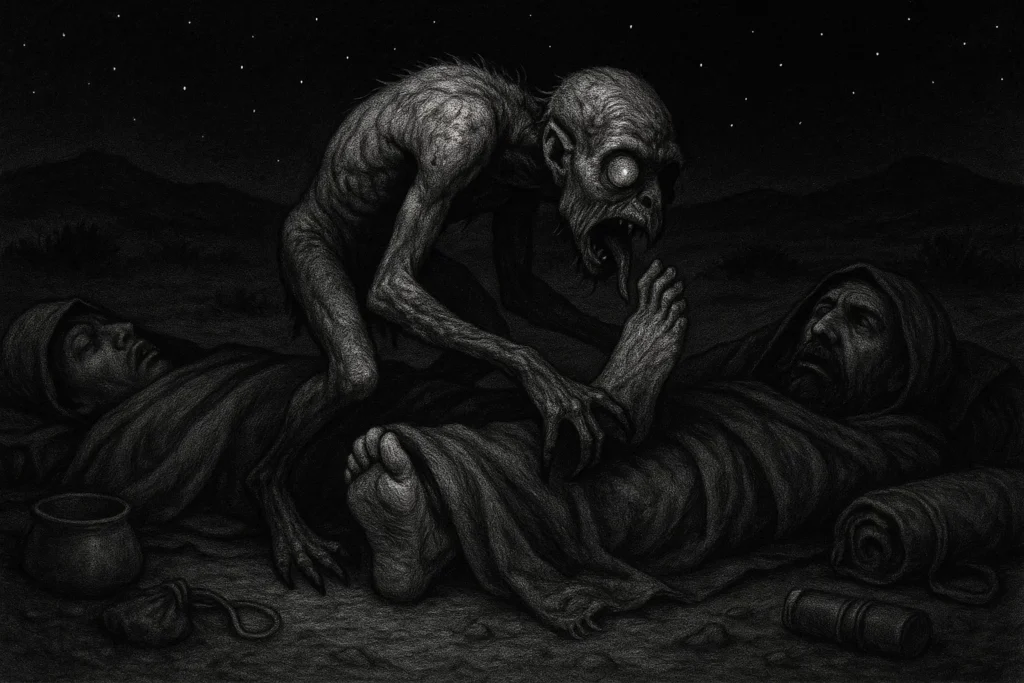
According to lore, it is said to exhibit low intelligence and is often described as a foot-licker. This entity attacks people while they sleep, focusing on the soles of the feet to consume blood.
It is believed that the Palis can be easily outwitted, with a common defense strategy involving two people sleeping with their feet touching or with one person’s feet positioned under the other’s head.
Summary
Key Takeaways
| Attribute | Details |
| Names | Palis (primary), Pālis (variation) |
| Type | Lesser Jinn (due to low intelligence and limited scope of power), also associated with Shayāṭīn (devils) due to malign nature. |
| Title | None |
| Gender | Male (implied in some narratives, but generally unspecified or ambiguous). |
| Servitors | None |
| Superior Jinn | None, but generally subordinates to Iblīs as a type of Shayṭān. |
| Powers | Vampirism (draining blood by licking), invisibility (common jinn trait), ability to induce deep sleep (implied for attack). |
| Appearance | Vague and anthropomorphic. Often described as a humanoid creature with low physical stature and sometimes with animalistic features or a singular eye (associated with similar desert entities). |
| Etymology | Possibly linked to the root P-L-S which may relate to soles or licking in a regional dialect. |
| Associated Figures | Other vampiric or low-intelligence desert jinn such as the Ghul. |
| Weaknesses | Low intelligence (easily deceived), physical positioning (sleeping foot-to-foot), potentially repelled by general Islamic protective prayers (e.g., Ayat al-Kursī). |
| Opposing Holy Figure | Generally opposed by the Prophet Sulaymān (Solomon) and Archangel Jibrīl (Gabriel) as figures who counter all Jinn/Shayāṭīn. |
| Social Structure or Tribe | Solitary Jinn or low-ranking follower within the general hierarchy of the Shayāṭīn. |
| Followers/Tribe Size | None. Solitary or operates in small, loose groups (no command structure). |
| Primary Sources | Arabian folklore, regional oral traditions (especially in parts of the Arabian Peninsula and North Africa). |
Who or What is Palis?
The Palis is an entity embedded in Arabian and Middle Eastern folklore, specifically categorized as a type of lesser Jinn or a creature akin to a low-level demon (Shayṭān).
It is consistently portrayed as a malign entity whose primary activity is the consumption of human blood. Its unique method of attack involves targeting sleeping individuals and draining the blood by licking the soles of their feet.
This specific, non-violent, and highly localized form of vampirism distinguishes it from more powerful and overtly aggressive Jinn types like the Ifrīt or Ghul. The consensus across various regional accounts focuses on the low intellectual capacity of the creature, making it vulnerable to simple stratagems and tricks, which is a key defining characteristic of this entity.
1,000+ SPIRITS, GODS & GODDESSES AWAITING YOUR CALL. Limited-Time: Up to 49% OFF!
The ultimate global spirit encyclopedia – 2,000+ entries from every culture on Earth. Fairies • Djinn • Demons • Loa • Angels • Deities • Ancestors Real names • True offerings • Ancient rituals that actually work. Judika Illes’ legendary masterwork – the one book every serious witch, mage, and spirit-worker owns.
“Palis” Meaning
The precise etymological origin and meaning of the name Palis is not documented in major classical Islamic or Arabic lexicographical works. As the entity primarily exists within regional oral traditions and lesser-documented folklore, its name may be derived from a highly localized or archaic dialect.
One speculative, though unverified, theory links the name to a word root denoting licking or a term related to the sole of the foot (fī l-qadam or similar regional terms), reflecting its signature attack method.
The absence of the name in classical literature, such as the Lisān al-‘Arab, or in canonical religious texts, suggests that the term is either a later cultural invention or a survival of a pre-Islamic tribal appellation that was never formally integrated into the broader Islamic theological or literary framework of Jinn classification.
When it comes to regional folklore, the name simply serves as a proper noun to identify this specific type of foot-licking, blood-draining nocturnal creature. Any variations of the name, such as Pālis, are usually merely linguistic transcriptions reflecting differences in regional pronunciation or transcription from the oral tradition rather than distinctions in the entity itself.
How to Pronounce “Palis” in English
The common English pronunciation for Palis, based on standard transliteration, is “PAH-lis”. The initial “P” is pronounced as in the English word “pet,” and the emphasis is placed on the first syllable. In contrast, the “A” is typically pronounced with a short ‘a’ sound.
What Does Palis Look Like?
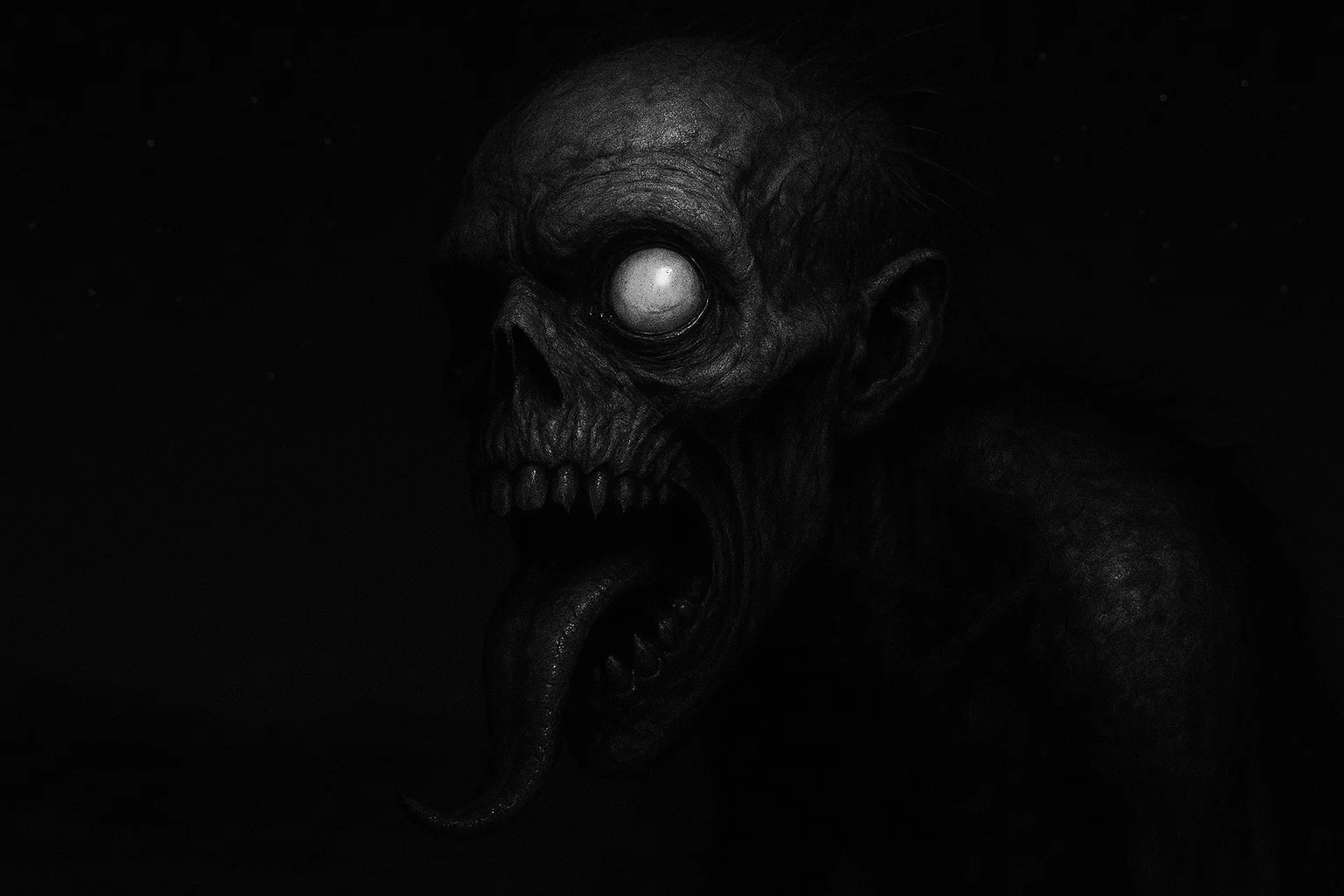
Descriptions of the Palis are generally vague and inconsistent across folklore, focusing more on its actions than its specific form, a common characteristic for lesser Jinn. However, certain common elements recur. The Palis is typically conceived as a creature of low stature, often described as small or stunted, which allows it to approach sleeping victims unnoticed.
It is frequently portrayed as anthropomorphic, possessing a basic humanoid shape, but with definite monstrous or animalistic characteristics. Some accounts describe a singular eye (similar to other desert monsters like the Dajjal in some folk descriptions) or a grotesque, wide mouth suitable for the licking action it performs.
Its body may be depicted as gaunt or desiccated, reflecting its desert habitat and its need for sustenance through blood. In some retellings, it may possess hair or fur and sometimes claws, further blurring the line between a Jinn and a beast.
Unlike major Jinn—like the Ifrīt (associated with fire), this lesser entity doesn’t have a distinctive material composition described. It usually appears as a shade (or corporeal form) in the desert night.
You may also enjoy:
Akateko: The Bloody Hand Ghost That Guards a Cursed Temple Tree
November 14, 2025
What Is Jorōgumo? The Deadly Spider Woman of Japanese Myth
February 2, 2026
Who Is the Demon Andras, The Great Marquis of Discord?
January 15, 2026
Alû: The Mesopotamian Demon of Malevolence and Pestilence
November 10, 2025
What Is Qarin and Why Does It Follow Every Human Being?
October 8, 2025
Ambri: The Imperial Duchess of Caspiel’s Empire
December 1, 2025
Origins
The origins of the Palis are deeply embedded in the oral traditions of pre-modern desert-dwelling peoples in Arabia and North Africa.
These narratives often feature creatures that personify the dangers and anxieties of the harsh, isolated, and frequently deadly desert environment. The earliest documented appearances are difficult to pinpoint because it to absent from major classical texts.
It likely originated as a localized tribal belief—a way to explain nocturnal sickness, unexplained weakness (anemia), or sudden death that might occur during sleep in remote areas, attributing the affliction to a stealthy, low-cunning entity.
Before the widespread integration of formal Islamic theology, the Arabian Peninsula was rich with beliefs in various nature spirits, genies (Jinn), and demons (ghūl).
Creatures like the Ghul, a grave-haunting, flesh-eating Jinn, share the malign, solitary nature and low intelligence with the Palis, suggesting they may have evolved from a common substratum of desert demonology. When Islam arrived, it reframed these indigenous spirits.
The most powerful and malign of these were either absorbed into the general category of Shayāṭīn (devils, followers of Iblīs) or classified as lesser, more regional types of Jinn.
The Palis, with its specialized, non-cosmic threat and easily defeated nature, was never granted the theological importance of an Ifrīt or a Qarīn but was assimilated as a minor, easily thwarted threat within the broader Islamic framework of supernatural creatures.
BREAK THE TOUGHEST DEMONIC BONDAGE! Limited-Time: Up to 41% OFF!
Real-life deliverance secrets from Apostle Alexander Chisango – straight from the front lines in Africa. Generational curses • Witchcraft • Sexual bondages • Addiction strongholds. Step-by-step keys that actually work when everything else has failed. Hundreds set free – your breakthrough starts here!

Was Palis Ever Mentioned in the Quran or Hadith?
This lesser Jinn is not mentioned in the Quran or the canonical Hadith collections. References in these foundational Islamic texts are typically reserved for the major classes of Jinn, such as the Jinn collectively, the arch-demon Iblīs (Shayṭān), and occasional mention of the ‘Afārīt (a powerful class of Jinn/Shayāṭīn).
Palis in Other Texts
The creature is not mentioned in the key occult and magical grimoires of the Islamic world, such as the Shams al-Ma’ārif or works of al-Būnī. These texts primarily focus on the more powerful and commanding classes of Jinn and Shayāṭīn, which can be summoned, bound, or commanded for magical operations.
Its low intelligence likely made it unsuitable for inclusion in these complex works of ceremonial magic, which typically seek entities that offer knowledge, power, or servitude.
Powers and Abilities
The Palis is considered a low-tier entity when compared to major figures such as the Marīd or Ifrīt. Its power level is highly specialized and generally limited to its predatory activities.
While a threat to a single, sleeping individual, it poses no cosmic, civilizational, or widespread danger. The Ghul is similar in terms of malign intent and low intelligence. Still, its power is generally considered greater due to its ability to shape-shift and consume human flesh well to blood. The Palis is limited to a single, easily guarded area of the body.
Powers and abilities of this lesser Jinn include:
- Vampirism: The defining power, allowing it to drain blood from a victim by licking the soles of their feet, leading to weakness and illness.
- Stealth and Invisibility: As a Jinn, it has the innate ability to become invisible and to move with exceptional stealth, enabling it to enter a house or approach a victim without detection.
- Inducing Deep Sleep: To successfully execute its attack, it is implied that the creature must possess a minor ability to deepen its victim’s sleep or render them incapable of awakening during the act, though this is not explicitly stated.
- Nocturnal Activity: Its attacks are exclusively conducted at night, aligning with the typical vulnerability windows of many malignant Jinn.
Influence on Humans and Possession
This lesser Jinn primarily exerts its malign influence on humans through its vampiric attack, resulting in physical debilitation rather than mental or spiritual corruption. The direct influence is characterized by:
- Physical Weakness: Victims experience extreme fatigue, anemia, and a general loss of vitality due to the nocturnal blood loss. This is the main manifestation of the attack.
- Inability to Wake: The victim may recall a sense of pressure or an unsettling dream but remains unable to move or fully wake during the attack, which can be interpreted as a form of localized nocturnal paralysis induced by the creature.
The creature is not typically associated with possession in the sense of a Jinn fully inhabiting a human body, which is a trait reserved for more powerful Shayāṭīn or ‘Afārīt.
Any reported possession signs would likely be misattributions of a more powerful Jinn’s activity or psychological manifestations of the trauma caused by the attack.
COMMAND THE 72 DEMONS OF THE ARS GOETIA. Limited-Time: Up to 10% OFF!
The complete Lemegeton – restored from ancient manuscripts. Full seals & rituals • True evocation rites • Ranks & powers of every spirit Ars Goetia • Theurgia-Goetia • Ars Paulina • Almadel • Notoria • The ultimate grimoire of Solomon.
The most accurate, beautiful edition ever published (Skinner & Rankine). Every serious magician owns this. Do you?
Protection and Exorcism Methods
Given the creature’s simple nature, protection methods are often practical and folkloric rather than strictly theological. These are described in historical remedies, not as current instructions.
The most famous protection method is a simple stratagem of physical placement:
- Foot-to-Foot Sleeping: Two individuals sleep end-to-end with their soles pressed against one another. When the Palis arrives and begins to lick the first person’s feet, it is said to become confused by the sudden change in direction or the presence of the second person’s head where feet should be.
- Feet Under Head: Another tactic involves sleeping with one’s feet under another person’s head. When the Palis begins its licking, it is said to mistake the knee or thigh for the sole and, realizing its error, becomes frustrated and leaves.
As a general rule against malignant Jinn, general Islamic protective measures are also considered effective:
- Recitation of the Quran: Specifically, the recitation of Ayat al-Kursī (The Throne Verse, Quran 2:255) and the final three chapters of the Quran (Al-Ikhlās, Al-Falaq, and An-Nās) are historically remedies believed to repel all malign Shayāṭīn, including the Palis.
- Wudu (Ablution): Performing ritual washing before sleep is a general protection against nocturnal evils.
- Protective Charms: In some regional traditions, amulets or talismans inscribed with specific verses or symbols are used. Salt and iron are materials sometimes cited in folklore as being universally disliked by Jinn and Shayāṭīn.
You may also enjoy:
Lamia: The Queen Cursed to Devour the Children of Others
January 7, 2026
Vritra: The Dragon Who Swallowed the Sky in Hindu Mythology
October 7, 2025
What Is a Pishacha, the Flesh-Eating Demon of the Dead?
February 11, 2026
What Is Jorōgumo? The Deadly Spider Woman of Japanese Myth
February 2, 2026
What Is the Akashita, the Red-Tongued Demon of Japanese Folklore?
November 5, 2025
What Is the Akkorokamui, Japan’s Colossal Sea Monster?
November 14, 2025
Myths, Legends, and Stories
The narratives surrounding the Palis are not found in canonical religious texts. Still, they are preserved in the folkloric warning tales of the desert regions, often serving to illustrate a simple moral lesson about vigilance against the nocturnal unknown.
The Legend of the Confused Foot-Licker
In a commonly recounted story from the regional Arabian folklore, a traveler was crossing a vast desert and was forced to make camp alone. He had heard the warnings about the Palis and its blood-draining attacks. That night, the Palis approached the sleeping traveler, moving silently across the sand.
The creature was drawn to the man’s scent and began licking the sole of his foot, initiating the draining process. The man, having been prepared, had placed a small piece of cooked camel fat on the sole of his other foot. The Palis, in its low cunning, moved to the second foot, believing it could draw more blood. When it licked the fat, it paused, utterly confused.
In its limited thought process, it reasoned that a human body should not taste of cooked fat. The delay allowed the traveler to stir and utter a small, simple protective prayer.
The Palis, startled by the minor resistance and bewildered by the unusual taste, immediately fled into the darkness, unable to reconcile the event with its simple predatory routine.
The Tale of the Two Travelers
Another recurring narrative, designed as an instructional tale, tells of two traveling merchants who were warned about the Palis as they settled in for the night.
The first merchant scoffed at the idea, saying, “A creature that is tricked by its own hunger is no threat at all!” The second, more cautious merchant, suggested they follow the advice given by a local Bedouin. As they lay down to sleep, the first merchant lay normally.
In contrast, the second merchant positioned his feet so that they were resting directly under the first merchant’s head. In the middle of the night, the Palis arrived and began to lick the exposed feet of the first merchant.
Once it had finished with one foot, it moved to the other. When it reached the end of the second leg, it found not another foot, but the head of the second merchant. According to the lore, the creature’s simple mind could not comprehend the inversion of the human form—it saw a person with two heads and no feet, or perhaps a single body with two heads.
In a flash of fear and confusion, the Palis shrieked and abandoned the attack entirely, leaving both men unharmed, proving that its simple mental map of the human form is its greatest vulnerability.
Palis vs Other Jinn
| Jinn Name | Associated Traits/Influence | Rank/Origin | Key Traits/Powers |
| Ghul (Ghoul) | Grave-haunting, anthropophagy, misleading travelers | Lower-level Jinn/Shayṭān (Arabian Folklore) | Shape-shifting (especially into a woman), preying on children, consumption of corpses and flesh |
| Ifrīt | Maliciousness, power, association with fire | High-ranking Shayṭān/Jinn (Quran & Folklore) | Incredible strength, control over fire/smoke, ability to tunnel through earth, ability to possess |
| Marīd | Rebellion, sea-dwelling, stubbornness | High-ranking Jinn (Folklore & One Thousand and One Nights) | Mastery of water magic, commanding fleets, capable of granting wishes (if bound) |
| Hinn | Animalistic, benevolent or neutral, weaker than other Jinn | Low-ranking Jinn (Pre-Islamic/Folklore) | Associated with animals, can appear as dogs or other beasts, often tied to specific places |
| Si’lah | Shape-shifting, often depicted as female and predatory | Lesser Jinn/Shayṭān (Arabian Folklore) | Easily killed, but can be difficult to catch due to constant change in form |
| Qutrub | Wolf-like creatures, associated with the desert | Lesser Shayṭān (Folklore) | Preys on animals and humans; similar to a Ghul but more beastly |
| Shayṭān | Disobedience, temptation, spiritual corruption | Class of Jinn/Followers of Iblīs (Quran & Islamic Theology) | Whispering (waswas), spiritual attack, mass possession, inciting sin |
| Nasnas | Half-human/half-Jinn (or Ghul), monstrous | Mixed Entity/Lesser Jinn (Yemeni Folklore) | Possesses half a body (half-head, half-torso, one leg), hops to move, instantly fatal to encounter |
| Qarīn | Spiritual double, constant temptation, personal devil | Low-ranking Jinn (Quran & Hadith) | Whispers doubts, encourages sin, attached to one human from birth to death |
| Jann | Neutral or generally benevolent, associated with the desert | Low-ranking Jinn (Folklore/Classical texts) | Can be seen as snakes or scorpions, associated with creating mirages, easily tricked |
| Ma’id | A type of rebellious, malign spirit | Lesser Shayṭān/Jinn (Magical Texts) | Associated with specific tasks in magical rituals, often bound to specific talismans |
Position Among Jinn
This creature occupies an extremely low rank within the broader hierarchical structure of the Jinn and Shayāṭīn. It is a classic example of a lesser, regional folkloric entity that exists on the periphery of the central theological discourse.
Its classification is often considered to be a minor form of Shayṭān (devil) due to its purely malign and blood-draining intent, placing it indirectly under the command structure of Iblīs (Satan), the master of all rebellious Jinn.
However, unlike the powerful Ifrīt or the strategic Qarīn, the Palis is neither a named commander nor a consistent soldier in Iblīs’s spiritual war against humanity. It is more akin to a solitary desert predator operating solely on base instinct for sustenance.
The Palis has no formal title and commands no tribes (unlike the Ifrīt, which may lead whole legions of Jinn). Its low intelligence and easily exploitable nature ensure that it is not considered useful for complex tasks like tempting prophets (a task for Iblīs) or carrying out powerful magical commands (a task for a Marīd).
Its only relationship with other Jinn is its generic association with the hostile desert environment, shared with the Ghul and the Si’lah, both of which are also malignant shape-shifters that prey on humans but are generally considered more formidable than the Palis.
In the mystical ordering of the Jinn, the Palis would be placed far down, just above the simplest and nameless animalistic spirits.
Palis’s Sigil
As an insignificant Jinn, this creature does not have a recognized sigil or seal in any known grimoires, occult texts, or folkloric records. A sigil is typically a unique symbol of power and authority, used in ritual magic to summon, bind, or command an entity.
You may also enjoy:
Ambri: The Imperial Duchess of Caspiel’s Empire
December 1, 2025
Banasura: The Thousand-Armed Demon King
October 10, 2025
Abadir: The Demon Servant of Chaos and Dispersion
September 30, 2025
Who Is Aka Manto, Japan’s Terrifying Red-Cloaked Yōkai?
October 24, 2025
Abura-sumashi: The Potato-Headed Yōkai That Punishes Greed
October 23, 2025
Andrealphus: The Peacock Demon Who Twists Minds and Bodies
January 19, 2026
Frequently Asked Questions
Does the Palis have a specific connection to the Islamic concept of the Qarīn?
No, the Palis is distinct from the Qarīn. The Qarīn is a personal spirit or “companion Jinn” attached to every human from birth, whose primary function is to whisper temptations (waswās) and encourage sin throughout the person’s life. The Palis, on the other hand, is a solitary, physical predator focused only on the literal act of draining blood from the feet and has no known role in spiritual corruption or lifelong temptation.
What is the primary difference in creation between the Palis (as a Jinn) and Humans?
According to Islamic tradition, Jinn, including creatures like the Palis, were created by God from smokeless fire (mārij min nār), as referenced in the Quran (e.g., Surah Ar-Raḥmān 55:15). In contrast, humans were created from clay (ṭīn) or Earth (turāb). This fundamental difference in elemental origin is what defines the nature, powers, and invisibility of the Jinn world.
Is the Palis ever confused with the Ghul in local folklore?
Yes, the Palis and the Ghul (Ghoul) are sometimes confused or conflated, as both are malign desert entities with low intelligence. However, the Ghul is typically a metamorph associated with graveyards and cemeteries and primarily consumes flesh (anthropophagy), often appearing as a monstrous woman. The Palis is uniquely focused on vampirism by specifically licking the soles of the feet and is generally tied to remote desert trails rather than burial grounds.
